Magnesium Alloy Die Casting Process
Improvement using the Single Minute Exchange
of Dies (SMED) Method and Other Techniques.
Alan Pendry
BEng (Hons) Msc PgCert FHEA AIED MIET
School of Engineering and the Built Environment,
Birmingham City University,
Millennium Point, Birmingham, UK. B4 7XG.
Email: [email protected]
Abstract
In the die casting process, the optimisation of machine capacity utilisation is a key goal in achieving economic throughput. The tooling changeover procedure is widely recognised as a possible area for reducing plant downtime. Following a visit to a sister plant in Canada, the SMED method has been augmented by rationalisation of procedures. Identification of internal and external activities and moving activities off-line wherever appropriate was investigated, along with the elimination of Non-Value-Added Activities wherever possible. There was also a bottleneck in the use of a single crane which may have been otherwise engaged when dies need to be changed. Other operating parameters will need to be investigated, including robotic loading and unloading. There are a number of challenges and opportunities for further downtime reduction, and this study is therefore on-going. The design of a Smart Die and associated condition monitoring systems will be investigated. The business case needs to be addressed and costs/benefits analysed. Changeover times at the UK plant have so far been reduced from 24 hours to an average of 6½ hours.
Keywords: SMED. Single Minute Exchange of Dies. Lean Manufacture. Downtime Reduction.
1. Introduction
Meridian Lightweight Technologies UK (Meridian) is part of a larger group, Wanfeng Auto, and produces high-pressure die castings (HPDC) mostly for the automotive market. The UK plant is in Sutton-in-Ashfield, Nottinghamshire, with a Global Technology Centre and two production plants in Strathroy, Ontario, Canada.
Changeovers at Sutton-in-Ashfield were taking 24 hours to complete, while downtime for similar operations in Strathroy is 4 hours. Following visits to the Strathroy facilities by Meridian staff, the Sutton-in-Ashfield time has so far been reduced to an average of 6½ hours.
2. Assessment and Improvement of Changeover
Practices
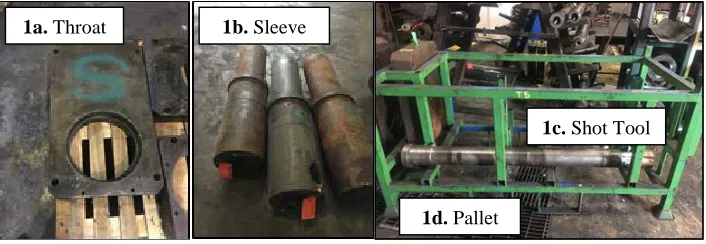
As recommended by Shingo in 1985 [1] and subsequently by many others, including McIntosh et al [2] and Bicheno and Holweg [3], the improvement process began with the documentation of the current state of the changeover process. This included Production Orders, Standard Operating Instructions and External Activities. In terms of tooling and equipment, Dies, Jigs and Fixtures (Including bolts, clamps, washers, etc), Tools (spanners, screwdrivers, Allen keys, etc), Moving/Handling equipment, Measurement and Inspection Tools and Inspection Instructions were considered. Changeover Team Members were identified, along with backup teams, and expectations documented during training. Significant benefits were realised by involving the plant users to help with the project, particularly in the development of standardised procedures. This helped build new competencies and skills and gave ownership of (and hence promote compliance with) the process to the shop floor staff. The changeover time reduction at Sutton-in-Ashfield has been achieved in a number of ways. The Strathroy changeovers were observed and video recorded and good practice following typical SMED philosophies has been adopted. The greatest savings have been made by placing Shot End components on stillages (Figure 1): these include the Sleeve (900kg), the Shot Tool (500kg) and the Throat Plate (500kg) and together form a large syringe which forces molten magnesium alloy into the mould cavity. The Throat determines the height of the shot end in relation to the specific die. These components were formerly stored separately and are still stored in another part of the facility, though palletisation means they are more readily available to the changeover team.
Figure 1: Pallet and Shot End Components.
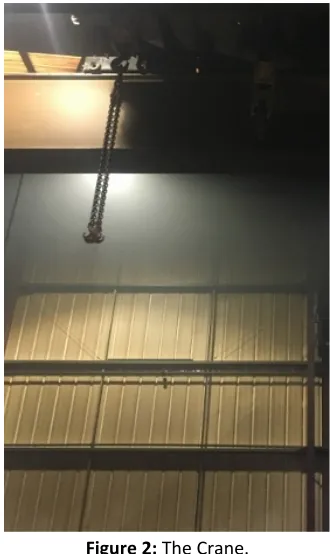
A crane (Figure 2) has been designated as being solely to be used for die changing during the specified changeover time. Ejector Dies (28 tonnes), Cover Dies (19 to 22 T) and Trim Tools (9 T) can now be loaded and unloaded sequentially. This was formerly a bottleneck in the system since the crane could have been in use elsewhere when it was needed for a changeover. The crane is now reserved purely for changeovers at the designated time and all staff have been trained in its use, with
1a. Throat 1b. Sleeve
1c. Shot Tool
more staff also being trained to operate forklift trucks. This ensures the availability of the crane and other moving equipment when it is needed.
Figure 2: The Crane.
The Trim Tool was originally put in first, but this delayed die heating: dies need to be put in place first so that they can be warmed-up while the Trim Tool is being changed. Dies at ambient temperature take around 8 hours to heat up, and are in fact heated up for a minimum of 24 hours before changeover: 48 hours in some cases. Overheating a die, or heating it too quickly, leads to expansion which means dies cannot be closed. It can also weaken the tool steel. Automated cooling is used to reduce these problems.
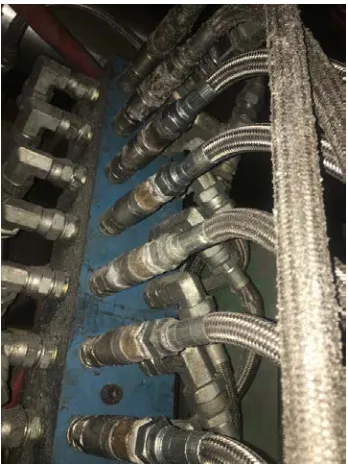
Figure 3: Quick Release Couplings.
A dedicated changeover team has been formed comprising two people with a second team available to cover absence or other unavailability of staff. A training package has been developed for the team who prepare and execute changeovers and oversee production for the first hour thereafter. This has led to standardisation and, with new procedures and methodology, consistency and a smooth operation.
Changeovers at Sutton-in-Ashfield are now scheduled at weekends when production is suspended. Die changes are started at 02:00 hours, so that by 07:00 hours on Mondays there is a full complement of staff on site with the knowledge to address any problems which may arise prior to recommencement of production.
Everything required for a tooling changeover is delivered to the production cell 2 hours prior to the scheduled changeover. This means that kits can be checked for completeness and there is no need to wait for components or special tools. Each station also has a dedicated set of tools to facilitate the changeover, with the key to the toolbox being held by the Team Leaders to ensure completeness and availability. Activities which have been made external to the die change process include programming and process setting of die lubrication and part extraction robots.
3. Further Work
thought to contribute significantly to the relatively high scrap rates – as high as 20% - experienced by not only Meridian, but most die-casting companies [7]: “The difficulty to maintain constant process parameters and the lack of interactions among the process control units make the HPDC a defect-generating process.” [7]. Much of this scrap is produced at the beginning of a production run after a tool changeover, with closer control of die temperatures “leading to lower manufacturing costs, reduced energy usage and increased useful die life.” [8].
It is therefore intended to investigate the design of a Smart Die which may be a combination of sensors and composite tooling which will facilitate the close monitoring and control of various parameters while reducing changeover time and significantly lowering scrap rates. Alternative tool materials will also be considered.
4. Conclusions
Reducing the regularity of die changes by moving them to the weekend does produce other challenges. As well as paying staff to work at weekends (though this is presently justified because the hourly cost of downtime is significantly greater than the extra wages bill), for production to be maintained throughout the week, parts are built to stock. Whilst this means that money and space is being tied up, it does help the company in a number of ways: Fewer changeovers means less downtime and performing them at weekends means there is less immediate pressure on production. Producing parts to be held as stock, or “Building to Bank” can lead to a number of disadvantages [4] which are yet to be investigated, but in this instance does mean that agreements with customers to hold a minimum of 4 days’ stock (in reality, the company likes to keep up to 7 days’ worth of parts) are easily met. These figures were arrived at by studying the hypothetical worst case production failure scenario. The company is seeking to attract customers from smaller volume OEMs, particularly but not exclusively from the automotive sector. When tooling changeover times are high, it is obviously important to further reduce downtime. The reduction from 24 to 6 ½ hours has taken 18 months to achieve, and constraints at the Sutton-in-Ashfield site mean that further reductions will demand careful consideration. The 4-hour changeover at Strathroy has been helped by the fact that the plant was purpose-built, while the Sutton-in-Ashfield facility is essentially a converted warehouse space. This means that some of the practices employed at Strathroy cannot be implemented at Sutton-in-Ashfield without considerable expense and disruption, if at all.
Acknowledgements
The author would like to thank Meridian Lightweight Technologies UK for financial support and permission to present this paper. Special thanks to Mr. Martin Colbert, Production Manager, in assisting with the research programme.
The views expressed in this paper are those of the author and do not necessarily represent those of the Meridian Lightweight Technologies UK.
References
1. Shingo S (1985). A Revolution in Manufacturing: The SMED System. Productivity Press. ISBN 0915299038.
2. McIntosh R Owen G Culley S and Mileham T (2007). Changeover Improvement: Reinterpreting Shingo's “SMED” Methodology. In IEEE Transactions on Engineering Management, vol. 54, no. 1, pp. 98-111, Feb. 2007. doi: 10.1109/TEM.2006.889070.
3. Bicheno J and Holweg M (2016). The Lean Toolbox (5th Ed). Picsie. ISBN-13:
978-0956830753.
4. Moinuddin K (2010). Single Minute Exchange of Dies (SMED).
http://www.processexcellencenetwork.com/business-process-management-bpm/articles/single-minute-exchange-of-dies-smed
5. James-Moore SM and Gibbons A (1997). International Journal of Operations & Production Management; Bradford.17.9 (1997): 911-899.
6. Bonollo F, Gramegna N and Timelli G (2015). High-Pressure Die-Casting: Contradictions and Challenges. JOM: the Journal of the Minerals, Metals & Materials Society.Vol 67 No 5 (2015): 901-908. DOI: 10.1007/s11837-015-1333-8 7. Winkler M and Kallien L (2015). Correlation between process parameters and
quality characteristics in aluminum high pressure die casting. North American Die Casting Association. 2015 Die Casting Congress and Exposition.