Secure Image Authentication
Gerold Laimer and Andreas Uhl
Department of Computer Sciences, University of Salzburg, Jakob-Haringerstaße 2, 5020 Salzburg, Austria
Correspondence should be addressed to Andreas Uhl,[email protected]
Received 31 May 2007; Accepted 12 December 2007
Recommended by S. Voloshynovskiy
We discuss a robust image authentication scheme based on a hash string constructed from leading JPEG2000 packet data. Motivated by attacks against the approach, key-dependency is added by means of employing a parameterized lifting scheme in the wavelet decomposition stage. Attacks can be prevented effectively in this manner and the security of the scheme in terms of unicity distance is assumed to be high. Key-dependency however can lead to reduced sensitivity of the scheme. This effect has to be compensated by an increase of the hash length which in turn decreases robustness.
Copyright © 2008 G. Laimer and A. Uhl. This is an open access article distributed under the Creative Commons Attribution License, which permits unrestricted use, distribution, and reproduction in any medium, provided the original work is properly cited.
1. INTRODUCTION
The widespread availability of digital image and video data has opened a wide range of possibilities to manipulate these data. Compression algorithms usually change image and video data without leaving perceptual traces. Additionally,
different image processing and image manipulation tools
offer a variety of possibilities to alter image data without
leaving traces which are recognizable by the human visual system.
In order to ensure the integrity and authenticity of digital visual data, algorithms have to be designed which consider the special properties of such data types. On the one hand, such an algorithm should be robust against compression and format conversion, since such operations are a very integral part of handling digital data (therefore, such techniques are termed “robust authentication,” “soft authentication,” or “semifragile authentication”). On the other hand, such an
algorithm should be able to detect a large amount of different
intentional manipulations to such data.
Classical cryptographic tools to check for data integrity like the cryptographic hash functions MD-5 or SHA are designed to be strongly dependent on every single bit of the input data. While this property is important for a big class of digital data (e.g., compressed text, executables, etc.), classical hash functions cannot provide any form of robustness and are therefore not suited for typical multimedia data.
To account for these properties, new techniques are required which do not assure the integrity of the digital representation of visual data but its visual appearance or perceptual content. In the area of multimedia security, two types of approaches have been proposed so far: semifrag-ile watermarking and robust/perceptual/visual multimedia hashes.
The use of robust hash algorithms for media authen-tication has been extensively researched in recent years. A
number of different algorithms [1–9] have been proposed
and discussed in literature.
Similar to cryptographic hash functions, robust hash functions for image authentication should satisfy 4 major
requirements [10] (where P denotes probability, H is the
hash function,X,X,Y are images,αandβare hash values,
and{0/1}L
represents binary strings of lengthL) as follows.
(1) Equal distribution of hash values holds
P[H(X)=α]≈ 1
2L, ∀α∈
0/1L. (1)
(2) Pairwise independence for visually different imagesX
andY:∀α,β∈ {0/1}L
holds
P[H(X)=α|H(Y)=β]≈P[H(X)=α]. (2)
(3) Invariance for visually similar imagesXandXholds
To fulfill this requirement, most proposed algorithms try to extract image features which are invariant to slight global modifications like compression or filtering.
(4) Distinction of visually different imagesXandYholds
P[H(X)=H(Y)]≈0. (4)
This final requirement also means that given an image
X, it is almost impossible to find a visually different
imageYwithH(X)=H(Y) (or evenH(X)≈H(Y)).
In other words, it should be impossible to create a forgery which results in the same hash value as the original image.
A robust visual hashing scheme usually relies on a technique for feature extraction as the initial processing stage, often transformations like DCT or wavelet transform
[7] are used for this purpose. Subsequently, the features (e.g.,
a set of carefully selected transform coefficients) are further
processed to increase robustness and/or reduce dimensional-ity (e.g., decoding stages of error-correcting codes are often used for this purpose). Note that the visual features selected according to requirement (3) are usually publicly known and can therefore be modified. This might threaten security, as the hash value could be adjusted maliciously to match that of another image.
For this reason, security has always been a major design
and evaluation criterion [3, 9, 11] for these algorithms.
Several attacks on popular algorithms have been proposed and countermeasures to these attacks have been developed. A key problem in the construction of secure hash values is the selection of image features that are resistant to common transformations. In order to ensure the algorithms’ security, these features are required to be key-dependent and must not be computable without knowledge of the key used for hash construction. Key-dependency schemes used in the construction of robust hashes include key-dependent
transformations [1, 4, 12], pseudorandom permutation
of the data [13], randomized statistical features [8–10],
and randomized quantization/clustering [14]. The majority
of these approaches adds key-dependency to the feature extraction stage, only the latter technique randomizes the actual hash string generation stage. Nevertheless, even key-dependent robust hashing schemes have been successfully attacked. For example, the visual hash function (VHF)
[1] projects image blocks onto key-dependent patterns to
achieve key-dependency. A security weakness of VHF has been pointed out and resolved by adding block
interde-pendencies to the algorithm [6]. As a second example,
we mention the strategy to achieve key-dependency by pseudorandom partitioning of wavelet subbands before the
computation of statistical features [9]. An attack against this
scheme has been demonstrated [15] which can be resolved
by employing key-dependent wavelet transforms [12] or the
use of overlapping and nondisjoint tiling. Recently, generic ways to assess the security of visual hash functions have
been proposed based ondifferential entropy[8] andunicity
distance[16].
In this work, we investigate the security of a JPEG2000-based robust hashing scheme which has been proposed in
earlier works [17, 18]. We describe severe attacks against
the original scheme and propose a key-dependent lifting parameterization in the wavelet transform stage of JPEG2000 encoding as key-dependency scheme for the JPEG2000-based robust hashing scheme. We discuss robustness and sensitivity of the resulting approach and show the improved attack resistance of the key-dependent scheme. Note that we restrict our investigations to the features extracted from the JPEG2000 bitstream themselves and treat them as actual hash string even though a final processing stage eliminat-ing redundancy, and so forth, has not yet been applied.
After reviewing JPEG2000 basics,Section 2discusses various
aspects and sorts of JPEG2000-based hashing schemes and presents the attack against the approach covered in this
work. InSection 3, the employed lifting parameterization is
shortly described. Subsequently, we discuss properties of the key-dependent hashing approach and provide experimental evidence for its improved attack resistance. Also, its actual
key-dependency and unicity distance is discussed.Section 4
concludes this paper.
2. JPEG2000-BASED (ROBUST) HASHING
Most robust hashing techniques use a custom and dedicated
procedure for hash generation which differs substantially
from one technique to the other. Several techniques have been proposed using the wavelet transform as a first stage
in feature extraction (e.g., [3,9,10]). The employment of a
standardized image coding technique like JPEG2000 (based
on a wavelet transform as well) for feature extraction offers
certain advantages as follows.
(1) Widespread knowledge on properties of the corre-sponding bitstream is available.
(2) A vast hardware (e.g., Analog Devices ADV202 chip)
and software (official reference implementations like
JJ2000 or Jasper and additional commercial codecs) repository is available.
(3) In case visual data is already given in JPEG2000 format, the hash value may be extracted with negligible
effort (parsing the bitstream and extracting the hash
data). In case any other visual data format is given, simply JPEG2000 compression has to be applied before extracting the features from the bitstream (this is the usual way JPEG2000-based hashing is applied).
2.1. JPEG2000 basics
The JPEG2000 [19] image coding standard uses the wavelet
transform as energy compaction method. JPEG2000 may be operated in lossy and lossless mode (using a reversible integer transform in the latter case) and also the wavelet
decomposition depth may be defined. The major difference
between previously proposed zerotree wavelet-based image compression algorithms such as EZW or SPIHT is that JPEG2000 operates on independent, nonoverlapping blocks
Bitstream parsing: extract packet body data
Hash creation: select required number of bytes
Figure2: Block-diagram of the JPEG2000 PBHash.
transform, the coefficients are (optionally) quantized and
encoded on a codeblock basis using the EBCOT scheme, which renders distortion scalability possible. Thereby, the
coefficients are grouped into codeblocks and these are
encoded bitplane by bitplane, each with three coding passes (except the first bitplane). While the arithmetic encoding of the codeblock is called Tier-1 coding, the generation of the rate-distortion optimal final bitstream with its scalable
struc-ture is called Tier-2 coding (see alsoFigure 2). The codeblock
size can be chosen arbitrarily with certain restrictions.
The final JPEG2000 bitstream (seeFigure 1) is organized
as follows. The main header is followed by packets of data (packet bodies) each of which is preceded by a packet header. A packet body contains CCPs (codeblock contribution to packet) of codeblocks that belong to the same image resolution (wavelet decomposition level) and layer (which roughly stand for successive quality levels). Depending on the
arrangement of the packets, different progression orders may
be specified. Resolution and layer progression order are the most important progression orders for grayscale images.
2.2. JPEG2000 authentication and hashing
Authentication of the JPEG2000 bitstream has been
de-scribed in previous work. In [20], it is proposed to apply
SHA-1 onto all packet data and to append the resulting hash value after the final termination marker to the JPEG2000 bitstream. Contrasting to this approach, when focusing onto
robust authentication, it turns out to be difficult to insert
the hash value directly into the codestream itself (e.g., after termination markers), since, in any operation which involves decoding and recompression, the original hash value would be lost. The only applications which do not destroy the
codestream while it remains valid also for parts of it (e.g., scaled versions) has been derived using Merkle hash trees
[22] (and tested with MD-5 and RSA).
JPEG2000-related information has been suggested recently to be used for content-based image search and retrieval in the context of JPSearch, a recent standardization
effort of the JPEG committee. General wavelet-based
features have been proposed for image indexing and retrieval which can be computed during JPEG2000 compression
(cf. [23]). However, this strategy does not take advantage
of the particular information available in JPEG2000 codestreams. The packet header information is specific to the visual content, and it is specific enough to be used as a fingerprint/hash for content search. Some suggestions have been made in this direction in the context of indexing,
retrieval, and classification. In [23] the number of bytes
spent on coding each subband (“information content”)
is used for texture classification. Similarly, in [24] a set of
classifiers based on the packet header (codeblock entropy)
and packet body data (wavelet coefficient distribution) is
used to retrieve specified textures from JPEG2000 image
databases. In [25] the number of leading bitplanes is used
(means and variances of the number of nonzero bitplanes in the codeblocks of each subband are computed) as a
fingerprint to retrieve specific images. Finally, in [26]
the same authors additionally propose to use significance
bitmaps of the coefficients and significant bits histograms.
In the following, we restrict the attention to a robust
hashing scheme proposed in earlier work [17, 18] which
employs parts of the JPEG2000 packet body data as robust hash—we denote this approach JPEG2000 PBHash (Packet Body Hash). An image given in arbitrary format is converted into raw pixel data and compressed into JPEG2000 format. Due to the embeddedness property of the JPEG2000 bit-stream, the perceptually more relevant bitstream parts are positioned at the very beginning of the file. Consequently, the bitstream is scanned from the very beginning to the end, and the data of each data packet—as they appear in the bitstream, excluding any header structures—are collected sequentially and concatenated to be then used as visual feature values (see Figure 2).
Note that it is not required to actually perform the entire JPEG2000 compression process—as soon as the amount of data required for hash generation has been output by the encoder, compression may be stopped. JPEG2000 PBHash has been demonstrated to exhibit high robustness against
JPEG2000 recompression and JPEG compression [17] and
provides satisfying sensitivity with respect to intentional
local image modifications [18]. As it is expected due to
(a) (b) (c) Figure3: 50-byte images of the test images Goldhill, Plane, and Lena.
0 500 1000 1500 2000 2500 3000
Fre
q
u
en
cy
0 0.2 0.4 0.6 0.8 1 Hamming distances for 200 images
(a)
0 500 1000 1500 2000 2500 3000 3500
Fre
q
u
en
cy
0 0.2 0.4 0.6 0.8 1 Hamming distances for 200
images using 1 key
(b)
0 1000 2000 3000 4000 5000 6000
Fre
q
u
en
cy
0 0.2 0.4 0.6 0.8 1 Hamming distances for 200 images
(c) Figure4: Hamming distances among 200 uncorrelated images.
against global geometric alterations and rescaling has been
reported [18] (as determined using the Stirmark [27] attack
suite). While the latter properties are prohibitive for the use of JPEG2000 PBHash in the content search scenario, these specific robustness limitations are less critical for authenti-cation purposes. In this scenario, a specific image size can be enforced (e.g., by image interpolation) before the hash is applied; and in a nonautomated scenario, image registration may be conducted before the actual authentication process.
The visual information contained in the hash string (i.e., concatenated packet body data) may be visualized by decoding the corresponding part of the bitstream by a JPEG2000 decoder (including the header information for providing the required context information to the decoder). Figure 3 shows the visual information corresponding to a
hash length of 50 bytes of the images displayed in Figures5–7
(in fact, the images shown are severely compressed JPEG2000 images).
Unless noted otherwise, we use JPEG2000 with layer progression order, output bitrate set to 1 bit per pixel, and wavelet decomposition level 5 to generate the hash string. The length of the hash and the wavelet decomposition depth
employed can be used as parameters to control the tradeoff
between robustness and sensitivity of the hashing scheme
[14]—obviously a shorter hash leads to increased robustness
and decreased sensitivity (see [17,18] for detailed results).
A shallow decomposition depth is not at all suited for the JPEG2000 PBHash application since settings of this type lead to a large LL subband. For a large LL band, the hash only
consists of coefficient data of the LL band corresponding to
the upper part of the image (due to the size of the subband
and the raster-scan order used in the bitstream assembly stage). Therefore, a certain minimal decomposition depth (e.g., down to decomposition level 3) is a must and a short hash string requires a higher decomposition depth for sensible employment of the JPEG2000 PBHash in order to avoid the phenomenon described before.
InFigure 4, we visualize the distribution of the Hamming distances computed among hashes of 200 uncorrelated images (i.e., perceptually entirely unrelated) for three param-eter settings: hash-length 16 bytes with decomposition level 7, length 50 bytes with decomposition level 5, and hash-length 128 bytes with decomposition level 6.
It can be observed that the distributions of the Hamming distances are centered around 0.5 as desired. The variance of the distribution is larger for the more robust settings, which is also to be expected. The influence of the wavelet decomposition level may not be immediately derived from
these results but it is known from earlier experiments [18]
that there is a trend to result in higher robustness for a lower decomposition level value (please refer also to the results in Section 3.2on this issue). The reason is obvious—low-decomposition depth causes the hash string to be mainly
consisting of low frequency coefficient data while differences
caused by subtle image modifications are found in higher
frequency coefficient data.
2.3. Attacks against the JPEG2000 PBHash
(a) (b)
Figure5: Test image Goldhill (original and with man removed).
(a) (b)
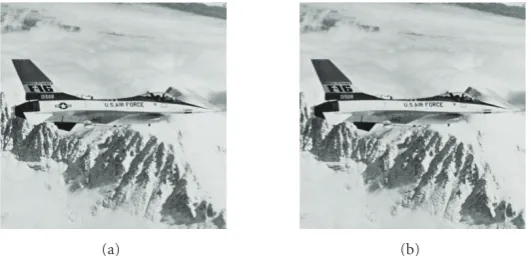
Figure6: Test image Plane (original and with flag removed).
against the approach using the sightly modified images as displayed in Figures5–7.
With the standard hash settings (length 50 bytes with decomposition level 5), the Hamming distance between original and modified images is 0.2 for Goldhill, 0.255 for Plane, and 0.1575 for Lena. Clearly, these modifications are detected when the modification threshold is set to a sensible value.
A possible attacker aims at maliciously tampering the modified image in a way that the hash string becomes similar or even identical to the hash string of the original image while preserving the visual content (this is the attacked image). In this way, the attacked image would be rated as being authentic by the hashing algorithm.
The attack actually conducted works as follows. Both the original and the modified images are considered in a JPEG2000 representation matching the parameters used for the JPEG2000 PBHash (if they do not match this condition, they are converted to JPEG2000). Now the first part of the bitstream of the original image (corresponding to the packet body data used for hashing) is exchanged with the corresponding part of the bitstream of the modified image resulting in the attacked image. Obviously, if the attacked image remains in JPEG2000 format, its hash exactly matches that of the original. But even if both the original and the attacked images are converted back to their source format (e.g., PNG) and the JPEG2000 PBHash is applied
subse-quently it turns out that the hash strings are still identical. Figure 8shows the corresponding attacked Goldhill and Lena images. Their hash strings are identical to those of the respective originals.
This attack is even more severe when we do not apply it to an original image and a slightly modified version as before
but to completely different images. In this case we denote
the attack as “collision attack” since we generate two visually entirely distinct images exhibiting an identical JPEG2000 PBHash using the same approach. Two arbitrary images (an original image and an attacked image) are either converted or already given in corresponding JPEG2000 representation. The attacked image should be modified to have a similar hash as the original image. To accomplish this, the first part of the bitstream of the attacked image is replaced by the first part
of the bitstream of the original image.Figure 9visualizes the
result for the Plane and Lena image, respectively. In case the images have been present in JPEG2000 format already and remain in this format, the first image exhibits a hash string identical to that of the Lena image and the second images hash is identical to the one of the Plane image. Obviously, this does not correspond to visual perception.
This attack facilitates the modification of a given original image in a way that its hash matches that of an arbitrary
different image while the visual appearance of the attacked
(a) (b) Figure7: Test image Lena (original and with a grin).
(a) (b)
Figure8: Attacked Goldhill and Lena images.
scheme. However, the hash values can only be made identical in case no format conversion is applied. If the attacked and
original images have to be converted back to a different
source format, the resulting Hamming. distances between the original and attacked versions are 0.235 and 0.113, This is in contrast to the previous case when originals and slightly modified versions have been considered. Still, those
differences are significantly below the values observed among
uncorrelated images (cf.Figure 4).
The demonstrated attack shows that the JPEG2000 PBHash is highly insecure in its original form and requires a significant security improvement to be useful as a reliable authentication hashing scheme.
3. KEY-DEPENDENT JPEG2000 PBHash
The concept of secret transform domains has been exploited as a key-dependency scheme to some degree in the area
of multimedia security during the last years. Fridrich [28,
29] introduced the concept of DCT-type key-dependent
basis functions in order to protect a watermark from
hostile attacks. Unnikrishnan and Singh [30] suggest to use
secret fractional Fourier domains to encrypt visual data, a technique which was also used to embed watermarks in
an unknown domain [31]. The many degrees of freedom
available to design a wavelet transform have also been exploited in similar manner for image and video encryption
[32,33] and to secure watermarking copy-protection [34,35]
and authentication [36] schemes.
In recent works [12,15, 37], we have proposed to use
Pollens’ orthogonal filter parameterization as a generic key-dependency scheme for wavelet-based visual hash functions. In the case of an authentication hash, this strategy proved to
be successful [12,15] while it did not work out for a CBIR
hash [37] due to the high robustness of the original scheme.
Since the orthogonal Pollen parameterization does not easily integrate with lifting-based biorthogonal JPEG2000 filters,
we propose to use a different strategy in this work, compliant
to the JPEG2000 Part 2 compression pipeline. JPEG2000 Part 2 allows to extend JPEG2000 in various ways. One possibility
is to employ different wavelet filters as specified in Part 1 of
the standard (e.g., user designed filters) and to vary the filters during decomposition, which is discussed to be used as key-dependency scheme in the following subsection.
(a) (b) Figure9: Collision attack: attacked Plane and Lena images.
3.1. Wavelet lifting parametrization
We use a lifting parameterization of the CDF 9/7 wavelet
filter, which is described in [32] based on the work of Zhong,
et al. [38], Daubechies and Sweldens [39] as well as Cohen,
et al. [40]. The following conditions for the lowpass and
highpass filter tapshandgare formulated [40] as follows:
h0+ 2 4
n=1
hn=√2, g0+ 2 3
n=1
gn=√2,
h0+ 2 4
n=1
(−1)nhn=0,
g0+ 2 3
n=1
(−1)ngn=0
2 3
n=1
n2(−1)n gn=0.
(5)
A possible transformation of the CDF 9/7 wavelet into lifting steps, as described in [39] looks like
s(0)
n =x2n,
dn(0)=x2n+1,
dn(1)=d(0)n +α
s(0)n +s(0)n+1
,
s(1)
n =s(0)n +β
d(1)
n +d
(1)
n−1
,
dn(2)=d(1)n +γ
s(1)n +s(1)n+1
,
s(2)
n =s(1)n +δ
d(2)
n +d
(2)
n−1
,
sn=ζs(2)
n ,
dn=d
(2)
n ζ .
(6)
These lifting steps can be used to express the filter taps of
handg as functions of the four parametersα,β,γ,δ, and a
scaling factorζ.A parameterization which is only dependent
on a single parameterαcan be derived from these lifting steps
together with condition (5) as described in [38]:
β= −1 41 + 2α 2, γ=−1−4α−4α2
1 + 4α ,
δ= 1 16
4−2 + 4α
1 + 2α 4 +
1−8α
1 + 2α 2
,
ζ=2 √
2(1 + 2α)
1 + 4α .
(7)
For α = −1.58613. . ., the original CDF 9/7 filter
is obtained. The parameterization comes at virtually no
additional computational cost, only the functions (7) have
to be evaluated, and the lowpass and highpass synthesis filter taps for normalization have to be calculated. For a discussion
on the applicability of certain parts of the range ofαand on
the resulting keyspace see [32]; here, we restrict the range of
admissibleαvalues to [−6,−1.4].
We do not only use one single key-dependent wavelet
filter in the decomposition. Instead, different key-dependent
filters are used at each decomposition level of the wavelet transform and for each decomposition orientation (i.e., horizontal and vertical). These techniques originate from
content adaptive image compression [41] and are denoted as
“nonstationary” and “inhomogeneous” multiresolution
analyses. Consequently, we actually employ 2kfilters during
ak-level wavelet decomposition—the corresponding 2k α’s
are all generated by a pseudorandom number generator
from a single seed denoted as “key.” However, in fact all 2k
α’s serve as potential key-material for our key-dependent
JPEG2000 PBHash and especially the approximation
subband data depends on all 2k α’s.
In the following, we investigate the impact of choosing
different keys on the resulting hash string, that is, whether
the resulting hash is really sufficiently dependent on the key
0 1000 2000 3000 4000 5000 6000 7000
Fre
q
u
en
cy
0 0.2 0.4 0.6 0.8 1 Hamming distances (wlev=7, hash length=16)
(a)
0 50 100 150 200 250 300 350
Fre
q
u
en
cy
0 0.2 0.4 0.6 0.8 1 Hamming distances for different seeds (Goldhill)
(b)
0 50 100 150 200 250 300 350
Fre
q
u
en
cy
0 0.2 0.4 0.6 0.8 1 Hamming distances for
different seeds (Lena)
(c)
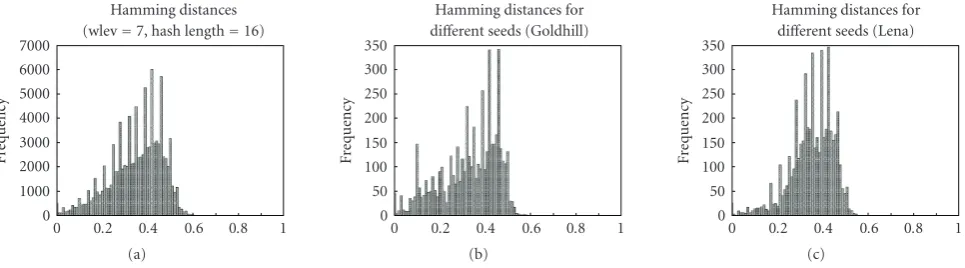
Figure10: Hamming distances among 16-byte hashes (decomposition depth 7) generated with 100 random keys (accumulation of 20 images, Goldhill, Lena).
distance among all hash strings is computed.Figure 10shows
the resulting Hamming distance histograms for the images Goldhill and Lena where the hash string is only 16 bytes long and decomposition depth 7 is selected. The first plot in Figure 10displays the Hamming distances among the hash strings of 100 randomly chosen keys where all corresponding distances of 20 test images are accumulated (this set of images includes Goldhill, Lena, Plane, Mandrill, Barbara, Boats, and several other test images).
It is obvious that the key-dependency scheme works in principle, however, there are several hash strings resulting
in distances below 0.1. Especially when compared to the
corresponding Hamming distance histogram for entirely
different images (seeFigure 4left), the distribution is shifted
to the left, is much broader, and exhibits many small values. The situation is much improved when increasing the hash
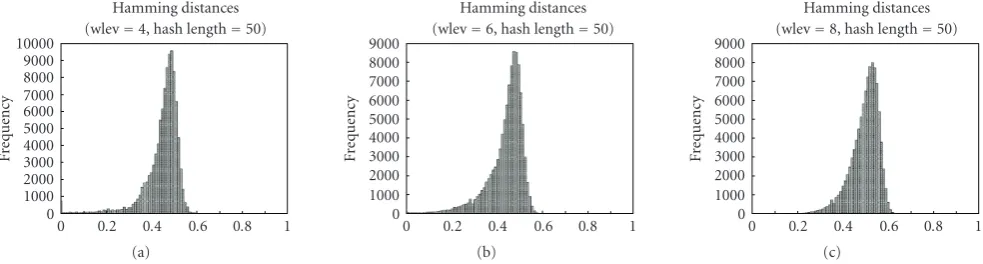
length to 50 bytes as displayed inFigure 11. This corresponds
well to our expectations since in the longer hash string
more high-frequency coefficient data is included which
reflects the differences among different filters much more
significantly as compared to the smoothed approximation subband data. The Hamming distance histograms are shown in accumulated manner for the same set of 20 test images as before varying the wavelet decomposition depth during hash generation.
The histograms do hardly contain Hamming distances below 0.2 for all three decomposition depths with this hash length. Increasing the hash length even further to 128 bytes
with a decomposition depth 6 as shown in Figure 12 for
the Goldhill and Lena images and the set of 20 test images
even resolves the undesired effects seen before. Most distance
values are clearly above 0.3 and the histograms are clearly unimodal. Still, the distributions of the Hamming distances
among different images inFigure 4are centered better and
have a lower variance. As a consequence, we recommend to use a hash length of at least 50 bytes when key-dependency of the resulting hash string is important.
3.2. Properties: sensitivity and robustness
Sensitivity is the property of a hashing scheme to detect image alterations—for the JPEG2000 PBHash, high
sen-sitivity means that a low number of packet body bytes are required to detect image manipulations. Robustness on the other hand is the property of a hashing scheme to maintain an identical hash string even under common image processing manipulations like compression—for the JPEG2000 PBHash, high robustness means that a high number of packet body bytes are required to detect such types of manipulations. While sensitivity against intentional image modifications and robustness with respect to image compression has been discussed in detail for the
key-independent JPEG2000 PBHash in previous work [17,18],
the impact of the different filters used in the key-dependency
scheme on these properties of the hashing scheme is not clear yet. Therefore, we conduct several experiments on these issues.
The first experiment investigates the sensitivity against
the modification of the Goldhill image shown inFigure 5. We
apply the JPEG2000 PBHash to the original and the modified Goldhill images with the same key, and record the number of bytes required to detect the modification (i.e., starting from the beginning of the two hash strings, the position/number of the first unequal byte is recorded). This procedure is
repeated for 100 different random keys and the results
for four different decomposition depths and are shown
in Figure 13(only two different decomposition depths are
shown in Figures14 and15). The solid line represents the
value obtained with the key-independent JPEG2000 PBHash while the dots represent 100 key-dependent results. Note that (unrealistically) long hashes with 1000 bytes are used in this experiments in order to be able to capture the corresponding behavior well.
First, it is obvious that, in the plots inFigure 13,
sensitiv-ity varies among the different keys employed. Second, there is
no clear trend with respect to the sensitivity of the “standard” JPEG2000 filter as compared to the parameterized versions. While for decomposition depths 4 and 5 it seems that most parameterized filters degrade sensitivity (i.e., more bytes are required to detect the modifications), decomposition depths 6 and 8 show improvements but also degradations in sensitivity of the parameterized filters as compared to the
standard filter. It has to be noted that the different results for
0 0.2 0.4 0.6 0.8 1 (a)
0 0.2 0.4 0.6 0.8 1 (b)
0 0.2 0.4 0.6 0.8 1 (c)
Figure11: Hamming distances among 50-byte hashes generated with 100 random keys (decomposition depths 4, 6, and 8), accumulated over 20 images.
0 2000 4000 6000 8000 10000 12000 14000 16000
Fre
q
u
en
cy
0 0.2 0.4 0.6 0.8 1 Hamming distances (wlev=6, hash length=128)
(a)
0 100 200 300 400 500 600 700 800
Fre
q
u
en
cy
0 0.2 0.4 0.6 0.8 1 Hamming distances for
100 keys (Goldhill)
(b)
0 100 200 300 400 500 600
Fre
q
u
en
cy
0 0.2 0.4 0.6 0.8 1 Hamming distances for
100 keys (Lena)
(c)
Figure12: Hamming distances among 128-byte hashes (decomposition depth 6) generated with 100 random keys (accumulation of 20 images, Goldhill, Lena).
Goldhill image and its modification and depend significantly on the kind and severeness of the modification performed (e.g., for decomposition depth 5, we notice a sensitivity decrease for the Goldhill image; but for the Lena image as
shown inFigure 15, we observe both improvements as well
as degradations). In fact, it is clear that there are variations and that the “standard” filter is just one out of many other filters with no specific properties with respect to sensitivity.
Figure 14displays the results for decomposition depths 6 and 8 for the Plane image. While decomposition depth 6 seems to improve sensitivity, for depth 8, we notice improvements as well as degradations as compared to the standard filter.
Similarly, in Figure 15 we both observe improvements
as well as degradations with respect to sensitivity for both decomposition depths considered.
The second experiment regarding sensitivity relates the
variations caused by the different filters to the type and
severeness of the modifications as shown in Figures5–7. We
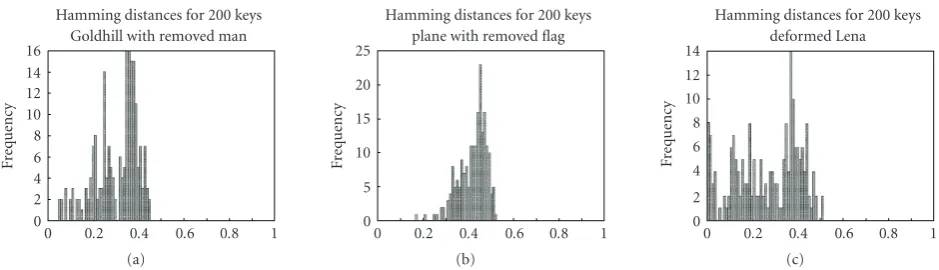
use the JPEG2000 PBHash with 128 bytes and decomposition depth 6 and compute the Hamming distances between the original and modified images for 200 random keys (identical
keys for original and modification are used).Figure 16shows
the corresponding results.
The modification performed on the Plane image is rich
in contrast and affects a considerable area in the image.
This modification is clearly detected for all keys assuming a detection threshold of 0.15 or lower as displayed by the middle histogram. The modification of the Goldhill
image also affects a considerable number of pixels, but the
contrast in this area is not changed that much. Therefore, the detection threshold had been set to 0.04 to detect the modification for all filters (which in turn negatively influences robustness of course). Finally, the modification
done to Lena image affects only few pixels and hardly changes
the contrast in the areas modified. Consequently, for some filter parameters, the modification is not detected at all (i.e., the Hamming distance between the hash strings is 0). Similar to the key-independent JPEG2000 PBHash, sensitivity can be controlled by setting the hash length accordingly. In
the key-dependent scheme, the variations among different
filters need to be considered additionally which means that longer hash strings as compared to the key-independent
scheme should be used to guarantee sufficient sensitivity
for all filters. Overall, employing the key-dependent hashing
scheme with different filters on the same image (see Figures
10–12) results in larger Hamming distances as compared to
using it with the same filters on an original and a slightly
modified image (Figure 16).
0 10 20 30 40 50 60 70 80 90 100 B yt es n eed ed to d et ect attac k
10 20 30 40 50 60 70 80 90 100 Seed
Random parameter filter Standard detection
Attack detection using random parameter filter Goldhill with removed man-wlev 4
(a) 0 10 20 30 40 50 60 70 80 B yt es n eed ed to d et ect attac k
10 20 30 40 50 60 70 80 90 100 Seed
Random parameter filter Standard detection
Attack detection using random parameter filter Goldhill with removed man-wlev 5
(b) 0 5 10 15 20 25 30 35 B yt es n eed ed to d et ect attac k
10 20 30 40 50 60 70 80 90 100 Seed
Random parameter filter Standard detection
Attack detection using random parameter filter Goldhill with removed man-wlev 6
(c) 0 5 10 15 20 25 30 35 40 45 50 B yt es n eed ed to d et ect attac k
10 20 30 40 50 60 70 80 90 100 Seed
Random parameter filter Standard detection
Attack detection using random parameter filter Goldhill with removed man-wlev 8
(d)
Figure13: Number of hash bytes required to detect the removed man in the Goldhill image (hash strings generated with 100 random keys versus “standard” JPEG2000 PBHash, decomposition depths 4, 5, 6, and 8).
0 5 10 15 20 25 30 35 B yt es n eed ed to d et ect attac k
10 20 30 40 50 60 70 80 90 100 Seed
Random parameter filter Standard detection
Attack detection using random parameter filter plane with removed flag-wlev6
(a) 0 1 2 3 4 5 6 7 8 9 B yt es n eed ed to d et ect attac k
10 20 30 40 50 60 70 80 90 100 Seed
Random parameter filter Standard detection
Attack detection using random parameter filter plane with removed flag-wlev 8
(b)
0
B
yt
10 20 30 40 50 60 70 80 90 100 Seed
Random parameter filter Standard detection
(a)
0
B
yt
10 20 30 40 50 60 70 80 90 100 Seed
Random parameter filter Standard detection
(b)
Figure15: Number of hash bytes required to detect Lena’s grin (hash strings generated with 100 random keys versus “standard” JPEG2000 PBHash, decomposition depths 3 and 5).
0 2 4 6 8 10 12 14 16
Fre
q
u
en
cy
0 0.2 0.4 0.6 0.8 1 Hamming distances for 200 keys
Goldhill with removed man
(a)
0 5 10 15 20 25
Fre
q
u
en
cy
0 0.2 0.4 0.6 0.8 1 Hamming distances for 200 keys
plane with removed flag
(b)
0 2 4 6 8 10 12 14
Fre
q
u
en
cy
0 0.2 0.4 0.6 0.8 1 Hamming distances for 200 keys
deformed Lena
(c)
Figure16: Hamming distances among 128-byte hashes (decomposition depth 6) generated with 200 random keys: hash of the original image is compared to the modified image, both use the same key (Goldhill, Plane, Lena).
JPEG2000 PBHash to the original and compressed Plane images (bitrate 0.5 bpp) with the same key and record the number of bytes required to detect the modification (i.e., starting from the beginning of the two hash strings, the position/number of the first unequal byte is recorded). This
procedure is repeated for 100 different random keys and the
results for four different decomposition depths are shown in
Figure 17(only two inFigure 18). The solid line represents the value obtained with the key-independent JPEG2000 PBHash while the dots represent 100 key-dependent results.
Similar to the investigations on sensitivity, we notice varying robustness for the parameterized filters (also con-cerning the relation to the robustness of the “standard”
JPEG2000 filter) and inconsistent results for the different
decomposition levels. However, the differences are not as
pronounced as in the case of sensitivity and the results are
similar for different images.
The second experiment regarding robustness relates the
variations caused by the different filters to the target bitrate
used for compression and the length of the hash string. We use the JPEG2000 PBHash with 16 and 128 bytes and
decomposition depths 7 and 6 and compute the Hamming distances between the original and compressed images for 100 random keys (identical keys for original and compressed
are used). Figure 19 shows the corresponding results for
target bitrate 0.5 bpp.
At this bitrate, the 16-byte JPEG2000 PBHash provides good robustness for almost all keys (i.e., almost all Hamming distances are 0). The 128-byte hash string on the other hand
produces differences up to 0.5 for some keys so that for
this setting, compression robustness cannot be provided. Figure 20shows corresponding results for a target bitrate of 0.05 bpp. At this low rate, even the 16-byte hash generates
differences up to 0.5 and the 128-byte hash results in a
histogram distribution similar to the case when different
images have been used as input.
To summarize, we may conclude that the key-dependency introduced into the JPEG2000 PBHash has
undesired effects on sensitivity and robustness. Caused by
the varying sensitivity for different filters used in the hashing
0 100 200 300 400 500 600 700 800 900
Eq
u
al
b
yt
es
10 20 30 40 50 60 70 80 90 100 Seed
Random parameter filter Standard detection
Reencoding using random parameter filter plane-wlev 3
(a)
0 100 200 300 400 500 600 700 800 900 1000
Eq
u
al
b
yt
es
10 20 30 40 50 60 70 80 90 100 Seed
Random parameter filter Standard detection
Reencoding using random parameter filter plane-wlev 4
(b)
0 100 200 300 400 500 600 700 800 900
Eq
u
al
b
yt
es
10 20 30 40 50 60 70 80 90 100 Seed
Random parameter filter Standard detection
Reencoding using random parameter filter plane-wlev 5
(c)
0 50 100 150 200 250 300 350
Eq
u
al
b
yt
es
10 20 30 40 50 60 70 80 90 100 Seed
Random parameter filter Standard detection
Reencoding using random parameter filter plane-wlev 8
(d)
Figure17: Number of hash bytes required to detect that the Plane image got compressed to 0.5 bpp (hash strings generated with 100 random keys versus “standard” JPEG2000 PBHash, decomposition depths 3, 4, 5, and 8).
0 200 400 600 800 1000 1200
Eq
u
al
b
yt
es
10 20 30 40 50 60 70 80 90 100 Seed
Random parameter filter Standard detection
Reencoding using random parameter filter Goldhill-wlev 3
(a)
0 200 400 600 800 1000 1200
Eq
u
al
b
yt
es
10 20 30 40 50 60 70 80 90 100 Seed
Random parameter filter Standard detection
Reencoding using random parameter filter Goldhill-wlev 5
(b)
0 0.2 0.4 0.6 0.8 1 (a)
0 0.2 0.4 0.6 0.8 1 (b)
Figure19: Hamming distances among hash strings generated with 100 random keys: hash of the original images is compared to a hash from a compressed image at 0.5 bpp (16-byte hash at decomposition depth 7 versus 128-byte hash at decomposition depth 6); distances are accumulated from 20 images.
0 50 100 150 200 250
Fre
q
u
en
cy
0 0.2 0.4 0.6 0.8 1 Normalized Hamming distances wlev: 7-hash length: 16-bpp: 0.05
(a)
0 20 40 60 80 100 120 140 160 180
Fre
q
u
en
cy
0 0.2 0.4 0.6 0.8 1 Normalized Hamming distances wlev: 6-hash length: 128-bpp: 0.05
(b)
Figure20: Hamming distances among hash strings generated with 100 random keys: hash of the original images is compared to a hash from a compressed image at 0.05 bpp (16-byte hash at decomposition depth 7 versus 128-byte hash at decomposition depth 6); distances are accumulated from 20 images.
small modifications reliably. For this setting, compression robustness is already hard to achieve for all filters. So, in a way, adding key-dependency to the scheme has to be paid
with an aggravation of the tradeoffbetween sensitivity and
robustness of the scheme caused by the varying respective properties of the filters used.
The sensitivity/robustness tradeoff issue has not been
discussed in depth in earlier works on key-dependent wavelet
transforms [12, 37] in the context of robust hashing. As
already mentioned, in the CBIR scenario [37], the high
robustness of the feature extraction itself prevents a
satis-factory key-dependency of the hash string. In [12],
param-eterized (Pollen) wavelet filters as well as key-dependent wavelet packet subband structures have been investigated for their usefulness in the context of an authentication hashing scheme. Key-dependency, key-space, and attack resistance have been found to be in sensible ranges, however, the
sensi-tivity/robustness tradeoffhas not been investigated explicitly.
However, the high variation in the Hamming distances found suggests varying sensitivity as found in this work.
In recent work [42], we have investigated key-dependent
wavelet packet subband structures as a means to add key-dependency to the JPEG2000 PBHash and found robustness
to be significantly reduced as compared to the standard pyramidal subband structure, while sensitivity was found to be almost identical to the standard case. Parameterized lifting as employed in this work is clearly better suited to add key-dependency as compared to key-dependent wavelet packet structures, at least in the case of the JPEG2000 PBHash.
3.3. Attack resistance
The aim of adding key-dependency to the JPEG2000 PBHash
is to prevent the attacks as described is Section 2.3. In
case the key-dependent hashing scheme is used, an attacker does not know which key is used to compute the hash string for an image subject to authentication. He can just choose an arbitrary key and perform the attack as described using this key in hash generation (i.e., both the original and the modified images are JPEG2000-compressed using this particular chosen key for the attack and the part of the bitstream required for the hash is interchanged). Now, the attacker hopes that the Hamming distance between the original image and her attacked version will be small also for
other keys than the single one used in her attack.Figure 21
(a)
0 2 4 6 8 10 12 14 16 18
Fre
q
u
en
cy
0 0.2 0.4 0.6 0.8 1 Normalized Hamming distances
for different seeds-wlev: 5
(b)
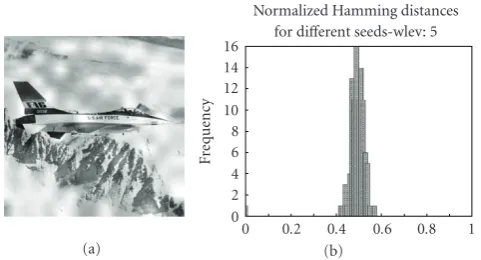
Figure21: Attacked Lena image and Hamming distances to hash strings of the original generated with 100 random keys (50-byte hash at decomposition depth 5).
(a)
0 2 4 6 8 10 12 14 16
Fre
q
u
en
cy
0 0.2 0.4 0.6 0.8 1 Normalized Hamming distances
for different seeds-wlev: 5
(b)
Figure22: Attacked Plane image and Hamming distances to hash strings of the original generated with 100 random keys (50-byte hash at decomposition depth 5).
a histogram of Hamming distances between 50-byte hash
strings of the original and attacked images when 100 different
random keys are used in authentication (the same key is used for both original and attacked versions).
It is clearly visible that only one key results in distance 0 which is the case where the authentication key is identical to the key used for the attack. Two more distances are around 0.2, the rest is between 0.4 and 0.6. We see that the key-dependency scheme enables the JPEG2000 PBHash
to identify the attacked image reliably.Figure 22shows the
same effect on the attacked Plane image where all Hamming
distances are between 0.4 and 0.6 except for the single filter used in the attack.
Figure 23verifies for the Plane image that the attack is
successfully prevented with the 50-byte hash also for different
decomposition depths.
When the hash length is increased to 128 bytes, the attack
gets more difficult since a larger share of the bitstream data
needs to be exchanged between original and modified ver-sions possibly compromising image quality of the attacked
version. Figures24 and25 illustrate this case for the Lena
and the Goldhill images.
While the image quality of the attacked version might still
be sufficient for some applications, the Hamming distance
histograms clearly indicate that the attack is prevented also
under these settings (in these experiments, the key used for producing the attacked versions is not included in the keys used for authentication).
InSection 2.3, we have also demonstrated the collision attack against the JPEG2000 PBHash where an image has been attacked to produce the same hash as an arbitrary original image. We cover the case of a 16-byte hash since the
attacked images shown inFigure 9hardly meet any quality
requirement. In Figure 26, we visualize the attacked Lena
image modified to exhibit the hash string of the Plane image. Figure 27covers the vice versa situation. Again, the attacker has to select an arbitrary key for conducting the attack. All she can do is to hope that the hash string of the attacked image produced by other keys is similar to the string she created in the attack.
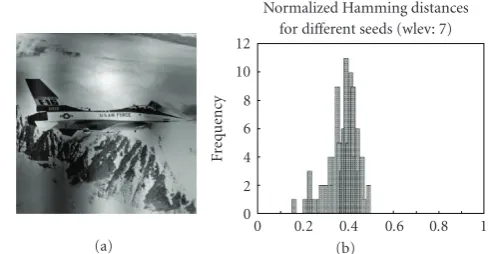
The histograms shown in Figures26 and27show that
again the attack can be prevented reliably. Most Hamming distances between the attacked image and the original image
are >0.2 and actually all are >0.1 The hash string of the
attacked image does no longer exhibit a high degree of similarity to the original image in the authentication. The same is of course true with respect to the original version of the attacked image (histograms look similar but are not shown).
The same results can be obtained for the settings
corresponding to the images shown in Figure 9; however,
since the visual quality of the attacked images is rather low, we do not give the plots here.
3.4. Key-dependency and security
Recently, a method for measuring the security of robust
image hashing algorithms has been proposed [16]. It is based
on unicity distance, a concept pioneered by Shannon [43] in 1949, which states that the amount of uncertainty in an encryption key reduces with each observed clear-text and cipher-text pair. This means for image hashing, that the secret key can be estimated when the key is reused multiple
times on different input images. In this case, the unicity
distance of a hashing scheme determines how often (i.e., for
how many different images) a key can be reused, before it can
be uniquely determined.
H() is the image hash function, X the input image,
K the secret key, and v = HK(X) the resulting hash
vector. When we use the same key n-times for different
input images, we get pairs of images and hash vectors (X1,v1), (X2,v2),. . ., (Xn,vn).The conditional entropy of the
secret key K can then be denoted by E(K | {(Xj,vj)}n
j=1).
In general, with the increase of n, conditional entropy will
decrease. To determine the unicity distance of the image-hashing algorithm, the observed image-hash pairs are taken as the input to a key estimation algorithm. The output of this algorithm (i.e., the estimated secret key) is gradually refined with the increased number of observed image-hash pairs. It is expected that the estimated key gets closer and closer to
the actual keyK, until they can be considered identical. The
number of image-hash pairs required to recover the keyKis
0 0.2 0.4 0.6 0.8 1 (a)
0 0.2 0.4 0.6 0.8 1 (b)
0 0.2 0.4 0.6 0.8 1 (c)
Figure23: Plane image: Hamming distances between hash strings of the original and the attacked images generated with 100 random keys (50-byte hash at decomposition depths 3, 4, 8).
(a)
0 2 4 6 8 10 12
Fre
q
u
en
cy
0 0.2 0.4 0.6 0.8 1 Normalized Hamming distances
for different seeds (wlev: 6)
(b)
Figure24: Attacked Lena image and Hamming distances to hash strings of the original generated with 100 random keys (128-byte hash at decomposition depth 6).
(a)
0 5 10 15 20 25
Fre
q
u
en
cy
0 0.2 0.4 0.6 0.8 1 Normalized Hamming distances
for different seeds (wlev: 6)
(b)
Figure 25: Attacked Goldhill image and Hamming distances to hash strings of the original generated with 100 random keys (128-byte hash at decomposition depth 6).
The iterative search algorithm suggested to estimate
key data [16] relies on the assumption that the Hamming
distances between hashes derived from similar keys get smaller the more similar the keys get. The sensitivity of the key-dependency scheme towards small changes in the key has therefore major impact on the convergence speed of this algorithm.
(a)
0 1 2 3 4 5 6
Fre
q
u
en
cy
0 0.2 0.4 0.6 0.8 1 Normalized Hamming distances
for different seeds (wlev: 7)
(b)
Figure26: Attacked Lena image and Hamming distances to hash strings of Plane generated with 100 random keys (16-byte hash at decomposition depth 7).
(a)
0 2 4 6 8 10 12
Fre
q
u
en
cy
0 0.2 0.4 0.6 0.8 1 Normalized Hamming distances
for different seeds (wlev: 7)
(b)
Figure27: Attacked Plane image and Hamming distances to hash strings of Lena generated with 100 random keys (16 byte hash at decomposition depth 7).
To investigate this issue in the context of the
key-dependent JPEG2000 PBHash, we list in Table 1 the α’s
0 0.1 0.2 0.3 0.4 0.5 0.6
H
amming
distanc
e
a−1 a−0.5 a a+ 0.5 a+ 1 Verticalαoffset
Hamming distances varying one vertical parameter
(a)
0 0.05 0.1 0.15 0.2 0.25 0.3 0.35 0.4 0.45 0.5
H
amming
distanc
e
a−1 a−0.5 a a+ 0.5 a+ 1 Verticalαoffset
Hamming distances varying one vertical parameter
(b)
Figure28: Hamming distances by varying oneα-parameter (resolution level 1-2).
0 0.1 0.2 0.3 0.4 0.5 0.6
H
amming
distanc
e
a−1 a−0.5 a a+ 0.5 a+ 1 Verticalαoffset
Hamming distances varying one vertical parameter
(a)
0 0.2 0.4 0.6 0.8 1
H
amming
distanc
e
a−1 a−0.5 a a+ 0.5 a+ 1 Verticalαoffset
Hamming distances varying one vertical parameter
(b)
Figure29: Hamming distances by varying oneα-parameter (resolution level 3-4).
Table1: Lifting parameters derived from the keys=25.
Verticalα Horizontalα
res. level 1 −1.4159169 −2.6140037 res. level 2 −2.1948574 −5.109782 res. level 3 −1.477038 −3.8211455 res. level 4 −5.109782 −1.7081523
res. level 5 −2.136 −1.698885
length 50 bytes computed with all correct α’s and a hash
determined where a single vertical α is slightly incorrect
(the value used as compared toTable 1is given in the table,
Hamming distances for 10 images are given).
We observe that when the resolution level-1 verticalα
is slightly incorrect, all hash values still show significant
Hamming differences. For incorrect level-2 and level-3α’s,
some images exhibit 0 Hamming distance (e.g., 3 out of 10 at level three), others show large distances. Only at level
4 (and level 5) all images show consistently a 0 difference
when all other parameters are known exactly. Note that these observations have been made under the assumption that 9
Table 2: Normalized Hamming distances for 10 images after varying one parameter.
Hamming distance
Level 1 Level 2 Level 3 Level 4
α= −1.47 α= −2.35 α= −1.6 α= −5.4
0.39 0.00 0.00 0.00
0.49 0.51 0.51 0.00
0.29 0.00 0.29 0.00
0.46 0.00 0.00 0.00
0.44 0.42 0.36 0.00
0.33 0.14 0.14 0.00
0.45 0.46 0.45 0.00
0.17 0.03 0.03 0.00
0.32 0.00 0.08 0.00
0.40 0.00 0.00 0.00
out of 10α’s are already correct without arguing how this
shown) the entire range investigated leads to a 0 Hamming distance.
The assumption made so far to determine all but oneα
correctly is already difficult to satisfy. Considering this fact
and the phenomenon that the iterative key search procedure has even problems to achieve convergence with all but one
correctαat least in case the level-1αis not yet correct makes
us believe that unicity distance will be rather large for the key-dependent JPEG2000 PBHash. In fact, the assumption that the Hamming distances between hashes derived from similar keys get smaller the more similar the keys get does only hold in very small neighborhoods. Therefore, instead of an iterative key estimation technique based on successive refinement, the only way to obtain the correct key would involve a rather costly random search through a significant share of the keyspace until a configuration with small Hamming distance is found which can be systematically improved.
Consequently, we estimate the key-dependent JPEG2000 PBHash to have a rather large unicity distance.
4. CONCLUSION AND FUTURE WORK
Key-dependency is added to a JPEG2000 packet data-based hashing scheme by means of employing a parameterized lifting scheme in the wavelet decomposition stage. Attacks demonstrated against the scheme without key-dependency
can be prevented effectively in this manner. Also the security
of the scheme in terms of unicity distance is assumed to be high. However, key-dependency comes at a certain cost for this scheme: due to reduced sensitivity of some potentially employed filters, the hash length has to be increased as compared to the scheme without key-dependency. This leads to reduced robustness on the other hand.
In future work, we will investigate possibilities how to add key-dependency to the JPEG2000 PBHash without
affecting sensitivity too much: while we have found
signifi-cant variations in sensitivity among the different
decompo-sitions and filters employed, it is not yet clear if it is possible
to identify subsets of the range forαwhere these variations
could be bounded. An alternative approach is to investigate
different types of key-dependency for wavelet transforms
like isotropic or anisotropic wavelet packets. Additionally, we will estimate the magnitude of the keyspace available (focusing on decomposition level-dependent discretization
of theαrange), and we will determine the sensitivity against
key modifications for the scheme in more detail to provide an approximation for an actual unicity distance value. In particular, we will investigate possibilities how to make the
ing parameterization implementation is gratefully acknowl-edged.
REFERENCES
[1] J. Fridrich, “Visual hash for oblivious watermarking,” in Security and Watermarking of Multimedia Contents II, P. W. Wong and E. J. Delp III, Eds., vol. 3971 ofProceedings of SPIE, pp. 286–294, San Jose, Calif, USA, January 2000.
[2] J. Fridrich and M. Goljan, “Robust hash functions for digital watermarking,” inProceedings of IEEE International Conference on Information Technology: Coding and Computing,, pp. 178– 183, Las Vegas, Nev, USA, March 2000.
[3] C.-S. Lu and H.-Y. M. Liao, “Structural digital signature for image authentication: an incidental distortion resistant scheme,” inProceedings of the ACM Workshops on Multimedia, pp. 115–118, Los Angeles, Calif, USA, October-November 2000.
[4] V. Monga and M. K. Mihc¸ak, “Robust image hashing via non-negative matrix factorizations,” inProceedings of IEEE Inter-national Conference on Acoustics, Speech and Signal Processing (ICASSP ’06), vol. 2, pp. 225–228, Toulouse, France, May 2006. [5] V. Monga, A. Banerjee, and B. L. Evans, “A clustering based approach to perceptual image hashing,”IEEE Transactions on Information Forensics and Security, vol. 1, no. 1, pp. 68–79, 2006.
[6] R. Radhakrishnan, Z. Xiong, and N. D. Memon, “Security of the visual hash function,” in Security and Watermarking of Multimedia Contents V, E. J. Delp III and P. W. Wong, Eds., vol. 5020 ofProceedings of SPIE, pp. 644–652, Santa Clara, Calif, USA, January 2003.
[7] C. J. Skrepth and A. Uhl, “Robust hash functions for visual data: an experimental comparison,” inProceedings of the 1st Iberian Conference on Pattern Recognition and Image Analysis (IbPRIA ’03), F. J. Perales L ´opez, A. C. Campilho, N. P. de la Blanca, and A. Sanfeliu, Eds., vol. 2652 of Lecture Notes in Computer Science, pp. 986–993, Springer, Mallorca, Spain, June 2003.
[8] A. Swaminathan, Y. Mao, and M. Wu, “Robust and secure image hashing,”IEEE Transactions on Information Forensics and Security, vol. 1, no. 2, pp. 215–230, 2006.
[9] R. Venkatesan, S.-M. Koon, M. H. Jakubowski, and P. Moulin, “Robust image hashing,” inProceedings of the International Conference on Image Processing (ICIP ’00), vol. 3, pp. 664–666, Vancouver, BC, Canada, September 2000.
[10] M. K. Mihc¸ak and R. Venkatesan, “New iterative geometric methods for robust perceptual image hashing,” inProceedings of the Workshop on Security and Privacy in Digital Rights Management, vol. 2320, pp. 13–21, Philadelphia, Pa, USA, November 2001.
(ICASSP ’05), vol. 2, pp. 1041–1044, Philadelphia, Pa, USA, March 2005.
[12] A. Meixner and A. Uhl, “Security enhancement of visual hashes through key dependent wavelet transformations,” in Proceedings of the 13th International Conference on Image Analysis and Processing (ICIAP ’05), F. Roli and S. Vitulano, Eds., vol. 3617 ofLecture Notes in Computer Science, pp. 543– 550, Springer, Cagliari, Italy, September 2005.
[13] H. ¨Ozer, B. Sankur, N. Memon, and E. Anarim, “Perceptual audio hashing functions,”EURASIP Journal on Applied Signal Processing, vol. 2005, no. 12, pp. 1780–1793, 2005.
[14] V. Monga and B. L. Evans, “Perceptual image hashing via feature points: performance evaluation and tradeoffs,”IEEE Transactions on Image Processing, vol. 15, no. 11, pp. 3452– 3465, 2006.
[15] A. Meixner and A. Uhl, “Analysis of a wavelet-based robust hash algorithm,” inSecurity, Steganography, and Watermaking of Multimedia Contents VI, E. J. Delp III and P. W. Wong, Eds., vol. 5306 ofProceedings of SPIE, pp. 772–783, San Jose, Calif, USA, January 2004.
[16] Y. Mao and M. Wu, “Unicity distance of robust image hashing,” IEEE Transactions on Information Forensics and Security, vol. 2, no. 3, pp. 462–467, 2007.
[17] R. Norcen and A. Uhl, “Robust authentication of the JPEG2000 bitstream,” inProceedings of the 6th IEEE Nordic Signal Processing Symposium (NORSIG ’04), pp. 121–124, Espoo, Finland, June 2004.
[18] R. Norcen and A. Uhl, “Robust visual hashing using JPEG2000,” inProceedings of the 8th IFIP TC6/TC11 Confer-ence on Communications and Multimedia Security (CMS ’04), D. Chadwick and B. Preneel, Eds., pp. 223–236, Springer, Lake Windermere, UK, September 2004.
[19] D. Taubman and M. W. Marcellin,JPEG2000: Image Compres-sion Fundamentals, Standards and Practice, Kluwer Academic Publishers, Dordrecht, The Netherlands, 2002.
[20] R. Grosbois, P. Gerbelot, and T. Ebrahimi, “Authentication and access control in the JPEG2000 compressed domain,” in Applications for Digital Image Processing XXIV, vol. 4472 of Proceedings of SPIE, pp. 95–104, San Diego, Calif, USA, July 2001.
[21] J. Apostolopoulos, S. Wee, F. Dufaux, T. Ebrahimi, Q. Sun, and Z. Zhang, “The emerging JPEG2000 security (JPSEC) standard,” inProceedings of IEEE International Symposium on Circuits and Systems (ISCAS ’06), pp. 3882–3885, Island of Kos, Greece, May 2006.
[22] C. Peng, R. H. Deng, Y. Wu, and W. Shao, “A flexible and scalable authentication scheme for JPEG2000 image codestreams,” in Proceedings of the 11th ACM International Conference on Multimedia (MULTIMEDIA ’03), pp. 433–441, Berkeley, Calif, USA, November 2003.
[23] A. Tabesh, A. Bilgin, K. Krishnan, and M. W. Marcellin, “JPEG2000 and motion JPEG2000 content analysis using codestream length information,” in Proceedings of the Data Compression Conference (DCC ’05), pp. 329–337, Snowbird, Utah, USA, March 2005.
[24] A. Descampe, P. Vandergheynst, C. De Vleeschouwer, and B. Macq, “Coarse-to-fine textures retrieval in the JPEG2000 com-pressed domain for fast browsing of large image databases,” inProceedings of the International Workshop on Multimedia Content Representation, Classification and Security (MRCS ’06), B. G¨unsel, A. K. Jain, A. M. Tekalp, and B. Sankur, Eds., vol. 4105 ofLecture Notes in Computer Science, pp. 282–289, Springer, Istanbul, Turkey, September 2006.
[25] C. Liu and M. Mandal, “Fast image indexing based on JPEG2000 packet header,” inProceedings of the ACM Work-shops on Multimedia: Multimedia Information Retrieval, pp. 46–49, Ottawa, Ontario, Canada, October 2001.
[26] M. K. Mandal and C. Liu, “Efficient image indexing techniques in the JPEG2000 domain,” Journal of Electronic Imaging, vol. 13, no. 1, pp. 182–190, 2004.
[27] F. A. P. Petitcolas, M. Steinebach, F. Raynal, J. Dittmann, C. Fontaine, and N. Fat`es, “Public automated web-based evalua-tion service for watermarking schemes: stirMark benchmark,” in Security and Watermarking of Multimedia Contents III, vol. 4314 ofProceedings of SPIE, pp. 575–584, San Jose, Calif, USA, January 2001.
[28] J. Fridrich, A. C. Baldoza, and R. J. Simard, “Robust digital watermarking based on key-dependent basis functions,” in Proceedings of the 2nd International Workshop on Information Hiding (IH ’98), D. Aucsmith, Ed., vol. 1525 ofLecture Notes in Computer Science, pp. 143–157, Springer, Portland, Ore, USA, April 1998.
[29] J. Fridrich, “Key-dependent random image transforms and their applications in image watermarking,” inProceedings of the International Conference on Imaging Science, Systems, and Technology (CISST ’99), pp. 237–243, Las Vegas, Nev, USA, June 1999.
[30] G. Unnikrishnan and K. Singh, “Double random fractional Fourier-domain encoding for optical security,”Optical Engi-neering, vol. 39, no. 11, pp. 2853–2859, 2000.
[31] I. Djurovic, S. Stankovic, and I. Pitas, “Digital watermarking in the fractional Fourier transformation domain,”Journal of Network and Computer Applications, vol. 24, no. 2, pp. 167– 173, 2001.
[32] D. Engel and A. Uhl, “Parameterized biorthogonal wavelet lifting for lightweight JPEG2000 transparent encryption,” in Proceedings of the 7th Workshop on Multimedia and Security (MM-SEC ’05), pp. 63–70, New York, NY, USA, August 2005. [33] A. Pommer and A. Uhl, “Selective encryption of
wavelet-packet encoded image data: efficiency and security,” Multime-dia Systems, vol. 9, no. 3, pp. 279–287, 2003.
[34] W. M. Dietl, P. Meerwald, and A. Uhl, “Protection of wavelet-based watermarking systems using filter parametrization,” Signal Processing, vol. 83, no. 10, pp. 2095–2116, 2003. [35] W. M. Dietl and A. Uhl, “Robustness against unauthorized
watermark removal attacks via key-dependent wavelet packet subband structures,” in Proceedings of IEEE International Conference on Multimedia and Expo (ICME ’04), vol. 3, pp. 2043–2046, Taipei, Taiwan, June 2004.
[36] J. Huang, J. Hu, D. Huang, and Y. Q. Shi, “Improve security of fragile watermarking via parameterized wavelet,” in Proceed-ings of the International Conference on Image Processing (ICIP ’04), vol. 2, pp. 721–724, Singapore, October 2004.
[37] A. Meixner and A. Uhl, “Robustness and security of a wavelet-based CBIR hashing algorithm,” in Proceeding of the 8th Workshop on Multimedia and Security (MM-Sec ’06), pp. 140– 145, Geneva, Switzerland, September 2006.
[38] G. Zhong, L. Cheng, and H. Chen, “A simple 9/7-tap wavelet filter based on lifting scheme,” inProceedings of the International Conference on Image Processing (ICIP ’01), vol. 2, pp. 249–252, Thessaloniki, Greece, October 2001.
[39] I. Daubechies and W. Sweldens, “Factoring wavelet transforms into lifting steps,”Journal of Fourier Analysis and Applications, vol. 4, no. 3, pp. 245–267, 1998.
Cepisca, Eds., pp. 127–132, Arcachon, France, October 2007. [43] C. E. Shannon, “Communication theory of secrecy systems,”