Mech. Sci., 4, 49–64, 2013 www.mech-sci.net/4/49/2013/ doi:10.5194/ms-4-49-2013
©Author(s) 2013. CC Attribution 3.0 License.
Mechanical
Sciences
Open Access
Chrono: a parallel multi-physics library for rigid-body,
flexible-body, and fluid dynamics
H. Mazhar1, T. Heyn1, A. Pazouki1, D. Melanz1, A. Seidl1, A. Bartholomew1, A. Tasora2, and D. Negrut1 1Simulation Based Engineering Lab, Department of Mechanical Engineering, University of Wisconsin,
Madison, WI, 53706, USA
2Department of Industrial Engineering, University of Parma, V.G.Usberti 181/A, 43100, Parma, Italy
Correspondence to: D. Negrut ([email protected])
Received: 16 November 2012 – Accepted: 26 January 2013 – Published: 12 February 2013
Abstract. The last decade witnessed a manifest shift in the microprocessor industry towards chip designs that promote parallel computing. Until recently the privilege of a select group of large research centers, Teraflop computing is becoming a commodity owing to inexpensive GPU cards and multi to many-core x86 processors. This paradigm shift towards large scale parallel computing has been leveraged inChrono, a freely available C++multi-physics simulation package.Chronois made up of a collection of loosely coupled components that facilitate different aspects of multi-physics modeling, simulation, and visualization. This contribution pro-vides an overview ofChrono::Engine,Chrono::Flex,Chrono::Fluid, andChrono::Render, which are modules that can capitalize on the processing power of hundreds of parallel processors. Problems that can be tackled inChronoinclude but are not limited to granular material dynamics, tangled large flexible structures with self contact, particulate flows, and tracked vehicle mobility. The paper presents an overview of each of these modules and illustrates through several examples the potential of this multi-physics library.
1 Introduction
Over the last decade there has been a manifest trend in the hardware industry to increase flop rates by increasing the number of cores available on a processor. To a very large extent, the tide that propelled sequential computing for sev-eral decades is subsiding. The frequency at which cores are operated today has at best plateaued; in many cases, it went down in an attempt to tame power dissipation and overheat-ing. Instruction level parallelism advances that ensured re-spectable gains through pipelining and out of order execu-tion have largely fulfilled their potential. The bright spot in this evolving hardware landscape has been the growing im-petus behind parallel computing hardware. If anything has held steady over the last four decades, it has been the pace at which transistors are packed per unit area in computer chips. This trend allows today chip designs that draw on 22 nm fea-ture length. Intel’s road map calls for 14 nm technology in 2014, 10 nm in 2016, 7 nm in 2018, and 5 nm in 2020. In other words, the number of transistors per unit area will
con-tinue to double every two years for the current decade. This will translate into immediate access to commodity chips that host multiple compute cores. Given the stagnation in proces-sor operating frequency, an ever growing gap between CPU speed and memory speed, and the waning of instruction level parallelism gains, it becomes apparent that the only way we can continue to enjoy reduced simulation times or ability to rely on refined models is to fall back on parallel comput-ing. There are two major directions in which parallel com-puting has evolved. The x86 architecture has defined a so-lution that evolved as a steady and predictable process in which the number of cores on a chip increased over time: AMD produces today 16 core chips, while Intel has 12 core processors. Leveraging these chips requires a low entry point that calls for programming against relatively mature libraries such as OpenMP, MPI, pthreads, cilk, TBB, etc. At mem-ory bandwidths of 75 GB s−1and flop rates of 0.3 TFlop s−1,
this has traditionally represented the conservative choice for entering the parallel computing arena. With the release of CUDA 1.0 in 2006, NVIDIA offered a second alternative
50 H. Mazhar et al.: Chrono: a parallel multi-physics library for rigid-body, flexible-body, and fluid dynamics
to leveraging parallel computing by programming the ubiq-uitous video cards available on millions of desktops world-wide. This path to parallel computing is less conventional as it requires one to get familiar with the hardware layout and memory hierarchy associated with GPUs. Today, an Nvidia GPU has close to seven billion transistors. Priced at about $6000, an Nvidia Kepler K20x delivers a memory bandwidth of 250 GB s−1and 1.3 TFlop s−1by virtue of using more than
2800 Scalar Processors. It is used side by side with a regular CPU processor, which means that heterogeneous computing, on the CPU and GPU, can lead to substantial speed gains. In this framework, the GPU plays the role of an accelerator by boosting the floating point performance of the CPU. A sim-ilar setup is offered now by Intel; i.e., CPU plus accelerator, owing to its recent release of the Knights Corner architec-ture. A Knights Corner chip has about 60 cores, can deliver up to 320 GB s−1 and 1 TFlop s−1, and uses the x86
instruc-tion set architecture, which translates into an easier adopinstruc-tion path provided one is familiar with OpenMP or MPI.
It becomes apparent that in the immediate future, any in-crease in simulation speed or model complexity in Compu-tational Science will be fueled by parallel computing. This paper outlines an ongoing effort in the area of computational mutlibody dynamics that is motivated by this belief. It starts with a description of a core simulation engine that aims at simulation of many-body dynamics problems with friction and contact.Chrono::Engine handles both rigid and flexible bodies and draws on MPI and/or GPU computing. It then discussesChrono::Fluid, a GPU parallel simulation tool that aims at fluid-solid interaction problems, which is singled out as an application area that has been largely ignored until re-cently due to an excessive computational burden incurred by the simulation of systems of practical relevance. Finally, the papers outlines a rendering pipeline that is used for postpro-cessing of big data.Chrono::Render is capable of using 320 cores and is built around Pixar’s RenderMan. All these com-ponents combine to produceChrono, a multi-physics simu-lation environment that is designed to take advantage of com-modity parallel computing made available by many-core and GPU architectures.
2 Chrono::Engine
TheChrono::Engine software is a general-purpose simulator for three dimensional multi-body problems (Tasora and An-itescu, 2011). Specifically, the code is designed to support the simulation of very large systems such as those encountered in granular dynamics, where the number of interacting elements can be in the millions. Target applications include tracked vehicles operating on granular terrain (Heyn, 2009) or the Mars Rover operating on discrete granular soil. In these ap-plications, it is desirable to model the granular terrain as a collection of many thousands or millions of discrete bodies interacting through contact, impact, and friction. Note that
such systems also include mechanisms composed of rigid bodies and mechanical joints. These challenges require an ef-ficient and robust simulation tool, which has been developed in theChronosimulation package.Chrono::Engine was ini-tially developed leveraging the Differential Variational In-equality (DVI) formulation as an efficient method to deal with problems that encompass many frictional contacts – a typical bottleneck for other types of formulations (Anitescu and Tasora, 2010; Tasora and Anitescu, 2010). This approach enforces non-penetration between rigid bodies through con-straints, leading to a cone-constrained quadratic optimiza-tion problem which must be solved at each time step (Ne-grut et al., 2012).Chrono::Engine has since been extended to support the Discrete Element Method (DEM) formula-tion for handling the fricformula-tional contacts present in granu-lar dynamics problems (Cundall, 1971; Cundall and Strack, 1979). This formulation computes contact forces by penaliz-ing small interpenetrations of collidpenaliz-ing rigid bodies. Various contact force models can be used depending on the applica-tion (Mindlin and Deresiewicz, 1953; Kruggel-Emden et al., 2007).
The remainder of this section describes the features of
Chrono::Engine, starting with the structure of the code. Next, several sub-sections describe the use of GPU computing in the collision detection task, the use of MPI for distributed so-lution of large systems, and validation work which has been done to assess the accuracy of the simulation tool.
2.1 Code structure of Chrono::Engine
The core ofChrono::Engine is built around the concept of middleware, namely a layer of classes and functions that can be used by third-party developers to create complex mechan-ical simulation software with little effort (Tasora et al., 2007). Because of this, graphical user interfaces and end-user tools are not the main focus of theChrono::Engine core project; it is assumed that programs with graphical interfaces are built on top of such middleware, or should be considered as addi-tional, or opaddi-tional, modules.
Given the complexity of the project, approaching half a million lines of code, the software is organized in classes and namespaces as recommended by the Object Oriented Programming paradigm, targeting modularity, en-capsulation, reusability and polymorphism. The libraries of
Chrono::Engine are thread safe, fully re-entrant, and include more than six hundred C++ classes. Objects from these classes can be instantiated and used to define models and simulations that run in third party software, for instance ve-hicle simulators, CAD tools, virtual reality applications, or robot simulators.
Chrono::Engine is completely platform-independent, hence libraries are available for Windows, Linux and Mac OSx, for both 32 bit and 64 bit versions. Moreover, we fol-lowed a modular approach, splitting the libraries in mod-ules that can be dynamically loaded only if necessary, thus
H. Mazhar et al.: Chrono: a parallel multi-physics library for rigid-body, flexible-body, and fluid dynamics 51
minimizing issues of dependency from other libraries and reducing memory footprint. For instance, we developed li-braries for MATLAB interoperability, for real-time visualiza-tion through OpenGL, for interfacing with post-processing tools, etc. (see Fig. 1).
Classes and objects have been tested and profiled for fast execution, in order to achieve real-time performance when possible. Modern programming techniques have been adopted, like metaprogramming, class templating, class fac-tories, memory leak trackers and persistent-transient data mapping. C++operator overloading has been used to provide a compact algebra to manage quaternions, static and moving coordinate systems, and OS-agnostic classes are used for log-ging, streaming/checkpointing and exception handling.
We embraced an intense object-oriented approach, there-fore most C++ objects that define parts of the multi-body model are inherited from a base class called
ChPhysicsItem, which defines the essential interfaces for all items that have some degrees of freedom. For example, specialized classes that inherit theChPhysicsItem are the
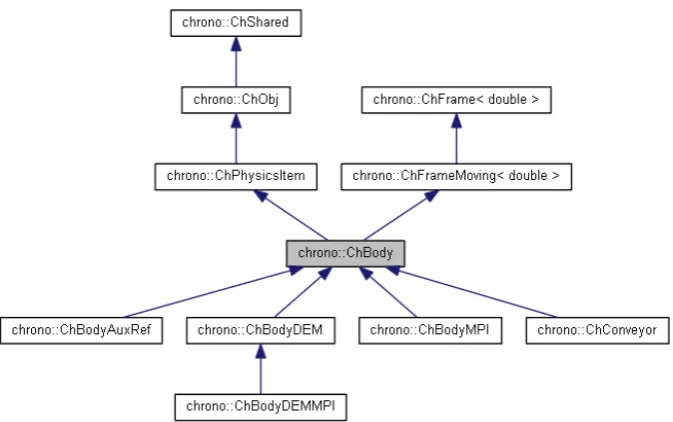
ChBodyclass, which is used for 3-D rigid bodies as shown in Fig. 2,ChShaft, which is used for 1-D concentrated pa-rameter models of power trains,ChLinkLockRevolutethat is a joint between rigid bodies, and so on. A set of more than thirty mechanical constraints are part of this class hierarchy. Furthermore, the architecture is open to further definition of new specialized classes for user-customized parts and joints. An object ofChSystemclass stores a list of all moving parts and performs the simulation.
EachChPhysicsItem-inheriting class can encapsulate a variable number of ChLcpVariableobjects and/or a vari-able number ofChLcpConstraintobjects, that are fed to the solver for Cone Complementarity Problems (CCP) at each time step of the DVI integration; this helps the devel-opment of black-box CCP solvers that are independent from the data structures of the physical layer. Also, these data structures represent the sparse data for the model descrip-tion, which is completely matrix- and vector-free for the sake of a small memory footprint and fast linear algebra. Specifi-cally, tthe system matrices for mass, Jacobians, etc. are never explicitly assembled. The objects of most of the above men-tioned classes are managed by smart (shared) pointers with automatic deletion.
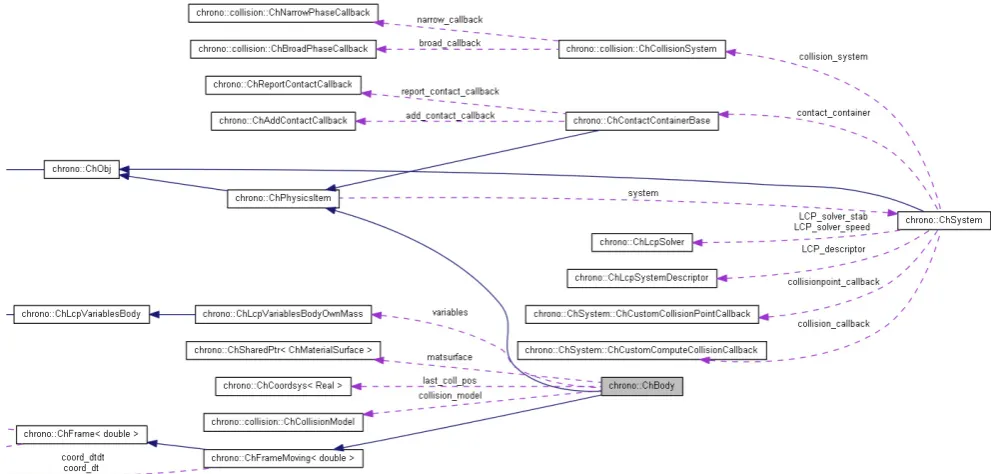
This relieves the programmer from the burden of taking care of object’s lifetime, given that the relationships between objects can be quite complex as illustrated in Fig. 3. A large portion of the C++classes are available also as Python mod-ules; this enables the use of most simulation features in a scripted environment. Since novice users are more comfort-able with Python than with C++, the Python interface proved to be optimal for teaching purposes. The Python interface was produced using the SWIG utility, a process that auto-matically generates the code for the Python wrapper.
The software architecture has been designed to accommo-date an expandable system for handling assets (meshes,
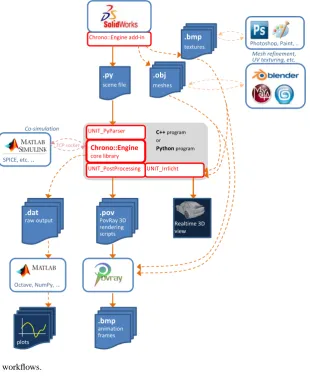
tex-tures, CAD models), with multiple paths from pre-processing to post-processing. To this end, we also provide a C# add-in for a parametric 3-D CAD package (SolidWorks) that can be used to export models intoChrono::Engine without pro-gramming efforts (see Fig. 4).
2.2 Collision detection in Chrono::Engine
This section describes the collision detection algorithm de-signed and implemented for the Chrono::Engine package. Recall that problems of interest are focused on granular dy-namics, such as sand flowing inside an hourglass, a rover running over sandy terrain, an excavator/frontloader dig-ging/loading granular material, etc. In this context, the col-lision detection task is performed on a rather small collec-tion of rigid and/or deformable bodies of complex geome-try (hourglass wall, wheel, track shoe, excavator blade, dip-per), and a very large number of bodies (millions to billions) that make up the granular material. On this scale, the colli-sion detection task, particularly when dealing with the gran-ular material, fits perfectly the Single Instruction Multiple Data (SIMD) computation paradigm. Specifically, the same sequence of instructions needs to be applied to every indi-vidual body and/or contact in the granular material. There-fore, a collision detection algorithm capable of leveraging the SIMD computational power of commodity Graphics Pro-cessing Units (GPUs) was developed and implemented to re-move collision detection as the bottleneck in large granular dynamics simulations.
The parallel collision detection algorithm is separated into two phases, broadphase, and narrowphase. The broadphase algorithm quickly determines a list of potential contact pairs while the narrowphase algorithm determines actual contact information. A brief outline of the parallel collision detection algorithm is presented below, for more details see (Mazhar et al., 2011; Pazouki et al., 2012, 2010).
2.2.1 Broad-Phase algorithm
The Broad-Phase algorithm is used to compute whether two bodies might be in contact at a given time. The purpose of the broad-phase algorithm is not to find actual contact infor-mation, but rather to determine if a contact could potentially occur based on the Axis Aligned Bounding Boxes of the bod-ies involved.
An Axis Aligned Bounding Box (AABB) is a special case of a bounding box that is always aligned to the global refer-ence frame, simplifying collision detection as the bounding box cannot rotate. Because of this, the volume enclosed by the bounding box will always be equal to or greater than the volume of the shape it encloses. AABB generation is simple and can be easily paralellized on a per object basis. See Fig. 5 for an example of AABB computation for a cylinder in 3-D space.
52 H. Mazhar et al.: Chrono: a parallel multi-physics library for rigid-body, flexible-body, and fluid dynamics
Mazhar et al.:
Chrono
: A Parallel Multi-Physics Library for Rigid-Body, Flexible-Body, and Fluid Dynamics
3
OpenGL
unit_IRRLICHT Chrono Engine
unit_POSTPROCESS unit_MATLAB
MATLAB
Operating System Irrlicht
unit_OPENGL
unit_CASCADE unit_PYTHON
Python v3
OpenCASCADE unit_MPI unit_GPU
CUDA MPICH2
Chrono libraries
Example C++ program 'A' Example C++ program 'B' Example Python program
Examples of use
External dependencies
Figure 1
: UML graph of dependencies between module libraries.
tion through OpenGL, for interfacing with post-processing
tools, etc. (see Figure 1).
Classes and objects have been tested and profiled for fast
ex-ecution, in order to achieve real-time performance when
pos-sible. Modern programming techniques have been adopted,
like metaprogramming, class templating, class factories,
memory leak trackers and persistent-transient data mapping.
C
++
operator overloading has been used to provide a
com-pact algebra to manage quaternions, static and moving
coor-dinate systems, and OS-agnostic classes are used for logging,
streaming
/
checkpointing and exception handling.
We embraced an intense object-oriented approach, therefore
most C
++
objects that define parts of the multi-body model
are inherited from a base class called
ChPhysicsItem
,
which defines the essential interfaces for all items that have
some degrees of freedom. For example, specialized classes
that inherit the
ChPhysicsItem
are the
ChBody
class, which
is used for 3D rigid bodies as shown in Fig.2,
ChShaft
,
which is used for 1D concentrated parameter models of
power trains,
ChLinkLockRevolute
that is a joint between
rigid bodies, and so on. A set of more than thirty
mechani-cal constraints are part of this class hierarchy. Furthermore,
the architecture is open to further definition of new
special-ized classes for user-customspecial-ized parts and joints. An object
of
ChSystem
class stores a list of all moving parts and
per-forms the simulation.
Each
ChPhysicsItem
-inheriting class can encapsulate a
variable number of
ChLcpVariable
objects and
/
or a
vari-able number of
ChLcpConstraint
objects, that are fed to
the solver for Cone Complementarity Problems (CCP) at
each time step of the DVI integration; this helps the
devel-opment of black-box CCP solvers that are independent from
the data structures of the physical layer. Also, these data
structures represent the sparse data for the model description,
which is completely matrix- and vector-free for the sake of a
small memory footprint and fast linear algebra. Specifically,
Figure 2
: Class ineritance diagram for objects of
ChBody
type.
tthe system matrices for mass, Jacobians, etc. are never
ex-plicitly assembled. The objects of most of the above
men-tioned classes are managed by smart (shared) pointers with
automatic deletion.
This relieves the programmer from the burden of taking care
of object’s lifetime, given that the relationships between
ob-jects can be quite complex as illustrated in Fig.3. A large
por-tion of the C
++
classes are available also as Python modules;
this enables the use of most simulation features in a scripted
environment. Since novice users are more comfortable with
Python than with C
++
, the Python interface proved to be
op-timal for teaching purposes. The Python interface was
pro-duced using the SWIG utility, a process that automatically
generates the code for the Python wrapper.
The software architecture has been designed to accommodate
an expandable system for handling assets (meshes, textures,
CAD models), with multiple paths from pre-processing to
post-processing. To this end, we also provide a C# add-in for
a parametric 3D CAD package (SolidWorks) that can be used
to export models into
Chrono
::Engine without programming
e
ff
orts (see Fig.4).
2.2
Collision Detection in
Chrono
::Engine
This section describes the collision detection algorithm
de-signed and implemented for the
Chrono
::Engine package.
Recall that problems of interest are focused on granular
dy-namics, such as sand flowing inside an hourglass, a rover
running over sandy terrain, an excavator
/
frontloader
dig-ging
/
loading granular material, etc. In this context, the
col-lision detection task is performed on a rather small
collec-tion of rigid and
/
or deformable bodies of complex
geome-try (hourglass wall, wheel, track shoe, excavator blade,
dip-per), and a very large number of bodies (millions to billions)
that make up the granular material. On this scale, the
colli-sion detection task, particularly when dealing with the
gran-Figure 1.UML graph of dependencies between module libraries.Figure 2.Class ineritance diagram for objects ofChBodytype.
2.2.2 Spatial Subdivision algorithm
A high-level overview of the GPU-based collision detection is as follows. The collision detection process starts by identi-fying the intersections between AABBs and bins (see Fig. 6 for a visual representation of a bin). The AABB-bin pairs are subsequently sorted by bin id. Next, each bin’s starting in-dex is determined so that the bins’ AABBs can be traversed sequentially. All AABBs touching a bin are subsequently checked against each other for collisions.
2.2.3 Narrow-Phase algorithm
Once potential contacts have been determined from the broad-phase collision detection stage, the Narrow-Phase al-gorithm needs to process each possible contact and determine if it actually occurs. To this end an algorithm capable of de-termining contacts between convex geometries was imple-mented on the GPU. This algorithm, called “XenoCollide” (Snethen, 2007), is based upon Minkowski Portal Refinement (MPR) (Snethen, 2008).
H. Mazhar et al.: Chrono: a parallel multi-physics library for rigid-body, flexible-body, and fluid dynamics 53
4 Mazhar et al.:Chrono: A Parallel Multi-Physics Library for Rigid-Body, Flexible-Body, and Fluid Dynamics
Figure 3: Collaboration graph between classes: example forChBodyandChSystem.
ular material, fits perfectly the Single Instruction Multiple Data (SIMD) computation paradigm. Specifically, the same sequence of instructions needs to be applied to every indi-vidual body and/or contact in the granular material. There-fore, a collision detection algorithm capable of leveraging the SIMD computational power of commodity Graphics Pro-cessing Units (GPUs) was developed and implemented to re-move collision detection as the bottleneck in large granular dynamics simulations.
The parallel collision detection algorithm is separated into two phases, broadphase, and narrowphase. The broadphase algorithm quickly determines a list of potential contact pairs while the narrowphase algorithm determines actual contact information. A brief outline of the parallel collision detection algorithm is presented below, for more details see (Mazhar et al., 2011; Pazouki et al., 2012, 2010).
2.2.1 Broad-Phase Algorithm
The Broad-Phase algorithm is used to compute whether two bodies might be in contact at a given time. The purpose of the broad-phase algorithm is not to find actual contact infor-mation, but rather to determine if a contact could potentially occur based on the Axis Aligned Bounding Boxes of the bod-ies involved.
An Axis Aligned Bounding Box (AABB) is a special case of a bounding box that is always aligned to the global refer-ence frame, simplifying collision detection as the bounding box cannot rotate. Because of this, the volume enclosed by the bounding box will always be equal to or greater than the
Chrono::Engine
core library UNIT_PyParser
UNIT_PostProcessing UNIT_Irrlicht
C++program or
Pythonprogram
.py
scene file
.obj
meshes
.pov
PovRay 3D rendering scripts
.bmp
animation frames
.dat
raw output
Octave, NumPy, ..
Chrono::Engine add-in
plots
SPICE, etc. .. Co-simulation
TCP socket
Mesh refinement, UV texturing, etc.
Realtime 3D view
Photoshop, Paint, ..
.bmp
textures
Figure 4: Network of asset workflows.
volume of the shape it encloses. AABB generation is sim-ple and can be easily paralellized on a per object basis. See Fig. 5 for an example of AABB computation for a cylinder in 3D space.
Mech. Sci. www.mech-sci.net
Figure 3.Collaboration graph between classes: example forChBodyandChSystem.
2.3 Using MPI for distributed Chrono
Chronohas been further extended to allow the use of CPU parallelism for certain problems. To efficiently simulate large systems, a domain decomposition approach has been devel-oped to allow the use of many-core compute clusters. In this approach, we divide the simulation domain into a number of sub-domains in a lattice structure. Each sub-domain manages the simulation of all bodies contained therein. Note that bod-ies may span the boundary between adjacent sub-domains. In this case, the body is considered shared and its dynamics may be influenced by the participating sub-domains. The im-plementation leverages the MPI standard (Gropp et al., 1999) to implement the necessary communication and synchroniza-tion between sub-domains.
This approach enables the simulation of large systems in two ways. First, it relies on the power of parallel comput-ing since one computer core can be assigned to each MPI process (and therefore to each sub-domain). These processes can execute in parallel, constrained only by the required com-munication and synchronization. Second, it allows access to the larger memory pool available on distributed memory ar-chitectures. Whereas a single node or GPU card may have about 6 GB of memory, a distributed memory cluster may have on the order of 1 TB of memory, enabling the simula-tion of vastly larger problems.
Note that the domain decomposition approach currently uses the discrete element method to resolve friction and con-tact forces between elements in the system. The approach also supports constraints between bodies in the simulation by considering an assembly of constrained rigid bodies as a
unit which must always be kept together. Therefore, if any body in a chain of constrained bodies is contained in a given sub-domain, all bodies in the chain are considered by that sub-domain and used to correctly solve the constraint equa-tions.
2.3.1 Sub-division and set-up
A pre-processing step is used to discretize the simulation domain into a specified number of sub-domains, set up the communication conduits between processes, and initialize the sub-domains as appropriate. The sub-division is based on a cubic lattice with support for arbitrary sized divisions. The sub-domain boundaries are aligned with the global carte-sian coordinate system, and their locations are user-specified. Separate MPI processes are mapped to each sub-domain. Note that at this time, the sub-division is static and does not change during the simulation. Therefore, the user should be careful to set up the discretization to maintain the best possi-ble load balancing.
In terms of communication, each sub-domain in the grid can communicate with all other sub-domains. These commu-nication pathways are set up and initialized during the pre-processing step and persist throughout the simulation.
Note that this implementation relies heavily on inheri-tance and the class-based structure of Chrono. For exam-ple, ChSystem is extended to ChSystemMPI by including the code to perform communication and synchronize the sub-domains.
54 H. Mazhar et al.: Chrono: a parallel multi-physics library for rigid-body, flexible-body, and fluid dynamics
4
Mazhar et al.:
Chrono
: A Parallel Multi-Physics Library for Rigid-Body, Flexible-Body, and Fluid Dynamics
Figure 3
: Collaboration graph between classes: example for
ChBody
and
ChSystem
.
ular material, fits perfectly the Single Instruction Multiple
Data (SIMD) computation paradigm. Specifically, the same
sequence of instructions needs to be applied to every
indi-vidual body and
/
or contact in the granular material.
There-fore, a collision detection algorithm capable of leveraging
the SIMD computational power of commodity Graphics
Pro-cessing Units (GPUs) was developed and implemented to
re-move collision detection as the bottleneck in large granular
dynamics simulations.
The parallel collision detection algorithm is separated into
two phases, broadphase, and narrowphase. The broadphase
algorithm quickly determines a list of potential contact pairs
while the narrowphase algorithm determines actual contact
information. A brief outline of the parallel collision detection
algorithm is presented below, for more details see (Mazhar
et al., 2011; Pazouki et al., 2012, 2010).
2.2.1
Broad-Phase Algorithm
The Broad-Phase algorithm is used to compute whether two
bodies might be in contact at a given time. The purpose of
the broad-phase algorithm is not to find actual contact
infor-mation, but rather to determine if a contact could potentially
occur based on the Axis Aligned Bounding Boxes of the
bod-ies involved.
An Axis Aligned Bounding Box (AABB) is a special case
of a bounding box that is always aligned to the global
refer-ence frame, simplifying collision detection as the bounding
box cannot rotate. Because of this, the volume enclosed by
the bounding box will always be equal to or greater than the
Chrono::Engine
core library UNIT_PyParser
UNIT_PostProcessing UNIT_Irrlicht
C++program or
Pythonprogram
.py
scene file
.obj
meshes
.pov
PovRay 3D rendering scripts
.bmp
animation frames
.dat
raw output
Octave, NumPy, ..
Chrono::Engine add-in
plots SPICE, etc. ..
Co-simulation
TCP socket
Mesh refinement, UV texturing, etc.
Realtime 3D view
Photoshop, Paint, .. .bmp
textures
Figure 4
: Network of asset workflows.
volume of the shape it encloses. AABB generation is
sim-ple and can be easily paralellized on a per object basis. See
Fig. 5 for an example of AABB computation for a cylinder
in 3D space.
Mech. Sci.
www.mech-sci.net
Figure 4.Network of asset workflows.
Figure 5.Example of AABB generation for 3-D cylinder.
2.3.2 Simulation and communication
Each sub-domain is now represented by aChSystemMPI ob-ject and an associated MPI process. For example, assume a simulation is discretized into a set S of m sub-domains. In this case, let S ={A,B,C,D} and m=4, and map an MPI
Mazhar et al.:
Chrono
: A Parallel Multi-Physics Library for Rigid-Body, Flexible-Body, and Fluid Dynamics
5
Minimum Point
Maximum Point
Figure 5
: Example of AABB generation for 3D cylinder.
3-Dimensional Grid
Bin
Figure 6
: Example of 3D space divided into bins.
2.2.2
Spatial Subdivision Algorithm
A high-level overview of the GPU-based collision detection
is as follows. The collision detection process starts by
identi-fying the intersections between AABBs and bins (see Fig. 6
for a visual representation of a bin). The AABB-bin pairs are
subsequently sorted by bin id. Next, each bin’s starting
in-dex is determined so that the bins’ AABBs can be traversed
sequentially. All AABBs touching a bin are subsequently
checked against each other for collisions.
2.2.3
Narrow-Phase Algorithm
Once potential contacts have been determined from the
broad-phase collision detection stage, the Narrow-Phase
al-gorithm needs to process each possible contact and
deter-mine if it actually occurs. To this end an algorithm
capa-ble of determining contacts between convex geometries was
implemented on the GPU. This algorithm, called
“XenoCol-lide” (Snethen, 2007), is based upon Minkowski Portal
Re-finement (MPR) (Snethen, 2008).
2.3
Using MPI for distributed
Chrono
Chrono
has been further extended to allow the use of CPU
parallelism for certain problems. To e
ffi
ciently simulate large
systems, a domain decomposition approach has been
devel-oped to allow the use of many-core compute clusters. In this
approach, we divide the simulation domain into a number of
sub-domains in a lattice structure. Each sub-domain manages
the simulation of all bodies contained therein. Note that
bod-ies may span the boundary between adjacent sub-domains.
In this case, the body is considered shared and its dynamics
may be influenced by the participating sub-domains. The
im-plementation leverages the MPI standard (Gropp et al., 1999)
to implement the necessary communication and
synchroniza-tion between sub-domains.
This approach enables the simulation of large systems in two
ways. First, it relies on the power of parallel computing since
one computer core can be assigned to each MPI process (and
therefore to each sub-domain). These processes can execute
in parallel, constrained only by the required communication
and synchronization. Second, it allows access to the larger
memory pool available on distributed memory architectures.
Whereas a single node or GPU card may have about 6 GB of
memory, a distributed memory cluster may have on the order
of 1TB of memory, enabling the simulation of vastly larger
problems.
Note that the domain decomposition approach currently uses
the discrete element method to resolve friction and contact
forces between elements in the system. The approach also
supports constraints between bodies in the simulation by
considering an assembly of constrained rigid bodies as a unit
which must always be kept together. Therefore, if any body
in a chain of constrained bodies is contained in a given
domain, all bodies in the chain are considered by that
sub-domain and used to correctly solve the constraint equations.
2.3.1
Sub-division and Set-up
A pre-processing step is used to discretize the simulation
domain into a specified number of sub-domains, set up the
communication conduits between processes, and initialize
the sub-domains as appropriate. The sub-division is based
on a cubic lattice with support for arbitrary sized divisions.
The sub-domain boundaries are aligned with the global
carte-sian coordinate system, and their locations are user-specified.
Separate MPI processes are mapped to each sub-domain.
Note that at this time, the sub-division is static and does not
change during the simulation. Therefore, the user should be
careful to set up the discretization to maintain the best
possi-ble load balancing.
In terms of communication, each sub-domain in the grid can
communicate with all other sub-domains. These
commu-nication pathways are set up and initialized during the
pre-processing step and persist throughout the simulation.
Note that this implementation relies heavily on inheritance
and the class-based structure of
Chrono
.
For example,
ChSystem
is extended to
ChSystemMPI
by including the
code to perform communication and synchronize the
sub-domains.
Figure 6.Example of 3-D space divided into bins.
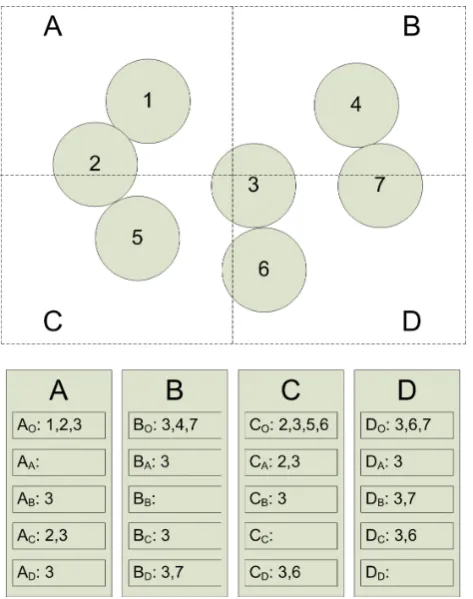
rank to each sub-domain so that A is mapped to MPI rank 0, B→1, C→2, and D→3. Each sub-domain maintains at all times m+1 lists of objects. The first list contains all objects which are even partially contained in the associated sub-domain. These are the objects which must be considered
H. Mazhar et al.: Chrono: a parallel multi-physics library for rigid-body, flexible-body, and fluid dynamics 55
6
Mazhar et al.:
Chrono: A Parallel Multi-Physics Library for Rigid-Body, Flexible-Body, and Fluid Dynamics
2.3.2 Simulation and Communication
Each sub-domain is now represented by a
ChSystemMPI
ob-ject and an associated MPI process. For example, assume
a simulation is discretized into a set
S
of
m
sub-domains.
In this case, let
S
=
{
A
,
B
,
C
,
D
}
and
m
=
4, and map an MPI
rank to each sub-domain so that
A
is mapped to MPI rank
0,
B
→
1,
C
→
2, and
D
→
3. Each sub-domain maintains
at all times
m
+
1 lists of objects. The first list contains all
objects which are even partially contained in the associated
sub-domain. These are the objects which must be considered
when computing contact forces, for example. The next
m
lists contain bodies which are shared with other sub-domains.
In our example, sub-domain
B
maintains the lists
B
O,
B
A,
B
B,
B
C, and
B
D.
B
Ois the list of all objects that intersect (touch)
sub-domain
B
, while
B
Ais the list of objects which are in
sub-domain
A
and
B
. Note that sub-domain
A
has a list
A
Bwhich should contain the same objects as
B
A. Further, list
B
Bis not used but is created for the sake of generality. All
lists are maintained in order sorted by object ID number (see
Fig.7).
Figure 7: (TOP) Sample 2D simulation domain with four
sub-domains and seven objects. (BOTTOM) Corresponding object lists for each sub-domain.
The domains are now ready for time-stepping. Each
sub-domain
X
performs collision detection among all objects in
list
X
Oand computes the associated collision forces based on
the DEM force model. Then, sub-domain
X
computes the
net force on each object in list
X
O, taking into account the
contact forces, gravitational forces, and applied forces.
Next, mid-step communication occurs.
Sub-domain
X
should send to each sub-domain
Y
the net force on each body
in list
X
Y. Similarly,
X
should receive from each
Y
the net
force on each body in list
X
Y. Finally,
X
should compute the
total force on each body in list
X
O. Note that
X
may receive
force contributions for a given body from any or all of the
other sub-domains in the system.
At this point, each sub-domain
X
has the true net force on
each body in its list
X
O. Each sub-domain can advance the
state of its bodies in time by one time step by computing the
new accelerations, velocities, and positions of all objects in
the sub-domain given their mass
/
inertia properties and the set
of applied forces. We perform an end-of-step communication
to synchronize object states among domains. All
sub-domains which share a given body should compute its new
state identically, but due to the potential for round-o
ff
error
we synchronize the state from the master sub-domain (where
the center-of-mass is located) to all others. The final stage
is to process the
m
+
1 lists in each sub-domain, as objects
may enter or leave a given sub-domain or be shared between
a di
ff
erent set of sub-domains, necessitating updates of the
contents of the lists.
2.3.3 Example Simulation
In this example we simulate a Mars Rover type wheeled
ve-hicle operating on granular terrain. The veve-hicle is composed
of a chassis and six wheels connected via revolute joints.
The wheels are driven with a constant angular velocity of
π
rad
/
sec. The granular terrain is composed of 2,016,000
spherical particles. The simulation is divided into 64
sub-domains and uses a time step of 10
−5sec. This small time
step is necessary due to the use of the DEM approach to
com-pute contact forces - a sti
ff
force model is used to achieve
small normal interpenetration, requiring a small step size to
maintain stability. A snapshot from the simulation can be
seen in Fig.8. In the figure, note that the wheels of the rover
are checkered blue and white. This signifies that the master
copy of the rover assembly is in the blue sub-domain and the
rover spans into adjacent sub-domains. In Fig. 8, the rover
has settled into the granular terrain and is starting to move
forward. The rear wheels displace more granular material
than the front wheels because the center of mass of the rover
is closer to the rear of the vehicle.
2.4 Validation and Demonstration of Technology
This section describes a validation e
ff
ort in which
experi-mental results were compared to simulation results obtained
from
Chrono::Engine. To this end, a test rig was designed
Mech. Sci.
www.mech-sci.net
Figure 7. (Top) Sample 2-D simulation domain with four sub-domains and seven objects. (Bottom) Corresponding object lists for each sub-domain.
when computing contact forces, for example. The next m lists contain bodies which are shared with other sub-domains.
In our example, sub-domain B maintains the lists BO, BA,
BB, BC, and BD. BO is the list of all objects that intersect
(touch) sub-domain B, while BA is the list of objects which
are in sub-domain A and B. Note that sub-domain A has a list
ABwhich should contain the same objects as BA. Further, list
BB is not used but is created for the sake of generality. All
lists are maintained in order sorted by object ID number (see Fig. 7).
The sub-domains are now ready for time-stepping. Each sub-domain X performs collision detection among all objects in list XOand computes the associated collision forces based
on the DEM force model. Then, sub-domain X computes the net force on each object in list XO, taking into account the
contact forces, gravitational forces, and applied forces. Next, mid-step communication occurs. Sub-domain X should send to each sub-domain Y the net force on each body in list XY. Similarly, X should receive from each Y the net
force on each body in list XY. Finally, X should compute the
total force on each body in list XO. Note that X may receive
force contributions for a given body from any or all of the other sub-domains in the system.
At this point, each sub-domain X has the true net force on each body in its list XO. Each sub-domain can advance
the state of its bodies in time by one time step by computing the new accelerations, velocities, and positions of all objects in the sub-domain given their mass/inertia properties and the set of applied forces. We perform an end-of-step communi-cation to synchronize object states among sub-domains. All sub-domains which share a given body should compute its new state identically, but due to the potential for round-off error we synchronize the state from the master sub-domain (where the center-of-mass is located) to all others. The fi-nal stage is to process the m+1 lists in each sub-domain, as objects may enter or leave a given sub-domain or be shared between a different set of sub-domains, necessitating updates of the contents of the lists.
2.3.3 Example simulation
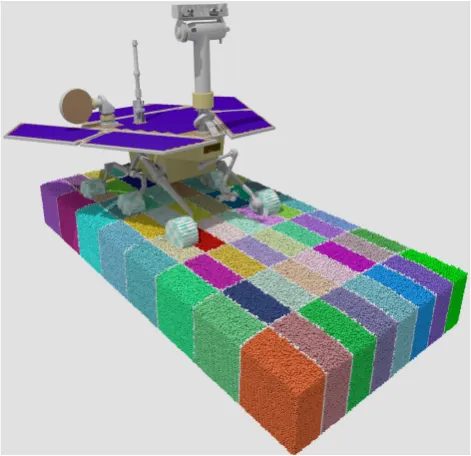
In this example we simulate a Mars Rover type wheeled vehicle operating on granular terrain. The vehicle is com-posed of a chassis and six wheels connected via revolute joints. The wheels are driven with a constant angular velocity of πrad s−1. The granular terrain is composed of 2 016 000
spherical particles. The simulation is divided into 64 sub-domains and uses a time step of 10−5s. This small time step is necessary due to the use of the DEM approach to compute contact forces – a stiffforce model is used to achieve small normal interpenetration, requiring a small step size to main-tain stability. A snapshot from the simulation can be seen in Fig. 8. In the figure, note that the wheels of the rover are checkered blue and white. This signifies that the master copy of the rover assembly is in the blue sub-domain and the rover spans into adjacent sub-domains. In Fig. 8, the rover has set-tled into the granular terrain and is starting to move forward. The rear wheels displace more granular material than the front wheels because the center of mass of the rover is closer to the rear of the vehicle.
2.4 Validation and demonstration of technology
This section describes a validation effort in which experi-mental results were compared to simulation results obtained fromChrono::Engine. To this end, a test rig was designed and fabricated to measure the rate at which granular material flowed out of a slit due to gravity.Chrono::Engine was used to set up a corresponding simulation to match the experimen-tal results. For more detail, see Melanz et al. (2010).
2.4.1 Experimental model
The experimental set-up consisted of a fixed base, a mov-able wall (angled at 45◦), a translational stage, a linear
tuator, and a scale (see schematic in Fig. 9). The linear ac-tuator was capable of quickly opening a precise gap, out of which the granular material would flow due to gravity. The
56 H. Mazhar et al.: Chrono: a parallel multi-physics library for rigid-body, flexible-body, and fluid dynamics
Mazhar et al.:
Chrono
: A Parallel Multi-Physics Library for Rigid-Body, Flexible-Body, and Fluid Dynamics
7
Figure 8
: Snapshot of Mars Rover simulation with 2,016,000
ter-rain particles using 64 domains. Bodies are colored by
sub-domain, with shared bodies (those which span sub-domain
bound-aries) colored white.
and fabricated to measure the rate at which granular material
flowed out of a slit due to gravity.
Chrono
::Engine was used
to set up a corresponding simulation to match the
experimen-tal results. For more detail, see (Melanz et al., 2010).
2.4.1
Experimental Model
The experimental set-up consisted of a fixed base, a movable
wall (angled at 45
◦), a translational stage, a linear actuator,
and a scale (see schematic in Fig. 9). The linear actuator
was capable of quickly opening a precise gap, out of which
the granular material would flow due to gravity. The scale
recorded the mass of collected granular material as a function
of time. The granular material consisted of approximately
40,000 uniform glass disruptor beads with diameter of 500
microns. Experiments were performed for gap sizes of 1.5
mm, 2 mm, 2.5 mm, and 3 mm. At least 5 experiments were
performed for each gap size.
2.4.2
Simulation Model
Chrono
::Engine was used to build a model representing the
experimental set up described above.
In the model, the
trough was represented by four rectangular boxes of finite
dimensions. The motion of the box representing the angled
side was captured from the data sheet of the translational
stage. The granular material was modeled as perfect,
identi-cal spheres with the same mass and coe
ffi
cient of friction.
The load cell measured the outflow through the gap. In the
simulation, the scale was modeled by counting the number
of spheres below a certain height. The number of spheres
Figure 9
: Schematic of validation experiment. A linear actuator
and translational stage moved the left angled side a fixed amount,
opening a precise gap from which the particles flowed. The mass
flow rate was measured by the scale. Schematic not to scale.
multiplied by the mass and gravity yielded the weight which
was compared with experimental results. A plane was used
to contain the spheres after they had been counted.
In order to save computational time, the simulation was split
into two parts: one representing the process of filling the
trough and the other the opening and measuring process.
In this way, the trough was filled with randomly positioned
spheres which were allowed to settle. Once the kinetic
en-ergy of the system was below 0.001 Joules and had reached
a relatively constant value, the x-, y- , and z-position of each
sphere was saved to a file.
The same initial conditions from the settling simulation were
used to perform all of the necessary simulations. At the
be-ginning of each simulation the position data set of the spheres
was loaded into the model and the spheres were created at the
same positions they appeared in the filling process. The
mo-tion was applied to the translating side to achieve the desired
gap size, and the material began to flow.
The simulations setup consisted of 39,000 rigid body spheres
with a radius of 2
.
5
×
10
−4m and a mass of 1
.
631
×
10
−7kg.
The following parameters were set for this simulation. A
time step of 10
−4[s] with 500 CCP iterations, and a tolerance
of 10
−7for the maximum velocity correction. Simulations
were generally run for 8 seconds. SI units were used for all
parameters.
2.4.3
Procedure Used to Select the Friction Coefficient
The friction coe
ffi
cient of a certain material is not a constant
value. It can depend on various environmental influences
such as humidity, surface quality, temperature etc. The
fric-www.mech-sci.net
Mech. Sci.
Figure 8.Snapshot of Mars Rover simulation with 2 016 000 terrain particles using 64 sub-domains. Bodies are colored by sub-domain, with shared bodies (those which span sub-domain boundaries) col-ored white.
Mazhar et al.:Chrono: A Parallel Multi-Physics Library for Rigid-Body, Flexible-Body, and Fluid Dynamics 7
Figure 8: Snapshot of Mars Rover simulation with 2,016,000 ter-rain particles using 64 domains. Bodies are colored by sub-domain, with shared bodies (those which span sub-domain bound-aries) colored white.
and fabricated to measure the rate at which granular material flowed out of a slit due to gravity.Chrono::Engine was used to set up a corresponding simulation to match the experimen-tal results. For more detail, see (Melanz et al., 2010).
2.4.1 Experimental Model
The experimental set-up consisted of a fixed base, a movable wall (angled at 45◦), a translational stage, a linear actuator, and a scale (see schematic in Fig. 9). The linear actuator was capable of quickly opening a precise gap, out of which the granular material would flow due to gravity. The scale recorded the mass of collected granular material as a function of time. The granular material consisted of approximately 40,000 uniform glass disruptor beads with diameter of 500 microns. Experiments were performed for gap sizes of 1.5 mm, 2 mm, 2.5 mm, and 3 mm. At least 5 experiments were performed for each gap size.
2.4.2 Simulation Model
Chrono::Engine was used to build a model representing the
experimental set up described above. In the model, the trough was represented by four rectangular boxes of finite dimensions. The motion of the box representing the angled side was captured from the data sheet of the translational stage. The granular material was modeled as perfect, identi-cal spheres with the same mass and coefficient of friction. The load cell measured the outflow through the gap. In the simulation, the scale was modeled by counting the number of spheres below a certain height. The number of spheres
Figure 9: Schematic of validation experiment. A linear actuator and translational stage moved the left angled side a fixed amount, opening a precise gap from which the particles flowed. The mass flow rate was measured by the scale. Schematic not to scale.
multiplied by the mass and gravity yielded the weight which was compared with experimental results. A plane was used to contain the spheres after they had been counted.
In order to save computational time, the simulation was split into two parts: one representing the process of filling the trough and the other the opening and measuring process. In this way, the trough was filled with randomly positioned spheres which were allowed to settle. Once the kinetic en-ergy of the system was below 0.001 Joules and had reached a relatively constant value, the x-, y- , and z-position of each sphere was saved to a file.
The same initial conditions from the settling simulation were used to perform all of the necessary simulations. At the be-ginning of each simulation the position data set of the spheres was loaded into the model and the spheres were created at the same positions they appeared in the filling process. The mo-tion was applied to the translating side to achieve the desired gap size, and the material began to flow.
The simulations setup consisted of 39,000 rigid body spheres with a radius of 2.5×10⁻⁴m and a mass of 1.631×10⁻⁷kg.
The following parameters were set for this simulation. A time step of 10−4[s] with 500 CCP iterations, and a tolerance
of 10−7 for the maximum velocity correction. Simulations were generally run for 8 seconds. SI units were used for all parameters.
2.4.3 Procedure Used to Select the Friction Coefficient
The friction coefficient of a certain material is not a constant value. It can depend on various environmental influences such as humidity, surface quality, temperature etc. The
fric-www.mech-sci.net Mech. Sci.
Figure 9.Schematic of validation experiment. A linear actuator and translational stage moved the left angled side a fixed amount, open-ing a precise gap from which the particles flowed. The mass flow rate was measured by the scale. Schematic not to scale.
scale recorded the mass of collected granular material as a function of time. The granular material consisted of approx-imately 40 000 uniform glass disruptor beads with diameter of 500 microns. Experiments were performed for gap sizes of 1.5 mm, 2 mm, 2.5 mm, and 3 mm. At least 5 experiments were performed for each gap size.
2.4.2 Simulation model
Chrono::Engine was used to build a model representing the experimental set up described above. In the model, the trough was represented by four rectangular boxes of finite dimen-sions. The motion of the box representing the angled side was captured from the data sheet of the translational stage. The granular material was modeled as perfect, identical spheres with the same mass and coefficient of friction.
The load cell measured the outflow through the gap. In the simulation, the scale was modeled by counting the number of spheres below a certain height. The number of spheres multiplied by the mass and gravity yielded the weight which was compared with experimental results. A plane was used to contain the spheres after they had been counted.
In order to save computational time, the simulation was split into two parts: one representing the process of filling the trough and the other the opening and measuring process. In this way, the trough was filled with randomly positioned spheres which were allowed to settle. Once the kinetic en-ergy of the system was below 0.001 Joules and had reached a relatively constant value, the x-, y- , and z-position of each sphere was saved to a file.
The same initial conditions from the settling simulation were used to perform all of the necessary simulations. At the beginning of each simulation the position data set of the spheres was loaded into the model and the spheres were cre-ated at the same positions they appeared in the filling process. The motion was applied to the translating side to achieve the desired gap size, and the material began to flow.
The simulations setup consisted of 39 000 rigid body spheres with a radius of 2.5×10⁻⁴m and a mass of 1.631×
10−7kg. The following parameters were set for this
simula-tion. A time step of 10−4s with 500 CCP iterations, and a
tolerance of 10−7for the maximum velocity correction.
Sim-ulations were generally run for 8 s. SI units were used for all parameters.
2.4.3 Procedure used to select the friction coefficient
The friction coefficient of a certain material is not a con-stant value. It can depend on various environmental influ-ences such as humidity, surface quality, temperature etc. The friction coefficient of glass was an unknown in the validation process and needed to be determined before further obser-vations could be done. To achieve this, one experiment at a gap size of 1.5 mm was performed and multiple simulations with the same setup and different friction coefficients were performed. The simulation results were compared to the ex-perimental test results to determine which friction coefficient resulted in the best match, see Fig. 10. It was determined that
µ=0.15 most closely matched the experimental results. This value was used for all subsequent simulations.
H. Mazhar et al.: Chrono: a parallel multi-physics library for rigid-body, flexible-body, and fluid dynamics 57
8
Mazhar et al.:
Chrono
: A Parallel Multi-Physics Library for Rigid-Body, Flexible-Body, and Fluid Dynamics
Figure 10
: Selection of
µ
Figure 11
: Weight vs time for a gap size of 3 mm.
tion coe
ffi
cient of glass was an unknown in the validation
process and needed to be determined before further
obser-vations could be done. To achieve this, one experiment at a
gap size of 1.5 mm was performed and multiple simulations
with the same setup and di
ff
erent friction coe
ffi
cients were
performed. The simulation results were compared to the
ex-perimental test results to determine which friction coe
ffi
cient
resulted in the best match, see Fig. 10. It was determined that
µ
=
0
.
15 most closely matched the experimental results. This
value was used for all subsequent simulations.
2.4.4
Results
The weight of the collected granular material is plotted
ver-sus time for various gap sizes in Fig. 11 through Fig. 14 using
the friction coe
ffi
cient determined in Fig. 10. For each
ex-periment, the result from the simulation in
Chrono
::Engine,
shown by the solid line, is overlaid on top of the standard
de-viation of the experimental runs, shown by the dashed line.
Note that the simulated result lies within a single standard
deviation of the experimental data.
Figure 12
: Weight vs time for a gap size of 2.5 mm.
Figure 13
: Weight vs time for a gap size of 2 mm.
3
Chrono::Flex
The
Chrono
::Flex software is a general-purpose simulator
for three dimensional flexible multi-body problems and
pro-vides a suite of flexible body support. The features included
in this module are multiple element types, the ability to
con-nect these elements with a variety of bilateral constraints,
multiple solvers, and contact with friction.
Additionally,
Chrono
::Flex leverages the GPU to accelerate solution of
large problems.
3.1
Element Types
Chrono
::Flex includes two element types implemented
us-ing the Absolute Nodal Coordinate Formulation (ANCF)
Berzeri et al. (2001); von Dombrowski (2002). The
gradient-deficient beam element and the gradient-gradient-deficient plate
ele-ment are described below.
3.1.1
Gradient-Deficient Beam Elements
This implementation uses gradient deficient ANCF beam
ele-ments to model slender beams, examples of which are shown
in Figure 15. These are two node elements with one position
vector and only one gradient vector used as nodal
coordi-nates. Each node thus has 6 coordinates: three components
Mech. Sci.
www.mech-sci.net
Figure 10.Selection ofµ.
8
Mazhar et al.:
Chrono
: A Parallel Multi-Physics Library for Rigid-Body, Flexible-Body, and Fluid Dynamics
Figure 10
: Selection of
µ
Figure 11
: Weight vs time for a gap size of 3 mm.
tion coe
ffi
cient of glass was an unknown in the validation
process and needed to be determined before further
obser-vations could be done. To achieve this, one experiment at a
gap size of 1.5 mm was performed and multiple simulations
with the same setup and di
ff
erent friction coe
ffi
cients were
performed. The simulation results were compared to the
ex-perimental test results to determine which friction coe
ffi
cient
resulted in the best match, see Fig. 10. It was determined that
µ
=
0
.
15 most closely matched the experimental results. This
value was used for all subsequent simulations.
2.4.4
Results
The weight of the collected granular material is plotted
ver-sus time for various gap sizes in Fig. 11 through Fig. 14 using
the friction coe
ffi
cient determined in Fig. 10. For each
ex-periment, the result from the simulation in
Chrono
::Engine,
shown by the solid line, is overlaid on top of the standard
de-viation of the experimental runs, shown by the dashed line.
Note that the simulated result lies within a single standard
deviation of the experimental data.
Figure 12
: Weight vs time for a gap size of 2.5 mm.
Figure 13
: Weight vs time for a gap size of 2 mm.
3
Chrono::Flex
The
Chrono
::Flex software is a general-purpose simulator
for three dimensional flexible multi-body problems and
pro-vides a suite of flexible body support. The features included
in this module are multiple element types, the ability to
con-nect these elements with a variety of bilateral constraints,
multiple solvers, and contact with friction.
Additionally,
Chrono
::Flex leverages the GPU to accelerate solution of
large problems.
3.1
Element Types
Chrono
::Flex includes two element types implemented
us-ing the Absolute Nodal Coordinate Formulation (ANCF)
Berzeri et al. (2001); von Dombrowski (2002). The
gradient-deficient beam element and the gradient-gradient-deficient plate
ele-ment are described below.
3.1.1
Gradient-Deficient Beam Elements
This implementation uses gradient deficient ANCF beam
ele-ments to model slender beams, examples of which are shown
in Figure 15. These are two node elements with one position
vector and only one gradient vector used as nodal
coordi-nates. Each node thus has 6 coordinates: three components
Mech. Sci.
www.mech-sci.net
Figure 11.Weight vs. time for a gap size of 3 mm.
2.4.4 Results
The weight of the collected granular material is plotted ver-sus time for various gap sizes in Fig. 11 through Fig. 14 using the friction coefficient determined in Fig. 10. For each ex-periment, the result from the simulation inChrono::Engine, shown by the solid line, is overlaid on top of the standard de-viation of the experimental runs, shown by the dashed line. Note that the simulated result lies within a single standard deviation of the experimental data.
3 Chrono::Flex
The Chrono::Flex software is a general-purpose simula-tor for three dimensional flexible multi-body problems and provides a suite of flexible body support. The features in-cluded in this module are multiple element types, the abil-ity to connect these elements with a variety of bilateral con-straints, multiple solvers, and contact with friction.
Addition-8
Mazhar et al.:
Chrono
: A Parallel Multi-Physics Library for Rigid-Body, Flexible-Body, and Fluid Dynamics
Figure 10
: Selection of
µ
Figure 11
: Weight vs time for a gap size of 3 mm.
tion coe
ffi
cient of glass was an unknown in the validation
process and needed to be determined before further
obser-vations could be done. To achieve this, one experiment at a
gap size of 1.5 mm was performed and multiple simulations
with the same setup and di
ff
erent friction coe
ffi
cients were
performed. The simulation results were compared to the
ex-perimental test results to determine which friction coe
ffi
cient
resulted in the best match, see Fig. 10. It was determined that
µ
=
0
.
15 most closely matched the experimental results. This
value was used for all subsequent simulations.
2.4.4
Results
The weight of the collected granular material is plotted
ver-sus time for various gap sizes in Fig. 11 through Fig. 14 using
the friction coe
ffi
cient determined in Fig. 10. For each
ex-periment, the result from the simulation in
Chrono
::Engine,
shown by the solid line, is overlaid on top of the standard
de-viation of the experimental runs, shown by the dashed line.
Note that the simulated result lies within a single standard
deviation of the experimental data.
Figure 12
: Weight vs time for a gap size of 2.5 mm.
Figure 13
: Weight vs time for a gap size of 2 mm.
3
Chrono::Flex
The
Chrono
::Flex software is a general-purpose simulator
for three dimensional flexible multi-body problems and
pro-vides a suite of flexible body support. The features included
in this module are multiple element types, the ability to
con-nect these elements with a variety of bilateral constraints,
multiple solvers, and contact with friction.
Additionally,
Chrono
::Flex leverages the GPU to accelerate solution of
large problems.
3.1
Element Types
Chrono
::Flex includes two element types implemented
us-ing the Absolute Nodal Coordinate Formulation (ANCF)
Berzeri et al. (2001); von Dombrowski (2002). The
gradient-deficient beam element and the gradient-gradient-deficient plate
ele-ment are described below.
3.1.1
Gradient-Deficient Beam Elements
This implementation uses gradient deficient ANCF beam
ele-ments to model slender beams, examples of which are shown
in Figure 15. These are two node elements with one position
vector and only one gradient vector used as nodal
coordi-nates. Each node thus has 6 coordinates: three components
Mech. Sci.
www.mech-sci.net
Figure 12.Weight vs. time for a gap size of 2.5 mm.
8
Mazhar et al.:
Chrono
: A Parallel Multi-Physics Library for Rigid-Body, Flexible-Body, and Fluid Dynamics
Figure 10
: Selection of
µ
Figure 11
: Weight vs time for a gap size of 3 mm.
tion coe
ffi
cient of glass was an unknown in the validation
process and needed to be determined before further
obser-vations could be done. To achieve this, one experiment at a
gap size of 1.5 mm was performed and multiple simulations
with the same setup and di
ff
erent friction coe
ffi
cients were
performed. The simulation results were compared to the
ex-perimental test results to determine which friction coe
ffi
cient
resulted in the best match, see Fig. 10. It was determined that
µ
=
0
.
15 most closely matched the experimental results. This
value was used for all subsequent simulations.
2.4.4
Results
The weight of the collected granular material is plotted
ver-sus time for various gap sizes in Fig. 11 through Fig. 14 using
the friction coe
ffi
cient determined in Fig. 10. For each
ex-periment, the result from the simulation in
Chrono
::Engine,
shown by the solid line, is overlaid on top of the standard
de-viation of the experimental runs, shown by the dashed line.
Note that the simulated result lies within a single standard
deviation of the experimental data.
Figure 12
: Weight vs time for a gap size of 2.5 mm.
Figure 13
: Weight vs time for a gap size of 2 mm.
3
Chrono::Flex
The
Chrono
::Flex software is a general-purpose simulator
for three dimensional flexible multi-body problems and
pro-vides a suite of flexible body support. The features included
in this module are multiple element types, the ability to
con-nect these elements with a variety of bilateral constraints,
multiple solvers, and contact with friction.
Additionally,
Chrono
::Flex leverages the GPU to accelerate solution of
large problems.
3.1
Element Types
Chrono
::Flex includes two element types implemented
us-ing the Absolute Nodal Coordinate Formulation (ANCF)
Berzeri et al. (2001); von Dombrowski (2002). The
gradient-deficient beam element and the gradient-gradient-deficient plate
ele-ment are described below.
3.1.1
Gradient-Deficient Beam Elements
This implementation uses gradient deficient ANCF beam
ele-ments to model slender beams, examples of which are shown
in Figure 15. These are two node elements with one position
vector and only one gradient vector used as nodal
coordi-nates. Each node thus has 6 coordinates: three components
Mech. Sci.
www.mech-sci.net
Figure 13.Weight vs. time for a gap size of 2 mm.
ally,Chrono::Flex leverages the GPU to accelerate solution of large problems.
3.1 Element types
Chrono::Flex includes two element types implemented us-ing the Absolute Nodal Coordinate Formulation (ANCF) (Berzeri et al., 2001; von Dombrowski, 2002). The gradient-deficient beam element and the gradient-gradient-deficient plate ele-ment are described below.
3.1.1 Gradient-deficient beam elements
This implementation uses gradient deficient ANCF beam ele-ments to model slender beams, examples of which are shown in Fig. 15. These are two node elements with one position vector and only one gradient vector used as nodal coordi-nates. Each node thus has 6 coordinates: three components of the global position vector of the node and three compo-nents of the position vector gradient at the node. This formu-lation displays no shear locking problems for thin and stiff beams and is computationally more efficient compared to the original ANCF due to the reduced number of nodal coordi-nates (Gerstmayr and Shabana, 2006). The gradient deficient
58 H. Mazhar et al.: Chrono: a parallel multi-physics library for rigid-body, flexible-body, and fluid dynamics
Figure 14.Weight vs. time for a gap size of 1.5 mm. This was the test case that was used for calibration.
Figure 15. Two models with friction and contact using Chrono::Flex beam elements: a ball sitting on grass-like beams and a ball hitting a net.
ANCF beam element does not describe a rotation of the beam about its own axis so the torsional effects cannot be modeled.
3.1.2 Gradient-deficient plate elements
Much like beams, numerical difficulties are encountered in the fully parameterized plate element when the system has very thin and stiffcomponents (Dufva and Shabana, 2005). The high frequencies that are induced along the thin direction of the element require an extremely small time step, resulting in longer simulation times. In the case where the aspect ratio (length divided by thickness) of the element is high, plane stress assumptions can be made that allow a reduced-order element to be accurate. Specifically, Kirchhoff’s plate theory, which does not account for shear deformation, is used and results in an element with 36 degrees of freedom, or nodal coordinates, are shown in Fig. 16.
3.2 Kinematic constraints
Several types of mechanical joints are modeled in
Chrono::Flex. A spherical joint (Shabana, 2005) between two nodes of an