Volume 2007, Article ID 13421,10pages doi:10.1155/2007/13421
Research Article
Block-Based Adaptive Vector Lifting Schemes for
Multichannel Image Coding
Amel Benazza-Benyahia,1Jean-Christophe Pesquet,2Jamel Hattay,1and Hela Masmoudi3, 4
1Unit´e de Recherche en Imagerie Satellitaire et ses Applications (URISA), Ecole Sup´erieure des Communications
(SUP’COM), Tunis 2083, Tunisia
2Institut Gaspard Monge and CNRS-UMR 8049, Universit´e de Marne la Vall´ee, 77454 Marne la Vall´ee C´edex 2, France 3Department of Electrical and Computer Engineering, George Washington University, Washington, DC 20052, USA
4US Food and Drug Administration, Center of Devices and Radiological Health, Division of Imaging and Applied Mathematics,
Rockville, MD 20852, USA
Received 28 August 2006; Revised 29 December 2006; Accepted 2 January 2007
Recommended by E. Fowler
We are interested in lossless and progressive coding of multispectral images. To this respect, nonseparable vector lifting schemes are used in order to exploit simultaneously the spatial and the interchannel similarities. The involved operators are adapted to the image contents thanks to block-based procedures grounded on an entropy optimization criterion. A vector encoding technique derived from EZW allows us to further improve the efficiency of the proposed approach. Simulation tests performed on remote sensing images show that a significant gain in terms of bit rate is achieved by the resulting adaptive coding method with respect to the non-adaptive one.
Copyright © 2007 Amel Benazza-Benyahia et al. This is an open access article distributed under the Creative Commons Attribution License, which permits unrestricted use, distribution, and reproduction in any medium, provided the original work is properly cited.
1. INTRODUCTION
The interest in multispectral imaging has been increasing in many fields such as agriculture and environmental sciences. In this context, each earth portion is observed by several
sen-sors operating at different wavelengths. By gathering all the
spectral responses of the scene, a multicomponent image is obtained. The spectral information is valuable for many ap-plications. For instance, it allows pixel identification of ma-terials in geology and the classification of vegetation type in agriculture. In addition, the long-term storage of such images is highly desirable in many applications. However, it con-stitutes a real bottleneck in managing multispectral image databases. For instance, in the Landsat 7 Enhanced Thematic Mapper Plus system, the 8-band multispectral scanning ra-diometer generates 3.8 Gbits per scene with a data rate of 150 Mbps. Similarly, the Earth Orbiter I (EO-I) instrument works at a data bit rate of 500 Mbps. The amount of data will continue to become larger with the increase of the num-ber of spectral bands, the enhancement of the spatial reso-lution, and the improvement of the radiometry accuracy re-quiring finer quantization steps. It is expected that the next
Landsat generation will work at a data rate of several Gbps. Hence, compression becomes mandatory when dealing with multichannel images. Several methods for data reduction are available, the choice strongly depend on the underlying
ap-plication requirements [1]. Generally, on-board compression
techniques are lossy because the acquisition data rates exceed the downlink capacities. However, ground coding methods are often lossless so as to avoid distortions that could dam-age the estimated values of the physical parameters corre-sponding to the sensed area. Besides, scalability during the browsing procedure constitutes a crucial feature for ground information systems. Indeed, a coarse version of the image is firstly sent to the user to make a decision about whether to abort the decoding if the data are considered of little in-terest or to continue the decoding process and refine the visual quality by sending additional information. The chal-lenge for such progressive decoding procedure is to design a compact multiresolution representation. Lifting schemes
(LS) have proved to be efficient tools for this purpose [2,3].
Generally, the 2D LS is handled in a separable way. Recent works have however introduced nonseparable quincunx
generation of coders following nonrectangularly subsampled
filterbanks [5–7]. These schemes are motivated by the
emer-gence of quincunx sampling image acquisition and display
devices such as in the SPOT5 satellite system [8]. Besides,
nonseparable decompositions offer the advantage of a “true”
two-dimensional processing of the images presenting more degrees of freedom than the separable ones. A key issue of such multiresolution decompositions (both LS and QLS) is the design of the involved decomposition operators. Indeed, the performance can be improved when the intrinsic spatial properties of the input image are accounted for. A possible adaptation approach consists in designing space-varying fil-ter banks based on conventional adaptive linear mean square
algorithms [9–11]. Another solution is to adaptively choose
the operators thanks to a nonlinear decision rule using the
local gradient information [12–15]. In a similar way,
Taub-man proposed to adapt the vertical operators for reducing the edge artifacts especially encountered in compound
doc-uments [16]. Boulgouris et al. have computed the optimal
predictors of an LS in the case of specific wide-sense station-ary fields by considering an a priori autocovariance model of
the input image [17]. More recently, adaptive QLS have been
built without requiring any prior statistical model [8] and, in
[18], a 2D orientation estimator has been used to generate an
edge adaptive predictor for the LS. However, all the reported works about adaptive LS or QLS have only considered mono-component images. In the case of multimono-component images, it is often implicitly suggested to decompose separately each component. Obviously, an approach that takes into account the spectral similarities in addition to the spatial ones should
be more efficient than the componentwise approach. A
pos-sible solution as proposed in Part 2 of the JPEG2000
stan-dard [19] is to apply a reversible transform operating on the
multiple components before their spatial multiresolution de-composition. In our previous work, we have introduced the
concept ofvectorlifting schemes (VLS) that decompose
si-multaneouslyall the spectral components in a separable
man-ner [20] or in a nonseparable way (QVLS) [21]. In this paper,
we consider blockwise adaptation procedures departing from the aforementioned adaptive approaches. Indeed, most of the existing works propose a pointwise adaptation of the opera-tors, which may be costly in terms of bit rate.
More precisely, we propose to firstly segment the image into nonoverlapping blocks which are further classified into
several regions corresponding to different statistical features.
The QVLS operators are then optimally computed for each region. The originality of our approach relies on the opti-mization of a criterion that operates directly on the entropy, which can be viewed as a sparsity measure for the multireso-lution representation.
This paper is organized as follows. InSection 2, we
pro-vide preliminaries about QVLS. The issue of the adaptation
of the QVLS operators is addressed inSection 3. The
objec-tive of this section is to design efficient adaptive
multireso-lution decompositions by modifying the basic structure of the QVLS. The choice of an appropriate encoding technique
is also discussed in this part. InSection 4, experimental
re-sults are presented showing the good performance of the
x o x o x o x o o x o x o x o x x o x o x o x o o x o x o x o x x o x o x o x o o x o x o x o x
Figure 1: Quincunx sampling grid: the polyphase components
x(0b)(m,n) correspond to the “x” pixels whereas the polyphase com-ponentsx(0b)(m,n) correspond to the “o” pixels.
proposed approach. A comparison of the fixed and variable block size strategies is also performed. Finally, some
conclud-ing remarks are given inSection 5.
2. VECTOR QUINCUNX LIFTING SCHEMES
2.1. The lifting principle
In a generic LS, the input image is firstly split into two sets
S1andS2of spatial samples. Because of the local correlation,
a predictor (P) allows to predict theS1samples from theS2
ones and to replace them by their prediction errors. Finally,
theS2samples are smoothed using the residual coefficients
thanks to an update (U) operator. The updated coefficients
correspond to a coarse version of the input signal and, a mul-tiresolution representation is then obtained by recursively re-peating this decomposition to the updated approximation
coefficients. The main advantage of the LS is its reversibility
regardless of the choice of the P and U operators. Indeed, the inverse transform is simply obtained by reversing the order of the operators (U-P) and substituting a minus (resp., plus) sign by a plus (resp., minus) one. Thus, the LS can be con-sidered as an appealing tool for exact and progressive coding. Generally, the LS is applied to images in a separable manner as for instance in the 5/3 wavelet transform retained for the JPEG2000 standard.
2.2. Quincunx lifting scheme
More general LS can be obtained with nonseparable
decom-positions giving rise to the so-called QLS [4]. In this case,
theS1andS2sets, respectively, correspond to the two
quin-cunx polyphase componentsx(j/b2)(m,n) andx(j/b2)(m,n) of the
approximationa(j/b2)(m,n) of thebth band at resolution j/2
(with j∈N):
x(j/b2)(m,n)=a(j/b2)(m−n,m+n),
x(j/b2)(m,n)=a(j/b2)(m−n+ 1,m+n),
(1)
where (m,n) denotes the current pixel. The initialization
is performed at resolution j = 0 by taking the polyphase
components of the original image x(n,m) when this one
has been rectangularly sampled (seeFigure 1). We have then
a0(n,m) = x(n,m). If the quincunx subsampled version of
x(b1)
j/2(m,n) + +
+ a(b1)
(j+1)/2(m,n)
p(b1)
j/2 u(j/b21)
x(b1)
j/2(m,n) − + +
d(b1) (j+1)/2(m,n) x(b2)
j/2(m,n) + +
+ a(b2)
(j+1)/2(m,n)
p(b2)
j/2 u(j/b22)
x(b2)
j/2(m,n) − + +
d(b2) (j+1)/2(m,n)
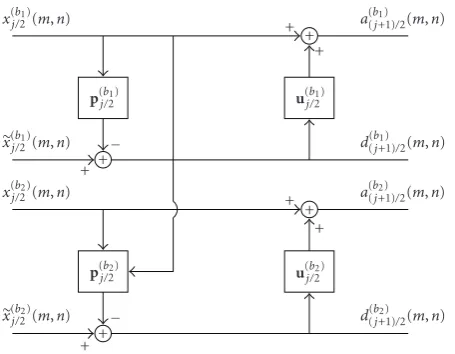
Figure2: An example of a decomposition vector lifting scheme in
the case of a two-channel image.
resolutionj=1/2 by settinga(1b/)2(n,m)=x(b)(m−n,m+n).
In the P step, the prediction errorsd((bj+1)) /2(m,n) are
com-puted:
d((bj+1)) /2(m,n)=x (b)
j/2(m,n)−
x(j/b2)(m,n)p(j/b2), (2)
where · is a rounding operator, x(j/b2)(m,n) is a vector
containing some a(j/b2)(m,n) samples, and, p (b)
j/2 is a vector
of prediction weights of the same size. The approximation
a((bj+1)) /2(m,n) ofa (b)
j/2(m,n) is an updated version ofx (b)
j/2(m,n)
using some of thed((bj+1)) /2(m,n) samples regrouped into the
vectord(j/b2)(m,n):
a((bj+1)) /2(m,n)=x (b)
j/2(m,n) +
d(j/b2)(m,n)u(j/b)2
, (3)
whereu(j/b2)is the associated update weight vector. The
result-ing approximation can be further decomposed so as to get a multiresolution representation of the initial image. Unlike classical separable multiresolution analyses where the input signal is decimated by a factor 4 to generate the approxima-tion signal, the number of pixels is divided by 2 at each (half-) resolution level of the nonseparable quincunx analysis.
2.3. Vector quincunx lifting scheme
The QLS can be extended to a QVLS in order to exploit the interchannel redundancies in addition to the spatial ones. More precisely, thed(j/b2)(m,n) anda
(b)
j/2(m,n) coefficients are
now obtained by using coefficients of the considered band
bandalso coefficients of theotherchannels. Obviously, the
QVLS represents a versatile framework, the QLS being a special case. Besides, the QVLS is quite flexible in terms of selection of the prediction mask and component ordering.
Figure 2shows the corresponding analysis structures. As an example of particular interest, we will consider the simple QVLS whose P operator relies on the following neighbors of
the coefficienta(j/b2)(m−n+ 1,m+n):
x(b1)
j/2(m,n)=
⎛ ⎜ ⎜ ⎜ ⎜ ⎜ ⎜ ⎝
a(b1)
j/2(m−n,m+n) a(b1)
j/2(m−n+ 1,m+n−1) a(b1)
j/2(m−n+ 1,m+n+ 1) a(b1)
j/2(m−n+ 2,m+n)
⎞ ⎟ ⎟ ⎟ ⎟ ⎟ ⎟ ⎠ ,
∀i >1, x(bi)
j/2(m,n)=
⎛ ⎜ ⎜ ⎜ ⎜ ⎜ ⎜ ⎜ ⎜ ⎜ ⎜ ⎜ ⎜ ⎜ ⎜ ⎜ ⎜ ⎜ ⎜ ⎜ ⎝
a(bi)
j/2(m−n,m+n) a(bi)
j/2(m−n+ 1,m+n−1) a(bi)
j/2(m−n+ 1,m+n+ 1) a(bi)
j/2(m−n+ 2,m+n)
a(bi−1)
j/2 (m−n+ 1,m+n)
.. .
a(b1)
j/2(m−n+ 1,m+n)
⎞ ⎟ ⎟ ⎟ ⎟ ⎟ ⎟ ⎟ ⎟ ⎟ ⎟ ⎟ ⎟ ⎟ ⎟ ⎟ ⎟ ⎟ ⎟ ⎟ ⎠ , (4)
where (b1,. . .,bB) is a given permutation of the channel
in-dices (1,. . .,B). Thus, the componentb1, which is chosen as a
reference channel, is coded by making use of a purely spatial
predictor. Then, the remaining componentsbi(fori >1) are
predicted both from neighboring samples of the same
com-ponentbi(spatial mode)andfrom the samples of the
previ-ous componentsbk(fork < i) located at the same position.
The final step corresponds to the following update, which is similarly performed for all the channels:
d(bi)
j/2(m,n)=
⎛ ⎜ ⎜ ⎜ ⎜ ⎜ ⎜ ⎝
d(bi)
j/2(m−1,n+ 1) d(bi)
j/2(m,n) d(bi)
j/2(m−1,n) d(bi)
j/2(m,n+ 1)
⎞ ⎟ ⎟ ⎟ ⎟ ⎟ ⎟ ⎠ . (5)
Note that such a decomposition structure requires to set
4B+ (B−1)B/2 parameters for the prediction weights and
4Bparameters for the update weights. It is worth
mention-ing that the update filter feeds the cross-channel information
back to the approximation coefficients since the detail
coef-ficients contain information from other channels. This may appear as an undesirable situation that may lead to some
leakage effects. However, due to the strong correlation
be-tween the channels, the detail coefficients of theBchannels
have a similar frequency content and no quality degradation was observed in practice.
3. ADAPTATION PROCEDURES
3.1. Entropy criterion
The compression ability of a QVLS-based representation de-pends on the appropriate choice of the P and U operators. In
general, the mean entropyHJ is a suitable measure of
com-pactness of theJ-stage multiresolution representation. This
algorithm is defined as the average of the entropiesHJ(b)of
theBchannel data:
HJ 1
B
B
b=1
H(b)
J . (6)
Likewise,HJ(b)is calculated as a weighted average of the
en-tropies of the approximation and the detail subbands:
H(b)
J
J
j=1
2−jH(b)
d,j/2
+ 2−JH(b)
a,J/2, (7)
whereHd(b,j/)2(resp.,Ha(,bJ/)2) denotes the entropy of the detail
(resp., approximation) coefficients of thebth channel, at
res-olution level j/2.
3.2. Optimization criteria
As mentioned inSection 1, the main contribution of this
pa-per is the introduction of some adaptivity rules in the QVLS
schemes. More precisely, the parameter vectorsp(j/b2)are
mod-ified according to the local activity of each subband. For this purpose, we have envisaged block-based approaches which start by partitioning each subband of each spectral
compo-nent into blocks. Then, for a given channel b, appropriate
classification procedures are applied in order to cluster the blocks which can use the same P and U operators within a given classc∈ {1,. . .,C(j/b2)}. It is worth pointing out that the
partition is very flexible as it depends on the considered spec-tral channel. In other words, the block segmentation yields
different maps from a channel to another. In this context, the
entropyHd(b,j/)2is expressed as follows:
H(b)
d,j/2=
C(j/b2)
c=1 π(j/b2,c)H
(b,c)
d,j/2, (8)
whereHd(b,j/,c2)denotes the entropy of the detail coefficients of
thebth channel within classcand, the weighting factorπ(j/b2,c)
corresponds to the probability that a detail sampled(j/b2)falls
into classc. Two problems are subsequently addressed: (i) the
optimization of the QVLS operators, (ii) the choice of the block segmentation method.
3.3. Optimization of the predictors
We now explain how a specific statistical modeling of the
detail coefficients within a classc can be exploited to effi
-ciently optimize the prediction weights. Indeed, the detail co-efficientsd((bj+1)) /2are often viewed as realizations of a
contin-uous zero mean random variableXwhose probability
den-sity functionfis given by a generalized Gaussian distribution
(GGD) [22,23]:
∀x∈R, fx;α((bj+1),c)/2,β (b,c) (j+1)/2
= β
(b,c) (j+1)/2
2α((bj,+1)c)/2Γ
1/β((bj,+1)c)/2
e−(|x|/α((jb,+1)c)/2)
β((bj,+1)c)/2
,
(9)
whereΓ(z)0+∞tz−1e−tdt,α(b,c)
(j+1)/2>0 is the scale
parame-ter, andβ((bj+1),c)/2>0 is the shape parameter. These parameters
can be easily estimated from the empirical moments of the
data samples [24]. The GGD model allows to express the
dif-ferential entropyH(α((bj,+1)c)/2,β (b,c)
(j+1)/2) as follows:
Hα((bj,+1)c)/2,β (b,c) (j+1)/2
=log
2
α((bj,+1)c)/2Γ
1/β((bj+1),c)/2
β((bj+1),c)/2
+ 1
β((bj+1),c)/2 .
(10)
It is worth noting that the proposed lifting structure
gener-ates integer-valued coefficients that can be viewed as
quan-tized versions of the continuous random variableX with a
quantization step q = 1. According to high rate
quantiza-tion theory [25], the differential entropyH(α((bj+1),c)/2,β (b,c) (j+1)/2)
provides a good estimate ofHd(b,j/,c)2. In practice, the following
empirical estimator of the detail coefficients entropy is
em-ployed:
Hd,K(b,c)
j/2
α((bj+1),c)/2,β (b,c) (j+1)/2
= − 1
K(j/b2,c)
K(j/b2,c)
k=1
logfx(j/b2,c)(k)−
x(j/b2,c)(k)
p(j/b,2c)
,
(11)
wherex(j/b2,c)(1),. . .,x(j/b2,c)(Kj/(b2,c)) andx(j/b2,c)(1),. . .,x(j/b,2c)(K(j/b2,c))
areKj/(b2,c) ∈ N∗ realizations ofx (b)
j/2 andx (b)
j/2 classified inc.
As we aim at designing the most compact representation,
the objective is to compute the predictor p(j/b2,c) that
mini-mizesHJ. From (6), (7), and (8), it can be deduced that the
optimal parameter vector also minimizesHd(b,j/)2 and
there-fore,H(α((bj,+1)c)/2,β (b,c)
(j+1)/2), which is consistently estimated by
Hd,K(b,c) (j+1)/2(α
(b,c) (j+1)/2,β
(b,c)
(j+1)/2). This leads to the maximization of
Lp(j/b,2c);α((bj+1),c)/2,β (b,c) (j+1)/2
= K(j/b2,c)
k=1
logfx(j/b2,c)(k)−
x(j/b2,c)(k)
p(j/b2,c)
.
(12)
Thus, the maximum likelihood estimator of p(j/b2,c) must be
determined. From (9), we deduce that the optimal predictor
minimizes the followingβ((bj+1),c)/2criterion:
β((bj,+1)c)/2
p(j/b2,c);α (b,c) (j+1)/2,β
(b,c) (j+1)/2
K(j/b2,c)
k=1
x(j/b2,c)(k)−
xj/2(k)(b,c)
p(j/b2,c)
β((bj+1),c)/2
.
Hence, thanks to the GGD model, it is possible to design a
predictor in each classcthat ensures the compactness of the
representation in terms of the resulting detail subband en-tropy. However, it has been observed that the considered sta-tistical model is not always adequate for the approximation subbands which makes impossible to derive a closed form ex-pression for the approximation subband entropy. Related to this fact, several alternatives can be envisaged for the selec-tion of the update operator. For instance, it can be adapted to the contents of the image so as to minimize the
reconstruc-tion error [8]. It is worth noticing that, in this case, the
un-derlying criterion is the variance of the reconstruction error and not the entropy. A simpler alternative that we have re-tained in our experiments consists in choosing the same up-date operator for all the channels, resolution levels, and clus-ters. Indeed, in our experiments, it has been observed that the decrease of the entropy is mainly due to the optimization of the predictor operators.
3.4. Fixed-size block segmentation
The second ingredient of our adaptive approach is the block segmentation procedure. We have envisaged two alternatives.
The first one consists in iteratively classifyingfixedsize blocks
as follows [8].
INIT
The block size s(j/b)2×t(j/b2) and the number of regions C(j/b2)
are fixed by the user. Then, the approximation a(j/b)2 is
par-titioned into nonoverlapping blocks that are classified into
C(j/b2)regions. It should be pointed out that the classification
of the approximation subband has been preferred to that of
the detail subbands at a given resolution level j. Indeed, it is
expected that homogenous regions (in the spatial domain) share a common predictor, and such homogeneous regions are more easily detected from the approximation subbands than from the detail ones. For instance, a possible classifica-tion map can be obtained by clustering the blocks according to their mean values.
PREDICT
In each classc, the GGD parametersα((bj+1),c)/2and,β (b,c) (j+1)/2are
estimated as described in [24]. Then, the optimal predictor
p(j/b,2c)that minimizes theβ((bj,+1)c)/2criterion is derived. The
ini-tial values of the predictor weights are set by minimizing the
detail coefficient variance.
ASSIGN
The contents of each classcare modified so that a block of
details initially in classccould be moved to another classc∗
according to some assignment criterion. More precisely, the global entropyHd(b,j/,c2)is equal to the sum of the contributions
of all the detail blocks within classc. This additive property
enables to easily derive the optimal assignement rule. At each
resolution level and, according to the retained band ordering,
a current blockBis assigned to a classc∗if its contribution
to the entropy of that class induces the maximum decrease of
the global entropy. This amounts to move the blockB,
ini-tially assumed to belong to classc, to classc∗if the following
condition is satisfied:
hB,α((bj+1),c)/2,β (b,c) (j+1)/2
< hB,α((bj,+1)c∗)/2,β (b,c∗) (j+1)/2
, (14)
where
hB,α((bj,+1)c)/2,β (b,c) (j+1)/2
s(j/b)2
m=1
t(j/b)2
n=1
logfB(m,n);α((bj+1),c)/2,β (b,c) (j+1)/2
.
(15)
PREDICTandASSIGNsteps are repeated until the conver-gence of the global entropy. Then, the procedure is iterated
through theJresolution stages.
At the convergence of the procedure, at each resolution level, the chosen predictor for each block is identified with a binary index code which is sent to the decoder leading to an overall overhead not exceeding
o=
B
b=1
J
j=1
log2C(j/b2)
s(j/b2t)
(b)
j/2
(bpp). (16)
Note that the amount of side information can be further
re-duced by differential encoding.
3.5. Variable-size block segmentation
More flexibility can be achieved by varying the block sizes according to the local activity of the image. To this respect, a quadtree (QT) segmentation in the spatial domain is used which provides a layered representation of the regions in the image. For simplicity, this approach has been imple-mented using a volumetric segmentation (same segmenta-tion for each image channel at a given resolusegmenta-tion as depicted in Figure 3) [26]. The regions are obtained according to a
segmentation criterion R that is suitable for compression
purposes. Generally, the QT can be built following two al-ternatives: a splitting or a merging approach. The first one starts from a partition of the transformed multicomponent
image into volumetric quadrants. Then, each quadrant f is
split into 4 volumetric subblocksc1,. . .,c4if the criterionR
holds, otherwise the untouched quadrantf is associated with
a leaf of the unbalanced QT. The subdivision is eventually
repeated on the subblocksc1,. . .,c4until the subblock
min-imum sizek1×k2 is achieved. Finally, the resulting
block-shaped regions correspond to the leaves of the unbalanced QT.
In contrast, the initial step of the dual approach (i.e., the merging procedure) corresponds to a partition of the image
into minimum sizek1×k2subblocks. Then, the
homogene-ity with respect to the ruleR of each quadrant formed by
adjacent volumetric subblocks c1,. . .,c4 is checked. In case
of homogeneity, the fusion of c1,. . .,c4 is carried out,
B
sp
ect
ral
co
mponents
Figure3: An example of a volumetric block-partitioning of aB
-component image.
the fusion procedure is recursively performed until the whole image size is reached.
Obviously, the key issue of such QT partitioning lies in
the definition of the segmentation ruleR. In our work, this
rule is based on the lifting optimization criterion. Indeed, in the case of the splitting alternative, the objective is to decide
whether the splitting of a node f into its 4 childrenc1,. . .,c4
provides a more compact representation than the node f
does. For each channel, the optimal prediction and update weights p(j/b,2f) u
(b,f)
j/2 of node f are computed for a J-stage
decomposition. The optimal weightsp(b,ci)
j/2 and,u (b,ci)
j/2 of the
childrenc1,. . .,c4are also computed. LetHd(b,j/,f2)and,H(b,ci)
d,j/2
denote the entropy of the resulting multiresolution
represen-tations. The splitting is decided if the following inequalityR
holds:
1
4B
4
i=1
B
b=1
H(b,ci)
d,j/2
+oci
< 1 B
B
b=1
H(b,f)
d,j/2
+o(f),
(17)
where o(n) is the coding cost of the side information
re-quired by the decoding procedure at noden. This overhead
information concerns the tree structure and the operators weights. Generally, it is easy to code the QT by assigning the bit “1” to an intermediate node and the bit “0” to a leaf. Since the image corresponds to all the leaves of the QT, the prob-lem amounts to the coding of the binary sequences point-ing on these terminatpoint-ing nodes. To this respect, a run-length coder is used. Concerning the operators weights, these ones should be exactly coded. As they take floating values, they are rounded prior to the arithmetic coding stage. Obviously, to avoid any mismatch, the approximation and detail coef-ficients are computed according to these rounded weights. Finally, it is worth noting that the merging rule is derived in
a straightforward way from (17).
Table1: Description of the test images.
Name Number ofcomponents Source Scene
Trento6 6 Thematic Mapper Rural Trento7 7 Thematic Mapper Rural
Tunis3 3 SPOT3 Urban
Kair4 4 SPOT4 Rural
Tunis4-160 4 SPOT4 Rural
Tunis4-166 4 SPOT4 Rural
Table2: Influence of the prediction optimization criterion on the
average entropies for non adaptive 4-level QLS and QVLS decom-positions. The update was fixed for all resolution levels and for all the components.
Image QLS
2
QLS
β Gain
QVLS
2
QVLS
β Gain
Trento6 4.2084 4.1172 0.0912 3.8774 3.7991 0.0783 Trento7 3.9811 3.8944 0.0867 3.3641 3.2988 0.0653 Tunis3 5.3281 5.2513 0.0768 4.5685 4.4771 0.0914 Kair4 4.3077 4.1966 0.1111 3.9222 3.8005 0.1217 Tunis4-160 4.7949 4.7143 0.0806 4.2448 4.1944 0.0504 Tunis4-166 3.9726 3.9075 0.0651 3.7408 3.6205 0.1203 Average 4.4321 4.3469 0.0853 3.9530 3.8651 0.0879
3.6. Improved EZW
Once the QVLS coefficients have been obtained, they are
en-coded by an embedded coder so as to meet the scalability requirement. Several scalable coders exist which can be used for this purpose, for example, the embedded zerotree wavelet
coder (EZW) [27], the set partitioning in hierarchical tree
(SPIHT) coder [28], the embedded block coder with
opti-mal truncation (EBCOT) [29]. Nevertheless, the efficiency of
such coders can be increased in the case of multispectral im-age coding as will be shown next. To illustrate this fact, we will focus on the EZW coder which has the simplest struc-ture. Note however that the other existing algorithms can be extended in a similar way.
The EZW algorithm allows a scalable reconstruction in quality by taking into account the interscale similarities
be-tween the detail coefficients [27]. Several experiments have
indeed indicated that if a detail coefficient at a coarse scale
is insignificant, then all the coefficients in the same
orienta-tion and in the same spatial locaorienta-tion at finer scales are likely to be insignificant too. Therefore, spatial orientation trees
whose nodes are detail coefficients can be easily built, the
scanning order starts from the coarsest resolution level. The EZW coder consists in detecting and encoding these
insignif-icant coefficients through a specific data structure called a
ze-rotree. This tree contains elements whose values are smaller
than the current threshold Ti. The use of the EZW coder
Table3: Average entropies for several lifting-based decompositions. Two resolution levels were used for the separable decompositions and four (half-)resolution levels for the nonseparable ones. The update was fixed except for Gouze’s decomposition OQLS (6,4).
Image 5/3 RKLT+5/3 QLS (4,2) OQLS (6,4) Our QLS Our QVLS
Merging QLS RKLT and
merging QLS Merging QVLS
k1=16 k1=16 k1=16
k2=16 k2=16 k2=16
Trento6 3.9926 3.9260 4.6034 3.9466 4.1172 3.7991 3.7243 3.5322 3.4822
Trento7 3.7299 3.7384 4.4309 3.9771 3.8944 3.2988 3.5543 3.3219 3.0554
Tunis3 5.0404 4.6586 5.7741 4.7718 5.2513 4.4771 4.2038 3.9425 3.0998
Kair4 4.0581 3.9104 4.6879 3.8572 4.1966 3.8005 3.6999 3.5240 3.1755
Tunis4-160 4.5203 4.2713 5.2312 4.1879 4.7143 4.1944 4.1208 3.6211 3.2988
Tunis4-166 3.6833 3.5784 4.4807 3.6788 3.9075 3.6205 3.8544 3.2198 3.0221
Average 4.1708 4.0138 4.8680 4.0699 4.3469 3.8651 3.8596 3.5269 3.1890
single symbol (ZTR) at the position of its root. In his
pio-neering paper, Shapiro has considered onlyseparablewavelet
transforms. In [30], we have extended the EZW to the case
ofnonseparableQLS by defining a modified parent-child
re-lationship. Indeed, each coefficient in a detail subimage at
level (j+ 1)/2 is the father oftwocolocated coefficients in
the detail subimage at level j/2. It is worth noticing that a
tree rooted in the coarsest approximation subband will have one main subtree rooted in the coarsest detail subband. As in the separable case, the Quincunx EZW (QEZW) alternates
between dominant passesDPiand subordinate passesSPiat
each roundi. All the wavelet coefficients are initially put in a
list called the dominant list,DL1, while the other listSL1(the
subordinate list) is empty. An initial thresholdT1is chosen
and the first round of passesR1starts (i=1). The dominant
passDPidetects the significant coefficients with respect to
the current thresholdTi. The signs of the significant coeffi
-cients are coded with either POS or NEG symbols. Then, the
significant coefficients are set to zero inDLito facilitate the
formation of zerotrees in the next rounds. Their magnitudes
are put in the subordinate list,SLi. In contrast, the
descen-dants of insignificant coefficient are tested for being included
in a zerotree. If this cannot be achieved, then these coeffi
-cients are isolated zeros and they are coded with the specific
symbol IZ. Once all the elements inDLihave been processed,
theDPi ends and theSPistarts: each significant coefficient
inSLiwill have a reconstruction value given by the decoder.
By default, an insignificant coefficient will have a
reconstruc-tion value equal to zero. DuringSPi, the uncertainty interval
is halved. The new reconstruction value is the center of this smaller uncertainty range depending on whether its magni-tude lies in the upper (UPP) or lower (LOW) half. Once the
SLihas been fully processed, the next iteration starts by
in-crementingi.
Therefore, for each channel, both EZW and QEZW pro-vide a set of coefficients (d(nb))nencoded according to the
se-lected scanning path. We subsequently propose to modify the QEZW algorithm so as to jointly encode the components of theB-uplet (dn(1),. . .,d(nB))n. The resulting algorithm will be
designated as V-QEZW. We begin with the observation that,
0 0.5 1 1.5 2 2.5 3 3.5 4 4.5 5 Bit rate (bpp)
20 30 40 50 60 70 80 90 100
PSNR
(dB)
RKLT+5/3 QEZW V-QEZW
Figure4: Image Trento7: average PSNR (in dB)versusaverage bit
rate (in bpp) generated by the embedded coders with the equivalent number of decomposition stages. The EZW coder is associated with the RKLT+5/3 transform and the QEZW, and the V-QEZW with the same QVLS. We have adopted that the convention PSNR=100 dB amounts to an infinite PSNR.
if a coefficientd(nb)is significant with respect to a fixed
thresh-old, then all the coefficientsd(nb)in the other channelb =b
are likely to be significant with respect to the same threshold.
Insignificant or isolated zero coefficients also satisfy such
in-ter channel similarity rule. The proposed coding algorithm
will avoid to manage and encodeseparatelyBdominant lists
andBsubordinate lists. The vector coding technique
intro-duces 4 extra-symbols that indicate that for a given indexn,
all theBcoefficients are either positive significant (APOS) or
negative significant (ANEG), or insignificant (AZTR) or iso-lated zeros (AIZ). More precisely, at each iteration of the
(a) (b)
(c) (d)
(e) (f)
Figure5: Recontructed images at several passes of the V-QEZW concerning the first channel (b=1) of the SPOT image TUNIS. (a) PSNR=
21.0285 dB channel bit rate=0.1692 bpp. (b) PSNR=28.2918 dB channel bit rate=0.7500 bpp. (c) PSNR=32.9983 dB channel bit rate= 1.4946 bpp. (d) PSNR=39.5670 dB channel bit rate=2.4972 bpp. (e) PSNR=57.6139 dB channel bit rate=4.2644 bpp. (f) PSNR=+∞ channel bit rate=4.5981 bpp
inter- and intrachannel information using the 3- bit codes: APOS, ANEG, AIZ, AZTR, POS, NEG, IZ, ZTR. The remain-ing channel significance maps are only concerned with intra-channel information consisting of POS, NEG, IZ, ZTR sym-bols coded with 2 bits. The stronger the similarities are, the
more efficient the proposed technique is.
4. EXPERIMENTAL RESULTS
Table 1 lists the 512×512 multichannel images used in our experiments. All these images are 8 bpp multispec-tral satellite images. The Trento6 image corresponds to the Landsat-Thematic Mapper Trento7 image where the sixth component has been discarded since it is not similar to the
other components. As the entropy decrease is not significant when more than 4 (half-)resolution levels are considered, we
choose to use 4-stage nonseparable decompositions (J =4).
All the proposed decompositions make use of a fixed up-date u(j/b)2 = (1/8, 1/8, 1/8, 1/8). The employed vector lift-ing schemes implicitly correspond to the band orderlift-ing that ensures the most compact representation. More precisely, an exhaustive search was performed for the SPOT images
(B≤4) by examining all the permutations. If a greater
num-ber of components are involved as for the Thematic Mapper images, this approach becomes computationally intractable.
Hence, an efficient algorithm must be applied for computing
as a graph theoretic problem [31]. Therefore, heuristic so-lutions should be found for band ordering. In our case, we have considered the correlations between the components and used the component(s) that is least correlated in an in-tracoding mode and the others in intercoding mode. Alter-natively, the band with the smallest entropy is coded in in-tramode as a reference band, the others in intermode.
First of all, we validate the use of the GGD model for the
detail coefficients.Table 2gives the global entropies obtained
with the QLS and the QVLS first using global minimum vari-ance predictors, then using global GGD-derived predictors
(i.e., minimizing theβcriterion in (13)). It shows that using
the predictors derived from theβ criterion yields improved
performance in the monoclass case. It is important to ob-serve that, even in the nonadaptive case (one single class), the GGD model is more suitable to derive optimized
pre-dictors. Besides,Table 2shows the outperformance of QVLS
over QLS, always in the nonadaptive case. For instance, in the case of Tunis4-160, a gain of 0.52 bpp is achieved by the QVLS schemes over the componentwise QLS.
In Table 3, the variable block size adaptive versions of the proposed QLS and QVLS are compared to those ob-tained with the most competitive reversible wavelet-based methods. All of the latter methods are applied separately to each spectral component. In particular, we have tested the 5/3 biorthogonal transform. Besides, prior the 5/3 transform or our QLS, a reversible Karhunen-Lo`eve transform (RKLT)
[32] has been applied to decorrelate theBcomponents as
rec-ommended in Part 2 of the JPEG2000 standard. As a
bench-mark, we have also retained the OQLS (6,4) reported in [8]
which uses an optimized update and a minimum variance predictor. It can be noted that the merging procedure was shown to outperform the splitting one and that it leads to substantial gains for both the QLS and QVLS. Our simula-tions also confirm the superiority of the QVLS over the
op-timal spectral decorrelation by the RKLT.Figure 4provides
the variations of the average PSNR versus the average bit rate achieved at each step of the QEZW or V-QEZW coder for the Trento7 data. As expected, the V-QEZW algorithm leads to a lower bit rate than the QEZW. At the final reconstruction pass, the V-QEZW bit rate is 0.33 bpp below the QEZW one.
Figure 5displays the reconstructed images for the first
chan-nel of the Tunis3 scene, which are obtained at the different
steps of the V-QEZW algorithm. These results demonstrate clearly the scalability in accuracy of this algorithm, which is suitable for telebrowsing applications.
5. CONCLUSION
In this paper we have suggested several tracks for improv-ing the performance of lossless compression for multichan-nel images. In order to take advantage of the correlations between the channels, we have made use of vector-lifting schemes combined with a joint encoding technique derived from EZW. In addition, a variable-size block segmentation
approach has been adopted for adapting the coefficients of
the predictors of the considered VQLS structure to the lo-cal contents of the multichannel images. The gains obtained
on satellite multispectral images show a significant improve-ment compared with existing wavelet-based techniques. We think that the proposed method could also be useful in other imaging application domains where multiple sensors are used, for example, medical imaging or astronomy.
Note
Part of this work has been presented in [26,33,34].
REFERENCES
[1] K. Sayood,Introduction to Data Compression, Academic Press, San Diego, Calif, USA, 1996.
[2] W. Sweldens, “Lifting scheme: a new philosophy in biorthog-onal wavelet constructions,” inWavelet Applications in Signal and Image Processing III, vol. 2569 ofProceedings of SPIE, pp. 68–79, San Diego, Calif, USA, July 1995.
[3] A. R. Calderbank, I. Daubechies, W. Sweldens, and B.-L. Yeo, “Wavelet transforms that map integers to integers,”Applied and Computational Harmonic Analysis, vol. 5, no. 3, pp. 332– 369, 1998.
[4] A. Gouze, M. Antonini, and M. Barlaud, “Quincunx lifting scheme for lossy image compression,” inProceedings of IEEE International Conference on Image Processing (ICIP ’00), vol. 1, pp. 665–668, Vancouver, BC, Canada, September 2000. [5] C. Guillemot, A. E. Cetin, and R. Ansari, “M-channel
non-rectangular wavelet representation for 2-D signals: basis for quincunx sampled signals,” in Proceedings of IEEE Interna-tional Conference on Acoustics, Speech, and Signal Process-ing (ICASSP ’91), vol. 4, pp. 2813–2816, Toronto, Ontario, Canada, April 1991.
[6] R. Ansari and C.-L. Lau, “Two-dimensional IIR filters for exact reconstruction in tree-structured sub-band decomposition,”
Electronics Letters, vol. 23, no. 12, pp. 633–634, 1987. [7] R. Ansari, A. E. Cetin, and S. H. Lee, “Subband coding of
images using nonrectangular filter banks,” inThe 32nd An-nual International Technical Symposium: Applications of Dig-ital Signal Processing, vol. 974 ofProceedings of SPIE, p. 315, San Diego, Calif, USA, August 1988.
[8] A. Gouze, M. Antonini, M. Barlaud, and B. Macq, “Design of signal-adapted multidimensional lifting scheme for lossy coding,”IEEE Transactions on Image Processing, vol. 13, no. 12, pp. 1589–1603, 2004.
[9] W. Trappe and K. J. R. Liu, “Adaptivity in the lifting scheme,” in Proceedings of the 33rd Annual Conference on Informa-tion Sciences and Systems, pp. 950–955, Baltimore, Md, USA, March 1999.
[10] A. Benazza-Benyahia and J.-C. Pesquet, “Progressive and loss-less image coding using optimized nonlinear subband decom-positions,” inProceedings of the IEEE-EURASIP Workshop on Nonlinear Signal and Image Processing (NSIP ’99), vol. 2, pp. 761–765, Antalya, Turkey, June 1999.
[11] ¨O. N. Gerek and A. E. C¸etin, “Adaptive polyphase subband de-composition structures for image compression,”IEEE Transac-tions on Image Processing, vol. 9, no. 10, pp. 1649–1660, 2000. [12] R. L. Claypoole, G. M. Davis, W. Sweldens, and R. G.
Bara-niuk, “Nonlinear wavelet transforms, for image coding via lift-ing,”IEEE Transactions on Image Processing, vol. 12, no. 12, pp. 1449–1459, 2003.
[14] G. Piella, B. Pesquet-Popescu, and H. Heijmans, “Adaptive up-date lifting with a decision rule based on derivative filters,”
IEEE Signal Processing Letters, vol. 9, no. 10, pp. 329–332, 2002. [15] J. Sol´e and P. Salembier, “Adaptive discrete generalized lift-ing for lossless compression,” inProceedings of IEEE Interna-tional Conference on Acoustics, Speech, and Signal Processing (ICASSP ’04), vol. 3, pp. 57–60, Montreal, Quebec, Canada, May 2004.
[16] D. S. Taubman, “Adaptive, non-separable lifting transforms for image compression,” inProceedings of IEEE International Conference on Image Processing (ICIP ’99), vol. 3, pp. 772–776, Kobe, Japan, October 1999.
[17] N. V. Boulgouris, D. Tzovaras, and M. G. Strintzis, “Lossless image compression based on optimal prediction, adaptive lift-ing, and conditional arithmetic codlift-ing,”IEEE Transactions on Image Processing, vol. 10, no. 1, pp. 1–14, 2001.
[18] ¨O. N. Gerek and A. E. C¸etin, “A 2-D orientation-adaptive prediction filter in lifting structures for image coding,”IEEE Transactions on Image Processing, vol. 15, no. 1, pp. 106–111, 2006.
[19] D. S. Taubman and M. W. Marcellin,JPEG2000: Image Com-pression Fundamentals, Standards and Practice, Kluwer Aca-demic, Boston, Mass, USA, 2002.
[20] A. Benazza-Benyahia, J.-C. Pesquet, and M. Hamdi, “Vector-lifting schemes for lossless coding and progressive archival of multispectral images,”IEEE Transactions on Geoscience and Re-mote Sensing, vol. 40, no. 9, pp. 2011–2024, 2002.
[21] A. Benazza-Benyahia, J.-C. Pesquet, and H. Masmoudi, “Vector-lifting scheme for lossless compression of quin-cunx sampled multispectral images,” in Proceedings of the IEEE International Geoscience and Remote Sensing Symposium (IGARSS ’02), p. 3, Toronto, Ontario, Canada, June 2002. [22] S. G. Mallat, “A theory for multiresolution signal
decomposi-tion: the wavelet representation,”IEEE Transactions on Pattern Analysis and Machine Intelligence, vol. 11, no. 7, pp. 674–693, 1989.
[23] M. Antonini, M. Barlaud, P. Mathieu, and I. Daubechies, “Im-age coding using wavelet transform,”IEEE Transactions of Im-age Processing, vol. 1, no. 2, pp. 205–220, 1992.
[24] K. Sharifi and A. Leron-Garcia, “Estimation of shape parame-ter for generalized Gaussian distributions in subband decom-positions of video,”IEEE Transactions on Circuits and Systems for Video Technology, vol. 5, no. 1, pp. 52–56, 1995.
[25] H. Gish and J. N. Pierce, “Asymptotically efficient quantizing,”
IEEE Transactions on Information Theory, vol. 14, no. 5, pp. 676–683, 1968.
[26] J. Hattay, A. Benazza-Benyahia, and J.-C. Pesquet, “Adaptive lifting schemes using variable-size block segmentation,” in
Proceedings of International Conference on Advanced Concepts for Intelligent Vision Systems (ACIVS ’04), pp. 311–318, Brus-sels, Belgium, August-September 2004.
[27] J. M. Shapiro, “Embedded image coding using zerotrees of wavelet coefficients,”IEEE Transactions on Signal Processing, vol. 41, no. 12, pp. 3445–3462, 1993.
[28] A. Said and W. A. Pearlman, “An image multiresolution rep-resentation for lossless and lossy compression,”IEEE Transac-tions on Image Processing, vol. 5, no. 9, pp. 1303–1310, 1996. [29] D. S. Taubman, “High performance scalable image
compres-sion with EBCOT,” IEEE Transactions on Image Processing, vol. 9, no. 7, pp. 1158–1170, 2000.
[30] J. Hattay, A. Benazza-Benyahia, and J.-C. Pesquet, “Multi-component image compression by an efficient coder based on vector lifting structures,” inProceedings of the 12th IEEE
International Conference on Electronics, Circuits and Systems (ICECS ’05), Gammarth, Tunisia, December 2005.
[31] S. R. Tate, “Band ordering in lossless compression of mul-tispectral images,” IEEE Transactions on Computers, vol. 46, no. 4, pp. 477–483, 1997.
[32] P. Hao and Q. Shi, “Reversible integer KLT for progressive-to-lossless compression of multiple component images,” in Pro-ceedings of IEEE International Conference on Image Processing (ICIP ’03), vol. 1, pp. 633–636, Barcelona, Spain, September 2003.
[33] H. Masmoudi, A. Benazza-Benyahia, and J.-C. Pesquet, “Block-based adaptive lifting schemes for multiband image compression,” inWavelet Applications in Industrial Processing, vol. 5266 ofProceedings of SPIE, pp. 118–128, Providence, RI, USA, October 2003.