R E S E A R C H A R T I C L E
Open Access
Learning motion primitives and annotative
texts from crowd-sourcing
Wataru Takano
Abstract
Humanoid robots are expected to be integrated into daily life, where a large variety of human actions and language expressions are observed. They need to learn the referential relations between the actions and language, and to understand the actions in the form of language in order to communicate with human partners or to make inference using language. Intensive research on imitation learning of human motions has been performed for the robots that can recognize human activity and synthesize human-like motions, and this research is subsequently extended to integration of motions and language. This research aims at developing robots that understand human actions in the form of natural language. One difficulty comes from handling a large variety of words or sentences used in daily life because it is too time-consuming for researchers to annotate human actions in various expressions. Recent development of information and communication technology gives an efficient process of crowd-sourcing where many users are available to complete a lot of simple tasks. This paper proposes a novel concept of collecting a large training dataset of motions and their descriptive sentences, and of developing an intelligent framework learning relations between the motions and sentences. This framework enables humanoid robots to understand human actions in various forms of sentences. We tested it on recognition of human daily full-body motions, and demonstrated the validity of it.
Keywords: Motion primitives; Natural language; Crowd-sourcing
Background
Robots are able to understand their surroundings by rely-ing on senses supplied by their body, which they can then move to act on the environment. For some time, research has been conducted on imitation learning [1,2], where the bodily motions of humans are projected onto the bodily motions of humanoid robots and recorded as dynami-cal system [3-6] and statistidynami-cal model [7-10] parameters while compressing the information. By using these mod-els, it has become possible for robots to recognize human bodily motions and to generate their own natural human-like motions. However, in the motion recognition phase, the motion is classified into its specific model, and in the motion generation phase, a command specifying the model is given to a robot. More specifically, indices of the motion models that are not understood by human part-ners intervene in the motion recognition and generation. The intermediate codes that can be intuitively understood
Correspondence: [email protected]
The Univ. of Tokyo, Bunkyoku Hongo 7-3-1, Tokyo, Japan
by the human partners are required. A natural language can be its solution, and facilitate an intuitive interaction between humans and robots. Several approaches extend the motion models to the language expressions, where robots understand human motions as text and can then generate bodily motions from text input [11,12]. Sev-eral models for a robot manipulating object via linguistic instructions have been developed using a neural network [13,14]. The Variation of the objects and actions is small. Our daily lives are overflowing with a huge variety of possible motions and expressions for describing them. Therefore, there is a need for humanoid robots to be able to adapt to this diversity.
In this study, I created a training dataset of motions and corresponding texts describing those motions by assign-ing a variety of text phrases to human bodily motions via crowdsourcing [15]. I then built an intellectual framework that can understand language for expressing movement by learning the correspondence between bodily motions and language expressions via a statistical model. This tech-nology to collect and utilize a massive amount of text
Method
Motion annotations
The full-body motions of humans were measured by optical motion capture or wearable motion sensors. Posi-tion data at each point on the body were converted into motions of a computer-generated model character using inverse kinematic calculations. Videos of these motions were made viewable on the Internet. Figure 1 shows exam-ples of frames from the videos.
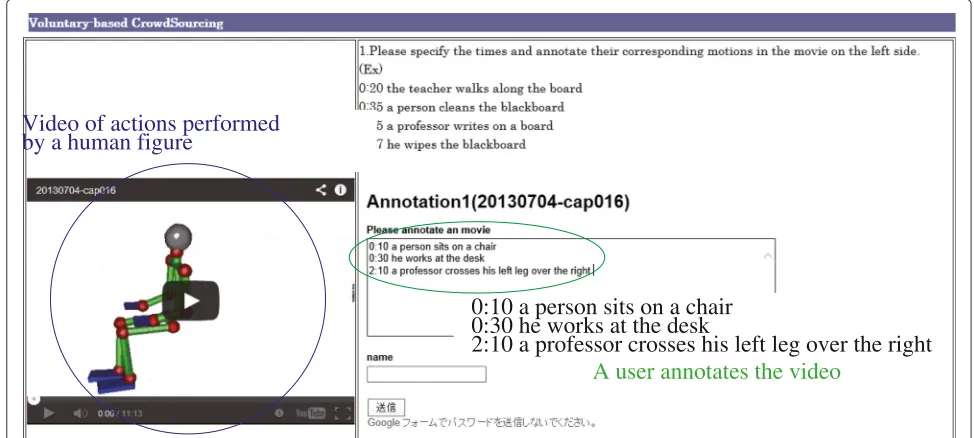
The task of manually assigning descriptive annotation to each motion video was carried out via crowdsourc-ing. In the annotation task, a video, a playback time, and a word representing the subject are presented. The user inputs descriptive text in English corresponding to the motion initiated by the given subject at the speci-fied time. Using this task, a training dataset of motions and corresponding descriptive texts can thus be col-lected. In this study, the annotation task was openly avail-able from our research laboratory’s website as shown by Figure 2. The students and researchers from my depart-ment are allowed to annotate the motions such that
and their corresponding times. This task does not pro-vide a start point and an end point of a motion segment to which the descriptive sentence is assigned. I man-ually detected the start point and end point for each motion segment after the annotation task, and conse-quently obtained datasets of the motion segments and their descriptive sentences.
Learning motions and annotations
A human full-body motion is represented by a sequence of angles of all the joints. Each sequence is encoded into an HMMλ. An HMM is a statistical model used to clas-sify input data into an appropriate category. An HMM is defined by a compact notationλ = {Q,A,B,}, where Q = q1,q2,· · ·,qn
is the set of nodes,A = aijis the matrix whose entriesaij are the probability of tran-sitioning from theith node to thejth node,Bis the set of output probability density functions at the nodes, and
= {π1,π2,· · ·,πn}is the set of initial node distribu-tion. In this study, the parameters of the HMM are opti-mized by Baum–Welch algorithm using its corresponding sequence of the joint angles. Baum–Welch algorithm is
20130705-cap009 20130705-cap010 20130705-cap006 20130705-cap003 20130705-cap008
20130705-cap001 20130704-cap018 20130704-cap019 20130704-cap015 20130704-cap017
20130704-cap016 20130704-cap014 20130704-cap011 20130704-cap013 20130704-cap012
20130704-cap004 20130704-cap003 20130704-cap010 20130704-cap005 20130704-cap002
6:16 5:42 5:09 4:48 1:12
1:15 15:16 15:25 12:28 11:14
1:14 7:55
9:18 10:38
11:14
11:14 11:02 11:44 8:23 1:24
A user annotates the video
0:10 a person sits on a chair
0:30 he works at the desk
2:10 a professor crosses his left leg over the right
Video of actions performed
by a human figure
Figure 2A video containing human activity is openly available.Any user can assign the descriptive annotation to the video on the Internet.
one of the expectation maximization (EM) algorithms [16]. The motion can be classified into its relevant HMM that is the most likely to generate this motion. The motion is expressed by the discrete form of the index of the HMM, and the HMM is hereinafter referred to as a “motion symbol”.
In the annotation task, a descriptive annotation is assigned to each motion symbol. Consequently, a training dataset of motion symbols and descriptive texts is col-lected. More specifically, each training data is a pair of motion symbolλk and a descriptive sentenceωk, where the descriptive sentence is expressed by a sequence of lk words, ωk =
ωk
1,ω2k,· · ·,ωlkk
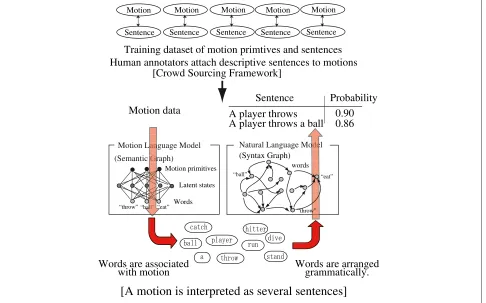
. This paper proposes a statistical model that converts the motion symbol to descriptive sentences as shown by Figure 3 [12]. This con-version results in understanding human full-body motion in the forms of sentences. The statistical model con-sists of two modules. One module learns the probabilis-tic relations between a motion symbol λ and a word
ω. This module is hereinafter referred to as “motion language module”. The other module learns the prob-abilistic relations of transition of two words in a sen-tence. This module is referred to as “natural language module”.
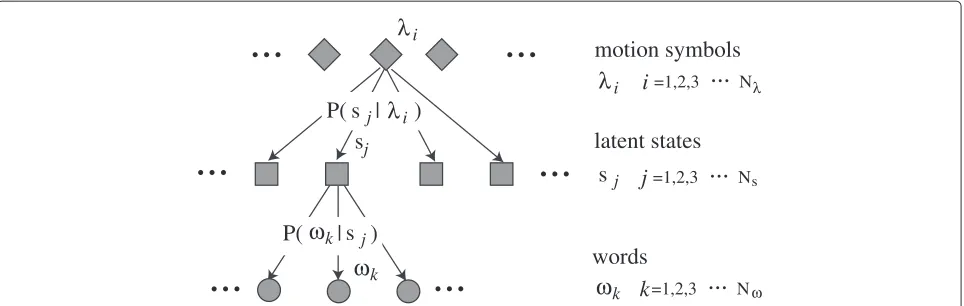
Figure 4 shows an overview of the motion language module that consists of three layers. The top layer includes motion symbols, the middle layer includes latent states, and the bottom layer includes words. A motion symbol generates a latent state, and a latent state generates a word. Association between the motion symbols and the words are represented by a generative model. Probabilistic
relation between the motion symbol and word is repre-sented using the probabilityP(s|λ)that the motion symbol
λgenerates the latent states, and the probability P(ω|s) that the latent statesgenerates the wordω. These prob-abilities are optimized such that the total probability that motion symbols generate the words in the descriptive sen-tences in the training dataset is maximized. The logarithm of the total probability is written as
(θ)=log
k
Pωk1,ωk2,· · ·,ωlk k|λk
(1)
= k
logPωk1,ωk2,· · ·,ωkl k|λk
(2)
= k,i
logP
ωk i|λk
(3)
= k,i
log j
P
ωk i,sj|λk
(4)
Motion Language Model (Semantic Graph)
Motion primitives
Words Latent states
Motion data
A player throws
Natural Language Model
(Syntax Graph)
Words are arranged
grammatically.
[A motion is interpreted as several sentences]
Words are associated
with motion
0.90
Sentenc
e
Probability
d oded odee o o e “eat” “ball” “throw” words
“throw”“ball”“eat” an G G all” Lan Gr G bal e bal e an Gr G bal Lan Gr G bal
Human annotators attach descriptive sentences to motions
[Crowd Sourcing Framework]
Training dataset of motion primtives and sentences
A player throws a ball
0.86
Figure 3Human annotators gives descriptive sentences to the motions.Training datasets of the motions are sentences are used to model the referential structure between the motions and sentences, to model the sentence structures only using sentences. The models are applied to interpretation of motions in the form of natural language.
P(ω|s,θ[t]) respectively. Equation (4) att-th iteration is
rewritten as
(θ[t])=
k,i log
j
Pωki,sj|λk,θ[t]
(5)
= k,i
log j
P
sj|λk,ωik
Pωki,sj|λk,θ[t]
Psj|λk,ωik
(6)
= k,i
logE Ps|λk,ωki
⎡ ⎣P
ωk
i,s|λk,θ[t]
P
s|λk,ωki
⎤ ⎦, (7)
whereEP[R] denotes the expected value ofRgiven the dis-tributionP. According to Jensen’s inequality, Equation (7) satisfies the following relation.
θ[t]≥
k,i E
P
s|λk,ωki
⎡ ⎣log P ωk
i,s|λk,θ[t]
P
s|λk,ωki
⎤ ⎦ (8)
Using Equation (3) and Equation (8), the following equations can be derived.
logP
ωk i|λk
−E
P
s|λk,ωik
⎡ ⎣log
Pωik,s|λk,θ[t]
P
s|λk,ωki ⎤ ⎦ (9) =E P s|λk,ωki
⎡ ⎣log
P
s|λk,ωki
P
s|λk,ωki,θ[t] ⎤ ⎦ (10) =KL P
s|λk,ωki
||P
s|λk,ωkiθ[t]
. (11)
...
...
motion symbols
λ
ii
=1,2,3 N...
λlatent states
s
jj
=1,2,3 N...
sλ
is
j...
...
words
ω
kk
=1,2,3 N...
ωω
k...
P( | )
ω
ks
j...
P( | )
s
jλ
iFigure 4A motion language module learns the probability of a word being generated from a motion symbol.This probability is calculated using the probability of a latent state being generated from the motion symbol and the probability of the word being generated from the latent state.
otherwise. The difference between(θ[t+1])and(θ[t]) is subsequently written as follows:
=θ[t+1]−θ[t]
= k,i
E P
s|λk,ωki
⎡ ⎣log
Pωki,s|λk,θ[t+1]
Ps|λk,ωik
⎤ ⎦
− k,i
E P
s|λk,ωki
⎡ ⎣log P ωk
i,s|λk,θ[t]
P
s|λk,ωki
⎤ ⎦
+ k,i
KL
P
s|λk,ωki
||P
s|λk,ωik,θ[t+1]
− k,i
KLPs|λk,ωki
||Ps|λk,ωik,θ[t]
(12)
The distribution P(s|λk,ωki) is assumed to be estimated asP(s|λk,ωik,θ[t]) based on the motion language model derived att-th iteration, and the third and fourth terms in Equation (12) take a positive value and zero respec-tively. Hence, I only have to search forθ[t+1] such that
the first term in Equation (12) becomes greater than the second term because the incremental update of θ[t+1] increases the total probability of the training data. More specifically, the first term only has to be max-imized by θ[t+1]. Using the probabilities P(s|λ,θ[t+1]) andP(ω|s,θ[t+1]), This maximization can be reduced as follows
arg max
θ[t+1]
k,i,j P
sj|λk,ωik logP
ωk
i,sj|λk,θ[t+1]
−logP
sj|λk,ωik
=arg max
θ[t+1]
k,i,j
Psj|λk,ωki
logPωki,sj|λk,θ[t+1]
=arg max
θ[t+1]
k,i,j P
sj|λk,ωki logP
ωk
i,|sj,θ[t+1]
+P
sj|λk,θ[t+1]
(13)
where the terms independent of θ[t+1] are eliminated. The probabilitiesP(s|λ,θ[t+1])andP(ω|s,θ[t+1])are con-strained as follows:
j
Psj|λ,θ[t+1]
=1 (14)
i
Pωi|s,θ[t+1]
=1 (15)
By applying the method of Lagrange multiplier to Equation (13), the probabilities P(s|λ,θ[t+1]) and P(ω|s,θ[t+1]) at t + 1-th iteration can be analytically derived.
Ps|λk,θ[t+1]
= i P
s|λk,ωik
i,j P
sj|λk,ωik
(16)
P
ωi|s,θ[t+1]
= k
nk,iP(s|λk,ωi)
k,i
nk,iP(s|λk,ωi)
(17)
described above are iterated, and consequently the opti-mal probabilitiesP(s|λ)andP(ω|s)can be derived.
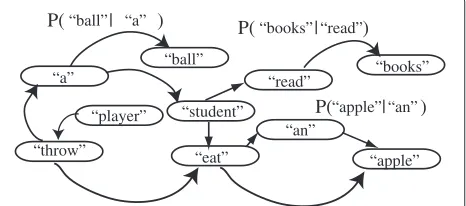
Figure 5 shows an overview of the natural language module. This module extracts the probability π(ω) of starting at the wordωand the probabilityP(ωj|ωi)of tran-sitioning from the wordωito the wordωjusing a training dataset of sentences assigned to the motion symbols. The probabilitiesπ(ωi)andP(ωj|ωi)are optimized such that the probability that the natural language module generates the training sentences. The logarithm of this probability is expressed by
(ϑ)=
k
logP(ωk) (18)
= k
logπω1k+ k,i
logPωki+1|ωki. (19)
whereϑ is a set of probabilitiesπ(ω)andP(ωj|ωi). The optimalϑcan be analytically derived as follows.
π(ω)= c(ω)
i c(ωi)
(20)
Pωj|ωi
= c
ωi,ωj
j
cωi,ωj
(21)
wherec(ω)is the frequency of the sentence starting at the wordω, andc(ωi,ωj)is the frequency of transitions from the wordωito the wordωj.
The conversion from the motion symbol λR to its descriptive sentencesωRcan be treated as the problem of searching for the sentences that are most likely to be
gen-P( | )
“throw”
“ball”
“eat” “a”
“student”
“apple” “player”
“read” “books”
“an” “ball” “a”
P( | )“apple” “an” P( | )“books” “read”
Figure 5A natural language module learns the probability of transitioning between words in sentences.
R
ˆ
ω R
=arg max ˆ
ω P
ˆ
ω1,ωˆ2,· · ·,ωˆl|λR
Pωˆ| ˆω1,ωˆ2,· · ·,ωˆl
(23)
where P(ωˆ1,ωˆ2,· · ·,ωˆl|λR) is the probability that the motion language module generates a set of words
ˆ
ω1,ωˆ2,· · ·,ωˆl
from the motion symbol λR, and P(ωˆ| ˆω1,ωˆ2,· · ·,ωˆl)is the probability that the natural lan-guage module arranges the set of wordsωˆ1,ωˆ2,· · ·,ωˆl
into the sentence ωˆ. Therefore, these two probabilities can be written using the probabilities defining the motion language module and the natural language module.
Pωˆ1,ωˆ2,· · ·,ωˆl|λR
=
i
Pωˆi|λR (24)
Pωˆ| ˆω1,ωˆ2,· · ·,ωˆl
=πωˆ1
i
Pωˆi+1| ˆωi
(25)
whereP(ωˆi|λR)can be calculated asjP(ωˆi|sj)P(sj|λR). Substituting Equation (24) and Equation (25) into Equation (23) and taking the logarithm of it, Equation (23) can be reduced to the following equation.
ωR=arg max
ˆ
ω
i
logPωˆi|λR+logπωˆ1
+ i
logPωˆi+1| ˆωi
(26)
Equation (26) can be efficiently solved using Dijkstra’s algorithm.
Result and discussion
Experiments
a sentence is assigned to by five users, were subsequently collected. The number of different words used in the descriptive sentences was 419. Table 1 shows sample parts of the training dataset of motions and their descriptive sentences.
After learning the motion language module and the nat-ural language module using the training dataset as shown by Table 1, the proposed framework was tested on 100 different full-body motions of human. Each motion is con-verted to five descriptive sentences that are most likely to be generated by both the motion language module and the natural language module. Figure 6 shows the exper-imental result of conversion from a full-body motion to sentences, where a sentence containing less than three words is removed as a candidate sentence. A motion “sit-ting” is converted into sentences “a person sits”, “a person sits down”, “a person sits back” and “he sits down”. A motion “drinking” is converted into sentences “a person is drinking” and “he is drinking”. These sentences were confirmed to correctly represent the full-body motions. A motion “sitting with legs crossed” is correctly converted
into sentences “he is sitting”, but it is wrongly converted into another sentence “he is sitting with his legs”. Addi-tionally, it is correctly converted into a long sentence “he is sitting with his legs crossed”, that is ranked lower than the wrong sentence “he is sitting with his legs”. A motion “writing on a blackboard” is converted into a correct sen-tence “he is writing”, and wrong sensen-tence “he is writing on” and “he is writing a blackboard” that are close to the correct sentence “he is writing on a blackboard”. The sev-eral wrong sentences are terminated at the inappropriate words, and longer sentences are unlikely to be generated. The natural language model needs to be extend to word trigrams such that it represents the relations among words that are distant from each other in the sentences, and the conversion from the motion to the sentence, expressed by Equation (26), should be modified to take into account the length of sentences.
I also quantitatively evaluate the conversion from the motions to sentences. Five users assigned a descriptive sentence to each test motion. The performer and users in this test phase are same as those in the learning phase.
Table 1 Motionsλand Annotationsωin the training dataset
λ ω λ ω
1 a person is sitting 2 a person is sitting
3 a performer is sitting 4 a person is working at his desk 5 a performer is working at his desk 6 a person is sitting in a chair 7 a person is reaching out a hand 8 a person sits back
9 a performer sits back 10 a person crosses his right leg over the left 11 he crosses his right leg over the left 12 a performer crosses his right leg over the left 13 a person crosses his right leg over the left 14 a person is operating a computer with his legs crossed 15 a person is sitting in a chair 16 a performer is sitting with his legs crossed
17 a person sits down 18 a professor sits down 19 a person is sitting in a chair 20 a performer is sitting in a chair 21 he scratches his shoulder 22 he is reading
23 he is relaxed 24 he concentrates on reading 25 he concentrates 26 he puts down his book 27 he puts down 28 he is crossing his left leg 29 he is reading 30 a person is sittiing down 31 he is writing on a blackboard 32 he is checking
33 he is walking 34 he is checking his notebook 35 he is writing on a blackboard 36 he is looking at students 37 he is teaching 38 he is writing on a blackboard 39 he is pointing out 40 he is explaining
41 he plants his arm on his chin 42 he plants his arm on a table 43 he is drinking 44 he is drinking
45 he puts down something 46 he is resting 47 he puts his hands on a table 48 he drinks
a person sits a person sits down a person sits back he sits down
a person is drinking a person drinking he is drinking
he is sitting
he is sitting with his legs he is reading
he is thinking
he is sitting with his legs crossed
he scratches his face
a person is walking a person is walking around he is walking
he is walking around
he is writing he is writing on
he is writing a blackboard
he is writing he is writing on
he is writing a blackboard
he is erasing
he is writing
he is thinking
he is drinking
Figure 6A human full-body motion is converted to multiple descriptive sentences.This conversion make it possible for a humanoid robot to understand observation of the human motion in the forms of sentence.
Each motion that was converted to several candidate sentences, one of which is exactly same as the sentence assigned to this test motion was counted as the correct. The accuracy of the conversion can be computed as a ratio of the correct motions to the test motions. The number of the candidate sentences was varied. In the case that the number of the candidate sentences was set to 1, the accuracy of the conversion was 0.34. The number of the candidate sentences was set to 2, the accuracy of the conversion reached 0.59. Three, four, and five candidate sentences result in the accuracies of 0.64, 0.68 and 0.71 respectively.
Conclusion
The contributions of this paper are summarized as follows.
1. This paper proposes a novel scheme of collecting a training dataset of human full-body motions and their descriptive sentences via crowdsourcing.
Videos containing human activity are made viewable on the Internet. The task of assigning the descriptive annotations to the videos is designed. The task is openly available, and can be carried out by any users. Through this simple task, a training data set of motions and corresponding descriptive sentences can be collected. In this study, there are 621 motions and descriptive sentences with 419 different words in the training dataset.
3. The experiment on the conversion from the human full-body motion to the sentences was conducted using dataset of motions and descriptive annotations derived via the crowdsourcing. I varied the number of candidate sentences converted from the motion. The accuracy of the conversion of 0.34, 0.59, 0.64, 0.68 and 0.71 were obtained from one, two, three, four and five candidate sentences respectively. The experiment shows that the full-body motions are converted to correct descriptive sentences, and demonstrates the validity of the proposed statistical framework for the conversion of the motions to the sentences. Additionally I found several limitations that a long sentence is unlikely to generated, and that many sentences are terminated at the wrong words.
Competing interests
The author declares that he has no competing interests.
Acknowledgements
This research was supported by Grant-in-Aid for Young Scientists (A) (26700021), Japan Society for the Promotion of Science.
Received: 18 August 2014 Accepted: 15 November 2014
References
1. Breazeal C, Scassellati B (2002) Robots that imitate humans. Trends Cognitive Sci 6(11):481–487
2. Argall B, Chernova S, Veloso M, Browning B (2009) A survey of robot learning from demonstration. Robot Autonomous Syst 57(5):469–483 3. Okada M, Tatani K, Nakamura Y (2002) Polynomial design of the nonlinear
dynamics for the brain-like information processing of whole body motion. In: Proceedings of the IEEE International Conference on Robotics and Automation. pp 1410–1415
4. Ijspeert AJ, Nakanishi J, Shaal S (2003) Learning control policies for movement imitation and movement recognition. Neural Inf Process Syst 15:1547–1554
5. Kadone H, Nakamura Y (2005) Symbolic memory for humanoid robots using hierarchical bifurcations of attractors in nonmonotonic neural networks. In: Proceedings of the 2005 IEEE/RSJ International Conference on Intelligent Robots and Systems. pp 2900–2905
6. Ito M, Noda K, Hoshino Y, Tani J (2006) Dynamic and interactive generation of object handing behaviors by a small humanoid robot using a dynamic neural network model. Neural Netw 19(3):323–337
7. Inamura T, Toshima I, Tanie H, Nakamura Y (2004) Embodied symbol emergence based on mimesis theory. Intl J Robot Res 23(4):363–377 8. Asfour T, Gyarfas F, Azad P, Dillmann R (2006) Imitation learning of
dual-arm manipulation task in humanoid robots. In: Proceedings of the IEEE-RAS International Conference on Humanoid Robots. pp 40–47 9. Billard A, Calinon S, Guenter F (2006) Discriminative and adaptive imitation
in unimanual and bi-manual tasks. Robot Autonomous Syst 54:370–384 10. Kulic D, Takano W, Nakamura Y (2008) Incremental learning, clustering
and hierarchy formation of whole body motion patterns using adaptive hidden markov chains. Intl J Robot Res 27(7):761–784
11. Takano W, Yamane K, Nakamura Y (2007) Capture database through symbolization, recognition and generation of motion patterns. In: Proceedings of the IEEE International Conference on Robotics and Automation. pp 3092–3097
12. Takano W, Nakamura Y (2008) Integrating whole body motion primitives and natural language for humanoid robots. In: Proceedings of the IEEE-RAS International Conference on Humanoid Robots. pp 708–713 13. Tuci E, Ferrauto T, Zeschel A, Massera G, Nolfi S (2011) An experiment
on behavior generalization and the emergence of linguistic
compositionality in evolving robots. IEEE Trans Autonomous Mental Dev 2(2):176–189
14. Tuci E, Ferrauto T, Zeschel A, Massera G, Nolfi S (2010) The facilitatory role of linguistic instructions on developing manipulation skills. IEEE Comput Intell Mag 5(3):33–42
15. Howe J (2006) The Rise of Crowdsourcing. Wired Magazine 14(6) 16. Rabiner L, Juang BH (1993) Fundamentals of speech recognition. In:
Prentice Hall Signal Processing Series.
Submit your manuscript to a
journal and benefi t from:
7Convenient online submission
7Rigorous peer review
7Immediate publication on acceptance
7Open access: articles freely available online
7High visibility within the fi eld
7Retaining the copyright to your article