http://www.sciencepublishinggroup.com/j/cm doi: 10.11648/j.cm.20190302.11
Development of a Brake Pad with Environment-friendly for a
Bus
Yunfa Qiao
*, Ronghui Lin, Shuaichao Li
College of Mechanical and Automotive Engineering, Qingdao University of Technology, Qingdao,China
Email address:
*Corresponding author
To cite this article:
Yunfa Qiao, Ronghui Lin, Shuaichao Li. Development of a Brake Pad with Environment-friendly for a Bus. Composite Materials.
Vol. 3, No. 2, 2019, pp. 36-42. doi: 10.11648/j.cm.20190302.11
Received: July 7, 2019; Accepted: July 31, 2019; Published: August 13, 2019
Abstract:
The application of disc brakes on a large bus is more and more. The development of a brake pad with high performance and environmental protection for a bus has important social significance and economic value. The effects of the hardness of friction plate on brake noise was studied experimentally. The results show that the hardness of friction plate has a significant influence on brake noise, the lower the hardness, the more difficult to brake noise. The green raw materials with high quality were chosen, a formula of friction plate was optimized by using quadratic response surface regression mathematics models, a brake pad with environment-friendly was developed. It is verified that the developed one has high stability friction coefficient, low wear rate, and it brakes noiselessly by brake noise and friction performance test. The road experiment for the developed one was carried out. The results indicate that the average service life for the developed one improved significantly, the front wheel by about 59%, and the rear wheel by about 74%, compared with the auxiliary brake pad.Keywords:
Bus, Brake Pad, Formula, Development1. Introduction
Pure electric vehicles have the advantages of small environmental pollution, low noise, high efficiency, convenient maintenance and wide range of use [1-2]. Compared with traditional cars, there is no air pollution. The overall energy utilization efficiency of electric cars is higher than that of conventional fuel cars in cities. At the same time, if electric cars are charged at night to avoid peak electricity consumption, energy waste can be further reduced. Electric cars are generally quiet in operation, especially suitable for urban roads that need to reduce noise pollution. In cities, vehicles must be stopped and started constantly, which means a lot of energy consumption for traditional fuel cars and more exhaust emissions. In the case of electric vehicles, the kinetic energy of the vehicle can be "regenerated" into electric energy and stored in batteries or other energy storage devices through the magneto-electric effect when slowing down and stopping. In this way, when parking, the motor does not have to idle, which can greatly improve energy efficiency and reduce air pollution. Compared with traditional fuel vehicles, electric vehicles are easy to operate, simple in structure, and
have fewer transmission parts to run. There is no need to change the oil, oil pump, noise elimination device, etc., and no need to add cooling water. At present, the imported pure electric vehicles are equipped with energy-saving and low-carbon products such as domestic high-quality electric motors, vacuum tires, LED car lights and CAN bus. Pure electric buses convert the electric energy of lithium batteries into vehicle kinetic energy through traction motors. Compared with conventional internal combustion engines, pure electric buses greatly reduce the cost of vehicle fuel and material use and maintenance, reduce the noise of vehicle operation, and realize zero emission.
Electric bus mainly refers to pure electric bus, which USES electric energy to drive. Such products have low noise, high driving stability and zero emission. Electric bus refers to the bus driven by on-board power, which is equipped with appropriate on-board battery or cable power supply equipment. Electric buses have good power performance, continuous range of 500 km, long battery life (more than two years) and low cost, and are well equipped with the whole vehicle. Vehicles that meet the requirements of road traffic and safety laws and regulations.
to be addressed, hyundai said it would contribute to the solution by developing more environmentally friendly cars.
Pure electric bus has the advantages of environmental protection, low noise and no emission, etc. It can travel up to 150 kilometers after charging for 3.5 hours. Full power, stepless speed change, easy operation, greatly reduce the labor intensity of bus drivers; The comfortable riding environment is praised by the passengers.
400 a new type of pure electric bus not only fashion novel appearance, equipped with advanced hardware, adopts the 4 d whole bearing structure of the aircraft manufacturing technology, electric cars using lightweight body design, matching ZF axle and air suspension system, the "double insurance" design enhance the stability of the runtime, reduced by rough feeling, has the advantages of the comfortable, stable, safe, Qingdao citizens to take public transit can also be treated like enjoy "luxury cars".
In addition, for the first time, these 400 all-electric buses are equipped with a technologically advanced tire pressure monitoring system, which can monitor tire pressure in real time and maintain body balance in spite of such complicated road conditions as rugged, sleet and mud. There is more space inside the carriage, which increases the carrying rate by 20%.
Compared with diesel cars, electric cars have obvious advantages. It adopts the direct drive mode of electric motor, which eliminates the operation of stepping on and off to shift gears and makes driving easier. Without the diesel engine, the noise and odor of electric vehicles disappear, and the "black tail" is completely eliminated, achieving zero emissions. Based on the investigation of byd K9, a pure electric bus operated in some cities, this paper analyzes the operation status of pure electric bus in some cities in China, as well as the bottlenecks and problems to be solved urgently under the current situation of China's pure electric bus marketization, and proposes solutions.
Public transportation, as an important means of urban intensive transportation, and bus, as the main carrier of public transportation, should realize the transformation from traditional powered bus to new energy pure electric bus, it is worth paying attention to from the aspects of energy, environmental protection and economy. Therefore, bus manufacturers, battery manufacturers, bus companies and government departments are actively involved in the development of pure electric buses in urban road traffic system. In August 2012, 4 byd K9 pure electric buses, which were purchased by xi 'an high-tech zone management committee and operated by xi 'an bus company, entered xi 'an city road traffic system for the first time [3]. The line is K204 (byd station - nanmen station), with a single mileage of about 18 kilometers. The table on the right shows the model parameters of byd K9.
Compared with disc brake, drum brake braking force stability is poor, in different road braking force changes greatly, not easy to control; Heat dissipation performance is poor, in the process of braking easy to produce "thermal recession" phenomenon. Therefore, replacing drum brake
with disc brake has become one of the development trends of automobile [4-5]. Before 2012, drum brakes were mainly installed on buses for cost reasons. With the implementation of gb7258-2012 motor vehicle operation safety technical conditions on September 1, 2012, more and more buses are equipped with disc brakes. Brake block is the key safety and wearing part of disc brake, its characteristics not only directly affect the braking performance of the car, but also cause the important factor of brake noise [6-7]. At present, the brake block is mainly developed for the use of cars, the performance of this brake block is difficult to meet the use requirements of large buses. Therefore, it is urgent to develop high-performance, environment-friendly brake blocks suitable for large buses.
2. Large Bus Brake Block Performance
Requirements
The brake block is composed of a metal base plate and a friction plate, which are bonded together by an adhesive, as shown in Figure 1. The friction disc is made of composite material by high temperature and high pressure molding. The friction between the disc and the dual friction produces braking torque, which determines the main performance of the brake block. The main work of developing new brake block is to study the formula and forming technology of friction plate.
Figure 1. The Photos of a brake block.
With the rapid development of the automobile industry, as well as the improvement of people's environmental protection awareness, the requirements for automotive brake blocks are increasingly high, not only to have excellent friction and wear performance, heat resistance, but also to have low brake noise, no pollution and so on. The main performance requirements of large bus brake blocks are:
1)Moderate and stable friction coefficient, generally 0.40±0.05.
2)Wear resistance, long service life. Under normal driving conditions of the vehicle, the service life mileage of the front wheel brake block is 100,000 ~ 120000Km, and the service life mileage of the rear wheel brake block is 30,000 ~ 50000Km.
3. Test Section
3.1. Raw Materials of Brake Block Friction Disc
Brake block friction disc (hereinafter referred to as friction disc) is a composite material composed of three components: matrix, reinforcing material and filler (including friction performance regulator). When choosing friction sheet raw material, besides considering performance and cost, consider whether harmful to human body, environment even.
3.1.1. Substrate
In the friction film, the matrix is a kind of resin adhesive, its function is to bond the reinforcing material and filler together, and play the role of transfer and uniform load, its main performance requirements are good thermal performance and toughness [8].
The traditional friction disc mainly USES phenolic resin as matrix. Pure phenolic resin has poor temperature resistance and high brittleness, so it cannot meet the requirement of high performance friction plate. For this reason, the high performance friction disc mainly USES modified phenolic resin as matrix. Based on the comprehensive consideration of the performance requirements and cost factors of the bus brake block, after several screening tests, the cashew oil modified phenolic resin (PF-6200A, shandong shengquan chemical co., LTD.) was selected as the matrix.
3.1.2. Reinforcing Materials
The reinforcing material is the main bearing component of the friction plate and plays the role of skeleton. Main properties of reinforced materials: (1) sufficient strength; (2) good dispersion and compatibility with matrix binder; (3) suitable hardness, no damage to the dual material and moderate price [9].
The reinforcing materials used by friction plates are mainly fiber materials, including asbestos, steel fiber, organic fiber, glass fiber and aramid. Asbestos is harmful to human health and has been gradually phased out. Other fibers also have a variety of problems, it is difficult to meet the use of high-performance friction plate requirements. Therefore, hybrid fibers have become the development trend of non - asbestos friction sheets. After the experimental research on the binary system materials composed of various fibers and the selected matrix resin, we selected arambra pulp. (DFP-101, Shanghai lanbang industrial fiber co., LTD.), mineral composite fiber (BE-FB050, qingyuan Boer fiber co., LTD.) and paper fiber (230, linyi xinsheng friction material co., LTD.) as reinforcing materials.
3.1.3. Packing
The main function of filler in friction plate is to improve tribological properties, mechanical properties and reduce material cost. In order to develop brake block hardness low, and environmentally friendly. In the packing, it is preferred to choose multi-hole material, material with good toughness and material harmless to human body [10].
Through dozens of fillers and the matrix resin of selected
binary system studies the material, choose brass powder (40 ~ 60 mesh), flake graphite (80 mesh), acrylonitrile butadiene rubber powder (acrylonitrile content 26-40%, 60 mesh), chromium iron ore powder (325 mesh), brown fused alumina (325 mesh), vermiculite (40-60 mesh) and calcined petroleum coke, tire powder (40 ~ 60 mesh) and barite powder (200 mesh) for packing.
3.2. Preparation Process and Test
On the basis of experimental research, the preparation technology of brake block was developed.
Process: batching → mixing → metal plate machining, gluing and drying → cold pressing → hot pressing → heat treatment → mechanical processing → finished products [11].
Main preparation equipment and process parameters: (1) mixing: plough and rake mixer (JF801SJ, electrical and mechanical equipment research institute of geely university), mixing time: 30 min.(2) cold pressing: adopt a four-column hydraulic press (32-200, nantong tiejun machinery co., LTD.), with the blank pressure of 35~45MPa.(3) hot pressing: a four-column hydraulic press (JF60, electrical and mechanical equipment research institute of geely university) is adopted, with a temperature of 165±5°C, a pressure of 20~30 MPa, and two or three times of air venting.(4) heat treatment: electric blast drying box (RW101A, suzhou ruiwei purification technology co., LTD.), temperature: 150°C, time: 3 h; Temperature 180°C, time: 1 h. According to the actual structural size of bus brake block, the friction plate forming mould is designed and manufactured, and the test sample block is prepared according to the above process.
Test: (1) hardness test: electric plastic rockwell hardness tester (xhrd-150, jinan hengsi grand instrument co., LTD.) and gb5766-1996 standards were adopted.(2) brake noise test: vehicle brake inertia test bench (LINK3900, Link company USA) and SAE J2430 standard are adopted, and the brake is the disc brake supporting the bus.(3) friction performance test: adopt constant speed friction testing machine (JF151, wanda machinery co., LTD.) and GB5763 - 1998 standards.(4) road test: swb6115q7-3 natural gas vehicle was used for road test on route 308 of Qingdao bus group.
4 Results and Discussion
4.1. Influence of Friction Disc Hardness on Brake Noise
When the car brakes, the high frequency and the sound of the flute will damage people's hearing greatly, which will seriously affect people's riding comfort. Therefore, brake noise is widely concerned [12] Is one of the difficult problems to be solved in the development of new brake block.
Table 1. Formula of friction plates (wt. %).
formula A1 A2 A3 A4
Phenolic resin 5 8 12 18
The paper fiber 7 5 3 0
Mineral composite fibre 30 30 30 30
Flake graphite 15 15 15 15
barite 33 36 37 37
vermiculite 10 6 3 0
The hardness and brake noise test results of the four samples are shown in table 2.
Table 2. Abrasion of sample pieces and brake noise.
The sample piece Rockwell hardness Number of brake Number of noise
A1 45 HRM 100 0
A2 63 HRM 100 0
A3 78 HRM 100 2
A4 83 HRM 100 6
As can be seen from table 2, the hardness of sample blocks A1 and A2 is relatively low, and there is no brake noise in the test. The hardness of sample A3 is higher, and brake noise appears in the test. The hardness of sample block A4 is the highest among the four, and braking noise appears in the test for many times, indicating that the hardness of friction plate has a significant impact on the generation of braking noise, and will not produce braking noise when it is lower than a certain value. The low hardness of friction disc is beneficial to its fitting with dual brake disc, stabilizing friction coefficient and reducing brake noise [13]. Therefore, the hardness of bus brake block should be strictly controlled under 63HRM.
4.2. Formulation Design and Optimization of Friction Plates
The performance of the friction disc is not only dependent on the raw materials selected, but also related to the ratio of raw materials in the composite materials. The traditional design method of friction disc formula is mainly trial and error method, relying on experience and a lot of tests. This method has the problems of long development cycle, large workload and high cost. Therefore, in recent years, formulation optimization design method has been a hot topic in the field of friction materials.
This study adopted uniform design method to design the
experimental scheme [14]. The software SAS/STAT was used to process the test data, and the quadratic response surface regression mathematical model of the friction coefficient was established. The formula of the friction blade was optimized with the minimum fluctuation value of the friction coefficient as the optimization objective. In addition, supplemented by friction plate hardness optimization formula modification.
4.2.1. Factors and Levels
The components which have great influence on the friction properties and hardness of the friction plate are selected as the factors. According to previous research experience, four components, including cashew oil-modified phenolic resin, paper fiber, vermiculite and nitrile butadiene rubber powder, were selected as factors, and their dosage ranges were shown in table 3. To understand the influence of each component on friction performance, five levels were adopted. Considering the errors in the experiment, the quasi-level method is adopted, even if each level is repeated twice. The 5 levels of each factor and their arrangement are as follows:
X1: 9, 11, 13, 15, 17, 9, 11, 13, 15, 17 X2: 3, 4, 5, 6, 7, 3, 4, 5, 6, 7
X3: 2, 3, 4, 5, 6, 2, 3, 4, 5, 6 X4: 2, 3, 4, 5, 6, 2, 3, 4, 5, 6
Table 3. Compositions and their dosage of friction plates.
Group into said Dosage range
materials symbol (weight percentage) Cashew oil modified phenolic resin X1 9-17
The paper fiber X2 3 to 7
vermiculite X3 2-6
Nitrile butadiene rubber powder X4 2-6
other 57
barite Add to 100
Note: others include mineral composite fiber 26, arambra pulp 3, brass powder 5, flake graphite 6, chromite powder 7, brown corundum 1.5, calcined petroleum coke 2.5, tire powder 6.
4.2.2. Test Plan and Results
Table 4. Experimental scheme (wt. %).
Due to the grain With the No
1 2 3 4 5 6 7 8 9 10
X1 9 11 13 15 17 9 11 13 15 17
X2 5 3 6 3 6 3 2 4 7 5
X3 6 4 2 6 5 4 3 6 4 3
X4 6 6 5 5 4 4 3 3 2 2
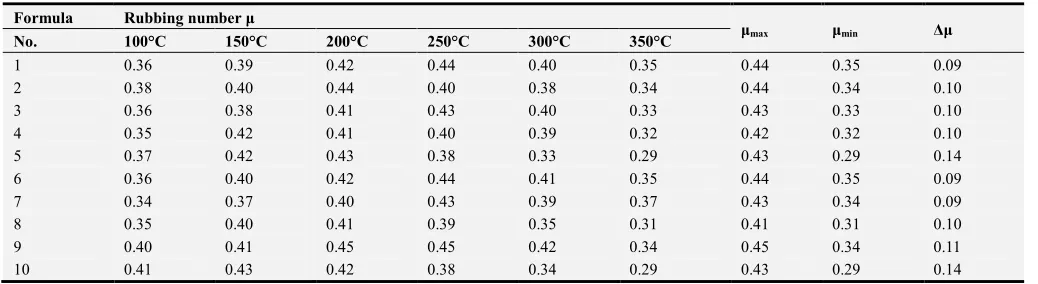
Sample blocks were prepared according to the 10 kinds of friction plate formulas in table 4, and the friction performance test was carried out. The test results are shown in table 5.
Table 5. Friction coefficient and their fluctuated values.
Formula Rubbing number µ
µmax µmin ∆µ
No. 100°C 150°C 200°C 250°C 300°C 350°C
1 0.36 0.39 0.42 0.44 0.40 0.35 0.44 0.35 0.09 2 0.38 0.40 0.44 0.40 0.38 0.34 0.44 0.34 0.10 3 0.36 0.38 0.41 0.43 0.40 0.33 0.43 0.33 0.10 4 0.35 0.42 0.41 0.40 0.39 0.32 0.42 0.32 0.10 5 0.37 0.42 0.43 0.38 0.33 0.29 0.43 0.29 0.14 6 0.36 0.40 0.42 0.44 0.41 0.35 0.44 0.35 0.09 7 0.34 0.37 0.40 0.43 0.39 0.37 0.43 0.34 0.09 8 0.35 0.40 0.41 0.39 0.35 0.31 0.41 0.31 0.10 9 0.40 0.41 0.45 0.45 0.42 0.34 0.45 0.34 0.11 10 0.41 0.43 0.42 0.38 0.34 0.29 0.43 0.29 0.14
4.2.3. Establishment of Regression Model and Formulation Optimization
To 100°C, 150°C, 200°C, 250°C, 300°C and 350°C friction coefficient fluctuation value △µ (△µ=µmax-µmin)
the minimum is the optimization goal, and the formulation is optimized.
Regression model of quadratic response surface was established by SAS/STAT software. The basic principle of establishing the model: assume that the dependent variable and independent variable satisfy the quadratic function relationship, and each independent variable measures more than three different values, then the quadric surface can be
obtained by the least squares estimation method. Let's say some dependent variable Y has m factors of X1, X2, X3,...
Xm, the quadratic response model of dependent variable Y
is [15]:
In the formula, β0,{βi},{βii},{βij} are regression coefficients and ε are random errors.
In this study, Y is the fluctuation value of friction coefficient, X1 is cashew oil modified phenolic resin ratio,
X2 is paper fiber ratio, X3 is the ratio of vermiculite, X4 is
the ratio of nitrile butadiene rubber powder. After inputting the test data in table 5 into the computer and running SAS software, the multivariate regression equation can be obtained:
Y = 0.57326-0.05765 X-0.00728 X2-0.00658 X3-0.04897 X4+ 0.00649 X12+ 0.00052 X22
+ 0.000568 X32+ 0.000899 X42-0.00045 X2X1-0.000132 X2X4-0.00568 X4X 1
Based on the typical analysis of the response surface, the minimum predicted value of Y is 0.045, and the corresponding coordinate is:X1=10.2,X2=4.9,X3=4.6,X4=3.8 for a quick
lining optimized formula % (weight percentage):cashew oil-modified phenolic resin 10.2, paper fiber 4.9, vermiculite 4.6, nitrile rubber powder 3.8, mineral composite fiber 26, arboxylon pulp 3, copper powder 5, flake graphite 6, chromite powder 7, corundum 1.5, calcined petroleum coke 2.5, tire powder 6 and barite 19.5.
In order to lower the hardness of the friction plate and facilitate the application of practical production, the optimized formula ratio is fine-tuned and rounded. The final formula of the friction plate is: cashew oil-modified phenolic resin 10, paper fiber 5, vermiculite 5, nitrile rubber powder 4, mineral composite fiber 26, aramba pulp 3, brass powder 5, flake graphite 6, chromite powder 7, corundum
1.5, calcined petroleum coke 2.5, tire powder 6 and barite 19.
4.3. Bus Brake Block Trial Production and Test
According to the preparation process in 2.2 and the final formula of friction plate, 200 brake blocks were trial-produced, and random sampling blocks were taken from them for hardness, brake noise, friction performance and road tests. In order to compare, the same test was carried out on the brake blocks produced by bus matching manufacturers (hereinafter referred to as matching brake blocks).
4.3.1. Hardness and Brake Noise Test
results are shown in table 6.
Table 6. Abrasion of brake pads and brake noise.
Block type Rockwell hardness (HRM) The number of brake The number of noise
Research 53 100 0
Assort 72 100 2
As can be seen from table 6, the hardness of the developed brake block is lower than that of the supporting brake block, and there is no brake noise in the brake noise test, which is consistent with the research results in 3.1. The brake block has the reason of restraining brake noise, which is mainly attributed to its low hardness. In addition, porous calcined petroleum coke, vermiculite, butadiene rubber with good toughness and tire powder are selected in the friction disc
components. These materials have certain effects of absorbing friction vibration and reducing brake noise.
4.3.2. Friction Performance Test
Test the friction performance of the sample block according to the 2.2 medium test method, and the test results are shown in figure 2.
Figure 2. Friction points of brake pads.
It can be seen from figure 2 that: 1) the friction coefficient of the developed brake block changes within the range of 0.39-0.44, and its fluctuation value is 0.05, meeting the design requirements; The relative error is about 12%. 2) the friction performance of brake blocks developed is far higher than the standard requirements of gb5763-2008. 3) compared with the supporting brake block, the friction coefficient of the developed brake block has low thermal recession, high stability and low wear rate, which indicates that the friction performance of the developed brake block is superior to the supporting brake block and
reaches the advanced level of similar domestic products.
4.3.3. Road Test
The brake block and supporting brake block were tested on DD178 and DD180 of Qingdao bus group respectively. During the test, the brake discs of these two test cars are replaced with matching new brake discs with the same brake pressure. The test is completed when the residual thickness of the friction plate reaches 4mm, and the test results are shown in table 7.
Table 7. Service life of brake Pads and brake noise.
The sample piece type Average service life (ten thousand kilometers) brake
Front rear wheel noise
The trial production 168235 89512 presence Form a complete set of 105691 51367 absence
It can be seen from table 7 that the life mileage of the developed brake block is much higher than that of the supporting brake block. The average life mileage of the front wheel brake block is increased by about 59%, and the average life mileage of the rear wheel brake block is increased by about 74%, which is basically consistent with the results of the sample test. The good
friction performance of brake block is mainly attributed to the optimized formula of friction disc. In addition, the high quality raw materials, such as arylon pulp, nitrile butadiene rubber powder and brass shavings, are selected.
brake noise in the test vehicle installed with the supporting brake block, which was consistent with the bench test results.
5. Conclusion
As the hardness of friction material increases, the frequency of friction material noise during braking also increases. When the hardness of friction material is higher than 63HRM, friction material noise starts to appear during braking. Using the method of secondary response surface, the fluctuation value of the coefficient of friction (△µ) was optimized, and the regression model of secondary response surface was established. The minimum predicted value of △µ was 0.045, and the formula of optimized friction plate was determined. Compared with the supporting brake block, the developed brake block has higher friction coefficient stability and lower wear rate, and its average service life is increased by about 59% for the front wheel and 74% for the rear wheel.
References
[1] FAN Z M, MA Y D ZHANG X W. Study on vibration characteristics of electric vehicle suspension system [J]. Journal of Qingdao university of science and technology (natural science edition), 2019 (04): 98-104.
[2] Rafael Zárate-Miñano, Alberto Flores Burgos, Miguel Carrión. Analysis of different modeling approaches for integration studies of plug-in electric vehicles [J]. International Journal of Electrical Power and Energy Systems, 2020, 114.
[3] Xi'an public transport [J]. Urban public transport, 2019 (04): 68.
[4] WANG G J, LIU W H, SUN K L. Analysis on first-order vehicles in Shanghai [J]. Bus calibers Technology and research, 2015, 37 (4): 53-55.
[5] LI Y P, GONG B L, DU B C, et al. Comparative Analysis of Automotive Brake Pads Thermoforming [J]. Automobile Technology, 2013, (4): 57-60.
[6] WANG H Q, WANG C G, ZHUANG G S, et al. The Application Study of Hybrid Fibers Brake Pad For Railroad Coach [J]. Journal of Materials Engineering, 2013, (7): 56-60. [7] MENG C L, ZHANG Y, YANG S, et al. Experimental Study on the suppression and Noise of steel-free Fiber compression of Material [J]. Noise and Noise Control, 2010, (2): 134-137. [8] ZHANG Z. Application status of friction materials in powder metallurgy and requirements for raw materials [J]. Metallurgical management, 2019 (09): 47+49.
[9] DU M Z. Characteristics and strengthening mechanism of reinforcing fiber nakaiv for drum brake pad [J]. China equipment engineering, 2018 (13): 128-129.
[10] ZHONG L CHEN M Q. Research status and development trend of brake pad friction materials [J]. Synthetic material aging and application, 2017, 46 (06): 84-89.
[11] HAN W W. Design and preparation of high-speed brake copper based powder metallurgy friction material [D]. Nanchang university, 2018.
[12] QIU K P, Analysis and countermeasures of the influence of friction material performance on brake noise [J]. Electromechanical technology, 2013, (1): 101-102.
[13] JIN J S, YANG Y, NIU L J, et al. A new approach to effectively reduce brake temperature and brake noise of brake plate [J]. Locomotive electric drive, 2015, (5): 36-38. [14] FANG K T, Uniform design and uniform design table [M].
Beijing: science press, 1994: 43-78.