Page 316
EFFECTIVE USE OF INNOVATION AND TECHNOLOGY IN HIGHER EDUCATION Anelly Kremenska1, Petya Yaneva2
1Faculty of Biology, Sofia University “St. Kliment Ohridski”, 8 Dragan Tsankov Blvd., 1164 Sofia, Bulgaria
2Faculty of Classical and Modern Philology, Sofia University “St. Kliment Ohridski”, 15 Tsar Osvoboditel Blvd., 1504 Sofia, Bulgaria
Abstract
The article summarizes the achievements of a three-year academia training project of Sofia University and presents the results of an action research conducted to ensure academia training effectiveness. 42 young specialists and post-doctoral academics were trained in 18 specially designed courses in introducing innovative methodology and technology in teaching at university level. The training was based on a specially designed model, combining training in teaching in a foreign language with innovative methodologies and technologies. The results showed that such training is highly successful, appreciated and needed, and, as a result, more than 100 academic blended learning courses were designed. The challenges identified were a need of more fragmentation and specialization of the training, as well as flexible personalized facilitation at the stage of course design and redesign. The most important conclusion was that such training and support should be institutionalized and made permanently available in order to ensure further academia development in the field.
Key words: teacher training, blended learning, higher education
1. INTRODUCTION
Investing in staff training is a leading strategy as human resources are recognized as the most valuable asset for steady growth of each industry, especially in Bulgaria, as the economy and Eurostat analyses show (Euroepean Commission, n.d.) (Yordanova, 2017). It is crucial for the field of higher education as the universities provide working force for all spheres, including school education (Republic of Bulgaria Council of Ministers, 2014) (Jisc, 2015) (Smith, et al., 2013). In response, a number of projects of Sofia University were dedicated to training university lecturers in using cutting-edge educational technologies and methodologies (Sofia University "St. Kliment Ohridski" , n.d.) (Yaneva, et al., 2011).
Page 317
In order to facilitate further dissemination of the achievements, we would like to provide some supplementary information. First of all, we passed through a serious preparation process, during which teams were set up to study good practice (in Bulgaria and abroad) in teaching English, French and German, and other academic subjects using modern information and communication technologies (ICT). They worked on:
a) studying modern pedagogical paradigms and their application to electronic forms to teaching in a foreign language;
b) studying contemporary methods and good practices of teaching in a foreign language;
c) studying theoretical and practical potential of different types of modern information and computer technologies (affordances), and respective techniques they require, in teaching in a foreign language;
d) exploring the necessary academic skills for learning in and through foreign languages with the help of technologies and for professional realization.
As a result of this work, guidelines for achieving common academic skills - pedagogical, technical and communication ones, were created. Furthermore, the experts also reflected on the resources which were necessary to accomplish specific tasks. What was considered was: appropriate databases and information resources for teaching in foreign languages and for studying the methodology of language teaching; electronic textbooks and electronic tools, including these in different languages and for professional purposes; electronic dictionaries (types, application, possible activities with them), including these in different languages and for professional purposes; software for translation support; plagiarism detection software. The resulting guidance was summarized in a compendium "Good Practices in Learning in and on a Foreign Language", which is available as a training material on the project website: http://su.acadlit.uni-sofia.bg/docs/GoodPractices.pdf
The experts also elaborated on a Matrix of Competence of the Electronic Teacher in Foreign Language, and a Matrix of Competencies of the Electronic Lecturer of an Academic Discipline in a Foreign Language. Based on these competencies matrices, the experts formulated criteria for certification of university academic staff in the field of teaching in foreign languages. These criteria were piloted in the first run of the training. Analysis of the results of applying the descriptors and the competence matrix enabled the team to formulate and suggest to be established Standards for academic skills in implementing technology, respective methodology and teaching in a foreign language for higher education. Based on these matrices and respective competencies, 8 training courses of different duration were designed for the initial training: Applied Linguistics, Academic Writing: Citation, Referencing and Documentation (English), Academic Writing and Critical Thinking (Bulgarian), Text Corpora in Philological Practice, Computer Assisted Language Learning, Virtual Learning Environments for learning in a foreign language, Web 2.0 based collaborative writing, and Foreign Language Course Books for Adults (for short annotations of each course please see http://su.acadlit.uni-sofia.bg/docs/annot/annotEN1.pdf). The challenge in designing these courses was the complexity of the training and the diversity of fields of expertise of the trainees, as well as the wide variety of readiness to use technology in their academic practice.
Page 318
well as indirect-beneficiaries’ and external experts’ involvement and activity.
The initial trainings were delivered with the technical support provided by the Faculty of Mathematics and Informatics and the University Center for Information and Communication Technologies, whose computer labs were used for the face-to-face sessions. Next, the necessary equipment was ensured though funding by the project and the training and independent work of the beneficiaries was conducted in a newly redecorated computer lab - 531 on the premises of Sofia University campus bl. 1 at 125 Tsarigradsko shosse Blvd. The lab was equipped with 20 workstations: computers with monitors and peripherals, a router, a switch, respective network, etc. In addition, a website was designed to endure information and documentation availability (Sofia University, Faculty of Classical and Modern Philology, 2015), and a blog of the project was established to facilitate the communication among the project participants (http://su-acadlit.blogspot.com). In addition, 15 tablets were purchased, which were distributed on a competitive basis among the beneficiaries. Last but not least, we provided five data bases accompanied by reference materials (2 pieces each) - Macmillan English Placement Tests, Macmillan English Courses, Macmillan English Teaching Games, Macmillan English Tests, Macmillan English Courses (Elementary Level, Pre-Intermediate Level, Upper Level). These were available through the Macmillan English Campus platform (for 18 months, 50 users per month), which ensured the opportunity of upgrading the beneficiaries' development and self-paced learning. We also bought 52 volumes of books, listed as needed by the beneficiaries, available through the University libraries.
2. CONTEXT
The final stage of the project training consisted of a seminar in Blagoevgrad, face-to-face personalized support for developing own courses and participation in the final conference. The seminar provided intensive training on the different aspects of assessment, and testing in particular (to which the beneficiaries showed higher interest at the second stage of the trainings, see (Kremenska & Yaneva, 2014) (Kremenska, 2015)): Testing in Teaching in a Foreign Language (TTFL), Electronic Testing (ET) and Academic Teaching Techniques (AT). Each of these topics was covered by a dedicated session, all organized as hands-on interaction and collaboration. The seminar also presented an opportunity for the participants to share their achievements as a result of the project, including professional development and designed e-courses. It was held over 5 days, with 16 beneficiaries and 3 experts. The philologists were 1/3 of all participants (please see About the project -> target group (Sofia University, Faculty of Classical and Modern Philology, 2015)).
This stage also featured reporting on the overall results in the other activities, supported by the project: publications, participation in external trainings in leading universities, participation in external conferences, etc.
The organized post-project activities included: gathering once a month for discussions on a topic suggested by external experts or beneficiaries, within the scope of the project goals: methodology of teaching, teaching in a foreign language and using technology in higher education.
3. ACADEMIC STAFF TRAINING: RESULTS AND ANALYSIS 3.1. Feedback on the seminar training
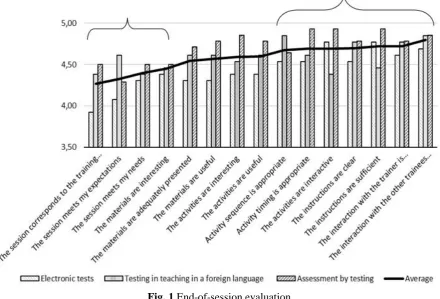
The tool for end-of-session feedback contains 15 closed and 5 open ended questions, with standard 5-grade Likert scale answers. The results for the final training are given in fig. 1, where the columns correspond to the three topics listed above and the line shows the average values for each question. It is evident that these average values vary between 4.25 and 4.75 (of 5) for all questions, which is the area between “agree” and “strongly agree”.
Page 319
relevance, meeting the expectations, and meeting the needs. This can be explained by the fact that the training was delivered by experts – philologists, which, naturally, led to examples from this field. As larger portion of the beneficiaries represented other scientific fields, this relatively lower result could be expected. However, the absolute values of the answers are above 4 (“agree”), which can be interpreted as high appreciation of the training the way it was. The second group of questions scoring even higher (average between 4.5 – 4.6) includes the questions regarding the materials: if they were interesting and adequately presented, and the activities: interesting and well-timed. The scores of the course ET were below this average (about 4.3), TTFL received positive attitude at the average, and AT – above it (about 4.75). The third group is the largest, comprising the rest of the questions, all scoring an average of 4.6 to 4.8. Slightly lower were the answers regarding ET and TTFL, higher were the AT ones. The latter almost reached absolute appreciation for the questions about timing, interactivity and sufficient instruction. The steadily higher values for the training in AT can be explained by the more general orientation of the course in comparison to the other two ones, although all of these were based on examples of teaching languages.
Fig. 1 End-of-session evaluation
The open-ended questions of this questionnaire support the latter suggestion: the practical orientation of the trainings was distinguished as most effective (16 instances, for all three topics), followed closely by the highly interactive presentation (15), and the discussions during the sessions (14). These results show the high degree of involvement achieved, towards sharing and active learning. The following were listed as least effective: the insufficient time for discussions (7) and too few session breaks (3). The beneficiaries also noted the focus on examples from teaching languages as ineffective (6 people highlighted this), especially in the case of ET (which were based on English as a Foreign Language Testing). Although the limitations of such a seminar were distinctly recognized, the participants showed clear desire for even more focused, hands-on training, highly personalized to meet the specifics of their individual contexts.
Page 320
bio data questions, a group of general satisfaction questions, 7 groups of closed questions (using a 5-grade Likert scales), and an open question for general suggestions. The closed questions investigate the participants’ attitude towards the following 7 training aspects; design, goals, independence, general academic skills, workload, delivery and assessment. The bio data distribution from the 11 volunteers, who anonymously answered, corresponds to the characteristics of the whole group of beneficiaries, therefore the results are considered to be representative. The figures below present the results as tendencies based on the average values, for more details please refer to (Kremenska, 2015).
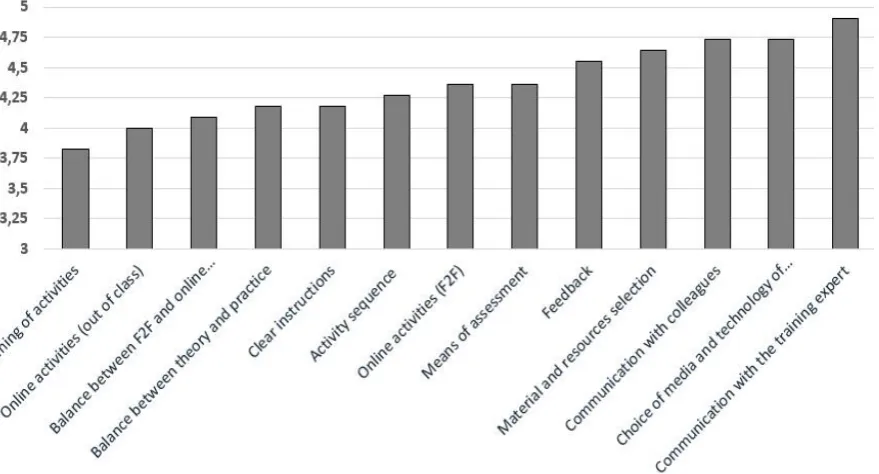
The general satisfaction shows that most questions score high average evaluation, between 4 and 5 (Fig. 2), with only the timing slightly below 4. The online activities for independent work out of class, the balance between these and the F2F activities, the balance between theory and practice, clarity of instructions and activity sequencing gained appreciation between 4 and 4.25. These results can be considered a significant success as all trainings were designed for the first time, some of them were redesigned ad-hock to meet particular demands, and the trainees’ needs and contexts varied greatly. Next are the results for the assessment and online activities for face-to-face (F2F) interaction: above 4.25. Even higher, between 4.5 and 4.75 are the average scores for the feedback received from the trainers, the choice of material and resources, the presenting the latter, and the communication with the colleagues.
Fig. 2 Overall training evaluation
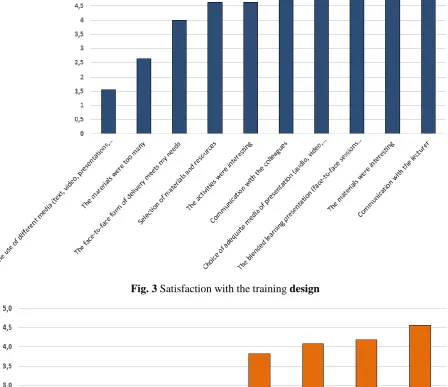
The first group of questions inquires on the participants’ opinion regarding the training design (fig. 3), with two questions asked as negative (the answers are not normalized). It is clear, that the use of different media for presenting the content is very well accepted (the negative question received average values of 1.5, and the materials are not too many (below the neutral point, at 2.6). Meeting the trainees’ needs achieved an average of 4 (“agree”), and the rest of the questions, concerning the choice of materials and resources, the choice of media for presenting the material, the interesting activities and materials, the expert delivery using web based technology, and the communication between the lecturer and the trainees, as well as among trainees, received almost the highest score – between 4.5 and 5 (“absolutely agree”). It can be said that the participants highly appreciate the preparation and delivery, and especially value the interaction with the colleagues and the lecturers.
Page 321
timing of the activities shows appreciation of 3.8 (closer to 4, “agree”); the balance between activities for the face-to-face sessions and the ones for self-study, and between theory and practice is very good (received appreciation at 4.1 and 4.2, respectively); the time given to understand what is taught is ample (4.6). These results prove that the training is well-balanced, with adequate difficulty of the activities and the time allocated for work on them is enough.
Fig. 3 Satisfaction with the training design
Page 322
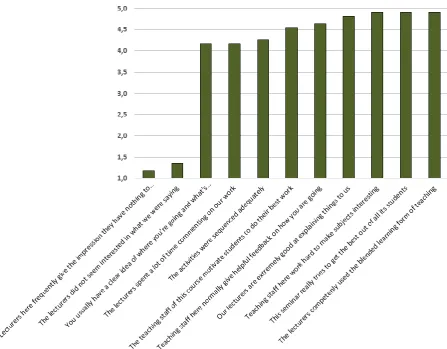
Fig. 5 Opinions regarding the delivery of the training: teaching
Page 323
The next group of questions highlights trainees’ opinion on training delivery (fig. 5): it is definitely not true that the lecturers are not interested in what the trainees would like to share, and that they would not learn from the trainees (received averages at about 1, “strongly disagree”). Next three questions scored at 4.2, which means that the instructions were clear, the feedback received was enough, and the sequence of activities was appropriate. Even higher is the appreciation of the attitude of the lecturers towards motivating the participants and giving relevant feedback (4.6), with closer to 5 (4.9) score for efforts to make the contents interesting, to inspire the participants and to use the technologies to their best. Evidently, teaching is the strong side of this seminar and gained highly positive reaction.
The results from the questions about the skills developed by the training show (fig. 6) that lowest, still well above the neutral point and closer to “agree” scores the written communication skills improvement (3.8). As this was not the goal of the seminar, the result is encouraging since it can be considered as a side-effect of the work. Teamwork and planning achieved much higher average (4.25), problem-solving is at 4.45, slightly below the analytical skill development (4.55), and gaining confidence as the most appreciated skill (4.65). It can be concluded, that the soft skills developed as a result of the seminar were well-accepted and valued, especially in terms of gaining confidence and analysis. The seminar aimed at developing very specific academic skills concerning assessment. That is why these results can be interpreted as very high and prove that the training managed to achieve goals beyond the immediate ones.
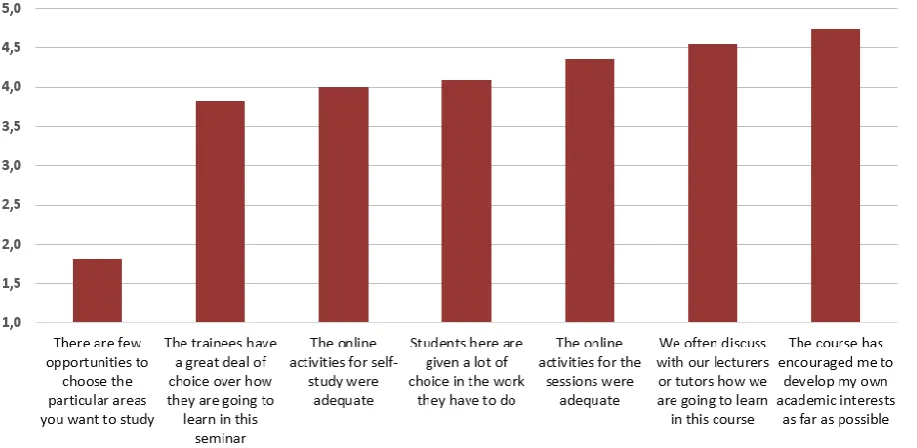
Perceived choice is investigated by the next group of questions (fig. 7), and this group is of great importance for the particular training due to the fact that the trainees are university lecturers, who are in their turn responsible for training students at the highest level of education. It is evident, that the choice of areas of training were appreciated (the negative question scored at 1.8, and the positive one – at 4.1), the activities for the sessions were better appreciated than the ones for self-study (4.4 and 4, respectively), and the development of the personal academic interest received the highest result (4.7). Clearly, the colleagues recognize the chance to choose how to be trained and in what areas, and are highly positive about the resulted training.
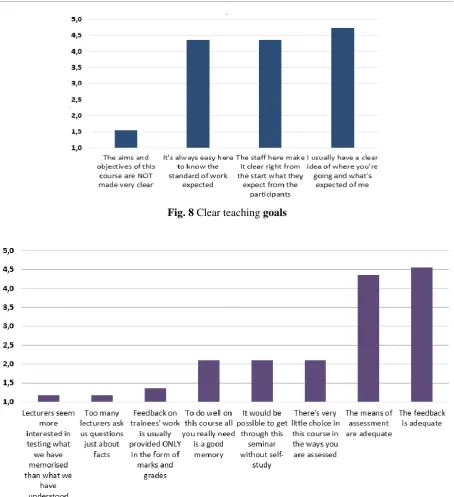
Fig. 8 presents the answers to the questions on how clear were the goals of the training. As far as the participants had actively participated in previous training and other activities of the project, the results can be considered as expected. It is evident that the trainees were well acquainted with the goals and requirements (4.4), with clear idea of what is expected of them (scored 4.7).
Page 324
Fig. 8 Clear teaching goals
Fig. 9 Assessment – perceived adequacy of assessment
Page 325
discussed upon during the training itself. Ultimately, such trainings are well accepted and with results beyond the intended ones; at the same time they support interdisciplinary academia communication and sharing as they involve colleagues from different fields. The benefits from these trainings are discussed in terms of outcomes below.
What cannot be revealed by the diagrams is the change of the beneficiaries’ attitude towards their university activities, and especially towards their work in the auditorium. This is reflected by their narrative reports deposited at the end of the training. Nearly half of them stated that, at the beginning, they did not expect to profit much from the project. They had a rather narrow aim concerning either improvement of their foreign language proficiency, or learning how to work with Moodle. Few of them expected development of their scientific career.
The group of those who wanted to improve their proficiency in a foreign language reported that the course in electronic education had been considered unnecessary. Only after having passed the training in design of university course in electronic environment did they understand that it could lead to innovation in their practices. This resulted in an ambition for creation of e-learning courses of their own – even in fields where it was considered impossible to apply technology.
On the other hand, those who participated in the group where the stress was on electronic education could not see the need of methodology courses at first, and thought them superfluous. Moreover, we had two specialists in methodology in this group. At the end however, they also admitted that the discussions with the other colleagues enriched their knowledge and experience. To demonstrate how the motivation of the beneficiaries changed, we will quote here the comment of one of our best performing participants: “It has been 11 years now since I became a lecturer in the Department of German Studies, and it is for the first time that I reconsider my practice trying to find better ways to teach my students and evaluate their work. I am very grateful to the project for this opportunity”. This, combined with the wish of a great number of former participants to continue their development in the field, is perhaps the most satisfying outcome of the project.
In the sphere of scientific research, two courses proved very productive – Action Research and Theory and Methods of Measuring in Education. They demonstrated the need of a clear preliminary plan, organization, and choice of instruments, to both conduct the research and analyze the results. The introduction in statistics was considered very useful by those who were working on their PhD theses. In accordance with the accepted standards, the participants in the project were certified for the first time and, depending on the acquired knowledge, competencies, and skills, they were divided into three groups:
a) participants who have demonstrated an expert level in teaching in and on a foreign language with modern methods and information and computer technologies;
b) participants who have demonstrated advanced skills in teaching academic courses in and on a foreign with modern methods and information and computer technologies;
c) participants who have acquired basic skills in teaching academic courses in and on foreign languages with modern methods and information and computer technologies.
The issued certificates in this sphere are 42. In addition, 22 certificates of proven proficiency in English or German were issued.
3.2. Participation in project activities
Page 326
Between the first and the second seminar, Open Doors Days were organized, which allowed the first presentations of the courses created by beneficiaries to be made. These were met with enthusiasm and provoked many more to attempt to introduce Moodle and other technologies in their work.
The second seminar with a workshop on “New methods in teaching foreign languages and in foreign languages” was dedicated to meeting the beneficiaries’ newly inspired interests. The participants noted that this flexibility contributed a lot to the success of the project. This event was also of great importance to the dissemination of our achievements among the colleagues from Veliko Tarnovo, where the seminar was held. The lectures evoked multitude of questions and the resulting discussions continued long after the fixed time.
The third seminar was held in parallel to the final Conference (2-3 October 2015). As expected, the highest interest was attracted by the leading expert Prof. Norbert Pachler, UCL, Institute of Education, and his lecture Mobile Assisted Language Learning, delivered as a webinar. The conference was marked by participation of beneficiaries, experts, and guests from different universities. The productive discussions and the feeling of belonging to a community, which shares the concern of high-quality academia education, were an enormous stimulus for the participants in the project.
Two other activities further enriched the beneficiaries’ development:
11 colleagues participated in conferences abroad (all their papers were published);
12 colleagues joined different qualification courses in universities in the UK, Germany, Ireland, and France. This training was 20-25 days long. It is worth mentioning here the courses in which they have participated: International Training Seminar EMLAR / Utrecht University; Modern trends in German Language Learning / Ludwig Maximilian University in Munich; English for Professional Purposes / Oxford House College (4 participants); Creative Methodology / Oxford House College; Vocational Training / Oxford House College; General English Plus (Level 6) (2 participants) / Oxford House College; Conversation / Pronunciation (Level 6) (2 participants) / Oxford House College; English for Professional Purposes / Dublin University (2 participants); German Language and Culture / Martin Luther University in Wittenberg; The Seminars of Prof. Ulrich Feder on Literary Problems / Humboldt University in Berlin; PhD studies and preparation for internal defense of a dissertation / Paris 3 University. In addition to enriching their qualification, this training gave our beneficiaries a pool of new ideas for the different ways of teaching that they shared at the seminar in Blagoevgrad and the final scientific conference.
Both activities were accepted with gratitude since they proved to be important for the career progress of the participants. A very good example is that one of them was devoted to consultations of a PhD candidate with her supervisor abroad.
3.3. Publications
The publication activity exceeded by far the planned project outcomes, which featured 3 monographs. 9 monographs were published, which allowed 6 colleagues to become Associate Professors, and one other to be undergoing a procedure for Associate Professorship. The remaining monographs are participants’ PhD theses and a textbook of Ukrainian for university students.
The beneficiaries also wrote 21 articles. Appropriate places for these to be published were promptly identified: three were released by journals with impact factor, and 4 - in journals with an open access (all of them in the sphere of biology, and all in English). These were an important part of the bibliography, with which 3 more colleagues became Associate Professors.
Page 327 our colleague, presented in 2017.
As a result of this activity, one PhD candidate successfully passed her viva, 2 are in the process of completing their theses, and one specializing colleague applied for a Doctoral Candidate position.
3.4. Participation in sharing good practices
We would like to stress here that we paid special attention to the dissemination of our experience and exchange of ideas with leading universities. The main experts’ activities in this sphere are:
Dr. Anelly Kremenska received an invitation for a guest lecturer at the University College London, Institute of Education, London, where she had a lot of meetings, trainings and presentations. It was a great acknowledgment of our achievements.
Participation in a conference The Magic of Innovation: New Techniques and Technologies in Teaching Foreign Languages in Moscow, 4 and 5 October 2013.
Participation in an e-learning conference “Electronically based forms of distance learning - new
opportunities for lifelong learning”, organized by the National Military University "V. Levski" in
Veliko Tarnovo, 13-14 June 2014.
Organization of a joint workshop with VTU "St. St. Kiril and Metodiy where we discussed with the colleagues our results, and the new challenges before university education. A special lecture was delivered by Dr. Dimitar Iliev from the Department of Classical Philology at Sofia University "St. Kliment Ohridski ". He spoke on the topic of "Humanities in the Digital World".
Participation in a conference organized by the University of Applied Sciences, Berlin, within the framework of the European Thematic Network "The future of education and training: supporting learning everywhere and at any time" (11-12 September 2015).
Chief Assist. Prof. Ekaterina Sofronieva presented the results of our project as a guest lecturer at the University of Rushkin in Chelmsford (UK) in the period from 26.10. Until 29.10. 2015
SWU "Neofit Rilski" invited us to make section Language and Latest Technology within the conference organized by them with international participation Linguistics: History, Challenges, Perspectives (24-27 September 2015).
4. POST-PROJECT ACTIVITY
The post-project activities were focused on organizing regular (once in two months) meetings, with invited external experts and beneficiaries as experts, for sharing and discussions. The goal was to support the established collaboration and provide opportunities for mutual support, which were the most valued takeaways of the project. During these meetings, the colleagues share about increased publication activity, triggered by the research and training during the project. These also served as a base for establishing a Consultancy Centre for Academic Competencies.
Page 328 5. CONCLUSIONS AND FUTURE WORK
To sum up, it can be said that the tendencies identified at the first two stages of the research are conformed in this final stage, characterized by high overall appreciation, scoring between 4 (agree) and 5 (absolutely agree). More than 2/3 of the question average values exceed 4.5, and most valued are the communication with the colleagues and experts, as well as the means of presenting materials (about 4,75). It is evident, that the most successful side of the trainings was the opportunity of exchanging experience with colleagues from different fields, which is strongly supported by the focus group results and the open question answers. It can be stated that the model of training, combining presenting technology affordances with e-learning methodology, and teaching in a foreign language was successful. Based on the extremely positive results, it is evident that the model can be further employed for the case of Sofia University, and it could be of support to other HE institutions.
The researched showed that the initiative of training university lecturers in methodology and using technology was very well accepted, with as many as 100 blended learning courses created as a result. More than 1/3 of the trainees continue creating and maintaining such courses, a year after the project finished. Regular meetings of the project participants, both experts and beneficiaries, support the exchange of good practices, solutions, and talks on innovation in education by invited external speakers. Clearly, such training, providing assistance and support in designing innovative courses in different subjects, is vital for staff development at Sofia University.
Future work is focused on providing further support in the field of e-learning methodology on a functional principle and working towards institutionalizing it as a permanent availability, as well as introducing more new techniques (e.g. providing bite-sized learning opportunities). As redesigning courses to meet contemporary ever-growing demands is an ongoing process, such support is viewed as essential for ensuring high quality and availability of university education. Furthermore, the designed blended learning courses are envisioned to become the core of distance learning programmes, offering a whole new opportunity for university degrees to a wider audience. Naturally, applying for external funding is also planned, as an additional source for further development of the initiative and meeting the substantial costs of impact factor publishing, opportunities for exchanging practices in leading universities, etc.
REFERENCES
Euroepean Commission, n.d. Eurostat. [Online] Available at: http://ec.europa.eu/eurostat [Accessed 17 July 2017].
Georgieva, M., 2015. Designing academic courses in Moodle. Sofia, Poligraphyug, pp. 117-124. Jisc, 2015. Jist Projects. [Online] Available at: https://www.jisc.ac.uk/rd/projects/staff-and-institutional-development-in-fe-and-skills [Accessed 29 March 2017].
Kremenska, A., 2013. Designing Curricula for Language Teacher Training in Computer Literacy. Moscow, MGIMO, pp. 259-263.
Kremenska, A., 2015. Action research on raining specializing, postdoctoral and young scientist for teaching academic courses in and on a foreign language using current methodologies and ICT. Report, stage 2. Sofia: Miliva Ltd.
Kremenska, A., 2015. Action research on raining specializing, postdoctoral and young scientist for teaching academic courses in and on a foreign language using current methodologies and ICT. Report, stage 3. In: P. Yaneva, L. Grozdanova & T. Angelova, eds. Sofia: Miliva, Ltd.
Kremenska, A., 2015. Training for Designing e-Learning Courses in Foreign Languages. Berlin, s.n., pp. 74-79.
Page 329
Republic of Bulgaria Council of Ministers, 2014. National Strategy for Lifelong Learning 2014 – 2020. [Online] Available at: http://www.government.bg/cgi-bin/e-cms/vis/vis.pl?s=001&p=0228&n=5504 [Accessed 29 March 2017].
Ryan, R. & Deci, E., n.d. Self-Determination Theory (Questionnaires, education). [Online] Available at: http://selfdeterminationtheory.org/self-regulation-questionnaires/ [Accessed 17 July 2017].
Smith, R., Kilen, C. & Knight, K., 2013. Using technology to improve curriculum design. [Online] Available at: https://www.jisc.ac.uk/guides/using-technology-to-improve-curriculum-design [Accessed 29 March 2017].
Sofia University "St. Kliment Ohridski" , n.d. Projects. [Online] Available at: https://www.uni-sofia.bg/index.php/bul/nauka/proekti_na_su [Accessed 29 March 2017].
Sofia University, Faculty of Classical and Modern Philology, 2015. Project BG051PO001-3.3.06 - 0045 „Developing the capacity of specializing, postdoctoral and young scientist for teaching academic courses in and on a foreign language using current methodologies and ICT”. [Online] Available at: http://su.acadlit.uni-sofia.bg/ [Accessed 17 July 2017].
Uzunov, B., 2015. Challenges and Ideas on E-Based Courses for Biologists. Sofia, Poligraphyug, pp. 101-108.
Yaneva, P., Kremenska, A. & Hinkovski, S., 2011. Intergation of Current Multimedia technologies in Foreign Language Teaching. Sofia: Sigilla Libri, Iztok-Zapad.