Page 238
CHALLENGES OF COMPANY AND ACADEMIC MENTORS IN WORK-BASED LEARNING
Tsvetelina Petrova, Irena Rashkova
Technical University of Gabrovo, 4 Hadji Dimitar Str., Gabrovo-5300, Bulgaria
Abstract
The present paper considers the challenges facing company and academic mentors when delivering work-based learning and apprenticeship for students following a bachelor degree courses in Engineering. Taking into consideration the existing problems, a solution is provided by a team of company trainers and university lecturers from Bulgaria, Poland and Austria, in the form of an E-Apprenticeship Workshop for Knowledge and Experience Transfer (EAWKET). It aims to build effective cooperation between academic and company mentors so as to successfully deliver WBL and apprenticeship thus sharing knowledge and experience between the world of business and higher education. The content and features of EAWKET are presented in details, as well as the impact on company trainers and university lectures been trained to become successful mentors.
Keywords: WBL, academic mentors, company mentors, E-Apprenticeship Workshop for knowledge and experience transfer, e-train-the-trainer module
1. INTRODUCTION
Being on the brink of the Fourth Industrial Revolution, Industry 4.0, Europe faces radical challenges in relation to its workforce profile. The emerging cyber-physical systems, the Internet of things and cloud computing in the so called smart factory demand knowledge- and skill-intensive jobs, and therefore require highly-skilled employees that combine excellent technical, generic and entrepreneurial competences. It holds true, most of all, for engineers who appear the driving force of innovation and advanced technologies.
According to a number of EU documents there is a shortage of a talented engineering pool, which impedes the march towards Industry 4.0. The skills mismatches are staggering - 40% of EU employers have difficulty finding employees, including engineers, with the skills they need to grow and innovate, which results in hindering EU productivity and excellence. In addition, the youth unemployment, including engineering graduates, in some EU countries is very high. According to a 2015 EMEA survey, in BG “engineers” is the first on the top job list employers have difficulty filling. Furthermore, BG has the second highest skills mismatch in EU.
Young engineering recruits do not meet both employers’ expectations due to lack of industry-relevant and generic skills and needs due to lack of practical and field-specific skills/experience and the application of a multidisciplinary approach. Engineering university degrees are not up-to-date with industry and advanced technologies. On the other hand, there is an insufficient cooperation between businesses and universities and unwillingness on behalf of most enterprises to participate in the development of university engineering curricula that best suits industry demands.
Page 239
Furthermore, both authorities and social partners at local, regional and national level can also undertake initiatives aimed at encouraging the rapprochement between higher education and businesses.
The European project Apprenticeship Cluster for Industry-ready Engineers of Tomorrow (ACIRET) initiated by the Technical University of Gabrovo, Gabrovo Municipality and Mechatronica SC – Gabrovo can be regarded as such an initiative for bringing universities and industries closer together. Taking into consideration the cross-border nature of this problem the project partnership included partners from Poland and Austria – respectively Gdansk University of Technology, Foundation Centre for Educational Excellence and University of Applied Sciences JOANNEUM in order to share ideas and experience.
2. AIMS AND METHODS 2.1. Aims
The projects aims at establishing a new partnership structure between higher education and business which fosters the cooperation between technical universities and machine-building enterprises supported by the authorities and social partners at local and regional level, on the one hand, and offering work-based learning and apprenticeship in the sectors of Mechanical Engineering and Mechatronics in higher education, on the other hand. By means of this structure university and company mentors are able to exchange knowledge, skills and experience thus increasing their mentor’s competences and improving engineering training and education quality.
2.2. Methods
2.2.1. Dual / cooperative study
The work-based learning approach with focus on apprenticeship, also referred to as dual (in German-speaking countries) or cooperative (in the English-German-speaking counties) study, has more than 100 years of history. Its origin can be traced back to 1906 when Herman Schneider, Dean of the College of Engineering at the University of Cincinnaty, USA, invented the cooperative education model. The program generally consists of alternating semesters of coursework on campus and work at a host company, giving students over one year of relevant work experience by the time they graduate.
In Europe the companies Robert Bosch, Standard Electric Lorenz and especislly Daimler Benz JSC were the pioneers of dual study in Germany, the federal state of Baden-Würtemberg. It was Daimler Benz which put forward a suggestion to Baden-Würtemberg’s Ministry of Education to make the higher education more attractive by combining traditional education with practical training. The so called Stuttgart model based on this idea was presented to the public in 1972. The first vocational colleges were founded in Stuttgart and Mainnheim in 1974 putting the Stuttgard model into practice.
In 2009 all professional academies in Baden-Würtemberg combined into Baden-Wuerttemberg Cooperative State University, the first higher education institution in Germany based on the US State University System, which incorporates work-based training and academic studies and, therefore, achieves a close integration of theory and practice, both being components of dual educational system. In 2002 the first dual study program in Austria was launched at the University of Applied Sciences JOANNEUM in Graz. These are the two EU countries which traditionally have the lowest youth unemployment rates.
The dual study approach combines a traditional theoretical phase at the university with a mandatory practical one in the form of apprenticeship in a company which alternates with each other on a regular basis in the form of a block model with a longer theoretical and practical phase duration (a couple of months) or a week block model with a shorter theoretical and practical phase duration (a couple of weeks).
Page 240
extensive practical and professionals skills in a company; being integrated into operational structures, working methods, project flow; having excellent job and career prospects, smooth transition from university to job and earlier start of a professional career.
On the other hand, companies also take full advantage of the dual study approach. They strengthen their cooperation with the world of higher education; tailor engineering university education so as to bridge the skills gap; have easy access to apprentices; implement apprentice projects; develop their own staff; recruit young industry-ready graduates whom they have already known; achieve higher productivity and performance since former apprentices require less training.
Last but not least, universities are the third beneficiary because they offer more attractive dual degree programs; enhance the cooperation between academic mentors and company mentors; improve the career guidance of their students and produce industry-ready professionals.
2.2.2. Mentoring
Mentoring is of vital importance for successfully implementing the dual study system since academic and company mentors are considered to be key actors in ensuring the smooth transition from theoretical to practical phase and vice versa during the dual study.
The origin and meaning of the word “mentor” can be traced back to the Greek mythology. Odysseus had an old friend called Mentor, whose responsibility was both to initiate his son into life and to be his father when Odysseus was absent. In the 1980s the term “mentoring” was taken up again in the USA and came back to Europe. Mentoring describes the relationship between two persons: mentees who are willing to achieve some objectives and mentors who support mentees on this way. Both mentors and mentees should voluntarily and gladly enter into the relationship, confidentially treat the content of all discussions and equally benefit from this. The support could be offered in the form of discussions on a regular basis, specific instructions, knowledge and skill transfer.
Mentoring has proven to be an innovative, efficient and proven tool for supporting the junior staff both during their studies and in their professional life. Within work-based learning there are two places of learning: the university and the company. At both places mentors are needed to support the integration of theory and practice.
However, what is the role of a mentor? What are their specific tasks? How to train them so that they are able to teach and support students during the apprenticeship in companies?
3. RESULTS
Taking into consideration the above mentioned, ACIRET project partnership developed an E-Apprenticeship workshop for experience transfer. It aims to build effective cooperation between academic mentors and company mentors so as to successfully deliver work-based learning and apprenticeships thus exchanging knowledge and experience between business and higher education. On the one hand, company trainers are able to build/improve their teaching competences and generic skills and, on the other hand, the academic mentors are able to enhance their competences in work-placed practices, processes, latest equipment and technologies.
Page 241
The e-train-the-trainer module for company mentors is intended for employees who are willing to become company mentors. It aims to get them aware of the competences a good mentor should possess in order to be successful; different mentoring types and the tasks and responsibilities of a company mentor described in details; cutting-edge mentoring methods so that they can successfully perform their mentoring role and how to teach and work with different generations, taking into consideration their values and attitude to learning, work, technology and communication. It involves four topics:
Profile of a good company mentor
Tasks and responsibilities of a company mentor Mentoring methods and techniques
Characteristics of generations Y and Z – the youngest employees
The aim of the first topic Profile of a good company mentor is to provide company mentors with a basic survival kit how to be a successful mentor. It delivers a definition, determines mentor roles and defines a set of competences (professional, methodological, personal and social) a mentor needs.
Fig. 1. Selected slides of the Profile of a good company mentor Source: www.aciret.eu
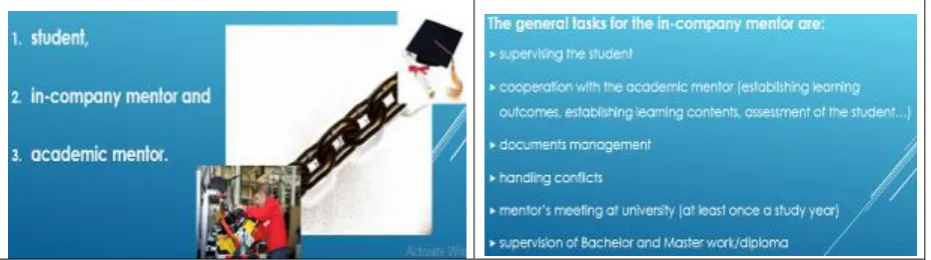
The second topic Tasks and responsibilities of a company mentor offers mentors an insight into what, when and how to do during the apprenticeship. The tasks and responsibilities are presented one after another in their time sequence.
Page 242
The module Mentoring methods and techniques provides company mentors with useful information on three state-of-the-art teaching methods, especially suitable for students completing their practical phase of study in a company. A special focus is placed on the four step method, case study method and project method. A definition, steps, advantages and disadvantages, and situations, where each method should be applied, are presented in details.
Fig. 3. Selected slides of the Mentoring methods and techniques Source: www.aciret.eu
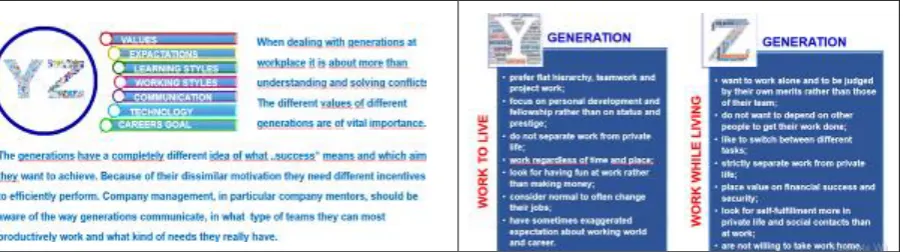
The last module Characteristics of generations Y and Z – the youngest employees is of vital importance when it comes to teaching young people. The demographic change entails four different generations working together in a company. Their expectations and demands towards work and leadership are different for each generation. For a company mentor it is essential to know and consider the differences between different generations. The module presents definitions, main factors shaping both generations, their values, attitude to work, learning, technology and communication and how to successfully manage them at the work place.
Fig. 4. Selected slides of the Characteristics of generations Y and Z – the youngest employees Source: www.aciret.eu
Page 243 Profile of a good company mentor
Company Culture and Organization Machinery and Technology
Company Safety Regulations
Each topic has a general introduction pinpointing the importance of the respective issue for both academic mentors and apprentices, which is then followed by case studies taken from companies offering apprenticeships.
The first topic Profile of a good company mentor is common for both e-train-the-trainer modules since a good mentor should be equipped with a set of skills, knowledge and competences regardless of whether they work in a university or a company.
The second topic Company Culture and Organization provides information on company culture and organization, prior to full-time employment, gets both the academic mentors and apprentices familiar with the business environment they will encounter during apprenticeships. Knowing company structure, values, beliefs, traditions, norms and behaviour patterns in advance, the academic mentors could better communicate them to the potential apprentices so that the latter are well prepared what to expect when stepping into the particular business setting. Being aware of company practices, business lines, main markets targeted, the apprentices may better match their expectations and actions to those anticipated by the company thus resulting in better performance at the work place.
Fig. 5. Selected slides of the Company Culture and Organization Source: www.aciret.eu
Page 244
Fig. 6. Selected slides of the Machinery and Technology Source: www.aciret.eu
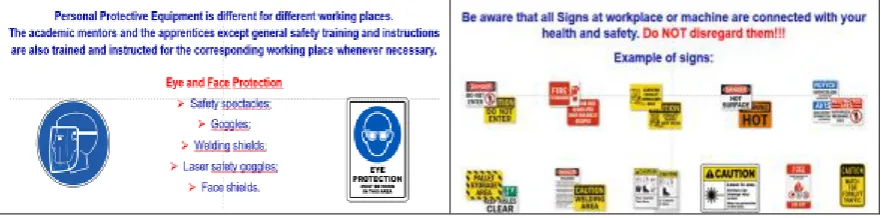
The last module Company Safety Regulations aims to ensure the safety of both academic mentors and apprentices while they are in the company. Lack of knowledge and discipline may result in serious injuries and deteriorated health, especially when working in dangerous environment. Therefore, academic mentors have to be fully aware of company safety rules and transfer that information to the apprentices they are responsible for. Apprentices might be hired as full-time employees in the future. Hence, they are expected to write engineering documentation, including safety regulations, throughout their career path. Being aware of this specific area in advance adds value to their professional portfolio.
Fig. 7. Selected slides of the Company Safety Regulations Source: www.aciret.eu
4. CONCLUSIONS
The E-Apprenticeship Workshop for knowledge and experience transfer is a training tool which provides the academic and company mentors with knowledge and skills which facilitate the interaction between students (apprentices) and mentors and ensure teaching quality. Furthermore, academic and company mentors have the opportunity to exchange ideas, come up with suggestions for improving the training process and learn from each other in the discussion forum integrated in the E-Apprenticeship Workshop.
ACKNOWLEDGMENT
Page 245 REFERENCES
1. European Commission. (2012). Work-Based Learning in Europe. Practices and Policy Pointers.
<http://ec.europa.eu/dgs/education_culture/repository/education/policy/vocational-policy/doc/alliance/work-based-learning-in-europe_en.pdf>
2. Fiacco, F. et al. (2014). Intermediate Report on Work-Based Learning Needs and Gaps. <http://www.erasmusplus.it/wp-content/uploads/2015/07/3_NetWBL_WBL_Needsgaps.pdf>