www.soil-journal.net/1/1/2015/ doi:10.5194/soil-1-1-2015
© Author(s) 2015. CC Attribution 3.0 License.
SOIL
Carbon nanomaterials in clean and contaminated soils:
environmental implications and applications
M. J. Riding, F. L. Martin, K. C. Jones, and K. T. Semple
Lancaster University, Lancaster Environment Centre, Lancaster, LA1 4YQ, UK
Correspondence to: K. T. Semple ([email protected])
Received: 2 June 2014 – Published in SOIL Discuss.: 20 June 2014
Revised: 12 November 2014 – Accepted: 17 November 2014 – Published: 5 January 2015
Abstract. The exceptional sorptive ability of carbon nanomaterials (CNMs) for hydrophobic organic contam-inants (HOCs) is driven by their characteristically large reactive surface areas and highly hydrophobic nature. Given these properties, it is possible for CNMs to impact on the persistence, mobility and bioavailability of con-taminants within soils, either favourably through sorption and sequestration, hence reducing their bioavailability, or unfavourably through increasing contaminant dispersal. This review considers the complex and dynamic na-ture of both soil and CNM physicochemical properties to determine their fate and behaviour, together with their interaction with contaminants and the soil microflora. It is argued that assessment of CNMs within soil should be conducted on a case-by-case basis and further work to assess the long-term stability and toxicity of sorbed con-taminants, as well as the toxicity of CNMs themselves, is required before their sorptive abilities can be applied to remedy environmental issues.
1 Introduction
With the continued upscaling of carbon nanomaterial (CNM) production (Nowack and Bucheli, 2007) as well as the di-verse array of consumer (Sharma and Ahuja, 2008), medical (Peretz and Regev, 2012) and industrial applications in which they are increasingly becoming incorporated, widespread environmental release of these physically and chemically unique macromolecules has become inevitable (Köhler et al., 2008). Once released, soils are likely to be a primary repos-itory (Mueller and Nowack, 2008; Gottschalk et al., 2009), with the quantities anticipated to increase on an annual basis (Gottschalk et al., 2009). In spite of this, studies focused on CNMs within soils are scarce, and many areas of uncertainty remain. Understanding the interactions between CNMs, soils and components therein is therefore an urgent and essential aspect of any risk assessment process.
In their pristine form, CNMs are broadly characterised by their large reactive surface areas, highly hydrophobic characteristics and high degree of biogeochemical recalci-trance. They are known to be toxic to various soil micro-biota (Riding et al., 2012a, b), and possess a high affinity for the sorption of a range of hydrophobic organic compounds
(HOCs), such as polycyclic aromatic hydrocarbons (PAHs), and polychlorinated biphenyls (PCBs) (Pan and Xing, 2010). As both PAHs and PCBs are important classes of hydropho-bic, toxic organic compounds, which are both abundant and persistent in soils (Stokes et al., 2005), the potential for CNMs to modify the availability and mobility of HOCs, ei-ther favourably through sorption and sequestration, or un-favourably through increasing contaminant dispersal, is cur-rently unknown. Presently, there is only limited and occa-sionally contradictory information regarding the implications of contaminants while sorbed to CNMs, as well as the fate and behaviour of CNMs in uncontaminated soils. Exploring these issues in light of the emerging nature of CNMs as xeno-biotic soil components is therefore essential.
2 Carbon nanomaterial diversity and detection
Within the environment, some CNMs can occur naturally or have close naturally occurring relatives due to various en-vironmental events (Heymann et al., 1994; Chijiwa et al., 1999; Velasco-Santos et al., 2003; Esquivel and Murr, 2004). However, concentrations occurring naturally are likely to be relatively small (0.1–0.2 parts per million) (Heymann et al., 1994; Chijiwa et al., 1999). Therefore, when referring to CNMs, this review explicitly focuses on those that are an-thropogenic in origin.
The properties of CNMs vary dramatically between the different methods of production, functionalization status and cleaning/purification methods employed (Nowack and Bucheli, 2007). Hence, determining their environmental be-haviour is all the more challenging, and generalisation of the characteristics of CNMs is not possible, with each type re-quiring careful characterisation (Nowack and Bucheli, 2007). Of the many different forms of CNMs available, this re-view focuses specifically on carbon nanotubes (CNTs) and C60 fullerene, which are two of the most widely utilised and
investigated classes of CNMs (Mueller and Nowack, 2008; Gottschalk et al., 2009, 2010; Petersen and Henry, 2012).
To date, CNTs are arguably the most promising of all nanomaterials produced (Giles, 2006). In their pristine form, CNTs are extremely hydrophobic and consist of graphene sheets rolled into nanoscale diameter cylinders, the ends of which may contain spherical fullerene cappings (Mauter and Elimelech, 2008). One single-rolled graphite sheet is called a single-walled carbon nanotube (SWCNT), while several SWCNTs nested together in a concentric fashion comprise a multi-walled carbon nanotube (MWCNT) (Pan and Xing, 2008). They consist of sp2carbon atom arrange-ments in a fused benzene ring configuration, which results in exceptional physicochemical properties and consequentially their incorporation into a vast array of composite materials (Liu et al., 1999; Snow et al., 2005; Mauter and Elimelech, 2008; Almecija et al., 2009). An excellent and more detailed discussion about the unique physicochemical properties of CNTs is provided by Mauter and Elimelech (2008).
Fullerenes are spherically arranged carbon atoms resem-bling a geodesic dome. The size of the fullerene dome can vary depending on the number and spherical configuration of carbon atoms. C60fullerene (buckminsterfullerene or
bucky-ball) has arguably the best defined physicochemical parame-ters, produced in the largest quantities, and has been the fo-cus of most scientific engagement (Campbell and Rohmund, 2000; Petersen and Henry, 2012). C60 is comprised of a
spherical configuration of 5- and 6-carbon rings, consisting of 60 carbon atoms in total. It commonly exists as nano-C60 (nC60)particles (regarded as the most environmentally
relevant form), which are crystalline structures containing 100–1000 C60 molecules (Colvin, 2003; Sayes et al., 2004).
Presently, fullerenes have proposed applications in biology
(Lucafò et al., 2012) and electronic/optical devices as thin films combined with polymers (Richards et al., 2012).
Unlike most organic chemicals with well-defined struc-tures, the diversity of particle sizes, lengths, diameters, charges, surface areas, coatings, molecular weight, impu-rities and aggregation states are not necessarily constant. These are often tailored to the intended end use of the parti-cles and can be modified by the environmental compartments in which they reside, which limits their detection and charac-terisation in soils and other complex environmental matrices through chromatographic techniques (Petersen et al., 2011). A summary of methods used to detect CNMs within soils and sediments is presented in Table 1.
In addition, as the lifecycles of CNM-containing products are likely to vary greatly, the means by which these mate-rials enter the soil environment are also likely to be highly variable (Pan and Xing, 2012). An excellent review of dif-ferent CNM exposure scenarios, for both humans and the environment, is provided by Köhler et al. (2008). Further complicating their detection is the emerging nature of man-ufactured CNMs as soil xenobiotic components, and hence their presently low concentrations, together with their inter-action with naturally occurring nanomaterials and other en-vironmental components, which leads to particles with sizes and compositions that significantly differ from their native forms (Nowack and Bucheli, 2007; Darlington et al., 2009; Chen et al., 2011). As such, careful consideration of multiple environmental variables is required to determine their impact on CNM fate and behaviour.
3 CNM behaviour and fate within the soil environment
Once released into the soil, the fate and behaviour of CNMs is governed by their interactions with various compo-nents within the environment. Derjaguin–Landau–Verwey– Overbeek (DLVO) interactions, such as electrostatic interac-tions and van der Waals (vdW) forces, and non-DLVO in-teractions, such as hydrogen bonding and steric hindrance, ultimately determine the mobility, aggregation and adhesion of CNMs within soils. These forces may operate in concert to various extents, with the predominating force controlled by factors such as the properties and quantity of soil organic matter (SOM), characteristics of inorganic matter, and the type and quantity of clays, together with the properties of CNMs themselves. Each of these factors are heavily influ-enced by variables that are not necessarily constant over time, such as pH and ionic strength.
3.1 The impact of soil organic matter
T ab le 1. Recent methods used to detect CNMs in comple x en vironmental matrices. Author Method of detecti on CNM type used Matrix characteristics Results Notable adv antages Notable disadv antages Doudrick et al. (2012) Separation of or g anic and ele-mental carbon using thermal op-tical transmittance/reflectance SWCNTs; MWC-NTs Sediment No interference from naturally occur -ring elemental carbon with CNTs that comb usted at high temperatures Interference from elemental car -bon with CNTs that comb usted at lo w temperatures Plata et al. (2012) Thermogra vimetric analysis cou-pled with mass spectrometry SWCNTs Sediment Detection limit of 100 µg g − 1 Capable of distinguishing betwe en nat-urally occurring soot and manuf actured CNMs Schierz et al. (2012) Near -infrared fluorescence spec-troscop y SWCNTs Sediment 62 ng g − 1 Able to dif ferentiate SWCNT s from naturally occurring soot Sobek and Bucheli (2009) Chemothermal oxidation at 375 ◦C SWCNTs; MWC-NTs Clay (v ertisol) and marine sediment Highly v ariable detection of CNTs depending on CNT struc-ture and comple xity of matrix Able to isolate CNTs from matrix Unable to distinguish CNTs from naturally occurring soot
animal remains (Lee et al., 1981)) is an all-encompassing term describing organic matter (OM) dispersed ubiquitously throughout the soil environment, and is composed of a heterogeneous mixture of lipids, carbohydrates, carboxylic acids, humic substances, hydrophilic acids, proteins, carbo-hydrates, hydrocarbons and amino acids. However, the mech-anism by which SOM maintains the CNM stability in sus-pension is still under investigation and debate (Dinesh et al., 2012). Specifically, the aim of this section is therefore to pro-vide an overview of recent investigations in which the man-ner of solid SOM, dissolved organic matter (DOM), humic acid (HA) and tannic acid (TA) influence the behaviour of CNMs.
Adsorption of molecular DOM onto CNMs occurs through either aromatic ring sorption or binding of aliphatic chains viaπ–πor CH–πinteractions, leaving the hydrophilic moi-eties exposed (Lin and Xing, 2008). Consequentially, the surfaces of CNMs significantly change from a hydropho-bic, aromatic-like structure to that of the organic, hydrophilic functional groups in DOM (Zhang et al., 2011a), with poten-tially large implications for other DLVO and non-DLVO in-teractions. In studyingnC60, Kwon (2012) found the type of
DOM-determined suspension stability, with those containing long, hydrophobic carbon backbones readily adsorbing via vdW interactions onto nC60 surfaces, promoting their
sta-bility. However, Zhang et al. (2011a) found that peat (di-agenetically young SOM) in dissolved form (DOM) also prevented MWCNT aggregation through both steric hin-drance and electrostatic repulsion in sodium concentrations
>4 mM or in solutions of pH≥4 (Zhang et al., 2011a). Increasing ionic strength resulted in greater adsorption of DOM onto MWCNTs (Hyung et al., 2006; Hyung and Kim, 2008; Zhang et al., 2011a) due to reduced electrostatic pulsion between the DOM and the particle surface. As a re-sult, cations impairing electrostatic interactions at high ionic strengths in the presence of DOM may slightly shift the rela-tive importance of suspension mechanisms from electrostatic repulsion, in favour of steric hindrance (Zhang et al., 2011a); broadly similar results have been identified withnC60 (Qu
et al., 2012). Ionic strength therefore primarily affects the balance between electrostatic repulsion and steric hindrance mechanisms of particle suspension in the presence of DOM. Typically, frequently occurring cations within the environ-ment (K+, Na+, Ca+ and Mg2+) induce aggregation and deposition in systems devoid of SOM through reductions in electrostatic repulsion between particles, hence reducing CNM stability (Zhang et al., 2012b). The influence of cations on the behaviour of CNMs is well illustrated by the extent to which physical straining (filtering out) of nC60 occurs
in saturated porous media. Zhang et al. (2012a) found that columns of pure quartz resulted in very limited nanoparticle deposition even at low flow velocities, whereas a heteroge-neous sandy soil with low OM content and small, irregular and rough grains of sand, significantly inhibitednC60
was observed in both sand and soil; however, significantly more straining occurred in the soil due to the greater num-ber of complexation sites for Ca2+ clay and OM fractions relative to sand (Zhang et al., 2012a). For both the sand and soil columns, Ca2+ had a much larger effect on the trans-port ofnC60than Na+at the same ionic strengths (Zhang et
al., 2012a). This most likely occurred due to efficient neu-tralisation of surface charges on bothnC60and sand and soil
particles by Ca2+relative to Na+, which reduced the electro-static repulsion (Kuznar and Elimelech, 2004; Zhang et al., 2012a).
When considering the fate and behaviour of CNMs in soils, solid peat may have a different impact to that of molec-ular DOM under environmentally relevant ionic conditions. This could be caused by the alteration of particle-phase dis-tributions due to the direct sorption of CNMs, as well as the possibility of DOM or cations being release from the soil particles themselves (Zhang et al., 2011a). In the ab-sence of sodium ions, Zhang et al. (2011a) found no adsorp-tion of MWCNTs to solid peat, indicating a limited affinity of DOM-MWCNT composites towards the solid phase rel-ative to the aqueous phase, possibly due to electrostatic re-pulsion and hydrophilicity of DOM-coated nanotubes. With the addition of Na+ions, the relative affinity between DOM-MWCNTs and peat was increased due to reductions in the charge potential and subsequent increase in interactions oc-curring through hydrophobic interactions and/or vdW attrac-tion (Zhang et al., 2011a). Zhang et al. (2011a) concluded that with increasing ionic strength (such as in environments containing seawater or hard freshwater), an increased pre-cipitation of MWCNTs from the aqueous phase will occur, impeding their transport within the environment.
Consideration of theζ potential (diffuse surface charge) of CNMs in relation to the soil matrix is important when con-sidering the dynamics of smaller particles’ dispersal, trans-port and deposition, for which charge forces are likely to be highly influential relative to larger particles or agglomerates (Darlington et al., 2009). Its measure, in part, provides infor-mation on the likely mobility, rates of interaction and aggre-gation status due to electrostatic forces generated by charged surfaces (Hu et al., 2005; Jafar and Hamzeh, 2013). Pris-tine CNTs typically express a limited surface charge (Mo-hanty et al., 2007); however, P. Wang et al. (2008) found that theζ potential of CNTs with a HA coating was highly neg-ative, which resulted in electrostatic repulsion between the particles and hence stability when partitioned into the aque-ous phase. They concluded that mobility and environmental transport within typically negatively charged porous media, such as certain types of soils, was highly likely, with par-ticles remaining stable over a wide range of ionic strengths (P. Wang et al., 2008). A reduction in pH to the point at which the CNTs had no charge was identified as an effective means of causing CNTs to precipitate, through the destabilization of the HA coatings (P. Wang et al., 2008).
The properties of the humic substances determine the ex-tent to which DLVO and non-DLVO interactions influence particle behaviour. TA (Chibowski et al., 1998) and HA sorbed to CNTs enhance stabilisation in water through reduc-ing vdW forces between particles and increasreduc-ing steric repul-sion (Terashima and Nagao, 2007; Ren et al., 2011). How-ever, Qu et al. (2012) identified that high molecular weight (HMW) HAs were more effective in promoting suspension stability due to stronger steric repulsion than that of low molecular weight (LMW) HAs. Similarly, HAs containing large quantities surfactive domains, such as those which are strongly hydrophilic and lipophilic, promote the dispersal of CNTs in solutions, while those containing carbohydrates and predominantly hydrophilic domains resulted in limited dis-persal (Chappell et al., 2009).
The composition of SOM in relation to ionic strength and pH dictates the behaviour of CNMs within soils. Presently, however, insufficient data regarding the relative impact of different SOM fractions and combinations on DLVO and non-DLVO forces in soils is lacking, reducing the ability to estimate how CNMs may behave based on analysis of soil OM content. Furthermore, in addition to the organic fraction of soils and coating of CNMs, the role of the inorganic frac-tion in determining particle behaviour must also be consid-ered.
3.2 The impact of soil inorganic matter
of surfactants from solution by clay minerals and (ii) clay minerals bridging between MWCNTs and surfactants (Han et al., 2008).
Furthermore, the charge characteristics of soils can also influence the behaviour and fate of CNMs. Broadly, all soils can be divided into two groups: permanent-charge (P-C) and variable-charge (V-C) soils (Sollins et al., 1988). In P-C soils, the substitution of ions with lower valence for ions with higher valence results in the alteration of crystal lattice structures within layer-silicate clays (illite, smectite, chlo-rite and kaolin) and a permanent charge deficit, which per-sists irrespective of variations in the composition of soil so-lutions and pH (Sollins et al., 1988). In V-C soils, protonation and deprotonation of surface hydroxyl groups results in the positive charge and hence anion exchange capacity (AEC), whereas deprotonation results in cation exchange capacity (CEC) (Sollins et al., 1988). The structure of V-C soils is also modified in response to increasing pH, resulting in in-creased repulsion and more limited aggregation (Sollins et al., 1988). Both P-C and V-C surfaces are present in all soil types; however, only one charge system typically dominates, dictated largely by soil mineralogy (Sollins et al., 1988). While V-C soils occur more frequently in tropical regions due to the typical mineralogical composition which forms under humid, warm conditions, they do not occur ubiqui-tously, and many areas with predominantly P-C characteris-tics occur (Sanchez, 1976; Sollins et al., 1988). Hence, while V-C soils represent a small fraction of global soil types, inter-actions between nanoparticles and soils are likely to be much more dynamic relative to those with a P-C. Despite this, al-most all investigations have predominantly focused on P-C soils, restricting the applicability of CNM fate and behaviour investigations.
The behaviour of CNMs in V-C soils has been assessed by Zhang et al. (2012b), who investigated the stability of MWC-NTs suspended in water containing either kaolinite, smec-tite or shale over a range of sodium concentrations. Without additional Na+, no significant difference in the stability of MWCNTs between each of the soil minerals was observed; however, with increasing ionic strength, the removal of MWCNTs from the aqueous phase followed the order smec-tite>kaolinite>shale (weakest-to-largest MWCNT associ-ation). As ionic strength increased, the MWCNT removal tendency for smectite and kaolinite was inversely corre-lated to the mineral surface potential. However, the elec-trostatic potential of shale is higher than either kaolinite or smectite, yet shale demonstrated the strongest sorption of MWCNTs (Zhang et al., 2012b). This was attributed to the large, hydrophobic, organic content of shale, which is able to strongly sorb MWCNTs. Hence, under these soil conditions, the transport of CNMs in soils is directly correlated with min-eral hydrophobicity, but inversely correlated with surface po-tential (Zhang et al., 2012b). It is therefore imperative that studies of nanomaterial fate and behaviour in soils include detailed information regarding soil mineralogy.
3.3 The impact of CNM preparation methods, functional groups and UV exposure
In addition to the influence of soil type and properties, the properties of CNMs themselves vary greatly depending on an array of parameters. As commercial applications of CNMs will likely employ surface functional groups and a variety of different preparation techniques, nanoparticle properties and behaviour within the environment will become increas-ingly complex (Turco et al., 2011). For example, the physic-ochemical properties of pristinenC60, such as surface charge
and particle size, heavily depend on the method of prepara-tion, with a corresponding impact upon the stability of the nanomaterial (Chen and Elimelech, 2008, 2009; Isaacson et al., 2011). As discussed previously, deposition and aggrega-tion of CNMs in their pristine state is highly susceptible to variations in soil water ionic strength; however, the exact ex-tent of sensitivity is known to vary significantly according to the method of preparation. For example, in an aqueous so-lution, the deposition ofnC60 occurs in NaCl at
concentra-tions of 18 mM when prepared by sonication (100 W probe, 30 min) (Qu et al., 2012) and 30 and 32 mM NaCl when pre-pared by solvent exchange methods (Chen and Elimelech, 2008; Smith et al., 2008). However, most investigations have been conducted in simple solutions of electrolytes using pris-tinenC60and in complex environmental systems (Qu et al.,
2012). As a result, the effects of cation valence on the stabil-ity of CNMs may substantially differ from those in a labora-tory setting.
Typically, agglomeration of CNMs in the presence of di-valent (Ca2+)cations occurs to a greater extent than with monovalent (Na+) cations. However, when exposed to so-lar irradiation,nC60 can undergo surface oxidation and
de-composition (Hou and Jafvert, 2008, 2009), with large im-plications for environmental behaviour and fate (Qu et al., 2012). Following exposure to UV-A (the largest component of UV radiation in sunlight), the oxygen-containing func-tional groups formed onnC60hindered aggregation in NaCl
solutions due to their elevated hydrophilicity and negative surface charge (Hou and Jafvert, 2009). Conversely, neutrali-sation of the negative surface charge on oxidisednC60 due
to interactions with Ca2+ ions when suspended in CaCl2
can result in particle agglomeration (Li and Liang, 2007). This potentially occurs due to the charge screening ability of Ca2+relative to Na+, which reduces the stability of colloids (Li and Liang, 2007). Qu et al. (2012) expanded upon this work through studying the effects of UV-A exposure for ei-ther 20 h or 7 d on the rate of deposition and the attachment efficiency ofnC60onto silica bead surfaces. The stability of
nC60 increased proportionally with increasing UV-A
expo-sure time against aggregation in solutions containing NaCl, which was attributed to the increase in surface oxidation and hydrophilicity (Qu et al., 2012). Furthermore, while the at-tachment efficiency ofnC60 exposed to UV-A for 7 d was
attach-ment decreased following an increase in NaCl concentration to 300 mM. This indicates that stability of nC60-containing
oxygen surface functional groups was attributed to the hydra-tion force and not DLVO forces, which was more significant with the 7 d UV-exposednC60 than either the pristine or the
20 h UV due to the greater hydrophilicity (Qu et al., 2012). In other investigations, surface immobilisation of macro-molecules, such as HAs at environmentally relevant concen-trations, has increased the solubility of C60due to the effect
of steric hindrance caused by the sorbed SOM and a reduc-tion in the hydrophobicity of the nanoparticle surface, pre-venting reaggregation and reducing attachment efficiency (Li et al., 2009; Qu et al., 2012). However, Qu et al. (2012) found 7 d UV-exposednC60had negligible surface sorption of
ei-ther HWM or LMW HAs due to the negative surface charge and elevated surface hydrophilicity. Hence, DOM is likely to be less significant in determining the suspension stability of irradiatednC60(Qu et al., 2012). A similar relationship may
occur due to the formation of oxygen-containing hydroxyl-and carboxyl-groups on MWCNTs due to surface oxidation, which can promote colloidal stability and hydrophilicity of CNTs in addition to inducing alterations to surface charge (Shieh et al., 2007; Smith et al., 2009). This is illustrated by Hu et al. (2005), in which carboxylic acid groups as a result of nitric acid treatment of SWCNTs had high ζ potentials (−28 mV) over a pH range of 2–10, indicating their mod-erate stability in water in contrast to pristine CNTs (Hu et al., 2005). Reduced deposition of pristinenC60occurred on
silica glass beads coated in HMW HA rather than LMW HA due to steric hindrance (Qu et al., 2012). The effect was more pronounced at lower ionic strengths due to electrostatic re-pulsion between charge groups resulting in a more stretched-out conformation of HA molecules (Qu et al., 2012). How-ever, both HMW and LMW HA-coated beads facilitated the deposition of 7 d UV-exposed nC60, with reduced
sensitiv-ity to changes in ionic strength as a result of reduced steric hindrance (due to the compact conformation of HAs at high ionic strengths (∼60 mM)), lower surface potential and in-creased hydrogen bonding between the oxygen-containing groups of the functionalised nC60 and nitrogen and oxygen
groups on the HA (Qu et al., 2012).
Comparatively determining the relative importance of CNM functionalization and ionic strength on CNTs andnC60
behaviour in soils is difficult due to the myriad of differ-ent experimdiffer-ental configurations. To overcome this, Jaisi and Elimelech (2009) used carboxyl-functionalised SWCNTs andnC60(radius of 51 nm) in natural soil columns,
contain-ing 29 % clay and pore sizes of 22 µm, to determine the im-pact of ionic strength on particle transport and deposition. As ionic strength increased (0.03–100 mM), the rate of SWCNT deposition within the soil column also increased, with the observed effect more apparent with divalent cations (Ca2+)
than monovalent cations (K+). Interestingly, whilenC60was
highly sensitive to variations in ionic strength, far lower de-position rates were observed. It was proposed that the
struc-ture and shape of SWCNTs, in particular their large aspect ratio and bulky agglomerated states, in addition to soil par-ticle heterogeneity increased the straining effect and reten-tion by the soil matrix (Jaisi and Elimelech, 2009). Nano-material structural conformation is therefore a further con-sideration in the relative extent to which CNMs will be dis-persed and transported within the soil, withnC60more likely
to experience leaching than SWCNTs under a variety of so-lution chemistries (Jaisi and Elimelech, 2009) within nega-tively charged soil media.
Functionalization status is therefore a fundamental consid-eration to the behaviour of CNMs, resulting in distinct char-acteristics, which significantly modify behaviour in relation to their unfunctionalised counterparts. However, key ques-tions as to the behaviour of CNMs within the environment remain unaddressed; for example, how does the repeated ex-posure of CNMs to weathering cycles within the soil influ-ence their fate and behaviour?
3.4 CNM-contaminant sorption, desorption and mobility in soils
The ability of natural colloids to assist in the transport of or-ganic contaminants has been well documented and reviewed (De Jonge et al., 2004; Sen and Khilar, 2006; Li et al., 2013). Typically, hydrophobic compounds such as PCBs and PAHs have limited environmental mobility due to strong sorption to SOM. Kan and Tomson (1990), however, demonstrated that high concentrations of colloidal materials such as DOM may enhance the transport of hydrophobic compounds such as phenanthrene and naphthalene by a factor of 1000 or greater, with possible implications for the spread of con-tamination and groundwater quality (De Jonge et al., 2004). Although CNMs may be tailored to suit specific require-ments, their behaviour is not necessarily different to colloids naturally occurring in the environment (Colvin, 2003; Lead and Wilkinson, 2006). To determine the relevance of natural nanoparticle-facilitated transport of contaminants in porous media such as soils, Kretzschmar et al. (1999) identified four key factors that will be used as a framework for this section:
1. sufficiently high concentration of nanoparticles
2. mobility of the nanoparticles carrying sorbed HOCs
3. sorbate toxicity even when present in trace quantities
4. the ratio of sorption to desorption relative to the timescale of particle mobility.
emerging materials to become widespread in the soil environ-ment, particularly those with a strongly hydrophobic nature and large reactive surface area such as CNMs, raises ques-tions and concerns about the environmental consequences of their release (Pan and Xing, 2010).
3.5 CNM contaminant sorption and desorption in soils
Understanding the adsorption and desorption of HOCs to CNMs in soils is critical to the environmental risk assess-ment processes, as well as determining their potential appli-cations as environmental adsorbents (Yang et al., 2006a). As the fundamentals of CNM-HOC sorption have been exten-sively reviewed, the reader is referred to a review by Ren et al. (2011) for a comprehensive overview. This section ad-dresses the manner in which soils may alter the HOC sorp-tion/desorption properties of CNMs, focusing specifically on two conflicting effects: (i) CNM dispersal by DOM (increas-ing the surface area and hence the number of adsorption sites; Hyung et al., 2006; Lin and Xing, 2008), versus (ii) the for-mation of CNM-DOM coatings (blocking and/or competing for adsorption sites reducing the number available for organic contaminants (Chen et al., 2008; Wang and Keller, 2009; Cui et al., 2011; Wang et al., 2011; Zhang et al., 2011)). The rel-ative importance of these two phenomena is poorly under-stood in relation to their sorption and desorption of organic contaminants (Zhang et al., 2011; Pan and Xing, 2012), and it is highly dependent on both the nanoparticle properties, as well as the nature of SOM and the sorbate (Wang et al., 2009; Zhang et al., 2011; Lerman et al., 2013).
In assessing the impact of OM on CNM sorption in the environment, further complications arise as contaminants are able to sorb to both the CNM and CNM-OM coating (X. Wang et al., 2008). Hyung and Kim (2008) identified that SOM adsorption to nanotubes was highly variable de-pending on the type of SOM, occurring proportionally to its aromatic carbon content. This has implications for determin-ing the ability of CNMs to sorb organic compounds, yet most investigations fail to consider the role of different OM frac-tions in CNT-pollutant interacfrac-tions (Lerman et al., 2013).
X. Wang et al. (2008) assessed the extent to which HAs and peptone altered the sorption of phenanthrene, naphtha-lene or 1-naphthol onto MWCNTs (outer diameter of 40 nm), by fitting sorption data with Freundlich and Polanyi models. Their results showed that each type of DOM resulted in non-linear sorption isotherms to the MWCNTs, following the or-der peptone>HAs. Although the inherent sorptive ability of HA for each of the contaminants was more limited than that of pristine MWCNTs, HA coatings did not result in large changes to the sorption of any of the contaminants, which is inconsistent with models indicating that “fouling” of sorp-tion sites by DOM will reduce contaminant sorpsorp-tion capacity (Carter and Weber, 1994; X. Wang et al., 2008). The authors proposed that either uneven coating of the MWCNT by HA occurred, or that the anticipated sorption reduction as a
re-sult of polar moieties from the HA coating was offset due to the increase in O-containing moieties resulting in particle re-pulsion and dispersal, exposing new sites available for HOC sorption. Contrastingly, peptone, due to the large quantity sorbed relative to each of the other DOM fractions, resulted in the largest reduction in available sorption sites (X. Wang et al., 2008). Similar interactions as to the relative ability of dif-ferent OM coatings to alter CNM sorption have been identi-fied by Cui et al. (2011) and Gai et al. (2011). Although direct comparison of the studies is not possible due to the different particles used, Cui et al. (2011) found HAs, TAs and pep-tone pre-interacted with SWCNTs resulting in the formation of polar functional groups on the nanotube surface, reducing the area available for phenanthrene sorption in the order of peptone>TAs>HAs. Similarly, Gai et al. (2011) identified a reduction in C60agglomerate sizes due to the dispersal
ef-fects of HA, increasing atrazine sorption due to dispersal and rearrangement, rather than interactions between the atrazine and HA (Gai et al., 2011). Hence, it may be argued that the impact of DOM on CNM-HOC sorption is dependent on the type of OM present and possibly also CNM type.
Within a soil environment, Li (2012) identified the sorp-tion behaviour of naphthalene, phenanthrene and fluorine in a sandy loam soil, silt loam soil and Ottawa sand was unaf-fected following amendment of MWCNTs at concentrations of 2 mg g−1. For each contaminant investigated, sorption in both the MWCNT-amended and -unamended samples fol-lowed the same order, silt loam>sandy loam>sand, indi-cating the sorptive ability was driven by the organic carbon content (Li, 2012). Additionally, no difference between sorp-tion isotherms of MWCNT-amended and -unamended sam-ples was apparent, indicating that MWCNTs held no influ-ence over the sample’s inherent sorption capacity (Li, 2012). Similarly, the order in which PAHs sorbed was unaffected by the MWCNTs, occurring as anticipated according to the PAH’sKowvalues (Li, 2012). After 24 h of
at 2 mg kg−1, it was not possible to consider the desorption
of contaminants if transport were to occur.
An excellent study by Towell et al. (2011) assessed the extent to which HPCD extraction of HOCs with different physicochemical properties desorbed from soils amended with CNMs at concentrations between 0.05 and 0.5 % (sub-stantially larger than that employed by Li, 2012). At con-centrations≥0.05 %, Towell et al. (2011) identified signif-icantly less 14C-B[a]P extracted from CNM-amended soils than14C-phenanthrene due to the high hydrophobicity and a logKowvalue reducing the ability of14C-B[a]P to partition
into the aqueous phase. This was exacerbated by the rela-tively HMW of14C-B[a]P, which has been proven as a criti-cal factor determining the bonding energy between SWCNTs and PAHs (Debnath et al., 2008; Towell et al., 2011). In rela-tion to factor 4, the nature of the sorbate may therefore influ-ence the extent of desorption, and therefore the duration for which contaminants will remain sorbed. It may be proposed that CNM-sorbed HMW HOCs represent a greater risk of increased distance of transport within the environment than LMW HOCs.
While sorption of HOCs to CNMs in soils can occur, the extent of sorption and desorption is dependent on the type of OM and concentration of CNMs. With a view into the man-ner in which the properties outlined above potentially facil-itate the transport of contaminants sorbed to CNMs in soils, studies in which mobility has been directly investigated will also be discussed.
3.6 CNM-HOC mobility
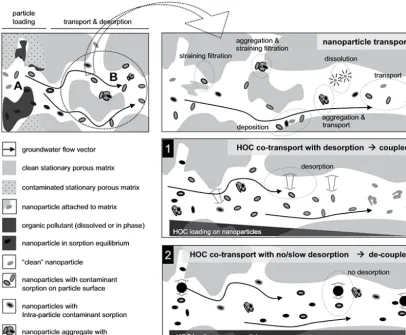
Once sorbed to freely suspended CNMs within the soil ma-trix, the mobility of HOCs is potentially increased; however, very few studies have focused on determining the impact of CNMs on contaminant movement in soils. An overview of the basic principal of CNM-facilitated HOC transport is pre-sented in Fig. 1. Using column leach tests, Li (2012) ex-amined the behaviour of phenanthrene, fluorine, naphtha-lene and pyrene in a saturated sandy loam soil amended with MWCNTs, functionalised MWCNTs (f-MWCNTs) and functionalised SWCNTs (f-SWCNTs) at a concentration of 5 mg kg−1. Significant retention of PAHs within the soil col-umn was observed, due to the strong sorption of contam-inants by CNTs and their limited mobility within the soil column (Li, 2012). In control soils and those amended with MWCNTs and f-MWCNTs, retention of PAHs occurred in the order naphthalene<fluorine<phenanthrene<pyrene, with hydrophobic interactions between the CNTs and PAHs cited as the predominant cause of the observed pattern (Li, 2012). Contrastingly, retention of contaminants within soils amended with f-SWCNTs occurred in the order of naph-thalene >fluorine>phenanthrene>pyrene, the sorption of which could not be accounted for by hydrophobic forces alone (Li, 2012). The trend was negatively correlated to molecular size, indicating that larger sorbate molecules may
have less space for sorption due to the additional hydrophilic functional group (Yang et al., 2006b; Li, 2012). It was con-cluded that leaching behaviours were determined by physical characteristics of both CNTs and contaminants (Yang et al., 2006b; Li, 2012).
To determine the extent to which CNMs facilitated the movement of contaminants relative to various types of DOM, Zhang et al. (2011b) used saturated, sandy soil columns contaminated with either PCBs or phenanthrene to comparatively assess the mobilising ability of nC60 at
1.55–12.8 mg L−1 relative to DOM at 10–11 mg L−1. In this experiment, PCB (12.4–13.9 µg L−1) or phenanthrene (14.8 µg L−1)was added to a sonicated suspension ofnC60
(1.55–12.8 mg L−1in electrolyte solution of 0.5 mM NaCl), and tumbled end-over-end (3 rpm) for 7 d to reach adsorp-tion equilibrium. The suspension was then added to the columns. The results showed that even the lowest concen-tration ofnC60 significantly enhanced the dispersal of both
PCB and phenanthrene, whereas columns containing only various types of DOM had no effect on contaminant trans-port (Zhang et al., 2011b). The enhanced contaminant mo-bilisation ability ofnC60relative to naturally occurring DOM
was attributed to its unique porous structure and surface en-thalpies of interaction, which generate a large sorption affin-ity together with an irreversibly or slowly desorbable frac-tion of adsorbed phenanthrene/PCBs (Hofmann and von der Kammer, 2009; Zhang et al., 2011b; Wang et al., 2012a). CNMs may therefore be much more efficient at enhancing the mobility of contaminants than natural colloidal materi-als.
Different processes of nC60 formation have also been
identified as contributing to large differences in their ability to alter the fate and transport of contaminants (Wang et al., 2012b). Wang et al. (2012b) assessednC60samples prepared
using either the standard solvent exchange method, eight dif-ferent types of SOM or surfactant modifications, or by the phase transferring ofnC60from a solution of toluene to either
SOM or a surfactant (Wang et al., 2012b). Their results in-dicated that while the mobility ofnC60 was similar between
each of the preparation methods, the contaminant mobilising capability significantly differed. Relative to the unmodified
nC60, transport of PCBs through a saturated column of sandy
soil increased by 42.2–227 % with surfactant-modifiednC60,
and by 233–370 % with SOM-modified samples (Wang et al., 2012b). The results were attributed to both increased adsorp-tion affinities and enhanced resistance to desorpadsorp-tion due to alterations tonC60 aggregation properties as a result of the
SOM surfactant (Wang et al., 2012b). During the process of aggregate formation, it is possible that a fraction of SOM or another surfactant was intercalated within the C60
aggre-gates, significantly influencing the porosity and geometry of the resultingnC60 aggregates, contributing to the enhanced
Figure 1.“Worst case scenario” processes by which CNMs may facilitate the transport of HOCs. Top-left panel: (A) HOC equilibrates with CNM and is (B) transported. The top-right panel shows the processes by which CNMs may be transported. The centre-right panel (1) shows the transport and rapid desorption of HOCs from CNMs. Equilibrium is achieved between the liquid phase, CNM and matrix. The bottom-right panel (2) shows slow desorption kinetics, with no desorption from the CNM (Hofmann and von der Kammer, 2009). Re-printed with permission from Elsevier©2014.
nC60 could be tailored to specific physicochemical
proper-ties for use in in situ site remediation (Wang et al., 2012b). Hence, the adsorption, desorption and transport of contami-nants bynC60 will vary greatly depending on the condition
of its formation (Wang et al., 2012a).
Using a different approach, Hofmann and von der Kam-mer (2009) computer modelled the extent to which CNMs could result in the movement of HOCs in soils under various scenario-based conditions, to determine when relevant CNM transport of sorbed HOCs might occur. Worst-case scenar-ios were adopted, assuming fully mobile CNMs within the porous medium, over a range of realistic yet high CNM con-centrations (100 mg L−1–1 g−1)occurring in aggregate sizes of 10–100 mM. It was also assumed that CNMs were pre-equilibrated with the HOC at source and that diffusion was the rate-limiting step for desorption (Hofmann and von der Kammer, 2009). From this, it was possible to estimate the fraction of contaminants bound to CNMs at different dis-tances from the source over different time periods (days to
years) using the Streamtube Model for Advective and Reac-tive Transport (SMART) (Finkel et al., 1998), combined with the application of retarded pore diffusion approximations (Bold et al., 2003) and combinations of two first-order rate expressions (Cornelissen et al., 1997). The results showed that for aggregates of 100 mM, 2, 7, 40, 75, and 82 % of bound contaminants were transported>1 m at nanoparti-cle concentrations of 0.1, 1, 10, 100, and 1000 mg L−1, re-spectively. Conversely, modelled transportation of contami-nants sorbed to aggregates of 10 mM in size were reduced to 0.1, 0.5, 3.6, and 8 % for the same respective concentra-tions. Breakthrough of the 1 m modelled column did not oc-cur in any of the considered scenarios and all contaminants remained bound to the nanoparticle.
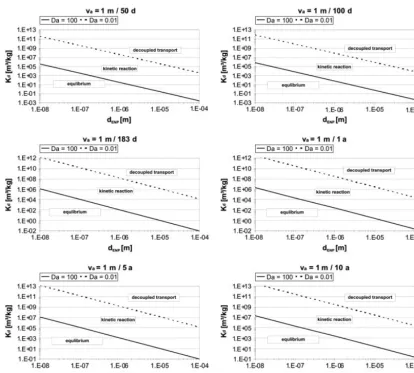
Parameterisation of the ratio of desorption to sorption and particle transportation is achieved by the Damköhler number (Da) (Eq. 1) (Jennings and Kirkner, 1984), which was em-ployed to simulate the HOC desorption from CNMs.
where DaNP is the Damköhler number for the NP, λ the
rate constants (first order) for the reaction (s−1), and s
the average residence time within the system, which may also be expressed as average flow velocity (Hofmann and von der Kammer, 2009). A ratio of 0 identifies equilibrium between particle-contaminant interactions, whereas 1 indi-cates a decoupled transport (i.e. the HOC in the solution will be transported independently of contaminants sorbed to the CNM) and <0.01 indicates fully decoupled transport. In these instances, HOCs sorbed to CNMs will not desorb over the transportation time frame, but rather relocate within the media (Hofmann and von der Kammer, 2009). At Da numbers>100, an equilibrium exists between the immobile porous media and mobile CNM (Kretzschmar et al., 1999; Bold et al., 2003), resulting in limited nanoparticle relocation of the contaminant (Hofmann and von der Kammer, 2009).
Hofmann and von der Kammer (2009) calculated Damköhler numbers for CNM aggregates of different sizes and partitioning coefficients according to the rate constant data shown in Fig. 2, and based on different flow velocities of 1 m in 50 d (fast flow)–1 m in 10 years (slow movement). It was inferred that the CNM-contaminant transport mecha-nisms are strongly dependent on the size of CNM agglomer-ates together with the distribution coefficients (logKd)
(Hof-mann and von der Kammer, 2009). For example, Fig. 2 shows contaminants sorbed to 1 mM aggregates at a flow velocity of 1 m 50 d−1will not experience contaminant desorption until the log Kd of HOC CNMs is 8 m3kg−1, reaching
equilib-rium at log Kd 1 m3kg−1(Hofmann and von der Kammer,
2009). However, at a flow velocity of 1 m yr−1, decoupled transport will predominate for 1 mM aggregates at a logKd
of 9 m3kg−1 reaching equilibrium at log K
d of 2 m3kg−1
(Hofmann and von der Kammer, 2009). It was concluded that under equilibrium sorption/desorption conditions, CNM mo-bility resulted in negligible transport of sorbed contaminants (Hofmann and von der Kammer, 2009). However, the mobil-ity and concentration of CNMs becomes increasingly impor-tant in instances with slow to very slow desorption (Hofmann and von der Kammer, 2009). While there are many assump-tions and simplificaassump-tions associated with every modelling technique, the model identifies scenarios in which transport and desorption of sorbed contaminant could potentially oc-cur, possibly providing useful guidelines for risk assessment if applied on a case-by-case basis. However, further work aimed specifically at validating the model against traditional column leach tests in both V-C and P-C soils and additional desorption kinetics are urgent prerequisites.
From the above discussion, it can be concluded that each of the four factors identified by Kretzschmar et al. (1999) for significant transport of contaminants by CNMs have been met. However, more work examining the subsurface trans-port of CNMs through well-defined soils of various types (such as clays, peats and silts) and CNMs with a variety of functional groups, sizes and sorbed compounds in both saturated and unsaturated conditions are required (Jaisi and
Elimelech, 2009; Petersen et al., 2011). Of studies that are available, variation in experimental conditions between the investigations renders comparisons of the efficiency of con-taminant mobility between CNM types tentative until stan-dardised comparative testing is conducted. Additionally, the molecular weights and sizes of CNMs may not be constant during their transport within the soil environment, due to their physical, chemical or biological interaction with soil components, which will likely influence their aggregation status, shape, surface charge (Pan and Xing, 2012), and pos-sibly also their ability to sorb and mobilise contaminants over long timescales. Furthermore, definitive data of the des-orption kinetics of HOCs from CNMs in soils are essen-tial to understanding their ability to transport contaminants (Ibaraki and Sudicky, 1995; Choi and Yavuz Corapcioglu, 1997; Corapcioglu et al., 1999; Bold et al., 2003; Hofmann and von der Kammer, 2009), with slow desorption identi-fied as a critical requirement (Roy and Dzombak, 1998). The lack of experimentally derived desorption kinetic data from a range of soil types and conditions makes determining the ex-tent to which HOC sorption is strong enough and desorption slow enough to allow CNMs to transport sorbed HOCs, and the associated implications of transport, difficult to predict (Qu et al., 2012).
4 CNM–microorganism interactions
As soils represent one of the ultimate sinks for nanomateri-als (Nowack and Bucheli, 2007), terrestrial microorganisms, which are a large component of soils, may be significantly affected (Navarro et al., 2008). The reader is directed to an excellent review by Holden et al. (2014), which evaluates the possible exposure concentrations of anthropogenic nanoma-terials in a range of environmental compartments, and as-sesses their relevance. However, understanding the impact of CNMs on the soil microbial community is a subject still in its infancy (Dinesh et al., 2012). The extent to which CNMs interact with microflora will (in part) determine the extent of possible disruptions to bio-geochemical processes within soils that they may cause (Neal, 2008). This section discusses recent literature related to the modification of CNM fate and behaviour by microbiota, the toxicity of CNMs in soils and the possible implications for the biodegradation of contami-nants.
4.1 Biological modification of CNMs in soils
The influence of microbial populations on the physical and chemical state of nanoparticles must be considered when discussing the ultimate fate of nanomaterials (Aruguete and Hochella, 2010). Degradation of C60 in aqueous solutions
pre-Figure 2.Simulation of diffusion-limited desorption using of pore water velocities (va) between 1 m 50 d−1and 1–10 m year−1(where “a”=annum). The solid line represents the Damköhler number of 100 (representing equilibrium transport above which the HOC will equi-librate between the CNM and soil matrix), the dashed line indicates a Damköhler number of 0.01 (decoupled transport below which HOC desorption will not occur within the time frame of transport). If Damköhler numbers are<100 or>0.01, the kinetics of sorption should be considered in transport models (Hofmann and von der Kammer, 2009). Re-printed with permission from Elsevier©2014.
cursors for subsequent biological interactions (Turco et al., 2011). While C60 photochemical reactions at the soil
sur-face have not been studied, its oxidation and transforma-tion to the more reactive fullerol (i.e. C60–OH) has been
ob-served in water and in the presence of oxygen (Turco et al., 2011). Following the abiotic photochemical modification of C60 through sunlight into fullerols, white-rot fungi was able
to attack and subsequently incorporate a small amount of fullerol carbon into fungal biomass (lipids) after 32 weeks of decay (Schreiner et al., 2009). By contrast, unmodified C60
was recalcitrant to such attack (Schreiner et al., 2009); hence, following minor surface alterations, biological interactions with C60 were substantially altered, changing the fate of the
particle. Similarly, the potential for horseradish peroxidase to biodegrade CNTs is strongly related to the presence of carboxyl groups on the nanotubes’ surface, which permitted
enzyme-mediated oxidation relative to pristine CNTs (Allen et al., 2008, 2009). Furthermore, Fenton’s reagents oxi-dised carboxyl-functionalised SWCNTs (SWCNT-COOH) through the formation of hydroxyl radicals (Allen et al., 2008, 2009). It has therefore been suggested that both white and brown rot mediated fungal activity could modify surface functionalised CNTs in a similar manner to fullerols (Turco et al., 2011).
Ultimately, Turco et al. (2011) suggested that the fate of C60 in soil is potentially controlled by the rate of abiotic
oc-cur in sufficiently large quantities to efficiently reduce any possible burden of CNM presence in soils.
4.2 CNM toxicity to soil microorganisms
The toxicity of CNMs is dependent upon the bioaccessibil-ity of nanoparticles to bacteria, and retention of some the nanoparticles’ reactivity (Neal, 2008). Currently, little lit-erature is available related to the toxicity of CNMs within soils (Dinesh et al., 2012). Hence, the discussion presented here provides a theoretical estimation of the specific micro-bial communities that may be more vulnerable to soilborne CNMs, followed by an overview of recent CNM-amended soil toxicity findings published within the literature.
Soil conditions will ultimately dictate the extent to which CNMs are able to interact with terrestrial microflora. Based on the discussion earlier relating to the fate and behaviour of CNMs in soils, in addition to information regarding cell properties (Mehmannavaz et al., 2001), it may be possible to tentatively speculate as to the bioavailability or bioacces-sibility of CNMs to different microbial populations. When assessing nanotoxicity, consideration must be given to both the likelihood of a nanoparticle coming into contact with mi-crobial cells and the initial concentration added to soils in order to provide an accurate means of estimating the parti-cle availability (Dinesh et al., 2012). A strong interplay ex-ists between the dispersal status of nanoparticles and their bioaccessibility to specific soil microbial populations (Turco et al., 2011). As bacteria frequently adhere to surfaces in the soil environment, attached cells within biofilms constitute a large proportion of the bacterial community in the subsur-face environment (Neal, 2008). Neal (2008) therefore pro-posed that the study of nanotoxicity towards biofilm com-munities is a more appropriate measure of toxicity in envi-ronmental systems than planktonic cells. However, it is con-ceivable that given appropriate DLVO and non-DLVO forces between CNMs, microorganisms and the soil matrix, CNMs could also become available to planktonic cells. One exam-ple of which may be that CNM-SOM coatings could result in easier access to the cell surface relative to uncoated particles due to the similarities in solubility between the cell mem-brane and surfactant; however, the coating itself may atten-uate the toxicity due to a lack of physical contact between the CNM and a microbial cell (Lubick, 2008). Further work into the conditions under which CNMs will be available to different microbial communities in soils is needed.
The extent to which soils with different properties deter-mine the toxicity of some CNMs was directly investigated by Chung et al. (2011). The impact of MWCNTs at 50, 500 and 5000 µg−1 soil on the activity of soil microorgan-isms in a sandy loam (pH 6.98, OC content 17.69 g kg−1, CEC 13.51±0.78) and loamy sand (pH 5.21, OC content 8.33 g kg−1, CEC 9.05±0.10) was considered. Based on an analysis of the activity of enzymes involved with cycling car-bon (1,4-β-glucosidase, cellobiohydrolase, xylosidase),
ni-trogen (1,4-β-acetylglucosaminidase) and phosphatase to-gether with lower microbial biomass nitrogen and carbon in soil, their results indicated that MWCNTs exhibited antimi-crobial properties within both soil types (Chung et al., 2011). As these findings are consistent with culture studies outside of the soil environment, in which reduced microbial activity was a result of membrane damage, physical piercing and ox-idative stress (Kang et al., 2007; Simon-Deckers et al., 2009), the authors assumed that these antimicrobial mechanisms of action may be responsible, with their impact not attenuated by the different soil properties investigated.
Other investigations of nanotoxicity within soil usingnC60
have found more limited toxicity effects. For example, Jo-hansen et al. (2008) found microbial respiration and biomass to be unaffected by pristine C60agglomerates (50 nm–50 µm
size) applied at concentrations of 0, 5, 25 and 50 mg kg−1to
dry, clay-loam-textured soil containing 2.5 % OM and with a pH of 6.7. However, polymerase chain reaction and dena-turing gradient gel electrophoresis (PCR-DGGE) measure-ments of the diversity and number of bacteria over a 14 d period showed that a three- to fourfold reduction in rapidly growing bacteria occurred immediately following the addi-tion of C60(Johansen et al., 2008). The authors proposed the
results may have been observed as a direct consequence of ROS formed by the C60, which disrupted DNA and lipids
within membranes (Johansen et al., 2008). However, con-firmation of ROS damage could not be acquired due to the complexity of the soil environment (Dinesh et al., 2012), and a recent publication by Chae et al. (2012) casts some doubt on the extent to which ROS are generated in the presence of SOM. It may therefore be considered more likely that the ob-served alterations to the diversity and number of bacteria may be an indirect result of a reduction in nutrient bioavailability due to adsorption by C60(Johansen et al., 2008).
In a similar investigation, Tong et al. (2007) assessed the role aggregation status plays in determining nanotoxicity within soils. The impact of eithernC60 at 1 µg C60g−1soil,
or 1000 µg C60g−1soil in granular form on the function and
structure of soil microbial community was assessed (Tong et al., 2007). The silty clay loam soil (pH of 6.9, OM content 4 %) was incubated with each of the nanoparticle treatments for 180 d (Tong et al., 2007). Both C60 andnC60resulted in
limited alteration to either the function or structure of mi-crobial processes or communities (Tong et al., 2007). These findings are similar to those of Johansen et al. (2008), and consistent with other investigations in which the bioavailabil-ity and antibacterial activbioavailabil-ity ofnC60 reportedly diminished
following sorption to soil, with the overall sorption capacity dictated by the soil OM content (Li et al., 2008).
Despite differences in experimental setups between the studies by Johansen et al. (2008) and Tong et al. (2007), from the data presented, it is not possible to rule out the bioaccessi-bility and toxicity of C60to a proportion of microbiota within
study, functional substitution of specific impaired microor-ganisms may have occurred, masking any apparent variation (Ekelund et al., 2003; Johansen et al., 2008). The studies pre-sented here provide credible insight into the possible toxicity of CNMs within the environment; however, insufficient data comparatively analysing the impact of all CNMs on micro-bial populations within a range of well-defined soil types is a major obstacle in determining their potential environmen-tal impact. Experimenenvironmen-tal work aimed at addressing the real-world implications for particle toxicity to different microbial communities, systematically testing the factors determining the behaviour and fate of CNMs in soils highlighted previ-ously, is required before firm conclusions can be drawn re-garding the impact of CNMs on soil microbial activity and structure. Specifically, the implications of abiotic alterations and methods of CNM preparation on the bioaccessibility and toxicity to soil microbiota have received little investigation.
4.3 The bioavailability and bioaccessibility of CNM-associated contaminants
Sorption of contaminants is a fundamental mechanism in the regulation of organic compound bioavailability (Lou et al., 2011). Given their strong sorptive capability, the addition of CNMs to soil may result in the sequestration of organic con-taminants, reducing their extractability and bioaccessibility, operating in a similar manner to hard or black carbon (Chen et al., 2007). However, the extent to which the processes identified in Sect. 4.1 impact upon the bioaccessibility of contaminants and biodegradation has not received much re-search within soils.
The conditions under which CNMs enter the soil are also critical to determining their impact upon contami-nant bioaccessibility. Zhou et al. (2013) incubated14 C-2,4-dichlorophenol (14C-2,4-DCP) in a soil (sandy loam, pH 6.31, 2.5 % OC, 46.7 % clay. 37.9 % silt, 15.4 % sand) con-taining either 0, 2, 20 or 2000 mg kg−1SWCNTs or MWC-NTs to determine the impact of carbon nanomaterials on the mineralisation, degradation and distribution of14C-2,4-DCP in the soil. The impact of the order in which the nanoma-terials were added to the soil was also assessed, with nano-materials added either after spiking with14C-2,4-DCP, sim-ulating disturbance of CNTs on pre-existing contamination in soils, or CNMs as a mixture with14C-2,4-DCP, simulat-ing HOC degradation when carried or accumulated (concen-trated) by CNMs within the environment from other sources. The CNMs were homogenised using ultrasonication at 90 w, 20 Hz, for 5 min in deionized water, followed by shaking at 100 rpm for 1 d prior to use. The results showed that CNTs added at concentrations≤20 mg kg−1 to soil after spiking with 14C-2,4-DCP resulted in no significant effects on the time course of mineralisation, indicating that the activity of microorganisms was not significantly influenced, nor did the desorption from CNTs reduce 14C-2,4-DCP bioavailability in soil (Zhou et al., 2013). Following the addition of CNTs
at 2000 mg kg−1added after14C-2,4-DCP spiking,
mineral-isation of14C-2,4-DCP was significantly (P <0.05) inhib-ited, which was attributed to a reduction in the aqueous phase concentration of14C-2,4-DCP in soil solution by 1/5 and 1/12 for SWCNTs and MWCNTs, respectively (Zhou et al., 2013). However, significant inhibitory effects on the degra-dation of14C-2,4-DCP when pre-sorbed to CNTs occurred at a CNT concentration of 20 mg kg−1.
These results show that CNT interactions with contam-inants within the soil environment reduced the number of available sorption sites, with their sorptive ability further re-duced by CNM aggregation and interaction with soil com-ponents such as humic substances, DOM, peptone and TA, which potentially coat CNTs modifying surface polarity, re-ducing surface area and hence rere-ducing HOC sorption ca-pacity as discussed in Sect. 4.1 (X. Wang et al., 2008; Cui et al., 2011; Zhou et al., 2013). As the adsorption of14 C-DCP to CNTs was reversible, the bioaccessibility of 2,4-DCP was not reduced; however, it may be possible that the indigenous microorganisms were not able to mineralise des-orbed 14C-2,4-DCP at the same rate of desorption due to the possible toxicity effects of CNTs on microbial activity (Zhou et al., 2013). CNTs are therefore potentially able to increase the persistence of organic pollutants within soil by reducing biodegradation, with greater effects observed for pre-adsorbed contaminants (Zhou et al., 2013). However, it is possible to speculate about the environmental relevance of the investigation, as a concentration of 2000 mg kg−1 is likely several orders of magnitude higher than could realis-tically be assumed to exist (outside of localised “hotspots”) within the environment (Zhou et al., 2013).
Similar results were obtained by Cui et al. (2011). Sediments (20 g) were first amended with either biochar (100 mg), charcoal (20 mg) or SWCNTs (20 mg), then spiked with phenanthrene (0.50 mg kg−1). The mineralisation of phenanthrene by Mycobacterium vanbaalenii PYR1) was inhibited by 40.3±1.5, 40.5±2.6 and 29.5±3.5 % for biochar, charcoal or SWCNTs, respectively. It was proposed that the larger surface area and pore volume of SWCNTs rel-ative to the other sorbents was responsible for the reduced phenanthrene mineralisation. However, following the coat-ing of SWCNTs with either HAs, TAs or peptone, a reduc-tion in phenanthrene sorpreduc-tion occurred due to reduced pore volumes and surface area, ultimately also reducing the extent to which sorption to SWCNTs reduced mineralisation (Cui et al., 2011).
et al., 2008b) and mineralisation of 14C-phenanthrene, and HPCD extractability of14C-benzo[a]pyrene (14C-B[a]P) in soils over an 80 d period. Soils were first amended with CNMs, and then spiked with the contaminant. At concentra-tions≥0.05 % CNMs,14C-phenanthrene mineralisation was significantly inhibited, suggesting enhanced PAH sorption reduced the aqueous substrate available for microbial miner-alisation (Towell et al., 2011). Differences were also appar-ent between CNM types, with SWCNTs generally resulting in greater mineralisation inhibition in relation to MWCNTs and FS (Towell et al., 2011). However, at a concentration of 0.5 % CNMs,14C-phenanthrene was mineralised to a greater extent with SWCNT amendments than FS. This disparity was attributed to variation in rates of phenanthrene desorp-tion from the solid to aqueous phase, as desorpdesorp-tion hystere-sis occurs more commonly with fullerenes than CNTs due to differences in aggregate structure and availability of sorp-tion sites (Cheng et al., 2005; Yang and Xing, 2007; Towell et al., 2011). The HPCD extractability of14C-phenanthrene was significantly reduced as a result of CNM amendment in a concentration-dependant manner due to increased numbers of sorption sites resulting in enhanced phenanthrene sorption (Towell et al., 2011). However, while the HPCD extractabil-ity of 14C-B[a]P decreased with increasing concentrations of SWCNTs and MWCNTs, no significant concentration-dependant differences were observed with FS (Towell et al., 2011). The ability of CNMs to sorb and hence modify the bioaccessibility of HOCs is therefore dependent on the dif-ferences in physicochemical properties of the PAH in rela-tion to the properties of the CNM. However, the study did not consider possible differences in the toxicity of CNMs be-tween particle types when discussing variations in minerali-sation trends.
When considering the fraction of contaminants sorbed to CNMs within these investigations, and the resulting reduced bioavailability, two schools of thought may be adopted: (i) over time the nondegradable, bound fraction may innocu-ously degrade (Gevao et al., 2000a), or (ii) the bound fraction is potentially remobilised over long timescales with potential environmental implications (Gevao et al., 2000b). This draws on the discussion by Semple et al. (2013), in which the signif-icance of distinguishing between bioavailability and bioac-cessibility is significant, particularly when dealing with en-vironmental “super sorbents” such as CNMs with reference to remediation of contaminated land and risk assessment. Semple et al. (2004) defined bioavailability as “that which is freely available to cross an organism’s cellular membrane from the medium the organism inhabits at a given time”, and is considered as a rate of substrate delivery to cells. While bioaccessibility encompasses this fraction, it additionally ex-tends to those which are potentially available over time, but are currently chemically or physically removed from the mi-croorganism (Semple et al., 2004). In other words, it pro-vides a definition of the total extent of substrate that will be available to cells. Arguably, bioaccessibility is of
rela-tively greater importance when considering the fate and be-haviour of CNM-sorbed contaminants, due to the larger tem-poral range and lack of implied immediacy. However, un-der some environmental conditions, microbial colonisation of CNM agglomerates can occur, with potential implications for the bioaccessibility of the bound contaminant fraction.
4.4 Microbial sorption and biofilm formation
While the toxicity of CNMs in soil is dependent on their bioaccessibility in addition to retention of reactivity, if ag-glomerates of CNMs are present with a reduced cytotoxic na-ture, it is conceivable that interstitial gaps in the agglomerate with mesopore dimensions will result in their increased suit-ability for the sorption of microorganisms (Agnihotri et al., 2005; Upadhyayula and Gadhamshetty, 2010). When this is related to the previous discussion of CNM contaminant sorp-tion and the implicasorp-tions for biodegradasorp-tion, it is possible to reconsider the lack of bioaccessibility of CNM-sorbed con-taminants reported in some studies, and consider their poten-tial to increase contaminant bioaccessibility in certain situa-tions. Properties of particular importance when considering CNMs for such applications include (i) structures with high porosities readily colonisable by microorganisms, (ii) poten-tial ability to encourage biofilm formation through offering a buffering capacity, and (iii) the ability to adsorb high con-centrations of contaminants from bulk solution yet regulate the microbial biodegradation through desorption (Abu-Salah et al., 1996).
Biofilms are groups of well-organised, adjoining cells en-capsulated within a matrix of insoluble, extracellular poly-metric substances (EPS) (Morikawa, 2006). EPS encapsu-lation supports cell substance and growth through the trap-ping, binding and dissemination of external nutrients by charged polysaccharide groups (Cheng et al., 2007), and of-fers greater protection against external stresses within the environment relative to those residing in a planktonic state (Pang et al., 2005). Materials that allow a high degree of bac-terial colonisation and possibly biofilm formation are poten-tially suited to facilitating biodegradation (Upadhyayula and Gadhamshetty, 2010), which is typically most effective when microorganisms are in a biofilm state as opposed to plank-tonic, due to greater bioavailability, protection and adapt-ability to toxic conditions and hence more rapid pollutant degradation (Singh and Cameotra, 2004; Singh et al., 2006). Furthermore, bacterial colonisation may stabilise nanoparti-cle aggregates as polysaccharides, such as those generated by bacteria, have been observed to significantly increase the ag-gregation of C60fullerene, reducing particle mobility within
the environment (Espinasse et al., 2007).
area of 7.85×10⁻¹²m2. Assuming that 10 % of the surface area of 0.1 g of CNTs added to media was available for bac-terial sorption, the CNTs would be able to sorb 3.18×10¹³
S. oneidensis cells (Upadhyayula and Gadhamshetty, 2010).
Furthermore, Upadhyayula et al. (2009) confirmed the ad-sorptive capacity of nanotubes for the bacterial strain
Bacil-lus subtilis to be 37 times greater than the capacity of
acti-vated carbon; however, this may vary depending upon pore volumes and surface area, which are key determinants of immobilisation capacity (Upadhyayula and Gadhamshetty, 2010). Given these parameters, it is conceivable that biofilms could develop on CNM aggregates given sufficient pore vol-umes and diminished CNM reactivity.
When the potential for biofilm development on CNMs is considered in relation to their HOC sorptive ability and aggregation within soils, it has been suggested that CNMs may be useful for enhancing biodegradation of organic pol-lutants that cannot be easily concentrated. With CNM ag-gregates behaving as an organic chemical collector and ac-cumulator, biofilm development on CNMs potentially in-creases the bioavailability/bioaccessibility of the contami-nant (Yang et al., 2006b). Given adequate reversibility of or-ganic compound adsorption and limited desorption hystere-sis, sorption of bacterial cells to the surface of CNM ag-gregates may shorten the diffusion distance, facilitating the utilisation of the sorbed organic compound by the bacteria. This is well illustrated by Yan et al. (2004), who studied the removal efficiency of microcystin (MC) toxins from so-lution by Ralstonia solanacearum bacteria (Gram-negative cells which are able to readily coalesce on fibrous mate-rial) immobilised as a biofilm on a nontoxic form of CNTs. Their results showed that the removal efficiencies of MCs were 20 % greater by CNT biological composites than ei-ther CNTs or bacteria alone (Yan et al., 2004). The find-ings were explained through absorption of large amounts of MCs and R. solanacearum by CNTs, resulting in a concerted biodegradation reaction (Yan et al., 2004). In a similar in-vestigation, Kanepalli and Donna (2006) used CNT-bacteria nanocomposites to assess the bioremediation of highly per-sistent trichloroethylene (TCE) in groundwater. The study re-vealed that TCE instantly sorbed to bacteria nanocomposites, which was later released to bacteria that were immobilised on the surface and metabolised.
Xia et al. (2013) studied the bioavailability and desorption (Tenax TA) of 14C phenanthrene aged over 60 d with four different MWCNTs with varying surface areas in aqueous so-lution. MWCNTs significantly (P <0.05) reduced the min-eralisation of phenanthrene in accordance with their proper-ties, with particles possessing larger specific surface areas to-gether with large meso- and micropore volumes resulting in the lowest mineralisation efficiencies. Bacteria were also ob-served to colonise the surface of MWCNT aggregates, pro-portional to the quantity of phenanthrene desorbed through Tenax TA extractions (Xia et al., 2013). Although slight changes to the physical appearance of the bacteria were
ob-served when sorbed to MWCNT aggregates, potentially indi-cating a toxicity effect, the ability of the cells to metabolise phenanthrene sorbed to low surface area particles may not have been significantly reduced (Xia et al., 2013). However, the lack of a control sample in which the metabolism of cells under conditions devoid of CNMs was assessed lim-ited the ability of the paper to determine the overall impact of MWCNT aggregates on phenanthrene mineralisation.
Very little information is available on how CNMs act within soil matrices, especially in relation to their adsorp-tion to organic fracadsorp-tions, organic pollutants and their sub-sequent toxicity (Dinesh et al., 2012). With an angelus sor-bents such as black carbon (BC), elevated mineralisation of a phenanthrene substrate has been observed as a direct result of BC addition to soil, which was tentatively attributed to microbial sorption and utilisation of phenanthrene from the sorbed phase (Rhodes et al., 2008a, 2012). Only one study has identified an increase in contaminant mineralisation in soils following the addition of CNMs. Xia et al. (2010) stud-ied phenanthrene biodegradation and desorption characteris-tics (using XAD-2) in 21–40 d aged MWCNT-amended soils relative to soils amended with wood char and black carbon. Following each ageing interval, Agrobacterium (the degrad-ing inoculum) was added to the soil, and the contaminant degradation efficiency was measured. After 28 and 40 d age-ing, the degradation efficiency in MWCNT-amended soils was 54.2 and 24.6 %, respectively,; wood char amended 73.5 and 25.1 %, respectively, and black carbon amended 83.8 and 38.3 %, respectively. Thus, a reduction in bioavailability of contaminants sorbed to each of the sorbents with increas-ing soil contact time is observed (Xia et al., 2010), together with the relatively low bioavailability of contaminants sorbed to MWCNTs relative to other environmental sorbents. Des-orption studies identified similar residual concentrations of phenanthrene; however, during rapid stages of degradation, desorption rates were found to underpredict the rate of degra-dation (Xia et al., 2010). This potentially suggests that for each of the sorbents, phenanthrene was available to bacteria either through the promotion of desorption or direct access (Xia et al., 2010).