S-TRAP: Optimization and Evaluation
of Timely Recovery to Any Point-in-time (TRAP)
Chao Wang1, Zhanhuai Li1, Na Hu1 and Yanming Nie1 1 School of Computer Science, Northwestern Polytechnical University
710072 Xi'an, China
{wch, huna601, yanming}@mail.nwpu.edu.cn, [email protected]
Abstract. This paper presents S-TRAP, a novel block-level CDP
(Continuous Data Protection) recovery mechanism based on TRAP. In accordance with a certain time intervalL, S-TRAP breaks down the parity chain of TRAP and generates new sub-chains. Besides, S-TRAP introduces previous block cache which can reduce the negative impact on the primary storage system. Both mathematical analysis and experimental evaluation demonstrate that S-TRAP not only has the advantage of high recovery efficiency and reliability, but also further reduces the parity storage usage. Even more important, S-TRAP reduces the negative impacts on primary storage system performance to a large extent.
Keywords: data protection, snapshot, CDP, data backup, data
recovery.
1.
Introduction and Related Work
With explosive growth of networked information services and e-commerce, data protection has become one of the major issues for business organizations, government institutions and individuals [17]. Due to the close coupling between information service and the maturity of storage technology, failures such as hardware/software defects, human errors, virus attacks, and power outage can cause data damage or data loss. Recent work [11, 20] has demonstrated that the loss caused by data unavailability or data damage can be up to millions of dollars per hour. In order to protect data from possible failures and to recover data in case of failures, data protection technology is very necessary [26].
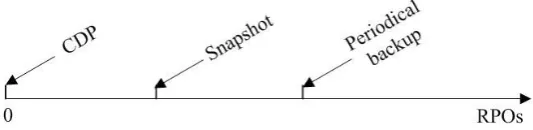
Fig. 1. Data Protection mechanisms for different RPOs
Periodical backup. Traditional periodical backup [2, 22, 27] has been widely adopted in data protection systems. Typically, backups are done on a daily, weekly or monthly basis. Since the backups can only be done in an offline manner, there may be exist the problems of data unavailability during the backup procedure. Besides, a huge amount of storage has to be occupied to keep the backups, so data compression technologies are often used to save the backup storage usage. As a result, periodical backup consumes too much time and storage space and also degrades system performance.
Snapshot. A snapshot is a point-in-time image of a collection of data which allows online backup. Generally, there are two common snapshot mechanisms: COW (Copy-On-Write) [1, 21, 23, 32, 33] and ROW (Redirect-On-Write) [6, 19, 30]. In order to save storage space, COW snapshot obtains and maintains the previous images of a data block upon the first write operation to that data block. Different from COW, ROW snapshot redirects all the write operations to the snapshot storage. Snapshots can be integrated in disk arrays [14], volume managers, file systems [3, 8, 9, 12, 21, 28, 29] and backup systems. Compared with periodical backup, snapshot can be created online, use less storage space, and has less negative impact to application performance. But it still cannot achieve timely recovery to any point in time.
Continuous data protection (CDP). CDP can provide timely recovery to
any point in time at block level. Traditional CDP mechanism [4, 13, 18] keeps a log of changed data for each data block in timestamp order. Performance overhead and recovery efficiency are the important parameters to measure CDP system, much work [5, 16, 25, 35] has been done. Mariner [16] is a block-level CDP system that is designed to minimize the performance overhead associated with block update logging. Zhu and Chiueh [35] proposed a portable and efficient user-level CDP system, which incurs minimal performance overhead. TH-CDP [25] mainly focuses on general purpose, easy recovery and fast check pointing for fast recovery. Rather than per block basis schemes, GSP_BCDP [5] provides faster recovery by per volume basis.
(TRAP) the time dimension, it can improve space efficiency significantly. But its recovery efficiency and reliability is low; what’s more, it has a great negative impact on storage system performance. ST-CDP [15], a TRAP-based optimal implementation, improves the recovery efficiency and reliability by adding snapshots between parity chains, but still has great impact on storage system performance.
To overcome the shortcomings of existing continuous data protection mechanisms, in this paper we presented a novel block level CDP architecture based on TRAP, named S-TRAP. In accordance with certain time intervalL, S-TRAP breaks down the parity chain of TRAP and generates new sub-chains. In addition, the Previous Block Cache which contains partial images of data blocks at the time point T-1 is leveraged to reduce the negative impact on primary storage system. In comparison with ST-CDP, S-TRAP not only has the advantage of fast recovery efficiency and high reliability, but also further reduces the parity storage occupation. Even more important, S-TRAP reduces the negative impact on primary storage system performance to a large extent. Formal analysis and preliminary experiment result show that S-TRAP have low RTO and high reliability, while retaining lower storage overhead and less infection on primary storage system.
The rest of this paper is organized as follows: Section 2 gives a brief overview of the TRAP architecture. Section 3 presents our optimal CDP mechanism S-TRAP in detail. In Section 4, we use mathematical model to guide our design in terms of six aspects, including recovery time, parity storage space usage, reliability, impact on system performance, recovery direction and optimal L . Section 5 describes the experiment settings. Numerical result and discussions are presented in Section 6. We conclude the paper in Section 7.
2.
Brief Overview of TRAP
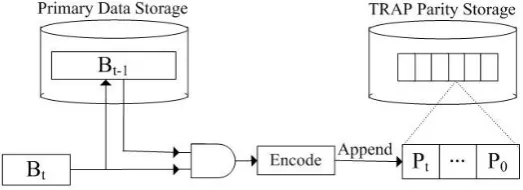
Instead of keeping all versions of a data block as being modified by write operations, TRAP only keeps a parity log of each write on the parity storage. Fig. 2 shows the basic design of TRAP. Suppose that at time pointt, a write operation is submitted to block B which updates its content from Bt1 toBt.
TRAP generates the new parity of block B as follows:
1
t t t
PB B (1)
where is a bitwise XOR operator. And then TRAP appends the new parity
t
Fig. 2. Basic design of TRAP architecture
Extensive experiments [33] have demonstrated a very strong content locality that only 5%-20% of bits inside a data block are actually changed by a write operation. Because of the characteristics of bitwise XOR operation, the parity can reflect the exact changes made by the new write operation at the bit level, i.e., except a very small portion of nonzero bits, most bits in the new parity are zeros. Consequently the parities can be compressed easily with a high compression ratio. Therefore, the storage space required to keep track of write operations can be greatly reduced by orders of magnitude.
TRAP architecture provides a double-way data recovery capability, either forward or backward, referred to as redo and undo, respectively. Consider the parity chain
P P1, 2, ,Pt1,Pt
corresponding to data blockB . Suppose wehave both the initial and latest images of block B, referred to as B0 and Bt. If we need to recovery block B to the previous image of time point
(0 )
r r t , TRAP performs the following process:
0 1 2
r r
B B P P P (2)
where Br denotes the data image of block B at time point r.
The above process represents a typical forward/redo recovery. Similarly, to recover from the opposite direction, TRAP performs backward/undo recovery according to the following process:
1 2
r r r t t
B P P P B (3)
Definition 1 For any recovery time pointr, the recovery chain of block B
is
P P1, 2, ,Pr1,Pr
with length r, or
Pr1,Pr2, ,Pt1,Pt
with length tr.We can infer from Equation (2) and (3) that any damaged parity in the recovery chain will lead to the failure of the whole recovery process.
(TRAP) in the RAID controller; (c) both primary storage and parity storage have to be under the same RAID controller. In addition, we can also infer from Equation (2) and (3) that the recovery time becomes longer as the parity chain gets longer, and the recovery efficiency decreases as the length of the recovery chain increases. The invalid parity results in the invalidity of the corresponding recovery chains, obviously, the failure probability is larger in a longer recovery chain. Therefore, the reliability of TRAP also decreases with the growth of recovery chain length increases. All these restrictions can limit the application of TRAP.
ST-CDP is an optimal implementation of continuous data protection in Linux kernel based on TRAP. By adding snapshots between parity chains, ST-CDP can improve the recovery efficiency and reliability, but the snapshots increase the parity storage usage as well. Furthermore, ST-CDP also has to obtain the previous data image from primary storage; therefore, high I/O response problem still exists.
3.
Design of S-TRAP Mechanism
3.1. Parity recording
In accordance with a certain time intervalL, S-TRAP divides the parity chain of TRAP and generates new sub-chains. Consecutive L parities from a sub-chain are illustrated in Fig. 3. Different form ST-CDP, S-TRAP does not add snapshots between parity chains. Instead, we use a special generation method for the FIRST parity of each sub-chain. Consider data blockB, the first parity of each sub-chain is generated as:
1 0 1
kL kL
P B B (4)
while the generating method of the other parities is consistent with TRAP, as shown in Equation (1).
B
0P
2 …P
L …P
'kL+1P
kL+2 … …P
(')tSub-chain 0 Sub-chain k
P
(k+1)LHEAD
P
'1Fig. 3. Parity chain of S-TRAP
Different from TRAP, the idea of our approach breaks down parity chain to sub-chains. Since all parities of write operations are kept on backup storage with the form of SUB-chains in order to provide Timely Recovery to Any Point in time, we name our approach as S-TRAP.
3.2. Previous Block Cache
Caching is one of the major technologies used to improve I/O performance in disk array. However, if TRAP wants to takes the advantage of the cache in disk array to reduce the negative impact on primary storage system, it would require: (a) implementing TRAP architecture in the disk array controller; (b) both primary storage and parity storage to be under the same disk array controller. In order to eliminate these restrictions, S-TRAP manages a separate cache to improve its I/O efficiency, which is called Previous Block Cache (PBC).
Suppose that at time pointt, a write operation is submitted to blockB, S-TRAP firstly checks in PBC. If there is a cache hit, S-S-TRAP:
(a) commits the new data image of block B directly to primary storage system,
(b) generates parity by previous data image of block B in Cache, and commits it to parity storage system, and
(c) replaces the new image of block B into Cache according to replacement algorithm;
Otherwise, it:
(a) gets the previous image of block B from primary storage system, (b) commits the new data image of block B directly to primary storage system,
(c) generates parity by previous data image of block B in Cache, and commits it to parity storage system, and
(d) replaces the new image of block B into Cache according to replacement algorithm.
Upon cache hitting, S-TRAP saves one additional I/O operation. Therefore, PBC can reduce the negative impact on primary storage system.
3.3. Data Recovery
Without loss of generality, consider the sub-chain
P'kL+1,PkL2, ,P(k1)L
whichcorresponds to data block B. In order to restore it to the previous recovery
time point rkL i (1 i L), S-TRAP performs the following process:
'
0 1 2
r kL i kL kL kL i
(TRAP) Due to the particularity of the first parity in each sub-chain, we do analysis under two conditions:
(a)rkL, recovery time point r is the time point which associates with the first parity in the kth sub-chain. In this case, S-TRAP only needs to perform Br B0PkL1 to do a forward/redo recovery. The length of recovery chain
PkL1
is 1 and XOR operation only needs to be performed once. So, recovery efficiency is high, and(b)rkL i , 0 i L, this is the most general case, and recovery time point r falls on the time point which associates with other parities of the kth
sub-chain. S-TRAP performs forward/redo recovery based on Equation (5). The length of recovery chain
PkL1,PkL2,PkL3, ,PkL i
is i, so XOR operationneeds to be performed i times.
4.
Formal Analysis of S-TRAP
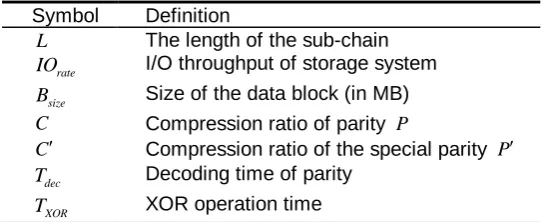
In this session, we mathematically model the S-TRAP mechanisms in detail, including recovery time, parity storage space usage, reliability, and its impacts on system performance and recovery direction. In addition, we calculate the key optimal L value, which has a major impact on parity storage space usage and recovery time. In order to facilitate the description, we define the following notations as shown in Table 1.
Table 1. Definition of Symbols Symbol Definition
L The length of the sub-chain
rate
IO I/O throughput of storage system
size
B Size of the data block (in MB)
C Compression ratio of parity P
C Compression ratio of the special parity P dec
T Decoding time of parity
XOR
T XOR operation time
4.1. Recovery Time
Theorem 1 For any recovery time point r, with using S-TRAP mechanism, the maximum length of recovery chain isL, and the expected length of recovery length is(L1) / 2.
Proof. For any recovery time pointr, without loss of generality, it certainly falls on the time interval associated with one of the sub-chains
P'kL+1,PkL2, ,P(k1)L
, and it is uniformly distributed among1
kL and(k1)L.
(a) The worst case is that the recovery time point r is the time point which is associated with the last parity of sub-chaink, i.e., r(k1)L. Therefore, the maximum length of recovery chain isL.
(b) Because recovery time r is uniformly distributed on a closed intervalkL1,
k1
L, the expected length of recovery length is:
1
1 2 L
r k
L
E L k P x k
(6)Theorem 2 For any recovery time pointr, the recovery time of TRAP is proportional tor, and the recovery time of S-TRAP is proportional toL.
Proof.
(a) The recovery time of TRAP is:
size size size
TRAP dec xor
rate rate rate
B B B
T T T r
IO C IO IO
(7)
where the first item is the time of getting and transferring the initial imageB0, the second is the time of decoding, and the last is the time of transferring and recording the final image. It can be deducted from equation (7) that the recovery time of TRAP is proportional to recovery time pointr.
(b) The recovery time of S-TRAP is:
size size size size
S TRAP dec dec xor r
rate rate rate rate
B B B B
T T T T E L
IO C IO C IO IO
(8)
where the first item is the time of getting and transferring the initial imageB0, the second is the decoding time of the first parity in sub-chain, the third is the decoding time of other parities, and the last is the time of transferring and recording the final image. We substitute Equation (6) to Equation (8), so we can draw a conclusion that the recovery time of S-TRAP is proportional to L
and independent of the recovery time pointr.
(TRAP) recovery time of S-TRAP always fluctuates within a small range which is defined by L value and Equation (8). As a result, S-TRAP has high and stable recovery efficiency.
The recovery time of both ST-CDP and S-TRAP is independent of RPO, but is dependent on d and L. The recovery time is similar between two mechanisms, which consist of 1) getting and transferring snapshot, and 2) decoding and transferring the final image. When the d value of ST-CDP equals to the L value of S-TRAP, both mechanisms have the same numbers of XOR operations. Thus, the recovery time of two mechanisms is approximately the same.
4.2. Parity Storage Space Usage
Theorem 3 Compared with TRAP, the additional parity storage space usage ratio of S-TRAP is inversely proportional toL.
Proof. Without loss of generality, consider data block B at the latest time pointt,
The parity storage space of TRAP is:
size TRAP
B t
S
C
(9)
The parity storage space of S-TRAP is:
1 1
B
S TRAP size size
size size
t t
S B B t
C L C L
B t t
t
C L C L
(10)
where the first item is the storage space usage of the first parities in sub-chains, the second item is the storage space usage of the other parities.
Additional storage space usage is:
1 1
size
B t
S
L C C
(11)
Additional parity storage space usage ratio is:
1
1 TRAP
S C
S L C
(12)
Therefore, it can be drawn from Equation (12) that the additional parity storage space usage ratio of S-TRAP is inversely proportional toL.
of ST-CDP equals to the sub-chain length L of S-TRAP, the parity storage usage of S-TRAP is smaller than that of ST-CDP.
Theorem 4 When d equals to L, the storage usage of S-TRAP is smaller than ST-CDP.
The parity storage space of ST-CDP is:
size ST CDP size
B t
S B t
d C
(13)
Delta parity storage usage between ST-CDP and S-TRAP is:
1
1 size
size
B
t t
S B
d C C d
(14)
where C C ( 1)is the compression ratio of special parity, thus, S 0. Therefore, the storage usage of S-TRAP is smaller than that of ST-CDP when d equals to L.
4.3. Reliability
Due to hardware and/or software failures, disasters or outages, both the initial image and parities are likely to be damaged. It is obvious that invalid parity results in the invalidity of the corresponding recovery chains and the invalid recovery chain can make us unable to recover data to previous time points. Therefore, improving the reliability of recovery chain is extremely important for CDP.
In S-TRAP mechanism, the valid probability of recovery chain only correlates toL, and would not decrease as time point grows; while the valid probability of recovery chain of TRAP decreases with the growth of recovery chain length.
Definition 3 The invalid probability of initial image and parity isp.
Theorem 5 For any recovery time pointr, with using S-TRAP mechanism,
the valid probability of recovery chain is
1p
L1 in the worst case, and the mathematical expectation of the valid probability of recovery chainis 1
1 p
2 1 p
L 2 pL
.
Proof. For any recovery time pointr, without loss of generality, it certainly falls on the time interval which is associated with one of the sub-chains
P'kL+1,PkL2, ,P(k1)L
, and it is uniformly distributed among kL1and(k1)L.
(TRAP) sub-chain must be valid. Therefore, the valid probability of recovery chain is minimized in such case:
1PS TRAP 1 p L (15)
(b) Because recovery time r is uniformly distributed on closed intervalkL1,
k1
L, the expected valid probability of recovery chain is:
1
2
2 11 1
P 1 1 1
L
k L
S TRAP k
E p p p
L pL
(16)Theorem 6 For any recovery time pointr, with using TRAP mechanism, the valid probability of recovery chain is decreasing with the increase of time pointr.
Proof. For any recovery time pointr, with using TRAP mechanism, all the parities from time point 1 tor, and the initial image should be valid to ensure the validity of recovery chain. So, the valid probability of recovery chain is:
1PTRAP 1 p r
(17)
According to Equation (17), the valid probability of recovery chain for TRAP mechanism is decreasing with the increase of time pointr.
Based on the above analysis, compared with TRAP mechanism, the valid probability of recovery chain in S-TRAP mechanism is only correlated toL, and would not decrease with the growth of time point. Therefore, S-TRAP can provide much higher reliability than TRAP can.
S-TRAP does not insert snapshot between parity chains as ST-CDP, so initial image is required for every recovery operation. Therefore, this causes a single point of failure.
4.4. Impact on system performance
For each write operation:
(a) both TRAP and ST-CDP have to get the image of previous time points from primary storage system first, and thereafter the new image can be committed to parity storage; while
(b) S-TRAP firstly checks whether the block cache is hit or not. If there is a hit, it gets the image of previous time point from PBC directly, and then one I/O operation is saved for primary storage system. Cache hit makes committing the new image to primary storage faster, thus reduced the IO response time of primary storage system. If there is a miss, S-TRAP has to get the image from primary storage as well, and then puts the image into PBC according to certain replacement algorithm.
S-TRAP saves more I/O operations for primary storage system accordingly. Meanwhile, S-TRAP has a higher memory footprint than TRAP and ST-CDP do.
4.5. Recovery Direction
In S-TRAP mechanism, the special parity in each sub-chain is generated by bitwise XOR operation between initial and the latest image of data block. Due to the special generation method, S-TRAP could only recover in one direction (i.e., forward/redo). Compared with the double-way recovery of TRAP and ST-CDP, S-TRAP cannot recover data when the initial image is damaged. However, except for the initial image stored in primary storage, S-TRAP also keeps an addition backup in parity storage. This lowers the probability of an invalid initial image. Moreover, S-TRAP can also escalate to double-way recovery easily by adding an additional normal parity at the first time point of each sub-chain.
4.6. Optimal L value
Recovery time and parity storage space usage are the two key factors to measure the recovery cost of CDP mechanism. Next, we will come out with a definition for the recovery cost function of S-TRAP.
Definition 4 The recovery cost of S-TRAP is the product of its recovery time and parity storage space usage:
41 2 3
S TRAP S TRAP
G L T L S L
A
A A L A
L
(18)
where 1 2 3 4 2 1 2 1 ; 2 ; 1 1
size size size
dec xor dec xor
rate rate rate
size dec xor
rate
size
size
B B B
A T T T T
IO C IO C IO
B
A T T
C IO
B t
A C
A B t
(TRAP)
The minimum value of G L( ) exists when 1 4 0
2 3
A A
L L
A A
. Since L is an
integer, we choose the integer closest to L0 as optimal L value.
5.
Experiment Setup
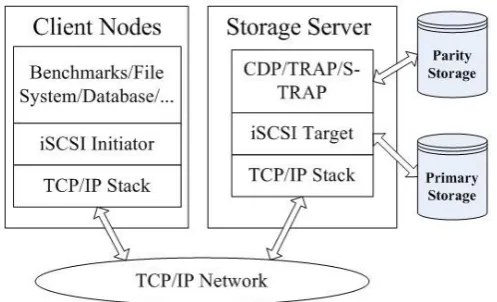
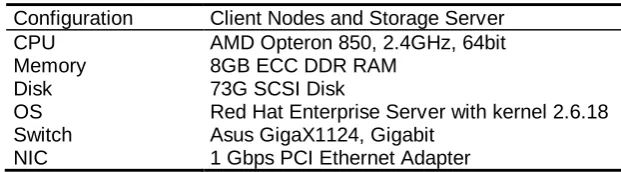
In order to evaluate the S-TRAP mechanism, we designed and implemented a prototyped system. Fig. 4 shows the architecture of this prototype which integrates such three mechanisms, as TRAP, ST-CDP and S-TRAP. The prototype is a block device driver layered below file system, database system or other applications in the Linux kernel and therefore it works transparently to upper-level applications. The prototype captures write requests from upper levels and all the mechanisms keep all parities of each block at any time point according to the description in previous sections; In addition, all the mechanisms use the same open-source compression library, i.e., zlib. Meanwhile, all the mechanisms are implemented independently of RAID controller. According to the discussion of ST-CDP [15], we set the d value of ST-CDP to 85. In addition, we chose five different block sizes: 4KB, 8KB, 16KB, 32KB and 64KB. Experimental configurations are listed in Table 2.
Fig. 4. System architecture of prototype
algorithm complexity is high. For block address order, it is easy to recover because all the parities of each data block are kept together, so the recovery algorithm complexity is low. But here an efficiency parity space management algorithm is needed. For the purpose of getting an accurate evaluation, we choose block address-ordered to keep parities in the prototype for both TRAP and S-TRAP.
Table 2. Experiment Environments
Configuration Client Nodes and Storage Server CPU AMD Opteron 850, 2.4GHz, 64bit
Memory 8GB ECC DDR RAM
Disk 73G SCSI Disk
OS Red Hat Enterprise Server with kernel 2.6.18 Switch Asus GigaX1124, Gigabit
NIC 1 Gbps PCI Ethernet Adapter
Appropriate workloads are important for performance studies [10]. We use popular benchmarks in our experiments, which are C and IoMeter. TPC-C is a well-known benchmark used to model the operation terminal of businesses where real-time transactions are processed. We choose one of the TPC-C implementations developed by the Hammerora Project [24] for Oracle database. According to the TPC-C specification, data tables for five warehouses with 25 users were built in order to issue transactional workloads to Oracle database. IoMeter is a flexible and configurable file system benchmark. In our experiments, we choose the mode of 30% writes and 70% reads for measuring the performance of file system and block device.
6.
Results and Discussions
6.1. Impacts on system performance
(TRAP)
Table 3. Measured Computation Time
Block Size (KB) XOR Time (ms) Decompress Time (ms)
4 0.025132 0.070960
8 0.050406 0.130094
16 0.101033 0.220106
32 0.211721 0.374015
64 0.420478 0.613474
Except for the slight impact caused by computation of bitwise XOR and decompression for parities, parity recording and reading, which needs disk I/O operation, have even more negative impact on primary storage system. In order to see quantitatively how much the impact is, we carried out the following experiments.
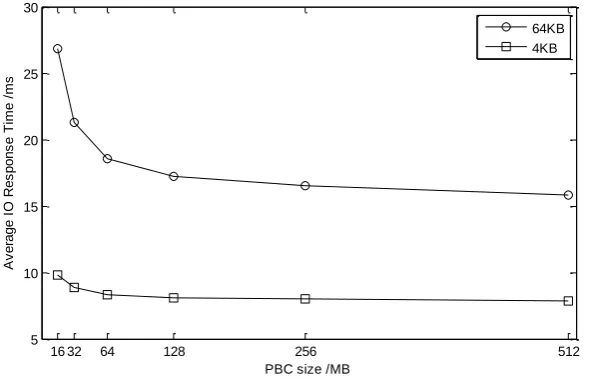
In S-TRAP mechanism, PBC is important to mitigate the negative impact on primary storage system. In order to find the suitable size of PBC, we measure the average I/O response time for different PBC size. With block size 4KB and 64KB, we run IoMeter benchmark (70% reads and 30% writes) for one hour on S-TRAP configured with different PBC size. As shown in Fig. 5, the average I/O response time decreases with PBC size increases, and becomes stable after 128MB. So we choose 128MB as the PBC size in the following experiments.
16 32 64 128 256 512
5 10 15 20 25 30
PBC size /MB
A
v
e
ra
g
e
I
O
R
e
s
p
o
n
s
e
T
im
e
/
m
s
64KB 4KB
Fig. 5. Average IO Response Time over PBC size
mechanisms. Fig. 6 shows the measured results of average I/O response time for 70% writes and 30% reads of IoMeter benchmark.
As shown in Fig. 6, we observed in our experiments that all the three CDP mechanisms have negative performance impacts; TRAP has the most while S-TRAP the least. For block size 64KB, compared with original storage system, TRAP’s average I/O response time is about 66.07% longer, 70.18% and 31.48% for ST-CDP and TRAP, respectively. It can be seen that S-TRAP reduces the negative impact on primary storage system about 52.35% compared with TRAP.
The reason is that, with the introduction of Previous Block Cache, the number of additional I/O reduced, and the impact on primary system reduced accordingly. After neglecting the slight impact caused by computation of bitwise XOR and decompress, TRAP and ST-CDP still have one additional I/O to get the image of pervious time point when recording parities. Thus, S-TRAP has less impact.
4 8 16 32 64
0 5 10 15 20
Block Size /KB
A
v
e
ra
g
e
I
O
R
e
s
p
o
n
s
e
T
im
e
/
m
s
NONE S-TRAP ST-CDP TRAP
Fig. 6. Average I/O response time comparison
6.2. Sub-chain Length L
(TRAP) recovery time and parity storage usage are shown in Figs. 7 and 8. The recovery cost under Def. 4 is shown in Fig 9.
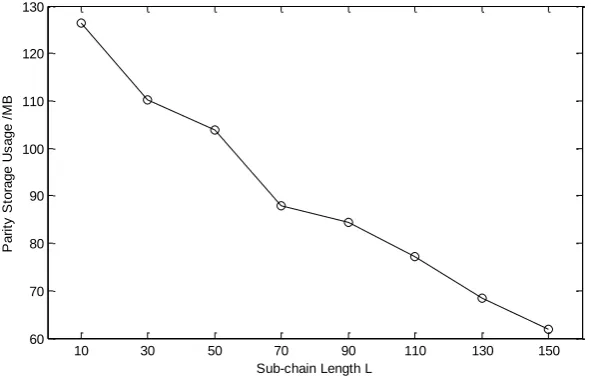
As shown in Figs. 7 and 8, with the increasing of sub-chain length L, the parity storage usage decreases while the recovery time grows. In Fig. 9, we observed that the recovery cost obtains the minimum when sub-chain is 90. So we choose 90 as the sub-chain length in the following experiments.
10 30 50 70 90 110 130 150
300 350 400 450 500 550 600 650 700
Sub-chain length L
R
e
c
o
v
e
ry
T
im
e
/
s
Fig. 7. Recovery time of S-TRAP configured with different sub-chain length
10 30 50 70 90 110 130 150
60 70 80 90 100 110 120 130
Sub-chain Length L
P
a
ri
ty
S
to
ra
g
e
U
s
a
g
e
/
M
B
10 30 50 70 90 110 130 150 3.4
3.5 3.6 3.7 3.8 3.9 4 4.1 4.2 4.3x 10
4
Sub-chain Length L
R
e
c
o
v
e
ry
C
o
s
t
Fig. 9. Recovery cost of S-TRAP configured with different sub-chain length
6.3. Parity storage space usage
4 8 16 32 64
0 20 40 60 80 100 120
Block Size /KB
P
a
ri
ty
S
to
ra
g
e
U
s
a
g
e
/
M
B
TRAP S-TRAP ST-CDP
Fig. 10. Parity storage space usage comparison
(TRAP) respectively. Then, we measured the parity storage space usage for different mechanisms. Fig. 10 shows the results of parity storage space usage comparison for TPC-C on the oracle database.
In Fig. 11, we also measure the space usage of TRAP, ST-CDP and S-TRAP for different protecting time durations with block size 4KB and 64KB.
It is shown in Fig. 10 that TRAP requires the least parity storage space while the ST-CDP the most. For example, for the block size of 16KB, the space usage of ST-CDP increases by 22.22% compared with TRAP, while S-TRAP is only 9.52%. We can get similar results from Fig. 11.
15 30 60 90 120 150 180 210 240
0 50 100 150 200 250 300
Time Duration of Protection /min
P a ri ty S to ra g e U s a g e / M B ST-CDP S-TRAP TRAP (a)
15 30 60 90 120 150 180 210 240
0 50 100 150 200 250 300 350 400 450
Time Duration of Protection /min
P a ri ty S to ra g e U s a g e / M B ST-CDP S-TRAP TRAP (b)
Fig. 11. Parity storage space usage over time duration: (a) Block Size=4KB; (b) Block Size=64KB
parities. On the other hand, ST-CDP supplely adds a snapshot for each d parities. Compared with parities with high compression ratio, snapshot takes up more storage space.
6.4. Recovery time
RTO (Recovery Time Objective) is a key indicator to evaluate a data protection mechanism, and it reflects the recovery duration of time after a disaster. In order to compare the recovery time among TRAP, ST-CDP and S-TRAP, we carried out this experiment. With block sizes of 4KB and 64KB, we run TPC-C benchmark for a sufficiently long time, more than five hours, on TRAP, ST-CDP and S-TRAP, separately. As the benchmark runs, the parity storage was filled with sufficient parities. Then, we perform recoveries for different time points in the past. Fig. 12 shows the measured results of recovery time for TRAP, ST-CDP and S-TRAP.
In Fig. 12, TRAP’s recovery time increases obviously as RPO increases; while the recovery time of ST-CDP and S-TRAP keeps flat while RPO changes. This also illustrates the related results of Theorem (2). In addition, ST-CDP and S-TRAP perform almost the same in recovery ability. Thus it can be seem that, under the premise of further reducing parity storage usage, S-TRAP still maintains high recovery efficiency. For example, for block size 4KB, TRAP takes 1440 seconds to recover data to 30 minutes ago, about 4.3 times longer than ST-CDP or S-TRAP; while TRAP takes 3790 seconds to recover data to 240 minutes ago, about 11.3 times longer than ST-CDP or S-TRAP. Consequently, ST-CDP and S-TRAP have faster and more stable recovery ability.
15 30 60 90 120 150 180 210 240
0 500 1000 1500 2000 2500 3000 3500 4000
Recovery Time Point r /min
R
e
c
o
v
e
ry
T
im
e
/
s
ST-CDP S-TRAP TRAP
(TRAP)
15 30 60 90 120 150 180 210 240
0 500 1000 1500 2000 2500
Recovery Time Point r /min
R
e
c
o
v
e
ry
T
im
e
/
s
ST-CDP S-TRAP TRAP
(b)
Fig. 12. Recovery time comparison between TRAP, S-TRAP and ST-CDP: (a) Block
Size=4KB; (b) Block Size=64KB
7.
Conclusions
In this paper, we present a novel block-level CDP architecture, referred to as S-TRAP. In accordance with a certain time intervalL, S-TRAP breaks down the parity chain of TRAP and generates new sub-chains. Furthermore, S-TRAP introduces PBC which can reduce the negative impact on primary storage system. We use a simple mathematical model to guide our design in such six aspects as: recovery time, parity storage space usage, reliability, impact on system performance, recovery direction and optimalL. Extensive experiments have been carried out to evaluate S-TRAP. Both mathematical analysis and experimental evaluation have shown that S-TRAP not only has the advantage of high recovery efficiency and reliability, but also further reduces the parity storage usage. Even more important, S-TRAP reduces the negative impacts on primary storage system performance to a large extent.
For future work, we plan to further improve the reliability and recoverability of S-TRAP by ECC (Error Correcting Codes) in sub-chains. We also plan to design parity storage architecture for S-TRAP in order to improve its recording and recovering ability.
Acknowledgment. This research is supported by the National High Technology
References
1. Charles, B.M., Grunwald, D.: Peabody: The time travelling disk. In Proceedings of the 20th IEEE/11th NASA Goddard Conference on Mass Storage Systems and Technologies. San Diego, CA, USA, 241-253. (2003)
2. Chervenak, A., Vellanki, V., Kurmas, Z.: Protecting File Systems: A Survey of Backup Techniques. In Proceedings of the 6th NASA Goddard Conference on Mass Storage Systems and Technologies / 15th IEEE Symposium on Mass Storage Systems, College Park, MD, USA, 17-31. (1998)
3. Cox, L.P., Murray, C.D., Noble, B.D.: Pastiche: making backup cheap and easy. In Proceedings of the 5th Symposium on Operating Systems Design and Implementation, Boston, MA, USA, 285-298. (2002)
4. Damoulakis, J.: Continuous Protection. Storage, Vol. 3, No. 4, 33-39. (2004) 5. Deng, Y.B., Chen, S.G., Hu, W., Gao, F., Liu, C.Y.: A novel block-level
continuous data protection system. In Proceedings of the 4th International Conference on New Trends in Information Science and Service Science, Gyeongju, Korea, 242-247. (2010)
6. Duzy, G.: Match Snaps to Apps. Storage, special issue on managing the information that drives the enterprise, 46-52. (2005)
7. Flouris, M.D., Bilas, A.: Clotho: Transparent Data Versioning at the Block I/O Level. In Proceedings of the 12th NASA Goddard / 21st IEEE Conference on Mass Storage Systems and Technologies, College Park, MD, USA, 101-114. (2004)
8. Gifford, D.K., Needham, R.M., Schroeder, M.D.: The Cedar File System. Communications of the ACM, Vol. 31, No. 3, 188-198. (1998)
9. Howard, J.H., Kazar, M.L., Menees, S.G., Nichols, D.A., Satyanarayanan, M., Sidebotham, R.N., West, M.J.: Scale and performance in a distributed file system. In Proceedings of the 11th ACM Symposium on Operating Systems Principles, New York, NY, USA, 1-2. (1987)
10. Hu, Y.M., Yang, Q.: DCD-disk caching disk: a new approach for boosting I/O performance. In Proceedings of the 23rd Annual International Conference on Computer Architecture, Philadelphia, PA, USA, 169-178. (1996)
11. Keeton, K., Santos, C., Beyer, D., Chase, J., Wilkes, J.: Designing for disasters. In Proceedings of the 3rd Usenix Conference on File and Storage Technologies, San Francisco, CA, USA, 59-72. (2004)
12. Kistler, J.J., Satyanarayanan, M.: Disconnected operation in the Coda File System. ACM Transactions on Computer Systems, Vol. 10, No. 1, 3-25. (1992) 13. Laden, G., Ta-Shma, P., Yaffe, E., Factor, M., Fienblit, S.: Architectures for
controller based CDP. In Proceedings of the 5th Usenix Conference on File and Storage Technologies, San Jose, CA, USA, 107-121. (2007)
14. Lee, E.K., Thekkath, C.A.: Petal: distributed virtual disks. In Proceedings of the 7th International Conference on Architectural Support for Programming Languages and Operating Systems, Cambridge, MA, USA, 84-92. (1996) 15. Li, X., Xie, C.S., Yang, Q.: Optimal Implementation of Continuous Data
Protection (CDP) in Linux Kernel. In Proceedings of the IEEE 2008 International Conference on Networking, Architecture, and Storage, Chongqing, China, 28-35. (2008)
(TRAP) 17. McKnight, J., Asaro, T., Babineau, B.: Digital Archiving: End-User Survey and Market Forecast. The Enterprise Strategy Group (2006). [Online]. Available: http://www.enterprisestrategygroup.com/2006/03/digital-archiving-end-user-survey-market-forecast-2006-2010/ (current December 2011)
18. Morrey, C.B., III, Grunwald, D.: Peabody: the time travelling disk. In Proceedings of the 20th IEEE / 11th NASA Goddard Conference on Mass Storage Systems and Technologies, San Diego, CA, USA, 241-253. (2003)
19. Patterson H., Manley S., Federwisch M., Hitz D., Kleiman S., Owara S.: SnapMirror(R): file system based asynchronous mirroring for disaster recovery. In Proceedings of the 1st Usenix Conference on File and Storge Technologies, Monterey, CA, USA, 117-129. (2002)
20. Patterson, D.: Availability and Maintainability >> Performance: New Focus for a New Century. Keynote of the 1st Usenix Conference on File and Storge Technologies, Monterey, CA, USA (2002). [Online]. Available : http://www.cs.berkeley.edu/~pattrsn/talks/keynote.html (current December 2011) 21. Peterson, Z., Burns, R.: Ext3cow: a time-shifting file system for regulatory
compliance. ACM Transactions on Storage, Vol. 1, No. 2, 190-212. (2005) 22. Rock, M., Poresky, P.: Shorten Your Backup Window. Storage, special issue on
managing the information that drives the enterprise, 28-34. (2005)
23. Santry, D.S., Feeley, M.J., Hutchinson, N.C., Veitch, A.C., Carton, R.W., Ofir, J.: Deciding when to forget in the Elephant file system. In Proceedings of the 17th ACM symposium on Operating systems principles, New York, NY, USA, 110-123. (1999)
24. Shaw, S.: Hammerora: Load Testing Oracle Databases with Open Source Tools. Hammerora Project (2004). [Online]. Available: http://hammerora.sourceforge.net (current December 2011)
25. Sheng, Y.H., Wang, D.S., He, J.Y., Ju, D.P.: TH-CDP: An Efficient Block Level Continuous Data Protection System. In Proceedings of the 2009 IEEE International Conference on Networking, Architecture, and Storage, Zhangjiajie, China, 395-404. (2009)
26. The 451 Group: Total Recall: Challenges and Opportunities for the Data Protection Industry. The 451 Group (2006). [Online]. Available: http://www.the451group.com/reports/executive_summary.php?id=218 (current December 2011)
27. Wang, D., Xue, W., Shu, J.W., Shen, M.M.: Fault Tolerance with Virtual Disk Replicas in the Mass Storage Network. Journal of Computer Research and Development, Vol. 43, No. 10, 1849-1854. (2006)
28. Xiang, X.J., Shu J.W., Zheng, W.M.: An efficient fine granularity multi-version file system. Journal of Software, Vol. 20, No. 3, 754-765. (2009)
29. Xiang, X.J., Shu, J.W., Xue, W., Zheng, W.M.: Design and implementation of an efficient multi-version file system. In Proceedings of the 2007 International Conference on Networking, Architecture, and Storage, Guilin, China, 277-278. (2007)
30. Xiao, W.J., Liu, Y., Yang, Q., Ren, J., Xie, C.: Implementation and Performance Evaluation of Two Snapshot Methods on iSCSI Target Storages. In Proceedings of the 14th NASA Goddard / 23rd IEEE Conference on Mass Storage Systems and Technologies, College Park, MD, USA, 101-110. (2006)
32. Xiao, W.J., Yang, Q., Ren, J., Xie, C.S., Li, H.Y.: Design and Analysis of Block-Level Snapshots for Data Protection and Recovery. IEEE Transactions on Computers, Vol. 58, No. 12, 1615-1625. (2009)
33. Xiao, W.J., Ren, J., Yang, Q.: A Case for Continuous Data Protection at Block Level in Disk Array Storages. IEEE Transactions on Parallel and Distributed Systems, Vol. 20, No. 6, 898-911. (2009)
34. Yang, Q., Xiao, W.J., Ren, J.: TRAP-Array: A Disk Array Architecture Providing Timely Recovery to Any Point-in-time. In Proceedings of the 33rd International Symposium on Computer Architecture, Boston, MA, USA, 289-300. (2006) 35. Zhu, N.N., Chiueh, T.: Portable and Efficient Continuous Data Protection for
Network File Servers. In Proceedings of the 37th Annual IEEE/IFIP International Conference on Dependable Systems and Networks, Edinburgh, UK, 687-697. (2007)
Chao Wang is currently a PhD candidate at the School of Computer Science,
Northwestern Polytechnical University, Xi'an, China. His research interests include disaster tolerant, massive storage system and performance evaluation.
Zhanhuai Li is a professor at the School of Computer, Northwestern Polytechnical University, Xi'an, China. He is vice chairman of Database Technical Committee, China Computer Federation. He is a senior member of China Computer Federation. He received his Master's and Ph.D. degrees from Northwestern Polytechnical University in 1987 and 1996 respectively. His current research interests include RFID data management and multimedia real-time database.
Na Hu is currently a Master candidate at the School of Computer Science, Northwestern Polytechnical University, Xi'an, China. Her research interests include data protection and performance evaluation.
Yanming Nie is currently a PhD candidate at the School of Computer Science, Northwestern Polytechnical University, Xi'an, China. His research interests include data stream processing, uncertain data management, RFID data management and software engineering and process.