Geschke Center
Doctoral Dissertations Theses, Dissertations, Capstones and Projects
2008
The relationship between emotional intelligence
and academic achievement in elementary-school
children
Barbara A. Fatum
Follow this and additional works at:https://repository.usfca.edu/diss
Part of theEducation Commons
This Dissertation is brought to you for free and open access by the Theses, Dissertations, Capstones and Projects at USF Scholarship: a digital repository @ Gleeson Library | Geschke Center. It has been accepted for inclusion in Doctoral Dissertations by an authorized administrator of USF Scholarship: a digital repository @ Gleeson Library | Geschke Center. For more information, please [email protected].
Recommended Citation
Fatum, Barbara A., "The relationship between emotional intelligence and academic achievement in elementary-school children" (2008).Doctoral Dissertations. 265.
The University of San Francisco
THE RELATIONSHIP BETWEEN EMOTIONAL INTELLIGENCE AND ACADEMIC ACHIEVEMENT IN ELEMENTARY-
SCHOOL CHILDREN
A Dissertation Presented to
The Faculty of the School of Education Learning and Instruction Department
In Partial Fulfillment of the Requirements for the Degree
Doctor of Education
by
Barbara A. Fatum San Francisco, California
encouragement, availability and guidance. I have benefited greatly from her knowledge of the dissertation process, research design, and statistical analysis. I am forever grateful for her patience, kindness, and wisdom.
I would also like to thank Dr. Christine Yeh for her advice and support. Her knowledge of the Consensual Qualitative Research process and her expertise in
qualitative research were invaluable. I learned so much from our discussions, Dr. Yeh. Thank you.
I would also like to thank Dr. Lanna Andrews for her knowledge and experience in the field of Learning Disabilities. Your suggestions, Dr. Andrews, made me think carefully about the impact of EI on students diagnosed with Learning Disabilities. Thank you. In addition, I would like to extend a thank you to the principals, teachers, and students at the schools in which I conducted research, especially Susan Charles, my Peer Coach extraordinaire!! My time with you was very valuable to me and I thank you for teaching me so much about the value of Emotional Intelligence to our schools and students. I would be remiss not to thank Dr. Anabel Jensen, Marsha Rideout, and Josh Freedman of the Six Seconds Emotional Intelligence Organization for their
encouragement, support, and professional development. I truly admire your noble goal of spreading EI around the world to benefit its organizations and people.
I am also thankful for the time, effort, support and collaboration of my wonderful colleagues, Robin Parker-Meredith, Kathy Gray, Steve Morris, Ingrid Sheets, Barbara Hughes, and Chris Kurasch. I have to give special thanks to my dear friend and editor, Kristin Anundsen. Kristin, your enthusiasm and steadfast support have made the difference in a long and sometimes rocky road!! I am lucky to have colleagues and friends that are willing to jump in and help out with such enthusiasm. I dedicate the results of this study to you!!
Lastly, I would like to thank my wonderful husband, Art, for the countless hours he spent helping with the difficult (for me) and rather mundane tasks of the dissertation process. I truly would not have completed this process without his love and
This dissertation is dedicated to my dear family:
To my husband, Art Fatum. Everything I do is better when you are beside me. You are truly my knight in shining armor!!
To my mother, Grace Clark. Thank you, mom, for years of support, encouragement, and love. I know you are smiling down from Heaven.
To my sister, Susie. Your cheerleading and faith has always brought a smile to my face and laughter to my day. Thank you for being such a supportive sister.
To my other mom and dad, Art and Evelyn. Thank you for your love and faith in Art and I. We have accomplished what we have because you have made it possible.
Emotional Intelligence and Academic Achievement in Elementary-School Children
The purpose of this study was to investigate the relationship between Emotional Intelligence (EI) and Academic Achievement in elementary-age children.
Emotional Intelligence competencies were measured using the Six Seconds Emotional Intelligence Assessment for Youth (SEI-YV). The SEI-YV is a self-report instrument that provides scores on three composite measures of EI, eight EI competencies, and five barometers of health. Academic achievement scores were measured using the California Standardized Testing and Reporting program (STAR) achievement tests in English-Language Arts, Mathematics, and Science.
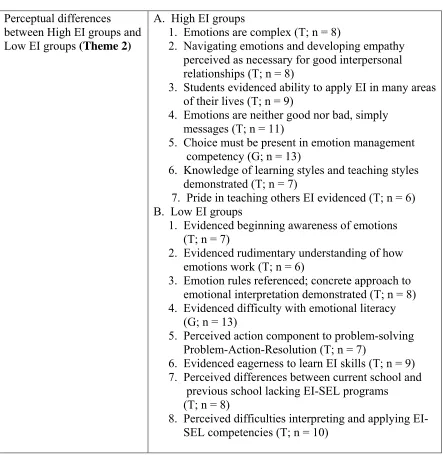
diagnosed with learning disabilities scored almost one standard deviation below students without that diagnosis on all five barometers of health as measured by the SEI-YV. Four themes emerged from this study. The first theme suggested that students enrolled in an EI curriculum like Self-Science develop EI competencies and display intrinsic motivation to apply those competencies. In contrast, students enrolled in a traditional SEL curriculum develop leadership and citizenship skills but evidence extrinsic motivation when applying those competencies. The second theme suggested that students whose EI competencies scored as high were able to reflect on those
competencies, display an ability to exercise choice in application of those competencies, and apply those competencies in different contexts. In contrast, students whose EI competencies scored as low were engaged in figuring out the process and rules to follow to understand and utilize emotional intelligence competencies. The third theme
suggested that students in both schools and in the high- and low-EI groups appreciated the difficulties of acquiring and applying EI-SEL competencies. Conclusions were that students perceived a need for adults to model competencies, for opportunities to practice competencies, for safe contexts in which to make and correct mistakes, and for
opportunities to reflect on and discuss EI-SEL competencies. The fourth theme demonstrated student perceptions that EI-SEL competencies allowed them to be successful both inside and outside of school.
This dissertation, written under the direction of the candidate’s dissertation committee and approved by the members of the committee, has been presented to and accepted by the Faculty of the School of Education in partial fulfillment of the requirements for the degree of Doctor of Education. The content and research methodologies presented in this work represent the work of the candidate alone.
Barbara A. Fatum 12 November 2008 Candidate Date
Dissertation Committee
Patricia Busk 12 November 2008 Chairperson
iii
TABLE OF CONTENTS
Page
ACKNOWLEDGEMENTS ... ii
TABLE OF CONTENTS ... iii
LIST OF TABLES ... vi
LIST OF FIGURES ... vii
CHAPTER I. INTRODUCTION ...1
Statement of the Problem ...4
Purpose of the Study ...6
Research Questions ...8
Background and Need ...9
Theoretical Rationale ...15
Definition of Terms...21
Educational Significance ...25
II. REVIEW OF THE LITERATURE ...27
Emotional Intelligence ...29
The Mayer and Salovey Constructs of Emotional Intelligence ...32
Goleman Model of Emotional Intelligence ...36
The Self-Science Model of Emotional Intelligence ...40
Development of Empathy, Prosocial Behavior, and Emotional Intelligence ...44
Brain-based Research and Emotional Intelligence ...57
Learning Disabilities and Emotional Intelligence ...64
Academic achievement ...72
School Management and Academic Achievement ...75
Caring, Connected School Communities and Academic Achievement ...79
Reduction of Violence in Schools and Academic Achievement ...84
Summary ...92
III. THE METHODOLOGY ...95
Restatement of the Problem ...95
Research Design ...95
General Characteristics of Study Sample ...97
Protection of Human Subjects ...98
iv
TABLE OF CONTENTS Continued
CHAPTER Page
Data Collection Methods ...102
SEI-YV Administration ...102
STAR Test Administration ...103
Qualitative Procedures ...104
Researcher Biases ...108
Instrumentation ...111
Validity and Reliability ...116
Restatement of the Research Questions ...118
Data-Analysis Methods ...119
Quantitative Analysis ...119
Qualitative Analysis ...121
Steps in Analysis ...121
IV. RESULTS Introduction ...123
Descriptive Results ...123
Quantitative Results ...124
Research Question 1 ...124
Research Question 3 ...127
Research Question 4 ...128
Qualitative Results ...130
Research Question 2 ...130
Themes ...131
Differences in Perception of EI and SEL Competencies ...137
EI Competencies ...137
SEL Competencies ...142
Differences in Perception Between High and Low EI Groups ...145
High-EI Groups ...145
Low-EI Groups ...149
Student-Perceived Difficulties in Learning, Practicing, and Applying EI Competencies ...152
EI Allows Students to be More Successful Both Inside and Outside of School ...156
v
TABLE OF CONTENTS Continued
CHAPTER Page V. DISCUSSION, SUMMARY OF RESULTS, LIMITATIONS,
IMPLICATIONS, AND RECOMMENDATIONS ...165
Summary of the Study ...165
Limitations ...166
Summary of Findings ...167
Discussion of Results ...170
Relationship between EI Competencies and Academic Achievement ...170
Differences in EI Competencies between Students Diagnosed With Learning Disabilities and Those without a Diagnosis of LD ....174
Differences in EI as a Result of Pedagogical Approach ...176
Student Perceptions of EI Competencies ...177
Implications for Educational Practice ...183
Recommendations for Future Research ...186
Summary ...189
REFERENCES ...195
APPENDIXES ...207
A: Six Seconds Emotional Intelligence Assessment for Youth (SEI-YV) ...208
B: Parental Consent for Research Participation ...209
C: Consent Form for Focus Group Participation ...213
D: Focus Group Questions ...216
E: Student Responses to SEI-YV ...218
F: Transcripts of Student Responses to Focus Group Questions ...221
Focus Groups Session 1 ...222
Focus Groups Session 2 ...246
Focus Groups Session 3 ...272
1. Demographic Information for Two Schools in Sample Given in
Percentages ...98
2. Focus Group Demographics and Score Ranges ...106
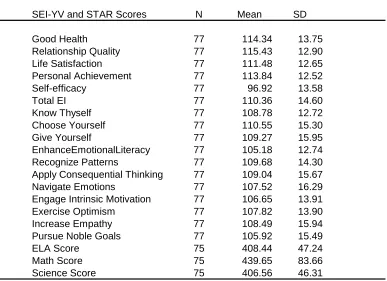
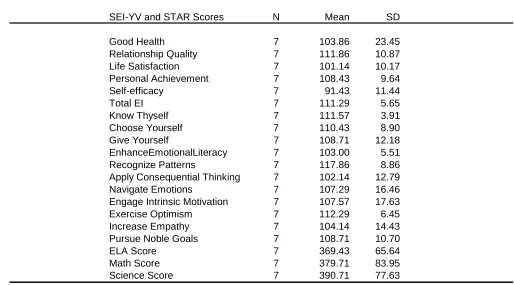
3. Means and Standard Deviations for SEI-YV Competencies and STAR Achievement Tests ...124
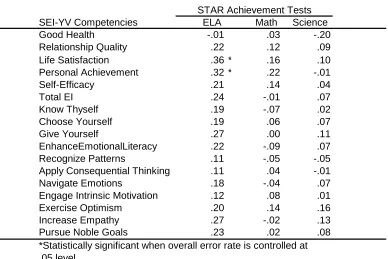
4. Pearson Product-Moment Correlations Between SEI-YV and STAR Achievement Tests ...125
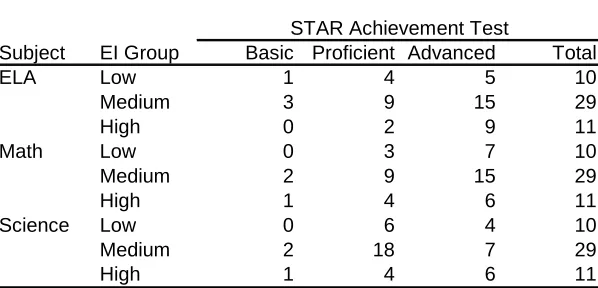
5. Alternate School Achievement by EI Group ...126
6. Traditional School Achievement by EI Group ...127
7. IEP Student Means and Standard Deviations for SEI-YV and STAR Achievement Tests ...128
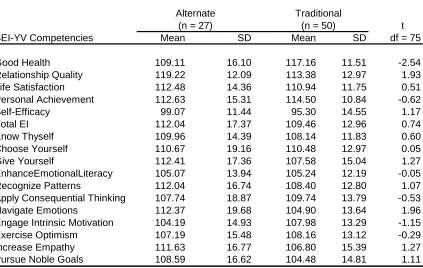
8. Means and Standard Deviations for t-test Comparing Alternate and Traditional Schools for Scales ...129
9. Means and Standard Deviations for t-test Comparing Pedagogy and SEI-YV Scores ...130
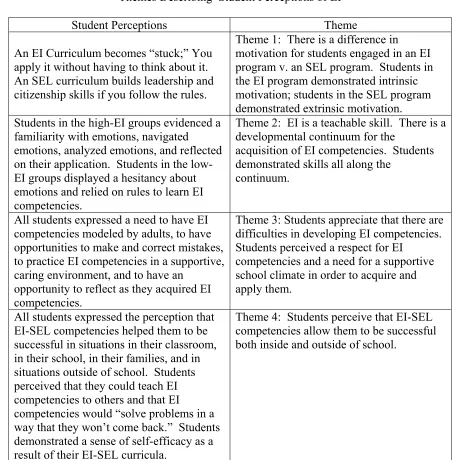
10. Themes Describing Student Perceptions of EI ...131
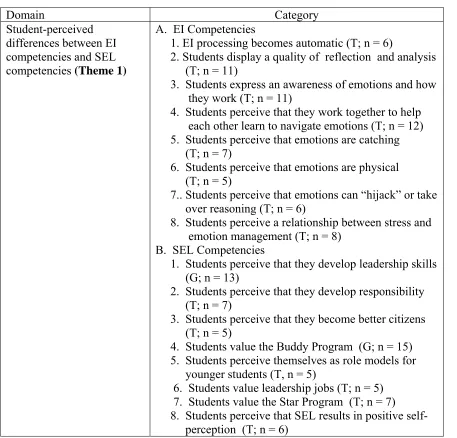
11. Results of Qualitative Analysis ...134
12. EI Focus Group Theme 3 Responses ... 152
13. EI Focus Group Theme 4 Responses ...156
14. Relationship of Themes to 6 Seconds EI Model ...180
FIGURE Page
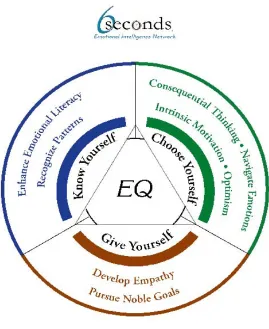
1. Six Seconds Model of Emotional Intelligence ...112 2. Barometers of Health as Measured by the SEI-YV ...115 3. Relationships between Student Perceptions of EI ...182
CHAPTER I
INTRODUCTION
Adelman and Taylor (2000) argued that if schools focus only on academic instruction
and school management in their efforts to help students attain academic success, they will
fall short of their goals. In the words of Larry Leverett, Superintendent of Schools in
Greenwich, Connecticut,
Each day our students arrive at the doors of classrooms across America with challenges that serve as barriers to their success as learners. These students are affluent and poor; they are English-language learners and English-language speakers; they are white, Hispanic, African-American, and Asian; they are urban, suburban, and rural. Regardless of who they are, where they come from, or the extent of their poverty or wealth, the reality is that many lack the personal, social, and
emotional competencies to receive the maximum benefit of a rigorous, standards-based instructional program. (Elias & Arnold, 2006, p. 2)
Historically, in education, emotions have been thought to be peripheral to the process
of learning. Recent research (Elias, 2004), however, has begun to indicate that Emotional
Intelligence (EI) is a necessary component of any educational community. EI has been
defined by Elias as a set of skills necessary for effective social interaction and classroom
success: (a) emotional recognition and regulation, (b) self-control, (c) goal setting, (d)
social responsibility, (e) empathy, (f) problem solving, (g) conflict resolution, and (h)
skills needed for leadership and effective group participation.
An increased interest in research in the area of emotional intelligence has led to a
quest for a strong empirical case connecting the measurement of social and emotional
learning (SEL) programs that teach EI to improved school behavior and academic
performance. Recent brain research has defined EI as a measurable connection in the
(Bradberry & Greaves, 2005). Educational programs that focus on SEL generally instruct
children with curriculum designed to help them understand and use EI abilities. Students,
teachers, administrators, and schools have begun to realize the positive effects of
high-quality SEL programs that are integrated into the curriculum of public-school life (Zins,
Bloodworth, Weissberg, & Walberg, 2004). Through SEL programming, children learn
to recognize and manage emotions, care about others, make good decisions, behave
ethically and responsibly, develop positive relationships, and avoid negative behaviors
(Elias et al., 1997).
The Collaborative for Academic, Social, and Emotional Learning (CASEL), founded
by Daniel Goleman, Tim Shriver, and Eileen Rockefeller Growald in 1994, has been
studying effective Social and Emotional Learning programs and the schools
implementing SEL programming. CASEL (2003) undertook the task of evaluating SEL
programs for effectiveness, providing standards-based evidence that successful models
can be replicated in schools. Exemplary SEL programs reviewed by CASEL have been
implemented in a variety of school districts (urban, suburban, and rural). Models of
effective SEL programs allow educators to focus resources on preventive approaches that
focus on the development of the whole child. CASEL (2006), in its implementation
guide for evidence-based SEL programs, suggested that excellent SEL programs are
characterized by two levels. The first level establishes safe, caring, well-managed
learning environments that lead to greater student attachment to school, less risky
behavior on the part of students, and better academic performance. The second level
supports positive student development and greater academic success through instruction
Weissberg and Utne O’Brien (2004) suggested that SEL programs effectively address
emotional and behavioral problems within a broader context of school and community,
building emotional skills and connections with others that allow children to adapt and
develop protective factors that promote academic success. Luiselli, Putnam, Handler,
and Feinberg (2005) indicated quality SEL programs foster an important connection
between students and students, teachers and students, teachers and parents, teachers and
administrators, students and administrators, and the school and the community. Service
learning programs, found in many quality SEL programs, often bring together the school
community, teachers, administrators, parents, and community organizations through a
common goal and higher sense of purpose (Luiselli et al., 2005).
Zins et al. (2004) argued in a review of the research that SEL may be the enabling
component that fosters academic success. Research suggests that the “missing piece” in
promoting academic achievement is educational programming that integrates SEL into
the curriculum of the school (Elias et al., 2002). Quality SEL programs have been linked
to improved academic performance through the development of student EI competencies
(Elias & Arnold, 2006). Educators have found that promoting students’ social and
emotional skills plays a critical role in improving their academic performance and that EI
competencies may provide an important link to academic achievement through allowing
students greater opportunities to interact with academic material in the social setting of
the classroom (Bencivenga & Elias, 2003; Durlak & Weissberg, 2005; Elias, Wang,
Weissberg, Zins, & Walberg, 2002; Izard, Fine, Schultz, Mostow, & Ackerman, 2001;
Olweus, 2003; Parker, 2004; Payton et al., 2000; Zins, Elias, Greenberg, & Weissberg,
Since the late 1960s, two SEL programs have been integrated into the academic
curriculum with effective results: Self-Science, developed by Karen Stone McKown in
California, and the School Development Program (SDP),authored by James Comer in
Connecticut. Research on SEL programs like Self-Science and SDP highlights the
importance of programs that help children learn EI competencies that develop values and
allow them to navigate emotions. SEL programs give children a framework for
developing empathy for others, understanding the consequences of choices, and
developing connections to the larger community through service to others (Haynes,
Norris, & Comer, 1996; Jensen, 2001).
Statement of the Problem
Without emotional intelligence skills, children may be more vulnerable to physical
ailments that deplete their energy and strength, as well as emotional difficulties that
impede academic achievement (Elias & Arnold, 2006). Educators are learning that
children suffer emotionally, intellectually, and physically when EI skills are not part of a
school culture (Elias & Arnold, 2006). Stone McCown (1998) has stated that a
well-developed Emotional Intelligence curriculum is an essential preventative solution for
many of today’s school problems. Instead of struggling with short-term interventions, an
integrated EI curriculum can be most helpful (Jensen, Freedman, & Rideout, 2007).
The literature indicates that socially and academically effective schools are
distinguished by a systematic SEL component integrated into a school’s everyday life and
curriculum, yet very few schools implement effective whole-of-school SEL programs
(Bencivenga & Elias, 2003; Gottfredson, 2000; Olweus, 1993; Zins et al., 2004). The
problem behavior and promote safe learning environments; research suggests that these
programs are ineffective because they are short-term and lack connection to each other
and integration into the curriculum and life of the school (CASEL, 2003; Payton et al.,
2000). Results of research on current prevention programs show scattered success,
usually of a short duration (Adelman & Taylor, 2000; Brown, 2005; Olweus, 1993;
Ringwalt, Ennett, Vincus, Rohrbach, & Simons-Rudolph, 2004). An additional difficulty
is that prevention approaches without empirical support have been used widely in U.S.
public schools (Cauce, Comer, & Schwartz, 1987; Gottfredson et al., 2000). Because of
limited time and resources, these programs tend to be implemented in short-term,
fragmented ways, with inadequate staff development and little availability of support for
the programs (Payton et al., 2000; Weisz & Hawley, 2002).
Findings on prevention programs in schools indicate a need to investigate a more
comprehensive path in the quest to promote the health and well-being of students
attending public schools in the United States. In addition, research on positive youth
development and prevention suggests that 2 or more years of programming have greater
statistically significant impact than a single year (Payton et al., 2000). CASEL (2003)
has urged that schools adopt whole-of-school approaches to student health that teach
emotional intelligence skills through school-based SEL programs. CASEL and the Six
Seconds Emotional Intelligence Organization have been developed to support schools
seeking to implement EI-SEL programs. Both networks disseminate research-based
information about exemplary SEL programs; both networks urge future research on the
available on the relationship between EI-SEL programs and academic achievement in
elementary-school children.
Purpose of Study
The purpose of this study was to investigate the relationship between EI-SEL
programming and academic achievement in fifth-grade students in two San Francisco
Bay Area elementary public schools: one is an alternate school and the other is a more
traditional school. Both of these schools have established an EI-SEL curriculum and
integrated that curriculum into the academic and social aspects of the school for a number
of years. Faculty and parents in both schools have been trained through professional
development with the Six Seconds Emotional Intelligence Organization.
In the alternate school, every teacher teaches EI both formally and informally on a
daily basis. Teachers are allowed discretion as to the appropriate time to teach EI
lessons, but class meetings and check-in with students after recess are a regular part of
the school EI curriculum. In the more traditional school, the year is broken into themes
that reflect EI principles. Every Wednesday afternoon, fifth-grade teachers devote time
to formal EI instruction, usually with a buddy class. Fifth-grade classes are paired with
younger classes to share EI experiences. Older children are encouraged to be mentors for
younger children. On one Wednesday afternoon each month, a whole-of-school
assembly is held to address EI issues and competencies for the whole school. Both
schools incorporate parent education with parallel themes. Parents and children are thus
working together on the same concepts, creating a common language, approach, and a
The alternate school has adopted an “open-education” approach to instruction; no
grades are given to students. Instead, portfolio assessment, criterion-referenced concept
mastery, and narrative descriptions of student progress are used to communicate with the
parents. Students are required to take the California Standardized Testing and Reporting
program (STAR) achievement tests in English and Language-Arts, Mathematics, and
Science, designed to measure reading and language-arts competency, science
competency, and mathematics competency in fifth-grade students. The more traditional
school has a norm-referenced, graded, approach; report cards are the method of
communicating student progress to parents. Students at this school take the same
standardized exams.
Recent research (Elias, 2004) has recommended investigation of the possible
differences in EI competencies between students diagnosed with learning disabilities
(LD) and those without that diagnosis. Research results suggested that LD students
experience difficulties compared with their non-disabled peers in the areas of stress
management and adaptability (Elias, 2004). EI competencies, as measured by the Bar-On
Emotional Quotient Inventory (EQ-i:YV), underpin competencies in this area (Reiff,
Hatzes, Bramel, & Gibbon, 2001). Students diagnosed with Learning Disabilities require
extra support in developing EI competencies (Elias, 2004).
Specific purposes of this study are (a) to investigate the relationship between
emotional intelligence (as defined by the three composite, eight factor, and five
barometer scores on the Six Seconds Emotional Intelligence Assessment for Youth
[SEI-YV]) and academic achievement (as defined by student scores on the California
students, using focus groups, comparing students who score at high levels of EI
competencies with students who score at low levels of EI competencies, after instruction
through an EI- SEL program; (c) to investigate whether there is a difference in emotional
intelligence competency for students diagnosed with learning disabilities and those
without such a diagnosis; and (d) to examine possible differences in EI that might occur
as a result of instructional pedagogy.
This study will address these concerns by investigating the whole-of-school
application of the EI-SEL curriculum in two elementary schools and contribute to the
growing empirical body of knowledge about EI-SEL and academic achievement.
In addition to empirical findings, this study attempted to address qualitatively, from
individual students’ perspectives, the factors that foster the development of EI
competencies. Students were placed in high-EI focus or low-EI focus groups based on
their SEI-YV scores. Focus-group discussion perceptions and SEI-YV survey results
were used to address the development of a social-emotional perspective, intrinsic
motivation, the development of empathy, and pursuit of noble goals. Consensual
qualitative research (CQR) methods were used to analyze the data from the focus groups
(Hill et al., 2005).
Research Questions
Research questions designed to investigate the purposes provided above were as
follows:
1. To what extent is there a relationship between fifth-grade students’ ability to
composite, eight factor, and five barometer scores on the SEI-YV) and academic
achievement?
2. How do fifth-grade students who have been instructed in EI competencies using the
Self-Science Emotional Intelligence Curriculum perceive emotional intelligence?
3. To what extent is there a difference in emotional intelligence competencies (as
measured by the three composite, eight factor, and five barometer scores on the SEI-YV)
between fifth-grade students diagnosed with learning disabilities and students without
that diagnosis?
4. To what extent is there a difference in emotional intelligence (as measured by the
three composite, eight factor, and five barometer scores on the SEI-YV) of fifth-grade
students from schools that utilize traditional versus alternate instructional methods?
Background and Need
In their pioneering work on Emotional Intelligence, Salovey and Mayer (1990)
focused on skills that enable people to process and interpret emotional information.
Evidence from this research indicated that these emotional interpretive skills represent an
interrelated set of information-processing abilities: a distinct type of intelligence.
Additional studies by Mayer and Salovey have suggested that emotional intelligence
skills develop with age and experience (Mayer, Caruso, & Salovey, 1997). Research
results have suggested that EI abilities may provide an important link to academic
achievement (Durlak & Weissberg, 2005; Izard et al., 2001; Parker et al., 2004).
Emotional Intelligence became a popular educational construct with the work of
Daniel Goleman. Building on the work of Mayer and Salovey, Goleman (1995) suggested
of emotions and self-management of emotions. He suggested that emotional literacy
programs that focus on enabling children to recognize, name, and navigate emotions,
improve children’s academic performance. Summarizing years of work done in schools,
workplaces, hospitals, and families, Goleman concluded that intellectual abilities (IQ)
alone can account for only 20% of success at home, at work, at school, and at play. As a
result of his findings and his best-selling books, EI competencies began to receive
research attention. Goleman’s contentions were responsible, in part, for sparking
widespread interest in the EI movement in education.
Children and adolescents have experienced increasing symptoms of psychological
distress in the US in the 20th century (Pipher, 1994, 1996). Statistics gathered by the
Centers for Disease Control and Prevention (CDC) indicated that the current generation
of students are hurting emotionally as a result of a lack of connection to larger,
meaningful, and community-oriented goals (Benson, Scales, & Roehlkepartain, 1999).
Children in the 20th century have experienced life changes that include increased
economic and social pressures on families, easier access to media that encourage
health-damaging behavior, and weakening of family, church, and community organizations that
were once expected to fulfill emotional and social needs of growing children (Weissberg,
Kumpfer, & Seligman, 2003).
The Surgeon General’s 1999 report on mental health indicated that 20% of children
and adolescents experience the symptoms of a mental disorder during the course of a year
and that 75 to 80% of these children fail to receive appropriate services (U.S. Department
of Health and Human Services, 1999). The Search Institute (Benson et al., 1999)
report themselves as thinking through the results of their choices and planning ahead,
65% of youth do not report themselves as respecting the values and beliefs of people of
different races and cultures, and 76% of youth report feeling that their teachers really do
not care about them. In 2003, CDC reported that 28% of youth reported feeling so sad or
hopeless every day for 2 weeks or more that they stopped doing their normal activities,
16% made a plan to commit suicide sometime during the last 12 months, and more than
50% of students in some groups dropped out of school. These results suggest an alarming
decline in the emotional health of young people in the US.
Statistics on the state of mental health in young people have suggested that the need
for SEL programming in schools is greater than at any other time in the modern history of
education. Achenbach undertook a massive survey of a group of parents and teachers in
the mid-1970s, a comparable group in the mid-1980s, and a third comparable group in the
1990s. Results suggested a steady worsening of children’s emotional intelligence.
Survey results show the most recent generation of children to be more emotionally
troubled than the last. Children are reported to be more lonely and depressed, more angry
and unruly, more nervous and prone to worry, and more impulsive and aggressive
(Achenbach & Howell, 1993; Achenbach, Howell, Quay, & Conners, 1991; Achenbach,
Dumenci, & Rescorla, 2003).
The breakdown in cultural institutions in the U.S. culture creates a void in SEL
competencies taught to children, according to Pipher (1996), who wrote and spoke about
a U.S. culture that has fallen apart and communities that no longer exist. “There’s been a
real loss of community between families and schools. Our culture is at war with families.
benevolent and less benevolent authority” (p. 9). Connecting social skills to academic
achievement, Pipher believed that “If kids don’t have a modicum of manners, an
understanding of how to deal with stress, they can’t learn anything…how do you sit in a
class and learn something when you’re worried about getting beaten up after school?” (p.
31).
Stone McCown, the chairman of the Six Seconds Emotional Intelligence
Organization, has concurred with Pipher’s analysis of the breakdown in cultural
transmission of emotional intelligence skills from adults to children. In a recent speech,
Stone McCown (2005) noted the breakdown of some cultural institutions, like the nuclear
family, and the effect that breakdown has had in offering fewer opportunities for children
to learn age-appropriate emotional intelligence skills. Schools, Stone McCown
contended in her speech, need to fill the void and teach social and emotional intelligence
skills, replacing the experiences lost to children as a result of cultural changes.
“Children must have safety before they can pay attention” (Scherer, 1998, p. 7). Vail
concurred (1994), having argued that emotional stressors disrupt children’s academic
achievement through the processes of depletion, depression, and devaluation. Classrooms
that young people perceive to be emotionally unsafe are highly stressful for students. Vail
suggested that the brain’s physiological response to this stress often presents a barrier that
prevents children from accessing higher-order cognitive processing. When children do
not feel safe in school or the classroom, the rational processes necessary for academic
achievement are overridden by the emotional processes of self-preservation and survival
Two educational visionaries cited by Goleman (1995) for best practice in EI-SEL
programming emphasized combining social and emotional development with academic
rigor. Goleman lauded the work of Stone McCown in developing the Self- Science
Curriculum at La Nueva School in Hillsborough, California, and the work of Comer in
developing the New Haven Schools’ School Development Program (SDP). Both
programs emphasized the integration of thinking, feeling, and behavior, and promoted a
connection between the child and a supportive environment. Beginning in the 1990s, this
concept of a mind-body connection became increasingly important as a growing body of
research in the neurobiology of the mind challenged the idea that reason and emotion
operate independently of each other (Damasio, 1994; LeDoux, 1992, 1994).
The Self-Science Curriculum was developed in 1967 at La Nueva School for gifted
children in Hillsborough, California. Stone McCown’s intention was to redefine the
concept of education to include the social-emotional domain that educators currently call
Social and Emotional Learning (SEL). La Nueva School was an experiment to learn
what would happen if the emotional development of children and a supportive school
community were given equal emphasis with intellectual development. During the
process of program development, Stone McCown met with psychological visionaries
Abraham Maslow, Anna Freud, and Erik Erikson to incorporate ideas from the theoretical
domain of children’s development and child psychology. The Self-Science EI-SEL
curriculum is grounded firmly in the principles of child development and cognitive
development.
The Self-Science Curriculum teaches children to use self-investigation to understand
become more aware of themselves and to make conscious decisions about the ways they
think, feel, and act, independently and interdependently (Jensen, 2001). An initial pilot
study (2001) of the Self-Science Curriculum reported that 100% of the participating
teachers responded that the program increased student cooperation and improved
relationships in the classroom. Teachers also reported a decrease in violence and
put-downs in the classroom and an improvement in student learning. This research provided
support for Self-Science’s belief that “Emotions are not in the way of learning; they are
the route to learning” (Jensen, 2001, p. 6). Self-Science teaches children, teachers, and
administrators that when emotions are brought into focus they are less likely to develop
into problems that interfere with classroom learning.
A second program lauded by Goleman, Comer’s School Development Program
(SDP), was developed in the New Haven schools beginning in the late 1960s. In Comer’s
view, “Children develop and learn best when they are nurtured and challenged by caring
adults in supportive environments” (Haynes, Norris, & Comer, 1996, p. 501). Working
with underserved children in an urban community, Comer developed an approach that
connected educational programming with parents and organizations in the broader
community. Research results suggested that the SDP has had a positive impact on
student achievement, behavior, self-esteem, and overall adjustment (Cauce, Comer, &
Schwartz, 1987; Haynes, 1994; Haynes & Comer, 1990). SDP has been expanded to
include programming for Kindergarten through 12th grade and has become one of the
most widely implemented programs in urban public schools in the US.
In the decade since Goleman brought the attention of educators to the importance of
educational impact? Researchers have learned that emotional intelligence only implies a
potential for developing EI competencies. One caution from an extensive review of
programs is that the contribution of SEL and EI to academic achievement is likely to be
mitigated by several factors: (a) how academic achievement is defined and assessed, (b)
whether social and emotional learning is integrated into the curriculum of the school, and
(c) the amount of focus SEL programs provide on enhancing children’s bonding to
prosocial peers and adults (Durlak & Weissberg, 2005). SEL programs must adhere to the
guidelines developed by CASEL in order to implement comprehensive programming
with integrity (CASEL, 2003).
CASEL has designated 22 programs that integrate EI-SEL into the curriculum of the
school, teach EI competencies in an age-appropriate and authentic way, and focus on
prosocial bonding to peers and adults. These are comprehensive programs that address
the problem-prevention needs of young people and foster their academic success
(CASEL, 2003). The Self-Science curriculum has been lauded as a program meeting
CASEL guidelines for successful EI-SEL education.
This study contributed to the CASEL mission by assessing the effect of the
Self-Science curriculum on academic achievement in two elementary schools in the San
Francisco Bay area, using the SEI-YV to assess children’s EI competencies at the
fifth-grade level. The next section provides the theoretical underpinning of the Self-Science
curriculum.
Theoretical Rationale
In the 1990s, three theories emerged in the literature to explain the construct of EI.
theory of EI, and Bar-On’s (1997) trait theory of EI. Self-Science curriculum principles
are based on Mayer et al.’s theoretical approach to EI as a separate and distinct
intelligence, as well as Goleman’s model of EI competencies. Bar-On’s model views EI
as a group of traits, rather than an intelligence. The Self-Science approach views EI as an
intelligence underlying the development of competencies, thus is based on Goleman’s
and Mayer et al.’s theoretical approach.
Salovey and Mayer (1990) originally elaborated a theory of emotional intelligence that
investigated EI as an intellectual ability separate and distinct from IQ. “Emotional
Intelligence involves the ability to perceive accurately, appraise, and express
emotion….and the ability to regulate emotions to promote emotional and intellectual
growth” (Mayer & Salovey, 2004, p. 35 ). Initially, Salovey and Mayer (1990) divided
EI abilities into five main domains. Knowing one’s emotions involves self-awareness in
recognizing a feeling as it happens. Mayer and Salovey proposed that an inability to
notice emotions leaves individuals at the mercy of those emotions. Managing emotions
refers to the ability to handle feelings, to self-soothe, and to deal with negative emotions.
Individuals who demonstrate this skill bounce back much more quickly from life’s
difficulties. Motivating oneself involves utilizing emotions to pay attention, to delay
gratification, and to achieve mastery. Recognizing emotions in others, an ability often
labeled as empathy, builds emotional self-awareness. Recognizing others’ emotions is
the first step to good relationships with others and includes active listening to others and
an ability to understand another’s perspective and feelings. Handling relationships, the
final step in this theoretical approach to EI competence, involves managing emotions in
Bar-On (2000) created a conceptual model of EI that investigated the traits that
comprise EI. Bar-On began developing the Emotional Quotient Inventory (Bar-On EQ-i)
in the early 1980s as an instrument designed to investigate social and emotional
intelligence in diverse populations around the world. Bar-On reasoned that an instrument
measuring emotionally and socially competent behavior would reveal information about
the underlying construct of social and emotional intelligence. The Bar-On EQ-i was
published in 1997. Bar-On’s research has revealed similarities among diverse
populations around the world in social and emotional traits. It has been translated into 22
languages; normative data have been collected in more than 15 countries; and numerous
reliability and validity studies have been conducted. A youth version (EQ-i:YV) was
developed for children from 6 to 17 years of age (Bar-On & Parker, 2000).
Goleman (1995) reviewed the information available on the effects of EI in his book,
Emotional Intelligence: Why it can matter more than IQ. Goleman popularized the
concept of EI and, in doing so, muddled the theoretical understanding of EI. Goleman’s
initial work was misinterpreted to suggest that EI accounts for much of the 80% of the
variance in success in life that IQ does not account for. In more recent books, Goleman
has sought to define EI competencies as they related to success in the workplace
(Goleman, 1998). Recently, he has expanded the range of emotional competencies in
applying his theory to the workplace (Goleman, Boyatzis, & McKee, 2002). EI, in this
theoretical model, is defined as competencies in four broad areas: awareness,
self-management, awareness of others and empathy, and management of social relationships.
Goleman’s research has focused on using EI to improve leadership and productivity in
correlated highly with personality characteristics, rendering them indistinct from
personality theory.
In response to the criticism from researchers that EI correlates highly with the “Big 5”
personality traits, Mayer, Salovey, and Caruso (2002) refined their approach to the theory
of EI to establish a conceptualization that qualifies it as a standard intelligence. From this
theoretical viewpoint, EI is seen as an intelligence that benefits from and processes
emotions. Since 2000, their work has led Mayer et al. to define EI as “composed of
mental abilities, skills, or capacities” (p. 105). Mayer and Salovey’s (2004) model of
emotional intelligence viewed EI as usually operating as a unitary system but divisible
into four branches. The first branch of EI, emotional perception, involves registering,
attending to, and decoding emotional messages from the external world. Individuals
lacking this basic branch of EI fail to integrate emotion and cognition. The second
branch of EI, emotional integration, focuses on how an emotion enters the cognitive
system and alters cognition to assist thinking. Emotions can change thoughts, making
them positive when a person feels happy and negative when a person feels sad. The third
branch of EI, emotional understanding, allows the individual to recognize and label
emotions. The implications of emotions are considered, along with their interactive and
temporal applications. The fourth branch of EI, emotional management, is based on the
idea that emotional management must begin with perception. Only with good emotional
perceptions can an individual make use of mood changes and understand emotions.
Because relationships with others are unpredictable, emotional management involves the
Salovey (2004) stated that emotional intelligence, conceptualized as a mental ability and
measured with objective tasks, constitutes a unitary intelligence.
Programs like Self-Science and SDP were created to develop children’s EI
competencies and to improve social and academic achievement. What followed was a
call for empirical evidence linking the two. In response, several researchers developed
assessment measures to evaluate and define EI competencies in adults. Standardized
assessment of emotional intelligence in children has been slow to develop, in part
because educators and researchers have been reluctant to reduce EI skills to an empirical
form. The EI movement developed, in part, in reaction to standardized assessment and
its limiting measures.
In 1997, Bar-On developed a self-report test of adult emotional intelligence, entitled
the Bar-On Emotional Quotient Inventory (Bar-On EQI). Using the Bar-On EQI, he
studied the emotional intelligence of more than 15,000 people, ranging in age from
teenagers to individuals in their 50s, in a dozen countries on four continents. His results
show an identical pattern of strengths and weaknesses in emotional intelligence for men
and women worldwide (Bar-On, 1997). He also found small, but significant, increases in
EI as people age that indicated that EI improves through life experience. Research by
Riggs, Greenberg, Kusche, and Pentz (2006) corroborated the idea that there is a
developmental difference between emotional processing in children and adults. One
implication from this research is that programs designed to develop EI-SEL competencies
may improve EI competencies by developing underlying core EI abilities. The
Self-Science Curriculum has been designed to develop these core EI abilities and to aid
Mayer, Salovey, Caruso, and Sitarenios (2003) designed the Mayer, Salovey, and
Caruso Emotional Intelligence Test (MSCEIT) to assess EI abilities in adults without the
subjective difficulties inherent in self-report assessments. Tasks on the MSCEIT include
decoding facial emotional expressions, integration of thinking processes and emotional
information, and assessment of emotion self-management in interpersonal situations.
Designed for adults, the MSCEIT has shown evidence of criterion validity and reliability.
The MSCEIT shows promise in measuring how well people deal with emotions. Results
from the MSCEIT also demonstrate that adults score higher on average than adolescents,
corroborating results from Bar-On’s (1997) studies that suggested a developmental
progression of EI abilities and competencies. In 2007, a version of the MSCEIT was
being developed to assess EI abilities in children.
Six Seconds, an organization created by Stone McCown, Jensen, Freedman, and
Rideout in 1997 to promote knowledge about Social and Emotional Learning and
Emotional Intelligence skills, has developed a self-report assessment of EI for adults.
The Six Seconds Emotional Intelligence Assessment (SEI) assesses eight competencies
essential to EI. EI is measured by three composite scores on the SEI and subscales for
each of eight emotional intelligence factors. Theoretically based on Mayer and Salovey’s
(2004) ability research and Goleman’s (1998) subsequent model of EI competencies, the
SEI assesses self-awareness of emotions, managing emotions, motivating oneself,
recognizing emotions in others, and handling relationships. Results from research with
the SEI show a strong, positive correlation between EI and success in the workplace.
Using pedagogy based on the Mayer and Salovey theoretical model and incorporating
that “It is essential for parents and educators to understand that there is no educational
function more basic than developing affective skills” (Stone McCown et al., 1998, p. x).
An initial qualitative pilot study of the Self-Science Curriculum highlighted the
effectiveness of positive emotional development in children on academic achievement
and school climate (Jensen, 2001).
A version of the SEI for youth (SEI-YV), developed by the Six Seconds Emotional
Intelligence Organization, was the instrument used to assess EI in elementary-school
children in the Fall of 2007 in this study. The SEI-YV was designed to measure the
development of EI competencies in children ages 8 to 17 and to aid counselors, teachers,
and students in developing EI competencies and interpreting their effect on school
success. This objective measure of EI has the advantage of using larger sample sizes and
aiding counselors and teachers in the instruction of EI competencies. The SEI-YV is
amenable to assessing larger program or academic outcomes and is designed to contribute
to children’s understanding of their own emotional intelligence development (Jensen,
Freedman, & Rideout, 2007). This study assessed quantitatively, using the SEI-YV,
elementary children’s EI competencies and sought to understand, qualitatively, through
the use of focus groups and write-in answers on the SEI-YV, children’s perceptions of
their own EI development, connecting EI competency to academic achievement.
Definition of Terms
This study defines these terms and concepts according to the following commonly
accepted definitions found in the literature.
Academic Achievement is defined in this study as scores on the California Standardized
Science achievement tests, designed to measure academic competency in fifth-grade
students.
Apply Consequential Thinking (ACT) is an EI competency that incorporates evaluating
the costs and benefits of choices (Six Seconds, 2005). Children who can apply
consequential thinking are able to successfully incorporate emotion-knowledge in
decision making. This competency is one of the basic competencies taught through the
Self-Science curriculum and measured by the SEI-YV.
California Standardized Testing and Reporting (STAR) program achievement testsare
administered throughout the State of California as an objective measure of academic
progress in English-Language Arts, Mathematics, and Science. STAR achievement tests
are administered annually in the spring.
Consensual Qualitative Research (CQR) uses constructivist methods to uncover meaning
through words and text. This research uses team consensus to construct interpretation of
data (Hill et al., 2005). CQR was used to analyze fifth-grade students’ perceptions of EI
in this study.
Emotional Intelligence (EI) refers to the ability to recognize emotions in oneself and
others, to motivate oneself, and to manage one’s emotions well in oneself and others
(Goleman, 1995). In this study, EI was measured through individual and total composite
scores on the SEI-YV.
Engage Intrinsic Motivation (EIM) is an EI competency that ensures that an individual
gains energy from personal values and commitments, rather than being driven by external
and learn from mistakes. This competency is one of the intermediate-level competencies
taught through the Self-Science curriculum and measured by the SEI-YV.
Enhance Emotional Literacy (EEL) is an emotional intelligence competency that
develops the process of accurately identifying and interpreting both simple and
compound feelings (Six Seconds, 2005). Children who develop emotional literacy
understand that emotions vary in intensity and are able to regulate emotional response to
engage in successful social interactions. This competency is one of the basic
competencies taught through the Self-Science curriculum and measured by the SEI-YV.
Exercising Optimism (EOP) is an EI competency in which an individual takes a proactive
perspective of hope and possibility (Six Seconds, 2005). Optimism is a learned
competency; children who are optimistic are also able to be resilient in the face of
difficulty. This competency is one of the intermediate-level competencies taught through
the Self-Science curriculum and measured by the SEI-YV.
Increase Empathy (ICE) is an EI competency utilized by an individual to recognize and
appropriately respond to others’ emotions (Six Seconds, 2005). Empathic individuals
seek to understand the feelings of others and develop excellent listening skills. Empathy
leads to prosocial behavior or an ability to relate well to others. This competency is a
higher-level competency taught through the Self-Science curriculum and measured by the
SEI-YV.
Learning Disability (LD) is a disorder in one or more psychological processes related to
learning, in combination with otherwise average abilities essential for thinking and
reasoning. Learning disabilities are specific not global impairments and are distinct from
neuron-biological factors. They are not caused by factors such as cultural or language
differences, inadequate or inappropriate instruction, socioeconomic status, or lack of
motivation (Learning Disabilities Resource Community, 2007).
Navigate Emotions (NVE) is an EI competency that utilizes the assessment, management,
and transformation of emotions as a strategic resource (Six Seconds, 2005). Children who
are able to navigate emotions recognize that emotional intensity is a matter of choice.
This competency is one of the intermediate competencies taught through the Self-Science
curriculum and measured by the SEI-YV.
Pursuit of Noble Goals (PNG) is an emotional intelligence competency through which an
individual connects daily choices with an overarching sense of purpose (Six Seconds,
2005). Students engage in community service or service learning projects designed to
benefit the larger community. This competency is a higher-level competency taught
through the Self-Science curriculum and measured by the SEI-YV.
Recognize Patterns (RCP) is an EI competency that involves acknowledging frequently
recurring reactions and behaviors (Six Seconds, 2005). RCP competency leads an
individual to the beginning of the process of change. Students learn that they have a
choice in behavior and are not restricted by recurring patterns they have acquired. This
competency is one of the basic competencies taught through the Self-Science curriculum
and measured by the SEI-YV.
Social and Emotional Intelligence (SEL) is the process through which one learns to
recognize and manage emotions, care about others, make good decisions, behave
ethically and responsibly, develop positive relationships, and avoid negative behaviors
Educational Significance
The findings on prevention programs in schools (Adelman & Taylor, 2000; Brown,
2005; Olweus, 1993; Ringwalt et al., 2004) have suggested a need to investigate a more
comprehensive path in the quest to promote the health and well-being of students
attending public schools in the United States. The Collaborative for Academic, Social,
and Emotional Learning (CASEL, 2003) has urged that schools adopt whole-of-school
approaches to student health that teach EI skills through school-based SEL programs.
Both CASEL and the Six Seconds Emotional Intelligence Organization have been
developed to support schools seeking to implement SEL programs. Both networks
disseminate research-based information about exemplary SEL programs; both networks
urge future research on the link between EI-SEL programming and academic
achievement. This study addressed this concern in an effort to contribute to the growing
empirical body of knowledge about the relationship between EI-SEL programming and
academic achievement.
In addition to empirical findings, this study addressed qualitatively, from individual
student’s perspectives, the factors that foster the development of EI competencies.
Consensual qualitative research (CQR) methods (Hill et al., 2005; Yeh & Inman, 2007),
were used to interpret student perceptions about individual development of EI
competencies at the elementary-school level.
Forecast of the Study
To give the readers a sense of organization, the study starts with an introductory
relationship between EI and Academic Achievement in elementary-school children.
Chapter II is the Review of the Literature. Components of the literature review are (a) a
review of emotional intelligence theory, (b) the development of empathy, prosocial
behavior, and EI, (c) brain-based research and emotional intelligence, (d) learning
disabilities and emotional intelligence, (e) academic achievement, (f) school management
and academic achievement, (g) caring and connected school communities and academic
achievement, and (h) reduction of violence in schools and academic achievement.
Chapter III is the Methodology section, where the methodology of the study is described.
The research design, general characteristics of the study sample, protection of human
subjects, location in which the study takes place, procedures to be followed in data
collection, researcher biases, instrumentation used, data-analysis methods and steps in
data analysis are also explained.
The results of the investigation are reported in Chapter IV. Conclusions drawn from
this investigation including limitations and implications of the study for future research
CHAPTER II
REVIEW OF THE LITERATURE
The purpose of this study was to investigate the association between the development
of emotional intelligence (EI) competencies through a whole-of-school Social and
Emotional Learning (SEL) program and academic achievement in elementary-school
children in two schools in the San Francisco Bay area. Recent research (Elias, 2004) has
recommended investigation of the possible differences in EI competencies between
students diagnosed with learning disabilities (LD) and those without that diagnosis. In
addition, the researcher used consensual qualitative methods (Hill et al., 2005) to
examine the perceptions of fifth-grade students concerning the development of EI
competencies after instruction through a whole-of-school EI-SEL program. The
researcher investigated the possibility of a difference in EI competencies in children who
received instruction through a traditional pedagogy versus those who were instructed
using alternate educational methods.
The following review of the literature drew upon a variety of psychosocial research
that aids understanding of the factors in the literature connecting academic achievement
and the development of emotional intelligence through EI-SEL programming. The
review of the literature is divided into sections highlighting key concepts in Emotional
Intelligence (EI) and Academic Achievement.
In the first section, the literature examining the theoretical development of the
construct of EI is reviewed. A section exploring a possible link between empathy and
prosocial behavior as a precursor to social and emotional competence follows. Research
intellect is reviewed. Literature suggesting that students diagnosed with LD experience
problems in three key EI skill areas is introduced as a context for examining the
differences in EI competencies between students diagnosed with LD and those without
that diagnosis.
The academic achievement section contains studies on the effects of school
management and academic achievement. The effect of a creating a caring and connected
school climate on student achievement is investigated. Studies of EI-SEL interventions
for preventing violence in the schools and their effect on academic achievement are
described. Research on the effectiveness of SEL programs in elementary schools is
presented, highlighting links to successful academic achievement. The Collaborative for
Social and Emotional Learning (CASEL, 2003) has reviewed the effect of EI-SEL
programs on reducing violence and has found that as children build EI-SEL skills a more
positive learning environment is created. EI-SEL programs provide opportunities for
academic and social successes as a replacement for discouragement for underachieving or
at-risk students, increased safety, and freedom from violence. As a result, learning
becomes more valued by students, which leads to more risk reduction, asset building, and
greater attachment and engagement in school. It is clear from CASEL’s research that
providing EI-SEL programming for children facing difficult events is a sound violence-
prevention strategy that also promotes better academic outcomes. EI-SEL curricula, like
Self-Science, promote classroom lessons that develop empathy and caring and are aimed
at helping children explore behavioral choices, particularly as they relate to bullying and
lessons. EI-SEL curricula also operate at the individual level, training teachers to coach,
prompt, and work with students as situations occur.
Emotional Intelligence
Emotional Intelligence (EI) has been defined as the ability to empathize, persevere,
control impulses, communicate clearly, make thoughtful decisions, solve problems, and
work with others in a way that earns friends and success (Stone McCown, Jensen,
Freedman, & Rideout, 1998). These abilities allow an individual to recognize and
regulate emotion, develop self-control, set goals, develop empathy, resolve conflicts, and
develop skills needed for leadership and effective group participation (Elias, 2004).
Within the emotional-intelligence paradigm, three theories of EI have contended for
recognition (Bar-On, 2000; Goleman, 1995, 1998; Mayer, Caruso, & Salovey, 1997;
Mayer, Salovey, & Caruso, 2002). Each theory has developed in the last decade as an
attempt to explain the abilities, traits, and competencies associated with emotional
intelligence. These theories are examined in this section to give the reader an
understanding of the development of the construct of EI.
Mayer et al.’s (1997) model of EI is an ability model, focusing on the constructs that
increase intelligence through the understanding of emotions. EI, in this model, represents
the potential for achieving mastery of specific abilities in the emotional intelligence
domain.
Bar-On’s (2000) model is a trait model of EI. It measures EI through five composites:
Interpersonal Skills, Intrapersonal Skills, Stress Management, Adaptability, and General
Mood. Interpersonal skills involve management of relationships with others.
plan and carry out independent projects. Stress-management skills encompass an
individual’s ability to remain calm, utilize positive coping techniques, and develop strong
support systems. Adaptability skills include flexibility, strong problem-solving skills, and
the ability to reframe problems and solutions. General Mood is an indicator of optimism
and resilience. Bar-On (1997) theorized that emotionally intelligent people “are
generally optimistic, flexible, realistic, and successful at solving problems and coping
with stress, without losing control” (p. 156).
Goleman’s model of EI (1995, 1998) is a competency model, initially more general
but focused on EI competencies that allow a person to gain success in the workplace.
Grounding his theory specifically within the context of work performance separated
Goleman’s model from those of Bar-On (2000) and Mayer et al. (1997), who focus on
educational outcomes as well as workplace outcomes. Emotional intelligence in the
context of work has been shown to inspire others to problem-solve, cooperate, and work
to find equitable ways to develop solutions that benefit all sides of a conflict (Goleman,
Boyatzis, & McKee, 2002). Goleman et al.’s studies have shown that leaders who use EI
skills maintain departments with greater productivity and loyalty. Workers are more
likely to give such leaders bad news, allow problems to be addressed, and necessary
changes to be carried out (Goleman et al., 2002).
The three major EI models are each associated with a distinctive measurement
approach. Bar-On’s (2000) trait-approach model uses self-report assessment instruments
such as the Bar-On Emotional Quotient Inventory (EQ-i) to measure the components of
EI. Research defining the construct of EI in this model shows a high degree of overlap
Goleman’s (1998) competency model often uses “other-report” methods of
assessment, sometimes favoring a 360-degree assessment model that gathers feedback
from superiors, peers, and individuals who report to the individual being measured.
Research has shown 360-degree methodology like Goleman’s Emotional Competence
Inventory (ECI 2.0) to be reliable and valid, capturing both the self and others’ views.
The current ECI model reflects the results of recent statistical analysis conducted to gain
insight into the structure of social and emotional competencies (Boyatzis, Goleman, &
Rhee, 2000).
Mayer et al.’s (2002) ability model favors performance-based measures of emotional
intelligence. The Mayer, Salovey, and Caruso Emotional Intelligence Test (MSCEIT v
2.0) uses this approach. Scores are based on an individual’s performance on a set of
items designed to measure the four-branch model of emotional intelligence. Mayer and
his colleagues (2002) have provided evidence to support their claim of EI as a separate
and distinct ability in recent research. As Sternberg (2002) contended, “An impressive
aspect of this work is Salovey, Mayer, and their colleagues’ program of careful validation
to assess the construct validity of their theory and measures. In a relatively short amount
of time, they have developed measures, and provided good evidence of both convergent
and discriminant validity” (p. 3).
This study investigated the Self-Science EI curriculum, theoretically based on the
Mayer et al.’s (2004) ability model and the Goleman (1998) competency model of EI.
Review of the literature investigating these two models of EI follows. Two studies (Izard
et al., 2001; Greenberg, Kusche, Cook, & Quamma, 1995) supporting the Mayer and
school children. These studies suggested that the development of emotion-knowledge
and the ability to regulate emotions early in the elementary grades predicted improved
academic performance in later elementary grades. Studies with Goleman’s Emotional
Competence Inventory (ECI; Emmerling & Goleman, 2003) and studies from the
Weatherhead School of Management (Boyatzis, Leonard, Rhee, & Wheeler, 1996;
Boyatzis, Stubbs, & Taylor, 2002) indicated that people can improve their social and
emotional competencies with sustained effort and a systematic program. In the last part of
this section, the Self-Science EI curriculum is described theoretically, connecting it to the
studies in the literature that support the Mayer and Salovey and Goleman models of
emotional intelligence.
The Mayer and Salovey Construct of Emotional Intelligence
Recent research has shown the Mayer and Salovey (2004) model of EI to focus on EI
as an ability, suggesting that “EI as a mental ability exists is a distinct, clearly defined
construct that has evidence of incremental validity” (Brackett & Mayer, 2003). Mayer
and Salovey (1993) published a seminal article defining EI as an intellectual ability that
utilizes emotional information in thinking. Mayer and Salovey were careful to
distinguish emotion that alters thinking or mood-congruent judgment from emotional
intelligence. The Mayer and Salovey model specifies that each individual possesses the
capacity to process and reason about emotions. Through the lens of Mayer and Salovey’s
(2004) theoretical model, EI is described as an intellectual ability rather than a
competency. Simply put, recognizing emotional reactions requires some form of
intelligence. EI involves the individual thinking about feelings, not simply perceiving