Journal of Digital Forensics,
Journal of Digital Forensics,
Security and Law
Security and Law
Volume 14 Number 2 Article 5
6-30-2019
Forensic Cell Site Analysis: Mobile Network Operator Evidence
Forensic Cell Site Analysis: Mobile Network Operator Evidence
Integrity Maintenance Research
Integrity Maintenance Research
John B. Minor
Follow this and additional works at: https://commons.erau.edu/jdfsl
Part of the Computer Law Commons, and the Information Security Commons
Recommended Citation Recommended Citation
Minor, John B. (2019) "Forensic Cell Site Analysis: Mobile Network Operator Evidence Integrity Maintenance Research," Journal of Digital Forensics, Security and Law: Vol. 14 : No. 2 , Article 5. DOI: https://doi.org/10.15394/jdfsl.2019.1608
Available at: https://commons.erau.edu/jdfsl/vol14/iss2/5
This Article is brought to you for free and open access by the Journals at Scholarly Commons. It has been
accepted for inclusion in Journal of Digital Forensics, Security and Law by an authorized administrator of Scholarly Commons. For more information, please contact [email protected].
FORENSIC CELL SITE ANALYSIS:
MOBILE NETWORK OPERATOR
EVIDENCE INTEGRITY MAINTENANCE
RESEARCH
John B. Minor
johnbminor.com [email protected]
ABSTRACT
Mobile Network Operator (MNO) and Mobile Virtual Network Operator (MVNO) evidence have become an important evidentiary focus in the courtroom. This type of evidence is routinely produced as business records under U.S. Federal Rules of Evidence for use in the emerging discipline of Forensic Cell Site Analysis. The research was undertaken to determine if evidence produced by operators should be classified as digital evidence and, if so, what evidence handling methodologies are appropriate to ensure evidence integrity. This research project resulted in the creation of a method of determining if business records produced by MNO/MVNO organizations are digital evidence and whether evidentiary integrity is maintained in the conveyance of evidence between MNO/MVNO records custodians, law enforcement investigators and attorneys in criminal and civil cases. Block-chain based Distributed Ledger Technology was examined as a feasible evidence integrity maintenance solution.
Keywords: Distributed Ledger Technology, DLT, Block-chain, Openchain, Charging Data Records, Call Data Records, Call Detail Records
1.
INTRODUCTION
A cell phone subscription in the United States is activated with either a Mobile Network Operator (MNO) or Mobile Virtual Network Operator (MVNO), which includes a variety of business models variously termed Virtual Network Operator or Mobile Other Licensed Operator. MNO/MVNO subscriber activity records, technically defined in 3G standards as Charging Data Records, are “a formatted collection of information about a chargeable event (e.g. time of call set-up, duration of the
JDFSL V14N2 Forensic Cell Site Analysis...
“The following are not excluded by the rule against hearsay, regardless of whether the declarant is available as a witness:”. . . (6) Records of a Regularly Conducted
Ac-tivity. A record of an act, event, condition, opinion, or diagnosis if:
• (A) the record was made at or near the time by—or from information transmit-ted by—someone with knowledge;
• (B) the record was kept in the course of a regularly conducted activity of a business, organization, occupation, or calling, whether or not for profit;
• (C) making the record was a regular practice of that activity;
• (D) all these conditions are shown by the testimony of the custodian or another qualified witness, or by a certification that complies with Rule 902 (11) or (12) or with a statute permitting certification; and
• (E) the opponent does not show that the source of information or the method or circumstances of preparation indicate a lack of trustworthiness.”
the records should be subject to the same fun-damental evidence handling standards and rules as any other digital evidence.
The research for this project is based upon patented scientific concepts and peer re-viewed research as well as standards derived from the 3rd Generation Partnership Project (3GPP), International Organization for Stan-dards (ISO), European Telecommunications Standards Institute (ETSI) and the Inter-net Engineering Task Force (IETF), The 5G Public Private Partnership (5G-PPP), the American Society for Testing and Materials (ASTM) and the Institute of Electrical and
Electronics Engineers (IEEE) .
1.1
Digital Evidence Test
A four-part test was devised and applied to MNO/MVNO evidence to determine if this type of evidence should be subject to digi-tal evidence handling and analysis standards. The devised test is as follows:
• Is mobile network subscriber communica-tions activity record keeping a computer driven digital process?
• Are subscriber communications activity records maintained by MNOs/MVNOs and extracted for litigation purposes clas-sified as digital evidence?
• Is this type of evidence subject to digital evidence handling standards?
• Do the same rules for spoliation deter-mination apply to this type of evidence?
When applied to a control group of MNO/MVNO records produced as evidence from a pool of 100 civil and criminal cases the four-part test resulted in a positive deter-mination that this class of evidence is indeed digital evidence.
This conclusion led to an evidence spolia-tion analysis of the control group of evidence, Notethatunderrule803,(6),Recordsofa
RegularlyConductedActivity, MNO/MVNO produced evidence including Call Detail Records and other records meet the require-ments as business records, if, according to (6)(E) theopponent doesnot showthat the source of information or the method or cir-cumstancesof preparation indicate a lack of trustworthiness. (FederalRules of Evidence, 2019)This analysiswill test the trustworthi-nessof MNO/MVNO records productionas businessrecords under FRE803(6)(E).
consisting of over 700 evidence items, to de-termine if any evidence items were tainted during initial production and postproduction conveyance between parties.
1.2
Evidence Spoliation/Taint
Analysis
The evidence spoliation analysis consisted of a multi-part test applied to determine if any evidence items exhibit positive indications for spoliation. The test was designed to answer the following questions:
• Is chain of custody documentation present for the conveyance from the pro-ducing MNO/MVNO to recipient(s)?
• What are the metadata creation and modification dates of each evidence arti-fact received?
• Is a modification date present indicating post creation modification to the evi-dence artifact?
• What are the metadata creation dates and authorship of the content of each evidence artifact?
• Is a modification date present indicating post creation modification to the evi-dence artifact and by whom?
• Has all metadata been removed from any analyzed evidence artifact?
• Is a verification function cryptographic hash value present for the original production evidence artifacts (ASTM, 2018)?
2.
BACKGROUND
Mobile Network Operators (MNO)/Mobile Virtual Network Operators (MVNO) ini-tiated subscriber activity tracking for
billing purposes when analogue cellular was launched in 1979. In 1996, the Federal Com-munications Commission (FCC) issued an order for the Enhanced 911 initiative, aug-menting mobile network billing records to in-clude location information. Phase 1 required that the location of the cell site to which a subscriber device was registered during com-munications be documented as part of the record keeping process.
Multiple technologies are utilized within mobile networks including radio frequency isotropic propagation technologies, Public Switched Telephone Network (PSTN) com-munications standards-based technologies, patented communications flow technologies, and a variety of data recording and gather-ing technologies. This section will not at-tempt to reiterate the corpora addressing the MNO/MVNO technology layers utilized in what are commonly referred to as 1G, 2G, 3G, 4G and 5G cellular communications but rather will address the science and methodol-ogy more directly applicable to the account-ing and billaccount-ing for subscriber communications activities of a mobile phone.
CDRs as evidence were made available from MNO/MVNO in response to the Com-munications Assistance for Law Enforcement Act (CALEA) (1994), Wireless Communi-cation and Public Safety Act (911 Act) and Electronic Communications Privacy Act (ECPA) (1986) acts. This type of evidence has become an important evidentiary focus in the courtroom.
JDFSL V14N2 Forensic Cell Site Analysis...
subscriber and 2) where the subscriber device was located during communications.
2.1
Forensic Cell Site Analysis
Forensic cell site analysis is a developing forensic analysis discipline requiring founda-tion knowledge of mobile network infrastruc-ture and operations as well as an ability to analyze and interpret Call Detail Record/-Cell Site Location Information (CDR/CSLI) and other Mobile Network Operator (MNO) produced evidence. Forensic cell site anal-ysis is a complex field incorporating radio, atmospheric, photonic, wave propagation, metrology and computer sciences, and is pri-marily reliant on human estimations aided by network testing, basic mapping, spread-sheet and word processing software tools. Under-developed algorithms embedded in au-tomated tools currently used to process ev-idence and perform a preliminary analysis have resulted in a developing analysis capa-bility in its nascent stage. Deficiencies in knowledge, skills and abilities (KSAs) or er-rors in algorithms, tools, and processes leads to incorrect findings, hence the necessity for standard analysis, validation and error miti-gation protocol development. The scientific disciplines upon which forensic cell site anal-ysis is dependent are often interlaced in com-plex scenarios due to various factors includ-ing:
• MNO infrastructure conditions and uti-lization loading.
• Cell site to mobile switching core back-haul issues.
• Subscriber and public event crowd be-havior.
• Atmospheric events.
• Global network cyber-security events.
Basic understanding of the following areas of science should be requisite to every practi-tioner’s KSAs.
2.2
Radio Science
Radio science is central to forensic cell site analysis despite the fact that typically less than 5% of the communications path between subscriber device and mobile switching core consists of a radio connection. Radio fre-quencies in use, communications technologies utilized, electromagnetic radiation physics, antenna radiation behaviors and other fun-damental radio issues must be considered during an analysis.
2.3
Atmospheric Science
Atmospheric science impacts the airgap of mobile network linkage between subscriber device and cell site. Antenna radiation pattern and sizing in mobile subscriber de-vices such as cell phones and mobile net-work access points (Base Transceiver Station, NodeB, eNodeB, gNodeB) may be affected by heightened solar activity, certain precipi-tation events, lightning strikes or near strikes, and extremely high winds often affect mobile network operation and radio signal propaga-tion. Atmospheric impact can reduce, block, destabilize or skew cell site coverage.
2.4
Photonic Science
2.5
Wave Propagation Science
Wave propagation science has a direct bear-ing on how radio signals propagate between subscriber device and cell site. The wave func-tion is a key feature of quantum mechanics and radio wave scintillations including reflec-tion, diffracreflec-tion, refracreflec-tion, absorption and other scattering of radio signal propagation at various frequencies, affected by objects in the path between a subscriber device and cell site, determine the extent and quality of cell coverage. Defined as manmade or nat-urally occurring objects varying in density and height, morphologies include vegetal, ge-ographic, building or other structures, streets, waterways, and much more. Morphologies impact wave propagation and thereby cell site coverage. Antenna wave propagation behav-iors must be considered during an analysis.
2.6
Metrology Science
Metrology, the science of measurement, is utilized in forensic cell site analysis to elevate the accuracy of analytical outcomes. An obvi-ous example is the use of time and frequency metrology in performing radio surveys for mobile network testing. The units of mea-surement result in a standard, meaningful measurement of mobile network element per-formance and impact the radio link analysis between subscriber device and cell sites.
The photonic backhaul link between the mobile network cell site and the mobile net-work core is similarly subjected to link in-tegrity quantification.
Location determination technologies uti-lized by mobile network operators to geolo-cate a subscriber device, the algorithms for which utilize a variety of measurements, of-fer another example of how the science of metrology influences forensic cell site analy-sis outcomes.
Standardized measurement units are criti-cal to experimental and theoreticriti-cal
determi-nations. Metrology establishes a standard measurement basis for discussion of analysis outcomes and resulting opinions.
From the evaluation of communications session metadata to radio frequencies in use during communications, time and frequency metrology plays a primary role in forensic cell site analysis.
The airgap between mobile network sub-scriber device and cell site consists of less than 5% of the path to the mobile net-work core. The measurement of various radio signal parameters and the associated formulae for determining cell site coverage, quality of service, handoff, and likelihood of service outages are critical to determin-ing analysis outcomes and the formation of expert opinions. Examples include use of several formula models including Okumura– Hata Model, COST 231–Walfisch–Ikegami Model, COST 207 GSM Model, ITU-R Mod-els, 3GPP Spatial Channel Model, ITU-Advanced Channel Model, and 802.15.4a UWB Channel Model to determine pathloss .
Dimensional Metrology is the science of using measurement equipment to quantify the distance from an object. Examples of the use of measurement equipment in forensic cell site analysis illustrate this usage.
Subscriber device location quantification in forensic cell site analysis is dependent upon location determination technology ranging from highly accurate, finite location deter-mination to wide-ranging, general location determination.
Forensic Cell Site Analysis...
2.8
MNO/MVNO
Charging/Billing
Architecture
Mobile network subscriber activity records are created during the usage of a subscriber device, while registered to the MNO/MVNO infrastructure and during communications sessions transporting voice calls, SMS text messages and data usage. Multiple mobile network elements, including Home Location Register (HLR), Visitor Location Register (VLR), Charging Gateway Function (CGF), and Policy and Charging Rules Function (PCRF) are tasked with documenting device usage and sending the activity records to a Billing/Charging Gateway and subsequently on to the Billing Domain, thereby creating records that become the basis of customer billing.
Charging Data Records, known as Call Detail Records (CDRs), are subscriber com-munications activity records produced from the billing information database and are typ-ically considered to be higher accuracy ac-counts of device usage than a cell phone bill, e.g. metadata time stamp accuracy to the second rather than rounded to the minute, etc.
The functional output of the charging/-billing architecture has remained fundamen-tally the same during the evolution from 2G to 5G. The result has been highly accurate recordkeeping of subscriber activities during communications sessions, absent any errors in recordkeeping resulting from network docu-mentation or functionality issues, network or billing domain configuration errors, or data storage failures.
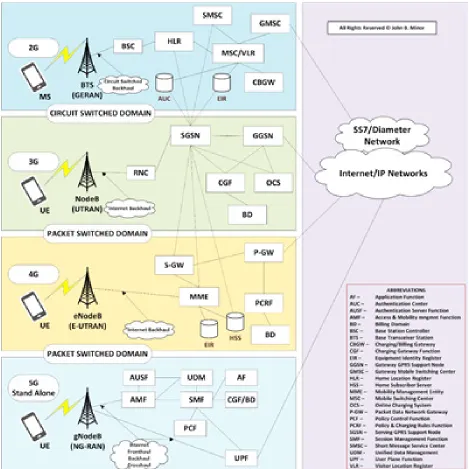
A logical diagram of 2G, 3G, 4G and 5G ar-chitecture including an overview of the basic network elements and reference connectivity to the billing domain elucidates the concept that mobile networks are complex systems. These systems require significant knowledge JDFSLV14N2
Opticalmetrologyis the scienceand tech-nology of measurements with photons. In forensiccell site analysis 95% of the commu-nicationslinkage between subscriber device andmobileswitchingcoreiscomposedof pho-toniclinks. Understanding the measurement unit and normal link loss over segments of thephotonicnetworks employed totransport communicationssessions fora subscriber de-vice on the mobile network is essential to calculatingprobabilities of network latency issues that may cause dropped calls, out of sequencetext messaging, andother irregular-ities in communications sessions.
Metrology assists decision making in the analytical process by quantifying measure-ments and depending on type I (false posi-tive) and type II (false negative)error rate determination.
Systematicerrors usually originate within testandmeasurementinstruments andoccur due toinstrument malfunction orimproper use. Randomerrorsoccurbyunknownand of-tenunpredictablefactorssuchasatmospheric conditionsormorphologiesintroducing reflec-tion, refractionor absorption ofradio signals.
2.7
Computer
Science
by analysts of the differences and complexi-ties within each network generation.
The CDRs are extracted from larger database systems within the mobile net-work charging/billing infrastructure. The integrity of evidence extracted from this data repository is dependent upon the extraction methodology employed by mobile network legal production personnel and the handling of the evidence post extraction. Mobile
network records custodians do not produce any chain of custody documentation, how-ever, in many instances the records custodian prepares a notarized certification of records, indicating, for example, that “such records were kept in the course of regularly conducted business activity”, that “the business activity made such records as a regular practice” and that “if such record is not the original, such record is a duplicate of the original”. Typi-cally, the certification letter lists the phone number(s) and start and end dates of records produced without listing, by name or other means, the digital evidence items accompa-nying the certification.
Various other records are also maintained by various MNO/MVNO departments includ-ing billinclud-ing records, network maintenance logs, real time and near real-time subscriber de-vice location tracking logs, cell site database records that include technical data about each access point in the mobile network, con-figuration data regarding how the mobile net-work is configured, mobile netnet-work radio sur-vey or drive test data, key performance in-dicator data that exhibits the coverage and health of the mobile network and other tech-nical information about subscriber activities or network conditions. All records, apart from handwritten logs from physical cell site access, of maintenance, upgrade and repair personnel, are digital in origin and should be considered digital evidence when produced in court as evidence.
In the digital forensic science discipline, digital evidence obtained from sources includ-ing computer hard drive evidence and mobile device (cell phone), is preserved using a chain of custody methodology and must be proven identifiable as true to the original evidence produced to avoid preclusion by the courts. Digital evidence integrity is assured with ver-ification of metadata creation and modifica-tion date/time preservamodifica-tion along with verifi-cation function cryptographic checksum hash-ing of each digital evidence item.
The International Organization of Stan-dards (ISO) and the Internet Engineering Task Force (IETF) have published standards for the acquisition, preservation and handling of digital evidence, including the establish-ment of chain of custody and evidence ver-ification function. The National Institute of Standards and Technology (NIST) and the American Society for Testing and Mate-rials (ASTM) International have published extensive forensic evidence guidance and stan-dards documents for the acquisition, valida-tion and analysis of computer and cell phone evidence. Curiously absent are standards for the handling, validation or error mitigation of CDR/CSLI evidence in any of the afore-mentioned standards bodies.
JDFSL V14N2 Forensic Cell Site Analysis...
Figure 1. 2G-3G-4G-5G Mobile Network / Charging/Billing Architecture
2.9
Mobile Network Toll &
Call Data Records Are a
Computer Driven Process
Other records are produced by MNO/MVNO include a variety of logs, technical configuration data for segments of the mobile network, test data from radio survey results, and billing records.
2.10
Charging and Billing
System
The MNO/MVNO charging/billing sys-tem necessarily maintains careful account-ing of subscriber communications activi-ties. The charging/billing system of each MNO/MVNO is operated according to stan-dards established by a variety of organiza-tions, including national and international bodies.
Charging Data Records, commonly known as Call Detail Records (CDRs) are main-tained and produced from a standards based data flow to the Charging Gateway Func-tion and into the CDR database in a format established by standards.
2.11
3GPP/ETSI Standards
One of the applicable standards related to billing and charging functionality, for ex-ample, are specified within 3GPP TS 32.299 V12.6.0 (2014-10)(ETSI, 2014) 3rd Genera-tion Partnership Project; Technical Specifi-cation Group Service and System Aspects; Telecommunication management; Charging management; Diameter charging applications (Release 8). These standards among others are followed by MNO/MVNO in the United States and virtually all other MNO/MVNO.
The 3rd Generation Partnership Project (3GPP) – European Telecommunications Standards Institute (ETSI) TS 32.297 v13.2.0 (2016-06) standard addresses Charging man-agement; Charging Data Record (CDR) file format and transfer, thereby clearly demon-strating that MNO/MVNO records are digi-tal evidence.
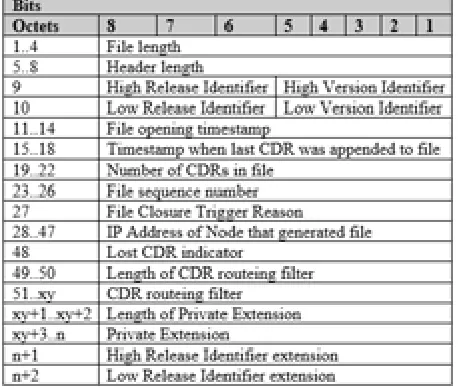
In Chapter 6 of TS 32.297 v13.2.0, CDR file format specification, 6.1.1.0, General, the exact format of the CDR file header is given in table 6.1.1.1. This record keeping format is indicative of entirely digital content. Note that timestamps, file sequence numbers and
other important information is maintained, according to this standard. (ETSI, 2016) The following table, from chapter 6, provides the data repository record layout for CDR data:
Table 6.1.1.0.1: Format of CDR file header (p.21)
CDRs are addressed extensively in the file header and a variety of key indicators of the digital nature of this record keeping activity includes timestamp metadata, record num-bers, file sequence numnum-bers, record exten-sion information and IP addressing of the node generating the CDR file. The specifica-tion concisely addresses how informaspecifica-tion is recorded and integrity is maintained.
Metadata timestamps include when a CDR file was opened, the local time differential off-set from Universal Coordinated Time (UTC), append and closure times.
Information integrity is addressed in this format standard including number of CDRs in a file, file sequence numbers, file closure triggering and reasons for closure.
Finally, the specification provides for the IP address of the Charging Gateway Func-tion creating the CDR file and a Lost CDR Indicator providing traceability of any error conditions detected.
JDFSL V14N2 Forensic Cell Site Analysis...
6.1.1.5 File opening timestamp These parameters indicate the time when the file was opened, according to the following binary format:
- The first four binary bits indicate the month (1 .. 12), according to the CGF’s(ETSI, 2005)
local time zone;
- The next five binary bits contain the date (1 :: 31), according to the CGF’s local time
zone;
- The next five binary bits contain the hour (0 .. 23), according to the CGF’s local time
zone;
- The next six binary bits contain the minute (0 .. 59), according to the CGF’s local time
zone;
- The next bit indicates the sign of the local time differential from UTC (bit set to “1” expresses ”+” or bit set to ”0” expresses ”-” time deviation), in case the time differential to UTC is 0 then the sign may be arbitrarily set to ”+” or ”-”;
- The next five binary bits contain the hour (0 .. 23) deviation of the local time towards UTC, according to the CGF’s local time zone; - The next six binary bits contain the minute (0 .. 59) deviation of the local time towards UTC, according to the CGF’s local time zone; Note that the CDR file name contains de-tailed date and time information related to file closure (see clause 6.2)
taining more CDRs than represented by that value) and shall therefore not be used.
6.1.1.8 File sequence number This pa-rameter is a value in binary that contains a running number of the CDR file generated by the same CGF. The first file of a CGF is indicated by the value ”0”. When the max-imum number of file is reached (all bits set to “1”), the sequence shall be restarted with ”0”.
6.1.1.9 File closure trigger reason The file closure reason provides a means to deter-mine the reason that the file was closed by the CGF. It is encoded as a single octet as follows:
Normal closure reasons (Binary values 0 to 127):
0 = Normal closure (Undefined normal clo-sure reason).
1 = File size limit reached (OAM&P config-ured).
2 = File open-time limit reached (OAM&P configured).
3 = Maximum number of CDRs in file reached (OAM&P configured).
4 = File closed by manual intervention. 5 = CDR release, version or encoding change. 6 to 127 are reserved for future use.
Abnormal closure reasons (Binary values 128 to 255):
128 = Abnormal file closure (Undefined error closure reason).
129 = File system error.
130 = File system storage exhausted. 131 = File integrity error.
132 to 255 are reserved for future use.
6.1.1.10 Node IP address This param-eter indicates the IP address of the CGF generating the file. For both IPv4 and IPv6 CGF addresses, the parameter is encoded in IPv6 representation. The first four bytes of the parameter, which are [preceding] this IPv6 address, are insignificant, e.g. filled with ’FF’.
6.1.1.6 Last CDR append timestamp This parameter is formattedthe sameas in clause 6.1.1.5, and indicatesthe time when the last CDR was appended to the file in UTCformat. Incaseofanemptyfile(i.e. no CDRs included), the valueof the parameter is ”0”.
6.1.1.7 Number of CDRs in file This parameter contains abinary valuethat spec-ifies the total number of CDRs that are in-cluded inthe file.
con-6.1.1.11 Lost CDR indicator This pa-rameter indicates if and how many CDRs were lost during their processing in the CGF (see clause 5.1.1). The term ”lost” implies that the CDR(s) could not be placed into the destination file due to irrecoverable errors. Due to the possibility that the irrecoverable CDR errors may have impacted CDR param-eters that are relevant for CDR routeing, it is possible that the CGF cannot determine for a particular file whether CDRs have been lost. Appropriate indication shall be given according to the following encoding of the ”lost CDR indicator”.
- MSB bit “0”, all other bits “0”: no CDRs have been lost;
- MSB bit “0”, all other bits set to a value corresponding to decimal 1 to decimal 126: CGF has identified that a number of CDRs corresponding to the value of the lower 7 bits were lost, while it is unknown whether more CDRs were lost;
- MSB bit “0”, all other bits set to “1”: CGF has identified that 127 or more CDRs were lost, while it is unknown whether more CDRs were lost;
- MSB bit “1”, all other bits “0”: CDRs have been lost but CGF cannot determine the number of lost CDRs;
- MSB bit “1”, all other bits set to a value corresponding to decimal 1 to decimal 126: CGF has calculated the number of lost CDRs as indicated in the value of the lower 7 bits; - MSB bit “1”, all other bits set to “1”: CGF has calculated the number of lost CDRs to be 127 or more.” (ETSI, 2016)
2.12
Digital Evidence
Integrity Maintenance
Standards
ISO (The International Organization for Standardization) and IEC (The International Electrotechnical Commission) form the
spe-cialized system for worldwide standardiza-tion. National bodies that are members of ISO or IEC participate in the development of International Standards through techni-cal committees established by the respective organization to deal with specific fields of technical activity. (ISO, 2012)
ISO 27037, Section 5.4, titled “Digital ev-idence handling processes”, Section 6 titled “Key components of identification, collection, acquisition and preservation of digital evi-dence”, and Section 6.1, titled “Chain of cus-tody” (ibid), address the global standards for digital evidence handling including collec-tion, acquisicollec-tion, preservation and chain of custody.
The introduction to ISO 27037 states in part . . . “These processes are required in an investigation that is designed to main-tain the integrity of the digital evidence – an acceptable methodology in obtaining digital evidence that will contribute to its admissibil-ity in legal and disciplinary actions as well as other required instances. This International Standard also provides general guidelines for the collection of non-digital evidence that may be helpful in the analysis stage of the potential digital evidence.”
The standard continues with the follow-ing statement: “This International Standard also intends to inform decision-makers who need to determine the reliability of digital evidence presented to them. It is applicable to organizations needing to protect, analyze and present potential digital evidence.” . . . ” Due to the fragility of digital evidence, it is necessary to carry out an acceptable method-ology to ensure the integrity and authenticity of the potential digital evidence.”
Under Section 1, Scope, the standard de-lineates applicable devices as ” . . . devices and/or functions that are used in various circumstances:
JDFSL V14N2 Forensic Cell Site Analysis...
and magneto optical disks, data devices with similar functions,
— Mobile phones, Personal Digital Assistants (PDAs), Personal Electronic Devices (PEDs),
memory cards,
— Mobile navigation systems,
— Digital still and video cameras (including CCTV),
— Standard computer with network connec-tions,
— Networks based on TCP/IP and other digi-tal protocols, and
— Devices with similar functions as above.” MNO/MVNO networks are a composite of several of the listed devices including “net-works based on TCP/IP and other digital protocols”, “digital storage media used in standard computers”, “mobile navigation sys-tems”, “mobile phones, personal digital as-sistants”, “standard computer with network connection”, and “devices with similar func-tions as above”.
Under Section 3, Terms and Definitions, several definitions were found to be relevant to this analysis, including:
“3.1 acquisition
process of creating a copy of data within a defined set Note 1 to entry: The product of an acquisition is a potential digital evidence copy.”
“3.5 digital evidence
information or data, stored or transmitted in binary form that may be relied on as evi-dence”
“3.6 digital evidence copy
copy of the digital evidence that has been produced to maintain the reliability of the ev-idence by including both the digital evev-idence and verification means where the method of verifying it can be either embedded in or in-dependent from the tools used in doing the verification”
“3.1 preservation
process to maintain and safeguard the in-tegrity and/or original condition of the po-tential digital evidence”
“3.19 spoliation
act of making or allowing change(s) to the potential digital evidence that diminishes its evidential value”
“3.22 timestamp
time variant parameter which denotes a point in time with respect to a common time refer-ence
[SOURCE: ISO/IEC 11770-1:1996]” “3.25 verification function
function which is used to verify that two sets of data are identical
Note 1 to entry: No two non-identical data sets should produce an identical match from a verification function.
Note 2 to entry: Verification functions are commonly implemented using hash functions such as MD5, SHA1, etc., but other methods may be used.”
ASTM International establishes that “con-fidence in digital and multimedia evidence forensic results is best achieved by using an error mitigation analysis approach that fo-cuses on recognizing potential sources of error and then applying techniques used to miti-gate them, including trained and competent personnel using tested and validated methods and practices”. (ASTM, 2018)
All MNO/MVNO networks are pervasively integrated into the network of networks com-monly called the Internet. Voice, text and data communications over the cellular net-work traverse the Internet from cell sites to MNO/MVNO network core (Cisco, 2011).
The Internet Engineering Task Force (IETF) provides guidance and standardiza-tion for handling digital evidence in RFC 3227. The standard states in part “. . . you should consider generating checksums and cryptographically signing the collected evi-dence, as this may make it easier to preserve a strong chain of evidence. In doing so you must not alter the evidence.” (IETF, 2002)
The National Institute of Standards and Technology (NIST), in the publica-tion “Guidelines on Mobile Device Forensics” (NIST, 2007), verifies that all digital evidence
must be handled using an appropriate chain of custody and a forensic hash validation of the evidence. NIST defines each of the pro-cedures as follows:
• “Forensic Hash Validation: A forensic hash is used to maintain the integrity of an acquisition by computing a crypto-graphically strong, non-reversible value over the acquired data. After acquisition, any changes made to the data may be de-tected, since a new hash value computed over the data will be inconsistent with the old value. For non-forensic tools, hash values should be created using a tool such as sha1sum and retained for in-tegrity verification. Even tools labelled as forensic tools may not compute a cryp-tographic hash, and (in these cases an integrity hash should be computed sepa-rately).”
• “Chain of Custody – A process that tracks the movement of evidence through its collection, safeguarding, and analy-sis lifecycle by documenting each person who handled the evidence, the date/time it was collected or transferred, and the purpose for any transfers.”
The Forensic Hash Validation is an integral part of the scientific digital forensics step process.
The verification function mentioned in ISO 27037 is best performed by comparing two digital evidence artifacts using a forensic hash validation.
2.13
Role of Metadata Date &
Time
An important method of determining if digital evidence is spoliated is to analyze metadata creation and modification times and authorship of digital evidence artifacts. Documents such as Microsoft Word, Excel Spreadsheets or Adobe PDF’s can also be an-alyzed for content creation and modification metadata, including authorship to further enhance the accuracy of digital evidence spo-liation analysis.
Metadata creation and modification dates/-times should be identical if copies of digital evidence have not been tainted. Absence of this information is an important positive in-dicator of spoliation, absent the presence of verification function hash values.
NIST publication “Guide To Integrating Forensic Techniques Into Incident Response” describes external file metadata as follows - File Modification, Access and Creation
Times.
It is often important to know when a file was created, used, or manipulated, and most OSs keep track of certain timestamps related to files. The most commonly used times-tamps are the modification, access, and cre-ation (MAC) times, as follows:
• Modification Time. This is the last time a file was changed in any way, including when a file is written to and when it is changed by another program.
• Access Time. This is the last time any access was performed on a file (e.g., viewed, opened, printed).
how-JDFSL V14N2 Forensic Cell Site Analysis...
ever, when a file is copied to a system, the creation time will become the time the file was copied to the new system. The modification time will remain intact.
A method of validating cellular carrier records accuracy for forensic cell site analysis is defined in United States Patent US9113307. The process includes a multi-part test to vali-date CDR/CSLI records and an analysis error mitigation methodology.
At least one MNO/MVNO has concluded that this evidence is digital evidence and should be treated as such. In 2013, AT&T Mobility acquired Cricket Wireless, a prepaid mobile network provider (Mobile Virtual Net-work Operator or MVNO). Cricket Wireless uses the AT&T infrastructure to process com-munications for its subscribers and the
AT&T Mobility charging/billing system provides usage records to Cricket Wireless. Cricket produces CDR/CSLI evidence for its subscribers in response to legal requests and offers the following disclaimer when digital copies of CDR/CSLI evidence is produced and emailed to a requesting party:
“At the request of the law enforce-ment agency receiving the following Subpoena Compliance information, Cricket Communications (”Cricket”) provides the following information electronically in a searchable, manip-ulable form. Although Cricket veri-fies the authenticity of the informa-tion attached to this e-mail as sent, Cricket cannot and will not testify to the authenticity of this information after it is received by the recipient law enforcement agency. This is be-cause the attached information elec-tronically sent by Cricket is manipu-lable.” (Pennsylvania Superior Court, 2016)
3.
RESEARCH
METHODOLOGY
The analysis was performed in four phases as follows:
Different typesof filesystem maystore differ-ent types of times. For example, Windows systemsretainthelastmodifiedtime,thelast access time, andthe creationtime of files...” (NIST,2006)
2.14
Error
Rates
MNO/MVNO have documented error rates in subscriber activity records that, to date, have not been publicly disclosed. Research performed during validation and error mit-igation testing on over 300,000 pages of MNO/MVNO produced evidence realized er-ror rates that approach 2% in some cases (Minor, 2017).
Thepreviouslymentioned3GPP/ETSITS 32.297standard, Section6.1.1.11 LostCDR indicator,mentions error rates; however,in hundreds of cases analyzed,and many cases inwhich aMNO/MVNO employeetestified, none has everdisclosed any error rate infor-mation. The standard states in part ”This parameter indicates if and how manyCDRs were lost duringtheir processing in theCGF (see clause 5.1.1). The term ”lost” implies thattheCDR(s) couldnotbeplacedintothe destination file due toirrecoverable errors.”
3.1
Phase I
A four-part test was applied to first de-termine if MNO/MVNO subscriber activity records should be subjected to digital ev-idence handling and analysis standards as follows:
• Is MNO/MVNO subscriber communica-tions activity record keeping a computer driven digital process?
• Are subscriber communications activity records, extracted for litigation purposes, digital evidence?
• Is this type of evidence subject to digital evidence handling standards?
• Do the same rules for spoliation deter-mination apply to this type of evidence?
3.2
Phase II
The control group of MNO/MVNO digi-tal evidence was reviewed for the presence of any chain of custody documents. Note that any certification letters provided by records custodians do not list evidence items by doc-ument name, number or other confirmable identifier.
3.3
Phase III
The MNO/MVNO CDR evidence was then subjected to a five-part metadata analysis using the following protocol:
• Internally within each digital evidence item, any document “creation date” metadata including date and author. This portion of the analysis was doc-umented under the Internal Document Metadata categorization.
• Internally within each digital evidence item, any document “modification date” metadata including date and author.
This portion of the analysis was doc-umented under the Internal Document Metadata categorization.
• Internally within each digital evidence item, any document “last printed date” metadata including date and author. This portion of the analysis was doc-umented under the Internal Document Metadata categorization.
• Externally, any valid original creation date metadata for each digital evidence item. This portion of the analysis was documented under the External File Metadata categorization. (NIST, 2006)
• Externally, any valid original modifica-tion date metadata for each digital evi-dence item. This portion of the analysis was documented under the External File Metadata categorization.
3.4
Phase IV
Finally, a verification function analysis was performed to determine that the copy of the evidence is identical to the evidence produced by the MNO/MVNO custodian of records in the following manner:
• Each evidence item was scrutinized for a verification function cryptographic checksum hash value. A cryptographic checksum hash value should have been calculated on the original and any copy of the evidence item.
JDFSL V14N2 Forensic Cell Site Analysis...
Microsoft Excel, a spreadsheet database software product, was utilized to document the chain of custody analysis, metadata anal-ysis, verification function analysis outlined above and document the presence or absence of spoliation. All information in the matrix is independently verifiable.
4.
OUTCOMES
4.1
Phase I - Business
Records – The Question of
Digital Evidence
Are Mobile Network Records Produced as Evidence Actually Digital Evidence?
Analysis of MNO/MVNO CDR evidence was undertaken from the research control group of cases to determine if each evidence artifact should be classified as digital evi-dence by applying the devised four-part test. All evidence items tested positive as digital evidence.
The following outcomes were observed for Phase I:
1. Is MNO/MVNO subscriber communica-tions activity record keeping a computer driven digital process? Yes, standards for digital record keeping methods and formats clearly affirm this question.
2. Are MNO/MVNO subscriber communi-cations activity records, extracted for litigation purposes, classified as digital evidence? Yes, the records are created digitally by computing-based methods and the extracted reports produced are digital evidence and, thus, are purely digital from inception to production.
3. Is this type of evidence subject to digital evidence handling standards? Yes, all digital evidence is subject to the same evidence handling standards.
4. Do the same rules for evidence spolia-tion determinaspolia-tion apply to this type of evidence? Yes, no exceptions to the standards are addressed.
4.2
Phase II - Chain of
Custody Issue
No chain of custody documentation accom-panied any of the evidence. Chain of custody documentation should have been created and forwarded with the CDR evidence from the MNO/MVNO legal department/custodian of records and all others conveying the evidence.
The Custodian of Records certification let-ters were present in many cases. When such documents were present, the certifications did not describe or specify which files, doc-uments or other digital evidence were being provided, by file name, traceable number or any other recognizable, traceable or account-able method.
The following outcomes were observed for Phase II:
None of the digital evidence items were accompanied by chain of custody documen-tation.
4.3
Phase III - Evidence
Condition Observations
and Findings
A spoliation analysis of the MNO/MVNO CDR evidence produced the following results:
1. Observation: MNO/MVNO CDR evi-dence within the control group was pro-duced in a variety of digital formats including Microsoft Excel spreadsheet file, comma-separated values (CSV) file (IETF, 2005) (typically opened
Figure 2. Outcomes Summary
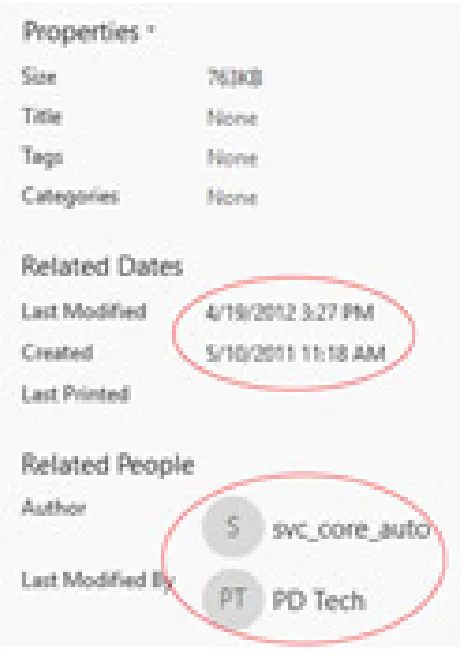
2. Observation: MNOs/MVNOs began to offer degraded evidence production as pressure to respond to escalating de-mand during recent years. Observed manifestations were typically either re-moval of all creation/modification meta-data, creation of documents using meth-ods that produce no creation/modifica-tion metadata, multiple employee (au-thor) creation/modification metadata, or removal of employee (author) meta-data combined with differing creation and modification metadata. Examples of appropriate creation/modification meta-data were rarely found within the control group.
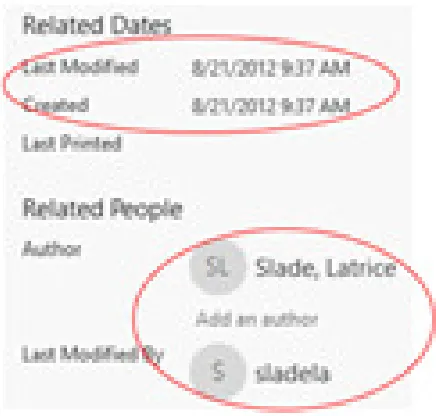
Figure 3. MNO evidence item example in-dicating appropriate evidence creation and handling
Examples of tainted evidence is indicated in significant percentages of MNO/MVNO
ev-Figure 4. MNO evidence item example inter-nal metadata with proper artifact integrity
idence when multiple authors are discovered during analysis of metadata.
JDFSL V14N2 Forensic Cell Site Analysis...
Figure 5. MNO evidence item example pre-senting multiple authors with no metadata date changes. The Last Modified by author is consistent with changes by a different author
from some MNOs/MVNOs do not pro-vide neighboring cell site locations.
2. The National Domestic Communi-cations Assistance Center (NDCAC, 2018) is provided extensive support by MNOs/MVNOs, specifically supplying lists of cell sites with technical config-urations for each site to NDCAC. A request to NDCAC for access to the cell site database receives an access de-nial from NDCAC personnel with the message “Users who access our systems must acknowledge and attest they are an employee of a law enforcement or
Figure 6. MNO evidence item example pre-senting multiple authors and disparate cre-ation and modificcre-ation dates metadata evi-dence taint
criminal justice agency, in good stand-ing and are accessstand-ing this U.S. Govern-ment system for official use only”. Until MNOs/MVNOs provide the information produced in a data repository that is ac-cessible to all stakeholders / practition-ers, or, an acceptance of MNO/MVNO evidence as digital evidence transpires, performing any verification of authentic-ity or validation of the condition of this category of evidence will continue to be a challenge.
Figure 7. Results of the Phase III Analysis
1. Analysis of the internal file metadata present within the evidence revealed that only 0.41% of the internal metadata cre-ation dates had been altered.
2. Various authorship was indicated in internal file creation and modification metadata in 10.9% of the control group analysis.
3. The last modified date, according to internal file metadata, was not consis-tent with pristine evidence condition in 23.17% of the evidence.
4. 20.14% of the evidence was found to have been scrubbed of internal file meta-data creation / modification information, thus rendering the evidence subject to undetectable, inappropriate alteration. The most commonly observed evidence with such missing metadata was Comma Separated Values or CSV data, a method of saving spreadsheet files, commonly used to eradicate any indications of au-thorship or metadata creation/modifica-tion informacreation/modifica-tion. CSV format evidence
from the control group is from more re-cent cases.
5. External file metadata for last modified date was found to be tainted in 37.79% of the evidence.
6. Overall, excluding the tests for chain of custody and verification function hash value presence, 74.07% of evidence re-viewed from the control group were found to be tainted.
7. Evidence taint was introduced ei-ther carelessly or nefariously by MNO/MVNO employees, law enforce-ment investigators, attorney staff or others involved in handling and conveyance of evidence.
8. 100% of the evidence was found to have no chain of custody documentation.
9. 100% of the evidence was found to have no calculated verification function cryp-tographic checksum hash values.
4.4
Phase IV – Verification
Function Calculated Hash
Value Analysis
The following outcomes were observed for Phase IV:
JDFSL V14N2 Forensic Cell Site Analysis...
Figure 8. Evidence Spoliation/Taint was Discovered Throughout the Stakeholder Spectrum
5.
EVIDENCE
INTEGRITY
MAINTENANCE
SOLUTIONS
MNOs/MVNOs do not currently utilize a mechanism to properly preserve the integrity of evidence produced in criminal or civil case requests. Research into multiple existing or emerging chain of custody/verification func-tion technologies resulted in potential solu-tions to the evidence integrity maintenance challenge.
5.1
Background and
Incentives
Key incentives for MNO/MVNO adoption of a solution are likely to be the following:
• Ease of integrating a solution into exist-ing chargexist-ing/billexist-ing architectures.
• Judicious Capitalization (CAPEX) and Operating (OPEX) Expenses.
• Timeliness and performance speed of ev-idence integrity preservation processing.
• Ability for the solution to be assimilated by each successive generation of the mo-bile network.
MNO/MVNO evidence production is clearly a process lacking uniformity between operators, varying widely in internal evidence extraction techniques. Format and content of evidence production also varies widely.
Standards are non-existent for uniform MNO/MVNO evidence extraction, format, integrity assurance or delivery methods. The widespread use of this type of evidence in criminal and civil cases necessitates an ur-gent need for evidence production and man-agement protocols that incorporate chain of custody, verification function hash value gen-eration and maintenance of evidence integrity assurance, none of which are currently uti-lized by MNO/MVNO nor other digital plat-forms such as social network, search engine, or other digital service providers during evi-dence production.
This research project undertook develop-ment of a simplified solution to MNO/MVNO evidence production protocols that would pro-vide a relatively low cost, state of the art evidence integrity assurance mechanism that meets basic digital evidence handling stan-dards. MNO/MVNO operations are complex, ultra-busy environs with an exponential rise in communications volume and evidence pro-duction expected in the coming years, con-sequently any solution would necessarily be efficient and effective.
5.2
Distributed Ledger
Technology/Block-chain
Research
Block-chain/Distributed Ledger Technology (DLT)(Gramoli, 2018) offers a promising solu-tion to digital document authenticasolu-tion and verification. Block-chain paradigms such as Bitcoin and other open source technologies, e.g. Openchain (Openchain, 2019), provide for a distributed ledger-based chain of cus-tody and verification function checksum hash value generation for each evidence artifact, en-abling an analyst to verify evidence integrity. Numerous service providers currently offer document authentication and verification ser-vices that utilize Block-chain/DLT protocols. Incorporating a built-in Block-chain/DLT client during the evidence production process would eliminate the evidence spoliation/taint issues discovered during this research project and would introduce readily validated dence that is synonymous with digital evi-dence in all other digital forensics disciplines. Block-chain/DLT provides key elements of a functional architecture that ensure validity and integrity of digital evidence.
Fundamental DLT Architecture
The architecture of Distributed Ledger Tech-nology is articulated in several elements. (Gramoli, 2018)
The Consensus Element (p.19) is a funda-mental function of a Block-chain providing a “distributed voting process”. Protocols that are both scalable and secure will be required to accommodate the rapidly growing world of MNO/MVNO evidence production.
The Security Element (p.20) is critical to authentication and integrity, providing mali-cious user protections.
The Validation Element (p.20) is the asym-metric cryptographic system used to create necessary public and private key pairs, us-ing technologies currently available includus-ing
Elliptic Curve Cryptography (ECC) (IETF, 2011) algorithms. Despite security
concerns regarding early ECC algorithms adopted by NIST (NIST, 2000) almost 20 years ago, more current ECC including Curve 25519 (IETF, 2016) offer security levels with exponentiated Elliptical Curve Digital Signa-ture Algorithm (ECDSA) protections.
The Ownership Element (Gramoli, p. 20) enables transfer of evidence copy while ensur-ing authenticity and integrity. DLT transac-tion language offers the opportunity for such transfer of digital assets between accounts while maintaining evidence integrity.
All entities requesting evidence production from an MNO/MVNO would be dealt with uniformly as follows:
1. As evidence extraction from the
MNO/MVNO occurs a
Block-chain/DLT process is incorporated during evidence production to create a chain of custody and a public key is utilized to encrypt each evidence item.
2. Using Block-chaining transaction tech-niques during the encryption process, a ledger-based chain of custody and verifi-cation function hash value calculation is automatically created.
3. Each evidence artifact is transmitted to an evidence portal to be accessed by the evidence requesting entity. Evidence items are decrypted by authorized par-ties, producing a chain of custody result-ing in self-auditresult-ing evidence artifacts.
4. An evidence integrity checking mecha-nism is integrated into the same portal, resulting in the ability for anyone who has access to the evidence to determine the condition of the evidence.
JDFSL V14N2 Forensic Cell Site Analysis...
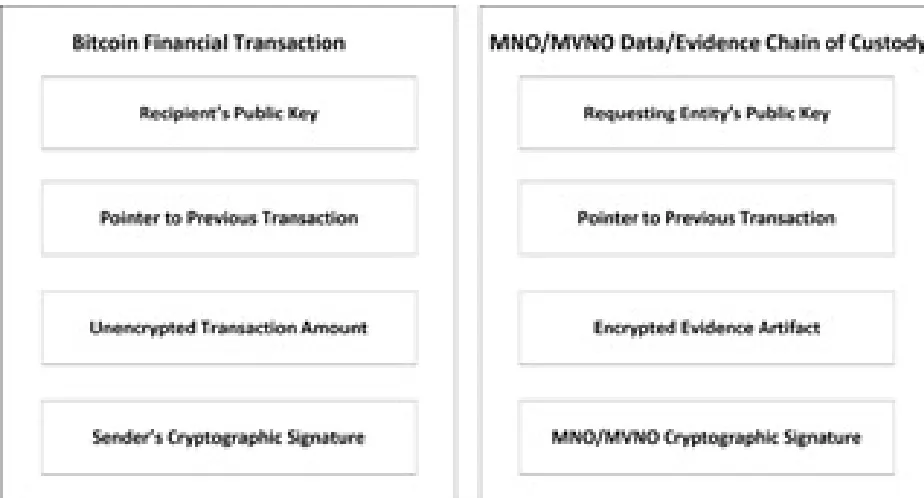
Figure 9. Comparison of Bitcoin Financial Transaction and MNO/MVNO Evidence Transac-tion Paradigms
Figure 10. Data Flow for the MNO/MVNO Compliance Center Evidence Production with Built-in Distributed Ledger
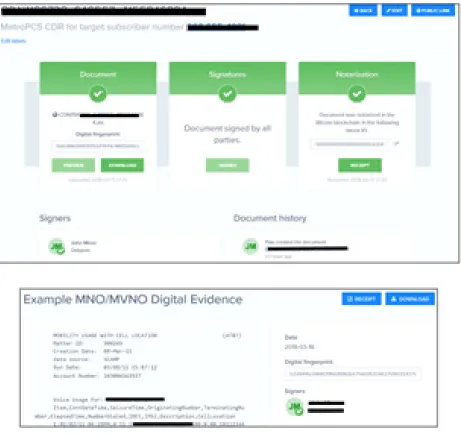
MNO/MVNO evidence, an experiment was conducted using MNO/MVNO produced evi-dence to authenticate and provide condition verification services for each evidence item.
The experiment consisted of several steps as follows:
1. Creation of a user ID on the website of a provider offering DLT digital document authentication and verification services.
2. Two MNO/MVNO evidence items were then processed into the portal. The time
to perform an intake varied from 15-45 seconds (processing time is primarily re-lated to digital file size and Internet ac-cess bandwidth). Proac-cessing timeliness may be a critical function for MNOs as the volume of evidence requests soars.
Figure 11. Example test Block-chain processing of MNO/MVNO evidence
4. The intake, verification function hash value calculation and signature process required a total of 1-2 minutes to per-form for each evidence artifact. The final step in this process, notarization, required a short pause for verification of steps 1-3.
5. At this stage in the process the evid-nce receipt is available, and the evideevid-nce item is available to download by the re-questing party.
Block-chain/DLT research (Bonomi 2018) (Lone 2019) has produced similar methods for
evidence processing, demonstrating that at least conceptually, this is a potential solution that MNOs/MVNOs, and tech giants such as Facebook, Google and other technology platforms could readily integrate to introduce an evidence integrity maintenance process to legal records production as evidence.
Forensic Cell Site Analysis...
integrity, and with affirmative evidence spoli-ation/taint indicators, such evidence should be precluded by a court.
The use of a variety of existing methods for maintaining the integrity of digital evi-dence offers an opportunity to bring much needed integrity to MNO/MVNO evidence production.
Use of Block-chain based DLT technol-ogy, researched and tested as an evidence integrity maintenance solution, would per-mit MNO/MVNO organizations to create chain of custody and verification function cryptographic hash value calculations during evidence production. The process could be performed with minimal human interaction, requiring no trusted third party while ensur-ing that evidence integrity endures durensur-ing evidence conveyance among parties.
Further performance and conformity testing will ultimately evolve an ade-quately robust mechanism for preserving ev-idence integrity in MNO/MVNO environs. MNOs/MVNOs work together continuously to create global standards for the operation and inter-operation of mobile networks world-wide. No published standards work has oc-curred to jointly create a uniform evidence production format or evidence handling, in-tegrity maintenance and conveyance proto-cols.
5G and future Generations of mobile net-works are expected to continue to produce increasing volumes of evidence as continu-ous connectivity between subscribers reaches ubiquity and use of this evidence in criminal and civil cases becomes ever more prolific.
MNOs/MVNOs cooperate with govern-ment and law enforcegovern-ment entities necessarily as a requirement of CALEA and other acts. The Federal Communications Commission (FCC) regulates radio frequency spectrum in the United States yet has no oversight regard-ing evidence produced by MNOs/MVNOs. Determination whether evidence produced JDFSLV14N2
MNOs/MVNOs includethe use of a digital certificate, by ”[i]nserting the certifica-tion into the file”, research of which has demonstrated,“is the only apparent reliable method and is theapproach used by leading companies such asMicrosoft andAdobe for digitalsigningofOffice andPDFdocuments” (Curran 2017) offer potential resolution of
this issue, however may be cumbersome to integrate.
6.
CONCLUSIONS
The MNO/MVNO evidence analyzed dur-ing thisresearch project was determined to be digital evidence. Subsequently, the evi-dence was subjected to a multi-part spolia-tion/taint test and examined to validate if each digital evidence artifact was identical to the evidence originally produced by the MNO/MVNO recordscustodian.
Over74% of the evidence was determined to bespoliated/tainted based uponan anal-ysis of the metadata creation/modification dates and/or authorship for each evidence artifact.
National and international standards for thepreservation, integrity maintenance and handlingofdigitalevidencewerenotfollowed in100% of the evidence.
Neither chain of custody documentation nor verification functioncryptographic hash valueswerefoundtobepresentwithinanyof the evidence, further eliminating any oppor-tunityto validatethatthe evidenceanalyzed was an exact copy of the original evidence producedby the MNO/MVNO.
by MNOs/MVNOs is permissible in a court-room as business records under FRE 803 (6) or is required to be treated as digital evi-dence falls under the scope of the United States Federal Judiciary. A persuasive ar-gument using FRE 803 (6)(E) could result in a judicial decision that the current prac-tice of introducing this evidence in a court as business records is an obsolete paradigm for MNO/MVNO evidence acceptance by courts, resulting in a shift in judicial precedent for this issue. The increased use of this type of evidence in criminal and civil cases could also result in U.S. Congress deciding to regulate these decisions through legislation to ensure that constitutional rights are upheld.
Only when MNOs/MVNOs follow well es-tablished digital evidence preservation, in-tegrity maintenance and handling protocols will pristine evidence be found throughout the life cycle of a civil or criminal case.
REFERENCES
[1] American Society for Testing and Materials (ASTM)(2018), Standard Ter-minology for Digital and Multimedia Evidence. Retrieved on December 15, 2018 from https://compass.astm.org/EDIT /html annot.cgi?E2916+13#s00007
[2] American Society for Testing and Materials (ASTM)(2018). ASTM E3016-18 Standard Guide for Establishing Confidence in Digital and Multimedia Evi-dence Forensic Results by Error Mitigation Analysis. Retrieved on January 4, 2019, from https://www.astm.org/Standards/E3016.htm
[3] Bonomi, Silvia & Casini, Marco & Ciccotelli, Claudio. (2018). B-CoC: A Block-chain-based Chain of Custody for Evidences Management in Digital Foren-sics. Retrieved on June 6, 2019, from https://www.researchgate.net/publication
/326681814 B-CoC A Block-chain-based Chain of Custody for Evidences
Management in Digital Forensics
[4] Cisco (2011). The Case for IP Backhaul -The Internet Protocol Journal, Volume 14, No. 3. Retrieved on January 4, 2019, from https://www.cisco.com/c/en/us/about/press/ internet-protocol-journal/back-issues/table-contents-53/143-backhaul.html
[5] Curran,Kevin, Harran, Martin, & Farrelly, William. (2017). A method for verifying integrity & authenticating digital media. Letterkenny Institute of Technology, Done-gal, Ireland, Ulster University, Derry, United Kingdom. Retrieved on June 6, 2019, from https://doi.org/10.1016/j.aci.2017.05.006
[6] European Telecommunications Standards Institute (ETSI). (2005). Universal Mobile Telecommunications System (UMTS); Telecommunication management; Charging management; Charging architecture and principles (3GPP TS 32.240 version 6.2.0 Release 6)
[7] Retrieved on January 4, 2019, from http://www.etsi.org/deliver/etsi
ts/132200 132299/132240/06.02.00 60 /ts 132240v060200p.pdf
[8] European Telecommunications Standards Institute (ETSI). (2014) Digital cellular telecommunications system (Phase 2+); Universal Mobile Telecommunications System (UMTS); LTE; Telecommunication management; Charging management; Di-ameter charging applications. Retrieved on January 4, 2019, from https://www.etsi.org /deliver/etsi-ts/132200-132299/132299 /09.17.00-60/ts-132299v091700p.pdf
JDFSL V14N2 Forensic Cell Site Analysis...
telecommunications system (Phase 2+) (GSM); Universal Mobile Telecommunica-tions System (UMTS); LTE; Telecommuni-cations management; Charging management; Charging Data Record (CDR) file format and transfer (#GPP TS version 13.2.0 Release 13). Retrieved on January 4, 2019, from http://www.etsi.org/deliver/etsi ts/132200 132299/132297/13.02.00
60/ts 132297v130200p.pdf
[10] European Telecommunications Stan-dards Institute (ETSI). (2017). ETSI Digital cellular telecommunications system (Phase 2+); Universal Mobile Telecommunications System (UMTS); LTE; Telecommunica-tion management; Charging management; Charging Data Record (CDR) parameter de-scription. Retrieved on January 4, 2019, from http://www.etsi.org/deliver/etsi ts/132200
132299/132298/12.06.00 60/ts 132298v120600p.pdf
[11] Gramoli, Vincent & Staples, Mark. (2018). Block-chain Standard: Can We
Reach Consensus?. IEEE Communications Standards Magazine. 2. 16-21. 10.1109/M-COMSTD.2018.1800022.
[12] International Organization for Stan-dardization (ISO)(2012). Information technology — Security techniques — Guidelines for identification, collection, acquisition and preservation of digital evi-dence. Retrieved on January 4, 2019, from https://www.iso.org/obp/ui/#iso:std:iso-iec:27037:ed-1:v1:en
[13] Internet Engineering Task Force (IETF)(2002). Guidelines for
Evi-dence Collection and Archiving. Re-trieved on January 4, 2019, from http://www.ietf.org/rfc/rfc3227.txt
[14] Internet Engineering Task Force (IETF)(2005). Common Format and MIME Type for Comma-Separated Values (CSV) Files. Retrieved on January 4, 2019, from https://tools.ietf.org/html/rfc4180
[15] Internet Engineering Task Force (IETF)(2011). Fundamental
Ellip-tic Curve Cryptography Algorithms. Retrieved on January 4, 2019, from https://tools.ietf.org/html/rfc6090
[16] Internet Engineering Task Force (IETF)(2016). Elliptic Curves for
Secu-rity. Retrieved on January 4, 2019, from https://tools.ietf.org/html/rfc7748
[17] Lone, Auqib Hamid & Mir, Roohie Naaz,. (2019). Forensic-chain: Block-chain based digital forensics chain of custody with PoC in Hyperledger Composer. Department of Computer Science and Engineering, NIT Srinagar, Jammu and Kashmir, 190006, India. Retrieved on June 6, 2019, from https://www.sciencedirect.com /science/arti-cle/pii/S174228761830344X
[18] Minor, J. B. (2015). A method of validating cellular carrier records accuracy, U.S. Patent No. 9,113,307. Washing-ton, DC: U.S. Patent and Trademark Office. Retrieved on January 4, 2019, from https://www.google.com/patents/US9113307
[19] Minor, John B. (2017) ”Forensic Cell Site Analysis: A Validation & Error Mitigation Methodology,” Jour-nal of Digital Forensics, Security and Law: Vol. 12: No. 2, Article 7. DOI: https://doi.org/10.15394/jdfsl.2017.1474 Retrieved on January 4, 2019, from https://commons.erau.edu/jdfsl/vol12/iss2/7
DIGI-TAL SIGNATURE STANDARD (DSS). Retrieved on December 14, 2019, from https://csrc.nist.gov/csrc/media/ publications /fips/186/2/archive/2000-01-27/documents/fips186-2.pdf
[21] National Institute of Standards and Technology (NIST)(2007). Guide-lines on Cell Phone Forensics. Re-trieved on December 14, 2019, from http://nvlpubs.nist.gov/nistpubs/Special Publications/NIST.SP.800-101r1.pdf
[22] National Institute of Standards and Tech-nology (NIST)(2006). Guide to Integrating Forensic Techniques into Incident Response. Retrieved on December 14, 2019, from http://nvlpubs.nist.gov/nistpubs/Legacy/SP/ nistspecialpublication800-86.pdf
[23] Openchain. (2019) Openchain is an open source distributed ledger technol-ogy. Retrieved on January 4, 2019, from https://www.openchain.org/
[24] Pennsylvania Superior Court. (PSC)(2016). Commonwealth of Pennsylva-nia vs. Bryant Jones, No. 865 WDA 2015 (page 17). Retrieved on January 4, 2019, from
http://www.pacourts.us/assets/opinions/ Superior/out/J-S37012-16m.pdf
[25] Peredo, Oscar & Deschamps, Ro-main. (2017). Time Accuracy Analysis of Post-Mediation Packet-Switched Charging Data Records for Urban Mobility Applica-tions. Retrieved on January 4, 2019, from https://www.researchgate.net/publication /316921278 Time Accuracy Analysis of
Post-Mediation
Packet-Switched Charging Data Records for Urban Mobility Applications
[26] Scientific Working Group on Digital
Evidence (SWGDE)(2017). SWGDE
Recommendations for Cell Site Analy-sis. Retrieved on January 4, 2019, from https://www.swgde.org/documents/Current Documents/SWGDE Recommendations for Cell site Analysis.
[27] The National Domestic Communica-tions Assistance Center. (NDCAC)(2018). Retrieved on January 4, 2019, from https://ndcac.fbi.gov/