A NEMO-HWSN Solution to Support 6LoWPAN
Network Mobility in Hospital Wireless Sensor Network
Mohammadreza Sahebi Shahamabadi1, Borhanuddin M Ali1, Nor Kamariah Noordin1, Mohd Fadlee b. A. Rasid1, Pooria Varahram1, and Antonio J. Jara2
1 Faculty of Engineering, Universiti Putra Malaysia,
43400 UPM Serdang, Malaysia
[email protected], {borhan, nknordin, fadlee, varahram}@upm.edu.my
2 University of Applied Science Western Switzerland (HES-SO),
Switzerland [email protected]
Abstract. IPv6 Low-power Personal Area Networks (6LoWPANs) have recently found renewed interest because of the emergence of Internet of Things (IoT). Mobility support in 6LoWPANs for large-scale IP-based sensor technology in future IoT is still in its infancy. The hospital wireless network is one important 6LoWPAN application of the IoT, it keeps continuous monitoring of vital signs of moveing patients. Proper mobility management is needed to maintain connectivity between patient nodes and the hospital network. In this paper, first we survey IPv6 mobility protocols and propose a solution for a hospital architecture based on 6LoWPAN technology. Moreover, we discuss an important metric like signaling overload to optimize the power consumption and how it can be optimized through the mobility management. This metric is more effective on the mobile router as a coordinator in network mobility since a mobile router normally constitutes a bottleneck in such a system. Finally, we present our initial results on a reduction of the mobility signaling cost and the tunneling traffic on the mobile PAN.
Keywords: 6LoWPAN, NEMO, Handoff, Mobility, Wireless Sensor Networks, Healthcare.
1.
Introduction
home and industrial automation, military, to education, transport, healthcare and many more. It has been developed over IEEE 802.15.4 which is a layer_2 standard defined for Personal Area Network (PAN). WSN is designed for infrastructure-less type of networks which does not require an established network to be set up unlike the case with cellular based networks. WSN is also designed to connect to the Internet, this is done via a suitable node called the gateway [4]. However, IEEE 802.15.4 is defined to be of limited capabilities by way of smaller frame sizes, low memory capacity and data rate, respectively. It was primarily designed for short range communications with efficient power management. Eventually it creates a Low-power Personal Area Networks (LoWPANs) that supports a large number of nodes with energy saving capability [5]. The Internet Engineering Task Force (IETF) defines IPv6 Low-power Personal Area Network (6LoWPAN) which is an IPv6-based LoWPAN on the basis of IEEE 802.15.4 for communications with the Internet. With its vast address space, 6LoWPAN allows global connectivity between a large number of IPv6 intelligent devices over large areas. The protocol also enables the nodes to be organized i.e. can do detection, self-healing, and self-configuring, without human intervention [4].
For the success of IoT in general, and for healthcare in particular, mobility support is essential [6]. Mobility support is required to maintain fault tolerance of the network and full access to information regardless of their locations. In healthcare, some of the main applications for 6LoWPAN are for real-time monitoring of vital signs some examples being ECG (electrocardiogram), heart rate, SPo2, blood pressure, weight and breathing rate of patients. Moreover, it is important that these monitoring could be performed while the patients move around within the hospital [7]. In addition, because of the criticalness of healthcare provisioning mobility protocol needs to be reliable under any conditions, that is, it has to reduce packet loss, end-to-end delay, and network failures. Therefore, among the aims of a portable monitoring system are: firstly to control and monitor the patients in any location, and secondly to store the information as the Knowledge Based System (KBS) in order to study and survey symptoms and predict illness [8].
The design features of 6LoWPAN node like packet size restrictions, energy and power restrictions and delays in the reception of messages, have constrained host-based mobility protocols such as MIPv6 [9], HMIPv6 [10], FMIPv6 [9]. The Mobile Node (MN) which a mobile patient would carry, is involved in most of the mobility management signaling, and this weighs on the MN in the way of power consumption [11]. Hence, Proxy MIPv6 (PMIPv6) [12] is more appropriate in this respect to support 6LoWPAN mobility rather than the host-based solutions, but it has two shortcomings: that it cannot support multi-hop and that it requires 64 bit network prefix to be assigned to each MN [13].
has been defined for hospitals as smart building, equipped with MNs, Border Routers (BRs) and gateways. Although this mobility solution has been tuned for hospital applications and therefore made more compatible with it, but the energy constraint of mobile patient nodes which comprises a set of sensor nodes as a PAN has not been considered [4]. It also did not consider network mobility especially on the aspect of energy consumption in Mobile Router (MR) this will constrain the PAN lifetime.
From this brief discourse, it is anticipated that 6LoWPAN will become more popular in the near future. This is primarily because it has a wide address space that is well suited to individually address all objects that are connected to the Internet. Nevertheless, power consumption is a serious issue in 6LoWPAN, hence, mechanisms need to be sought in order to optimize this resource. One example of a busy device is MR; it is a very complex device that manages significant mobility functions [1].
In this paper, we propose a new mobility solution for mobile networks such as mobile patient nodes that comprise of a set of sensor nodes that consitutes a single unit called mobile patient node in HWSN6 scenario [15]. In this scheme, the MR that acts as a coordinator manages the mobility and PAN functions. This mobility solution decreases the amount of message on MR, and prolongs the lifetime of a patient PAN via MR.
This paper is organized as follows: a review of the related works is presented in section 2. A discussion on system architecture is given in section 3. Section 4 presents the HWSN6 mobility scenario. In section 5, our mobility mechanism scheme is evaluated. Finally, simulation results and conclusion are discussed in section 6 and 7 respectively.
2.
Related Works
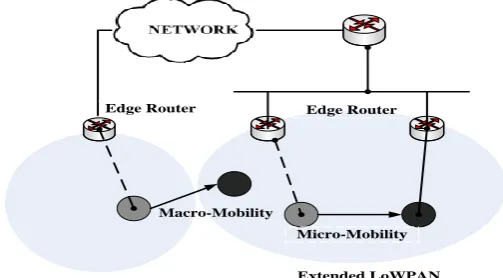
Micro-Mobility Macro-Mobility
Simple LoWPAN Extended LoWPAN
Edge Router Edge Router
Fig. 1. 6LoWPAN Micro-Mobility and Macro-Mobility
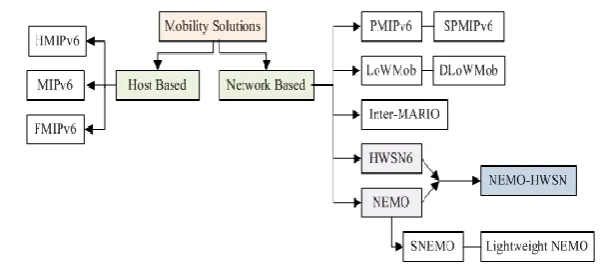
The chart in figure 2 depicts the various mobility protocols and their hierarchies in MIPv6 when an MN changes its point of attachment in the network, it should update its current Care-of Address (CoA) by itself and informs the HA of its CoA using the Binding Update message (BU) [17]. An enhancement to the MIPv6, Hierarchical Mobile IPv6 (HMIPv6) was introduced, whereby it separates global mobility from local mobility [10]. Then, for the optimization of MIPv6, Fast handover for Mobile IPv6 (FMIPv6) was introduced. It reduces handoff delays by performing CoA configuration even before an MN leaves its current network [18]. In [19], they presented an authentication protocol for HMIPv6 roaming service to establish secure communications, when an MN is roaming into a foreign network. In the host-based mobility management protocols, an MN is involved in the processing of mobility and signaling to configure an IP address on a new link management [10]. FMIPv6, HMIPv6 and MIPv6 are of type host-based mobility protocol, but they are not suitable for 6LoWPAN due to its constraints [7].
to enhance the multi-hop routing path between source and destination nodes, (ii) considering security aspects, (iii) equipping SNs with antennas in order to get the Angle of Arrival (AoA) measurements, and (iv) equipping SNs with a radio-triggered component to manage the sleep state by sending wake up radio signal [16]. Another protocol called Inter-MARIO has been proposed to perform handover based on the pre-configuration mechanism of 6LoWPAN mobility. This solution runs pre-configuration via the partner nodes to save the information on the PAN coordinators in the neighborhood PANs and reduces the mobility handover delay [21].
The philosophy behind NEMO protocolis that it runs Mobile IP and full IPv6 stacks only at MR/edge router, and does not run Mobile IP for attached nodes. This mobility solution fits the 6LoWPAN model perfectly as LoWPAN nodes are not adjustable for dealing with MIPv6 [20]. Lightweight NEMO protocol compresses the packet header to reduce the signaling overhead between MRs and gateways, this is done by using a compressed mobility header to support the 6LoWPAN mobility [11]. Inter-PAN mobility solution proposes an adaptation layer packet format for 6LoWPAN mobility signaling to reduce handover time. It provides extra information about the frequencies of the surrounding PANs at the border nodes [22]. To support mobility in 6LoWPAN sensor nodes, Sensor NEMO (SNEMO) has been introduced, it presents an interoperable architecture between NEMO and 6LoWPAN by way of an extended LOAD routing scheme for MRs [23].Chai et al. [24] proposed a network architecture that supports the integration of NEMO and 6LoWPAN which shows that the handoff signaling of NEMO is 1/N times (N is the number of MNs) smaller than that of MIPv6, hence this means that the consumed energy of NEMO is much smaller than that of MIPv6. However, nodes that are selected as sensor routers consume more energy thus they suggested the use of non-power aware devices as sensor routers or MRs in NEMO.
HWSN6 defines a protocol to carry out intra-WSN mobility to support medical sensor networks based on 6LoWPAN. In this protocol, the mobility management is delegated to Monere system as BR which monitors a mobile patient’s vital data [25]. This mobility scenario looks very similar to the NEMO protocol, in which the mobility of the entire network is viewed as a single unit.
The state of the art in HWSN6 related with high performance solutions includes security and authentication of MN for movements, global IPv6 addressing, intra-mobility among the Monere systems, reduced overload in MNs with respect to Mobile IPv6, distributed storage of the information among all the Monere systems, and mobility control messages to avoid fragmentation. Node authorization and authentication must be supported to offer security capability, integrity and confidentiality of the information, ensure protection of the resources.
In [26], they overview available handover mechanisms used for wireless sensors mobility and proposes a new ubiquitous mobility solutions for Body Sensor Networks (BSNs) in healthcare monitoring. This paper [27] surveys the most recent intra-mobility solutions with special focus on handover approaches that can be used in HWSNs. It proposed open issues that can contribute to improving the performance of handover solutions when applied to hospitalized patients were highlighted.
Fig. 2. Summary of IPv6 Mobility Solutions
3.
System Architecture
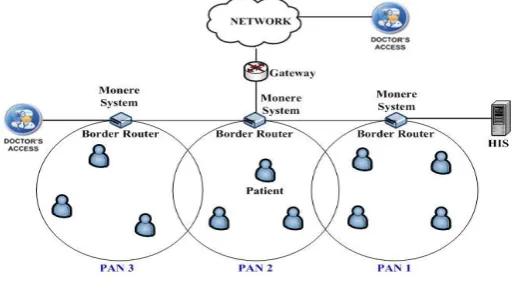
The hospital system architecture is made up of patient nodes (MN with a set of sensors), Monere system (local gateway or BR), Internet gateway, Hospital Information System (HIS), and users (physicians, surgeons and nurses). As shown in figure 3, each part of the hospital such as operating theatre, observation rooms and wards are organised as a PAN which is under network coverage to keep the connectivity among the nodes and the Internet. Each PAN with all the nodes belong to the same domain deployed with a BR to connect to the Internet, HIS, and other PANs via the network backbone [4].
3.1. Gateway and HIS Node
A gateway manages its domain, establishes connections between networks, and interconnects with each other through wireless or wired links. HIS is a system based on Open Services Gateway Initiative (OSGi) technology for the management of all the other systems from the hospital. HIS saves the important monitoring information of all nodes and provides information and services to the other systems belonging to the hospital such as management of alarms from the Monere systems, electronic health record, health status, localization service, and directory service [4].
3.2. Monere System
BRs is referred to as a PAN or domain. 6LoWPAN BR plays two roles: it be identified as an HA responsible for buffering and forwarding packets to the MN, or as a Foreign Agent (FA) which coordinates visited network. Finally, it supports the security requirements like privacy and security that it can cipher the communications with AES-CBC cryptography (256bits key) [4].
3.3. Patient Node
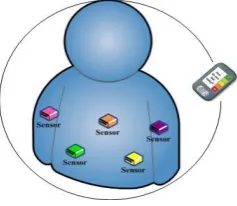
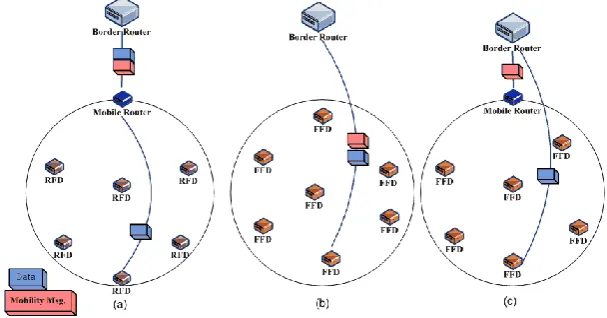
This paper proposed the concept of mobile patient node which moves between multiple PANs in a hospital environment. A set of sensors acting as one unit fixed on the patient's body (6LoWPAN MN) measures and collects health data continuously such as heart rate, SpO2, peripheral and core body temperature, glucose etc [25]. From figure 4, two types of sensor nodes have been defined in IEEE 802.15.4: they are Full-Function Device (FFD) and Reduced-Function Device (RFD) respectively. FFDs are designed to support all network functionalities and participate in peer-to-peer topologies with multi-hop communications. On the other hand, RFD devices are limited mainly to perform measurements only of physical parameters and to processing non-complex tasks in star topologies since they do not support multi-hop communications. Normally each PAN coordinator controls a PAN, this is done by way of setting up and maintaining of the PAN. Hence, only a FFD device can assume the role of PAN coordinator [13].Two models are suggested for the patient mobile node: in the first model, there is a main FFD device with one IP address which collects data from a set of RFDs and also manages the patient node area as a coordinator. FFD acts as an MR and connects the BR to the patient through a 6LoWPAN node. All RFDs data are accessible from FFD, and this constitutes a bottleneck in the network. In the second model all 6LoWPAN sensors are considered as FFD devices with their own IPv6 addresses, they send their data directly to BR without any interface such as MR. Thus, it is clear that the second model is more expensive in terms of energy requirement and data exchange during mobility [25].
Fig. 4. Patient Node Sample Architecture and Topology
4.
The HWSN6 Mobility Scenario
The WSNs mobility protocols proposed a large scope of applicability with the conjunction of the variety of case scenarios make it difficult to generate a standard mobility. To overcome this challenge, a specific scheme in mobility management for hospital WSNs has been proposed. The requirements of this scheme are continuous monitoring, low latency, no packet loss and low signaling. Figure 5 shows a movement scenario of a patient that moves between the home network and visited networks and then returns to base/home network. This kind of scenario is common at hospitals when the patients walk or move to other rooms to do medical tests. Phase 1 shows an initial state of the patient node which is in its home network and exchanges vital signs via the Monere system to maintain a continuous monitoring. In phase 2 and 3, it moves to a visited network and runs mobility protocol and handover mechanism, and finally it returns to the home network in phase 4.
Home Agent
Foreign Agent
Foreign Agent
Border Router
Border Router
Patient MN Sink Node Monere System Base Network
Visited Network(A)
Visited Network(B)
Patient MN
Sink Node Monere System
Border Router
Border Router Patient
MN
Sink Node Monere System
Border Router
Border Router
(3) (1)
(2)
(4)
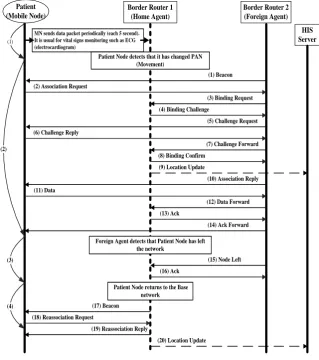
Figure 6 shows the HWSN6 mobility diagram with the messages exchanged in each step of mobility scenario as follows:
Exchange of messages in home network: The general frames (data, requests, responses and ACK frames) exchanged between sensors such as SPo2 level per each 5 seconds and BR.
Patient (Mobile Node)
Border Router 1 (Home Agent)
Border Router 2 (Foreign Agent)
MN sends data packet periodically (each 5 second). It is usual for vital signs monitoring such as ECG (electrocardiogram)
Patient Node detects that it has changed PAN (Movement)
(1) Beacon
(2) Association Request
(3) Binding Request
(4) Binding Challenge
(5) Challenge Request
(6) Challenge Reply
(7) Challenge Forward
(8) Binding Confirm
(10) Association Reply
(11) Data
(12) Data Forward
(13) Ack
(14) Ack Forward
Foreign Agent detects that Patient Node has left the network
(15) Node Left
(16) Ack
Patient Node returns to the Base network (17) Beacon
(18) Reassociation Request
(19) Reassociation Reply (1)
(2)
(3)
(4)
(9) Location Update
HIS Server
(20) Location Update
Fig. 6. Message Exchanges in a Mobility Scenario
Movement detection time: When an MN moves, it detects that its link quality has degraded beyond a certain threshold. This means that the existing router is no longer reachable, or a new access router is available [30].
following messages are exchanged: Binding Request (message 3), Binding Challenge (message 4), Challenge Request (message 5), Challenge Reply (message 6), Challenge Forward (message 7), Binding Confirm (message 8), Location Update (message 9), and Association Reply (message 10) message. These challenge messages are used to confirm that MN is a real node from its network. Patient node ciphers the challenge message and sends it to the FA. FA forwards to the HA. HA checks the challenge, if it is right, it sends a confirm message to the FA. In other case, it sends a deny message to avoid that the unauthenticated patient node receives or sends confidential information. Finally, the proposed mobility protocol supports security and authenticate MN with a challenge based on AES 128 bits when the MN changes its BR.
Interchange of data frames in the visited network: The messages from 11 to 14 show how a data frame and its Ack are exchanged.
Returning to the base network: Finally, as the patient node returns to its base network, it informs HA of its new location by sending a Re-association Request message (messages 17-20).
Movement between visited networks: When a patient node leaves the visited networks, FA informs the HA via Node Left and Ack messages (messages 15 and 16) of the event.
5.
NEMO-HWSN Mobility Mechanism Scheme
As mentioned in section 3, the mobile patient node with its attached sensors is considered as a network or PAN that moves between different PANs like NEMO, because when the patient moves, all attached sensor nodes move together. Hence, it looks like the PAN or a group of mobile sensor nodes moves together and they also need a strong power device acting as an MR to coordinate and collect the PAN data. Hence, the partial of mobility cost have close relation to the PAN architecture such as type and number of sensors, message overhead, and the MR as a coordinator which manages the mobility in mobile PAN. The handoff and tunneling costs of patients in the mobility process depend on the number of attached sensors. As a result, the increased number of sensor node increases the complexity of fast handoff detection and decreases its efficiency, and finally increase the energy consumption. Hence, in the following methods, we will survey possible mobility scenarios to show the benefits of our proposed scheme. Figure 7 shows three mobility models that can be applied with mobile patient sensor nodes.
mobility and collect data as a sink node. The benefit of this model is that it is less mobility complex and can perform fast handoff detection. The most serious problems are therefore bottleneck at the MR and end-to-end delay in tunneling process.
Fig. 7. The Messages Scheduling of Three Models. (a) RFD Devices with MR, (b) FFD Devices without MR, (c) FFD Devices with MR
Figure 7 (b) shows the second model in which all body sensors are FFD devices without any coordinator that attend to the mobility process. Accordingly, all FFDs repeat and execute the mobility scenario such as coordinator node (in previous model) and send their mobility messages to BR directly. This model is similar to individual mobile node that runs mobility scenario; it means the mobility protocol is supported with each individual node separately. The disadvantage with this model is that the handoff process will be increased based on the number of nodes, therefore the handoff complexity also will be increased [25]. With the benefit of this model is that each sensor node can leave its PAN and run mobility scenario separately and hence there is no bottleneck compared with the previous model. Finally, the MNNs send their data frames directly, thus the end-to-end delay in tunneling process will be optimized compared with previous method.
Table 1. Benefits of NEMO-HWSN Scheme
Mobility Issues NEMO HWSN6 NEMO-HWSN
End-to-End Delay High Low Low
Bottleneck Node MR Node No Optimized
Mobility Complexity Low High Low
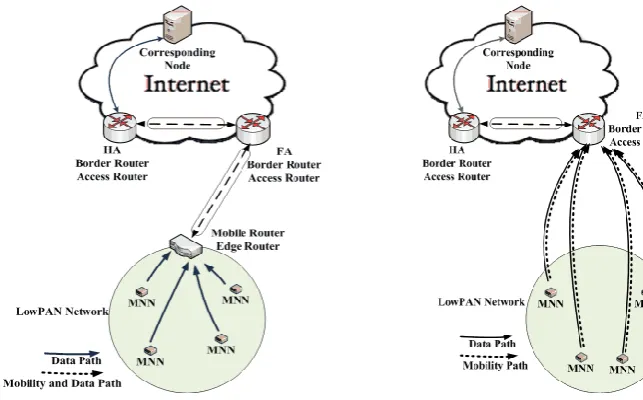
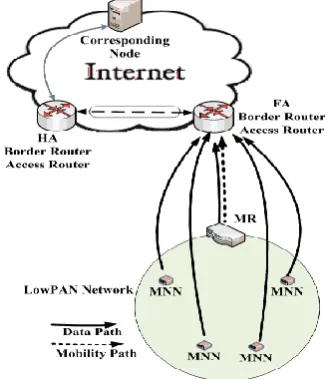
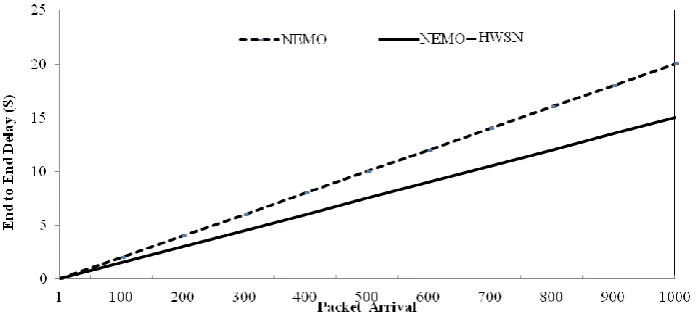
delay in tunneling will be reduced due to remove one hop (MR node) in the direction of tunneling process. Hence, the duty of sensing data transmission is eliminated from MR, thus it leads to longer lifetime of MR during the tunneling process and sensor nodes can be located behind the MR without mobility message support. Finally, the MR registers all FFDs in the BR as an FA in order to create a connection with a new FA and transmit their data frames into networks. By way of this technique, we provide the best handoff cost and mobility scenario for MR. Hence, any increase in the number of FFD will not increase the cost of handoff during mobility. As a result, FFDs as members of patients’ node send their data frames directly and the MR is set free of congestion at tunneling time. Thus, the bottleneck problem will be overcome by this scheme. Table 1 shows the previous challenges that are solved in NEMO-HWSN.
Figure 8, 9, and 10 show a comparison of the mobility diagram in terms of mobility and data messages scenario in three models. The dotted lines show handoff messages direction, when the MR or Mobile Network Nodes (MNNs) as mobile sensors run the mobility scenario which exchanges the handoff messages to follow the mobility process. The bold lines present the case when the tunneling scenario happens to exchange the sensing data from MNNs to destination like HA or CN. As shown in figure 10, the total signaling cost of our proposed scheme is better than the two previous mobility models. The NEMO-HWSN scheme that the MR mobility overhead is optimized by way of reduction in the MR traffic and the amount of mobility messages. As has been pointed out, the mobility cost is related to handoff and tunneling process time. Both of them have been surveyed by way of NEMO-HWSN solution through scheduling and managing the mobility functions of the MR.
Fig. 10. NEMO-HWSN Mobility Mechanism
6.
Simulation Results
To simulate our proposed scheme, we used OMNet++ simulator and the HWSN6 message diagram (Figure 6) which including binding update, challenging messages and etc. that exchange between MNNs, MR, HA, and FA in during the mobility scenario. In this scenario, the patient node consists of the five MNNs as mobile sensor nodes (attached sensors) to generate the sensing data and one MR node as a coordinator to manage the mobility mechanism.
process. The NEMO-HWSN does not impose heavy traffic on the MR, and hence the bottleneck traffic is optimized. Therefore, the PAN lifetime is prolonged in mobility scenario process.
Finally, our proposed scheme reduces the mobility overhead of MR through reduction the tunneling messages to help extend the lifetime of PAN. This type of scenario is suitable for 6LoWPAN network mobility such as NEMO, which suffers from energy challenges such as energy constraint, limited battery or accessing to energy resources.
Fig. 11. Comparison of the Total Signaling Cost in Three Models
7.
Conclusion
This paper described a mobility solution for a group of 6LoWPAN mobile sensors like patient node with attached sensors in hospital settings to maintain the continuous connectivity between the patient nodes and hospital area network as a smart building. This solution considers the hospital architecture in order to define a solution that reduces the amount of messages exchanged between the mobile patient node and 6LoWPAN hospital network through the MR. This means that the signaling overload is decreased and also the lifetime of the MR is optimized due to the reduction in the total amount of mobility messages. The patient node should not run a costly configuration for new topology that causes the MR dies early due to congestion. Finally, it is shown that this scheme provides the low tunneling cost and light traffic on MR and BR regardless of the number of sensors attached to a patient node. Hence, the NEMO-HWSN mobility protocol for hospital architecture should be more feasible in a 6LoWPAN topology.
The article offers important insights for further studies on healthcare monitoring by using 6LoWPAN MNs as a part of IoT in movement. In the future, we will present the analytical model and real implementation to carry out a real test for performance evaluation in order to obtain the optimum handover solution along the mobility process.
Acknowledgements. The work is funded by the Ministry of Science, Technology and Innovation (MOSTI) of The GOVERNMENT OF MALAYSIA (No. 01-01-04-SF1218) and Universiti Putra Malaysia. The authors would like to thank all parties which have contributed towards the success of this project.
References
1. Sahebi Shahamabadi, M., Mohd Ali, B. B., Varahram, P., Noura, M.: On Power Consumption in IPv6 Over Low Power Wireless Personal Area Network (6LoWPAN). In The First International Conference on Green Computing, Technology and Innovation. Kuala Lumpur, Malaysia, 21–28. (2013)
2. Dey, S., Shilpa, N.: Issues in IPv4 to IPv6 Migration. International Journal of Computer Applications in Engineering Sciences, Vol. I, No. I, 9–13. (2011)
3. Shelby, Z., Bormann, C.: 6LoWPAN: the wireless embedded internet. John Wiley & Sons, Ltd.United Kingdom. (2009)
4. Jara, A. J., Zamora, M. A., Skarmeta, A. F. G.: An Initial Approach to Support Mobility in Hospital Wireless Sensor Networks based on 6LoWPAN (HWSN6). Journal of Wireless Mobile Networks, Ubiquitous Computing, and Dependable Applications, Vol. 1, No. 2/3, 107–122. (2010)
5. Huai, J. W., Culler, D.: Extending IP to Personal Area Networks. Internet Computing, IEEE, Vol. 12, No. 4, 37–45. (2008)
6. Jabir, A. J., Subramaniam, S. K., Ahmad, Z. Z., Hamid, N. A. W. A.: A cluster-based proxy mobile IPv6 for IP-WSNs. EURASIP Journal on Wireless Communications and Networking, Vol. 2012, No. 1, 1-17. (2012)
7. Wang, X., Zhong, S., Zhou, R.: A mobility support scheme for 6LoWPAN. Computer Communications, Vol. 35, No. 3, 392–404. (2012)
Related Protocols. IEEE Network, Vol. 18, No. 34–40. (2004)
10. Soliman, H., Castelluccia, C., Bellier, L., Malki, K. El.: Hierarchical MIPv6 Mobility Management. In RFC 4140. (2005)
11. Kim, J. H., Hong, C. S., Shon, T.: A Lightweight NEMO Protocol to Support 6LoWPAN. ERTI Journal, Vol. 30, No. 5, 685–695. (2008)
12. Gundavelli, B. P. S., Leung, K., Devarapalli, V., Chowdhury K.: Proxy mobile IPv6. In IETF RFC 5213. (2008)
13. Oliveira, L. M. L., Sousa, A. F. D., Rodrigues, J. J. P. C.: Routing and mobility approaches in IPv6 over LoWPAN mesh networks. International Journal of Communication Systems, Vol. 24, No. 11, 1445–1466, (2011)
14. Caldeira, J. M. L. P., Rodrigues, J. J. P. C., Lorenz, P., Shu, L.: Intra-Mobility Handover Enhancement in Healthcare Wireless Sensor Networks. 14th International Conference on E-Health Networking, Applications and Services (IEEE E-Healthcom 2012), Beijing, China. (2012)
15. Sahebi Shahamabadi, M., Mohd Ali, B. B., Varahram, P., Jara, A. J.: A Network Mobility Solution Based on 6LoWPAN Hospital Wireless Sensor Network (NEMO-HWSN). The 7th International Conference on Innovative Mobile and Internet Services in Ubiquitous Computing (IMIS-2013). Taiwan, 433–438. (2013)
16. Bag, G., Raza, M. T., Kim, K.-H., Yoo, S.-W.: LoWMob: Intra-PAN Mobility Support Schemes for 6LoWPAN. Sensors, Vol. 9, No. 7, 5844–77. (2009)
17. Perkins, C. E., Johnson, D. B.: Mobility support in IPv6. In Proceedings of the 2nd annual international conference on Mobile computing and networking (MobiCom ’96). New York, USA, 27–37. (1996)
18. Camilo, T., Pinto, P., Rodrigues, A., Silva, J. S., Boavida, F.: Mobility management in IP-based Wireless Sensor Networks. In 2008 International Symposium on a World of Wireless, Mobile and Multimedia Networks. Newport Beach, CA, United States, 1–8. (2008)
19. Gao, T., Guo, N., Yim, K.: A Hybrid Approach to Secure Hierarchical Mobile IPv6 Networks. ComSIS Vol. 10, No. 2, 913-938. (2013)
20. Islam, M., Na, S., Lee, S., Huh, E.: A Novel Scheme for PMIPv6 Based Wireless Sensor Network. Lecture Notes in Computer Science, Vol. 6485, FGIT 2010, 429–438. (2010) 21. Ha, M., Kim, D., Kim, S. H., Hong, S.: Inter-MARIO: A Fast and Seamless Mobility
Protocol to Support Inter-Pan Handover in 6LoWPAN. IEEE Global Telecommunications Conference GLOBECOM 2010. New York, USA,1–6. (2010)
22. Bag, G., Mukhtar, H., Shams, S. M. S., Kim, K. H., Yoo, S.: Inter-PAN Mobility Support for 6LoWPAN. In 2008 Third International Conference on Convergence and Hybrid Information Technology. Busan, South Korea, 787–792. (2008)
23. Kim, J. H., Hong, C. S., Okamura, K.: A Routing Scheme for Supporting Network Mobility of Sensor Network Based on 6LoWPAN. Lecture Notes in Computer Science, Vol. 4773, APNOMS 2007, Springer-Verlag Berlin Heidelberg New York, 155–164. (2007)
24. Chai, R., Zhao, Y.-L., Chen, Q.-B., Dong, T., Zhou, W.-G.: Group mobility in 6LoWPAN-based WSN. In 2010 International Conference on Wireless Communications & Signal Processing (WCSP). Suzhou, China,1–5. (2010)
25. Jara, A. J., Zamora, M. A., Skarmeta, A. F. G.: HWSN6: Hospital Wireless Sensor Networks Based on 6LoWPAN Technology: Mobility and Fault Tolerance Management. In International Conference on Computational Science and Engineering. Vancouver, BC, Canada, 879–884. (2009)
27. Caldeira, J. M. L. P., Rodrigues, J. J. P. C., Lorenz, P.: Intra-Mobility Support Solutions for Healthcare Wireless Sensor Networks – Handover Issues. IEEE Sensors Journal, VOL. 13, NO. 11, 4339-4347, (2013)
28. Jara, A. J., Zamora-Izquierdo, M. A., Skarmeta, A. F.: Interconnection Framework for mHealth and Remote Monitoring Based on the Internet of Things. IEEE Journal in Selected Areas in Communications, Vol.31, No.9, 47-65. (2013)
29. Zamora-izquierdo, M. A., Gómez-skarmeta, A. F.: An Integral and Networked Home Automation Solution towards Indoor Ambient Intelligence. IEEE Pervasive Computing, Vol. 9, No. 4, 66–77. (2010)
30. Bag, G., Raza, M. T., Mukhtar, H., Akbar, A. H., Shams, S. M. S., Kim, K.-H., Yoo, S., Kim, D.: Energy-aware and bandwidth-efficient mobility architecture for 6LoWPAN. In MILCOM 2008 - 2008 IEEE Military Communications Conference. San Diego, CA, United States, 1–7. (2008)
MohammadrezaSahebi Shahamabadi has received his bachelor degree in Computer Hardware Engineering from the Islamic Azad University, Maybod, Iran in 2001. Later, he received the Master degrees from the Islamic Azad University, Arak, Iran in 2008. He has started the Ph.D degree in wireless senseor networks in Universiti Putra Malaysia since 2010.
Borhanuddin M Ali received his PhD from the University of Wales (Cardiff) in 1985 and subsequently became a lecturer in Universiti Pertanian Malaysia (now renamed Universiti Putra Malaysia) since 1985. He served the university as a lecturer and various administrative positions -- Director of the Institute of Multimedia and Software; Director of Institute of Advanced Technology UPM (ITMA), and presently Director of the National Centre of Excellence in Sensor Technology (NEST), besides being the Head of Department twice. In 1996 he helped to realize the formation of Teman project a precursor to MYREN (a national research network), and later was made the Chairman of the MYREN Research Community till 2006. He is a Chartered Electrical Engineer and a member of IET and Senior Member of IEEE. He was Chair of IEEE Malaysia Section 2002-2004, and ComSoc Chapter twice, 1999-2002, and 2006-2008, and various portfolios in ComSoc AP Board culminating as Vice Director (2014-2016) and conference coordinator IEEE Region 10 in 2013. His research interest spans wireless communications in particular wireless sensor networks and broadband communications. He has authored and co authored some 100 journal papers and 200 conference papers under those areas of interests.
Mohd Fadlee A. Rasid is currently the deputy director for National Centre of Excellence for Sensor Technology (NEST) in Universiti Putra Malaysia (UPM). He received a Ph.D. in electronic and electrical engineering (mobile communications) from Loughborough University, U.K. He directs research activities within the Wireless Sensor Network (WSN) group and his work on wireless medical sensors is gaining importance in health care applications involving mobile telemedicine and has had worldwide publicity, including BBC news. He was a research consultant for a British Council UKIERI project on wireless medical sensors project. He was also part of the French Government STIC Asia Project on ICT-ADI: Toward a human-friendly assistive environment for Aging, Disability & Independence. He currently leads a few research projects on WSN, particularly for medical and agriculture applications. He is currently involved with a project under Qatar National Research Fund by Qatar Foundations on Ubiquitous Healthcare. He was nominated for IEE J A Lodge Award for Outstanding Work in Field of Medical Engineering, London, 2005 and was the proud recipient of State of Selangor Young Scientist Award 2006.
Pooria Varahram has obtained his bachelor degree in Electrical, Electronics Engineering from the Khaje Nasir University, Tehran, Iran in 2002. Later, he received the Master and Ph.D degrees in Wireless Communications from Tarbiat Modares, Tehran, Iran and Universiti Putra Malaysia, in 2005 and 2010. He is a member of IEEE since 2010. He has more than 5 years of experience in designing and developing a range of electronic and telecommunication related projects. He is currently senior lecturer in UPM.
Antonio J. Jara; Assistant Prof. PostDoc at University of Applied Sciences Western Switzerland (HES-SO) from Switzerland, vice-chair of the IEEE Communications Society Internet of Things Technical Committee, CTO and founder of the Wearable Computing and Personal Area Networks company HOP Ubiquitous S.L., CTO and co-founder of the Smart Cities company viBrain Solutions. He did his PhD (Cum Laude) at the Intelligent Systems and Telematics Research Group of the University of Murcia (UMU) from Spain. He was associated with the Department of Information and Communication Engineering, UMU, since 2007, where he has been working on several projects related to IPv6, WSNs. and RFID applications in building automation and healthcare. He is especially focused on the design and development of new protocols for security and mobility for Future Internet of things, which was the topic of his Ph.D. Nowadays, he continues working on IPv6 technologies for the Internet of Things in projects such as IoT6, and also Big Data and Knowledge Engineering for Smart Cities in collaboration with projects such as SmartSantander. He has also carried out a Master in Business Administration (MBA). He has published over 100 international papers, As well, he holds one patent. Finally, he participates in several Projects about the IPv6, Internet of Things, Smart Cities, and mobile healthcare.