Revisiting Snapshot Algorithms by Refinement-based
Techniques
Manamiary Bruno Andriamiarina1, Dominique Méry1, and Neeraj Kumar Singh2
1
Université de Lorraine, LORIA Vandœuvre-les-Nancy, France
{Manamiary.Andriamiarina, Dominique.Mery}@loria.fr 2
McMaster Centre for Software Certification, McMaster University Hamilton, Ontario, Canada
Abstract. The snapshot problem addresses a collection of important algorithmic issues related to distributed computations, which are used for debugging or recov-ering distributed programs. Among existing solutions, Chandy and Lamport have proposed a simple distributed algorithm. In this paper, we explore the correct-by-construction process to formalize the snapshot algorithms in distributed system. The formalization process is based on a modeling language Event B, which sup-ports a refinement-based incremental development using RODIN platform. These refinement-based techniques help to derive correct distributed algorithms. More-over, we demonstrate how other distributed algorithms can be revisited. A conse-quence is to provide a fully mechanized proof of the resulting distributed algo-rithms.
Keywords:Distributed algorithms, correctness-by-construction, refinement, snap-shot, verification.
1.
Introduction
In this paper, we focus on the distributed snapshots for specific problems. The prime objective is to solve a problem using refinement techniques and to provide an evidence of correctness of given solutions, which are obtained through thecorrect-by-construction process. We are mainly interested by providingrecipesfor using the Event B framework and refinement for developing the distributed algorithms. Massingill and Chandy[19] introduce archetypesfor facilitating parallel program design; more recently, Chandy et al [12] propose the refinement of formal archetypes to produce verified distributed soft-ware using the theorem prover PVS. The conceptual idea of the archetypes is very close to the design patterns in the software engineering domain. Refinement plays a central role in the integration of different archetypes and constitutes the semantical glue for ensuring the correctness of the resulting process. This approach is based on the use of PVS, which is employed to prove the properties of problems modelled using archetypes. Our recipesare conceptually close to the notion behind the archetypes and our aims are to use the Event B framework for developing correct-by-construction distributed al-gorithms, and enrich a collection of complex distributed algorithms (Project RIMEL: http://rimel.loria.fr). Another objective is to show the power of the correct-by-construction process and ourrecipesthrough the re-development and derivation of already existing and correct snapshot algorithms like the Chandy and Lamport algo-rithm [13], the algoalgo-rithm of Lai and Yang [16] or the algoalgo-rithm of Morgan [23]. Finally, the snapshot problem is already considered as a case study for illustrating the strength of rewriting logic [24] and we think that our development may help a reader to understand the behavioral theory of snapshot algorithms.
Our Contribution.This paper contributes to demonstrate semantical relationships exist-ing between various snapshot algorithms (algorithms of Chandy and Lamport [13], Lai and Yang [16], Morgan [23]) with the refinement of models. We start with an abstract initial specification of the snapshot problem and we enrich this specification gradually by a progressive and incremental refinement. Several refinement steps allow to capture the complete and desired behaviour of snapshot algorithms. The refinement of models is the key element allowing preservation of properties between the levels of abstraction.
Moreover, we propose an architecture based on thecorrection-by-construction para-digm, for conceiving algorithms dedicated to observation of global states of distributed systems. This capture of a global state of a distributed system is introduced in the archi-tecture by a modelOBSERVATION. Our architecture is reusable and extendable since algorithms can be conceived or studied by refining either theOBSERVATIONmodel or more concrete models (algorithms) provided in our architecture.
2.
Related Works
Several literatures [3, 10, 28, 30] report works on the design of algorithms for the ob-servation of distributed systems. Jaggi et al. [3] have proposed a snapshot algorithm (Distributed Snapshot Algorithm for MANETs) DSAM, which is derived from the al-gorithm of Chandy and Lamport, for dealing with snapshots in a mobile ad-hoc network. Chalopin et al. [10] have produced an algorithm combining the Chandy and Lamport and the SSP [27] algorithms for detecting the termination of the snapshot. Yang and Marsland [30] have elaborated debugging frameworks for distributed systems using various exist-ing snapshot algorithms (Venkatesan, Lai and Yang, Li, Radhakrishnan and Venkatesh, Spezialetti and Kearns Algorithm, Morgan). The main motivation of these works is the need ofobservingglobal states of distributed systems, for identifying stable properties such as termination and deadlock [10], creating breakpoints for recovery, debugging sys-tems [30], or taking into account non-fixed/mobile networks [3]. These works also present elements for proving the correctness of the designed algorithms. However, these elements are only partial proofs and do not assert completely the correctness and safe behaviour of the algorithms.
All these works present new algorithms, based on well-known classical ones (Chandy and Lamport, Lai and Yang, Morgan, etc), for the observation of distributed systems. However, the semantical link between the new and classical algorithms is not formally established. These works also focus on conceiving correct algorithms able to produce correct/consistent snapshots. Yet, as far as we know, the existing works are mainly based on simulation, which cannot guarantee the safe behavior. In this study, we use the formal techniques to specify the snapshot algorithms to make sure of the safe behavior, correct-ness and consistency using safety properties.
3.
The Snapshot Problem
This section presents an abstract overview of the snapshot problem, which helps to un-derstand our proposed solution. We consider a message passing model which formulates a distributed algorithm using a finite set of processes and channels. A direct channel con-nects each pair of nodes and a list of transformations is attached to each node, which performs either local actions or communications actions. The communication mechanism is supposed to be reliable, which guarantees that the channel does not lose any data pack-ets.
For each node (process), a set of events (send,receiveandinternalevents) is defined. Apartial orderingcalledlocal causal order(denoted<pfor a process (p)), induced by
the local sequentiality of each process is defined. The following relationshipei <p ej,
between two eventseiandejof a process (p), indicates thateioccurs beforeej. A cutC
of a local set of events is a subset of events satisfying the relationship :∀p∈ P, e, f ∈
C·f ∈L∧e <p f ⇒e ∈C.P is a set of processes andLis a set ofpre-shotevents
(happeningbeforethe cutC).
Anotherorderingcalledcausal order(denoted<) is defined as well. It is the smallest relation containing the local causal orders(<p) and satisfying the send/receive
order-ing between processes. The relationshipem < en, between two eventsemanden of a
1. Ifemandenare local to a process (p), thenem<pen.
2. Ifem represents the sending of a message, thenen formulates the receiving of the
message.
3. There exists another eventek, such thatem< ekandek < en.
A consistent cutCof a set of events of a distributed algorithm is a subset of events, which satisfies the following relationship :∀e, f ∈C·f ∈L∧e < f ⇒e∈C.
A snapshotS is a global state of a distributed system, which is defined by a set of local states of nodes, and a set of channels states, produced by either internal actions or communication actions. The snapshotS is meaningful and feasible, if there exists an execution producing the global state, and a set of messages is successfully passed through each channel (p 7→ q) of the distributed system, where a set of messages is sent by the node (p) and the sending messages are received by the node (q).
The following theorem [28] relates the notions of cut and snapshot :
Theorem 1. A snapshotSinduced by a cutCis meaningful if, and only if,Cis consistent if, and only if,Sis meaningful.
The aim of the snapshot algorithm is to compute a global state of the system from the local states or equivalently a consistent cut. We investigate steps for deriving three well-known snapshot algorithms [13, 16, 23] using proof-assisted stepwise development.
4.
Stepwise Design of Distributed Algorithms
Thecorrect-by-construction paradigm promotes the development of algorithms using a progressive and incremental approach. The key concept is the refinement which provides linking betweendiscretemodels by preserving safety properties. The Event B modeling language designed by Abrial [1, 8] borrows features from formal modeling languages like UNITY [11], TLA+[17], action systems [4, 5]; those modeling languages share common aspects and especially the refinement concepts. The Event B is supported by an open envi-ronment RODIN integrating formal features for developing discrete logico-mathematical models. The Event B provides structures for expressing the reactive systems as a set of actions called events and maintaining a list of assertions called (inductive) invariants. These invariants formulate safety properties. We express our design for modeling the dis-tributed algorithms in the Event B using correct-by-construction approach, which is also our primary objective of this work. We recall basic concepts of the Event B modeling language [1] and a formal development tool called RODIN [26].
4.1. Modelling Actions Over States
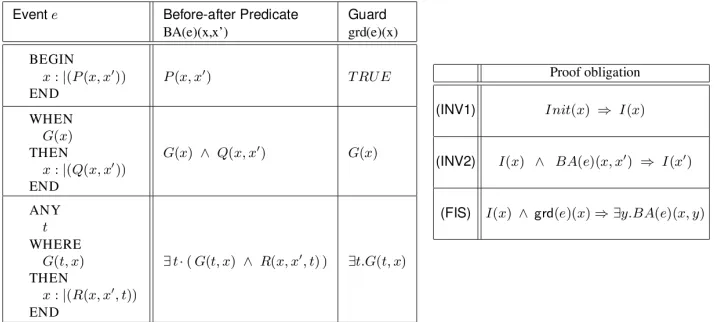
Modifications over state variables are stated by events. An eventehas two main parts: aguardgrd(e), which is a predicate built on the state variables, and anaction, which is a generalized substitution. An eventecan take one of the three normal forms described in the table 1 and is associated with a before-after predicateBA(e)(x, x0), which describes the event as a logical predicate expressing the relationship between values of the state variables just before (x) and just after (x0) the “execution” of the event (see Table 1).
Table 1.Event B events and proof obligations
Proof obligations (INV 1 andINV 2) are produced by the tool RODIN [26] from events in order to state that an invariant conditionI(x)is preserved. Their general form follows immediately from the definition of the before-after predicate,BA(e)(x, x0), of each evente(see Table 1). Note that it follows from the two guarded forms of the events and this obligation can be trivially discharged in case of false condition of the guard. When this is the case, the event is said to bedisabled. The proof obligationFISexpresses the feasibility of the eventewith respect to the invariantI.
4.2. Describing the Network and its Activities
4.3. Describing the Current System
The snapshot algorithm captures a set of actions modifying a set of variables, through the observation of the current distributed system. Hence, our modeling process states that the existing system simulates a new set of modifications in the current state. A model SYSTEMdescribes the general activities of the distributed system.
The defined variables for this modelSYSTEMare as follows:
– o associates each process to the timestamp of its last operation.
– ldescribes the local state of each process.
– hcontains the traces of the activities (history) for each process.
– chanpresents a set of messages that circulates inside channels.
– storedepicts a set of messages that is stored by each process.
– sendmodels the sending messages that are sent by the processes.
The activities of the distributed system depicted in the modelSYSTEMare as follows:
a) Internaloperations modify states and variables local to nodes. These activities are modelled by the following events:
• InternalLocaldemonstrates the modification of a local state of a process (p). A new state (ns) is chosen non-deterministically for the process (p).
• InternalMessagemodels the modification of the local set of messages of a pro-cess (p).
The process (p) deletes a message (m) from its local set of messages (store(p)). b) Externaloperations involve different nodes. These operations are described by the
following events:
• Receivingpresents the receiving of a message (m) by a process (q), via a channel (c). The message (m) is inside the channel (c) leading to the process (q): The message (m) is removed from the channel (c) and is stored by the process (q).
After each operation, the time-stamp (o(p)) of a process (p) is incremented, and a trace of activities (eitherinternal/localorexternal) is added to history (h(p)) of the process (p). A new step expresses the observation of the current system by another process which is defined by a refinement3of the current model. In the next section, we define the refinement
and apply it for the observation.
5.
Incremental Proof-Based Development
5.1. Model Refinement
The refinement of a formal model allows us to enrich a model in an incrementalway which is the foundation of thecorrect-by-construction [18] approach. Refinement pro-vides a way to strengthen invariants and to add details to a model. It is also used to trans-form an abstract model in a more concrete version by modifying the state description. This is done by extending the list of state variables (possibly suppressing some of them), by refining each abstract event into a corresponding concrete version, and by adding new events. The abstract state variables,x, and the concrete ones,y, are linked together by means of a, so-called,gluing invariantJ(x, y). A number of proof obligations ensure that (1) each abstract event is correctly refined by its corresponding concrete version, (2) each new event refinesskip, (3) no new event takes control for ever, and (4) relative deadlock-freeness is preserved. Details of the formulation of these proofs follows.
We suppose that an abstract modelAMwith variablesxand invariantI(x)is refined by a concrete modelCM with variablesyand gluing invariantJ(x, y). IfBA(e)(x, x0) andBA(f)(y, y0)are respectively the abstract and concrete before-after predicates of the same event, respectivelyeandf, we have to prove the following statement, corresponding to proof obligation (1):
I(x) ∧ J(x, y) ∧ BA(f)(y, y0) ⇒ ∃x0·(BA(e)(x, x0) ∧ J(x0, y0)).
Now, proof obligation (2) states thatBA(f)(y, y0)must refineskip(x0 =x), gener-ating the following simple statement to prove (2):
I(x) ∧ J(x, y) ∧ BA(f)(y, y0) ⇒ J(x, y0).
For the third proof obligation, we must formalize the notion of the system advancing in its execution; a standard technique is to introduce a variantV(y)that is decreased by each new event (to guarantee that an abstract step may occur). This leads to the following simple statement to prove (3):
I(x) ∧ J(x, y) ∧ BA(f)(y, y0) ⇒ V(y0)< V(y).
Finally, to prove that the concrete model does not introduce additional deadlocks, we give formalisms for reasoning about the event guards in the concrete and abstract models: grds(AM)represents the disjunction of the guards of the events of the abstract model, and grds(CM)represents the disjunction of the guards of the events of the concrete model. Relative deadlock freeness is now easily formalized as the following proof obligation (4):
I(x) ∧ J(x, y) ∧ grds(AM) ⇒ grds(CM).
When one refines a model, one can either refine an existing event by strengthen-ing the guard and/or the before-after predicate (effectively reducstrengthen-ing the degree of non-determinism), or add a new event in order to refine theskipevent. The feasibility contion is crucial for avoiding possible states which have no successor; for instance, the di-vision by zero. Furthermore, such refinement guarantees that a set of traces of the refined model contains (up to stuttering) traces of the resulting model. The basic foundations of the Event B modeling language along with several case studies are available in [1, 7]. The language ofgeneralized substitutionsis very rich and allows us to express any relation between states in a set-theoretical context. The expressive power of the language leads to require helps for writing relational specifications and this is why we should provide proof-based patterns for assisting the development of Event B models.
5.2. General Schema for Refinement
The correct-by-construction approach is based on the use of refinement and on introducing new features in the formal models. The methodology is simply described by the following diagram, which advocates different steps for producing a distributed algorithm using the correct-by-construction approach.
– The contextC states properties of graphs.
– The machineM0expresses the problem to solve by a set of events stating a relation between ini-tial and final states, for instance, the computa-tion of a correct snapshot.
– The refinement ofM0 intoM1presents the in-ductive property allowing to express the compu-tation of the snapshot by each node.
– The refinement ofM1 byIM prepares the localisation phase and may require more than one refinement step.
– The next refinement ofIMis a refinement for producing a set of events corresponding to the localisation of information.
– DA is derived from theM2;mappingchecks thatM2 can be translated into a dis-tributed programming language.
5.3. Introducing theOBSERVATIONmodel
The OBSERVATION model refinesthe SYSTEMmodel and introduces the functionality, which is required by the snapshot problem:to compute a snapshot. It does not explain how to compute it but what it should compute.
A set of new variables is introduced to model the required behaviour as follows:
– Two variablessandrare defined for ordering the sending and receiving of messages: • sassociates sent messages with channels and timestamps. The variable helps the users to determine the channel in which a message is sent and the time of the sending operation.
• rassociates received messages with channels and timestamps. This variable in-dicates the channel from which a message is received by a process and the time of the receiving operation.
– cutcontains the result of the snapshot.
The refined versions of the eventsSendingandReceivingare modified to take the variablesrandsinto account:
– Sendinguses the variablesto indicate the channel (c) in which a message (m) is sent and the sending time.
– Receivingrecords a message (m) and receiving time from the channel (c) into the variabler.
A new eventSnapshotmodels an abstraction of the snapshot procedure and states that a consistent cut (obtained inone-shot), namelyacut, is assigned tocut: a moving message is not allowed to be part of the snapshot, if origin of the message is outside of the
indicated by dots. Due to space limitations, we have given a sketch of the modeling. A detailed formal development is available4.
6.
Architecture of the Design
Figure 1 presents the complete formal development, which starts fromSYSTEMandNET -WORKand progressively leads to theOBSERVATION. The modelsASYNC-PROCESSand SYNC-PROCESS are derived from the model OBSERVATION and present two different ways of computing a consistent snapshot:ASYNC-PROCESSdescribes an asynchronous computation of a snapshot [13, 16], whereasSYNC-PROCESSdepicts a synchronous way of constructing a snapshot [23].
Fig. 1.General Architecture of the Design
It should be noted thatSYNC-PROCESSandASYNC-PROCESSmodel respectively the algorithms of Morgan [23] and Lai and Yang [16]. The model LAI-PROCESS presents a more concrete version of the snapshot algorithm of Lai and Yang [16]. A context FIFO-NETWORK extends NETWORK and adds elements of FIFO queues and communi-cations ordering to the network. The model of the algorithm of Chandy and Lamport [13] (FIFO-PROCESS) is refined from the modelASYNC-PROCESSand uses the contextFIFO -NETWORK. The modelLOC-FIFO-PROCESSis a refinement ofFIFO-PROCESSand defines a more concrete and local version of the snapshot algorithm of Chandy and Lamport [13].
6.1. Computing a Synchronous Snapshot
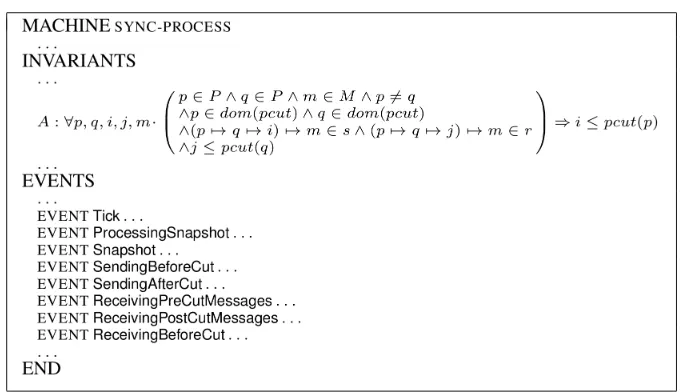
TheSYNC-PROCESSmodel (see Fig.2) is a refinement ofOBSERVATION, and defines the synchronous construction of a correct snapshot (pcut)gradually: an external parameter (e.g. a global clock) triggers the snapshot procedure for all the processes, at the same time. More precisely, theSYNC-PROCESSmodel describes the steps of the snapshot algorithm of Morgan [23], which is based on the availability of a global time for all the processes.
New variables are introduced:
4
Fig. 2.TheSYNC-PROCESSMachine
– mark_mcontains a set of messages that is sent after the snapshot.
– tmrepresents the global time.
– cstaterecords, for each process, the incomingpre-snapshotmessages.
– pstatecontains, for each process, the state of the process during the snapshot.
– pcutis an intermediate variable presenting the construction of the snapshot.
The invariant (A) (see Fig.2) defines constraints on these variables and states the con-sistency of the snapshot: If a messagemis sent by a process (p) at a time (i), and received by a process (q) at a time (j) before the snapshot, then the time (i) belongs to the past of the cut.
Events describe the computation of the snapshot :
– Tickmodels the flow of time.
EVENTTick
WHEN
grd1 : tm=F ALSE THEN
act1 : tm:=T RU E
– ProcessingSnapshotdemonstrates the simultaneous local snapshots of all the pro-cesses. When the global time (t) (for triggering the snapshot) has been reached, all the processes records their local states and begin to save incomingpre-snapshot mes-sages.
– Snapshotdescribes the global snapshot. An abstract parameteracut(modelling the global state of the system) of the event is removed and replaced by concrete variable
pcut. This new variablepcutrepresents the global state of the system and its value is computed in previous eventProcessingSnapshot. When all the processes have recorded their local states, as well as all the incomingpre-snapshot messages, the global state (pcut) of the system is saved into the variablecut.
The eventsSending andReceivingare refined and their refinements describe the pre-snapshotandpost-snapshotactivities of the system:
– SendingBeforeCut: This event models the sending of messages before the global time (t) for processing the snapshot is reached. The actions of this event are similar to the actions of the abstract eventSending.
– SendingAfterCut: This event demonstrates the sending of messages after the local snapshot of a process (p). The message (m) ismarkedas being sent by the process (p) after the local cut.
– ReceivingPreCutMessages: This event presents the receiving ofpre-snapshot mes-sages by a process (q), after a local cut.
The message (m) received by the process (q) is recorded as apre-snapshotmessage.
– ReceivingPostCutMessages: This event expresses the receiving of marked post-snapshotmessages by a process (q), after a local cut. The message (m) received by the process (q) is removed from the set (mark_m) of markedpost-snapshotmessages.
– ReceivingBeforeCut: This event models the receiving of messages before the global time (t) for processing the snapshot is reached. The actions of this event are the same as the actions of the abstract eventReceiving.
6.2. Computing an Asynchronous Snapshot
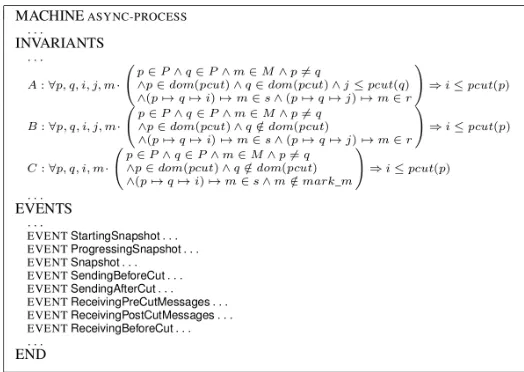
TheASYNC-PROCESSmodel (see Fig.3) refines theOBSERVATIONmodel, and presents the asynchronous construction of a correct snapshot (pcut)step-by-step. A control mes-sage (marker) is introduced along with events to separate pre and post-snapshot mes-sages for describing the development steps of the snapshot algorithm :
Fig. 3.TheASYNC-PROCESSMachine
– StartingSnapshot: A node (initiator) starts to build of the snapshot. The node (initiator) saves its local state. It begins to record the incoming messages (marker) and finally, this node (special) sends a message (marker) to all of its neighbouring nodes.
– ProgressingSnapshot: A node (i) receives a message (marker) from the neigh-bouring node and it begins to record all the incoming messages. If the node (i) re-ceives all the messages before sending the message (marker), it records the local state and transmits the message (marker) to its neighbours.
The model also introduces a set of properties for describing the consistency of the cut:
(A) If a messagemis sent by a process (p) at a time (i), and received by a process (q) at a time (j) before the snapshot, then the time (i) belongs to the past of the cut. (B) If a messagemis sent by a process (p) (which has already performed a local cut) at
the time (i), received by a process (q) (which has not yet performed a local cut) at a time (j), then the time (i) belongs to the past of the cut.
(C) If a messagemhas been sent by a process (p) to process (q) at a time (i) (before the receiving of a message (marker) by the process (p)), then the time (i) belongs to the past of the cut.
The events Sendingand Receivingare refined to distinguish pre-snapshot messages and/or activities from their post-snapshot counterparts:
– SendingBeforeCut: This event describes the sending of a message (m) by a process (p), before the local cut of the process (p). The actions of this event are similar to the actions of the“normal”eventSending.
– SendingAfterCut: This event presents the sending of the message (m) by the process (p), which follows the local cut of the process (p). The message (m) is marked as being sent after the local cut of the process(p).
– ReceivingPreCutMessages: This event demonstrates the receiving of the message (m) (sent by the process (p) before the local cut of the process (p)) by a process (q), after receiving a message (marker) by the process (q).
– ReceivingPostCutMessages: This event shows the receiving of a message (m) (sent by a process (p) after the local cut of the process (p)) by a process (q), after the process (q) has performed a local cut. The message (m) received by the process (q) is removed from the set (mark_m) of markedpost-snapshotmessages.
– ReceivingBeforeCut: This event describes the receiving of a message (m) (sent by a process (p) before the local cut of the process (p)) by a process (q), before the process (q) performs a local cut. The actions of this event are the same as the actions of the “normal”eventReceiving.
6.3. Deriving Asynchronous Snapshot Algorithms
The Lai and Yang Algorithm The Lai and Yang algorithm [16] is a two-phases proto-col: either (A) one special process (calledinitiator) initiates the snapshot, or (B) another process among non-initiator processes extends the snapshot. Due to their similarities, we will focus on phase (A), depicted by the following steps:
process (initiator) :
step 1: record local state;
step 2: snapshot := 1;
step 3: begin to record incoming pre-snapshot messages;
step 4: to send a message : <message, snapshot>;
Details of the two possible phases are described by the modelASYNC-PROCESS, an abstract model of the Lai and Yang algorithm [16]: channels between processes are rep-resented by sets of messages; however a message (m) is extended by a bit, which de-termines either if the message is pre or post-snapshot. The bit is 1, when the predicate
m∈mark(c)holds. The modelLAI-PROCESS, refiningASYNC-PROCESS, localizes in-formations and describes a model for the Lai and Yang algorithm. We can identify, in theLAI-PROCESSmodel, events representing the phases (A) and (B) of the Lai and Yang algorithm:
The actions of this event can be associated with the steps of phase (A) :
– act1 models step 1: the process (initiator) records its local state.
– act2 represents
step 2: the process (initiator) takes a local snapshot.
– act3indicates that the process (initiator) will record all pre-snapshot incoming mes-sages (step 3).
We can see that the two phases (A) and (B) are modelled, respectively, by the events
StartingSnapshotandProgressingSnapshot. The other events do not describe parts of the Lai and Yang algorithm; they depict activities of the processes and the network (communications, computations, etc.).
The Chandy and Lamport Algorithm The Chandy and Lamport algorithm [13] uses a mechanism of coloring and propagation of a red color from a white one. A white message occurs before a snapshot and a red message occurs after the snapshot. We split the two kinds of messages using a variablemark, indicating, whether or not messages (marker) have been sent by processes. The abstract modelFIFO-PROCESSof this algorithm refines the model PROCESS: it is an abstract model of the Lai and Yang algorithm. Behaviours of the model FIFO-PROCESScorrespond to behaviours of the model ASYNC-PROCESS, thanks to refinement. However, the machineFIFO-PROCESSand contextFIFO-NETWORK (extension of the contextNETWORK) introduce new features: the separation between the pre and post-snapshot messages is implemented by aFIFO communication mechanism. Channels between nodes are transformed from sets of messages toFIFOqueues. Because of the clear distinction between the pre and post-snapshot phases, the bit of membership defined in the Lai and Yang algorithm can be removed; which means that the messages are less complex. However, we can observe that a strong constraint is added: in the Chandy and Lamport algorithm, FIFO communication channels are mandatory. The LOC-FIFO -PROCESSmodel refines theFIFO-PROCESSmodel: theLOC-FIFO-PROCESSmodel local-izes events and is producing the algorithmic form of the Chandy and Lamport algorithm.
6.4. Comparing the Formal Modelling of Snapshot Algorithms
We have studied two categories of snapshot algorithms: synchronous snapshot algorithms and asynchronous snapshot algorithms.
In this section, we compare these two types of snapshot algorithms according to two criteria: first, we make comparisons of formal development complexity; then, we compare their local and global characteristics.
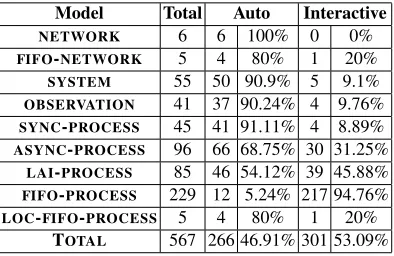
Model Total Auto Interactive
NETWORK 6 6 100% 0 0%
FIFO-NETWORK 5 4 80% 1 20%
SYSTEM 55 50 90.9% 5 9.1%
OBSERVATION 41 37 90.24% 4 9.76%
SYNC-PROCESS 45 41 91.11% 4 8.89%
ASYNC-PROCESS 96 66 68.75% 30 31.25%
LAI-PROCESS 85 46 54.12% 39 45.88%
FIFO-PROCESS 229 12 5.24% 217 94.76%
LOC-FIFO-PROCESS 5 4 80% 1 20% TOTAL 567 266 46.91% 301 53.09%
Table 2.Summary of Proof Obligations
Asynchronous snapshot algo-rithms seem at first glance more complex than synchronous ones: we can see in the previous sections that asynchronous algorithms pos-sess more steps than synchronous algorithms. Asynchronous snap-shot algorithms have two phases: 1) a snapshot initialisation phase (eventStartingSnapshot) and 2) a progression phase (event Pro-gressingSnapshot); whereas, synchronous algorithms only have one phase: the simultaneous computation of the snapshot by
the processes (event
formal models of asynchronous snapshot algorithms are more complex, since they con-tain more events. The difference in complexity is underlined by the number of invari-ants needed to demonstrate the consistency of a snapshot: theASYNC-PROCESSmodel requires a set of invariants (A, B, C, see Fig.3), while the SYNC-PROCESS model only necessitates one (A, see Fig.2). Furthermore, the table 2, presenting the proof obligations discharged either manually or automatically, confirms that modelling asynchronous algo-rithms is more complex: the total number of proofs (96) for these algoalgo-rithms is more than twice as much as the number of proofs (45) for synchronous algorithms, and it should be noted that the number of manual proofs for asynchronous algorithms is far greater (30 vs 4). The following table sums up the complexity differences between synchronous and asynchronous snapshot algorithms.
Complexity Synchronous Asynchronous Invariants (consistency of snapshot) less(1) more(3)
Number of Algorithmic Steps less(1) more(2) Number of Events related To The Computation less(1) more(2) Number of Proofs less(45) more(96)
Table 3.Complexity of the Models of Snapshot Algorithms
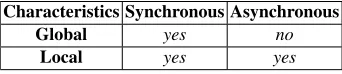
If we analyse their local and global characteristics, we can see that synchronous snap-shot algorithms are generally based on the observation of external global elements, such as global time, while, on the other hand asynchronous snapshot algorithms only relies on the local resources and informations of the processes. The table 4 summarises these characteristics:
Characteristics Synchronous Asynchronous
Global yes no
Local yes yes
Table 4.Local and Global Characteristics of the Models of Snapshot Algorithms
In a nutshell, we say that the availability of global shared elements (e.g. global time) greatly simplifies the formal design and modelling of distributed snapshot algorithms [30]. However this simplification of design is gained at the expense of other qualities, like localisation.
7.
Discussion, Conclusion and Future Work
system. The development of the snapshot is organised from the models calledASYNC -PROCESSandSYNC-PROCESS, which express the underlying computation procedure and can be refined into several other algorithms. The key idea is to separate the pre-shots and the post-shots and the solution depends on assumptions on communications, namely chan-nels and messages: themarkvariable is either a marker for a bit, a marker forfifochannels or a marker for global temporal aspects. The complexity of the development is measured by the number of proof obligations which are automatically/manually discharged (see ta-ble 2). The main difficulty of the development was the expression of a consistent snapshot in the machinesASYNC-PROCESSandSYNC-PROCESS, therefore the establishment of the refinement relation between these machines and the machineOBSERVATION. A set of in-variants (A,B,C) of the machine ASYNC-PROCESS(Fig.3) and the invariant (A) of the machineASYNC-PROCESS(Fig.2) were the keys of the development, where the gener-ated proof obligations were quite difficult to discharge. We also notice that the number of manual proof obligations increases dramatically for the modelFIFO-PROCESS(see table 3): this augmentation is due to the transformation of sets of messages intoFIFOqueues of messages. In fact, we had to prove a lot of properties defining the proper behaviours of FIFOqueues and communications. Moreover, the snapshot algorithm is supposed to work while another process SYSTEMis working; SYSTEMis a model for another distributed system and the snapshot algorithm is an implementation of the observation of the current system. Contrary to the verification by theorem provers [24], our work provides an archi-tecture for developing the snapshot algorithm using essential safety properties together with a formal proof that asserts its correctness.
In this paper, we have experimented on fixed networks. As a part of our future efforts we consider the global family of snapshot algorithms to give a very precise description of different solutions and to link between these algorithms, as we notice that the algorithm of Chandy and Lamport is obtained from the algorithm of Lai and Yang by adding a FIFOcommunication. Moreover, we plan to integrate the snapshot algorithm with complex distributed systems like mobile networks.
References
1. Abrial, J.R.: Modeling in Event-B: System and Software Engineering. Cambridge University Press (2010)
2. Abrial, J.R., Cansell, D., Méry, D.: A mechanically proved and incremental development of ieee 1394 tree identify protocol. Formal Asp. Comput. 14(3), 215–227 (2003)
3. Awadhesh Kumar Singh, P.K.J.: Message efficient global snapshot recording using a self stabi-lizing spanning tree in a manet. International Journal of Communication Networks and Infor-mation Security (IJCNIS) 3(3) (December 2011)
4. Back, R.J., Kurki-Suonio, R.: Distributed cooperation with action systems. ACM Trans. Pro-gram. Lang. Syst. 10(4), 513–554 (1988)
5. Back, R.J., Kurki-Suonio, R.: Decentralization of process nets with centralized control. Dis-tributed Computing 3(2), 73–87 (1989)
6. Back, R.J., Sere, K.: Stepwise refinement of action systems. Structured Programming 12(1), 17–30 (1991)
8. Cansell, D., Méry, D.: The Event-B Modelling Method - Concepts and Case Studies. In: Bjoerner, D., Henson, M. (eds.) Logics of Specification Languages, pp. 33–140. Mono-graphs in Theoretical Computer Science, Springer (Feb 2008),http://hal.inria.fr/ inria-00579550
9. Cansell, D., Méry, D.: Designing old and new distributed algorithms by replaying an incremen-tal proof-based development. In: Abrial, J.R., Glässer, U. (eds.) Rigorous Methods for Software Construction and Analysis. Lecture Notes in Computer Science, vol. 5115, pp. 17–32. Springer (2009)
10. Chalopin, J., Métivier, Y., Morsellino, T.: On snapshots and stable properties detection in anonymous fully distributed systems (extended abstract). In: Even, G., Halldórsson, M. (eds.) Structural Information and Communication Complexity, Lecture Notes in Computer Science, vol. 7355, pp. 207–218. Springer Berlin Heidelberg (2012),http://dx.doi.org/10. 1007/978-3-642-31104-8_18
11. Chandy, K.M., Misra, J.: Parallel Program Design A Foundation. Addison-Wesley Publishing Company (1988), iSBN 0-201-05866-9
12. Chandy, K.M., Go, B., Mitra, S., White, J.: Towards verified distributed software through re-finement of formal archetypes. In: IFIP Working Conference on Verified Software: Workshop on Experiments (October 2008)
13. Chandy, K.M., Lamport, L.: Distributed snapshots: Determining global states of distributed systems. ACM Trans. Comput. Syst. 3(1), 63–75 (1985)
14. Chaudhuri, K., Doligez, D., Lamport, L., Merz, S.: The TLA+proof system: Building a het-erogeneous verification platform. In: Cavalcanti, A., Déharbe, D., Gaudel, M.C., Woodcock, J. (eds.) International Conference on Theoretical Aspects of Computing - ICTAC 2010. Lec-ture Notes in Computer Science, vol. 6255, p. 44. Springer, Brazil Natal (2010), the original publication is available at www.springerlink.com
15. Clarke, E.M., Grumberg, O., Peled, D.: Model Checking. MIT Press (december 1999), iSBN 0-262-03270-8
16. Lai, T.H., Yang, T.H.: On distributed snapshots. Inf. Process. Lett. 25(3), 153–158 (1987) 17. Lamport, L.: Specifying Systems: The TLA+Language and Tools for Hardware and Software
Engineers. Addison-Wesley (2002)
18. Leavens, G.T., Abrial, J.R., Batory, D.S., Butler, M.J., Coglio, A., Fisler, K., Hehner, E.C.R., Jones, C.B., Miller, D., Jones, S.L.P., Sitaraman, M., Smith, D.R., Stump, A.: Roadmap for en-hanced languages and methods to aid verification. In: Jarzabek, S., Schmidt, D.C., Veldhuizen, T.L. (eds.) GPCE. pp. 221–236. ACM (2006)
19. Massingill, B.L., Chandy, K.M.: Parallel program archetypes. In: Proceedings of the Scalable Parallel Library Conference. pp. 1–9 (1997)
20. Méry, D., Mosbah, M., Tounsi, M.: Refinement-based verification of local synchronization algorithms. In: Butler, M., Schulte, W. (eds.) FM. Lecture Notes in Computer Science, vol. 6664, pp. 338–352. Springer (2011)
21. Méry, D., Singh, N.K.: Analysis of dsr protocol in event-b. In: Défago, X., Petit, F., Villain, V. (eds.) SSS. Lecture Notes in Computer Science, vol. 6976, pp. 401–415. Springer (2011) 22. Mohamed, O.A., Muñoz, C., Tahar, S. (eds.): Theorem Proving in Higher Order Logics, 21st
International Conference, TPHOLs 2008, Montreal, Canada, August 18-21, 2008. Proceedings, Lecture Notes in Computer Science, vol. 5170. Springer (2008)
23. Morgan, C.: Global and logical time in distributed algorithms. Inf. Process. Lett. 20(4), 189– 194 (1985)
24. Ogata, K., Huyen, P.T.T.: Specification and model checking of the chandy & lamport distributed snapshot algorithm in rewriting logic. In: ICFEM 2012 (2012)
25. Owre, S., Shankar, N.: A brief overview of pvs. In: Mohamed et al. [22], pp. 22–27
27. Szymanski, B., Shi, Y., Prywes, N.: Synchronized distributed termination. IEEE Transactions on Software Engineering 11(10), 1136–1140 (1985)
28. Tel, G.: Introduction to Distributed Algorithms. Cambridge Unversity Press (1994)
29. Wenzel, M., Paulson, L.C., Nipkow, T.: The isabelle framework. In: Mohamed et al. [22], pp. 33–38
30. Yang, Z., Marsland, T.A.: Global snapshots for distributed debugging: An overview. Tech. rep., Computing Science Department, University of Alberta (1992)
Manamiary Bruno Andriamiarinais currently pursuing his PhD at the Laboratory LO-RIA at the Université de Lorraine in Nancy, France. His main area of research interest is in Formal Modelling, Refinement of Models, Event-Driven Development, Dynamic Dis-tributed Systems and Algorithms.
Dominique Méryis professor in computer science at Université de Lorraine since 1993. He is the Head of the Formal Methods Department of the LORIA Laboratory, a joint structure between CNRS, INRIA and Université de Lorraine. He is developing researches on formal methods and applications in the MOSEL team. His topics are formal mod-elling and applications of formal methods to embedded systems, healthcare systems and distributed systems.
Neeraj Kumar Singhreceived the Doctor in Computer Science degree from Henri Poinca-ré University, Nancy 1 (now the University of Lorraine), France, in 2011. He received his MS degree in Optimization System and Security (OSS) from University of Technology of Troyes, France, in 2008. He also received Master of Computer Application (MCA) from Uttar Pradesh Technical University (UTPU), India, in 2006, and B.Sc in Computer Science in 2003. From January 2012 to August 2013, he was a research associate in the Computer Science Department of University of York, UK. In August 2013, he joined McMaster University, Canada, as a postdoctoral researcher in the Department of Comput-ing and Software Information Technology. His current research interests are focused on software engineering, software and system certification, model driven engineering in the automotive domain, formal methods, biological environment modeling, cyber-physical systems, automatic code generation, concurrent systems, and formal verification of the medical protocols. The results of his research works are published in several articles. He is also the author of a book“Using Event-B for Critical Device Software Systems”.
![Figure 1 presents the complete formal development, which starts from SYSTEMways of computing a consistent snapshot:computation of a snapshot [13, 16], whereas and NET-WORK and progressively leads to the OBSERVATION](https://thumb-us.123doks.com/thumbv2/123dok_us/1174355.1620079/10.612.136.490.269.433/presents-development-systemways-computing-consistent-computation-progressively-observation.webp)