TR-IMDEA-Networks-2011-2
B-Neck: a distributed and
quiescent max-min fair
algorithm
Alberto Mozo
José Luis López-Presa
Antonio Fernández Anta
B-Neck: a distributed and quiescent max-min fair algorithm
Alberto M
OZO‡Jose Luis L
ÓPEZ-P
RESA?Antonio F
ERNÁNDEZA
NTA†‡
Dpto. Arquitectura y Tecnología de Computadores, Universidad Politécnica de Madrid, Madrid, Spain
?
DIATEL, Universidad Politécnica de Madrid, Madrid, Spain
†
Institute IMDEA Networks, Madrid, Spain
[email protected] [email protected] [email protected]
Abstract
The problem of fairly distributing a network capacity among a set of sessions has been widely studied. In this problem, each session connects via a single path a source and a destination, and its objective is to maximize its as-signed transmission rate (i.e., its throughput). Since the links of the network have limited bandwidth, some form
of criterion has to be defined to fairly distribute them among the sessions. A popular criterion ismax-min fairness
that, in short, guarantees that each sessionigets a rateλisuch that no sessionscan increaseλswithout causing
another sessions0to end up with a rateλs0 < λs. Many max-min fair algorithms have been proposed, both
central-ized and distributed. However, to our knowledge, all proposed distributed algorithms require control packets being continuously transmitted to recompute the max-min fair rates when needed.
1
Introduction
The fair distribution of network resources among a set of sessions is a recurring problem. In this problem, each session connects via a single communication path a source node and a destination node in the network, with the objective of maximizing the transmission rate (i.e., throughput) between them. Since the links of the network have limited capacity, the solution of the problem must use some criterion to fairly distribute the network resources among the sessions. A popular fairness criterion to share the available network capacity among a set of sessions without incurring in link overload is the, so called,max-min fairness[7, 20]. The basic idea behind the max-min fairness criterion is to first allocate equal bandwidth to all contending sessions at each link, and if a session can not utilize its bandwidth because of constraints elsewhere in its path, then the residual bandwidth is distributed among the other sessions. Thus, no session is penalized, and a certain minimum quality of service is guaranteed to all sessions. More precisely, max-min fairness takes into account the path of each session and the capacity of each link. Then, each sessioniis allocated a transmission rateλiso that no link is overloaded, and a session can only increase its rate at the expense of a session
with the same or smaller rate. In other words,max-min fairnessguarantees that each sessionigets a rateλi, such that
no sessionscan increaseλswithout causing another sessions0to end up with a rateλs0 < λs.
Many max-min fair algorithms have been proposed, both centralized and distributed (see the related work below). However, to our knowledge, all proposed distributed algorithms require packets being continuously transmitted to recompute the max-min fair rates when some change in the sessions happens (like new sessions arriving or sessions leaving). In this paper we propose a distributed algorithm, which we call B-Neck, to compute max-min fair rates that is quiescent, i.e., once the rates have been computed, the algorithm does not need, generate, nor assume any more traffic in the network. As far as we know, this is the first quiescent distributed algorithm that solves the max-min fairness problem.
1.1
Related Work
We are interested in computing the max-min fair rate allocation for single path sessions. The max-min fair rates of the sessions can be efficiently computed in a centralized way with the Water-Filling algorithm [7, 20]. Max-min fairness has usually been chosen as the target fairness criterion implemented by congestion control protocols to allocate the bandwidth of network links among the sessions that cross them. From a taxonomic point of view, centralized and distributed algorithms have been proposed. The latter have typically been implemented as the congestion control protocols. Another classification of max-min fair algorithms is based on considering if per-session state information is needed in routers, or if, otherwise, only constant information is used.
To our knowledge, the proposals of Gallager [12] and Katevenis [18] were the first to apply max-min fairness to share bandwidth among sessions in a packet switched network. They achieved fairness by implementing a round robin scheduler of packets in each router link. No max-min fair rate is explicitly calculated, and a window-based flow control is needed in order to control congestion. Per-session state information is needed, and updated by every data packet, in each router link. Additionally, a continuous injection of traffic is needed to maintain the system in a stable state.
It is worth noting that all the distributed algorithms mentioned above need per-session state information at the routers of the network. Distributed algorithms that only use constant state information in each router have also been proposed [2, 6, 10]. Several max-min fair algorithms have been proposed that compute anapproximation of the rates [5, 4]. Unfortunately, it has been shown that max-min fair rates are sensitive to small changes, and hence an approximation with a small difference from the optimal allocation in one session can be drastically amplified at another session [1]. In any case, as already mentioned, all the algorithms proposed need packets to be continuously sent.
Recent research trends in explicit congestion control protocols (XCP [17], JetMax [27], RCP [11], PIQI-RCP [15]) implement efficient congestion controllers in routers, without the need to store and process state information for each session (in the case of RCP, even with a low per packet computational overhead), and guarantee that the max-min fair rate assignments are achieved when controllers are in steady state. In these proposals, the information returned to source nodes from the routers (e.g., an incremental window size or an explicit rate value) allows the sessions to know approximate values that converge eventually to their max-min fair rate assignments, as the system evolves to a steady state. Published results show formal analysis of stability of these protocols, but the experimental evaluations are done on simple topologies composed by a small number of links and sessions (far from real scenarios of large networks with transient dynamics). Additionally, none of them are quiescent, and so, traffic must be injected continuously in to the network in order to keep the system stable.
It is worth mentioning recent related works that explore different versions of the problem. Some of them compute the max-min fair rates with centralized algorithms that can be applied (a) to solve a generalized version of the problem when the bottlenecks are not easy to find (e.g. [21]), or (b) to find session routes that maximize the total bandwidth (e.g.,[3]). Other papers solve the problem in wireless networks, where new challenges appear because neighbors contend even if they use different wireless links. Huang and Bensaou [14] propose an algorithm that collects in the routers the session information of sections of the network, including many sessions that do not cross the router, and in the worst case, the whole set of sessions. Then, the problem is locally solved with a Water-Filling like algorithm. Tassiulas and Sarkar [23] propose a set of scheduling policies for providing fair allocation of bandwidth in the wireless context, but they do not compute max-min fair rates. Finally, some papers consider a multicast version of the problem [19, 22, 25].
1.2
Contributions
In this paper we propose Neck, a max-min fair distributed algorithm that is also quiescent. As far as we know, B-Neck is the first such algorithm. Instead of requiring a continuous injection of traffic to compute the max-min fair rates, B-Neck uses a limited number of control packets. In addition, each node only requires information of the sessions that traverse it. When changes in the sessions occur, B-Neck recomputes the new rates and asynchronously informs the affected sessions of their rate (i.e., sessions do not need to poll the network for changes). We have formalized the interaction between the (applications that create and use the) sessions and B-Neck, with a set of primitives. Then, primitives to start and end sessions have been defined (namely,API.Join andAPI.Leave). A primitive that B-Neck uses to notify a session of a change in its rate is also defined (namely, API.Rate). Finally, the interface allows a session to fix the maximum rate that it requires both at the time it is created (withAPI.Join) and by using a fourth primitive, defined to change the requested maximum rate (namely,API.Change).
The properties of B-Neck are formally proved. This proof has two parts. Firstly, we show its correctness, i.e., if sessions do not change (for a time period large enough) B-Neck correctly finds the max-min fair rates of all the sessions, and notifies these rates to them. Secondly, we showquiescence, i.e., after computing the rates, eventually B-Neck stops injecting traffic into the network. We want to note that, once B-B-Neck is quiescent, changes in the sessions (new arrivals, departures, or changes in the requested maximum rates) reactivate it, so that, once the changes end, the new appropriate rates are found and notified, and eventually B-Neck becomes quiescent again.
Our simulations have shown that B-Neck becomes quiescent very quickly, even in the presence of many interacting sessions. We have also stressed the algorithm by, once quiescent, causing large number of simultaneous departures and rate changes. In all cases B-Neck has shown to be robust and efficient, reaching convergence and quiescence again quickly. The control traffic caused in the network by the algorithm is also shown to be limited, and only for highly dynamic systems with many sessions has more than a few packets per session.
1.3
Structure of the Rest of the Paper
The rest of the paper is structured as follows. In Section 2 definitions and notations are provided. In Section 3 the max-min fair protocol B-Neck is presented, and in Section 4 its correctness is proved. Finally, in Section 5 experimental results are shown.
2
Definitions and Notation
In this section we describe the system model considered, and provide general definitions and notation. We have a network composed by routers and hosts which have directed links connecting them. The network can be modeled as a simple directed graphG= (V, E). The network links may have different propagation delays and different bandwidths. Connected nodes have links in both directions, i.e.,(u, v)∈E =⇒ (v, u)∈E. Some routers have hosts connected to them through dedicated links, so that each host is connected to only one router. Sessions follow a static path in the network. This path starts in a host which we call thesource nodeof the session, and ends in another host which we call thedestination node. The intermediate nodes in the path of a session are routers. Each host can only be the source node of one session. (This limitation is just for the sake of simplicity.) For every linke∈ E, we useCeto denote
its bandwidth1. We useπ(s)to denote the path of a sessions, which is a list of links from the source node to the
destination node. As it will be described, some packets of a sessionsin the proposed protocol are sent across links of the pathπ(s). These packets are said to be sentdownstream. Other packets of sessionsare sent across links in the reverse path2ofs. These packets are said to be sentupstream.
The problem we face is how to distribute the available network bandwidth among the sessions, assigning max-min fair rates to them. We allow the sessions to specify the maximum rate they need. (This maximum rate may be
∞.) Sessions are considered to be greedy in this context, i.e., they want to maximize their assigned bandwidth up to their maximum requested rate. We also allow the sessions to change their maximum rate request dynamically. The interface between the sessions and the protocol that implements a max-min fair rate assignment (with our additional capabilities) can be specified in terms of the following primitives:
• API.Join(s, r): Used by sessionsto join the system and request a maximum rate ofr.
• API.Leave(s): Used by sessionsto signal its termination.
• API.Change(s, r): Used by sessionsto request a new maximum rate ofr.
• API.Rate(s, λ): Used by the max-min fair algorithm to indicate to sessionsthat its max-min-fair rate isλ.
A sessionsisactiveif it has invokedAPI.Join(s, r), and it has not invokedAPI.Leave(s). We assume that the primitives are used in a sensible way as follows. No active session invokes anAPI.Join primitive, and only active sessions invokeAPI.LeaveandAPI.Change primitives. In exchange, the max-min fair algorithm must guarantee thatAPI.Rateis always invoked on active sessions. If, during a period of time, there are no invocations toAPI.Join,
API.LeaveorAPI.Changeprimitives, then we say that the network is in asteady statein that period.
Let us consider a network in a steady state period. We denote withSthe set of all active sessions in the system, and withSethe set of sessions inSthat cross linke. Let us denote, for eachs∈S, the maximum rate requested bysasrs.
The max-min fair rates of the system can be computed in a modified system in which the maximum rate requested by each session is∞, and the effective bandwidth of the first linkein the path of sessionsisDs= min(Ce, rs). For the
sake of simplicity, in the informal descriptions that follow we use this modified system with the notationCeinstead of
Ds(but the algorithm B-Neck correctly usesDs).
1We assume that this is the bandwidth allocated to data traffic, and that the control traffic caused by the max-min fair algorithm does not consume
any of this bandwidth.
1 for eache∈EdoRe←Se;Fe← ∅end for
2 L← {e∈E:Re6=∅}
3 whileL6=∅do
4 for eache∈LdoBe←(Ce−Ps∈Feλ
∗
s)/|Re|end for
5 B←mine∈L{Be}; L0← {e∈L:Be=B}; X←Se∈L0Re
6 for eachs∈Xdoλ∗s←Bend for
7 for eache∈L\L0doFe←Fe∪(Re∩X);Re←Re\Feend for
8 L← {e∈(L\L0) :R e6=∅}
9 end while
Figure 1: Centralized B-Neck Algorithm.
Let us denote byλ∗sthe max-min fair rate of sessions∈S.
Definition 1 For any sessions, a linke∈π(s)is abottleneckofsiffP
s0∈S
eλ
∗
s0 =Ceand∀s0 ∈Se, λ∗s0 ≤λ∗s.
A linkeis abottleneckof the system if it is a bottleneck for every session inSe. If a linkeis a bottleneck of a
sessions, we say thatsisrestrictedate. Otherwise we say thatsisunrestrictedate. In any max-min fair system, every session is restricted in at least one link, and hence has at least one bottleneck. It is also known that any max-min fair system has at least one bottleneck [7].
For each linke, the setsR∗eandFe∗are defined asRe∗={s:eis a bottleneck ofs}andFe∗ =Se\R∗e. Observe
that all sessions inR∗ehave the same rate. We denote this rate asBe∗and call it thebottleneck rateof linke. IfR∗e6=∅,
then this rate can be computed asB∗
e = (Ce−Ps∈F∗
e λ
∗
s)/|R∗e|. Then, every sessions∈Fe∗hasλ∗s< Be∗. Observe
that, ifR∗e=∅, then the bandwidth of linkeis not fully assigned to the sessions (i.e.,
P
s∈Seλ
∗
s< Ce).
3
B-Neck Algorithm
In this section, we describe the algorithm B-Neck. We start by presenting a centralized algorithm that conveys most of the intuition of the logic of B-Neck. Then, we will describe how the logic of this centralized algorithm is translated into a distributed form in the final algorithm.
3.1
Centralized B-Neck
As we said, before tackling the problem of computing max-min fair rates with a distributed algorithm, we will intro-duce a simple centralized iterative solution that illustrates how these rates may be computed. This algorithm computes the max-min fair rates in a form that is similar to the Water-Filling algorithm [7]. The Centralized B-Neck algorithm is presented in Figure 1. This algorithm discovers bottlenecks iteratively, in increasing order of their bottleneck rates. To do so, it computes estimates of thebottleneck ratesBe= (Ce−Ps∈Feλ
∗
s)/|Re|for each linkesuch thatRe6=∅.
In the first iteration, the bottlenecks of the system are discovered. Since for these bottlenecksFe∗=∅and, initially,
the variableFe = ∅, the ratesBe =Be∗are computed correctly. Then, all the sessionssthat cross these links are
assigned their ratesλ∗s=Be=Be∗, which is the bottleneck rate of these links. Once these sessions have got their rates
assigned, a new network configuration is generated. First, all the sessions that have their rates assigned, are moved fromRetoFein every linkeof their paths at which they are unrestricted (those links inL\L0). Thus, their rates
will be taken away in the computation of the following bottleneck rates. Then, all the bottleneck links discovered are removed from the system, together with those linksethat have no session inRe. The process continues untilL=∅.
This procedure correctly computes the max-min fair rates [7], and guarantees thatRe=R∗eandFe=Fe∗.
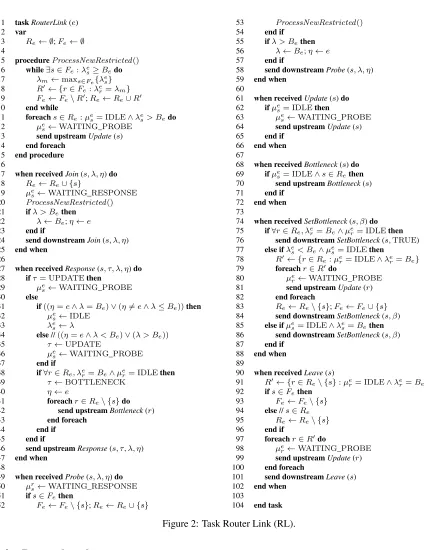
1 taskRouterLink(e) 2 var
3 Re← ∅;Fe← ∅
4
5 procedureProcessNewRestricted()
6 while∃s∈Fe:λes≥Bedo
7 λm←maxs∈Fe{λes}
8 R0← {r∈Fe:λer=λm}
9 Fe←Fe\R0;Re←Re∪R0
10 end while
11 foreachs∈Re:µse= IDLE∧λes> Bedo
12 µe
s←WAITING_PROBE
13 send upstreamUpdate(s)
14 end foreach
15 end procedure
16
17 when receivedJoin(s, λ, η)do
18 Re←Re∪ {s}
19 µe
s←WAITING_RESPONSE
20 ProcessNewRestricted()
21 ifλ > Bethen
22 λ←Be;η←e
23 end if
24 send downstreamJoin(s, λ, η)
25 end when
26
27 when receivedResponse(s, τ, λ, η)do
28 ifτ= UPDATEthen
29 µe
s←WAITING_PROBE
30 else
31 if((η=e∧λ=Be)∨(η6=e∧λ≤Be))then
32 µe
s←IDLE
33 λe
s←λ
34 else//((η=e∧λ < Be)∨(λ > Be))
35 τ←UPDATE
36 µes←WAITING_PROBE
37 end if
38 if∀r∈Re, λer=Be∧µer= IDLEthen
39 τ←BOTTLENECK
40 η←e
41 foreachr∈Re\ {s}do
42 send upstreamBottleneck(r)
43 end foreach
44 end if
45 end if
46 send upstreamResponse(s, τ, λ, η)
47 end when
48
49 when receivedProbe(s, λ, η)do
50 µr
s←WAITING_RESPONSE
51 ifs∈Fethen
52 Fe←Fe\ {s};Re←Re∪ {s}
53 ProcessNewRestricted()
54 end if
55 ifλ > Bethen
56 λ←Be;η←e
57 end if
58 send downstreamProbe(s, λ, η)
59 end when
60
61 when receivedUpdate(s)do
62 ifµe
s= IDLEthen
63 µes←WAITING_PROBE
64 send upstreamUpdate(s)
65 end if
66 end when
67
68 when receivedBottleneck(s)do
69 ifµe
s= IDLE∧s∈Rethen
70 send upstreamBottleneck(s)
71 end if
72 end when
73
74 when receivedSetBottleneck(s, β)do
75 if∀r∈Re, λer=Be∧µer= IDLEthen
76 send downstreamSetBottleneck(s,TRUE)
77 else ifλe
s< Be∧µes= IDLEthen
78 R0← {r∈Re:µre= IDLE∧λer=Be}
79 foreachr∈R0do
80 µe
r←WAITING_PROBE
81 send upstreamUpdate(r)
82 end foreach
83 Re←Re\ {s};Fe←Fe∪ {s}
84 send downstreamSetBottleneck(s, β)
85 else ifµe
s= IDLE∧λes=Bethen
86 send downstreamSetBottleneck(s, β)
87 end if
88 end when
89
90 when receivedLeave(s)
91 R0← {r∈Re\ {s}:µer= IDLE∧λer=Be}
92 ifs∈Fethen
93 Fe←Fe\ {s}
94 else//s∈Re
95 Re←Re\ {s}
96 end if
97 foreachr∈R0do
98 µer←WAITING_PROBE
99 send upstreamUpdate(r)
100 end foreach
101 send downstreamLeave(s)
102 end when
103
104 end task
Figure 2: Task Router Link (RL).
3.2
Protocol packets
The B-Neck algorithm runs in every network link, and the source and destination nodes of each session. Sessions communicate with B-Neck through the API primitives already described, and the entities that run the B-Neck algorithm interact exchanging B-Neck packets. The B-Neck packets are:
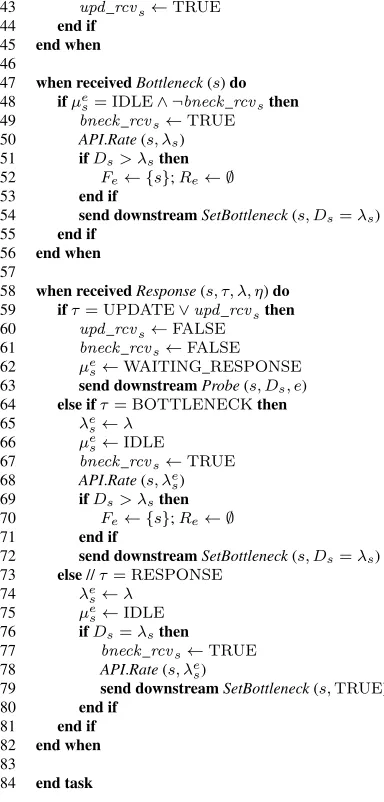
1 taskSourceNode(s, e) 2 //eis the first link ofs
3 //and it is not shared with any other session
4
5 whenAPI.Join(s, r)do
6 Re← {s}
7 Ds←min(r, Ce)
8 upd_rcvs←FALSE
9 bneck_rcvs←FALSE
10 µe
s←WAITING_RESPONSE
11 send downstreamJoin(s, Ds, e)
12 end when
13
14 whenAPI.Leave(s)do
15 Fe← ∅;Re← ∅
16 send downstreamLeave(s)
17 end when
18
19 whenAPI.Change(s, r)do
20 Ds←min(r, Ce)
21 ifµes= IDLEthen
22 ifs∈Fethen
23 Fe← ∅;Re← {s}
24 end if
25 upd_rcvs←FALSE
26 bneck_rcvs←FALSE
27 µe
s←WAITING_RESPONSE
28 send downstreamProbe(s, Ds, e)
29 else
30 upd_rcvs←TRUE
31 end if
32 end when
33
34 when receivedUpdate(s)do
35 ifµe
s= IDLEthen
36 ifs∈Fethen
37 Fe← ∅;Re← {s}
38 end if
39 bneck_rcvs←FALSE
40 µe
s←WAITING_RESPONSE
41 send downstreamProbe(s, Ds, e)
42 else
43 upd_rcvs←TRUE
44 end if
45 end when
46
47 when receivedBottleneck(s)do
48 ifµes= IDLE∧ ¬bneck_rcvsthen
49 bneck_rcvs←TRUE
50 API.Rate(s, λs)
51 ifDs> λsthen
52 Fe← {s};Re← ∅
53 end if
54 send downstreamSetBottleneck(s, Ds=λs)
55 end if
56 end when
57
58 when receivedResponse(s, τ, λ, η)do
59 ifτ= UPDATE∨upd_rcvsthen
60 upd_rcvs←FALSE
61 bneck_rcvs←FALSE
62 µe
s←WAITING_RESPONSE
63 send downstreamProbe(s, Ds, e)
64 else ifτ= BOTTLENECKthen
65 λe
s←λ
66 µe
s←IDLE
67 bneck_rcvs←TRUE
68 API.Rate(s, λes)
69 ifDs> λsthen
70 Fe← {s};Re← ∅
71 end if
72 send downstreamSetBottleneck(s, Ds=λs)
73 else//τ= RESPONSE
74 λe
s←λ
75 µe
s←IDLE
76 ifDs=λsthen
77 bneck_rcvs←TRUE
78 API.Rate(s, λes)
79 send downstreamSetBottleneck(s,TRUE)
80 end if
81 end if
82 end when
83
84 end task
Figure 3: Task Source Node (SN).
path.
• Probe(s, λ, η): LikeJoin, but sent at any time when the rate for sessionsneeds to be recomputed.
• Response(s, τ, λ, η): Sent upstream from the destination node to the source node, indicating the rateλthat can be assigned tos, which linkηimposed the strongest rate restriction, and an indicationτof the next action to be performed.
• Update(s): Sent upstream to the source node indicating that a new Probe cycle (see below) must be performed for sessions.
• Bottleneck(s): Sent upstream to the source node indicating that the current rate of sessionshas to be assumed to be its max-min fair rate.
• SetBottleneck(s, β): Sent downstream from the source node, indicating that the current rate for sessionsis assumed to be its max-min fair rate, and the linksethat do not restrictsmust move it fromRetoFe. Parameter
βis used to check that there is at least one bottleneck for sessions.
1 taskDestinationNode(s) 2
3 when receivedJoin(s, λ, η)do
4 send upstreamResponse(s,RESPONSE, λ, η)
5 end when
6
7 when receivedProbe(s, λ, η)do
8 send upstreamResponse(s,RESPONSE, λ, η)
9 end when
10
11 when receivedSetBottleneck(s, β)do
12 if¬βthen
13 send upstreamUpdate(s)
14 end if
15 end when
16
17 end task
Figure 4: Task Destination Node (DN).
3.3
A global perspective of B-Neck
In this section, we describe the distributed algorithm B-Neck, an event driven, distributed and quiescent algorithm which computes max-min fair rate allocations and notifies them to the sessions, in a network environment where sessions can asynchronously join and leave the network, or change their maximum desired rate.
Like other distributed algorithms that compute max-min fair rates, B-Neck needs to keep some per-session infor-mation at the links. It uses setsReandFe(as in Centralized B-Neck) to store the sessions that are restricted at this link,
and those that are restricted somewhere else, respectively, just like the centralized version. Besides, for each session s, it is necessary to store its stateµe
s ∈ {IDLE,WAITING_PROBE,WAITING_RESPONSE} and its assigned
rateλe
s, at each link. The assigned rate is meaningful only whens ∈ Fe ors ∈ Re andµes = IDLE. Whenever
necessary, a link computes its bottleneck rate asBe= (Ce−Ps∈Feλ
e
s)/|Re|. Note that this computation resembles
the one performed in Centralized B-Neck, with the only difference that in the centralized version, the rates assigned to sessions inFeare always the max-min fair ratesλ∗s, and in the distributed version the ratesλesmight (temporarily) not
be the max-min fair rates. However, as the most restrictive bottlenecks are discovered, the least restrictive ones will compute their bottleneck rates correctly, and the system will converge to the max-min fair rate assignment.
At the source nodes, the session’s maximum desired rateDsis kept in order to start new Probe cycles in the future
(Probe cycles are described below). Additionally, two flags are used:bneck_rcvswhich indicates that a max-min-fair
assignment has been made to sessions, andupd_rcvswhich indicates that an Update packet has arrived during a Probe cycle, and a new Probe cycle must be started after the current one ends.
Once we have introduced how the max-min fair rates can be computed, and the packets used by the distributed algorithm B-Neck, we will give here a simple intuition of the way it works. B-Neck is formally specified as three asynchronous tasks3that run: (1) in the source nodes (those that initiate the sessions), shown in Figure 3; (2) in the destination nodes, shown in Figure 4; and (3) in the internal routers to control each network link, shown in Figure 2. B-Neck is structured as a set of routines that are executed atomically, and activated asynchronously when an event is triggered. This happens when a primitive of the API is called from the session, or when a B-Neck packet is received. This is specified usingwhenblocks in the formal specification of the algorithm.
Whenever a session joins, changes its rate requirement or receives an Update packet from the network, it performs aProbe cycle. A Probe cycle is the basic procedure on which B-Neck relies to compute the max-min fair rates. A Probe cycle starts with the source node sending of a Probe packet (or Join when a session arrives) that, regenerated at each link, traverses the whole path of the session. At the destination node, a Response packet is generated and sent back to the source (regenerated at each link of the reverse path). A source node never starts a Probe cycle if there is one in course (this is guaranteed by flagupd_rcvs). Note that, since new Probe cycles are only triggered by the network when a change in the sessions configuration is detected, and only the affected sessions are notified, the traffic generated by B-Neck is very limited (unlike previous distributed algorithms that relayed directly on the sessions periodically polling the network to recompute their rate assignment). When sessions stop joining, leaving or changing their rate requirement, the network will eventually get stable, and no more traffic will be generated by B-Neck until there is another change in the sessions configuration.
The Response packets that close a Probe cycle are used at the links to assign rates to the sessions, and to detect bottleneck conditions. A link identifies itself as a bottleneck when all the sessions, that are not restricted somewhere else, have completed a Probe cycle, areIDLEand have been assigned the same rate. In this case, all these sessions
are sent a Bottleneck packet to inform them that their rate is stable (and corresponds to the max-min fair rate with the present sessions configuration). The session that is performing the probe cycle receives the indication in the form of a Response packet withτ= BOTTLENECK.
When a session joins the network, its source node sends a Join packet that traverses the path of this session, and serves two purposes: (1) it informs the links that a new session has arrived (and adds that session to theirResets), so
they can recompute their bottleneck rates and send Update packets to the affected sessions that may have their rates reduced, and (2) it acts like a Probe packet gathering information of the rate that corresponds to this session. When a session leaves the network, its source node sends a Leave packet that traverses the path of this session, so the links may delete all the information related with the session, and send Update packets to the affected sessions that could increase their assigned rate.
When a session receives the Bottleneck communication, it sends a SetBottleneck packet to inform the links in its path that the rate is stable. Additionally, if a link is not a bottleneck for that session, i.e. the session’s rate is lower than the links bottleneck rateBe, the session is moved formRetoFe, so it is reconsidered in the computation ofBe.
When a SetBottleneck packet reaches the destination node without having found a bottleneck for a session (what is controlled with theβfield of the SetBottleneck packet), it means that there has been a change in the network. Then, the session is informed by the destination node with an Update packet, to trigger a new Probe cycle. Note that, during the Probe cycle, the session must come back to setReto recomputeBeat each link.
B-Neck discovers bottlenecks in a similar fashion to Centralized B-Neck. However, since B-Neck is a distributed algorithm, concurrently executed by all the network links, bottlenecks may be discovered in parallel, what speeds up convergence. However, sometimes, a bottlenecklmight be incorrectly identified before a bottleneckl0 on which it depends, what would never happen with the centralized algorithm. Nevertheless, when bottleneckl0is identified, the SetBottleneck packets that will be sent afterwards will generate the necessary Update packets to be sent to the affected sessions, and the first bottlenecklwill eventually be correctly identified.
4
Proof of Correctness of B-Neck
In this section we prove the correctness of algorithm B-Neck. First, recall that Algorithm B-Neck uses for each link e, among others, the variablesRe,Fe, and for eachi ∈ Re∪Fevariablesµei andλ
e
i. WhenRe 6=∅, let us define,
Be= (Ce−Pj∈Feλ
e
j)/|Re|. Observe that whenRe=R∗eandFe=Fe∗, thenBe=Be∗.
Definition 2 Consider a network executing the B-Neck protocol, a linke is stable if∀i ∈ Re∪Fe, µei = IDLE,
∀i∈Re, λei =Be, and ifRe=6 ∅, then∀i∈Fe, λei < Be. The network is stable at a timetif all the links are stable
and there is no packet of the B-Neck protocol in the network, neither in transit nor being processed at a link (i.e., no link is executing awhenblock).
Observation 1 Allwhenblocks complete in a finite time, since there are no blocking (waiting) instructions and every
loop has a finite number of iterations (they iterate over finite setsRe or Fe). Hence packets cannot be processed
forever in awhenblock.
Lemma 1 Consider a network, which executes B-Neck, in a steady state. If an infinite number of packets of any kind
is generated while in steady state, then some session generates an infinite number of Probe packets.
Proof: If there is an infinite number of Bottleneck packets, there must be an infinite number of Response packets
because a Bottleneck packet is only generated when processing a Response packet (Line RL42), and the processing of each Response packet only generates a finite number of Bottleneck packets (Lines RL41 – 43). If there is an infinite number of Response packets, there must be an infinite number of Probe packets because (if there are no more Join packets) a Response packet is only generated at the destination node of the session when a Probe packet is received (Line DN4). If there is an infinite number of Update packets, (since there are no more Join or Leave packets) there must be an infinite number of Probe packets (Lines RL53 and RL13) or SetBottleneck packets (Lines RL81 and DN13). If there is an infinite number of SetBottleneck packets, there must be an infinite number of Probe packets, because the use ofbneck_rcvsin Task SourceNode guarantees that, between two SetBottleneck packets generated for a session, at
number of Probe packets is generated. Since the number of sessions is finite, then some session must generate an infinite number of Probe packets.
Lemma 2 Consider a network, which executes B-Neck, in a steady state. If an infinite number of packets of any kind
is generated while in steady state, then some session updates theλvariable of its source node an infinite number of times.
Proof: Let us assume that an infinite number of packets is generated. From Lemma 1 some sessionsgenerates an
infinite number of Probe packets. Then, the source node ofsreceives an infinite number of Response packets. If the condition at Line SN59 evaluates toFALSEinfinite times, then theλvariable of the source node is updated an infinite number of times. Otherwise, there is a time after which all Response packets received at the source node of sessions haveτ = UPDATE, or an Update packet was previously received (settingupd_rcvstoTRUE).
In the first case, if a Response is received withτ = UPDATE, then in the linkewhereτ was set toUPDATE (Lines RL34 – RL37), some session was moved fromFetoRe(caseλ > Be) by the processing of a Probe packet,
or fromRetoFe(caseη =e∧λ < Be) by the processing of a SetBottleneck packet, between the processing of the
Probe and the corresponding Response ofs.
In the second case, since sdoes not generate SetBottleneck packets, Update packets can only be generated in a link eat Line RL13 when processing a Probe packet of a sessions0 ∈ Fe that is moved to Re, or at Line RL87
when processing a SetBottleneck of a sessions0that is moved fromRetoFe. Hence, some sessions0, at some edge
e, is moved fromFetoReand vice versa an infinite number of times. The movement fromRetoFeis only done
when processing a SetBottleneck packet (Line RL83). Hence there are infinite SetBottleneck packets and this implies infinite updates of variableλat the source node ofs0.
Definition 3 A sessionscauses a Probe packet of another sessions0 6= sif (a) an Update packet of session s0 is
generated in Lines RL13 or RL81 when processing a packet from sessions, or (b) an Update packet of sessions00is generated in Lines RL13 or RL81 when processing a packet of sessions, ands00ands0share a bottleneck, what causes a SetBottleneck ofs0to reach its destination node withβ = FALSE. In this case, at the destination node, an Update packet is generated (Line DN13).
Observation 2 When ProcedureProcessNewRestricted is called from Line RL53 when processing a Probe packet
for sessions0, only sessionsssuch thatλe
s0 < λesmay be sent an Update packet.
Lemma 3 Consider a network, while executes B-Neck, in a steady state. Then, there is a time after which every Probe
packet generated for sessionsat timet(after it updates its source nodeλvariable) is caused by the processing of a Probe or SetBottleneck packet of another sessions0generated at timet0such that theλvariables of the source nodes of both sessions, namelyλsandλs0, satisfy thatλs0at timet0is smaller thanλsat timet.
Proof:When no session joins nor leaves the network, or changes its rate requirement, a new Probe packet is generated
at the source node when an Update packet is received, either generated immediately (Line SN41) or deferred to the reception of a Response packet (Line SN63) by settingupd_rcvs= TRUE(Line SN43).
Update packets can be generated by (a) a call to procedure ProcessNewRestricted when processing a Probe packet (Line RL53), (b) when processing a SetBottleneck packet at a router link (Line RL81), or (c) when processing a SetBottleneck packet at the destination node (Line DN13).
• Case (a): When ProcedureProcessNewRestricted is called, from Observation 2, the sessions0 that generates the Update packets (and, hence, causes the subsequent Probe packets) only sends Update packets to sessionss such thatλe
s0 < λes. Since the sessionssareIDLE, theλvalues at their source nodes, when the Update packet
is received, will beλe s.
• Case (b): If Line RL81 has been reached, then the condition of Line RL77 holds. Hence,λes0 < Be, and only
sessionsssuch thatµes = IDLEandλes=Beare sent an Update packet (Lines RL77 – RL82). Hence, theλ
• Case (c): The processing of a SetBottleneck packet at the destination node of session sgenerates an Update packet if the received flagβ = FALSE. Let us consider the linkewhere the bottleneck was detected, which generated a Bottleneck packet for s(Line RL42) or set τ = BOTTLENECKin the Response packet ofs (Line RL39). At the time when this happened, the bottleneck condition∀r∈Re, λer=Be∧µer= IDLEwas
satisfied (Line RL38). If the corresponding SetBottleneck packet is received at the destination node of sessions withβ = FALSEthen, when the following SetBottleneck packet was processed at linke, the former bottleneck condition was not fulfilled (Line RL75). However, sessionsremains withµe
s = IDLE. If this were not true,
the SetBottleneck packet would not have reached the destination node, because it is a necessary condition to forward the SetBottleneck packet (Lines RL75, RL77 and RL85).
If the bottleneck condition does not hold when the SetBottleneck packet of sessions reached linke, then a session s0 must have changed its state µe
s0 or its assigned bandwidth λes0 at some time since the bottleneck
condition was detected. If itsλe
s0has changed, then its state must have changed before. Let us consider the first
sessions0 ∈Rethat changed its state after the bottleneck condition was detected.
Ifs0 was inFewhen the bottleneck condition was detected, and moved toRe(what is only done when Join or
Probe packets are processed), then all the sessions inRewould have changed their state toWAITING_PROBE,
among them session s(Line RL12 called from Line RL53), and this is impossible since µesremains IDLE.
Hence,s0was inR
eand remains inRe.
As stated before, a Probe or Update packet for sessions0reached linke. Therefore, the former three cases (a,b
and c) may arise. In Case (c), when the SetBottleneck packet for s0 crossed linke, the bottleneck condition must have hold because it was the first session that changed ts state aftert0. Hence, Line RL76 must have been executed and so,β must have been set toTRUEwhen the SetBottleneck packet reached the destination node. Thus, the Update packet for sessions0could not be generated at its destination node. Hence, the only possible cases are (a) and (b) previously discussed, so there must be a sessions00with itsλvariable smaller than that of sessions0(and hence smaller than that ofs) that caused the Update packet ofs0, and transitively the Update packet ofs.
Thus we conclude that only a session with a smallerλmay cause a probe of another session, either directly or transitively.
Observation 3 Since the number of sessions in the network is finite and the possible contents of the setsFeandRe
at each nodeeare finite, and theλvariables take the values ofBe = (Ce−Ps∈Feλes)/|Re|, then the number of
different values of theλvariables is finite.
Lemma 4 Consider a network, executing the B-Neck, in a steady state. Then no session has an infinite number of
packets.
Proof:Let us assume that an infinite number of packets is generated. From Lemma 2 there are sessions that update the
λvariable at their source node an infinite number of times. Since there are finitely many possible values that can be assigned to theλvariables, there are values that are assigned infinitely many times to theλvariables of the sessions’ source nodes.
Consider a timetafter which the values assigned finitely many times are not assigned anymore to anyλvariable of a source node. However, (after timet) a sessionsmay be assigned a value that is assigned an infinite number of times to some other sessions0, although it is only assigned a finite number of times to sessions. Letxbe the smallest value
among those values assigned infinitely many times. Since the number of sessions is finite, some sessionsupdates theλvariable of its source node, with valuex, after timet. We will show that there is a time after whichsdoes not generate new Probe packets, and hence its source node eventually stops receiving Response packets and updating its λvariable, what will contradict the claim thatsupdates itsλvariable an infinite number of times.
From Lemma 3, eventually, every time theλvariable of the source node ofsis assignedx, the next Probe packet is caused by another session whoseλvariable at the source node has a value smaller thanx.
Consider now a sessions0that updates itsλvariable at the source node a finite number of times. We will show that, after timet, it can cause only a finite (small) number of Probe packets ofs. We will consider two cases:
• Assume first that, after timet, sessions0 causes more than one Probe packet at Line RL81 when processing SetBottleneck packets ofs0 (generating either anUpdate(s)or anUpdate(s00), see cases (a) and (b) above). When a SetBottleneck is generated at the source node ofs0, the flagbneck_rcvs0 is set toTRUE. To send the
next SetBottleneck packet, it has to be reset toFALSEat Lines SN39 or SN61, what forcesµs0 to be set to
WAITING_RESPONSE. Then, it has to wait untilµs0is set back toIDLE(Lines SN66 or SN75), what forces
λs0to be updated with a value no smaller thanx. Then, from Lemma 3, it will not cause more Probe packets of
s. Hence, it will not be able to cause an infinite number of Probe packets ofs.
• Assume now that, after time t, sessions0 causes more than one Probe packet at Line RL13 when processing Probe packets of s0 (generating either anUpdate(s)or anUpdate(s00), see cases (a) and (b) above). Every time this happens at any edge e, sessions0 is moved from FetoRe (Line RL52). The only way to move a
session fromRetoFe is with a SetBottleneck packet. Then, after a Probe packet is caused at Line RL13, a
SetBottleneck packet has to be generated before another Probe packet can be caused this way. This reduces this case to the previous one, in which several SetBottleneck packets are generated (sinceλs0 will be updated with a
value no smaller thanx, from Lemma 3, it will not cause more Probe packets ofs).
Lemma 5 Consider a network, executing B-Neck, in a steady state. Then there is a finite time after which the network
is permanently stable, i.e., after that time, the values ofRe,Fe,µie, andλei for alleandido not change.
Proof: From Lemma 4, if the network is in a steady state, then no session generates an infinite number of packets.
Hence, there is a time at which the network becomes stable. Now, observe that after the network becomes stable, it is permanently stable and the values ofRe,Fe,µei, andλ
e
i for alleandido not change. This follows from the
fact that the links change their state or generate new packets only when they receive some packet. Then, since there are no packets in the network and no new external (Join nor Leave) packets will be received, the above claim follows.
Next observation follows from the management of join and leave packets. Note that the Join and Leave packets are always propagated to the destination nodes (Lines RL24 and RL101), and sessions are correctly added and removed from the corresponding sets (Line RL18 during Join, and Lines RL92 – RL96 during Leave). Note also that, when a session is extracted from a setFeorRe, it is immediately added to the other set (Lines RL9, RL52, and RL83). At
the source node, sessions are registered the same way, with the difference that each source node has only one session. During Join, the session is stored in setRe(Line SN6). During Leave, it is deleted (Line SN15). In any other case
where a session leaves one set, it is stored in the other immediately (Lines SN23, SN37, SN52, and SN70).
Observation 4 In stability the set of sessions at each linkeis correct, i.e.Se=Re∪Fe.
Lemma 6 Consider a network executing the B-Neck protocol, and a time at which the network is stable. Then, for
each sessioni, for each two linkseande0in the pathπ(i)of sessioniit holds thatλe i =λe
0
i .
Proof:In order for the network to reach stability, all sessions must send their SetBottleneck packets, since they are the
last packets sent by the source nodes, and they have no response when there are no changes in the network. The source can only send a SetBottleneck packet when it receives (a) a Response packet withτ= BOTTLENECK, or (2) when it receives a Bottleneck packet. In the former case (a) the sameλvalue is established at every link in the session’s path (Line RL33) and at the source node (Line SN65). In the latter case (b) a Response packet was previously received at the source node, which established the sameλvalue at every link in the session’s path (Line RL33) and at the source node (Line SN74).
Lemma 7 Consider a network executing the B-Neck protocol, and a time at which the network is stable. Then, for
Proof:The source node of every session must send a SetBottleneck packet when it receives the Bottleneck indication, either in a Response packet (Line SN72) or with the Bottleneck packet (Line SN54), or when it identifies itself as the bottleneck for the session (Lines SN79). In all cases, if the first linke ∈π(i)is a bottleneck link for the session, it remains inRe, while, if it is not, the session is moved toFe(Lines SN51 – SN53, and SN69 – SN71). At any other
link, the only way for a session to get toFeat some link is when processing a SetBottleneck packet (Line RL83). The
SetBottleneck packet must reach the destination node withβ = TRUE. Otherwise it would cause an Update packet (Line DN13). Hence, either at the first linkβ = TRUEbecauseDs=λsand the session remained inRe, or at some
other linke, Line RL76 must have been executed for sessioniand, hence, Lines RL77 – RL84 were not executed at linke, so sessioniwas not moved fromRetoFe, and remains inRe.
We will denote byλithe valueλei of every linke∈π(i)of sessioniwhen the network is stable.λiis well defined
from Lemma 6.
Lemma 8 Consider a network executing the B-Neck protocol, and a time at which the network is stable. Then, for
each sessioni, every linkein the pathπ(i)of sessionihasλe i =λ∗i.
Proof: Let us assume, in order to reach a contradiction, that there is (at least) a sessionisuch thatλi 6=λ∗i. Let us
consider, among the sessions that satisfyλi6=λ∗i, a sessionsthat has minimalλ∗s. In case of a tie, the sessionswith
smallestλsis chosen (breaking ties arbitrarily). Letebe a bottleneck of sessions, as in Definition 1. Consider the
setsR∗eandFe∗as introduced after Definition 1. Observe thats∈R∗andBe∗=λ∗s. The values ofRe,Fe, andλesare
those computed by Protocol Bneck at linke. We study different cases.
(1) Fe=∅. From Observation 4,Re=Se. From the definition ofBeandFe=∅,λes=Be=Ce/|Se|. IfFe∗=∅,
thenR∗e =Se, and from the definition ofB∗ewe obtain thatλ∗s=B∗e =Ce/|Se|=λes. This is a contradiction,
since we assumed initially thatλe s6=λ∗s.
On the other hand, assume Fe∗ 6= ∅. Since eis bottleneck fors, λ∗s = Be∗. Consider the sessions0 ∈ Fe∗ with the smallest valueλ∗s0 (breaking ties arbitrarily). Then, we have thatλ∗s0 < Ce/|Se| < B∗e =λ∗s. From
the definition ofBeandFe =∅,λse0 = Ce/|Se|. Therefore,λes0 =λs0 6=λs∗0 andλ∗s0 < λ∗s, which yields a
contradiction from the minimality ofλ∗s.
(2) Fe6=∅. We consider several cases.
(2.a) s ∈Re. Let us consider first thatλs < λs∗. We show that all the sessionsiinR∗ehave a smaller rateλi
assigned by the protocol than the max-min rateλ∗i and all the capacityCeis consumed in both cases. Then,
some session inFe∗has a larger rate with the protocol, which leads to a contradiction. Recall thats∈R∗e.
Then, every sessioni ∈R∗ehasλ∗i =λ∗sand, sinces ∈ Re,λi ≤λs < λ∗i (independently on whether
iis inReorFe). SinceRe 6=∅andR∗e 6=∅, all the capacityCeis used. Hence, there is some session
s0 ∈F∗
e that hasλs0 > λ∗
s0. Furthermore,λ∗s0 < λ∗sgiven thats∈R∗eands0 ∈Fe∗. This contradicts the
assumption thatλ∗sis minimal.
Let us now consider thatλs> λ∗s. Sinces∈R∗e, no session has a max-min fair rate larger thanλ∗s(i.e.,
∀i∈Se :λ∗i ≤λ∗s) and the whole capacityCeis assigned (sinceR∗e 6=∅). Then, some sessions0 must
have a rate assigned by the protocol smaller than its max-min fair rate, λs0 < λ∗
s0. Sinceλ∗s0 ≤ λ∗s, the
existence ofs0contradicts the assumption thatλ∗sis minimal breaking ties withλs.
(2.b) s ∈Fe. Ifλs > λ∗s, the same argument of the previous proof (case (2.a) withλs > λ∗s) applies and we
reach a contradiction.
Ifλs < λ∗s, from Lemma 7, there is some linke0 in the path ofssuch thats ∈ Re0. We consider two
cases. Ifs ∈ Re∗0, then from the analysis of the case (2.a) withλs < λ∗s applied to edgee0 we reach a
contradiction.
Otherwise, we have thatλs < λ∗s,s∈ Re0, ands ∈ Fe∗0. SinceRe0 6=∅, the protocol has assigned the
whole capacityCe0 to the sessions. Then, the protocol has assigned some sessions0 a rateλs0 larger than
its max-min rateλ∗s0. Sinces ∈Re0, no session has been assigned by the protocol a rate larger thanλs.
Hence, λ∗s > λs ≥ λs0 > λ∗s0. In this case sessions0 has a smaller max-min fair rate thansand has
1E-‐01 1E+00 1E+01 1E+02 1E+03 1E+04 1E+05
1E+01 3E+01 1E+02 3E+02 1E+03 3E+03 1E+04 3E+04 1E+05 3E+05
Ti
me (
ms)
Sessions
LAN -‐ Small LAN -‐ Medium LAN -‐ Big WAN -‐ Small WAN -‐ Medium WAN -‐ Big
1E+00 1E+01 1E+02 1E+03 1E+04 1E+05 1E+06 1E+07 1E+08 1E+09
1E+01 3E+01 1E+02 3E+02 1E+03 3E+03 1E+04 3E+04 1E+05 3E+05
Pa
ck
et
s
Sessions
LAN -‐ Small LAN -‐ Medium LAN -‐ Big WAN -‐ Small WAN -‐ Medium WAN -‐ Big
Figure 5: Time until quiescence and number of packets observed in Experiment 1.
0 2000 4000 6000 8000 10000 12000 14000
0 15 30 45 60 75 90
105 120 135 150 165 180 195 210 225 240 255 270 285 300 315 330 345 360 375 390 405 420 435 450 465
Num
be
r of
pac
ke
ts
Time (ms)
Probe Response Update Join Leave Bo>leneck SetBo>leneck
100,000 sessions JOIN 20,000 sessions LEAVE 20,000 sessions CHANGE 20,000 sessions JOIN 20,000 sessions JOIN
20,000 sessions LEAVE 20,000 sessions CHANGE
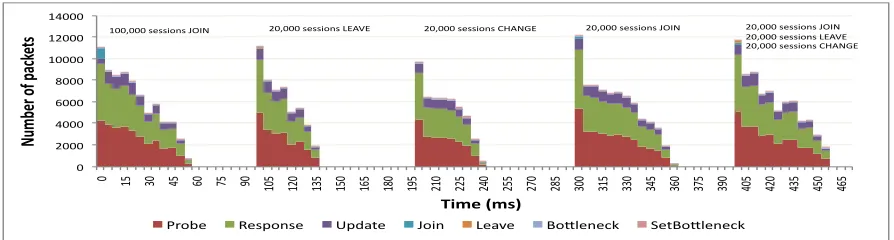
Figure 6: Traffic details of B-Neck in Experiment 2.
Theorem 1 Consider a network, executing the B-Neck protocol, in a steady state. Then, eventually, the network
becomes permanently stable, and all sessions are assigned their max-min fair rate.
Proof:Follows directly from Lemma 5 and Lemma 8.
5
Experimental evaluation
In order to get realistic evaluation results, we have coded the B-Neck algorithm in Java and run it on top of a discrete event simulator. We have modified a version of Peersim [16] to be able to run B-Neck with thousands of routers and up to a million hosts and sessions. Peersim has been adapted and optimized into our modified version,Peersim+, which allows (a) running B-Neck simulations with a large number of routers, hosts and sessions, (b) importing Internet-like topologies generated with the Georgia Techgt-itmtool [26], and (c) modelling several network parameters, like processing time in routers, and transmission and propagation times in the network links.
cycles are completed nearly instantly, and the interactions of Probe and Response packets with packets from other ses-sions are only produced when a large number of sesses-sions are present in the network. Secondly, in what we callWAN scenario, all links except host to router links have been assigned a propagation time generated uniformly at random in the range of 1 to 10 milliseconds. All the links between hosts and routers are assigned 1 microsecond of propagation time. This second scenario has a resemblance with an Internet topology where the propagation times in the internal network links are in the range of a typical WAN link. In this kind of networks, Probe cycles are completed more slowly and more interactions with packets from other sessions are potentially produced than in the LAN scenario. In the experiments, sessions have been created by choosing a source and a destination node, uniformly at random among all the network hosts. A session path is a shortest path from its source to its destination node. In order to check the correctness of the results obtained when executing B-Neck, we have programmed Centralized B-Neck (Figure 1), and so, every B-Neck execution result (the max min fair rate assignment to each session) has been successfully validated against the result obtained when executing the centralized version with the same input data. We have designed three different experiments, that we callExperiment 1,Experiment 2andExperiment 3.
In Experiment 1 we evaluate the behavior of B-Neck when many sessions arrive simultaneously. In this experiment a different number of sessions (from 10 to 300,000 sessions) join the network during the first millisecond of the simulation. The joining time of a session has been also chosen uniformly at random in the first millisecond of the simulation. We have run simulations using Small, Medium and Big networks configured in both LAN and WAN scenarios. In this experiment, we are interested in the time B-Neck requires to complete (i.e. to become quiescent) and the traffic it generates.
Figure 5 (left side) presents the time needed to reach quiescence in Experiment 1 (Observe that both axes are in logarithmic scale). It can be observed, in the LAN scenarios, that with a relatively small number of sessions (up to 100 for the Small network and up to 1,000 in Medium and Big networks) the time that B-Neck needs to calculate the max-min fair assignment for all sessions is almost negligible. This is because a small number of sessions in the network cause limited mutual interaction, and therefore, the B-Neck calculation process is simple. Hence, when the first millisecond completes, most of the sessions already have their max-min fair rate assigned. Only sessions that joined the network near the end of the first millisecond still have to be assigned a max-min fair rate, which can be done a few hundreds of microseconds later. However, when the number of sessions is large enough, the interaction among them is much higher, and so, the time B-Neck requires to complete grows roughly linearly with the number of participant sessions. In the WAN scenarios, the times to quiescence shown in Figure 5 are more linear than in the LAN scenarios. This is due to the predominance of larger propagation times, that produce round trip times of 40 milliseconds (on average) on each Probe cycle. In this case even a small dependence among sessions can delay the quiescence of B-Neck significantly. E.g., only 3 Probe cycles in a session delay the quiescence of B-Neck in 120 milliseconds on average. We have observed that the long round trip time of Probe cycles in the WAN scenarios reduces the number of Probe cycles required (because many Update packets from other sessions are received in the middle of a Probe cycle, and so, they are deferred until the Probe cycle finish).
In Figure 5 (right side) we observe that the number of packets transmitted in the network grows roughly linearly with the number of sessions. In this figure every packet sent across a link is accounted for, i.e., a Probe cycle of session sgenerates a number of packets that is twice the length ofs’s path. The size of the network has no uniform impact in the number of packets as the number of sessions changes. Conversely, each LAN scenario systematically produces more packets than the equivalent WAN scenario, caused by the smaller number of Probe cycles of the latter. However, the differences observed are less than one order of magnitude.
We can conclude the analysis of this experiment observing that B-Neck behaves rather efficiently both in terms of time to quiescence, and in terms of average number of packets per session. For instance, in the LAN scenarios, even with 300,000 sessions it completes in less than 1 second, while in the WAN scenarios it completes in the worst case in around 10 seconds. Regarding the number of transmitted packets, the average number of packets per session is less than 1,000 packets.
-20 -15 -10 -5 0 5 10 15 20 25
0 20000 40000 60000 80000 100000 120000
% error
microseconds Error at sources
B-Neck 10th,90th percentile B-Neck median B-Neck average Bartal 10th,90th percentile Bartal median Bartal average
-20 -15 -10 -5 0 5 10 15 20 25
0 20000 40000 60000 80000 100000 120000
% error
microseconds Error in network links
B-Neck 10th,90th percentile B-Neck median B-Neck average Bartal 10th,90th percentile Bartal median Bartal average
Figure 7: Error distribution in Experiment 3.
of the phase. B-Neck becomes quiescent in 35 ms. later. After that, in the third phase 20,000 sessions change their maximum rate during the first millisecond of the phase. B-Neck converges 40 ms. later. Next, in a fourth phase, 20,000 sessions join the network during the first millisecond of the phase. In this phase, B-Neck completes in 60 ms. (this value is bigger than the values of the second and third phases because B-Neck must calculate again the max-min fair rates of 100,000 sessions instead of 80,000). Finally, in a fifth phase, 20,000 sessions join, 20,000 sessions leave, and 20,000 sessions change their rates, during the first millisecond of the phase. B-Neck becomes quiescent in this phase after 55 ms.
In view of these results we can conclude that B-Neck performance in terms of time to quiescence, is nearly independent of the kind of session dynamics (joins, leaves and rate changes) and the temporal order when changes are produced.
0 1e+06 2e+06 3e+06 4e+06 5e+06 6e+06 7e+06 8e+06 9e+06
0 20000 40000 60000 80000 100000 120000
# pkts
microseconds Packets
B-Neck Bartal
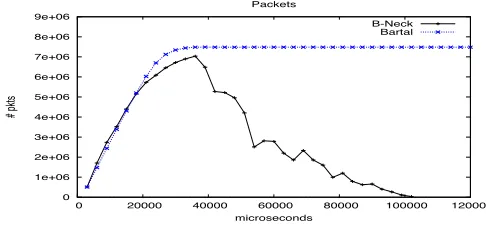
Figure 8: Packets transmitted in Experiment 3.
exact one has been assigned to the session. So, this error gives an idea of the variability that an application using this protocol is going to suffer. In Figure 7 (right side), we present the distribution of the relative error between the sum of the assigned rates (sa) of all the sessions crossing bottleneck links, and the sum of the max-min fair rates (sx) of these sessions ase= 100sasx−sx. In this case, the error gives an idea of the stress that the bottleneck links are going to suffer. The two figures show that B-Neck always behaves in a conservative way, while BFYZ tends to overload the network, assigning transient rates greater than the max-min fair rates. Hence B-Neck is morenetwork friendlythan BFYZ. Additionally, the two figures show that B-Neck converges faster than BFYZ (110milliseconds vs 230 milliseconds), although, in a practical sense, BFYZ reaches rates that are nearly the max-min fair rates in a similar time.
Finally in Figure 8 we plot the number of packets transmitted in each interval by B-Neck and BFYZ. It can be observed that B-Neck, in the worst case (around the 20th millisecond, when sessions have not converged yet to the max-min fair rate), injects to the network the same number of packets than BFYZ. However, as soon as sessions converge to their max-min fair rates, they stop injecting packets to the network and the total traffic generated by B-Neck decreases dramatically. Finally, no packet is injected when all the sessions have converged (around the 110th millisecond). However, BFYZ keeps injecting the same number of packets (around7·106packets in each interval)
even when convergence is reached (because BFYZ does not know that sessions are on the convergence point). In this experiment we can conclude that (a) B-Neck has an application and network friendly behavior, and (b) it converges strictly faster than BFYZ.
References
[1] Yehuda Afek, Yishay Mansour, and Zvi Ostfeld. Convergence complexity of optimistic rate-based flow-control algorithms.J. Algorithms, 30(1):106–143, 1999.
[2] Yehuda Afek, Yishay Mansour, and Zvi Ostfeld. Phantom: a simple and effective flow control scheme.Computer Networks, 32(3):277–305, 2000.
[3] Miriam Allalouf and Yuval Shavitt. Centralized and distributed algorithms for routing and weighted max-min fair bandwidth allocation. IEEE/ACM Trans. Netw., 16(5):1015–1024, 2008.
[4] Baruch Awerbuch and Yuval Shavitt. Converging to approximated max-min flow fairness in logarithmic time. In INFOCOM, pages 1350–1357, 1998.
[5] Yair Bartal, John W. Byers, and Danny Raz. Global optimization using local information with applications to flow control. InFOCS, pages 303–312, 1997.
[6] Yair Bartal, Martin Farach-Colton, Shibu Yooseph, and Lisa Zhang. Fast, fair and frugal bandwidth allocation in atm networks.Algorithmica, 33(3):272–286, 2002.
[7] Dimitri Bertsekas and Robert G. Gallager. Data Networks (2nd Edition). Prentice Hall, 1992.
[9] Anna Charny, David Clark, and Raj Jain. Congestion control with explicit rate indication. In International Conference on Communications, ICC’95, vol. 3, pages 1954 – 1963, 1995.
[10] Jorge Arturo Cobb and Mohamed G. Gouda. Stabilization of max-min fair networks without per-flow state. In Sandeep S. Kulkarni and André Schiper, editors,SSS, volume 5340 ofLecture Notes in Computer Science, pages 156–172. Springer, 2008.
[11] Nandita Dukkipati, Masayoshi Kobayashi, Rui Zhang-Shen, and Nick McKeown. Processor sharing flows in the internet. In Hermann de Meer and Nina T. Bhatti, editors,IWQoS, volume 3552 ofLecture Notes in Computer Science, pages 271–285. Springer, 2005.
[12] Ellen L. Hahne and Robert G. Gallager. Round robin scheduling for fair flow control in data communication networks. InIEEE International Conference in Communications, ICC’86, pages 103–107, 1986.
[13] Yiwei Thomas Hou, Henry H.-Y. Tzeng, and Shivendra S. Panwar. A generalized max-min rate allocation policy and its distributed implementation using abr flow control mechanism. InINFOCOM, pages 1366–1375, 1998.
[14] Xiao Long Huang and Brahim Bensaou. On max-min fairness and scheduling in wireless ad-hoc networks: analytical framework and implementation. InProceedings of the 2nd ACM international symposium on Mobile ad hoc networking & computing, MobiHoc ’01, pages 221–231, New York, NY, USA, 2001. ACM.
[15] S. Jain and D. Loguinov. Piqi-rcp: Design and analysis of rate-based explicit congestion control. InFifteenth IEEE International Workshop on Quality of Service, IWQoS 2007, pages 10 –20, June 2007.
[16] Márk Jelasity, Alberto Montresor, Gian Paolo Jesi, and Spyros Voulgaris. The Peersim simulator. http://peersim.sf.net.
[17] Dina Katabi, Mark Handley, and Charles E. Rohrs. Congestion control for high bandwidth-delay product net-works. InSIGCOMM, pages 89–102. ACM, 2002.
[18] Manolis Katevenis. Fast switching and fair control of congested flow in broadband networks. IEEE Journal on Selected Areas in Communications, SAC-5(8):1315–1326, 1987.
[19] Hyang-Won Lee, Jeong woo Cho, and Song Chong. Distributed max-min flow control for multi-rate overlay multicast.Computer Networks, 54(11):1727–1738, 2010.
[20] Dritan Nace and Michal Pióro. Max-min fairness and its applications to routing and load-balancing in commu-nication networks: A tutorial.IEEE Communications Surveys and Tutorials, 10(1-4):5–17, 2008.
[21] Bozidar Radunovic and Jean-Yves Le Boudec. A unified framework for max-min and min-max fairness with applications. IEEE/ACM Trans. Netw., 15(5):1073–1083, 2007.
[22] Dan Rubenstein, Jim Kurose, and Don Towsley. The impact of multicast layering on network fairness.IEEE/ACM Trans. Netw., 10:169–182, April 2002.
[23] Leandros Tassiulas and Saswati Sarkar. Maxmin fair scheduling in wireless networks. InINFOCOM, 2002.
[24] Wei Kang Tsai and Yuseok Kim. Re-examining maxmin protocols: A fundamental study on convergence, com-plexity, variations, and performance. InINFOCOM, pages 811–818, 1999.
[25] Hong-Yi Tzeng and Kai-Yeung Sin. On max-min fair congestion control for multicast abr service in atm. IEEE Journal on Selected Areas in Communications, 15(3):545 –556, April 1997.
[26] Ellen W. Zegura, Kenneth L. Calvert, and Samrat Bhattacharjee. How to model an internetwork. InINFOCOM, pages 594–602, 1996.