Available online on 15.06.2019 at http://jddtonline.info
Journal of Drug Delivery and Therapeutics
Open Access to Pharmaceutical and Medical Research© 2011-18, publisher and licensee JDDT, This is an Open Access article which permits unrestricted non-commercial use, provided the original work is properly cited
Open Access
Research Article
Development of Liquid and Solid Self-Emulsifying Drug Delivery System of
Silymarin
Shubhrajit Mantry, Debasmita Majumder*
Department of Pharmaceutics, Himalayan Pharmacy Institute, Majhitar, East Sikkim, 737136, INDIA
ABSTRACT
The objective of our investigation was to formulate a self-emulsifying drug delivery system (SEDDS) of Silymarin using minimum surfactant concentration that could include its solubility, stability and also oral bioavailability. Silymarin are widely use drug for the treatment of hepatitis C virus, have poor bioavailability due to their poor water solubility that limits dissolution rate. To overcome this limitation SEDDS were prepared to attempt their release property. The solubility of the drug was determined by various vehicles. Ternary phase diagram was constructed using Cinnamon (oil), Tween 20 (surfactant) and PEG 200 (co-surfactant) and water to identify the efficient Self-emulsifying region. Through pseudo ternary phase diagram investigation, four different formulations were prepared of liquid-solid SEDDS. The stability can be achieved more by developing the solid dosage form by converting the liquid SEDDS to solid SEDDS formulation. The liquid SEDDS was
converted into free flowing powder by adsorption of liquid onto solid carriers by using Aerosil 200 that provides a high surface area. The in
vitro release of solid SEDDS was 58.16% within 8 h. The optimized formulation (F1) showed higher dissolution release than the commercial
product. The in vitro drug release kinetics study of optimized formula was found better Regression coefficient (R2) compare with other
formulation. In conclusion the study elucidated that adsorption to solid carrier technique could be useful method to prepare the solid SEDDS from liquid SEDDS, which can improve oral absorption of Silymain.
Keywords: Silymarin, Self emulsifying drug delivery system, Cinnamon oil, Tween 20, PEG 200.
Article Info:Received 13 April 2019; Review Completed 20 May 2019; Accepted 22 May 2019; Available online 15 June 2019 Cite this article as:
Mantry S, Majumder D, Development of Liquid and Solid Self-Emulsifying Drug Delivery System of Silymarin, Journal of Drug Delivery and Therapeutics. 2019; 9(3-s):54-61 http://dx.doi.org/10.22270/jddt.v9i3-s.2754
*Address for Correspondence:
Debasmita Majumder, Department of Pharmaceutics, Himalayan Pharmacy Institute, Majhitar, East Sikkim, 737136, INDIA
INTRODUCTION
Self-emulsifying drug delivery systems are also known as SEDDS. The need for increased folds in bioavailability of oral lipophilic drugs which led to studies on self-emulsifying drug delivery system. Drugs which have low solubility in aqueous medium but high permeability have given rise to self-emulsifying drug delivery systems or we can say as SEDDS are used to solve low bioavailability issues of poorly soluble & highly permeable compounds.1 Self-emulsifying drug
delivery systems (SEDDS) are mixtures of oils and surfactants, ideally isotropic, and sometimes containing co-solvents, which emulsify spontaneously to produce fine oil-in-water emulsions (o/w) when introduced into aqueous phase under gentle agitation. 1,2. The first marketed SEDDS is
cyclosporine and it was found to have higher bioavailability than the conventional drug.3 Emulsions are liquid dosage
forms which consist of two immiscible phases; where one is a dispersed phase is dispersed into the other phase, dispersion medium, and stability is maintained with the help of an emulsifying agent. The process of self-emulsification can be better explained with the ouzo effect which occurs in
anise-flavoured liquors where an oil-in-water emulsion is formed when the anise comes in contact with water.3
When SEDDS formulation is released in the lumen of the gastrointestinal tract, they come in contact with GI fluid and form a fine emulsion (micro/ Nano) So called as in situ emulsification or self-emulsification which further leads to solubilisation of drug that can subsequently be absorbed by lymphatic pathways, bypassing the hepatic first-pass effect. 1, 2 Recently, SEDDS have been formulated using medium chain
tri-glyceride oils and non-ionic surfactants, the latter being less toxic. Upon per oral administration, these systems form fine emulsions (or micro-emulsions) in gastro-intestinal tract (GIT) with mild agitation provided by gastric mobility.2
The better absorbed drugs across the gastrointestinal tract (GIT) provide good oral bioavailability but have number of potentially limiting factors. These include appropriate stability and solubility in the GI fluid, reasonable intestinal permeability, and resistance to metabolism both within the enterocyte and the liver. 4
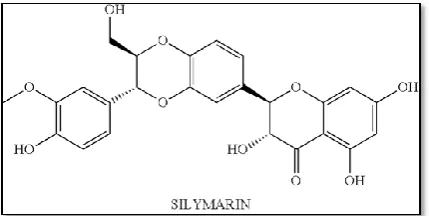
of silybin and its isomers, silicristin and silidianin. Silymarin displays antioxidant and membrane stabilizing activity. It protects various tissues and organs against chemical injury, and shows potential as an antihepatoxic agent. Silymarin is widely used to treat liver disease and it can shows hepatoprotective activity. It is also used to treat Amanita mushroom poisoning, hepatitis, alcoholic liver disease and cirrhosis, hypercholesterolemia, psoriasis etc.5
Figure 1: Structure of Silymarin
MATERIALS & METHODS
Materials
Silymarin obtained as gift sample from Sigma Aldrich, India. Cinnamon oil purchased from Yarrow Chem Products (Mumbai), Tween 20 and PEG-200 purchased from qualigens Fine Chemicals (Mumbai) respectively.
Methodology
I. Preparation of liquid Self-Emulsifying Drug
Delivery System of Silymarin
Based on the result of solubility study and Pseudo ternary phase diagram the appropriate quantities of oil phase, surfactant and co-surfactant were elected. Required quantity of Silymarin dispersed in appropriate quantity of co-surfactant in a beaker in the presence of heat by using magnetic stirrer. Accurately weighed quantity of oil was blended with the surfactant in another beaker. The blends were mixed thoroughly by using magnetic stirrer. This (drug + co-surfactant) mixture was added slowly with another mixture (oil + surfactant). At last, total mixture were mixed properly to get homogenized formulation.6
II. Prepared Solid Self-emulsifying drug delivery
system
The solid SEDDS was prepared by adsorption method. Accurate quantity of Aerosil 200, MCC and Lactose were mixed with the liquid SEDDS where Aerosil 200 acts as a adsorbing agent in a small mortar and pestle. The resulting formulation was uniformly homogenized to ensure that the mixture was uniformly distributed. The damp mass was passed through sieve No. 120 and dried at room temperature.6,7
Table 1: Various Formulations of Silymarin SEDDS
Formulation Code Drug (mg) Amount of Oil (%) Ratio of S/CoS
F1 140 5 1:1
F2 140 10 1:1
F3 140 15 1:1
F4 140 20 1:1
RESULT AND DISCUSSION
Standard curve of Silymarin in Acidic Buffer pH 1.2 Standard curve of Silymarin was successfully obtained in acidic buffer 1.2 by measuring the absorbance with respect to concentration at the λ max of 286 nm of Silymarin and linear regression coefficient is 0.9996.8
Table 2: Calibration curve of Silymarin in pH 1.2
Concentration (μg/ml) Absorbance (nm)
5 0.151
10 0.315
15 0.477
20 0.625
25 0.798
Figure 2: Standard curve of Silymarin in Acidic Buffer pH 1.2
Standard curve of Silymarin in phosphate buffer 7.4 Standard curve of Silymarin was successfully obtained in phosphate buffer 7.4 by measuring the absorbance with respect to concentrations at the λ max of 286 nm of Silymarin and linear regression coefficient is 0.9999.9
Table 3: Absorbance of Silymarin in Phosphate buffer pH 7.4 at λmax 286 nm
Concentration (μg/ml) Absorbance (nm)
5 0.108
10 0.21
15 0.311
20 0.408
25 0.514
Solubility Study
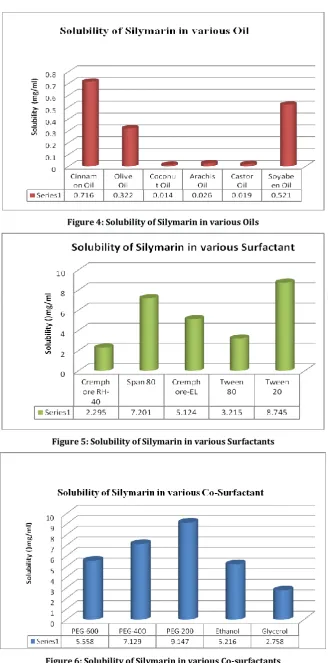
Solubility study of Silymarin in various oil, surfactant and co-surfactant were determined. Fig. 4 showed the Silymarin is better soluble in Cinnamon oil and Soyabean oil compared to
other. Fig. 5 showed the Silymarin was better soluble in Tween 20 and Span 80 compared to other surfactants. Fig. 6 showed the Silymarin was better soluble in PEG 200, PEG 400 compared to other co-surfactants.10
Figure 4: Solubility of Silymarin in various Oils
Figure 5: Solubility of Silymarin in various Surfactants
Pseudo ternary Phase diagram
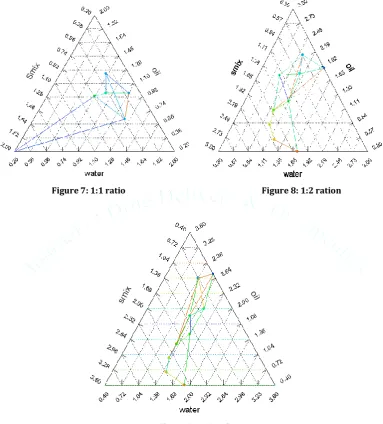
Ternary phase diagrams were constructed to identify the self-emulsifying regions and also to establish the optimum concentrations of oil, surfactant and co-surfactant. In the phase diagrams, Cinnamon oil, Tween 20 and PEG 200 were
constructed as oil, surfactant and co-surfactant respectively, with different ratios of surfactant and co-surfactant (Smix). From the diagrams the surfactant and co-surfactant mixture (Smix) ratio 1:1 showed better self-emulsification region than the other ratio 1:2, 1:3.10,11,12
Figure 7: 1:1 ratio Figure 8: 1:2 ration
Figure 9: 1:3 ratio
FTIR study
Drug excipient interaction was checked by comparing the IR spectra. The functional groups of pure drug remained intact in physical mixture containing different excipient.13
Figure 11: FTIR of Cinnamon oil + Silymarin
Figure 12: FTIR of Silymarin: Cinnamon oil: Tween 20: PEG 200 (1:0.5:1:1)
Evaluation of Liquid Self Emulsifying Drug Delivery System
A. Thermodynamic Stability Study
Centrifugation study
By using laboratory centrifuge (REMI R-8C) at 5000 rpm the formulation were centrifuged for 30 min.
Heating and cooling cycle
Three heating/cooling cycles between 4ºC and 40ºC with storage at each temperature for not less than 24 h.
Freeze thaw cycle
Formulations were subjected to 3 freeze-thaw cycles, which included freezing at -4ºC for 24 h followed by thawing at 40ºC for 24 h. Centrifugation was performed at 3000 rpm for
5 min. The formulations were then observed for phase separation.
B. Self-Emulsification Time
The efficiency of self-emulsification was checked using dissolution apparatus. One ml formulation was dissolved in 250 ml of water at 37±0.5ºC. At 60 rpm gentle agitation was provided by paddle rotating.
C. Dispersibility Test
The efficiency of self-emulsification of oral nano or micro emulsion is assessed by standard USP type II dissolution apparatus. 1 ml of each formulation was dissolved in 500 ml of water at 37 ± 1ºC. A standard stainless steel dissolution paddle was used with rotating speed of 50 rpm to provide gentle agitation.
Table 4: Results of thermodynamic stability of emulsion, emulsification time, and dispersibility test of liquid self-emulsifying drug delivery system.
Formulation No Centrifugation Thermodynamic Stability Emulsification Time (Second) Dispersibility Test (Grade) study Cooling cycle Heating and Freeze Thaw Cycle
F1 Yes Yes Yes 51 A
F2 Yes Yes Yes 57 A
F3 Yes Yes Yes 67 A
Evaluation of Solid Self Emulsifying Drug Delivery System
I. Micromeritic Properties Study
a. Bulk Density
Bulk density of the powder is the ratio of the mass of an unstrapped powder sample and its volume including the contribution of the interparticulate void volume.
The bulk density was determined by following equation-
Bulk Density (ρb) =
b. Tapped Density
The tapped density was obtained by mechanically tapping a graduated measuring cylinder or vessel containing the powder blend.
The trapped density was determined by following equation-
Tapped Density (ρt) =
c. Hausner’s Ratio
The hausner’s ratio was calculated by this following formula-
Hausner’s Ratio (H) =
d. Carr’s Index
Carr’s Index was determined by following equation
Carr’s Index (C) = X 100
e. Angle of Repose
Angle of repose was determined by Fixed Funnel method. Angle of repose was determined by following equation-
tanθ = h/r or θ = tan-1 (h/r),
θ = Angle of repose, h = Height of pile of powder blend, r = Radius of heap.
Table 5: Results of micromeritic properties of solid self-emulsifying drug delivery system
Formulation No
Bulk Density (ρb) (gm/cm3)
Tapped Density (ρt)
(gm/cm3)
Carr’s Index
(C) Hausner’s Ratio (H) Repose (θ) Angle of
F1 0.391 0.498 21.485 1.273 23.728
F2 0.303 0.515 41.165 1.7009 33.398
F3 0.354 0.485 27.010 1.372 30.618
F4 0.413 0.529 21.92 1.280 35.417
II. Drug Content Determination
Silymarin loaded solid SEDDS (10 mg) was dissolved in 100 ml of methanol in 100 ml volumetric flask. Filtered the solution through whatman filter paper. Then diluted the solution with methanol. Then the solution was analyzed by UV spectrophotometer.14
III. In-vitro release studies
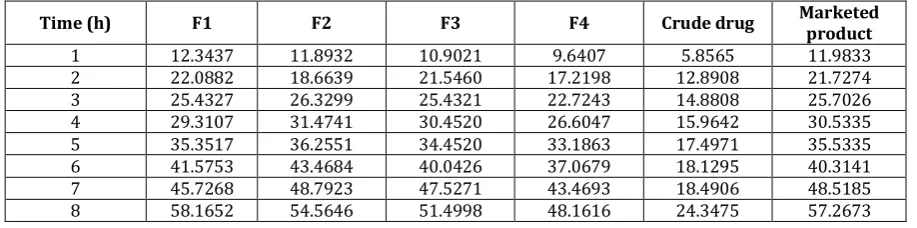
The percent cumulative release of Silymarin from the formulations F1 was found to be higher than the other formulations and marketed product (Silymarin®). The cumulative percentage drug released after 8 hours for F1and marketed product was 58.16% and 57.26% respectively.
Cumulative percent drug release is high in formulation F1 because of the amount of oil present in the formulation was lower than the other formulation.
Table 6: Results of Drug content of solid self-emulsifying drug delivery system
Formulation No Drug Content (%)
F1 98.57
F2 90.78
F3 89.94
F4 95.62
Table 7: In vitro drug release data comparison study between formulations (F1-F4), Crude drug and Marketed product.
Time (h) F1 F2 F3 F4 Crude drug Marketed product
1 12.3437 11.8932 10.9021 9.6407 5.8565 11.9833
2 22.0882 18.6639 21.5460 17.2198 12.8908 21.7274
3 25.4327 26.3299 25.4321 22.7243 14.8808 25.7026
4 29.3107 31.4741 30.4520 26.6047 15.9642 30.5335
5 35.3517 36.2551 34.4520 33.1863 17.4971 35.5335
6 41.5753 43.4684 40.0426 37.0679 18.1295 40.3141
7 45.7268 48.7923 47.5271 43.4693 18.4906 48.5185
Figure 13: In vitro drug release profile comparison study between formulations (F1-F4), Crude drug and Marketed product.
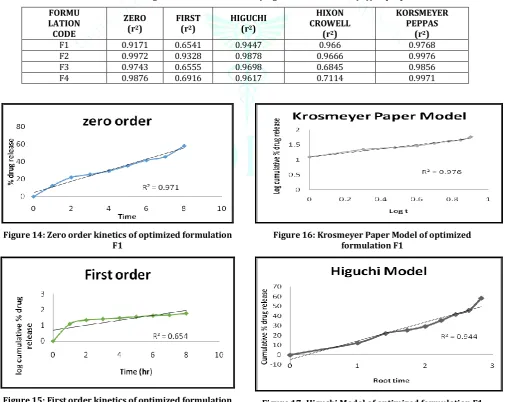
Drug Release Kinetics Study of Formulation (F1-F4) For the determination of the drug release kinetics, the in vitro data was analyzed by zero order, first order, Higuchi
and Krosemeyer Peppas equation for each formulation. The optimized formulation was found to be F1 in release kinetics study also because it shows the maximum % cumulative drug release from the formulation after 8hrs.
Table 8: Drug release kinetics studies (Regression coefficient (r2)) of prepared FORMU
LATION CODE
ZERO (r2)
FIRST (r2)
HIGUCHI (r2)
HIXON CROWELL
(r2)
KORSMEYER PEPPAS
(r2)
F1 0.9171 0.6541 0.9447 0.966 0.9768
F2 0.9972 0.9328 0.9878 0.9666 0.9976
F3 0.9743 0.6555 0.9698 0.6845 0.9856
F4 0.9876 0.6916 0.9617 0.7114 0.9971
Figure 14: Zero order kinetics of optimized formulation F1
Figure 15: First order kinetics of optimized formulation F1
Figure 16: Krosmeyer Paper Model of optimized formulation F1
Figure 18: Hixon crowell model of optimized formulation F1
CONCLUSION
The aim of present study was to formulate and evaluate liquid-solid self emulsifying drug delivery system of poorly water soluble drug Silymarin. And four formulations was prepared by using different ratio of cinnamon oil as oil phase and Tween 20 and PEG 200 as surfactant and co-surfactant respectively. In this present study pre-formulation parameters were investigated. The calibration curve of Silymarin in Phosphate buffer 7.4 and acidic buffer 1.2 were determined and the regression co-efficient were 0.9999 and 0.9996 respectively. The solubility study was conducted and from that Silymarin was soluble in Cinnamon oil, Soyabeen oil used as oil, Tween 20, Span 80 used as a surfactant and PEG 200, PEG 400 used as a co-surfactant. They showed better result compared to other substances. From pseudo ternary phase diagram the surfactant and co-surfactant mixture (Smix) ratio 1:1 showed better self-emulsifying region than 1:2, 1:3. Through pseudo ternary phase diagram investigation, four different formulations were prepared of liquid-solid SEDDS. The conclusion was F1 formulation confirmed better result than the other three formulations, the value of angle of repose less than 25 and the drug content 98.57% showed in F1 formulation. The drug release from F1 formulation and marketed product was 58.16% and 57.26% respectively after 8 h. Thus F1 formulation showed higher drug release from marketed product. So the BCS Class II drug Silymarin loaded SEDDS showed promising result of increased absorption and increased oral bioavailability from the marketed formulation.
ACKNOWLEDGMENTS
We are thankful to the authorities of Himalayan Pharmacy Institute for providing the facilities to complete our work successfully.
CONFLICTS OF INTEREST
There is no conflict of interest.
REFERENCES
1. Mistry R, Sheth NS, Self emulsifying drug delivery system,
International Journal of Pharmacy and Pharmaceutical Sciences 2011; 3(2):23-28.
2. Nigade PM, Patil SL, Tiwari SS, Self emulsifying drug delivery
system (SEDDS): A review, International Journal of Pharmacy and Biological Sciences, 2012; 2(2):42-52.
3. Ajay K, Surabh S, Ravindra K, Self-emulsifying drug delivery
systems (SEDDS): Future aspects’, International Journal of Pharmacy and Pharmaceutical sciences, 2012; 2(4):7-13.
4. Brahmankar DM, Jaiswal SB, First edition, “Absorption of
Drugs” Biopharmaceutics and Pharmacokinetics – A treatise, Vallabh Prakashan, Delhi 1995, 5-75.
5. Dixit N, Baboota S, Kohli K, Ahmad S, Ali J, Silymarin: A review
of pharmacological aspects and bioavailability enhancement approaches, Indian journal of pharmacology, 2007; 39(4):172.
6. Saifee M, Zarekar S, Rao VU, Zaheer Z, Soni R, Burande S,
Formulation and in vitro evaluation of solid-self-emulsifying
drug delivery system (SEDDS) of glibenclamide, American Journal of Advanced Drug Delivery, 2013; 1(3):323-340
7. Iosio T, Voinovich D, Perissutti B, Serdoz F, Hasa D, Grabnar I,
Dall’Acqua S, Zara GP, Muntoni E, Pinto JF, Oral bioavailability of silymarin phytocomplex formulated as self-emulsifying pellets, Phytomedicine, 2011; 18(6):505-12
8. Indian Pharmacopoeia; Volume: 1; The Indian Pharmacopoeia
Commission, Ghaziabad; 2007; 477
9. Indian Pharmacopoeia; Volume: 1; The Indian Pharmacopoeia
Commission, Ghaziabad; 2007; 480
10. Amrutkar C, Salunkhe K, Chaudhari S, Study on self nano
emulsifying drug delivery system of poorly water soluble drug rosuvastatin calcium, World Journal of Pharmaceutical Research, 2014; 3(4):2137-51
11. Gupta AK, Mishra DK., Mahajan SC, Preparation and in-vitro
evaluation of self emulsifying drug delivery system of antihypertensive drug Valsartan, International Journal of Pharmacy and Life Science, 2011; 2(3):633-638
12. Chanale AM, Raskar MA, Tarkase KN, Formulation and
Evaluation of Self Emulsifying Drug Delivery System of Ezetimibe, Der Pharmacia Lettre, 2016; 8(11):164-176
13. Kumar MS, Shailaja P, Murthy K, Pradesh A, Improvement of
oral bioavailability of nifedipine through self-microemulsifing drug delivery systems, Journal of Global Trends in Pharmaceutical Sciences, 2011; 2( 3):364-388
14. Bhattacharyya A, Bajpai M, Development and evaluation of a
self-emulsifying drug delivery system of amphotericin B, Asian Journal of Pharmaceutics (AJP): Free full text articles from