World Maritime University World Maritime University
The Maritime Commons: Digital Repository of the World Maritime
The Maritime Commons: Digital Repository of the World Maritime
University
University
World Maritime University Dissertations Dissertations
11-5-2017
The potential of Vizhinjam Port as a regional hub: a network
The potential of Vizhinjam Port as a regional hub: a network
analysis : a feasibility analysis from a network perspective
analysis : a feasibility analysis from a network perspective
Pratichi Rajan Mallick
Follow this and additional works at: https://commons.wmu.se/all_dissertations
Part of the Growth and Development Commons, and the Transportation Commons
Recommended Citation Recommended Citation
Mallick, Pratichi Rajan, "The potential of Vizhinjam Port as a regional hub: a network analysis : a feasibility analysis from a network perspective" (2017). World Maritime University Dissertations. 570.
https://commons.wmu.se/all_dissertations/570
WORLD MARITIME UNIVERSITY
Malmö, Sweden
THE POTENTIAL OF VIZHINJAM PORT
AS A REGIONAL HUB –A NETWORK ANALYSIS
A feasibility analysis from a Network perspective
By
PRATICHI RAJAN MALLICK
India
A dissertation to be submitted to the World Maritime University in partial
Fulfilment of the requirements for the award of the degree of
MASTER OF SCIENCE
In
MARITIME AFFAIRS
SHIPPING MANAGEMENT AND LOGISTICS
DECLARATION
I certify that all the material in this dissertation that is not my own work has ben identified, and that no material is included for which a degree has previously been conferred on me.
The contents of this dissertation reflect my own personal views, and are not necessarily endorsed by the University.
Supervised by: Professor Dong-Wook Song, World Maritime University
_________________________________________________________________________
Assessor: Professor Daniel Moon
Institution / Organization: World Maritime University, Malmo
Co-assessor: Dr. Okan Duru
ACKNOWLEDGMENT
This work would not have been possible without the unfailing support and encouragement from my sister, Alpana Mallick, and my parents, Jogesh and Ratna Mallick. They have always provided me with the secured academic time to pursue my goals.
I am especially indebted to Professor Dong-Wook Song, who has been actively guiding me through my academic pursuits at the World Maritime University. This dissertation is a culmination of ideas provoked by his critical analysis and valuable insights. Sir, I am grateful for your time and trust in me. I would also like to express my gratitude for Professor Ilias Visvikis, for his guidance and lessons, both inside and outside the classroom. The dissertation would have been impossible without the help of Chris Hoebeke and his team at the library. Their constant help in data collection, research and advice on writing have been valuable and I cherish there company and help.
ABSTRACT
Title of Dissertation: The potential of Vizhinjam Port as Regional Hub: A Network Analysis
Degree: MSc in Maritime Affairs
This paper explores and analyzes the south Asian maritime network to assess the potential of the Vizhinjam transshipment port in India from a network perspective. Port research has been going through a transitory phase as research topics have moved away from purely geographical and operation to an increasingly interdisciplinary approach. The spatial arrangement of port and port networks have risen to prominence for researchers in the last decade. Although European and East-Asian networks have been extensively discussed, research on the South Asian network structure remain scarce. This study fills the gap by examining the South Asian port network by using the social network analysis (SNA) approach. The weekly liner service schedule of all the members in the three major alliance operating in the South Asian, Middle Eastern and Indian Ocean region was collated and investigated using SNA principles on the Gephi open-source software.
On the whole, the south Asian network mimics the global network. The network analysis from a graph theoretical approach posits the scale-free nature of the system and the presence of clusters highlight the small-world characteristics of the network. Furthermore, the Indian port sector was studied, its performance and the current policy inputs discussed. Privatization can be seen to have improved performance owing to more competitiveness due to financial freedom in a dynamic liner market. A feasibility study using sensitivity analysis was also performed considering the estimated capacity of the Vizhinjam transshipment port. Multiple permutation of port linkages based on berth capacity were used to assess the optimum outcome. The analysis highlights the feasibility of the port on both the neutral and positive stance owing to its spatial and physical characteristic as seen by the change in the network structure upon Vizhinjam’s introduction in the system. A small-world approach, where by connection to central ports was seen viable but a feeder line bundling configuration along the Indian ocean and Indian east-west coast region was found to be the optimal solution due to its proximity to major routes and deep draft. The conclusion discusses the holistic view of the south Asian network and the benefits of privatization and policy changes on Indian ports, especially Vizhinjam.
TABLE OF CONTENTS
DECLARATION
... ii
ACKNOWLEDGMENT
... iii
ABSTRACT
... iv
TABLE OF CONTENTS
... v
LIST OF FIGURES
... viii
LIST OF TABLES
... ix
LIST OF ABBREVIATION
... x
Chapter One - Introduction
... 1
1.1 Background... 1
1.2 Problem Identification ... 2
1.3 Research Objective ... 3
1.4 Research Methodology ... 4
1.5 Dissertation Structure ... 4
Chapter Two - Ports as cornerstone of economic growth
... 6
2.1 Historical Background ... 6
2.2 Containerization ... 7
2.3 Ports ... 8
2.4 Evolution of Container Ports ... 8
2.5 Correlation of port and economy ... 11
2.6 Introduction to maritime Networks ... 12
2.7 Development of Indian port system ... 13
2.8 Current performance of Indian Ports ... 16
2.9 Indian Infrastructure policy ... 18
Chapter Three - The Asian Port Network
... 21
3.1 Vizhinjam international seaport limited Project ... 21
3.2 Civil engineering features ... 21
3.3 Adani Ports and Special Economic Zones Limited (APSEZ) ... 22
3.5 Application of Port Network Theory ... 28
Chapter Four - Social Network Analysis as an Analytical Tool
... 29
4.1 Network Analysis in Concept and Practice ... 29
4.2 Social Network Analysis as an Analytical Tool ... 32
Chapter Five - Application of Social Network Analysis to South Asian Ports
... 35
5.1 Container Shipping Data Analysis ... 35
5.2 Data Source ... 35
5.3 Gephi - Network Analysis Software ... 37
5.4 Regional Network Characteristics ... 37
5.5 Port hierarchy in Network ... 39
5.6 Sensitivity Analysis ... 42
5.7 Feasibility Analysis ... 44
Chapter Six - Discussion
... 46
6.1 Role of Vizhinjam International Seaport Terminal ... 46
6.2 Challenges ... 47
6.3 Opportunities and Future Scope ... 49
Chapter Seven – Conclusions
... 52
7.1 Summary ... 52
7.2 Limitation and Further Research ... 54
Bibliography
... 55
Appendix
... 63
Appendix A - Node List for SNA... 63
Appendix B1 Edge list of south Asian Port Network ... 64
Appendix B2 Edge list of south Asian port network ... 65
Appendix B3 Edge list of south Asian port network ... 66
Appendix B4 Edge list of south Asian port network ... 67
Appendix B5 Edge list of south Asian port network ... 68
Appendix B6 Edge list of south Asian port network ... 69
Appendix B7 Edge list of south Asian port network ... 70
Appendix B8 Edge list of south Asian port network ... 71
Appendix C - South Asian Region - Network Analysis Table ... 72
Appendix D2 Hinterland - Eastern ... 73
Appendix D3 Hinterland - Southern ... 74
Appendix E Vizhinjam Traffic ... 74
Appendix D Regression Analysis #1 ... 75
Appendix E Regression Analysis #2 ... 75
Appendix F Betweenness centrality of the current network... 76
Appendix G Degree Centrality of the current network ... 76
Appendix H Eigenvector Centrality of the current network ... 77
Appendix I K-core analysis to check maximal subset of the network in current network ... 77
Appendix J Network Graph highlight service frequency between ports ... 78
Appendix K Change in Degree with Vizhinjam's introduction... 78
Appendix L1 Change in Modularity with Vizhinjam's introduction ... 79
LIST OF FIGURES
Figure 1 Basic Port Management Models --- 10
Figure 2 Container traffic growth in India along with decline share of major ports as per Indian Container Market Report --- 14
Figure 3 Share of containers handled at west coast and east coast ports --- 14
Figure 4 Distribution on Indian Container handling port according to throughput 2015-16 as adopted from the Indian Conatiner Market Report 2016. --- 15
Figure 5.Comparison of world's top 10 Container port with Indian ports as adapted from the UNCTAD annual report and Ministry of shipping, government of India annual report. --- 16
Figure 6 Increase in throughput at Non-major ports as per Indian Container Market Report 19 Figure 7 Geographical position of Vizhinjam Port --- 21
Figure 8 APSEZ managed ports across India --- 23
Figure 9 Deviation from Europe-Far East Routes --- 24
Figure 10 Node Degree Values of a Random Graph. --- 30
Figure 11 Betweeness values of Nodes in a Random Graph --- 31
Figure 12 - Area under research --- 36
Figure 13 Node list --- 37
Figure 14 South Asian Port Network --- 38
Figure 15 Degree Distribution of South Asian Port Network --- 39
Figure 16 Port network of ports which can handle Megaships >18,000 TEU --- 40
Figure 17 Indian Port Network based on network analysis --- 41
Figure 18 Centrality measures of Indian ports in the network --- 41
Figure 19 South Asian maritime network including Vizhinjam optimum forecast --- 43
Figure 20 Port network including Vizhinjam. --- 44
Figure 21 Degree Centrality Based South Asian Port Network --- 45
Figure 22 Ports handling Indian transshipment cargo --- 46
LIST OF TABLES
Table 1 Port Throughput and Growth Rate ... 17 Table 2 Vizhinjam Expansion Plan ... 22 Table 3 Port comparison in the Research Area ... 24 Table 4 Factors affecting competitiveness and attractive of regional hubs adapted from
LIST OF ABBREVIATION
APSEZ Adani Ports and Special Economic Zone Limited
BOT Build-Operate-Transfer
CMA-CGM Compagnie Maritime d'Affrètement - Compagnie Générale Maritime
COSCO China Ocean Shipping Compnay
CSIL Center for Industrial Studies
DBFOT Design-Build-Finance-Operate-transfer
DP Dubai Port
FAL French Asia Line
FDI Foreign Direct Investment
GAIL Gas Authority of India
GoI Government of India
GSC Global Supply Chain
ICD Inland Container Depot
ICTT International Container Transhipment Terminal
JNPT Jawaharlal Nehru Port Trust
MSC Mediterranean Shipping Company
NMDP National Maritime Develpoment Program
ONGC Oil and Natural Gas Corporation Limited
PPP Public-Private Partnership
PTP Pelabuhan Tanjung Pelepas
SEZ Special Economic Zone
SNA Social Network Analysis
SWOT Strength Weakness Opportunities Threats
TEU Twenty-Foot Equivalent Unite
UASC United Arab Shipping Company
ULCV Ultra Large Container Vessel
UNCTAD United Nations Conference on Trade and Development
UNESCO United Nations Educational, Scientific and Cultural Organization
Chapter One - Introduction
1.1 Background
The outbreak of globalization, began centuries ago. Colonization and discovery voyages supplemented this process. Globalization as seen today was instigated particularly by the invention of containers. But unlike the trade imbalance perspective which explorers voyaged for, colonial states looked to capitalize on the low cost of production perspective something which has been further harnessed by the current global economy. The spatial separation of production from the consumption with added services to the overall supply chain function at cheaper locations owing to containerization, has led to the evolution of a complex maritime based logistical system and the emergence of ports as a crucial element in the form of a gateway for trade. The continual growth in world trade has not only transformed shipping but also ports. The increasing competition to meet the global market demands has intensified inter-port competition, changing the function of ports and accelerating the evolution process. Evolution ports to hubs of trade, has developed an intricate system intervened with accessibility and centrality. These hubs are characterized with strong links between cities with long standing maritime infrastructure supplement by a system of railways and canals. There is also an emergence of economic zones around major ports highlighting a shift from colonial to a modern economy-based change.
prowess. The added complexities of today’s global supply chain in conjunction with economic inequality has led to shipping via ports becoming a crucial building block in development of many city and countries (Dwarkesh & Salim, 2015). This evolution of ports from a traditional centre of transport to a dynamic centre of commerce and growth has been altered by globalization. The last decade has seen a further shift of ports from metropolis to suburban areas (like Shenzhen, Ningbo, JNPT, Mundra) as a result of differential port and city planning, in line with Barkes (1986) port decentralization concept in his five-phase model.
1.2 Problem Identification
Trade and economy complement each other. The transportation revolution as discussed by Lee, Song and Ducruet highlighted the contribution of containerization and intermodalism to economic changes in the past (2008). Rich dividends earned from investments on port infrastructure by nations like Singapore, Belgium in the past and China, Vietnam, Malaysia, Indonesia recently supplement this argument. Ports, in an increasingly competitive global market, have become the catalyst of promoting economic activities (Clarke, Dollar & Micco, 2004; Weiss, 1990;Ng, Yang, Cahoo & Lee, 2016 et al). With a long coastline, close proximity to the the trade routes presents an abundance of opportunities for the Indian sub-continent, which has so far failed to capitalize it well as compared to some of its counterparts like China and Srilanka.
1.3 Research Objective
The purpose of the study is to understand the relationships between the ports by identifying the structure of the system of ports in the south Asian region (we would include the middle-east and Indian ocean regions as well). Consequently, analysing these infrastructural characteristics to evaluate links in the network configuration and to perform sensitivity analysis according to the estimated operational capacity of Vizhijam to lure traffic away from Colombo, the immediate competitor in terms of ability to handle vessel capacity exceeding 12,000 TEUs and more importantly trans-shipment cargo. In the last decade, considerable research has been conducted on the shipping network on a comparative as well as feasibility basis. Despite a huge bank of data and analytical research, focusing on the global and regional patterns in containerized shipping, fairly small pool of research focuses on the Indian peninsula which is set to become one of the largest economies and consumer base in the future (Panigarh & Pradhan, 2012). This dissertation apart from adding to the current literature aims to add a new perspective for port infrastructure developers and government alike to understand shipping liner demands from a network perspective in inter-port relationships with respect to port competition and complementarity, especially when developing transhipping ports. The research for the dissertation would aim to achieve the following objectives:
Understanding the current liner network in South Asia through network analysis and evaluate the significance of the neighbouring competitive ports namely, Colombo, Kochi, Mundra and Mumbai-JNPT, from a network centrality and closeness perspective.
Understanding the correlation between draft and traffic characteristics to their network characteristics via regression analysis of port performance parameters with centrality coefficients as dependent factors.
Estimating Vizhinjam ports’ expected centrality based on the parameters of the port, currently under-construction highlighting the market potential of the project.
1.4 Research Methodology
With the feasibility of a port depending on both sea-side and land-side factors, the dissertation aims to dwell into the sea-side factors like liner network structure, port systems and port centrality. Research on the network structure, which still remains scarce is the cornerstone of this project. To understand the shipping network, we would investigate the connectivity of the case ports from the perspective of social network analysis(SNA), a branch of sociology which studies collection of individuals and the linkages among them. The linkages in our research would be the connection between various ports via container liner routes. For modelling networks, SNA uses graph theory, algebra and statistics (Wasserman & Faust, 1999). Hence we would develop a network model on graph theory and analyse various features of this network using algebra and statistics procured from the port of calls schedule of liner under the new alliances. By relating various actors (in this case, ports) into networks we can define competition, their complementarity and more importantly analyse the network structure and its behaviour. Under this perspective, the elemental factor that determine the success of a port would be its strategic location in the network. The dependencies among the ports can be measured with structural variables like centrality measures, which hypothesize that port do not function independently but rather influence each other. The computation for the same would be done using the software called - Gephi, a network analysis software which has been previously used for mapping networks in social context like Facebook and Twitter.
1.5 Dissertation Structure
Chapter Two - Ports as cornerstone of economic growth
2.1 Historical Background
The Indian maritime history dates back to the 3rd millennium BCE when the Mesopotamians begin trade with the Harappan civilization via sea routes marking the beginning of the evolution of shipping. Indus-port city of Lothal in present day Gujarat, India, proves the prominence of sea-trade in the Indian sub-continent (UNESCO,2017). The sheltered coastal sea routes proved a safer option over land trade for maritime trade to develop in the Babylon-Mesopotamia-Harappan region. The commodity and vessel trade with Swahilis late in the first millennium CE, discussed by Pollard & kinyera also highlights the naval presence of Indians (Pollard & Kinyera, 2017). Over the centuries, the evolution of sea trade moved westward, as succinctly pointed out by Stopford in his westline analogy (2009).
The rise of Greek shipping in the Mediterranean followed by roman empire’s widespread establishment of trade networks connected Europe to Asia (Stopford,2009). The emergence of Venice and the Hansetic sea trade routes in the 1st millennium CE was a result of increased prosperity of Europe. Empires became richer by trade and stronger by conquest. Though the Chinese were said to be technically more advance, the 15th century ban on ship construction paved the way for maritime dominance to European explorers which would dominate shipping for the next 5 centuries. The exploration of Portuguese and Spanish explorers was the cornerstone of evolution of trade and evolution of port cities as a result of new emerging markets. The emergence of London, Antwerp, Hamburg epitomizes the evolution of ports as trade centres based on exploratory or colonial voyages in America and Asia (Stopford, 2009). Colonized states too prospered. Colonial Port cities like Hong-Kong Bombay, Calcutta, Cochin all developed into major port cities most of which have been quaintly renamed to Mumbai, Kolkata and Kochi respectively in the post-independence era. Technology was another major factor which led to evolution of ports. The unitization of cargo and invention of telegraph led to a series of changes. With better knowledge of cargo demand, and advent of steamship let to reduce warehousing and increase speed of cargo movement (Alderton,1999).
value-added services (Alderton, 1999). Though there have been studies on evolution of ports, which would be discussed later, changes like containerization, evolution of megaships and the policies by government to adapt to these changes in the dynamic maritime ecosystem have been at the heart of port development.
2.2 Containerization
The shipping industry has been transformed by the expansion of trade, integration of different modes of transport and technological advancement. Containerization, for one has been herald as the lynchpin of globalization. But in the grand scheme of things, the adaption of containers and the assimilation of intermodal transport infrastructure in the years after Malcom Mclean envisioned this pioneering concept opened the true potential of containers. Add to this the production of components and goods across the world, especially in the developing economics as pointed out by Gereffi led to the establishment of global supply chains(GSCs) (1996). Transportation in a global supply chain put shipping in the forefront of the global economic system. It was a vector for growth in production and distribution, facilitating a shift from a push to pull logistics (Rodrigue and Notteboom, 2008). Acting as a bridge between different geographical and economical regions the maritime sector became the proponent of growth and economic change (Ng and Wilmsmeier, 2012; Rodrigue and Notteboom, 2009; Lee, Song & Ducruet, 2008; Notteboom & Winkelsmans, 2010 et al). The transport revolution subsequently changed the roles of seaports (hereafter referred as ports) from an interface between sea and land to an integrated element of the global supply chain as a consequence of intermodalism and logistic integration (Robinson, 2002). The evolution of containers brought about not only sea-based changes like ship design, liner routes along with economic changes but also significantly affected port infrastructure and operational practises. This phase of transformation of the maritime sector witnessed a significant increase in the research works particularly in operation, planning, governance and most recently sustainability in both shipping and ports sector (Lau, Ng, Fu & Li, 2013; Ducruet & Ng, 2014).
This highlights lack of container shipping research by Indian institutes even though it’s one of the largest economy boasting a more than 7,000 km coastline (Kumar, Pathak, Pednekar, Raju, & Gowthaman, 2006).
2.3 Ports
Port studies have been predominantly centred around geographic papers. Pioneers like Rimmer, Hayuth, Taaffe et al envisaged port evolution models based on growth and development of corridors which had a deeply amalgamated geographical ideology. The early studies on ports were specific to geographic importance (Like Hoyle 1967, 1968; Taaffe 1963, Fleming & Hayuth, 1994) but as shipping evolved, the focus also moved to an array of topics which were based on surveys and discussions, based on an area of choice to specific interconnected issues like economics, port city relations and ports as gateways (Bird, 1980; Hoyle, 1989; Slack, 1989) apart from the traditional approaches on port growth and importance. The emergences of the ‘Asian tigers’ saw a shift to research on Asian ports. The rise of competition has led to a more applied and interdisciplinary approach to research. The feasibility assessment of mega-containers ship by Cullinane and Khanna (1999) has fostered a paradigm shift witnessed by the rise of transhipment hubs. With every port striving to become a hub, an intuitive question arises - is it necessary? To be able to answer this, a more structural research on maritime networks with nodes and port links not only on global but also regional level is necessary. Containerization has significantly changed port operation models and competition amongst seaports (Cullinane & Song, 2006). A port’s management solely based on terminal infrastructure does not attract clients, and port operators have to make major decision on hinterland development to reduce overall transport and logistic costs to ensure sustained growth (Notteboom & Winkelmans, 2010; Oliver & Slack, 2006). From a port development perspective also, strong international connections and analysis of both sea and land based factors is essential to ensure feasibility of a port development project.
2.4 Evolution of Container Ports
evolution of megaports in an era of mega -containerships (Robinson, 2002; Ng, 2006; Baird, 2007). Frémont and Ducruet discussed the emergence of transhipment and regional port development and competitiveness (2005). With the examples of Busan, they highlighted the importance of physical, economical and bureaucratic function of ports and the need for port to adapt to the constantly changing maritime demand. Ports have become a key component of the logistical chain and therefore their operation and development are directly affected by economic variables. The direct correlation with quantifiable factors like network and spatial characteristics, operational services variables as well as qualitative factors like policy and governance affect ports’ growth rate as pointed out by Sanchez et al (2003). The recent trend of asymmetrical growth of ports and cities has further declined growth rates of ports as scope for expansions is reduced(Lee, Ducruet & Song, 2003). Sanchez et al also highlighted the reduction of cost and improvement in efficiency amongst other factors that mark the success of a port and its growth in the future. The advent of intermodalism and megaships largely affected the economics of international trade, with hub port rendering smaller ports redundant with cargo being moved to hub ports via inland transport corridors or feeder systems to large ports accessible by large ships to capitalizing on the economies of scale.
Container ports today can be divided into three categories: hub port, trunk port and feeder port, and the main criterion needed to be called a hub port is not throughput cargo rate but transhipment cargo rate (Huang, 2008 as cited in Nam & Song, 2011). A more subjective definition in terms of ship-to-ship transfer, the hub port is conceived as a pure transhipment port with the sole purpose of transfer goods from one ship to another. Under this perspective, the elemental function of the port is to reduce cargo handling time during ship transfer and all other logistical infrastructure like warehousing, packaging et al are vital but secondary or less important. This transfer efficiency is based on three intra-port aspects which are: berth handling, yard storage and intra-terminal transport and the overlapping network of the port to ensure efficient transhipment. So in a perfect transhipment hub, mother and feeder ship should be capable of docking fairly close to each other to minimize cargo handling time. Paradoxically, however, the type of development that has taken place in some ports has led to the opposite results: terminals have been built at considerable distance from one another because of the lack of available space and increased application of hub and spoke system by
liner companies (Foschi,2003).
share of containerized cargo tonnage is a strong indicator of the need of increased integration of Indian ports, as ports are internationally considered the centre of multimodal transport. The preposition of this study is in line with the extensive research of Nam & Song (2011), which proposes that, “hub ports (in particular, container ports) should be examined with not only their container throughputs in terms of Twenty-Foot Equivalent Units (TEU) but also their connections with shipping lines in the inter- and intra-region.” So the viability study of Vizhinjam port would have to focus on these qualitative and quantitative factors.
One must also understand the role of the ports as junction between sea transport and land transport which can be viewed from two perspectives – The user’s perspective and the operator’s perspective. From the stand point of users of the ports - shipping liners, forwarders and shippers, the attractiveness of a port, as per the research by Yuen, Zhang & Cheung on East Asian Port competitiveness highlight the location and costs of port, custom and regulations, services, cargo handling facility and hinterland as the major decision making factors (2012). The effect of hinterland conditions on the supply chain system to smoothen the logistical needs of the users is therefore important aspect for port operators to consider as the attractiveness of a port is dictated by the weakest link in this chain. This is justified by the fact that, port of Dubai, Colombo, Tenjung Pelepas and Port Klang in Malaysia are better positioned for trade than any of the Indian ports. The low connectivity and delay in cargo handling deterring shippers to move to other ports in the continent (World Bank, 2013).
Port governance has also changed. The last few decades have witnessed a shift in port management from government to private due to restrictive labour practices and centralized government structure which was slow to react in market fluctuation and most importantly to reduce risk by undertaking joint ventures (Port reform Toolkit, 2007). This led to changes in administration structure of ports, which can be broadly divided into 4 models, where operational responsibilities are taken up by either port authority or outsourced to a private firm or a partnership. The scenario in port management today involves, the public sector acting as planner, facilitator and regulator while ensuring access to hinterland properties, whereas the private sector acts as service provider, operator, and sometimes also as developer together with public sector (Brooks, 2004).
Figure 1 Basic Port Management Models
2.5 Correlation of port and economy
Port are the harbingers of change, they have a positive influence on development of surrounding areas (Ferrari & Musso, 2011). The medieval ports were the centres of trade whilst industrialization saw the colonial era ports become the epicentre of economic activities with road and rail networks focusing on moving goods to port. They served as a catalyst to change. As port hinterlands evolved into special economic zone, port moved from an old venetian markets places to industrial zones like in Shenzhen (Wang & Ng, 2011). An historical analysis of major cities in the world would highlight the correlation of ports and shipping activities to economic growth of surrounding areas. Ports have evolved differently in different regions in the world; while the western ports followed Hoyle’s port city model, Asian ports have followed a consolidated model posited by Lee, Song & Ducruet (2008). But the effect of port on regional and national economy in both the cases can not be undermined. A Port being the dense intersections connecting hinterland to foreland, play a crucial role economic growth and competitiveness of a country (Dwarkish & Salim, 2015). Port efficiency, which would be discussed in a later section, affects transportation cost and in turn the growth rate (Sanchez et al, 2003).
Ports are more than a sea-land interface, it’s a function, a set of activities that provides impetus for four types of industries. Firstly, the port-specific industries like stevedoring, port services (like bunkering). Secondly, port-related activities that include firms involving in shipping activities like import-export firms, provision or store suppliers and lastly port-induced activities like manufacturing industry and other industry that aid maritime trade like banks, legal firms, brokers and commodities trading firms (Yochum & Agarwal,1988, 1987). Ports also help directly or indirectly generate employment. Good example is the Port of Hamburg. The port of Hamburg more than 150,000 jobs in the Hamburg and Hanseatic city region supporting more than quarter of a million people and generating a gross domestic product of 12.6 Billion euros in 2010 (Dwarkish & Salim, 2015).
being positioned higher in the FDI network as compared to some other larger ports, especially Asian port cities (Zhao, Wall & Stavropoulos, 2017). This shows the significant influence of port and hinterland development on the economic growth and prosperity of port-cities. Furthermore, as Wilmsmeier and Sanchez (2010) pointed out, increased frequency of vessel calls provides incentives to invest as result of reduced transportation costs. This could be analyzed by studying the position of port, (in our case Vizhinjam) in the port network to understand its connectivity further helping the authorities and governments in the grand scheme of things.
2.6 Introduction to maritime Networks
Half a century ago, the French geographer Perpillou suggested that ports and maritime transport form a constellation highlighting a perspective of coexisting substructures and systems (1959). No further attempts were made to dwell into the subject. The application of network theories on ports was set out by the induction of cluster theory and interconnection of industrial clusters envisaged by Porter and containerization leading to formation of shipping service networks (1998). The globalized economy marked by complex supply chains led to a lot of discussion on spatial glocalization and an ever growing liner network. The concept of port systems were seminal works by Taaffe, Ducruet and Notteboom. This in turn led to network theories as initially discussed by Robinson (1976), Hayuth(1981), Fleming and Hayuth (1994), Slack and Wang(2002) et al as branch of spatial changes in port infrastructure , being further analysed by contemporary geographers like Ducruet, Notteboom and Ng. Notteboom and Ducruet evaluated the liner shipping route to develop the first network structure of ports using graph theory (2012). They also pointed out the influence of shipping network and port choices on the container throughput of the port as port connectivity is likely to influence the number of port of calls and thereby its performance as a whole as well (2012). The tendency to deploy larger ships and reduction of port of calls are steps to reap the benefits of economy of scale in today’s competitive market as posited by Kowalczyk (2012). Network analysis with significant focus on physical and operational feature of ports is therefore essential to access the feasibility. The increasing focus on transhipment cargo and the reduced number of calls as highlighted by Dwarkesh and Salim puts a push effect on ports (2015). Global hubs and maritime transport corridors, manifested by high capacity liner services with the advent of megaships, can be located at close spatial distance to underdeveloped and peripheral nodes (Wilmsmeier & Sanchez, 2012).
factors in the liner network planning, especially in terms of transhipment hubs. The evolution being triggered from an economic standpoint but spatial importance remains essential even though port centralities have not changed much in the last two decades (Ducruet and Notteboom, 2012). Firat Bolat in his Phd dissertation applied network principles to assess the feasibility of Turkish ports in the Bosporus region (2015). He approached feasibility using network analysis in two ways, namely, port connectivity and port collaboration. Competitiveness & collaboration of ports was determined using independent pairs based on a one to one analysis of each port in the Bosporus port system individually. This was different and more focused approach than the network analysis of Ducruet and Notteboom which focused on a global network based on liner vessel movement data from Lloydslist. They highlighted the correlation of centrality to container throughputs and posited the high betweenness of certain ports rather than their degree to connectivity (2008). No research exists on the south Asian region. Furthermore, out of all research on port economics, operation, management have increased in the last few decades, very few of these studies have been by Indians, even though the geographical and economical significance of the country (Lau et al, 2013). The lack of network understanding from an Indian port system perspective leaves numerous question unanswered. This puts port developers in a handicap, when developing strategies and policy to compete at the global level.
2.7 Development of Indian port system
(Behera,2016). India today has 12 major ports and more than 150 non-major ports, just more than 20 of those can handle containerized cargo.
Figure 2 Container traffic growth in India along with decline share of major ports as per Indian Container Market Report
(Source: Behara, 2016)
Figure 3 Share of containers handled at west coast and east coast ports
(Source: Behara, 2016)
(2016) states, “Developing countries remained key world importers and exporters in 2015 and have consolidated their position as suppliers of raw materials, while also strengthening their position as large sources of consumer demand and main players in globalized manufacturing process.” A SWOT Analysis of the Indian shipping sector highlights the judicial shortcomings along with under investment in the maritime sector in comparison to other major seaborne trading nations as a major weakness. Swift development in China, Srilanka, Dubai and inefficient port handling has severely impeded India’s potential.
The container traffic in India is set to grow being driven by - Growing International trade
- Penetration of containerisation
- Development Hub and feeder service structure - Presence of huge market and service industry
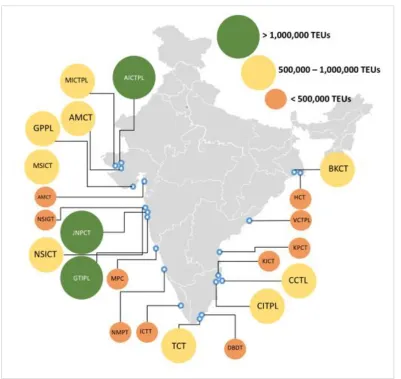
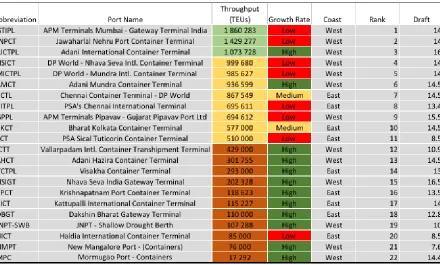
The figure below highlights the distribution of ports along with throughput in India. The throughput and draft of each of the ports are mentioned in the Table 1.
Figure 4 Distribution on Indian Container handling port according to throughput 2015-16 as adopted from the Indian Conatiner Market Report 2016.
2.8 Current performance of Indian Ports
15 of the top 20 container ports in the world are in Asia, mostly China with exception of Singapore, Dubai and Malaysian ports (UNCTAD, 2016). The figure 5 highlights the current TEU handling capacity of the world’s top 10 ports as adapted from UNCTAD compared to Indian ports as reported in the annual report from ministry of shipping, Government of India (2016). India doesn’t have any major ports neither in terms of container handling nor with the overall tonnage capacity in the world’s top 20 list.
Figure 5. Comparison of world's top 10 Container port with Indian ports as adapted from the UNCTAD annual report and Ministry of shipping, government of India annual report.
(Source: UNCTAD 2016 and Ministry of Shipping, Government of India (2016))
As a result of this most Indian ports are still being visited by feeder vessels, directly elongating the supply chain in turn affecting cost and transport time for cargos for shippers (Dasgupta & Sinha, 2016). The last decade has seen the cargo traffic double as a result of the economic growth witnessed by the nation. The expansion of the manufacturing sector and the increase demand on the back of growing purchasing power, has led to this rise in trade. This directly has affected the expansion of the port and maritime sector in India. With growing trade volume, moving in-out and through India, liner connectivity between trading partners like Europe, Asia and South-East Asia seeks particular attention. Container trade which was traditionally handled by major ports like Mumbai, Chennai is facing stiff competition by the evident growth in cargo handling by non-major ports like Mundra Port. Modernization and improved operational practises has also reduced turnaround time for ships to 2.14 days according to ministry of shipping (2016), but inland logistical delay still upsets shippers. The efficiency of the logistic system to connect ports to hinterland was also a weak link in the overall transport
0 5 10 15 20 25 30 35 40
Comparison of world's top 10 Container Ports with
Indian ports
logistic chain, as seen by the Maersk case study of India (Jensen, Olsen & Westergaard-Kabelmann, 2016). The operators of today’s ports know, the key to success is a complex process involving the needs of the user for logistical efficiency, technological changes, socio-economic factors, spatial characteristics and global demand of trade.
Table 1 Port Throughput and Growth Rate
(Source: Behera, 2016)
As per the report by Drewry Shipping Consultants, there are as many as 247 listed CFS's and ICD's in India. Most of these are located closer to the ports. This demonstrates the dependency on port based facilities as the primary point for containerisation and clearing cargo. Inland penetration of containers is a major issue. The presence of several bottlenecks as result of bureaucracy and irregular development of intermodal transport system (road and rail) leads to longer container turnaround and lack of last mile connectivity, which stall the growth of ports and shipping. Vessel handling capacity owing to draft restrictions also affect Indian shipper’s chances of ripping the benefit of economy of scales and the lack of transhipment ports in India adds a cost penalty (World Bank, 2013). Apart from developing deep draft ports, there is a need to address the following issues to help improve overall logistical performance of ports:
1. Hub and feeder operation along both coasts
2. Connectivity between inland depot and container freight stations 3. Intermodal connectivity at ports
4. Inland connectivity within ports on both coast
5. Development of special economic zones to enhance ports operation as a value adding node in the global market.
Given the recent changes in cabotage laws provides Vizhinjam port with a large market and ample opportunity to build on the hub-feeder system. Adani logistics Ltd at Mundra has shown efficiency levels at par with global standards. Adani ports and Special economic zone limited (APSEZ) also has joint ventures with major shipping lines at Mundra, this puts Vizhinjam port in a suitable position to explore the opportunities in the current global market.
2.9 Indian Infrastructure policy
Ports are infrastructural undertakings usually requiring heavy investment. As mentioned before, they have an economic multiplier effect on their surrounding regions and are the centre of many socio-economic activities ranging from leisure bases to industrial and energy supply bases (Alderton,1999). As an important part of a nation’s transport infrastructure, ports must
blamed, other factors like lack of integrated transport network, obsolete facilities, poor work practices have stalled growth of Indian ports. With import and export of merchandise steadily growing, there is a need to upgrade the overall national transport infrastructure (World Bank, 2013).
Since 1996, private participation in public infrastructure has been encouraged by the Government of India (hereafter GoI), on a build, operate and transfer basis (Lakshmanan, 2008). Major companies like Maersk, CMA-CGM, Adani group have invested in ports and terminals, but implementation remains sluggish owing to the risk and heavy bureaucratic challenges. But the increasing in cargo handling in privately managed and joint venture project at non-major ports, as highlighted below, shows the growing advantage of PPP projects.
Figure 6 Increase in throughput at Non-major ports as per Indian Container Market Report
(Source: Behera, 2016)
Chapter Three - The Asian Port Network
3.1 Vizhinjam international seaport limited Project
The Vizhinjam International Seaport Limited (VISL) is the special purpose government company, developing the deep water greenfield port at Vizhinjam. Adani ports and special economic zone limited (Hereafter, APSEZ) is developing the port under Design, Build, Finance, Operate and Transfer (DBFOT) model scheduled to be completed in 3 phases first of which is to be completed by December 2019. AECOM, India was in charge of the planning of the port project. The Final master plan was submitted in 2014 and no further changes or revised reports have been published, so the remainder of the research on the feasibility of this project would be based on the plans and productivity estimated according to the Integrated Port Master Plan Report.
Figure 7 Geographical position of Vizhinjam Port
(Source : Adani Ports, 2017)
The proposed project is a greenfield project aimed to develop Vizhinjam International Deepwater Multipurpose Seaport. First of it’s kind, the port with its deepwater draft of 20m would be capable of handling the largest fleet of vessel currently operating in the world. The project must also be noted is based on the projections of the Drewry report of 2010 submitted to AECOM (AECOM, 2014).
3.2 Civil engineering features
well. The port would also have a cruise berth for leisure and a liquid berth to allow for bunkering operations. The container yard in phase 1 would have 5,600 TEU ground slot for storage with utility route designed taking into consideration, expansion and port upgradation options.
The following phases of expansion would aim to increase port capacity to 3,350,000 TEUs with quay length of 2000m and 5 berths and TEU ground slots of 18,200 by 2044. A phase by phase growth is given in the following table
Table 2 Vizhinjam Expansion Plan
(Source: AECOM, 2014)
3.3 Adani Ports and Special Economic Zones Limited (APSEZ)
The largest port operator in India, the Adani groups subsidiary, APSEZ is currently operating ports and terminals in 10 locations, across the western and eastern seaboard (Adani Ports, 2017). With a pan-India presence and investments on international port management projects in Australia and Malaysia, APSEZ has been increasing their participation in the port sector. The growth in throughout of Mundra port is a testament to their performance as a port manager. The Adani group also the largest private container train link operator. This also provides APSEZ an added advantage of the possibility of developing intra-port intermodal connections.
Figure 8 APSEZ managed ports across India
Figure 9 Deviation from Europe-Far East Routes
(Source: Author, 2017)
A comparison of VISL with some of the major port along the east-west trade route are given in the table for a preliminary benchmarking before we proceed to the network analysis of the port network. The annual throughput, quay length, number of cranes, terminal area along with the draft are provided below.
Table 3 Port comparison in the Research Area
3.4 Benchmarking and Analysis
The Asian port network have risen to prominence in the world trade as a result of growing trade in the form of merchandize trade from production rich south and south-east Asian countries like China, Vietnam, Taiwan, Indonesia, Bangladesh, Thailand along with India. The boom in trade and economy has lead to development of terminals and transhipment ports moving cargo to Europe and the Americas. The unavoidable importance of the maritime route can be attributed to the following factors:
High density of maritime Traffic along the route
Increase traffic of New panamax and ultra large container vessels (ULCV) High Population density providing market place
Developing economies along the route providing cheap services including transhipment and manufacturing as a result of GSC
Presence of multiple choke point
For the purpose of the study, we shall consider the major transhipment terminals along the east-west route as highlighted in the previous table. Ports on the east of Singapore are ignored for the simplicity purpose as almost all vessel on the east-west route call at Singapore or port of Klang before calling at one of the south Asian or Middle-east ports. The strategic location of Vizhinjam Port close to the international maritime trade route along with its deep draft put it in direct competition with some of the port in south Asia.
Some of the other deep draft port in the South Asian region are mentioned below.
Port of ColomboLargest and busiest port in south Asia currently, the port of Colombo currently has three container terminals Jaya container terminal, South Asia Gateway Terminal and Unity Container Terminal. Present at the immediate vicinity of Vizhinjam, Colombo Ports could be directly affected by Vizhinjam ports’ operation.
Jebel Ali Port, Dubai
Port of Salalah OmanOne of the major ports located closest to the suez canal route, it becomes at imminenet point at the heart of the pacific rim providing opportunity to serve the middle-eastern, Indian and east african regions.
JNPT - APM Gateway terminal MumbaiThe largest and busiest port in India, it serves for transit and transhipment of the western region of Asian and the Indian sub-continent.
Mundra PortThe upcoming port in Gujarat, is also operated by the Adani ports (APSEZ). It registered the fastest growth rate in 2016 and its set to overtake Mumbai as the largest container port in India with the improved capacity to handle 5.5 million TEUs.
Kochi PortAlso situated in Kerala, the Vallarpadam and ICTT are domestic competitor of Vizhinjam and serve the same hinterland.
PSA SingaporeThe largest collective port facility in the world, PSA operates Tanjong Pagar, Keppel, Brani and Pasir Panjang and Sembawang Wharves with 69 berths out of which 10 berths at Pasir Panjang are capable of handles the largest container vessels.
Port of KlangLocated at one of the busiest shipping lanes, Port of Klang which comprises of the north and the west port, is strategically located in the Malacca strait. A combined 29 berths and 16.6 million TEUs capacity makes Port of Klang a major transshipment hub.
Jeddah Port
Apart from understanding the physical geographical and managerial aspects of shipping, it is also important to understand the decision-makers in the container global logistical chain to enhance performance. The chain comprises of freight owners that represent the demand for shipping, freight forwarders who decide optimal routes and seaport selection, either for transshipment or direct calls. This along with terminals operational characteristic and demand attracts liners companies. Research from various researchers have highlighted the following factors need to be considered for development and growth of a regional hub.
Table 4 Factors affecting competitiveness and attractive of regional hubs adapted from various research works
(Source: Author; 2017)
3.5 Application of Port Network Theory
Chapter Four - Social Network Analysis as an Analytical Tool
4.1 Network Analysis in Concept and Practice
Social network analysis (SNA) is a branch of sociology which studies collections of individuals and the linkages among them. For modelling social networks, SNA uses data from graph theory, algebra, and statistics (Wasserman & Faust, 1999). The theory differs from other sociological and mathematical theory at the elemental level by focusing on context and the behaviour of relationships between the actors rather than their discrete rational individualistic behaviour. The network analysis encompasses theories and application from a relational perspective.
Networks simply put, are a collection of nodes or actors, tangibly or intangibly connected by relations like friendship or trade. The relation between nodes is called an Edge, Ties or Link depending on the motive of studies. While networks can be mapped subjectively drawing a link between every node individually to draw a graph, mathematically they are represented by an adjacency matrix (Newman, 2007), which is symmetrical when we do not consider the direction of the link (Wasserman & Faust,1999)
.
The fundamental of SNA, which are associated with social behaviour, can also be used on inanimate systems like transport infrastructure, as well where each node would be a function (like ports, airports, ICDs). These nodes which are part of a systems or network would react to the operational action of other nodes analogous to the bullwhip effect in supply chains which is prominent in a cluster based network of present day supply chain. It is essential to understand that actors and their actions are contextual and interdependent. These links are viewed as systems that imposes constraints or present opportunities on the actors in the network (Wasserman & Faust, 1999). The aim of the chapter is to present the concepts of network and understand the coherent nature of the system as a whole along with individual attributes. This would help provide a picture other than an individual component’s characteristics.properties and weights to further add details to the network, akin to individual characteristics and strengthen of friendship between two people.
Every network has complexity owing to the various permutation and combinations with which each node can act with other nodes. These interactions can also be as a result of their own change in attributes. They have patterns which can be localized (Clustering) or skewed (Homophility) in the overall network and can be effected by positions of nodes and changing links between them. To better understand positions of nodes in the network, it is elemental to understand the characteristics of a node to cognize their influence on the network. In the Graph Theory, the measures of centrality are used to measure the importance of a node and also to rank nodes. For the research on south Asian ports, the following centrality measure would be vital to understand the features of the system.
Degree centrality – it captures the connectedness of a node. It highlights the position in the network and number of other nodes directly connected to a node. The degree of a node is the number of neighbours a node is connected. The degree centrality is an indicator of the connectedness of a node. For a graph with n nodes, the degree denoted for a node i by ki ,
which is the sum of all the connection. So if a node A is connected to four nodes, its degree is 4, similarly the centrality of B is 3 and so on.
Figure 10 Node Degree Values of a Random Graph.
betweenness could be considered in crucial element to ensure flow of information or commodities (Wasserman & Faust, 1994). They act as gate keepers or connector. So betweenness of a node k is the number of shortest paths between i and j that k lies on (Pk(i,j) compared to the number of shortest paths, that exist between i and j P(i,j).
Cb
=
Pk(i,j) P(i,j)
Figure 11 Betweeness values of Nodes in a Random Graph
The above mentioned measures of centrality highlight the position and not the influence of the node in the network. The Eigenvector centrality measure the centrality of the node i as a sum of the immediate neighbour’s centrality. The centrality
C
e= ∑
ik
ijC
dAnother inherent aspect of networks is the natural division of nodes into groups or clusters which interact more within themselves. Clustering, one must understand captures the node’s local cohesiveness by considering the formation of triplets in the community. In a social network concept, we often encounter friends who are acquainted to each other, similarly in shipping we have ports connect to each other via distinct links. This introduces an intuitive question as to if a node i is connected to two nodes j and k, what is the probability of j and k being connected? This helps us understand structural holes. We could find the pairs of neighbours of nodes i which are not connected with each other, this would indirectly indicate the opportunity for node i to control flow of information or commodities. This can be found using clustering coefficient of the node.
Clustering Coefficient, Ci =
number of connected pair neighbours of node i total number of pairs of neighbours of node i
Network analysis can also be used via visualization tools to determine the geographic spread of the network and highlight the polarization and nodal regions in the network. Modularity could be used to identify components and understand the quality of links within the partitions more efficiently and can be used to stabilize optimizing function of certain nodes. The Polarization could be measured using the clustering coefficient and finding major subgroups. By identifying cohesive sub-groups and major actor in it, we could devise a strategy to improve connectivity around these focal actors and thereby increasing the eigenvalue and connectivity and therefore improve the scope of viability. These characteristics complement the centrality indicators and indicate the influence of various nodes on the system as a whole.
4.2 Social Network Analysis as an Analytical Tool
SNA provides a workable model of networks which relates various actors into networks. The node attributes can then be assigned depending on the objective, to understand the network characteristics. This could then further provide a framework for collecting and analysing data useful for planning and monitoring changes in network activities (Wasserman & Faust, 1999)
.
Maritime networks (Ducruet & Notteboom, 2008) and have been used to predict epidemics, not only diseases but also social ideas, product adoption (Fowler & Christakis, 2010).
Though the metaphor of supply chain is borrowed from the idea of a chain from mechanics, in which every element is linked to the adjacent element, jointly providing strength with flexibility. The metaphor can transplant the chain idea into the sphere of shipping and ports (Mueller, Buergelt & Seidel-Lass, 2008). Ports being a crucial element of globalized trade, one would argue the metaphor of supply chain might be malapropos on ports logistics due to the lack of complete linearity in the chain and is often underlined with the presence of more expansive networks of ports and intermodalistic transport players. The chain in the maritime domain, is no more connected to two adjacent links but several other links which affect the efficiency and feasibility of the port.Under this perspective, the elemental factor that determine the success of port (also as a hub to some extent) strategic location and spatial characteristics of the port in the network. The social network analysis method explicitly focuses on the inter-relatedness of entities, in this case - Ports and provide methods to understand structural properties of networks (Wasserman & Faust,1999).
The notion of a network of relations linking entities or ties amongst them, has found wide expression throughout the social sciences, its application in shipping is enlightening. Recent researches largely being on the evolution and effects hubs on the network (Ducruet,2006 et al) and indicate the flow in network and their disproportionate importance (Newman,2010). The dependencies among the ports can be measured with structural variables, which hypothesize that functional characteristic of ports are not independently but rather influence each other. This measurement of system and its sub-structures, we hope would reveal patterns and relations that could be investigated to improve port connectivity and feasibility of future investment. The growing share of containerized cargo tonnage is a strong indicator of the need of increased integration of ports which are internationally considered the centre of multimodal transport.
Chapter Five - Application of Social Network Analysis to South
Asian Ports
5.1 Container Shipping Data Analysis
The last two decades has witness a continuous growth in containerization and throughput of ports. The increase in containerization and concentration of cargo on certain ports can be seen from port statistics of the past. There have been significant changes in the global port systems, with new ports rising to prominence in the liner shipping network. It’s a complex system comprising a byzantine combination of door to door services coupled with line bundling, pendulum and hub-spoke movement of containers. Container shipping lines preordain port selection and therefore influence port hierarchy and annual throughput (Ducruet & Notteboom, 2012). One of the most important route in container shipping is the Europe – Far east route (Drewry, 2017). Passing through the Indian ocean, shipping lines observe a fixed route selecting a few regional ports of call in South Asia. Representing more than 60% of maritime trade moving along the east-west route The growth, feasibility and competition amongst south Asian ports have predominantly been analysed from an operational perspective like throughput, berth optimization and other container statistics, a network perspective to analyse spatial efficiency was conducted in this study. The limited draft of port and the advent of ultra large container ships is likely to affect the average number of port calls per loop and port selection. This would increase port competition and is likely to change the current network dynamics of south Asian ports especially the transhipment hubs which remain redundant due to lack to transit cargo. But lower deviation costs add a centrality and intermediacy factor to these port (Fleming & Hayuth, 1994; Ducruet & Notteboom, 2012). As traffic flow is a result of route and port selection by main players in the chain, network cost and performance becomes crucial (Ducruet & Notteboom, 2012). Some ports have a strong hierarchical presence as a result of service variables and liner service networks. To understand the network, we analysed the vessel movement.
5.2 Data Source
Figure 12 - Area under research
(Source: Author,2017)
Following the April, 2017 reshuffling of shipping alliance, the current three alliances namely, 2M, THE Alliance and Ocean Alliance together represent 77.2% of the world container capacity. The data for the research comprise of vessel movement in the Suez and Europe-Far East routes along with the secondary feeder route of the liner companies in the three alliances and UASC-Hapag Lloyd on a weekly call basis. The ports were considered as the nodes and the vessel movement between these ports as the edges in the analysis. For the in-depth analysis of port competition from a network perspective both Liner schedule data along with port attributes like draft were included.
5.3 Gephi - Network Analysis Software
Gephi is an open-source graph and network analysis software suitable to work with complex data. It provides dynamic network visualization tools to elucidate large network to help understand the system better. Its high quality layout algorithms, data filtering option make the software flexible and user-friendly which could be used to plot inherently complex network graph articulately. Design features also allow to manipulate graph design to enhance visually interactive understanding. Data collect were exported to Gephi in two list, namely Nodes list indicating the distinct ports in the network and the Edge list indicating the interaction (in the form of vessel movement) between nodes (ports).
Figure 13 Node list
(Note : Ports considered in the Research based on Liner Schedules in September, 2017. Yellow Point is for new port – Vizhinjam)
(Source: Author, 2017)
5.4 Regional Network Characteristics
Figure 14 South Asian Port Network
(Note: Each color represents different Clusters) (Source: Author, 2017)
Table 5 - Topological feature of south Asian maritime network
(Source: Author, 2017)
between two pair of ports by all the liners per week. The network’s degree distribution highlights the scale-free properties of the network. The clustering coefficient of undirected weighted network was 0.512 with an average path length was 2.417 similar to the global network features (Ducruet & Notteboom, 2012). This indicates the small-world characteristics of the network. This analysis on the network was complemented by performing the modularity algorithm which measures the density of links within a port cluster/community comparing it to the inter cluster links. The positive yet low modularity highlighted the existence of overlapping clusters as seen by the presence of few ports on two clusters. It indicated the system is divided in four communities with slight overlapping as a result of overlying feeder network, line bundling network in those regions in order to increase frequency on the weekly basis. Middle-east with its market and south-southMiddle-east Asia as manufacturing further polarize the South Asian network. The deployment megaships can be seen by the convergence to their cluster hub like Jebel Ali, Colombo, Singapore and Jeddah. Unlike the global maritime network, the regional maritime network considered only intra-regional vessel movement and port of calls, the port hierarchy is slightly different from expected.
Figure 15 Degree Distribution of South Asian Port Network
(Source: Author, 2017)
5.5 Port hierarchy in Network
centring on Jebel Ali, the largest transhipment hub in the Persian Gulf. The presence in the straits, a point of congestion on the east-west route also puts certain ports in an ideal location for transhipment as seen with the high centrality measures of Jeddah, Djibouti in the Suez, Jebel Ali, Khor Fakkan in the Persian Gulf region and Singapore, Klang, PTP in the Malacca Strait.
Figure 16 Port network of ports which can handle Megaships >18,000 TEU
Note: Capacity based on vessel draft (Source: Author, 2017)
Figure 17 Indian Port Network based on network analysis
(Source: Author, 2017)
Figure 18 Centrality measures of Indian ports in the network
The degree distribution of the Indian subcontinent confirms the correlation of throughput to degree of ports. The absence of certain Indian ports can be attributed to lack of port of calls from major carriers and the presence of intra-regional feeder systems.
5.6 Sensitivity Analysis
Figure 19 South Asian maritime network including Vizhinjam optimum forecast
(Source: Author, 2017)
5.7 Feasibility Analysis
Figure 20 Port network including Vizhinjam.
(Note: Green nodes have highest degree of connection and red the least and Size highlights betweenness of the nodes)
(Source: Author, 2017)
without changing the structure of the network by staying connected to central nodes. There is also a possibility of increasing the number of cluster by connecting to feeder networks. These options highlight the potential of Vizhinjam from a network perspective, but the viability of the project would depend on many of the factors discussed in figure 10. Though the physical characteristics can be used for benchmarking, the network changes are affected by liner preferences which depend on other variables.
Figure 21 Degree Centrality Based South Asian Port Network
(Source: Author, 2017)
Chapter Six - Discussion
6.1 Role of Vizhinjam International Seaport Terminal
Understanding the network properties was essential to recognize how the system operates and behaves but other parameters need to be considered to access the viability of certain nodes and their affects on the system. With around 95% of the country’s trade by volume and 70% by value being carried via ships, ports are crucial to the Ind