.c
RESEARCH ARTICLE
DESIGN AND IMPLEMENTATION OF A MICROCONTROLLER BASED FLAMMABLE GAS DETECTOR
AND AUTOMATIC ALARM SYSTEM TO ENSURE THE INDUSTRIAL AND DOMESTIC SAFETY
1,*
Navid Bin Ahmed,
1Kazi Naziba Tahsin,
1Shahriar Khan,
2Mahbubul Hoq and
3Didarul Alam
1
School of Engineering and Computer Science, Independent University Bangladesh, Dhaka, 1212 Bangladesh
2Bangladesh Atomic Energy Commission, Dhaka, 1207, Bangladesh
3
ASHRAE, 1791 Tullie Cir, Atlanta, GA 30329, United States of America
ARTICLE INFO
ABSTRACT
The risk of industrial and domestic accidents from methane gas leakage can be minimized by an inexpensively designed gas detector. This approach intends to produce a suitable and reliable solution in the context of a third world country, where equipment and components are either not available or prohibitively expensive. This affordable and easy-to-install device monitors and displays the concentration of gas mixed in the air and sounds a buzzer just before the concentration reaches danger level. It is often required to know the amount of gases mixed in the air for which the optimum and safe amount of oxygen can be available in that area. This system is a reliable solution as a safety tool in modern industrial and residential settings. It consists of an Atmel Atmega 328P microcontroller, an MQ-9 gas sensor, a buzzer for automatic alarm system, a red LED for warning and an LCD monitor for display the concentration of gas. The system is user friendly and fit to be installed in kitchens, labs or industries.
Copyright © 2018,Navid Bin Ahmed et al. This is an open access article distributed under the Creative Commons Attribution License, which permits unrestricted use, distribution, and reproduction in any medium, provided the original work is properly cited.
INTRODUCTION
This detector detects the flammable gasses. Methane is the first gas from Alkane group (CnH2n+2), with increasing the
number of Hydrogen (H2) with single bonded (-) covalent
bond with Carbon (C12), the chance of gas being flammable
also increases, since the Hydrogen itself is a flammable gas. On the other hand, adding Carbon atom with the bond has slight effect on flammability. Next Alkanes in the series, i.e. Ethane, Propane, Butane and next has comparatively the same flammability that of Methane. Four covalent bonds act with a single Carbon atom in methane molecule. Ethane (C2H6) has 6
Hydrogen atoms with two Carbons. They have almost the same property. The detection of the flammable gas i.e. Methane leaks is important in maintaining safety standards in households and industries. Gas detectors must be economic and reliable in order to be commercially feasible in developing countries (Khan, 2017). Commercially available detectors are expensive in developing countries, whereas cheap detectors have tested to be unreliable and non-robust. This paper describes the design and implementation of an inexpensive and user friendly methane gas detector. About 50 people die across the world from accidents from flammable gas leakage. According to statistics from the International Association of Fire and Rescue Service (Brushlinsky, 2017), 9409 people died in fire deaths in Russia, and 3280 died in the USA.
*Corresponding author: Navid Bin Ahmed,
School of Engineering and Computer Science, Independent University Bangladesh, Dhaka, Bangladesh.
Although no clear statistics are available, the number is large in Bangladesh, possibly due to lax working conditions. Bangladesh has large natural gas reserves (14 trillion cubic feet), which is used widely in industry (Khan, 2012).
Design Objective: The developed simple and inexpensive
system displays the gas in parts per million at particular time intervals, and gives a warning when concentration reaches a danger level (4 %). The decision making is possible from a long distance with real time communication. The components used in this system, their working principle, implementation strategies and type of applications were different in gas detection and display and in established warning systems. But the detection, display and warningsystem wereimplemented together and simultaneouslyafter being sure about the accuracy of the individual components. Finally the flammable gas detector and warning system have gone through a number of experiments for validation. The methods followed to conduct the project and to finish the design are illustrated through the flow chart shown in Figure 1.
Design Mythology and Performance Analysis: The sensor
MQ-9 gas sensor used has high sensitivity to Methane (CH4),
but can also detect Carbon Monoxide (CO) and other flammable gases. The system can have domestic, industrial, and portable applications. The basic circuit loop is shown in Figure 2. A heater voltage (VH) is required. The ppm
concentration increases with the value of resistance of the
ISSN: 0976-3376
Vol. 09, Issue, 01, pp.7425-7429, January,Asian Journal of Science and Technology 2018Available Online at http://www.journalajst.com
ASIAN JOURNAL OF
SCIENCE AND TECHNOLOGY
Article History:
Received 19th October, 2017 Received in revised form 21st November, 2017 Accepted 03rd December, 2017 Published online 31st January, 2018
Key words:
Flammable; Detector; Automatic alarm; Leakage; safety;
Fire accidents; Inexpensive; User-friendly;
Figure 2. Sensor circuit diagram (
Figure
Figure 4. Output reading curve in comparison with a standard machine
This Machine (ppm)
PID (ppm)
Figure 1. Research flow diagram
Figure 2. Sensor circuit diagram (Simulation and Circuit Design, 2017, from Data sheet)
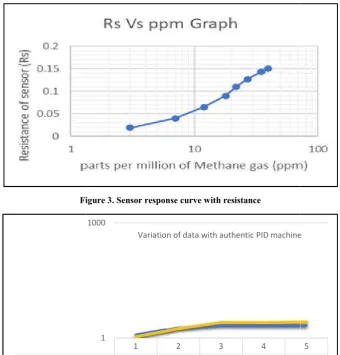
Figure 3. Sensor response curve with resistance
Figure 4. Output reading curve in comparison with a standard machine
1 2 3 4
This Machine (ppm) 1.2 1.83 2.109 2.1
1.107 1.757 2.543 2.496 2.622
1 1000
Variation of data with authentic PID machine
2017, from Data sheet)
Figure 4. Output reading curve in comparison with a standard machine
5
2.1
sensor (Rs). The concentration of gas varies with the variation
of this value. The resistance of the sensor consisting of the sensor (Rs) is calculated by
Rs = [
RI C V
V
- 1] RL ……….(1)
Here Vc is the test voltage and Vrl is the voltage at load
resistance (RL) in series with sensor.
Mathematical Analysis of Gas Amount: The concentration
of Methane has been calculated from the resistance of the sensor, Rs). Figure 4 shows resistance Rs vs concentration in
parts per million (ppm). In the graph above, the x axis is the resistance of the sensor (Rs) in KOhm and y axis is the concentration of the gas in ppm, represented in a logarithmic scale. The flaming limit of the gas is around 4%. Conversion from ppm to percentage was as follows:
ppm
Using this estimation, a buzzer and a red LED indicator has been programmed to warn when the concentration reaches up to 37,000 ppm. It turns “ON” when the buzzer starts giving alarm. So the system has got two types of warning systems which are very useful.
Sensor Validation: In comparison with a standard flammable
Photo Ion Detector (PID) this detector provides almost the same data. (Tiger Ion PID Detector, Reference).
Calibration Process: The PID – Photo Ionic Detector has
high sensitivity and rapid response. The observed data was very close to the data measured by the PID machine. In the programming code, the obtained reading was just multiplied with a scaler until both detectors dsipalyed the very same value on LCD display. The PID was showing up to thousandth decimal place (decimal three value). We had to fix and match that too. But it was observed the PID data decreases faster when the gas source was taken away, while ours detector used to stuck with a lower value.Figure 4 compares the graph of the designed sensor reading with the PID detector. The sensitivity of the sensor was very similar and accurate like the standard detector.
Performance Analysis: It was also observed that the system
responded faster with methane gas only. It worked for other gas sources, but the response time and sensitivity was faster with only methane since the software program was searching for detection of and measuring the perfect amount of methane gas. Four types of available gas sources were used to experiment the accuracy of the system. It was seen that the system took much time to respond with aerosol. The maximum amount was recorded as 13 ppm (parts per million) for this source of gas which indicated that Methane gas is hardly present in the bottle of aerosol. Similarly for other gasses also it was observed almost same except methane gas. The gas lighter which contains butane gas, another organic compound of hydrogen and carbon like methane gas which responds quite faster than Aerosol and aroma compunds like perfumes. Figure 5 compares the sensor response times for different gasses.
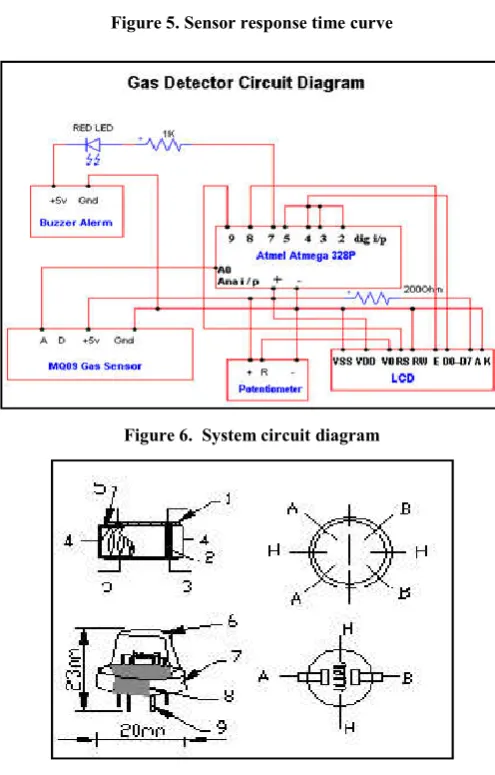
Circuit Diagram: The implemented detector and automatic
alarm system seeks to improve the working experience and lessen this death toll. It not only detects the presence of the flammable methane gas but also shows the amount of gas
present in the air. It automatically takes a decision to alarm before the concentration reaches a danger level. The measurement of the gas concentration has been carried out in parts per million unit, therefore the system warns before the concentration reaches to 4% or 40,000 ppm. A buzzer alarm and a red LED (Light Emitting Diode) have been used for alarming purpose. The following is the overall electrical circuit diagram of the system in Figure 6.
Figure 5. Sensor response time curve
Figure 6. System circuit diagram
Figure 7. Configuration of MQ 9 (Datasheet of MQ series gas sensors, no date)
Design Components: Along with a Microcontroller unit and
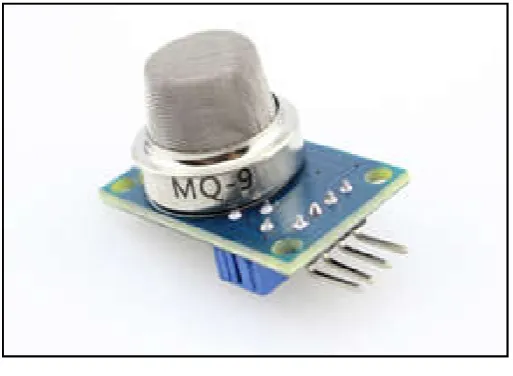
an LCD (Liquid Cristal Display) monitor, the following key components have been used to implement the system in Figure 7. The MQ 9 Gas Sensor was chosen as this semiconductor gas sensor detects the presence of combustible gas at concentrations from 100 to 10,000 ppm and Carbon Monoxide from 10 to 1,000 ppm. The sensor’s simple analog voltage
interface requires only one analog input pin from the microcontroller.
Structure and Configuration of Measuring Circuit: The
structure and configuration of the MQ-9 gas sensor is shown in Figure 8. The sensor is composed by micro Al2O3 ceramic tube and Tin Dioxide (SnO2) sensitive layer.A measuring electrode and heater are fixed into a crust made by plastic and stainless steel net. The heater provides necessary work conditions for sensitive components. The enveloped MQ-9 has 6 pins, 4 of which are used to fetch signals, and other 2 are used for providing heating current.
Figure 8. MQ 9 sensor
Buzzer Alarm: An audio signaling piezo electric device
consisting of an NPN transistor, 2 resistors of 10 Kilo O’hm and 100 Kilo O’hm resistance, one self drive tree terminal piezo electric buzzer, one 1-10 Milli Henry inductor coil (Figure9)and it operates with a power source of 3.3 Volt to 12 Volt (datasheet, 2017).
Figure 9. An electric buzzer alarm
Miscelleneous Components: Other than these, a 10 K Ω
potentiometer for adjusting the LCD contrast, 9 Volt battery for power supply have been used.
Software Programming: A programming code comprising C
and C++ programming language has been developed for the system. As used before by Jun-Tao (2014) using the datasheet of the gas sensor (MQ09), where a graph for Methane gas was
plotted as resistance ratio (Rs/R0, where R0 is a sensor resistance fixed as 10 ko’hm) vs ppm (parts per million) has been analysed and after a number of trial and error the code provided the desired and acceptable readings (Jun Tao et el., 2014; Yu Zhoe, 2009).
Cost Analysis and Large Scale Consideration:Two the most
important outcomes of this device are that it is inexpensive and easy to use.The project cost is not more than 950 BDT (Bangladeshi Taka) which is almost $ 9.5 USD. This is quite cheaper and affordable than most other lowtech devices at the market. The expense would be much lower when it is commercially maufactured. (S. Khan, 2017). The estimated cost is given below in Table 1. Commerically avalable methane detectors range from USD $ 20 – $100 and it can stated that the designed system is cost effective (eBay, 2017).The designed system is easy to instal and use. It has less power consumption and long usage time.A systematic and scientific way have been applied from the beginning of the planning to the final implementation and authentication process. The system is unique due to its standard method to detect and measure the gas and simplicity in use. A wide range of tests have been carried out to prove its accuracy. This device can become convenient for those at home and abroad.
Table 1. Data Variation
PID 1.107 1.757 2.543 2.496 2.622 This machine 1.20 1.830 2.109 2.100 2.100
Table 2. System cost
Units Cost (USD) Microcontroller Unit $ 3.00 Power Unit $ 2.80 Display Unit $1.40 Alarm Unit $ 0.15 Sensor Unit $ 2.00 Total $ 9.35
Future Work and Conclusion: An automatic audio alarm and
LED used to light up as the gas reaches a minimum threshold. The research methodology, circuit construction, software, and authentication of the implemented system have been provided in this paper. Methane gas (CH4) is an extremely flammable
gas and explosive if kept open. It main use as fuel in the form of natural gas. Its sources are underground and below sea level. In countries such as Bangladesh, methane is piped directly into homes and used as fuel for cooking. Cars and other transports use CNG for fuel. Poorly regulated sites and old renovated homes need to understand the importance of the levels of methane concentration and make sure they do not exceed standard values. Methane reacts with blood oxygen and leads to asphyxia during leaks of gas pipes. The designed methane detector can provide a portable, accurate and cheap methane gas detector suitable for leak detection or control. It can be modified to sound an alarm through mobile phone text message. The reading of the gas concentration at different times of the day can be saved for future analysis. Moreover, a wireless communication system can be built between the place and the monitoring room for remote decision making.
REFERENCES
Conversion Engineering, DOI:10.1109/IECEC.
1997.661895, Available: http://ieeexplore.ieee.org/
document/661895/
Brushlinsky, N.N., Ahrens, M., Sokolov, S. V. andWagner,P. 2017. “Comite technique international de prevention et d’extinction du Feu, International Association of Fire and Rescue Services”, Center of Fire Statistics, World Fire Statistics, Report 22, Available: http://ctif.org/ctif/world-fire-statistics.
Datasheet, 2017 of Piezo Buzzer AlarmProteus 8.1 Simulation and Circuit Design, Labcenter Electronics, “Sensor circuit diagram”, www.labcenter.com
Datasheet of MQ series gas sensors. No date. Available http://www.china-total.com/Product/meter/gas-sensor/Gas-sensor.htm
Jun-Tao Gu, Yong-De Zhang,Jin-Gang Jiang,2014. “Design and experimentation with sandwich microstructure for
catalytic combustion-type gas sensors”, Sensors Open
Access Journal,Vol. 14, Issue 3, p. 5183-5197
Methane Detector. eBay (1997 - 2017,nd). Retrieved from
http://www.ebay.com/bhp/methane-detector
.
Shahriar Khan, 2017. Economics, Management and
Professional Ethics, Dhaka, Bangladesh.
Shahriar Khan, 2014. Electrical Services for Buildings, Dhaka, Bangladesh.
Shahriar Khan, Modern Transitions in Saving Energy and the Environment, Fossil Fuel and the Environment, Publisher, InTech, 2012
Shahriar Khan, S. Alam, Ziauddin Alamgir, Abdus Salam,
2016.DistributedSensors,Computation,and
Communi-cations in Power Systems, IUB Journal of Computer
Science and Engineering.
Tiger Ion PID detector: http://www.ionscience.com/
products/tiger-handheld-voc-detector/.
Yue Zhou, Marco J. Castaldi and Tuncel M. Yegulalp, 2009. “Experimental investigation of Methane gas production
from Methane Hydrate”, Journal of American Chemical
Society, vol.48 Issue 6, p. 3142-3149, Available: http://
pubs.acs.org/doi/abs/10.1021/ie801004z