on ad-hoc frequency judgments in sport. Journal of Applied Sport Psychology, 24
(3). pp. 290-302.
Downloaded from: http://insight.cumbria.ac.uk/id/eprint/1376/
Usage of any items from the University of Cumbria’s institutional repository ‘Insight’ must conform to the following fair usage guidelines.
Any item and its associated metadata held in the University of Cumbria’s institutional repository Insight (unless stated otherwise on the metadata record) may becopied, displayed or performed, and stored in line with the JISC fair dealing guidelines (available here) for educational and not-for-profit activities
provided that
• the authors, title and full bibliographic details of the item are cited clearly when any part of the work is referred to verbally or in the written form
• a hyperlink/URL to the original Insight record of that item is included in any citations of the work • the content is not changed in any way
• all files required for usage of the item are kept together with the main item file. You may not
• sell any part of an item
• refer to any part of an item without citation
• amend any item or contextualise it in a way that will impugn the creator’s reputation • remove or alter the copyright statement on an item.
The full policy can be found here.
Heuristic Reasoning and the Observer’s View: The Influence of Example-Availability on
ad-hoc Frequency Judgments in Sport
Paul K. Miller, Louise Rowe, Colum Cronin, and Theodoros M. Bampouras
University of Cumbria
Author Note
Paul K. Miller, Louise Rowe, Colum Cronin, and Theodoros M. Bampouras, Faculty
of Health and Wellbeing, University of Cumbria, Lancaster, UK.
Correspondence concerning this article should be addressed to Paul K. Miller, Faculty
of Health and Wellbeing, University of Cumbria, Bowerham Road, Lancaster, UK. LA1 3JD.
Abstract
Drawing upon evidence from broader social psychology, and an illustrative empirical study
of frequency-estimation during a simple sporting ‘observe and recall’ task, this paper makes
the case for the more thorough investigation of the ‘availability heuristic’ (Tversky &
Kahneman, 1973) on practical state-of-play reasoning in largely observational sporting
activities. It is argued that this evidence particularly substantiates a need for a more robust
body of research in two primary domains: (a) the ‘gatekeeping’ tasks pertinent (and usually
preliminary) to an individual’s sporting performance such as talent scouting, team selection
and substitution decisions and, (b) the business of officiating in high-tempo environments.
Heuristic Reasoning and the Observer’s View:
The Influence of Example-Availability on ad-hoc Frequency Judgments in Sport
Although not entirely ignored, cognitive heuristics have to date been relatively underexplored
in sport psychology1. Moreover, and as is also true of the broader literature on sporting
decision-making, it is certainly the case that the bulk of heuristics research that has hitherto been completed is
concerned almost exclusively with sporting performance, and particularly performance in professional
and elite sports (see, for example, Souchon, Cabagno, Traclet, Trouilloud, & Maio, 2009). This is, in
many respects, a logical line of focus. Successful skill execution in many forms of high-level,
sport-related task is demonstrably premised to a great degree upon an individual’s ability to evaluate an
inherently uncertain context and make ‘pressurised decisions’ therein. In a moment-by-moment
manner, players make high-stakes judgements on the likely outcomes of various prospective courses
of action. These judgements are themselves premised on practical assessments of what is happening at
that time, and what has happened previously. It is the contention herein, however, that such
decision-making processes are important at all levels of sport: ‘stakes’ are, after all, relative to the level of
importance with which an individual or group imbues a situation. Equally, it could well be suggested
that an understanding of the cognitive dynamics of situated decision-making can provide valuable
insights not only into sport performance, but also in judgements made about sport performance ‘from
the sidelines’. The staggeringly diverse impressions that fans, scouts, coaches and so forth appear able
to form regarding ‘what actually happened’ during a single sporting event have, after all, been a major
focus for the social psychology of sport since the famous Dartmouth-Princeton football study by
Hastorf and Cantril (1954). Consequently, the focus of this paper falls upon judgements made during
the observation of sport. Supporting key assertions with evidence from an empirical study of
frequency-estimation during a simple sporting ‘observe and recall’ task, the paper advances the
following central thesis: the influence of cognitive heuristics on reasoning at the most primordial and
ostensibly ‘non-participatory’ sites of sporting involvement makes a clear case for their more
thorough psychological investigation with respect to two main realms of activity:
1. The ‘gatekeeping’ tasks pertinent (and usually preliminary) to an individual’s sporting
performance (e.g. talent scouting, team selection and substitution decisions), and;
2. The business of officiating in high-tempo environments;
In both of these, the salient mode of situated decision-making is of central importance.
Sport and Decision-Making
To date, human decision-making has been a topic of significant interest in a range of
academic domains2, with much of the early work in the field being derived largely from the
economically-oriented game theory of Von Neumann and Morgenstern (1944)3. In general
psychology, these ‘rationalistic’ models are ontologically allied to the econometrics from which they
arose; this is to say that they are grounded in a tacit assumption that everyday human decisions are
made through systematic, mathematical and probabilistic reasoning - Bayesian4 process - in an
endeavour to strategically secure the best possible outcome in any given situation. Progressively,
however, these models have come to be criticised for promoting an unrealistic image of decision
making in the real world. Firstly, they treat decision-making as a purely academic exercise, a logic
game, which is performed almost in a ‘social vacuum’. This fails to take account of the manner in
which individuals make operational decisions as parts of complex practical tasks and, critically,
within complex cultural, social and institutional contexts (see Key & Schwartz, 2007; Sharps, Hess,
& Ranes, 2007; Sharps & Martin, 2002; Thompson, 2003). Secondly, a range of subsequent studies
2 These domains include economics, mathematics, psychology, and many others. Bell, Raiffa and Tversky (1995) provide an
extensive review of various such perspectives.
3 See also Bicchieri (2004)
have demonstrated that decision makers in everyday circumstances are often motivated to make a
decision which would likely provide a ‘good enough’ outcome, rather than to seek a sole, optimal
solution (Luce, Payne, & Bettman, 1999; Mellers, Schwartz, & Cooke, 1999). Consequently, the
rationalistic paradigm in the study of decision-making has now been largely supplanted by a new
range of approaches, more descriptive than predictive in character, which emphasise the
personal-contextual, cognitive and experiential aspects of the ‘deciding process’. These include the more
normatively-oriented ‘Bounded Rationality’ approach (Simon, 1957), Prospect Theory (Kahneman &
Tversky, 1979), the Recognition-Primed Decision model (Klein, 1993) and, central to the argument
outlined in this paper, the heuristic reasoning approach (Tversky & Kahneman, 1973).
Sport, Decisions and Memory
In modern sport psychology, the processes involved in decision-making have to date proven a
rich area for exploration5. Macquet (2009), for example, draws upon the Recognition-Primed
Decision (RPD) model in articulating how the decisions made by participants in high-level volleyball,
rather than employing a systematic and rational use of probability estimation, are influenced by three
key situational factors: the manner in which the situation itself - and its ‘typicality’ - is identified, the
comparisons that are made with previous experiences, and the use of pre-planning. These findings are
congruent with those of traditional skill acquisition approaches6 such as Whiting’s information
processing model (Whiting, 1970) and Schmidt’s schema theory (Schmidt, 1975) which emphasise
the key role of memory in both decision-making, and the corollary processes of skill execution. More
recently, meanwhile, the multi-domain work of Ericsson and Kintsch (1995) on the role of long-term
working memory in the decisions and problem solving activities of experts and ‘skilled performers’
has proven highly influential in the psychology of sport. Their focus on the effective accessing of
5 This review, due to considerations of space, is thus illustrative of major themes, rather than exhaustive.
6 In sporting contexts, these models are primarily associated with the acquisition of motor and perceptual skills by sport
memory as a core part of the decision-making process has important ramifications not only for
investigation of the activities of skilled athletes, but also other sporting experts such as coaches and
officials. Indeed, contemporary research demonstrates that coaching, for example, is abound with
complex and situated decisions (Côté, Salmela, Trudel, Baria, & Russel, 1995; Cushion, 2007;
Cushion, Armour, & Jones, 2006; Jones & Wallace, 2005), the making of which can be heavily
influenced by the schemata stored in memories of coaches themselves (Jones & Bowes, 2006). In a
similar vein, refereeing and umpiring are social practices that, self-evidently, mandate the making of
‘snap decisions’. Drawing on the Expert Performance approach advocated by Ericsson and Smith
(1991), MacMahon, Starkes and Deakin (2007) demonstrate that recollections of past experience –
particularly past experiences as a player – exert a significant influence over the ability of a referee (or,
indeed, coach) to successfully identify infractions in real-time.
Although these approaches display a diversity of focus, there is little doubt that investigation
of the role of memory in the making of sporting decisions has become a key priority for sport
psychologists. Over the last forty years, however, a steadily expanding corpus of social cognitive
research has documented at length how, when performing everyday reasoning tasks on-the-fly,
individuals rarely, if ever, attempt (or indeed have the option of attempting) a comprehensive retrieval
and examination of all potentially domain-relevant resources from social memory (Rothman &
Schwarz, 1998; Winkielman & Schwarz, 2001; Winkielman, Schwarz, & Belli, 1998). More
commonly, metacognitive ‘short-cutting’ strategies – judgemental heuristics – are employed to
expedite these tasks (Kahneman, Slovic, & Tversky, 1982). Among the most commonly cited of these
are the ‘representativeness heuristic’, which describes individuals’ tendency to judge the probability
of a hypothesis by evaluating the degree to which that hypothesis resembles the data directly available
(see Tversky & Kahneman, 1974), and the ‘attitude heuristic’, in which truth and falsity judgements
tend to be directed by pre-existing positive and negative attitudes towards given personalities or issues
(Pratkanis, 1989). In terms of reasoning under conditions of contextual uncertainty, however, the most
robustly demonstrated is the availability heuristic, first identified in a series of experimental studies in
Heuristic Reasoning and Example-Availability
The availability heuristic, in its most basic terms, describes the manner in which situated
estimations of frequency or probability tend to be inducted from the germane information most
cognitively salient to an individual, i.e. this order of judgement task is primarily informed by the
task-relevant examples that can be easily recalled. For example, in one of their earliest experiments
Tversky and Kahneman (1973) themselves noted that, in the English language, the letters ‘K’, ‘L’,
‘N’, ‘R’ and ‘V’ all appear in more words as the third letter than as the first. When asked to estimate
rates of such occurrence, however, the significant majority of research participants (by a ratio of 2:1)
asserted the reverse to be true, on the grounds that examples of words that begin with these letters, on
the whole, the first letter of a word provides ‘...a better cue for recalling instances than does the third
letter.’ (Fox, 2006:86). A pertinent, and highly illustrative, field of research with respect to the
operation of the availability heuristic relates to practical ‘risk assessment’. In a famous study by
Lichtenstein et al. (1978), over 75% of American participants estimated that more people die from
accidents than from strokes, although strokes are almost twice as likely a cause of death as accidents
in the US. This, the authors surmise, may be an output of greater media reporting7 of accidents than
strokes, or simply because accidents provide more ‘vivid’ memories; whatever the causal factor(s)
that make accidents more available to memory, however, the level of skew in the estimates
themselves clearly demonstrates the availability heuristic at work. We might, with such examples in
mind, consider the availability heuristic something of a ‘rule of thumb’ mode of reasoning – ‘popular
induction’ (Nisbett, Borgida, Crandall, & Reed, 1976). Indeed, a number of authors point to the
manner in which use of the availability heuristic can lead people to classic ‘logical fallacies’, in which
robust and well-researched evidence is undermined in both the individual and popular consciousness
by deviant, but familiar, anecdotal examples. However, a cautionary note to sound at this point, and as
Gerd Gigerenzer (2006) has persuasively argued, is that one should always be guarded when
7 The link between media reporting and example availability was subsequently interrogated in more robust detail by Combs
conceptualising heuristics as little more than agents through which human reasoning becomes beset
by biases and errors. Indeed, it is only possible to do so if we are to directly compare the outputs of
ad-hoc reasoning tasks with those of formal statistical analysis, an inevitably uneven comparison from
which the former is unlikely to emerge creditably under the vast majority of circumstances8. Very few
sports, for example, structurally permit an individual to spend an extended period of time deliberating
the full range of potential outcomes across a range of possible scenarios before choosing their course
of action. In cricket or baseball, for example, where the player batting often has to contend with a ball
moving at over ninety miles per hour, a very limited period indeed is available in which to select a
shot that is likely to be profitable to play. Similarly, when making an in-the-field ‘snap’ judgement
regarding the state of play at any given moment, a sporting official rarely has the luxury of an
extended deliberation period. The use of some form of evidence-based systematic probability calculus
within restricted timeframes is simply not an option. What is perhaps, then, most striking about
heuristic reasoning in general is that it is an ‘adaptive tool’ (Gigerenzer, 2006) capable of producing
surprisingly and consistently effective on-the-spot judgements. Heuristics – to this extent – are not
‘parasites’ on human reason, but prime features of it. With this in mind, it is this paper’s explicit aim
henceforth to (a) explore the relevance of the availability heuristic itself in sporting contexts - as a
means of illuminating the potent connections between the availability of information in memory and
situated reasoning tasks - but also (b) to do so in a manner that does not assume that the reasoning
process itself is inherently ‘flawed’.
Availability and the ‘Schwarz Paradigm’
A major advance in the understanding of the availability heuristic arose initially in the work
of Schwarz et al. (1991), which proposes that much work in the field had failed to ‘...disentangle the
impact of content of recall and of the subjective experience of ease or difficulty that may accompany
8 Moreover, if a judgement being made is important, and the option of deliberation time is available, there is a very good
recall.’ (p. 195). In short, it is necessary to understand whether reasoning is more, respectively,
contingent upon the overall number of examples that can be recalled, or the understood ease with
which examples come to mind. Across three experimental studies, the authors found clear evidence to
suggest that categories of event are assessed to be more common, and thus more likely to occur, when
‘...instances more easily come to mind, even when a smaller absolute number of instances are
generated.’ (Fox, 2006, p. 86). For example, in the first of these studies, Schwarz et al. (1991) devised
a test to explore the supposition that if an individual finds a examples actively difficult to recall, they
are likely to assume that the examples ‘cannot be typical’ and downgrade their assessment of its
frequency or probability of occurrence in line with this. Students were asked to think of examples of
occasions on which they had been assertive, and then list either six such occasions from memory (a
relatively easy task) or twelve (a relatively difficult one). The students who listed six examples tended
to subsequently rank themselves as more assertive than those asked to list twelve, despite the latter
group recurrently recalling more actual examples overall than the former. This pattern of findings was
repeated when asking students to find examples of unassertive behaviour; those that easily recalled six
examples were more liable to judge themselves unassertive than those that struggled to recall twelve.
Thus:
‘...the content of recall affected self-judgments in the direction of the valence of
the recalled behaviors only if the recall process itself was experienced as easy. If
the recall process elicited experiences of difficulty, on the other hand, the content
of recall affected self-judgments in a direction opposite to the implications of the
recalled behaviors.’ (Schwarz, et al., 1991, p. 197)
This proposition has (subsequent to the original work of Schwarz and colleagues) been corroborated
by research on a number of phenomena involving probability and frequency judgements, such as
(Rothman & Schwarz, 1998). As previously outlined, however, exploration of general heuristic
reasoning in sport psychology – and the availability heuristic in particular – has to date been rather
limited in terms of total research conducted, and also in terms scope, with the bulk of papers attending
almost exclusively to the issue of athletic performance (such as Bennis & Pachur, 2006). One of the
best contemporary examples of work outside of the direct athlete-performance realm, however, is the
work of Souchon et al. (2009), in which the ‘sporting’ and ‘disciplinary’ decisions of referees in
handball matches, at both League and National levels, are evaluated in terms of a range of
judgemental heuristics. In terms of sporting decisions, the authors describe how:
‘...referees avoided giving the relatively minor...sporting intervention at the
higher standard of competition. This finding is consistent with the notion that a
high standard of competition involves greater flow, thus effective refereeing is
characterized by fewer interventions.’ (p. 699)
With respect to disciplinary judgements, meanwhile:
‘...the standard of competition interacted with the ambiguity of the offence to
predict the disciplinary decision. Surprisingly, the more ambiguous fouls were
punished as severely at a high standard of competition as at the low standard,
while the more obvious fouls were penalized differently according to the standard
of competition. After the obvious fouls, referees opted for fewer suspensions at a
high standard of competition than at a lower standard.’ (p. 700)
The study demonstrates with clarity that, when making both types of decision, referees use ‘standard
of competition’ itself as a heuristic; their pre-held stereotypes regarding what could and should occur
at different levels of sport effectively short-cut the need to fully recall and evaluate any given set of
In order to illustrate the core themes discussed above in a thematically relevant manner, a
frequency estimation study was conducted, with a view to assessing the influence of the availability
heuristic on participant reasoning during a simple sporting ‘observe and recall’ task. Drawing upon
existing research, the study design embedded measurement of participant frequency-estimation with
respect to two factors that might inform ‘vividness’. Firstly, as documented by McKelvie (1995;
1997; 2000), account was taken of the fact that famous or well-known examples of a phenomenon can
provide significant cues to memory, with resultant over-estimation of the quantity or frequency of its
overall occurrence. Secondly, and as Tversky & Kahnemann (1973) demonstrate, personal familiarity
or involvement with a phenomenon can also influence estimates in much the same way.
Method
Participants
With institutional ethical approval, undergraduate students reading for sport-related degrees
(N=141) were invited to participate in the study. All those invited (42 women, 99 men, Mage = 20.1
years, age range: 18-36 years) consented to be involved.
Materials
A show of 50 slides was prepared, lasting a total of 3 minutes. Each slide was shown for the
same duration as all others, and contained a photographic image of one of five sports being played:
association football, tennis, running, golf or netball. These slides were balanced in terms of overall
quantities (N=10 for each sport), and the sports themselves were distributed evenly across the show to
compensate for the effects of primacy/recency on participant recall (see Sousa, 2006). For the slides
containing images of association football and tennis, action shots of well-known athletes in the
shots were used; images showed non-famous athletes taking part in running, golf and netball
(henceforth ‘non-celebrity sports’).
Procedure
Participants were initially asked to make a note of the sport in which they themselves were
most heavily involved, and then to view the slideshow detailed above (with no indication made
regarding the nature of subsequent tasks). Immediately upon the slideshow’s conclusion, participants
were asked to complete, within a window of 45 seconds, a survey indicating which sports they had
seen, and how many slides pertinent to each of these there had been in the show. As such, it was
postulated that, within the pressurised timeframe:
a. In line with the work of McKelvie (2000), participants would produce statistically greater
mean frequency estimations for occurrences of the celebrity sports than the non-celebrity
sports, even though, in reality, there were equal numbers of all five sports displayed during
the slideshow, and/or:
b. In line with the work of Tversky & Kahnemann (1973), a positive relationship would emerge
between the sports in which the participants themselves were primarily involved and higher
frequency estimations of the occurrence of that sport in the slideshow.
Data Analysis
Data were initially examined for normality using the Kolmogorov-Smirnov test. The
assumption of normality was not met; therefore a non-parametric approach was employed. A
Friedman test was utilised to explore whether differences existed in participant frequency-estimation
between the five different sports (football, FB; tennis TNS, netball NB, running, RNG; and golf,
GLF), followed by a Wilcoxon signed-ranks test with Bonferroni adjustment to compare the overall
means of celebrity and non-celebrity sports. Spearman’s correlation (ρ) was carried out to examine for
relationships between the sports in which the participants were primarily involved and their estimated
stated. Significance level was set at p < 0.05. All statistical analyses were conducted using SPSS
v15.0.
Results.
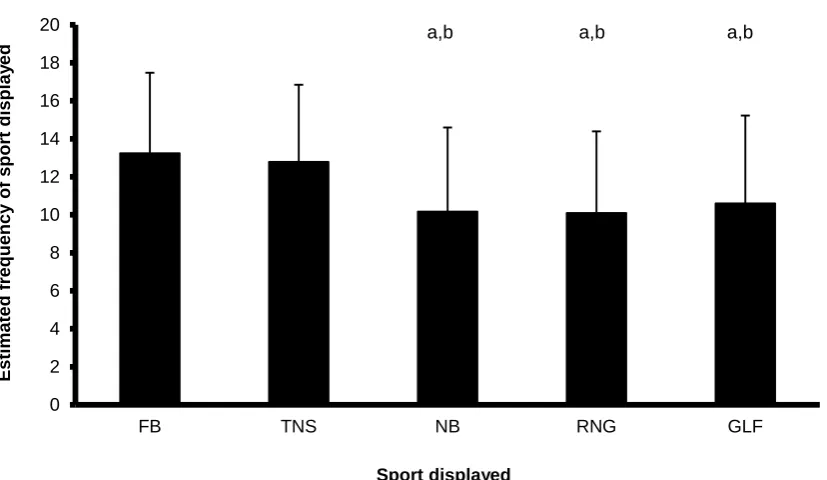
The Friedman test revealed a significant overall difference (p < 0.001) between celebrity and
non-celebrity sports. Bonferroni adjustment produced a significance value of 0.005 to be used for all the
comparisons. FB was not significantly different (p = 0.166) to TNS. However, they were both
significantly different to all other (non-celebrity) sports (P < 0.005). There were no significant
differences between the other sports (see Figure 1).
Figure 1: Estimated frequency of sport presented. Data presented as means. Vertical bars
denote SD. FB, football, TNS, tennis; NB, netball; RNG running; GLF, golf. ‘a’ indicates
significant difference with FB, while ‘b’ with TNS.
0 2 4 6 8 10 12 14 16 18 20
FB TNS NB RNG GLF
E st imat ed f req u en cy o f sp o rt d isp lay ed Sport displayed
Finally, there were no significant correlations between the sports in which participants were
‘primarily involved’ and their estimates of the frequency of occurrence of these sports within the
slideshow, nor were there demonstrably divergent trends along lines of gender or age.
Discussion.
The findings described confirm the first of the two postulated outcomes above. Although the sports
displayed in the slides occurred in equal numbers (N=10 for all), mean frequency estimations were
substantially greater for the celebrity sports, football (13.24) and tennis (12.79), than for the
non-celebrity sports, netball (10.17), running (10.10) and golf (10.60). In short, while participants’ mean
estimations of the frequencies of occurrence of non-celebrity sports in the slideshow were very
accurate indeed (a combined mean of 10.29), mean estimations of the occurrence for the celebrity
sports (a combined mean of 13.01) were inflated by over 30%. There was, however, no statistically
significant relationship between participants’ frequency estimations and their own involvement in
particular sports. This indicates that, within the sample:
a. Participants utilised the availability heuristic in making time-pressurised
frequency-estimations, sizeably over-estimating the frequency of occurrence of those sports linked
to more vivid examples.
b. The involvement of well-known athletes in the some of the viewed sports provided a
much stronger cue to memory (i.e. were more ‘vivid’) than either the sports themselves,
or the participants’ own personal involvement in particular sports.
c. The presence of ‘more vivid’ examples did not, however, lead to any substantial
counterbalancing underestimation of the frequency of occurrence of those sports linked to
less vivid examples.
Of course, the nature of the sample itself (a set of individuals that could reasonably be expected to
variety of studies to date, however, there is always an interpretative/experiential quality to how an
individual constitutes ‘vividness’ in any case of a ‘thing’ (McKelvie, 2000). The research reported
above, if repeated using a sample of participants with rather less interest and/or experience in (and
therefore knowledge of) sport, would likely have produced very different results. The proposed ‘fame’
of the athletes would simply not be a good cue to memory if the participants themselves did not
actually recognise those athletes, though one should always be mindful that the parameters of a
concept such as ‘fame’ are not themselves always easy to delineate. An athlete such as David
Beckham, for example, may have initially gained fame in association football but his subsequent
career trajectory now renders him internationally recognisable to many people with no knowledge of
sport whatsoever, but who may preserve strong interests in fashion or ‘celebrity culture’ at large.
Consequently, circumspection should always be exercised when prejudging what might, or might not,
provide strong cues to memory among given populations. It may well, for example, have been
reasonable to expect the regular golfers in the sample to provide higher estimations of the number of
golf-related slides in the show; this was, however, not the case. The recognisability of the footballers
and tennis players in the slideshow clearly provided a stronger cue to memory among these
participants than their own identification with golf itself.
Many judgements in ‘non-participatory’ sporting activities involve, or are premised upon,
individuals making quantity or frequency estimations regarding what has recently happened, or is
happening. As outlined in the introduction to this paper, there are two general domains for which
these observations have particular import, which are now discussed in turn.
‘Gatekeeping’ Tasks
There is little doubt that individuals involved in ‘gatekeeping’ activities in sport, i.e. those
responsible for the access of others to particular arenas such as talent scouts, coaches and team
selectors, are often called upon to make snap judgements grounded in ‘state of play’ assessments.
Although these are not always subject to the same degrees of time-pressurisation as those made by
still largely take place within limiting timeframes and against a variety of contextual backdrops such
as competition, training and organisation tasks (Côté, et al., 1995). As aforementioned, recent research
has portrayed coaching as a complex decision making process (Abraham, Collins, & Martindale,
2006; Jones & Standage, 2006) which is influenced by a myriad of social and psychological factors
(Cushion, 2007; Cushion, et al., 2006; Jones & Wallace, 2005). In practice a key aspect of the
decision making of coaches is the process of observing athletic performance to enable the use of
coaching knowledge to implement practical interventions such as providing feedback, substitutions
and tactical adjustments to aid athlete outcomes (Côté & Gilbert, 2009). Smith and Cushion (2006),
for example, report that in-game, youth soccer coaches spend 40.38% of their time in silence during
which they perform ‘...a number of cognitive processes, which included individual player analysis as
well as team tactical analysis’ (Smith & Cushion, 2006). Pertinently for coaching practice itself,
results from this study suggest that observation under time pressure in sport is potentially not a
quantifiably accurate or reliable measure if the availability heuristic is in play. Indeed results have
shown how a social factor such as ‘celebrity’ quantifiably may distort accurate recall even among
knowledgeable observers. This upholds the notion of coaching as a complex decision making process
which is subject to variegated social influences and questions the efficacy of pure (no matter how
focused) observation as a basis for sound decision-making. Furthermore it raises considerable issues
for active coaches who utilise ‘intuitive’ decision making when completing tasks such as such as
substitutions and in-game tactical adjustments under time pressure, as these may well be shown have
a basis in a quantitatively skewed estimate regarding the character of prior events. Given the apparent
influence of heuristics on recall in sport, coaching practitioners may wish to consider the use of
systematic performance analysis, a burgeoning area (Hughes & Franks, 2008) to support accurate
time-pressured decision making.
Officiating
Despite a widely-held desire for error-free decision-making from officials in association
influenced by, for example, such apparently arbitrary variables as the height of player (Quaquebeke &
Giessner, 2010), the colour of a player’s shirt (Frank & Gilovich, 1988; Tiryaki, 2005) and the level
and type of crowd noise (Nevill, Balmer, & Williams, 2002). If we consider, however, the particular
pressures of time limitation on an official’s decision-making, it is possible to hypothesise that all such
vivid stimuli may simply render particular cases-of-event easier to recall at the moment that the
decision is made. Cautions issued on the grounds of ‘persistent infringement’, for example, require an
official to make a situated judgement regarding the overall quantity of infractions committed by a
single player within a broad melee of activity. To keep a full count of all such infractions committed
within a single game by all players would, without the benefit of perfect recall, be extremely difficult,
and progressively more difficult as the clock advances. As such, it is reasonable to expect that some
kind of shortcutting strategy would need to be employed and, moreover, that some infractions, classes
of infraction and characteristics of infracting player are more vivid in memory than others. In cases
where the distribution of this mode of caution can be found to be inconsistent with the actual
numbers of infractions committed (i.e. where some players receive ‘persistent infraction’ cautions
despite other players having transgressed more often), a systematic analysis should reveal the classes
of cue responsible for the overestimation in given officials. The findings of Findlay & Ste-Marie
(2004), for example, demonstrate a clear ‘reputation bias’ among sporting officials; decisions are
often made in line with prior knowledge regarding the ‘type’ of athlete involved. If, therefore,
infractions committed by an athlete ‘known’ to be aggressive provide an official with more vivid
examples of transgressive behaviour than infractions committed by athletes without such a reputation,
there is a very real danger of emergent ‘self-fulfilling prophecies’. Essentially, overestimation of
infraction-frequency borne of an athlete’s reputation may well lead to public disciplinary action which
serves, in turn, to further contribute to that reputation. This mode of spiral can only be effectively
halted through intervention designed to rebalance the manner in which officials themselves manage
and understand the roles of particular cues.
The full impact of the pioneering work of Tversky and Kahneman (1973), and Schwarz et al.
(1991), has yet to be felt in the academic study of sport. Evidence from the broader realm of social
psychology, and the illustrative study presented herein, indicate that there is much scope in sport
psychology for a more thorough investigation of cognitive heuristics in general, and the availability
heuristic in particular. Moreover, this scope need not be confined to (expert) performance studies, but
should embrace a wide range of sport-related activities, not least coaching, scouting and officiating.
Domain-specific and rigorous research is required to facilitate a better understanding not only of
where the availability heuristic is in use in sporting activity, and its order of influence on judgements
made, but also which factor(s) most strongly inform(s) the very vividness of a recalled example. A
richer and more robust body of evidence relating to these matters has direct implications for not only
the better academic understanding of the formulation of sporting ‘state of play’ judgements, but also
References
Abraham, A., Collins, D., & Martindale, R. (2006). The coaching schematic: validation
through expert coach consensus. Journal of Sports Sciences, 24(6), 549-564.
Bell, D. E., Raifa, H., & Tversky., A. (1995). Decision Making: Descriptive, Normative and
Prescriptive Interactions. Cambridge: Cambridge University Press.
Bennis, W. M., & Pachur, T. (2006). Fast and frugal heuristics in sports. Psychology of Sport
and Exercise, 7, 611-629.
Bicchieri, C. (2004). Rationality and game theory. In A. R. Mele & P. Rawling (Eds.), The
Oxford Handbook of Rationality (pp. 182-205). Oxford: Oxford University Press.
Combs, B., & Slovic, P. (1979). Newspaper coverage of causes of death. Journalism
Quarterly, 56, 837-843.
Côté, J., & Gilbert, W. (2009). An integrative definition of coaching effectivenss and
expertise. International Journal of Sports Science and Coaching, 4(3), 307-322.
Côté, J., Salmela, J., Trudel, P., Baria, A., & Russel, S. (1995). The coaching model: A
grounded assessment of expert gymnastic coaches knowledge. Journal of Sport and
Exercise Psychology, 17(1), 1-17.
Cushion, C. J. (2007). Modelling the complexity of the coaching process. International
Journal of Sports Science and Coaching, 2(4), 395-401.
Cushion, C. J., Armour, K. M., & Jones, R. L. (2006). Locating the coaching process in
practice: Models for and of coaching. Physical Education and Sport Pedagogy, 11(1),
18-99.
Ericsson, K. A., & Kintsch, W. (1995). Long-term working memory. Psychological Review,
Ericsson, K. A., & Smith, J. (1991). Prospects and limits in the empirical study of expertise:
An introduction. In K. A. Ericsson & J. Smith (Eds.), Toward a General Theory of
Expertise: Prospects and Limits (pp. 1-38). Cambridge: Cambridge University Press.
Findlay, L., & Ste-Marie, D. (2004). A Reputation Bias in Figure Skating Judging. Journal of
Sport and Exercise Psychology, 26, 154-166.
Fox, C. R. (2006). The availability heuristic in the classroom: How soliciting more criticism
can boost your course ratings. Judgment and Decision Making, 1(1), 86-90.
Frank, M. G., & Gilovich, T. (1988). The dark side of self- and social perception: Black
uniforms and aggression in professional sports. Journal of Personality and Social
Psychology(54), 74-85.
Gigerenzer, G. (2006). Bounded and rational. In R. J. Stainton (Ed.), Contemporary Debates
in Cognitive Science (pp. 115-133). Oxford: Blackwell.
Hastorf, A., & Cantril, H. (1954). They saw a game: A case study. Journal of Abnormal and
Social Psychology, 49, 129-134.
Hughes, M. D., & Franks, I. M. (2008). The Essentials of Performance Analysis: An
Introduction. London: Routledge.
Jones, R. L., & Bowes, I. (2006). Working at the edge of chaos: Understand coaching as a
complex interpersonal system. The Sport Psychologist, 20(2), 235-245.
Jones, R. L., & Standage, M. (2006). First among equals: Shared leadership in the coaching
context. In R. L. Jones (Ed.), The Sports Coach as Educator: Reconceptualising
Sports Coaching (pp. 65-76). London: Routledge.
Jones, R. L., & Wallace, M. (2005). Another bad day at the training ground: Coping with
ambiguity in the coaching context. Sport, Education and Society, 10(1), 119-134.
Joyce, J. M. (2004). Bayesianism. In A. R. Mele & P. Rawling (Eds.), The Oxford Handbook
Kahneman, D., Slovic, P., & Tversky, A. (1982). Judgement Under Uncertainty: Heuristics
and Biases. Cambridge: Cambridge University Press.
Kahneman, D., & Tversky, A. (1979). Prospect theory: An analysis of decisions under risk.
Econometrica, 47, 313-327.
Key, D. J., & Schwartz, B. (2007). ‘‘Leaky’’ Rationality: How research on behavioral
decision making challenges normative standards of rationality. Perspective on
Psychological Science, 2(2), 162-180.
Klein, G. A. (1993). A recognition-primed decision (RPD) model of rapid decision making.
In G. A. Klein, J. Orasanu, R. Calderwood & Z. E. Zsambok (Eds.), Decision Making
in Action: Models and Methods (pp. 138-147). Norwood, CT: Ablex.
Lane, A., Nevill, A., Ahmad, N. S., & Balmer, N. (2006). Soccer referee decision-making:
Shall I blow the whistle? Journal of Sports Science and Medicine, 5, 243-253.
Lichtenstein, S., Slovic, P., Fischhoff, B., Layman, M., & Combs, B. (1978). Judged
Frequency of Lethal Events. Journal of Experimental Psychology: Human Learning
and Memory, 4(6), 551-578.
Luce, M. F., Payne, J. W., & Bettman, J. R. (1999). Emotional trade-off difficulty and choice.
Journal of Marketing Research, 36, 143-159.
MacMahon, C., Starkes, J., & Deakin, J. (2007). Referee decision making in a video-based
infraction detection task: Application and training considerations. International
Journal of Sports Science & Coaching, 2(3), 257-265.
Macquet, A. C. (2009). Recognition within the decision-making process: A case study of
expert volleyball players. Journal of Applied Sport Psychology, 21, 64-79.
McKelvie, S. J. (1995). Bias in the estimated frequency of names. Perceptual and Motor
McKelvie, S. J. (1997). The availability heuristic: effects of fame and gender on the estimated
frequency of male and female names. Journal of Social Psychology, 137(1), 63-78.
McKelvie, S. J. (2000). Quantifying the availability heuristic with famous names. North
American Journal of Psychology, 2, 347-356.
Mellers, B. A., Schwartz, A., & Cooke, A. D. J. (1999). Judgement and decision making.
Annual Review of Psychology, 49, 447-477.
Nevill, A. M., Balmer, N. J., & Williams, M. (2002). The influence of crowd noise and
experience upon refereeing decisions in football. Psychology of Sport and Exercise, 3,
261-272.
Nisbett, R. E., Borgida, E., Crandall, R., & Reed, H. (1976). Popular induction: Information
is not always informative. In J. S. Carroll & J. S. Paine (Eds.), Cognition and Social
Behavior (pp. 113 - 134). Hillsdale NJ: Lawrence Erlbaum.
Pratkanis, A. R. (1989). The cognitive representation of attitudes. In A. R. Pratkanis, S.
Breckler & S. Greenwald (Eds.), Attitude Structure and Function (pp. 70-98).
Hillsdale, NJ: Erlbaum.
Quaquebeke, N. V., & Giessner, S. R. (2010). How embodied cognitions affect judgments:
Height-related attribution bias in football foul calls. Journal of Sport & Exercise
Psychology, 32, 3-22.
Rothman, A. J., & Schwarz, N. (1998). Constructing perceptions of vulnerability: Personal
relevance and the use of experiential information in health judgments. Personality and
Social Psychology Bulletin, 24, 1053-1064.
Schmidt, R. A. (1975). A schema theory of discrete motor skill learning. Psychology Review,
Schwarz, N., Bless, H., Strack, F., Klumpp, G., Rittenauer-Schatka, H., & Simmons, A.
(1991). Ease of retrieval as information: Another look at the availability heuristic.
Journal of Personality and Social Psychology, 61, 195-202.
Sharps, M. J., Hess, A. B., & Ranes, B. (2007). Mindless decision making and environmental
issues: Gestalt/feature-intensive processing and contextual reasoning in environmental
decisions. The Journal of Psychology, 130(1), 525-537.
Sharps, M. J., & Martin, S. S. (2002). "Mindless" decision making as a failure of contextual
reasoning. Journal of Psychology, 136(3), 272-282.
Simon, H. (1957). A Behavioral Model of Rational Choice, in Models of Man, Social and
Rational: Mathematical Essays on Rational Human Behavior in a Social Setting. New
York: Wiley.
Smith, M., & Cushion, C. (2006). An investigation of the in-game behaviours of professional,
top-level youth soccer coaches. Journal of Sports Sciences, 24(4), 355-366.
Souchon, N., Cabagno, G., Traclet, A., Trouilloud, D., & Maio, G. (2009). Referees’ use of
heuristics: The moderating impact of standard of competition. Journal of Sports
Sciences, 27(7), 695-700.
Sousa, D. A. (2006). How the Brain Learns (3rd ed.). London: Corwin.
Thompson, C. (2003). Clinical experience as evidence in evidence-based practice. Journal of
Advanced Nursing, 43(3), 230-237.
Tiryaki, M. S. (2005). Assessing whether black uniforms affect the decisions of Turkish
soccer referees: Is the finding of Frank and Gilovich’s study valid for Turkish culture?
Perceptual and Motor Skills, 100, 51-57.
Tversky, A., & Kahneman, D. (1973). Availability: A heuristic for judging frequency and
Tversky, A., & Kahneman, D. (1974). Judgment under uncertainty: Heuristics and biases.
Science, 185, 1124-1131.
Von Neumann, J., & Morgernstern, O. (1944). Theory of Games and Economic Behaviour.
New York: Wiley.
Whiting, H. T. A. (1970). An operational analysis of a continuous ball throwing and catching
task. Ergonomics, 13, 445-454.
Winkielman, P., & Schwarz, N. (2001). How pleasant was your childhood? Beliefs about
memory shape inferences from experienced difficulty of recall. Psychological
Science, 12, 176-179.
Winkielman, P., Schwarz, N., & Belli, R. F. (1998). The Role of ease of retrieval and