The objective assessment of oral motor function during feeding: development and validation of the Schedule for Oral Motor Assessment (SOMA)
Sheena Reilly
Thesis submitted for the Degree of Doctor of Philosophy
May 1995
ProQuest Number: 10105165
All rights reserved
INFORMATION TO ALL USERS
The quality of this reproduction is dependent upon the quality of the copy submitted.
In the unlikely event that the author did not send a complete manuscript and there are missing pages, these will be noted. Also, if material had to be removed,
a note will indicate the deletion.
uest.
ProQuest 10105165
Published by ProQuest LLC(2016). Copyright of the Dissertation is held by the Author.
All rights reserved.
This work is protected against unauthorized copying under Title 17, United States Code. Microform Edition © ProQuest LLC.
ProQuest LLC
789 East Eisenhower Parkway P.O. Box 1346
This thesis is dedicated to three important people.
• First to my partner Paul whose patience and support has been unlimited.
• Second, my daughter Nuala who will no longer have to preface utterances with 'Mum, when you finish your Ph.d.'.
• Third, to my father who did not live to see it completed but whose pride in my accomplishments was always present.
I would like to thank my supervisors. Professor David Skuse and Dr Helen MacConachie for their support and guidance.
Special thanks also go to Jennifer Smith to whom I am indebted for her patience and help in the preparation and presentation of the thesis and to Dr Marjorie Smith who convinced me many years ago that I was capable of undertaking this task.
Abstract
No satisfactory method with established reliability and validity exists for
evaluating oral motor functioning and identifying the extent of any dysfunction in infants and young children. Furthermore, the nature and extent of oral motor difficulties in children with cerebral palsy is unknown.
The objectives of the thesis are twofold: first, to develop an instrument
capable of identifying children with clinically significant oral motor deficits and capable of discriminating them from children with normal oral motor function; second, to ascertain the reliability and validity of the instrument.
The Schedule for Oral Motor Assessment (SOMA) was developed to record oral motor skills objectively in infants with ages between 12and 24 months. The procedure is rated largely from a videorecording of a structured feeding session. A series of foodstuffs of varying textures, including liquids, is presented to the child in a standardised manner. Oral motor skills are evaluated in terms of discrete oral motor movements.
One hundred and twenty-seven children have been studied with the
instrument, including normal healthy infants and samples of children with non-organic failure to thrive, and cerebral palsy. Excellent inter-rater and
an independent sample of children with cerebral palsy was undertaken.
Discriminant validity was satisfactorily established by the analysis and an abbreviated version of the SOMA, suitable for screening purposes, was developed. The screening version has been shown to have positive
Table o f C ontents C hapter 1.
Introduction 1
C h ap ter 2.
Literature review Part 1
The development of oral and pharyngeal function during infancy and
early childhood 5
The use of terminology 5
Describing the normal process o f food ingestion 5
Describing abnormality 8
Structure and function of the oral cavity in infancy and early childhood 10
Development of sucking, chewing and swallowing 12
Developmental stages 12
Development in utero 12
The role o f the oral reflexes 13
Development in infancy and the transitional period 15
Development o f sucking 16
Development o f swallowing 19
Development o f chewing 20
Neurological Control of sucking, swallowing, chewing and respiration 24
Sucking, swallowing and respiration 24
The neurological control of chewing 26
The relationship between oral and pharyngeal development, and gross
motor development 29
Oral skill development in relation to foodstuffs 31 The role o f texture in the development of oral skills 31
A critical or sensitive period 34
The development of self feeding 37
Conclusions 39
Literature review. Part 2
Dysphagia in Infancy and Early Childhood 40
Types of dysphagia 40
Significance and Consequences of Dysphagia 44
Cerebral Palsy 45
Definition o f the cerebral palsies 45
Types o f cerebral palsy 46
Aetiology o f the cerebral palsies 48
Prevalence of cerebral palsy 49
Classification o f the cerebral palsies 50
Major disabilities associated with the cerebral palsies 51
Dysphagia in Cerebral Palsy 51
Aetiology and prevalence 52
Pharyngeal dysfunction 60 Significance and long term consequences o f dysphagia 61 The relationship between oral motor dysfunction and associated
disabilities 62
Failure to thrive 65
Definition o f failure to thrive 65
Aetiology o f failure to thrive 65
Prevalence o f failure to thrive 68
Dysphagia in failure to thrive 69
Evaluating dysphagia 70
Methods o f assessment 70
Chapter 3.
Summary and aim of the study 76
Research Hypotheses 76
Aims 77
Chapter 4.
The development study
Part 1. Introduction 79
Study design and description of sample 80
Study design 80
Description o f sample 81
Identification o f subjects 81
N O FT infants 82
Comparison infants 83
Children with CP 83
Recruitment o f subjects 84
Procedure 84
Instrument Design and development 85
Development 85
Administration 87
Structure 88
Oral motor challenge categories 89
Functional areas 90
Functional units 90
Discrete oral motor behaviours 90
Trials 91
Scoring 92
Data analysis - plan and procedures 93
Plan 93
Procedures 94
Defining abnormality 94
Reliability 98
Inter-rater reliability 98
Part 2 - Results
Introduction 105
Procedures 105
C h ap ter 5
The Validation Study - methodology and results
Methodology 132
Introduction 132
Study design and description of samples 133
Identification o f subjects 133
N O FT and Comparison infants 133
Subjects with Cerebral Palsy 133
Recruitment 138
Procedure 138
Data analysis 139
Statistical procedures/analysis 139
Analysis plan 139
Procedures 139
Results 141
Introduction 141
Cluster analysis - results 141
Identifying failed behaviours 141
Identification of normal and abnormal clusters 145 Characteristics of the DOM behaviours that discriminate
the normal from abnormal clusters 153 Summary of DOM behaviours which discriminate
normal from abnormal clusters 156
Comparison of index a generated on both sample
one and two 159
Comparison of the effectiveness of the indexes generated on both sample one and sample two 166 Further development and application o f the screening instrument
Introduction 178
Procedures for further development o f the Indices 179
Index 1b and 2b 179
Formulating a combined index for each sample 184 Applying the indexes to independent samples 185 Formulating a combined index from both samples 188
C h apter 6. Discussion
Research aims 190
The development of the SOMA 190
Prerequisites for an assessment of oral motor skills 190 The discrete oral motor behaviours entering the analysis 194
Rating difficulties 195
Refusal behaviours 196
Establishing the normal/abnormal status of each DOM
behaviour 200
Inter-rater and test-retest reliability 201
Research hypotheses 206
Discrimination between the comparisons and children
with cerebral palsy 206
C M C categories 207
Comparing the samples 209
Discrimination between failure to thrive, cerebral
palsy and comparison children 210
The sensitivity of texture in predicting abnormality 212 Further validation procedures - The screening version
o f SOMA 215
Comparison of the effectiveness of the different
screening instruments developed 215
Index 1 a and index 2a 215
Alternative screening procedures 218
Index 1b and index 2b 218
Index 1 c and index 2c 219
Index Id and index 2d 220
Index 1 e and index 2e 221
Methodological issues 222
Conclusions 225
List of tables and figures
Chapter 2
Table 1 Terminology used to describe the normal process
of food ingestion in children 7
Figure 1 Classification system used to describe abnormalities
of the ingestion of food 9
Figure 2 Normal coordination of sucking, swallowing and respiration 16 Figure 3 Non-nutritive and nutritive sucking patterns 17 Figure 4 The overlapping function of the cranial nerves involved
in sucking, swallowing and respiration 26 Table 2 Sensory and motor functions of cranial nerves
involved in mastication 28
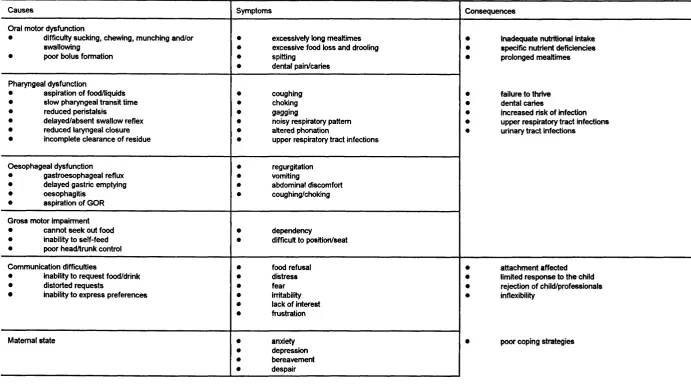
Table 3 The cause, symptoms and consequences of feeding
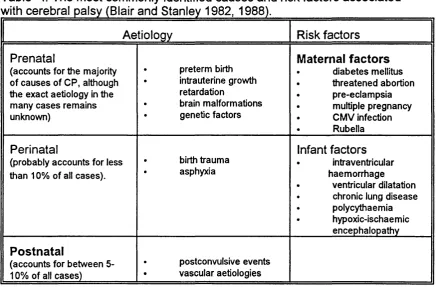
problems in children with cerebral palsy 43 Table 4 The most commonly identified causes and risk factors
associated with cerebral palsy 49
Table 5 Swedish classification of the cerebral palsies 51 Table 6 Classification of oral motor dysfunction in children
with cerebral palsy 57
Table 7 Common oral motor difficulties experienced by
children with cerebral palsy 58
Table 8 Pharyngeal dysfunction: Common problems 61
Chapter 4
Figure 1 The four components of the SOMA 88
Table 1 Computation of the kappa statistics 101
Table 2 Number and proportion of DOM behaviours that fell
into each of the kappa ranges - Inter-rater reliability 103 Table 3 Number and proportion of DOM behaviours that fell
into each of the kappa ranges - Test-retest reliability 104 Table 4 Oral-motor behaviours entering the analysis for each
foodstuff
Table 5 Preliminary 5 cluster solution for purée 114 Table 6 The relationship between OMC categories, DOM skills
and cluster designation 116
Table 7 Cluster rankings for the OMC category -purée 118 Table 8 Cluster membership showing proportions of members
of individual clusters failing a subset of discrete
oral motor behaviours-purée 120
Table 9 The relationship between the total dysfunction scores
obtained by individual children and cluster membership 123 Figure 2 Calculation of sensitivity, positive predictive value
and specificity for sample 2 124
Table 10 Purée - Positive predictive value, sensitivity
Table 11 SOMA screening version for purée 125 Table 12 SOMA screening version for semi-solids 126
Table 13 SOM A screening version for solids 127
Table 14 SOM A screening version for cracker 128
Table 15 SOMA screening version for bottle 129
Table 16 SOM A screening version for trainer-cup 130
Table 17 SOMA screening version for cup 131
Chapter 5
Figure 1 Sample characteristics 135
Table 1 The characteristics of C P I and CP 2 136 Table 2 Summary of the analysis steps undertaken in
the development study 140
Table 3 Cluster membership showing proportions of members of individual clusters failing a subset of DOM
behaviours 142
Table 4 Crosstabulation of cluster membership by rank
position of abnormality for sample one (purée) 14 6 Table 5 Crosstabulation of cluster membership by rank
position of abnormality for sample two (purée) 145 Table 6 Crosstabulation of cluster membership by rank
position of abnormality for sample one (semi-solids) 14^ Table 7 Crosstabulation of cluster membership by rank
position of abnormality for sample one (semi-solids) 14h Table 8 Crosstabulation of cluster membership by rank
position of abnormality for sample one (solids) 141-Table 9 Crosstabulation of cluster membership by rank
position of abnormality for sample two (solids) 147-Table 10 Crosstabulation of cluster membership by rank
position of abnormality for sample one (cracker) 14^ Table 11 Crosstabulation of cluster membership by rank
position of abnormality for sample two (cracker) 14^ Table 12 Crosstabulation of cluster membership by rank
position of abnormality for sample one (bottle) 149 Table 13 Crosstabulation of cluster membership by rank
position of abnormality for sample two (bottle) 144 Table 14 Crosstabulation of cluster membership by rank
position of abnormality for sample one (trainer-cup) 150 Table 15 Crosstabulation of cluster membership by rank
position of abnormality for sample two (trainer-cup) 150 Table 16 Crosstabulation of cluster membership by rank
position of abnormality for sample one (cup) 15î Table 17 Crosstabulation of cluster membership by rank
position of abnormality for sample two (cup) 15J Table 18 Purée. Proportion of children in normal/abnormal
cluster designation 15^
Table 19 Semi-solids. Proportion of children in normal/abnormal
Table 20 Solids. Proportion of children in normal/abnormal
cluster designation 15-^
Table 21 Cracker. Proportion of children in normal/abnormal
cluster designation 1 5 3
Table 22 Bottle. Proportion of children in normal/abnormal
cluster designation 15^
Table 23 Trainer-cup. Proportion of children in normal/abnormal
cluster designation 15(f
Table 24 Cup. Proportion of children in normal/abnormal cluster
designation 15^
Table 25 Cluster membership showing proportion of members of individual clusters failing a subset of DOM
behaviours 1 5 f
Table 26 Purée. The behaviours which form index 1 for both
sample one and two 1S8
Table 27 Semi-solids. The behaviours which form index 1 for
both sample one and two 15^
Table 28 Solids. The behaviours which form index 1 for both
sample one and two 160
Table 29 Cracker. The behaviours which form index 1 for both
sample one and two 16j
Table 30 Bottle. The behaviours which form index 1 for both
sample one and two 162
Table 31 Trainer-cup. The behaviours which form index 1 for
both sample one and two 163.
Table 32 Cup. The behaviours which form index 1 for both
sample one and two
164-Table 33 The relationship between total dysfunction scores
and cluster membership for purée 16t>
Table 34 Purée Efficiency of the screening procedure in
predicting group membership 16T
Table 35 Semi-solids. Efficiency of the screening procedure in
predicting group membership 163
Table 36 Solids. Efficiency of the screening procedure in
predicting group membership T6R
Table 37 Cracker. Efficiency of the screening procedure in
predicting group membership 170
Table 38 Bottle. Efficiency of the screening procedure in
predicting group membership 17|
Table 39 Trainer-cup. Efficiency of the screening procedure in
predicting group membership 17^
Table 40 Cup. Efficiency of the screening procedure in
predicting group membership 173
Table 41 The mean scores for the OMC categories screening
Table 42 Mean (sd) abnormality scores of the children with F I T and CP scoring above the threshold for each OMC
category 176
Table 43 Derivation of the iindicesdeveloped on both sample
one and two 1 7 ^
Table 44 Purée. The behaviours that form index b for sample
one and two 180
Table 45 The relationship between total dysfunction scores obtained by children on index b and cluster
membership 181
Table 46 Purée. Efficiency of the screening procedure using index b to predict group membership for sample one
and two 183
Table 47 Purée. Efficiency of the screening procedure using index a to predict group membership for sample one
and two 185
Table 48 The PPV, sensitivity and specificity of the indices when
switched from the sample on which they were generated 1 8 6 Table 49 Purée. Efficiency of the screening procedure using
index c to predict group membership for sample one
and two 187
Table 50 Summary of the PPV, sensitivity and specificity values
for the combined index 18B
Chapter 6
Table 1 Derivation of the indices developed on both sample one
Chapter 1. Introduction
The human feeding cycle is dependent on an integrated sequence of events requiring the coordination of over 20 different muscles for the movement of saliva or ingested foods from the mouth to the stomach (Dodds 1989, Palmer 1989). Four distinct stages have been identified; the preparatory or
anticipatory phase (Leopold and Kagel 1983), which involves food getting and anticipatory reactions; the oral stage (Leopold and Kagel 1983,
Logemann 1983), involving bolus management and transfer, sucking, munching and mastication; the pharyngeal phase (Logemann 1983), during which swallowing occurs; and finally, the oesophageal phase which begins with the opening of the oesophageal sphincter (Miller 1982).
Successful oral feeding in young children is dependent on the subtle interplay between the structure and function of the oral cavity and other aspects of infant development such as sensorimotor function, neurological maturation, cognition, emotion and human interaction. The oral and pharyngeal skills that enable the infant to feed are part of a complex process which may be
interrupted at any one or more points and result in feeding difficulties; such problems may be congenital or acquired and anatomical or functional in
may anse.
Feeding difficulties can be symptomatic of a variety of paediatric conditions. For many years clinicians have recognised that oral motor dysfunction occurs relatively frequently in association with conditions such as cerebral palsy. However, until recently, the topic received minimal attention in the literature (Bax 1989); many of the major texts dealing with the nature of cerebral palsy contain no mention of feeding difficulties.
The consequences of oral and pharyngeal dysfunction during infancy and early childhood range according to the severity of the problem. Whilst subtle defects may go undetected and cause minimal impairment and disruption, the most severe disorders can result in death due to aspiration pneumonia (Carter and Jancar 1983). For many years the growth failure associated with
conditions such as cerebral palsy has been attributed primarily to the child's neurological condition. However, recent evidence has confirmed that oral motor difficulties may substantially affect the child's nutritional intake and consequently be one of the major causes of growth failure (Stallings et al 1993).
The malnutrition observed in children with severe oral and pharyngeal deficits can have long lasting effects on the child's health and well being. For
reduced attention span are thought to affect the child's ability to learn. In addition, decreased motivation and irritability are also frequently mentioned (Stallings et al 1993 and Stevenson and Allaire 1991). As well as influencing the health and well being of the child, feeding disorders may also affect relationships within the family. The burden of caring for a physically disabled child has long been recognised as a source of stress within the family (Sloper and Turner 1993, Reilly and Skuse 1992 and Stevenson and Allaire 1991).
As will be illustrated in chapter 2 (Literature Review) of this thesis there is a paucity of information about the development of oral motor skills. To date no longitudinal study has been undertaken in order to describe the development of oral motor skills in normal children. Yet in recent years there has been increasing recognition of how widespread the problem is in infancy and the significance of oral motor dysfunction for both the child and caretakers (Skuse et al 1992, Mathisen et al 1989, Reilly and Skuse 1992, Sonies et al 1990, Stevenson and Allaire 1991). However, there is considerable variability in the type of oral motor assessments undertaken and no assessment tool which has been standardised on normally developing children and has established reliability and validity, is available to evaluate oral motor function in
paediatric departments in the UK.
modified barium swallow if warranted. The development of an assessment tool capable of identifying children with oral motor deficits and discriminating them from children without oral motor dysfunction would be of value both clinically and for research purposes.
This thesis aims to develop an instrument, with established reliability and validity, which will enable clinicians and researchers to rapidly identify
children with impaired oral motor skills. In Chapter 3 the hypotheses and aims of this study are proposed. The development of an instrument capable of distinguishing children with oral motor dysfunction from those with normal skills would have a number of benefits. For the first time a standardised description of both normal and abnormal oral motor behaviours could be made and children at risk could be provided with appropriate, 'early', intervention. In addition it would enable researchers to collect data on the prevalence of oral motor dysfunction in particular paediatric conditions. Having identified the extent of the problem, the service needs and resources required to effectively manage such difficulties could then be established. Finally, the identification of need and provision of appropriate services might prevent some of the severe consequences of oral and pharyngeal dysphagia, such as malnutrition from occurring.
Chapter 2 Literature review
P a rti
The development of oral and pharyngeal function during Infancy and
early childhood
The use of terminology
Describing the normal process o f food ingestion
There is considerable variation in the terminology used to describe both the normal process of food ingestion and the dysfunction that may arise. The client population in question affects the terminology used. For example, different terms are used to describe the process of eating and drinking in children than those used to describe the process in adults. During childhood, the terminology used relates largely to the child's developmental level and varies if the child is dependent on an adult for its nutritional needs or able to feed independently. Much confusion can and does occur both amongst
professionals and between professionals and parents.
describing the process of normal feeding is necessary.
Table 1. Terminology used to describe the normal process of food ingestion in children.
General terminoloav
SDecific terminoloav
■ Feeding ■ Suckling
■ Sucking - nutritive - non-nutritive
■ Eating ■ Munching
■ Chewing
■ Mastication
■ Drinking ■ Swallowing
■ Dealutition
For the purposes of this thesis, the process of feeding in young children will be described in 4 stages:
• Anticipation/Preparation • Oral
• Pharyngeal • Oesophageal
Describing abnormality
A variety of terms are used to describe any disruption to the normal process of ingesting food. It is equally important to be precise in the use of such terminology. In the literature the following terms are commonly used:
• Dysfunction • Disorder • Difficulty • Deviant • Dysphagia
Each of these terms may be combined with any one of the descriptors in Table 1 in an attempt to describe the child's difficulty. The manner in which it is described may indicate very little about the aetiology or exact nature of the problem. For example, a child described as having a 'feeding problem' or 'difficulties in feeding' could be seen by a variety of different health
professionals all of whom have different expertise. The aetiology could be functional or organic or may have arisen as a combination of both factors. If, for example, the aetiology is organic, the description used may tell us very little about the actual difficulties the child is experiencing; are they at the anticipatory, oral, pharyngeal or oesophageal level or a combination of one or more of these?
The term dysphagia will be used to describe any difficulties which occur in the four stages of feeding. The term oral motor dysfunction will be used to
Figure 1 summarises the terminology used in this thesis to describe and classify abnormalities of the feeding process in young children.
Figure 1: Classification system used to describe abnormalities of the ingestion of food.
Definition: "The term dysphagia is used to describe swallowing
disorders characterised by difficulty in oral preparation for the
swallow or in moving the bolus from the mouth to the stomach.
Subsumed in this definition are problems positioning food in the
mouth and in oral movements including suckling, sucking and
mastication" (Edieman et al 1991).
Anticipatory/Preparatory
Oral
Oral motor dysfunction; any difficulty
in
suckling
sucking
chewing
munching
oral stage of swallowing
Pharyngeal
structure and function of the oral cavity in infancy and early
childhood
The development of oral-motor skills in infancy is primarily dependent on two main factors, the structure and function of the oropharynx. The pharynx, which is comprised of three main cavities, the oropharynx, nasopharynx and hypopharynx, is implicit to normal feeding. The pharynx is concerned with three main aspects of motor function: stabilisation and maintenance of structural position and form, alimentation and respiration (Stevenson and Allaire 1992). The pharynx is a common anatomic pathway for both
respiration and digestion and requires complex and precise coordination from the neonate and young infant.
penetration. The Eustachian tube lies in a horizontal position in young infants and becomes more vertically aligned in older children and adults. The sucking pads, fatty tissue deposits encased in the muscles of the infants cheeks, provide the infant with "firmness" or stability for sucking. Tongue movement in the newborn is restricted because of the limited oral space available and the immaturity of the central nervous system. A combination of factors enable the newborn to extract milk from the teat or nipple by compression and suction; these include, the stability of the mandible (provided by the sucking pads), the limited size of the oral cavity and the large tongue (in proportion to the size of the oral cavity).
respiratory and lingual coordination in order to control the direction of the bolus.
Bosma (1992) proposed that the anatomical development and functional patterns of the oral cavity were interdependent and suggested that oral motor functioning could stimulate the growth and structural adaptation of the oral cavity. He attributed the changes in the size of the pharynx, larynx and oral cavity to the actions of continuous feeding.
Development of sucking, chewing and swallowing
Developmental stages
Bosma (1992) divides the development of feeding skills into 4 distinct stages: 1. Early infancy - birth to 12 months.
2. Transitional feeding -1 2 -6 0 months 3. School aged children
4. Mature feeding - pubertal children and adults
The discussion will focus on Bosma's first 2 stages, early infancy and transitional feeding, as these are most pertinent to the thesis.
Development in Utero
(Hooker 1942, Golobeva et al 1959). Suckle feeding develops rapidly after 33-35 weeks gestation and graduates from nonspecific mouth movements to a non-nutritive suckle and progresses to nutritive suckling coordinated with swallowing (Gyboski 1975, Wolff 1968, Herbst 1989). The act of suckle-swallowing in the fetus is thought both to provide training for suckle swallow in the neonatal period and to contribute to the complex regulation of amniotic fluid volume; the daily volume of amniotic fluid swallowed shortly before birth
matches that of the mother's milk ingested shortly after birth (Pritchard 1966).
The role o f the oral reflexes
The newborn begins life equipped with a set of reflexes which are considered necessary for survival. PrechtI and Beintema (1964) describe in detail the examination process for elicitation of the oral reflexes in the newborn infant and Sheppard and Mysak (1984) reviewed and summarised the published literature on infantile oral reflexes with detailed descriptions of the reflex, stimulus type and response.
The oral reflexes associated essential for establishing feeding include: • rooting,
• mouth opening,
• lateral tongue and • babkin reflexes.
Each reflex can be elicited by applying a stimulus and observing the infants response (Sheppard and Mysak 1984, PrechtI and Beintema 1964). Ingram (1962) considered that each oral reflex,
"represented a phase of a continuum of reflexely provoked motor activity." and therefore should not be examined individually. The oral reflexes enable the neonate to feed successfully and the protective reflexes such as the gag and cough reflexes ensure safe feeding. The rooting reflex is often described as a searching movement which enables the baby to find the nipple or teat. Prior to a breast feed, when the baby is alert and hungry, he/she can be seen to 'root' for milk; the reflex helps to guide the baby towards the breast without direction from the mother. Present at birth the reflex can still be elicited in approximately 80% of infants at 6 mths of age (Touwen 1976). Once the baby has found the breast the mandible is depressed (mouth opening reflex), the lips separate and orientate towards the stimulus enabling the baby to close the mouth (bite reflex) and to latch onto the nipple (lip reflex-lateral). The baby is then able to initiate the suckle-swallow sequence (suck and swallow reflexes).
reflex serve as protective mechanisms which help to prevent laryngeal
penetration. Unlike the other oral reflexes which disappear during the first 12 months the protective reflexes are present throughout life although the
sensitivity of the gag reflex is thought to diminish around 6-9 months when the solid food the baby is receiving is of a firmer consistency.
More recent work carried out by Sheppard and Mysak (1984) suggested that studying oral reflexes is useful. They found that the oral motor behaviours involved were very similar to early chewing patterns. They concluded that chewing appears to develop as a result of the functional interaction between reflexive and adaptive movements.
The elicitation of oral reflexes during infancy does appear to warrant some attention. First, they can provide useful information about the infant^ capacity to feed if they are observed as a part of the feeding process. Second, the reflexes may provide the clinician with useful information about the
emergence of oral motor behaviours such as chewing.
Development in infancy and the transitional period
For ease of discussion sucking and swallowing will be described separately, however, functionally, it is difficult to separate suckling/sucking from
bursts and pauses. During the sucking bursts, respirations are interspersed
with sucking and swallowing as can be seen in figure 2.
Figure 2. Normal coordination of sucking swallowing and respiration*
Sucking
Respiration
represents a swaOow
■Adapted from W o * and Glass (1992)
Development o f sucking
Sucking may be nutritive or non-nutritive. Nutritive sucking refers to the
process of obtaining nutrition or ingesting food whilst non-nutritive sucking
occurs in the absence of any flow of nutrients. Non-nutritive sucking may
occur to satisfy the infants desire to suck or as a state regulatory mechanism
(W olf and Glass 1992)
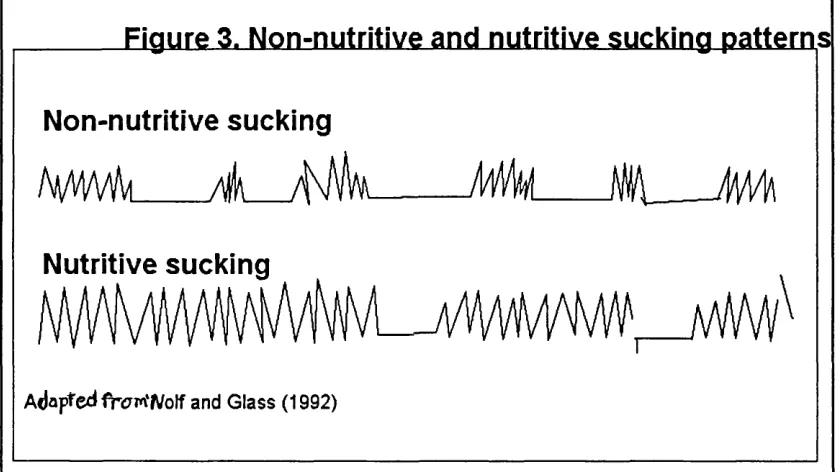
Figure 3. Non-nutritive and nutritive sucking patterns
Non-nutritive sucking
Â
/(\Mm
A#
Ê\
Nutritive sucking
Adapref*fr<7m‘Wolf and Glass (1992)
Sucking is the intake phase; it involves taking the liquid or food into the mouth 1992). The characteristics of these two types differ as can be seen in figure 3. Sucking is the intake phase; it involves taking the liquid or food into the mouth and moving it back in preparation for swallowing. Morris (1987) states that sucking needs to be easily initiated, rhythmical, strong, sustained and efficient.
Two types of sucking are usually described during the infantà early
tongue. It is sometimes referred to as pump sucking. During sucking the tongue, along with the hyoid bone, mandible and lower lip are moved in phases, downwards and forwards and then upwards and backwards to
express milk from the nipple. Bosma (1990) demonstrated through the use of ultrasound that there was a 'peristaltic displacement' of the medial portion of the tongue which occurred in wave like patterns of contraction and relaxation. These actions result in a milking or compression of the liquid from the nipple or teat. The lateral portions of the tongue function as stabilisers which enclose or cup the nipple or bolus and milk is moved into the pharynx by peristaltic waves in preparation for swallowing; the swallow is triggered when the bolus reached the posterior pharyngeal wall (Bosma 1992). Not every sucking action is followed by a swallow; two or three sucking actions may precede one swallow.
In the newborn and very young infant the position of the epiglottis helps to prevent aspiration and direct or divert the liquid laterally around the laryngeal opening (Stevenson and Allaire 1992). Crelin (1973) described the upward movement of the epiglottis to guide the larynx upwards behind the soft palate where it remains allowing smooth respiration to take place during suckling-swallowing.
respiration, the sequence is smooth and rhythmic and rapidly becomes established during the first weeks of life .
Development o f swallowing
Humans are thought to swallow approximately 2,400 times per day in a 24hr period and as much as 300 per hour during eating or drinking (Sakuda et al 1975). The act of swallowing serves two functions: to propel a bolus of food or liquid from the oral cavity into the oesophagus and to prevent aspiration of the bolus into the larynx. Swallowing is an extremely complex motor sequence which has stimulated much research of both animal and human deglutition systems. It is a triggered all or none sequence of movements; that is, once initiated it cannot be interrupted (Sessle 1981). Swallowing involves the coordination of a large number of muscles in the mouth, pharynx, larynx and oesophagus and is usually divided into 3 phases, oral, pharyngeal and
oesophageal. The oral phase involves bolus management and transfer, food or liquid is prepared, whether by sucking, munching or chewing, and propelled backwards in preparation for the swallow. During the pharyngeal phase the swallow reflex is triggered and in the oesophageal phase, food passes into the oesophagus. The anatomic and physiologic components of the swallow have been extensively described by numerous authors ( Doty and Bosma 1956, Sessle 1981, Bosma 1957, 1992).
about 6-8 months Morris and Klein (1987) suggest that a new type of swallow develops. The more mature swallow results in the infant being able to trigger a swallow independently, that is without it being preceded by a suck or suckle action. The swallow undergoes further development as the infant learns to drink from a cup which requires greater oral and pharyngeal control of a larger and faster flowing bolus. However, there has been no major study of the
changes that occur in the swallow pattern either in relation to the changing size or texture of the bolus in children.
Development o f chewing
Chewing is a complex, coordinated action involving the entire musculature of the oral cavity. The major function of chewing is to lubricate and reduce each mouthful of food to a particular size convenient for swallowing. Chewing cycles are variable with no two cycles ever being identical; they are
dependent on continuous sensory feedback from the oral structures (Ahlgren 1966). The musculature and structures required for chewing are present from birth, apart from the teeth which erupt at different stages during the first 18 months. Chewing is commonly thought to emerge between 5-8 months of age (Morris and Klein 1987).
from liquid to more solid feeds. Sessle (1981) highlights the fact that we do not know whether mastication utilises some of the pathways and mechanisms already in use for suckling or whether the nervous system develops new mechanisms which may for example be triggered by tooth eruption. Any study of the emergence of such skills is complicated by many factors which may influence how and when the oral motor skills required for chewing or munching foods are acquired. For example, the age at which texture is
introduced may vary according to cultural attitudes and the recommendations and trends for infant feeding.
The emerging oral motor skills necessary for chewing have been studied by most researchers as the introduction of solids takes place (Alexander 1987, Lewis 1982, Morris 1987). Most studies are descriptive and have involved small samples of children; specific stages which coincide directly with the offering of increasingly textured foods have been identified as oral motor milestones and the children observed at these time points.
Sheppard and Mysak's (1984) study of young infants is the only systematic observation of solid bolus feeding which was not been linked to the
movements of the mandible and mandibular depression and elevation at speed (approximately 1 cycle per second) were among the last characteristics of mature mastication to emerge at 26-31 weeks of age. The infants studied by Sheppard and Mysak were not receiving a diet containing chewable solids. Some components of chewing, such as mandibular elevation and depression and lateral tongue movements were considered similar to infant oral reflexes. They concluded that the emergence of the oral motor movements necessary for chewing could be observed well before the onset of functional chewing when infant oral reflexes were active (Sheppard and Mysak 1984).
child learns to deal with a more solid bolus of food.
Morris describes 4 sequential stages which occur in the development of mandibular movements for chewing. They are:
• the stereotyped, vertical pattern • the non-stereotyped, vertical pattern • the diagonal, rotary pattern and • the circular, rotary pattern.
Early chewing movements, often described as munching, are seen as the precursors of more mature chewing actions. Munching consists of vertical mandibular movements combined with elevation and depression of the tongue Morris (1987). Occasionally, gross tilting movements of the tongue may also be observed. Gradually the tongue and jaw orientate towards the stimulus if it is placed onto the molar gum margins; this is thought to be the beginning of the diagonal rotary jaw movements seen in the more mature chewing pattern.
The variety and extent of jaw, tongue and lip movements seen during chewing is dependent on the size and texture of the bolus. In mature chewing the tongue moves laterally from the central position to place food onto the molars and can transfer food back to the medial portion of the tongue in preparation for swallowing. The tongue also transfers food from one molar region to
depending on where the food is positioned. Gradually rotary-circular
movements develop which assist the tongue with placement and enable the child to manage a large bolus of food. A grinding action is sometimes
observed to masticate tougher textures such as meat.
Gisel and her colleagues (Gisel 1991, Stolovitz and Gisel 1991, Gisel 1988a, Gisel 1988b, Schwartz et al 1984) have contributed a great deal to our
knowledge of chewing patterns during early childhood. They found that the initiation of chewing becomes more efficient as children are exposed to more solid textures, the tongue becomes more mobile and independent of the jaw which is in agreement with Morris's (1987) description of separation of movement. The ability to manage different food textures (eg: purée verses solid textures) was found to mature at different rates and optimal efficiency is not reached until well after 2 years of age. However, many of Gisel's studies have been concerned with the duration of the feeding cycle rather than evaluating the individual oral motor movements. Whilst this work enables us to compare the duration of the feeding cycles according to the textural
property of the foodstuffs, in both normal children and children with CP, it does not describe the discrete oral motor movements that are involved.
Neurological Control of sucking, swailowing, chewing and respiration
Sucking, swallowing and respiration
swallowing and breathing. Both the sensory and motor components should be considered, although the former receives scant attention in the literature. This probably arises from the fact that the motor aspects can be more easily
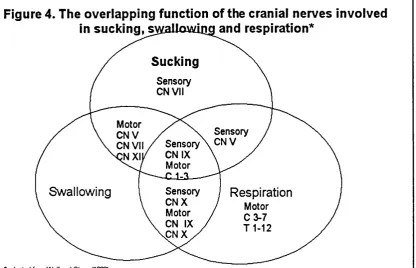
observed whereas it is not possible to quantify sensation and the child's response to stimulation cannot be objectively described. Figure 4, adapted from W olf and Glass (1992), illustrates the specific motor and sensory functions of the cranial nerves (V, VII, IX, X and XII) and branches of the upper cervical nerve roots which innervate the oral, nasal, pharyngeal, laryngeal and respiratory structures.
Figure 4. The overlapping function of the cranial nerves involved
in sucking, s\yailowuig and respiration*
Sucking
Sensory CN VII
Motor C N V CN VII
NXI
Sensory Sensory \ CN V CN IX
Motor
U
Swallowing Sensory
C N X Motor CN IX C N X
Respiration
Motor
C 3-7
T 1 - 1 2
* adapted from W olf and Glass (1992)
The swallowing neurons in the nucleus tractus solitarius (NTS) and the
adjacent reticular formation play a major role in the initiation and integration of swallowing.
The neurological control of chewing
feedback from the proprioceptors of the masticatory muscles innervated by the trigeminal nerve (V).
In the seventies, new theories emerged which suggested that the control system for mastication was based below the mesencephalon, since
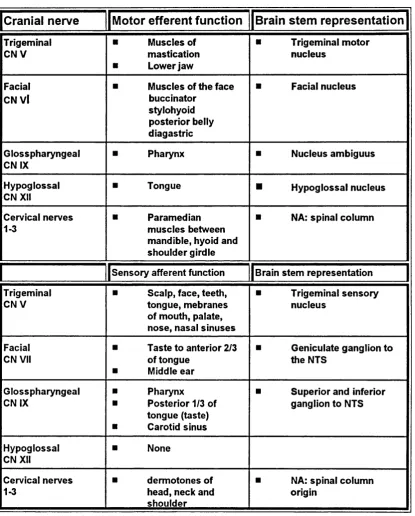
decerebrate animals (above the pons) were capable of chewing (Dellow and Lund 1971). The chewing centre is located in the reticular formation, adjacent to the rostral end of the mesencephalic nucleus of the trigeminal nerve. The masticatory centre contains a pool of interneurons, which initiate and maintain an alternating rhythmic activity to open and close the mandible and extend and retract the tongue. Mastication is an internally programmed cyclic activity; the neural circuits involved utilise the V, VII, IX and XII cranial nerves in a highly complex, smooth coordination of the various oral motor structures.
Table 2. Sensory and motor functions of cranial nerves involved in mastication
Cranial nerve
Motor efferent function
Brain stem representation
Trigeminal CNV
■ Muscles of
mastication
■ Lower jaw
■ Trigeminal motor
nucleus
Facial CN Vi
■ Muscles of the face
buccinator stylohyoid posterior belly diagastric
■ Facial nucleus
Glosspharyngea! CN IX
■ Pharynx ■ Nucleus ambiguus
Hypoglossal CN XII
■ Tongue ■ Hypoglossal nucleus
Cervical nerves 1-3
■ Paramedian
muscles between mandible, hyoid and shoulder girdle
■ NA: spinal column
Sensory afferent function 1 Brain stem representation
Trigeminal C N V
■ Scalp, face, teeth,
tongue, mebranes of mouth, palate, nose, nasal sinuses
■ Trigeminal sensory
nucleus
Facial CN VII
■ Taste to anterior 2/3
of tongue
■ Middle ear
■ Geniculate ganglion to
the NTS
Glosspharyngeal CN IX
■ Pharynx
■ Posterior 1/3 of
tongue (taste)
■ Carotid sinus
■ Superior and inferior
ganglion to NTS
Hypoglossal CN XII
■ None
Cervical nerves 1-3
■ dermotones of
head, neck and shoulder
■ NA: spinal column
origin
Mathews (1975) likened the masticatory cycle to flying a plane;
" The masticatory control can be compared to an automatic pilot, which will steer the plane on its own but which has manual over-ride facilities by which the pilot can take control should he wish to do so.”
The relationship between oral and pharyngeal development and gross
,rmotor development
It is important to place the emergence of oral motor skills into a developmental context; the oropharynx should not be studied in isolation but considered within the context of the whole body. Gross motor functioning affects to a great extent the function of the oropharynx. Morris (1987) mentions 4 aspects of gross motor control which she considers influence development of
feeding.
They are:
• Stability and Mobility • Separation of movement
• Straight planes of movement to rotation and • Midline development
poor trunk stability will be unlikely to be able to stabilise the head and neck and as a result will almost certainly be unable to develop jaw stability.
Children's movement patterns progress from gross to fine motor
development. This concept relates to both the sequence of development taking place for the total body and for oral motor skill acquisition. Early jaw movements initially appear gross and unrefined, for example, the baby or young infant is unable to grade jaw opening movements. However, with the development of total body and oral stability the infant's repertoire progresses rapidly to include finely graded jaw movements. For example the older infant is able to grade the exact degree of jaw opening required for different sized crackers. At the same time there is a gradual separation of movement. The young infant who tries to grasp an object will initially use a palmer grasp and his/her reach will involve the whole body; at times this may result in the infant lo' sing balance. Gradually however, the infant learns to finely tune the
movement so that they can pick up an object with a fine pincer grasp and isolate or separate the required movements from the rest of the body. In the same way, infants learning to cope with their first mouthfuls of solids will suck on the spoon and initially bite on the spoon to stabilise the lower jaw.
Gradually however, the baby develops internal stabilisation.
months onwards most infants sit in a well supported semi-sitting position although they may still be reclined at an angle. By seven months, most are seated upright with back support provided by an infant chair, although they may require the extra help of cushions, or inserts. By nine months most no longer require back support unless they tire and by 18 months the majority of children can sit unsupported at the family table or a small child's table and chair.
The position of the head and neck during feeding are of extreme importance. The patency of the airway can be affected by the degree of neck flexion or extension ( Logemann 1983 and W olf and Glass 1992). Bosma (1992) proposed that the maintenance of the pharyngeal airway is the antecedent of craniocervical posture and that the development of this posture begins with stabilisation around the pharyngeal airway in the infant. The airway continues to play a central role in postural mechanisms during the infants life.
Oral skill development in relation to foodstuffs
The role of texture in the development of oral skills
For the first few months of life the infant relies exclusively on liquids (milk) as the main source of nutrition and between 3 and 6 months is exposed to 'solid foods.' The use of the term 'solid foods' is somewhat misleading as initially most infants are fed foods of a puréed consistency which resemble thickened liquids. Perhaps the major difference is in fact the manner in which it is
as transition feeding or weaning. The majority of infants negotiate this transition successfully although it can be problematic for some. Gradually thicker purées are introduced followed by foods containing lumps and ground or mashed table foods (8-12 months). By about 12-18 months most infants are regularly eating coarsely chopped table foods and easily chewed meats and finally by 18-24 months they are able to manage an adult diet of meat, raw fruit and vegetables.
The timing and introduction of the various types of solid foods are controlled by the parent. Guidelines for feeding infants are regularly published in the United Kingdom by the Department of Health (1989) and parents are often advised by health visitors. There is, however, a paucity of information about the individual and contextual factors that contribute to successful transition feeding and wide variation in the age at which infants are introduced to different textures. There is limited information detailing how infants manage the transitory stages and little or no information on how texture may facilitate or impede the development of oral motor skills.
purée (6 years) and a viscous texture (7 years). Maturity was reached when no further decreases in time were noted to eat the relevant texture. Gisel and Patrick (1988) concluded that a firmer food texture elicited a more mature eating pattern as it was easier to manipulate a solid food bolus. Gisel (1988,
1 9 9 1 ,1 9 9 2 ) has consistently stated that solid foods are easier to manipulate because children revert to suckling on puréed textures when they should in her view be using a more mature chewing pattern.
This particular aspect of Gisel's work is confusing and contradictory; first, neither children nor adults use a 'mature chewing pattern' to manipulate a puréed texture; purées do not require mastication. Second, Gisel (1991) states that infants use the feeding method that requires the least effort; that is, if food can be ingested by suckling, the child will not munch. To suggest therefore, that a child's oral motor behaviours may be less mature or abnormal solely on the basis of the duration of the feeding cycle alone is insufficient. Whilst the duration of the feeding cycle is an important factor, maturation should include an evaluation of the discrete oral motor
movements required for mature oral feeding. For example, control of the lips, tongue and mandible are of equal importance.
of age. Other researchers have suggested that such movements do not emerge until much later (Morris 1987, Lewis 1982). For many years clinicians and researchers believed that the eruption of the teeth was an essential part of the successful transition to solid foods. This has, however, been shown to be incorrect as many infants can manage mashed and
coarsely chopped foods prior to the eruption of the primary dentition (Bosma 1986). It is apparent that there are many misconceptions regarding oral motor ability during infancy and the assumption that the emergence of oral motor behaviours parallels the introduction of the food texture may in fact be incorrect and certainly warrants further investigation.
A critical or sensitive period
The notion of a period of heightened susceptibility can be found in
psychological writings as early as the 1890's. However, the term a 'critical period' was not coined until much later when a number of researchers developed their theories on the basis of the large literature about critical periods in animal studies (for example. Bowl by 1953, Lorenz 1935, Denenberg and Bell 1960).
action; the sensitive period refers to the optimal time for the application of such a stimulus.
The critical period for a given development is closely related to the level of maturation of the central nervous system; Nash (1973) proposed that unless the CMS had reached a minimum state of maturation and had begun to
function the critical event would be ineffectual. Bronson (1962 and 1965) said critical periods could be organised into 3 categories; first, the nature of the stimuli to which the infant was sensitive; second the nature of the behaviour patterns that were affected; and third, the developmental stage during which these stimuli had their maximum effect on later behaviour.
The concept of a critical or sensitive period for oral motor development was first proposed by Illingworth and Lister (1964). They defined the term 'critical period' as a well-delineated period of time during which a specific stimulus must be applied in order to produce a particular action. A 'sensitive period' was considered to be the optimal time for the application of a stimulus. They proposed that if children were not given solid foods to chew at the appropriate time or solid foods were withheld (eg: delayed weaning), troublesome feeding problems could develop. Illingworth and Lister (1964) cited a number of case studies to illustrate their ideas and suggested that a child was
developmentally ready to chew at 6 mths.
by clinicians as providing an explanation for some of the paediatric feeding problems commonly encountered. Children who experience prolonged tube feeding are thought to be deprived of oral experience during 'critical periods' of infancy or exposed to adverse oral experiences; as a result many become resistant to oral feeding long after the need for enteral feeding has elapsed (Morris 1985).
Bosma (1992) felt there was a relationship between the structural
development of the oral cavity and the degree of practice. A recent study by Bier et al (1993) showed that low birth weight infants who had undergone prolonged intubation had significantly poorer sucking abilities at term and 3 months than infants of low birth weight with short periods of intubation and full term infants who had not been intubated. A contributory factor was thought to be the structural changes that occurred as a result of intubation-related injury or side effects such as palatal groove (Molteni and Blumstead 1986). The impact of palatal groove formation on the sucking patterns of young infants remains unknown; however, one could hypothesise that such a change in the structure of the oral cavity of young infants could disturb the relationship of the oral structures and create additional oral motor control difficulties for the
young infant. The authors concluded that prolonged intubation may be viewed as a marker for potential oral motor problems.
studies concerned with the subject add weight to the view that oral experience is an important component in the development of oral skills and suggests that even in the very young infant there may be a critical age for the introduction of solid foods. However, our understanding of the mechanisms involved are at this stage rather limited.
The development of self feeding
Self feeding skills need to be learned as motor skills mature. The first stage in learning to self feed begins with mouthing activities from the age of 2-3 months. Such activities can have a calming effect on the infant and be self regulatory. From 3 months onwards, the child is able to bring objects to its mouth and begins to recognise the bottle and anticipate its approach with changes in activity and movement such as kicking the legs, wriggling or sucking movements (Setter 1991). By four months infants are able to
purposefully reach for objects and the frequency of mouthing increases, they may touch and pat the bottle and place their hands on it (Morris and Klein 1987). By five months many are able to hold their own bottle.
to the mouth without spillage. As in all aspects of feeding development practice improves the performance and is an important component of self feeding development.
By 24 months of age the child may also be able to stab food with a fork, but it is not until 36-48 months that a child's ability to self feed with a fork or spoon fully matures (Morris and Klein 1987). The sequence of cup drinking develops
in a similar fashion and is equally dependent on experience and motor
maturity. At six months the infant can drink from a cup held by an adult and at 12 months can hold the cup and drink but will probably spill some liquid
(Fomon et al 1979). At 24 months the child can usually hold a cup in one hand and drink and at 30-36 months can pour liquid into a cup. Obviously abilities in this area depend on practice and the type of utensil given to the infant. The use of trainer cups, that is cups with a spouted lid^are common in the UK and many children continue to drink from these well into childhood although they are more than capable of controlling the flow of liquid from an ordinary cup.