282
Design And Construction Of Wireless Charging
System Using Inductive Coupling
Do Lam Mung, Kyaw Soe Lwin, Hla Myo Tun
Abstract: Wireless charging system described by using the method of inductive coupling. In this project, oscillation circuit converts DC energy to AC energy(transmitter coil) to transmit magnetic field by passing frequency and then induce the receiver coil. The properties of Induction coupling are wave(magnetic field-wideband), range(very short~cm), efficiency(hight) and operation frequency(LF-band~several handred kHz).The project shows as a small charging for 5V battery of phone in this method. The system bases on coupling magnetic field, then designed and constructed as two parts. There are transmitter part and receiver part. The transmitter coil (transmitter part) transmits coupling magnetic field to receiver coil (receiver part) by passing frequency at about 1.67MHz. The Ampere’s law, Biot-Savart law and Faraday law are used to calculate the inductive coupling between the transmitter coil and the receiver coil. The calculation of this law shows how many power transfer in receiver part when how many distance between the transmitter coil and the receiver coil. The system is safe for users and neighbouring electronic devices. To get more accurate wireless charging system, it needs to change the design of the following keywords.
Keywords: Wireless, power, transfer, inductive
————————————————————
1
I
NTRODUCTIONWIRELESSpower transfer transfer (WPT) refers to a family of techniques for delivering power without wires or contacts.[1] It was demonstrated firstly by MIT using inductive coupling the summer 2007.[2] In 2008, Intel also achieved wireless power though inductive coupling.[3]Wireless power transfer technolo-gy has existed for a long time: however, recent advances have allowed it to become more practical, and recent interest in the consumer market has bought it to the center of attention.[4] This project can be charged several different handheld devic-es, such as cellular phones and MP3 player (like 5V charging adapter). It can be charged on the surface of the transmitter coil by putting receiving coil at the device. Wireless power transfer means the power supply is not plugged into the device being charged (close proximity or physical contact)[5].
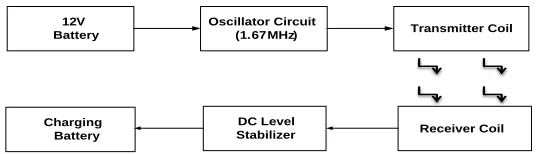
12V Battery
Oscillator Circuit
(1.67MHz) Transmitter Coil
Receiver Coil DC Level
Stabilizer Charging
Battery
Fig. 1.Block diagram of wireless power transfer system
In this project, supply voltage 12 DC drives oscillator circuit as push-pull driver to operate transmitter coil. Then, the transmit-ter coil transmits coupling magnetic field by passing frequency at about 1.67MHz. In this state, there are AC voltage and the receiver coil receiver coupling magnetic field as ACvoltage. DC level stabilizer converts AC to DC voltage again to charge the battery of device.
2
P
ROPOSEDS
YSTEMD
ESIGNAThe hardware configuration of wireless power transfer system is basically on inductive coupling method. The complete circuit diagram of project can be divided in two different sections:
• Transmission section and
• Receiving section
In transmission section, oscillation circuit operates as push-pull devices to transmit magnetic field to the receiving coil. The system uses coupled magnetic fields as a frequency to trans-fer electromagnetic energy from the transmitter to receiver.[6] Fig2 show the circuit diagram of transmission section.
L1 L2 12V C6 Relay R1 R2 R3 R4 D2 D1 D3 D4 T2 T1 C5 C8
L3
C7 C4 C3 C1 C2 C9 C10 C11 C12 C13 C14 C15 C16 C17 C18C17=220nF, C18=0.22uF,
C1=C2=C3=C4=C5=C6=C7=C8=C9=C10=C11=C12=C13=C14=C15=
C16=0.1uF, Relay=12V
R1=R2=100Ω(2W), R3=R4=5.6kΩ,
D1=D2=D3=D4=6A10MICdiode L1=L2=28.18uH(8-turns,
FT-50-43,ferrite core) L3=1 turn(220mm diameter,13mm
cop-per tube) T1=T2=IRF 2807 (n-channel)
Fig. 2. Circuit diagram of Transmission section
______________________
283
L4
C1 12V,5W Lamp Receiving coil LM317T IN OUT ADJ Diode Diode Diode Diode Diode Diode R1 R2 C4 C2 C3 C5 + -USB wire to phoneDC level stabilizer
L4=1turn (220mm diameter, 13mm copper tube),
C1=0.02uF, Diode=1N4007, C2=470uF, C3=1uF, R1=47Ω,
C4=10uF, VR=5kΩ, C5=1uF, R3=100kΩ, R4=11.11kΩ
Fig. 3. Circuit diagram of Receiving section
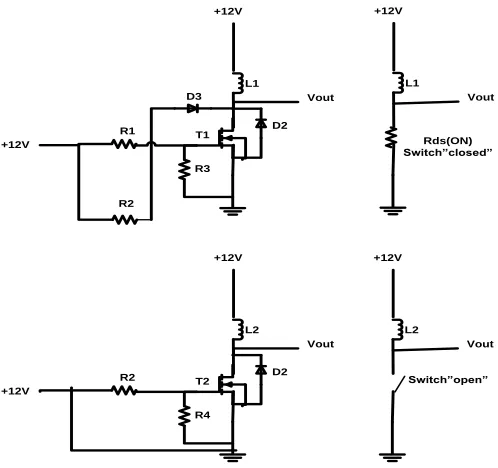
2.1OPETATION OF POWER MOSFETT1AND T2
When T1 is LOW (off) and the pass transistor gate is pulled up to T2 to keep it turned on. When T1 is HIGH(on), the pass tran-sistor gate is pulled to ground, and the trantran-sistor T2 turns off.
L1 +12V R1 R2 R3 D2 D3 T1 +12V Vout L1 Rds(ON) Switch”closed” +12V Vout L2 +12V R2 R4 D2 T2 +12V Vout L2 Switch”open” +12V Vout
Fig. 4. Power mosfet T1 HIGH(on) and T2 LOW(off)
2.2CALCULATION OF FREQUENCY(C AND L) AND COIL DESIGN
The frequency oscillation is calculated as the following:
1/Ca=1/C1+1/C2+1/C3+1/C4, Ca=25nF 1/Cb=1/C5+1/C6+1/C7+1/C8, Cb=25nF
1/Cc=1/C9+1/C10+1/C11+1/C12, Cc=25nF 1/Cd=1/C13+1/C14+1/C15+1/C16, Cd=25nF
Ca,C18 and Cb are series, Cx=11.83nF Cc and Cd are series, Cy=12.5nF
Cx and Cy are parallel, C=24.5nF
C6 C5 C8 L3 C7 C4 C3 C1 C2 C9 C10 C11 C12 C13 C14 C15 C16 C18
Fig. 5. Frequency oscillation by Inductor coil and Capacitors
f=1/2 π √LC=1.57MHz
Fig. 6.Copper tube(13mm diameter) and Diameter of coil
3
H
ARDWAREI
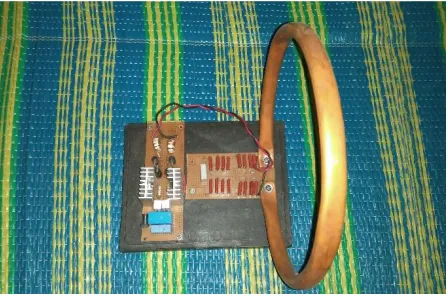
MPLEMENTATIONThe hardware design of wireless charging system describes as two sections.
(1). Transmitter section and (2). Receiver section
284
Fig. 7.The project of transmitter section
Receiver section is used for to receive power by magnetic field and passing the frequency oscillation. In this state is AC vol-tage and then it needs to convert DC volvol-tage for charging the battery of phone.
Fig. 8.The project of receiver section
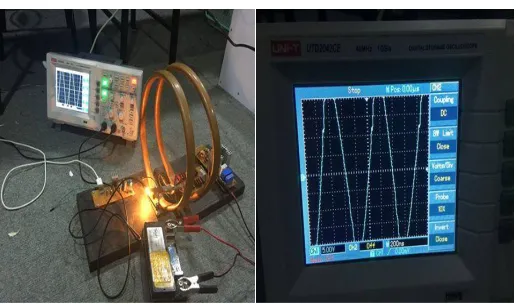
Fig. 9.The wireless charging system of mobile phone
3.1CALCULATION OF MAGNETIC FIELD(B)AND DISTANCE(X)
(A)PRIMARY COIL
Biot-Savart law gives out the magnetic flux density generated by the flow of charges:
Where;
r=the full displacement vector from wire element to the point er=the unit vector of r
Idl=linear-current-element in the wire µ0=the magnetic constant
For the circular coil, the generated magnetic flux density B at the point x;
a=110mm=11*10-2m, let x=5cm=5*10-2m, Ip=I=11.6A Bx=5*10
-5 exT
V0(t)=2Vmsinθ (Vm=12V,Vp=2Vm) θ=0, 90, 180, 270, 360,…
Vp=V0=0V, 24V, 0V, -24V, 0V, …
+Vp
-Vp 0
90 180 270 360 ...
Fig.10. Calculation by Power Mosfet T1 and T2 passing L and C
(B)SECONDARY COIL
285 According to the Faraday’s law of induction, the induced
vol-tage in the secondary coil is:
Fig. 11. Angle between the magnetic field and receiving coil
φm(t)=∫sB.dS=NBA cosa coswt=NBAcoswt (a=0) V(t)=-d φm(t)/dt=-NBA d/dt coswt=NBAwsinwt=NBAwsinθ θ=0, 90, 180, 270, 360 N=1, Bx=0.5µexT, A=πr
2
(r=11*10-2m), w=2πf (f=1.25MHz) Vp=0V, 15V, 0V, -15V, 0V (distance between 5cm transmitter and receiver)
3.1CALCULATION BY DIGITAL OSCILLOSCOPE
Fig. 12. Waveform of Vp(Primary coil) In the transmitter coil; Vp=24V, f=1/T=1/800ns=1.25 MHz (T=800ns)
Fig. 13. Waveform of Vp(Secondary coil) In the receiver coil; Vp=15V, f=1/T=1/800ns=1.25 MHz (T=800ns)
3.2 CALCULATION OF TRANSMITTER AND RECIVER COILS
(L3=L4=1TURN=420NH)
Fig. 14. Transmitter coil and receiver coil (13mm copper tube and 22omm diameter)
The number of turn to get L3=L4=1turn=420nH calculates as the following:
L= µ0N 2A/ℓ
From emf=∫CEdℓ=-d/dt∫ABdA
[the induction theorem (in general form)] and
e.m.f=d/dtφ(Faraday’s law)
Air core coil (L3=L4=420nH transmitting and receiving coils) ℓ=the length of the gap=diameter of the coil ℓ
=220mm=22cm=22*10-2m r=11cm=11*10-2m, L=420nH, A= π r2,µ0=4π *10
-7
H/m Get :N=1.3≈1 turn
3.3CALCULATION THE NUMBER OF TURNS IN CHOKE
The inductance of inductor with toroidal core calculates in the following:
Fig. 15.The inductance of inductor with toroidal core
L=λ/I =µrcµ0hN 2
/2π Ln(b/a) From ∫cH.dl= NI (dl=rdφ) ( Ap-plying Ampere’s law) L=28.18uH,µrc=800,µ0=4π*10
-7 H/m, h=0.47752*10-2m, a=0.35687*10-2m,b=0.635*10-2m, Get: N=8 turns
x
y
B
a
.
286
3.4CALCULATION BY DIGITAL VOLTMETER (DCVOLTAGE)
Fig. 16. DC Voltage and Ampere(between transmitter and re-ceiver=1.3inches)
P=VI=1.005*7.63=7.4W (Loading 10Ω,5W)
Fig. 17. DC Voltage and Ampere (between transmitter and receiver=4inches)
P=VI=145.1m*1.22=0.18W (Loading 10Ω,5W)
3.5EFFICIENCY, Ƞ EFFICIENCY,Ƞ={P(RECEIVING COIL) / P (TRANSMITTING COIL)}
Calculation of 1.3inches=transmitting coil and receiving coil; P(receiving coil)=7.4W
P(transmitting coil)=12*1.3=15.6W Get; Efficiency,Ƞ=0.47=47%
4 S
IMULATIONR
ESULTIn simulation, it shows the calculation of the waveform, DC voltage waveform by each power mosfet transistor, AC voltage
by both power mosfet transistors.
Fig. 18. Multisim Test for Wireless Power Transfer Circuit
Fig. 19. Frequency oscillation by simulation, XSC1 (both of power mosfet transistor T1 and T2)
287
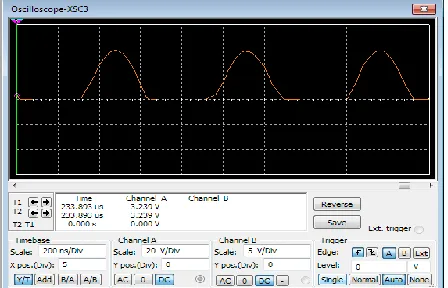
Fig. 21.Frequency oscillation XSC3 by power mosfer transistor T2
f = 1/T = 1/617.424n = 1.65MHz
Fig. 22. Calculation of frequency oscillation by simulation
5
C
ONCLUSIONWireless power transfer by inductive coupling is described in this paper. In this circuit project, power transfer about 7.4watt when the transmitter and receiver are between 1.3inches. It needs to redesign and reconstruct by changing power mosfet transistor. In the paper, the design is not perfect and redesign in this jounal. The components need to change. Wireless pow-er transfpow-er system can be realized to ppow-erform to high stan-dards followed more distance between transmitter and receiv-er by changing the size of coppreceiv-er wire guage or coppreceiv-er tube and design of inductance in toroidal core.
A
CKNOWLEDGMENTThe author would like to thank to Dr. Hla Myo Tun, Associate Professor and Head of the Department of Electronic Engineer-ing, Mandalay Technological University for his help. And thanks to the supervisor, Dr. Kyaw Soe Lwin, Lecturers, De-partment of Electronic Engineering, Mandalay Technological University for his guidance, support and encouragement.
R
EFERENCES[1] Program on Technology Innovation: Impact of Wire-less Power Transfer Technology (Initial Market As-sessment of Evolving Technologies-Final Report, De-cember 2009).
[2] Final Paper Wireless power transfer “Daniel Deller, Skip Dew, Justin Freeman, Custis Jordan, Ray Lec-ture, Malik Little”, Thusday, December 11, 2008.
[3] M.Longer, “Wireless power & “Sensitive” Ro-bots”,[Organization website], [Cited 1 September 2008], Available HTTP:
[4] A.Kurs, A.Karalis, R.Moffatt, J.D.Jounnopoules, P. Fisher and M. Soljacic, “Wireless power transfer via strongly coupling magnetic resonances”,( Science, vol.317, pp.83-86, 6 June 2007).
[5] Allen T.Waters for the degree of Honors Baccalau-reate of Science in Electrical and Computer
Engineer-ing presented on May 28,2010.
[6] @watch?v=hZ8Z07fOOqwhttps: