www.orientjchem.org
An International Open Access, Peer Reviewed Research Journal
2019, Vol. 35, No.(3): Pg.1167-1173
This is an Open Access article licensed under a Creative Commons license: Attribution 4.0 International (CC- BY). Published by Oriental Scientific Publishing Company © 2018
Composition Based Physicochemical Analysis of Modified
Bitumen by High-density polyethylene (HDPE) and
Low-density polyethylene (LDPE)
SONU SHARMA
1, SITANSH SHARMA
2* and NIRAJ UPADHYAY
3*
1Department of Chemistry, Lovely Professional University, Jalandhar, Punjab, India.
2Division of Physical Sciences and Engineering, King Abdullah University of Science and Technology,
Saudi Arabia.
3Department of Chemistry, Dr. Hari Singh Gour University, Sagar, Madhya Pradesh, India.
*Corresponding author E-mail: [email protected] http://dx.doi.org/10.13005/ojc/350336
(Received: June 02, 2019; Accepted: June 19, 2019)
ABSTRACT
The innovative use of polythene for bitumen modification to enhance the quality of bitumen is at the peak of research area of scientists working in the field of environmental sustainability. On the one hand, this method utilizes a large amount of non-biodegradable waste in an eco-friendly way and is an integral component of plastic waste management while on the other hand, it enhances the properties of bitumen. In our research we have used low density polythene (LDPE) and high density polythene (HDPE) in the form of pellets for modification of VG-30 bitumen. Different compositions of LDPE and HDPE modified bitumen (1%, 3%, 5% and 7% by weight of bitumen) were synthesized. Various physical, mechanical and structural properties of modified bitumen were studied and compared with that of neat bitumen using penetration test, softening point test, ductility test, separation tests, FTIR analysis, SEM etc. The results of research proved that there is enhancement in properties of bitumen after modification with LDPE and HDPE. Modified bitumen has reduced thermal susceptibility, more resistance towards permanent deformation and better storage stability. The best improvements were obtained at the 5% composition in case of LDPE and 3% in case of HDPE.
Keywords: Bitumen, High-density polyethylene (HDPE) and Low-density polyethylene(LDPE), Enhancement.
INTRODUCTION
Plastics are the macromolecules which are formed by the polymerization of small monomers like ethylene, propylene, styrene and many more. Their remarkable properties such as thermal insulation (low thermal conductivity), insolubility in the common organic and inorganic solvents, versatile, easily processable, recyclable, UV resistant, corrosion
resistant make them the materials of choice for various applications ranging from common domestic articles to sophisticated scientific and medical instruments1. Due to its low cost of manufacturing
13 million tonn plastic wastes is generated annually in India but due to lack of proper waste management strategies only 42% plastic waste is recycled whose quality decreases after each recycling in comparison to virgin plastic3. Among different types
of plastics, polythene is the most commonly used plastic. Polyolefin alone accounts for 60% of the total plastic consumption in India4. Out of different
types of polythenes, demand of HDPE is increasing day by day due to its use in the construction sector followed by LDPE which is used in packaging industry because of its moisture susceptibility and transparent nature. These two polythenes are in great demand so their waste is also increasing day by day. Their non-biodegradable nature make them one of the major soil and water pollutant which poses greater risk to land fertility as well as health of different living organisms5. Therefore, there is an
urgent need to find some alternative ways for their safe disposal.
For over a century in order to bind aggregate, bitumen is employed as an adhesive material during the road construction because of its properties like excellent binding properties, water proofing behavior and low cost6. However,
due to increased traffic load and extreme climatic variations various problems such as rutting, pothole formation, thermal cracking, and fatigue cracking (6) are appeared on the surface of the neat bituminous road. Therefore in order to enhance the performance of road, an additional substance is required which is cheap, can be homogenously mixed along with bitumen (in a molten form) to form composite materials which show high thermal stability, weight bearing, water resistant properties as compared to neat bitumen. For this aim the polymers are the materials of choice and these days have gain lot of interest7. Among the different choice of polymers
the polythene is the best one. So, an innovative use of polythene waste is in the road construction. Waste polythene as a modifier tends to enhance the properties of bitumen thus increasing the strength of roads. Its addition to bitumen represents an environmental friendly alternative approach for the future of waste polythene. On the one hand it gives rise to more durable roads and on the other hand it is one of the best methods for easy disposal of waste polythene.
Different researches have been performed on the use of waste polythene as a modifier in bitumen. Panda and Mazumdar (2002) highlighted that the reclaimed polythene as a modifier tends to enhance marshal stability, resilient modulus, and fatigue life and moisture susceptibility of mixes8.
Another research program (2008) concluded that recycled polythene tends to enhance the rheological and mechanical properties of bitumen which further enhances the resistance against rutting, thermal and fatigue cracking9. Use of pyrolysis polythene as
a modifier was studied by Al hadidy and Yi (2009) and found that addition of 6% pyrolysis LDPE results in durable, economic and high performing flexible pavement10. Another group of researchers
(2013) used gamma irradiated recycled low density polythene as a modifier in bitumen. The results indicated that g-LDPER has stiffening effect on bitumen which provides enhanced temperature susceptibility and better performance grades11.
Recycled polythene obtained from processing of waste plastic products as modifier results in enhancement of viscosity, cohesive strength, water and heat resistance of bitumen. There was decrease in rate of thermal ageing12. Addition of
5%wt. of polythene along with 2%wt. of a catalyst in asphalt results in increased stability and reduced thermal susceptibility which enhances life of roads and reduces the cost13. LDPE with lower molecular
weight and wider molecular weight distribution are better materials for asphalt modification as compared to high molecular weight LDPE with very narrow molecular weight distribution14. Costa,
Silva, Oliveira and Fernandes (2013) used waste plastics containing polythene to modify the bitumen. Their findings confirmed that SBS, EVA or HDPE have better storage stability15. Perez, Martinez,
Gallegos (2005) concluded that HDPE enhances the mechanical properties of bitumen and with 3% HDPE binder structure changes to gel like, thus giving more elastic properties16. Hinislioglu and
Agar (2004) investigated the use of plastic wastes having HDPE as modifier in asphalt concrete. They also highlighted that the maximum stability was achieved by adding 4% HDPE at 1650C within 30
minutes. This can be confirmed that waste HDPE modified bitumen provide better resistance against permanent deformations due to their high stability and high marshal quotient17. Bindu and Beena (2010)
in asphalt. Their research concluded that 10% shredded waste plastic can lead to flexible pavement with good performance and long durability18.
When HDPE was used in pellet form as a modifier (of 80/100 grade asphalt), it is found to decrease moisture susceptibility and temperature susceptibility of asphalt. 5% HDPE content was recommended for improvement of asphalt performance in this regard19.
A comparative study was carried out by Habib, Kamaruddin, Napiah, Tan (2011) on the rheological properties of 80/100 bitumen modified by linear LDPE, HDPE and polypropylene (PP). The outcomes showed that PP blends better as compare to LLDPE and HDPE. The addition of polymer tends to enhance viscosity of bitumen. Better results were obtained when polymer conc. was kept below 3%20. The effect
of HDPE based plastic waste on the performance of asphalt mixes was also being studied. HDPE as a modifier tends to enhance resistance to water damage. The bitumen sample modified with 4% of HDPE was the optimum concentration in terms of stability values21.
Many studies regarding the use of polythene as bitumen modifier are available in literature but nothing is said about the optimal ratio of polythene bitumen. So our research is focussed on finding the optimum concentration of polythene which can be mixed in bitumen so that the binder has best performance.
ExPERIMENTAL
MATERIALS AND METHODS
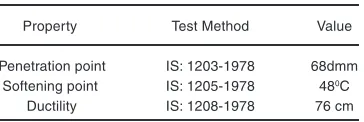
Viscosity Grade-30 (VG-30) bitumen was used for the study and it was procured from Hoshiarpur. The physico-mechanical properties of this bitumen are reported in Table 1. LDPE and HDPE were used in the form of pellets and procured from S.K. Industries, Daburji, Amritsar. Fig. 1. represents (a) LDPE and HDPE pellets (b) modified bitumen samples.
Fig. 1.(a). LDPE pellets (b) HDPE pellets (c) Modified Bitumen samples
Table 1: Physico-mechanical properties of VG-30 bitumen
Property Test Method Value
Penetration point IS: 1203-1978 68dmm Softening point IS: 1205-1978 480C
Ductility IS: 1208-1978 76 cm
FTIR (Shimadzu-8400s) was used for monitoring available functional group in Bitumen. Surface analysis was done of Field Emission Gun Scanning Electron Microscope NOVA Nano SEM 450.
Preparation of Modified bitumen:
Using wet process, the VG-30 bitumen was modified with 1, 3, 5, 7 parts by weight of polythene (both LDPE and HDPE) with the help of high shear mixer11. Initially, in an iron container 1000g
of bitumen was heated until it become a fluid and when the temperature reaches about 1600C, a pre
weighed amount of polythene was slowly added into the molten bitumen in 1%, 3%, 5%, 7% by weight of bitumen. In order to get homogenous samples, the mixture was continuously stirred for 1-1.5 h at 1500-2000 rpm under 160±50C temperature.
After this modified bitumen was poured into small containers and was further allowed to cool up to room temperature. In order to protect these samples from environmental oxidation these samples were sealed with aluminum foil and stored for further testing. The obtained polythene modified bituminous samples were labelled as below:
VG-30 Bitumen + 1%LDPE = 1 LDPMB VG-30 Bitumen + 1%HDPE = 1 HDPMB VG-30 Bitumen + 3%LDPE = 3 LDPMB VG-30 Bitumen + 3%HDPE = 3 HDPMB VG-30 Bitumen + 5%LDPE = 5 LDPMB VG-30 Bitumen + 5%HDPE = 5 HDPMB VG-30 Bitumen + 7%LDPE = 7 LDPMB VG-30 Bitumen + 7%HDPE = 7 HDPMB
Penetration test
This test is performed to find the degree of hardness of bitumen at 250C. Penetration test
was conducted using penetrometer according to IS:1203-197822. A standard needle was allowed
to penetrate bitumen sample under a 100 g load for 5s. The distance penetrated in tenths of an mm is the penetration value of bitumen. This test was performed on neat and modified bitumen at three different temperatures mainly 250C, 350C, 450C. The
motive to conduct this test at different temperatures was to find the bitumen which is less affected by temperature changes and hence have maximum thermal resistance. Three tests were carried out for each sample and the mean value of these three results was recorded as the penetration.
Softening point test
Ring and ball apparatus was used to find softening point of bitumen according to IS: 1205-197823. The bitumen was heated to 750C
and then it was poured into the hot metal rings which were coated with equal parts of glycerin and dextrin. The rings were kept at room temperature for 30 minutes. Then the apparatus was assembled in bath having freshly boiled distilled water in it. Water was heated at a rate of 50C per min and continuously
stirred until the balls passed through the rings. The moment at which sample surrounding the ball touches the bottom was noted as the softening point of bitumen. Two tests were carried out for each sample and the mean value of these two results was recorded as the softening point.
Ductility test
The ductility of bitumen is measured by the distance (in cm) to which a standard briquette of bitumen can be stretched before the thread breaks (IS:1208-1978). The test was conducted at 270C at
a rate of pull of 50 mm per minutes. Initially, bitumen was heated until it becomes fluid. Then, the mould was assembled on a brass plate and inner surfaces of sides of mould and surface of plate was coated with equal parts of glycerin and dextrin. After setting up and lubrication of the mould, the molten bitumen was slowly poured in a thin stream back and forth from end to end of the mould. After this the whole setup was kept at room temperature for 40 min and then kept at a water bath for half an hour at 270C. In
the last step of the test the briquette was removed from the plate and in the ductility testing machine,
the clips are pulled apart horizontally at a uniform speed until the briquette ruptured. The distance (in cm) through which the clips had been pulled to produce rupture was noted to characterize the ductility of the binder. Three tests were carried out for each sample and the mean value of these three results was recorded as the ductility of the sample.
Storage stability test:
Storage stability test was performed according to IRC SP53-201025. An aluminium tube
(diameter: 25.4 mm and height: 136.7 mm) was filled with hot polythene modified bitumen and was kept vertically at 163±50C for 48 hours. Then for
4 h the aluminum tube having modified bitumen is placed in a freezer having temperature of 6.7±50C
for solidification. After this the tube was cut into three equal parts and subsequently the softening point of top and bottom fractions of modified bitumen were noted using ring and ball apparatus.
SEM analysis
Surface analysis of neat and modified bitumen was performed on Field Emission Gun Scanning Electron Microscope(SEM). For the purpose a small sample was cut and placed over a conducting carbon tape and coated with gold in a sputtering unit followed by SEM measurement till 10 µm zoom.
FTIR analysis
IR studies were performed on neat bitumen and modified bitumens. Peaks which are seen in neat bitumen and modified bitumens have been designated.
RESULTS AND DISCUSSION
Penetration Test
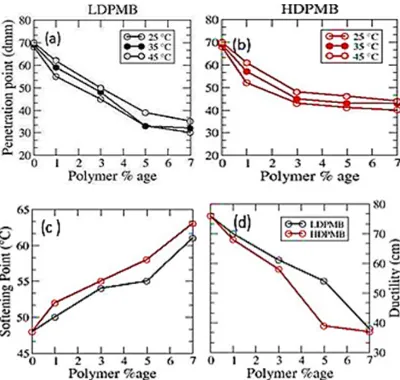
bitumen the modified bitumen samples have low penetration. For example, at 45OC, the penetration
value is decreased by 50% (LDPMB) and 37% (HDPMB) as compared to pure bitumen. Overall, these results show that with the incorporation of polythene the hardness and stiffness of the bitumen increases, which in turn leads to the enhancement in the resistance of modified bitumen towards permanent deformation and rutting at moderate and high temperatures. Due to this improvement in the hardness the road constructed using modified bitumen can resist the penetration in comparison to the traditional road build from neat bitumen and therefore, increase the longevity of the road.
HDPMB (Fig. 2(c) and 2(d). That is HDPE enhances the softening point more than LDPE.
Ductility test
The stretching ability of the bitumen is characterized with the help of ductility test. A good binder must form ductile thin films around the aggregates otherwise it would crack under heavy traffic loads especially in cold weather. Ductility of bitumen decreases after the modification with polythene. Modified bitumen with 5% LDPE decreases the ductility by 29% and then it decrease beyond minimum acceptable value. In case of modified bitumen with HDPE a 3% addition decreases ductility by 24% and then it falls below the minimum required value (see Figure 2(d).
Storage Stability Test
Storage stability test is performed to test the compatibility of bitumen with the polythene and to check the homogeneity of modified bitumen (PMB) under storage. PMB has dual phase morphology depending on the concentration of polythene used. At lower concentration of polythene, PMB behaves as asphaltene rich phase with polythene being dispersed in the bitumen. As the concentration of polythene increases, it becomes polythene rich phase with bitumen dispersed in it. So, there is possibility of phase separation between bitumen and polythene on storage of modified bitumen. For better storage stability the difference in softening point of top and bottom fractions should not exceeds 20C.
The results of storage stability test prove that at high concentrations, bitumen becomes incompatible with polythene. At 7% concentration of LDPE difference in softening point of top and bottom fractions is very high that is 4. 8. Such modified bitumen cannot be stored for longer periods of time because there will be phase separation. Similarly in case of HDPE 5% concentration and 7% concentration is unstable as proved by higher values of 3.1 and 4.9 in storage stability test. This implies that if we use high concentration of polythene in bitumen then the modified bitumen will not be workable and unstable. Hence 3% is considered as the optimum concentration in case of HDPE and 5% is optimum in case of LDPE for modification of VG-30 bitumen (See Fig. 3(a). These results are also compatible with the results obtained from ductility test.
Fig. 2. Variation of Penetration Point of a) LDPMB and b) HDPMB; Variation in softening point for modification with
Softening point
FTIR analysis of sample
Figure 3(b) and 3(c) shows FTIR overlay plot for bitumen and bitumen modified with LDPE and HDPE respectively. IR spectrum of VG-30 bitumen shows peaks at 2922 cm-1 and 2856 cm-1 that
correspond to C-H aliphatic stretching of alkanes, peak at 1608 cm-1 that correspond to C=C aromatic
stretching, peaks at 1454 cm-1, 1371 cm-1 correspond
to C-H bending mode of –CH2 and –CH3 group respectively, peaks at 864 cm-1, 806 cm-1 indicates
C=C of alkene bending, 1030 cm-1 indicates S=O
sulfoxide stretching, 736 cm-1 indicates C-H or C=S
bending. When we study the FTIR spectra of LDPE and HDPE modified bitumens, very slight observable change in peak position was observed that shows modification doesn’t change molecular properties of bitumen but the interaction between PE and bitumen is purely physical in nature.
Surface analysis of modified bitumen
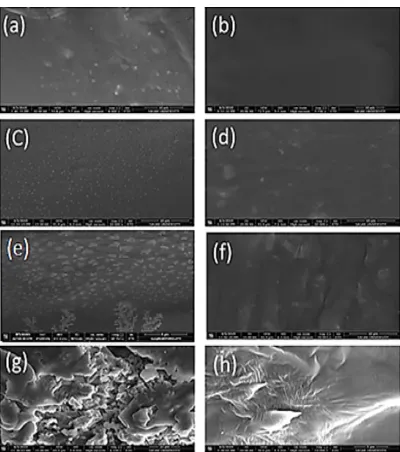
As both LDPE and HDPE are non-polar polymers, their interaction with bitumen is a physical process. In FTIR spectrum of modified bitumen no new peak is observed rather polythene; as polythene had either C-H or C-C band that both were already present in bitumen. So for finding the proof of incorporation of polythene in bitumen, SEM analysis was done. SEM images of different compositions of bitumen are shown in the Fig. 4. Bitumen, it self is black in color, and doped polythene is obtained as Fig. 3. Variation of Storage stability of (a) modified bitumen with polymer percentage; (b) IR overlay plot of different composition of modified bitumen with different percentage of LDPMB and (c) ) IR overlay plot of different composition of modified bitumen with different percentage of HDPMB
white patches. The images clearly suggest that with increase in the percentage composition of bitumen, white area is increasing and coming closure. After 5% composition of LDPE, they are accumulated and ruptured the surface of bitumen that clearly indicates, higher dosage of LDPE are dangerous for road making industry. Similar results were obtained after 3% composition of modified bitumen with HDPE. Lower dosage of HDPE/ LDPE (1%) in modified bitumen are although shown to be uniformly distributed, but their amount are very-very less for making any observable change in the properties of the bitumen.
Fig. 4. SEM images of a) 1% LDPMB b) Neat Bitumen c) 3% LDPMB d) 3% HDPMB e) 5% LDPMB f) 5% HDPMB g) 7%
LDPMB h) 7% HDPMB
CONCLUSION
is more enhancement in properties of bitumen with the addition of HDPE as compare to LDPE. FTIR analysis proved that interaction between bitumen and polythene is a physical process. The optimum concentration for modification of bitumen is 5% in case of LDPE and 3% in case of HDPE respectively. These concentrations also have maximum thermal resistance which is indicated by the results obtained from the penetration tests conducted on modified bitumens at different temperatures.
ACKNOwLEDGEMENT
We are sincerely thankful to Lovely Professional University, Phagwara for providing the necessary infrastructural support and Dr. Harisingh Gour Vishwavidyala, Sagar for providing SEM facility.
Conflict of interest
There is no conflict of interest regarding the publication of this article.
REFRENCES
1. https://nptel.ac.in/courses/116102026/ synthetic%20fibers-m7/polyethylene.htm. 2. Singh, R, K.; Ruj, B. Int. J. Plast. Technol.,
2015, 19, 211-226.
3. Banerjee, T.; Srivastava, R, K.; Hung, Y, T. Handbook of Environmental and Waste Management. World Scientific Publishing Co., Singapore, Ch., 2014, 17, 2.
4. Mutha, N, H.; Patel, M.; Premnath, V.; Resour. Conserv. Recycle., 2006, 47, 222-244. 5. Bharadwaj, A.;Yadav, D.;Varshney, S.
International Conference on Technologies for Sustainability., 2015, 391-398.
6. Mathew, T.V.;Rao, K, V, K. Pavement Materials :BitumenIntroduction to Transportation Engineering. NPTEL., 2006, 23, 23-1. 7. Saboo, N.; Kumar, P. Transportation Research
Procedia., 2016, 17, 98-106.
8. Panda, M.;Mazumdar, M. J. Mater. Civil Eng.,
2002, 14, 527-530.
9. Fuentes, Auden, C.; Sandoval, J, A.; Jerez, A.; Navarro, F, J.; Martinez, Boza, F, J.; Partal, P.; Gallegos, C.; Poly. Test., 2008, 27, 1005-1012.
10. Al, Hadidy, AI.; Yi, Qiu, T. Constr. Build. Mater.,
2009, 23, 1456-1464.
11. Ahmedzade, P.;Fainleib, A.;Gunay, T.; Starostenko, O. Kovalinska. T.; Int. J. Poly.
Sci., 2013, 1-9.
12. Kishchynskyi, S.; Nagaychuk, V.; Bezuglyi, A.
Procedia Engg., 2016, 143, 119-127.
13. Milkowski, W. J. Transp. Engg., 1985, 111, 54-72.
14. Ho, S.; Church, R.; Klassen, K.: Law, B.; Macleod, D.; Zanzotto, L. Can. J. Civ. Eng.,
2006, 33, 968-981.
15. Costa, L, M, B.; Silva, H. M. R. D.; Oliveira, J, R, M.;Fernandes, S, R, M. Int. J. Pavement Res.Technol., 2013, 6, 457-464.
16. Perez-Lepe, A.; Martinez-Boza, F, J.; Gallegos, C. Energy Fuels., 2005, 19, 1148-1152. 17. Hinislioglu, S.; Agar, E. Mater. Lett., 2004, 56,
267-271.
18. Bindu, C, S.;Beena, K, S. Int.J. Engg. Technol.,
2010, 2, 379-387.
19. Attaelmanan, M.;Feng, C, P.; Al- Hadidy, A, I.
Constr. Build. Mater., 2011, 25, 2764-2770. 20. Habib, N, Z.;Kamaruddin, I.;Napiah, M.;Tan,
I, M. Int. J. Civ. Env. Eng., 2011, 3, 96-100. 21. Kofteci, S. Proced. Engg., 2016, 161, 1268-1274. 22. IS:1203 Methods for testing tar and bituminous
materials: Determination of penetration. New Delhi: Bureau of Indian Standards., 1978
23. IS:1205 Methods for testing tar and bituminous materials : Determination of Softening point. New Delhi: Bureau of Indian Standards., 1978. 24. IS:1208 Methods for testing tar and bituminous
materials: Determination of Ductility. New Delhi: Bureau of Indian Standards., 1978. 25. IRC: SP 53-2010 Guidelines on use of