Constructing A Scoring Support Approach
Model For Classical Ballet: Combining
Motion Capture And Statistical Science
Kazuma Yanagisawa, Aoyama Gakuin University, JapanKakuro Amasaka, Aoyama Gakuin University, Japan
ABSTRACT
This study employs motion capture and statistics to develop an objective, rational scoring system for classical ballet and uses the results to construct a scoring support approach model. Specifically, the study focuses on classical ballet, using interviews with judges and other methods to clarify the correlation between practical skills and barre training as well as between technical and artistic scores. This process revealed that practical skills are a combination of movements practiced at a barre and that technical evaluations of barre training have a direct link to overall evaluations of practical skills. Based on these insights, the authors broke barre training down into individual movement elements and movement factors, then clarified the causal relationships among them using positioning data gathered from motion capture equipment and from scoring results by professional judges. The knowledge gained was, in turn, used to actually support the scoring of classical ballet barre training, and the desired results were obtained.
Keywords: Classical Ballet; Motion Capture; Scoring Support Approach Model
INTRODUCTION
he classical ballet scoring that is done by judges is not guided by a clear set of scoring criteria. Instead, each judge relies on his or her personal experience (standards of judgment) to produce a subjective score. The interval between the static and dynamic elements that make up each movement in classical ballet are complicated and instantaneous—and because it is tacitly understood that judges score according to the element of movement that they are focusing on, there can be significant variations in scoring results. It is for this reason that judges could use an objective and rational scoring support tool to help them score ballet performances. In response to this need, the authors employed motion capture and statistics to construct a rational classical ballet scoring support approach model.
Specifically, the authors looked at performance elements like the grand plié and cambré, then broke down the individual elements of movement that make up each of the varied positions based on the basic positions that comprise barre training. Next, the authors used motion capture to calculate positioning information for each movement factor included in body angle, smoothness, and other components of the main positions. Each movement element was then examined to determine its level of impact on overall score. The insights obtained from this process were used to create a statistical model of the causal relationships that determine by what standard scores on individual elements affect the total score - in other words, to define the standards affecting the relative weight of each score.
BACKGROUND
How Classical Ballet is Currently Judged
Classical ballet judging today is ambiguous, guided by no consistent set of evaluation criteria. As a result, it is common to have scores that vary widely among judges - a problematic situation that could be improved (Ota.H).
Every classical ballet competition uses a different scoring system, but the typical standard involves two five-point scales - one for technical performance and one for artistic performance. In this case, scoring tends to focus on the following five areas.
1. Ability to understand and express the variation: Understanding the role of the and expressing it well
2. Appearance: Articulation and openness of the hip joints
3. Musicality: Correct musical expression, rhythm, keeping time with the music
4. Technique: correct performance of each movement, positioning, rotation, jumping, balance, etc.
5. Potential: Likelihood that the dancer will be able to make a name for themselves with continued growth and
practice
However, this does not mean that scores are determined from these five areas; it only means that they are points of focus that guide judges to assign technical and artistic scores based on their own subjective impressions. Even though many competitions take steps to reduce scoring variation with strategies like throwing out high and low scores, this alone does not reduce the actual score variation among judges. The real problem causing the variation is the ambiguity in scoring criteria.
When six professional judges were surveyed on the current state of ballet judging, their feedback indicated that the lack of a detailed scoring standard for classical ballet made it extremely difficult for scoring to be done fairly. One judge scored a competitor higher than the one who took first place in an actual competition, while another scored that same competitor near the bottom of the group.
The judges themselves are aware that there is a problem in the current situation, where variation in scores arises because of a lack of evaluation criteria—meaning that every person has different standards of judgment. The lack of consistency in evaluation criteria also causes problems in coaching and a performer might work to improve a low score received at one competition only to be scored poorly in their strong area at another. In this way, ambiguous evaluation criteria hinder ballet dancers from improving their skills.
Prior Research
Prior research on similar topics was done by Yurie Ino et al (2011) who analyzed street dance moves and applied the results to dance instruction. The difference between expert and novice movements was clarified and made explicit by analyzing data obtained from motion capture equipment with the aim of sharing the insights gained with novice dancers to improve the efficiency of their training. Because the “expert” and “novice” designations were based on the number of years of dancing experience, the difference between good and bad movements remained implicit, and the study did not make clear the relationship of good and bad movements to actual evaluations.
To investigate causal relationship that is in implicit phenomenon, Amasaka (Aoyama Gakuin University) applied “product development technological method - Customer Science” (Amasaka, 2002a, 2008a). In this study, the authors used this approach to clarify causal relationship between dancers’ movements and evaluations of judges. CONSTRUCTING A SCORING SUPPORT APPROACH MODEL FOR CLASSICAL BALLET
By quantitatively capturing subjective human impressions of movement, this study aims to clarify and make explicit the relationship between classical ballet movements and the way those movements are evaluated. It also aims to address the problem of variation in scoring among classical ballet judges by constructing a scoring support model.
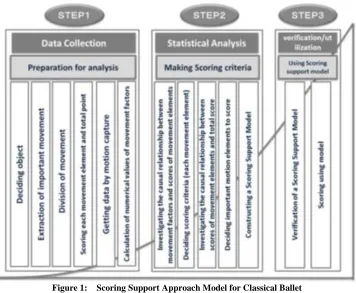
Figure 1: Scoring Support Approach Model for Classical Ballet
Deciding Movement for Analysis and Getting Data by Motion Capture
In this section, the authors define the movements that need to be analyzed in order to evaluate practical classical ballet skills and collect the required data.
To start, the following six insights were obtained through interviews with six professional judges:
1. It is difficult to directly consider artistic evaluations as long as the set standards for technical evaluations
have not been achieved.
2. Practical skills are applied movements and a combination of basic movements.
3. The integrity of applied movements is proportional to the integrity of individual basic movements.
4. Basic movements are acquired through barre training.
5. The plié is a basic movement performed during barre training.
6. The rond de jambe is a movement performed during barre training that clearly demonstrates a dancer’s
proficiency.
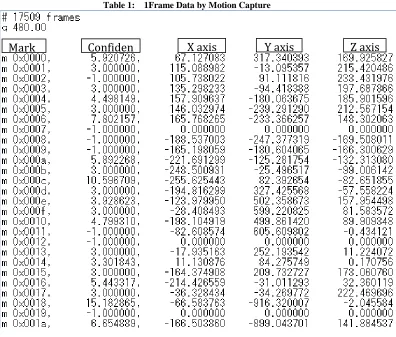
Table 1: 1Frame Data by Motion Capture
Clarifying Scoring Criteria
The plié and rond de jambe movements used for analysis could be broken down into thirteen types of movement elements in five categories (see Table 2). The authors then clarified the causal relationships between (1) angle and smoothness in each part of the body (labeled “movement factors”) during the thirteen individual types of movement elements and (2) scoring results. Interviews were conducted in order to determine the movement factors for each movement element and this information was used to examine which parts of the body should be focused on.
Table 2: Movement Element for Plié and Rond de Jambe
Plie Cambre Pointe Battement Preparation
De m i 1 De m i 2 Gra n d Ca m b re 1 Ca m b le 2 en d eh o rs Ten d eu Ara b esq u e Ba tt em en t 1 Ba tt em en t 2 Ro n d d e jam b e P re p ara ti o n 1 P re p ara ti o n 2
An eye-tracking camera was also used to conduct a line-of-sight analysis which revealed that the movement factors identified through the interviews were the same areas that viewers fixed their gaze on for relatively long periods of time. Using the positioning information obtained from the motion capture system, average cosine values for body angles were calculated and used to find numerical values for each movement factor.
The six professional judges were also shown videos of the thirteen types of movement elements performed by the six test subjects and asked to score them. This data were subjected to a multiple regression analysis to examine the degree of impact each of the movement factors had on movement element scores.
X axis
axis
Confiden
ce
Y axis
axis
Z axis
When the multiple regression analysis was conducted on the grand plié, the movement factors were designated as explanatory variables, while movement element scores were designated as objective variables. The
analysis yielded an R*2 coefficient of determination of 0.973, indicating explanatory power (see Table 3). Looking
at the standardized partial regression, coefficient values allowed the authors to determine the level and direction of impact for each variable. It was discovered that performers who stick out their chests receive higher scores.
Table 3: Result of Multiple Regression Analysis for Grand Plié
Standardized partial regression coefficient values
Constant -
Chest -0.349
Back 0.221
Heel -1.495
Knee -1.254
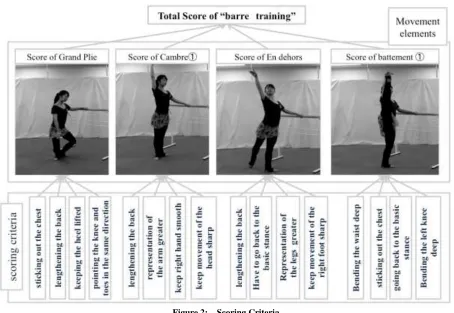
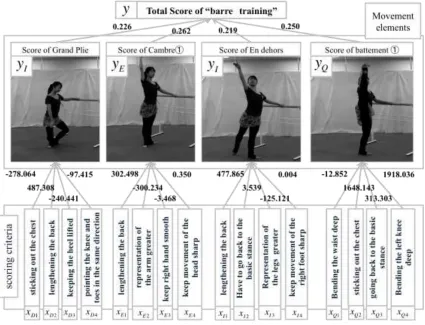
Using these results, it was possible to make “sticking out the chest” a key phrase to help score the grand plié. Other key scoring phrases for the grand plié included “lengthening the back”, “keeping the heel lifted”, and “pointing the knee and toes in the same direction”. Using the same approach, key scoring phrases were created for all thirteen elements of movement.
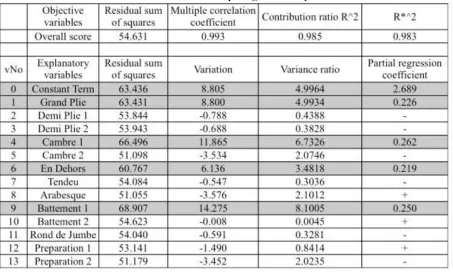
Next, the authors examined the relationship between the overall barre training score (which included the plié and rond de jambe) and the scores on each of the thirteen types of movement elements. Scores from the six professional judges evaluating each element of movement were used as explanatory variables, while overall barre training scores received from the same six judges were used as objective variables in a multiple regression analysis. Once the variables were selected using a stepwise regression method, partial regression coefficients revealed the level and direction of impact for each variable (see Table 4).
Table 4: Result of Multiple Regression Analysis
The analysis yielded an R*2 coefficient of determination of 0.985, indicating sufficient explanatory power.
score for a barre lesson consisting of a grand plié and rond de jambe was found to be strongly impacted by these movement elements.
In addition, the partial regression coefficients for the grand plié (0.226), cambre (1) (0.262), en dehors (0.219), and battement (1) (0.250) were very similar. These analysis results indicate that an objective rational scoring is possible if these four movement elements are weighted equally when coming up with an overall barre training score. These results also make it possible to determine key scoring phrases that can be used to establish concrete scoring criteria (see Figure 2).
Figure 2: Scoring Criteria
VERIFICATION
The scoring support model created by the authors was verified to determine whether it was a practical way to offer clear scoring elements (movement elements) and scoring criteria (movement factors). There were two parts to the verification process. The first was creating a model that assigned the partial regression coefficients found in the multiple regression analysis as coefficients for each explanatory variable, and then calculating scores by substituting in new data. When these results were compared with scores from the six judges (generated using the convention scoring method), the rank correlation coefficient verified the effectiveness of the model. In the second part, interviews were conducted with the judges to examine the effectiveness and necessity of the scoring criteria created from the scoring support model. The judges verified that the model addressed a need in classical ballet judging.
Verification by Scoring Support Model
the multiple regression analysis (see Figure 3). By making these consistent in a model formula, the authors were able to determine an overall score by substituting different values for the grand plié, cambre (1), en dehors, and rond de jambe (see Table 5).
Figure 3: Relation between Total Score and Movement Factors Table 5: Scoring Model Formula
The motion capture system was then used to collect new positioning data from ten ballet dancers performing barre training movements (plié and rond de jambe). Movement factor values were calculated and substituted in the formula in Table 5 to tabulate scores and come up with a ranking.
+
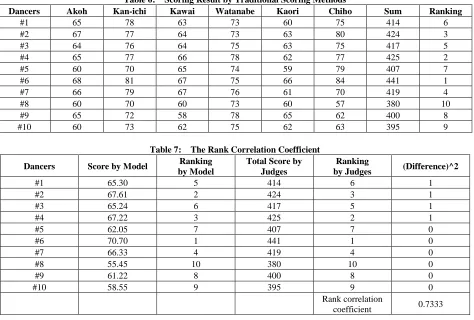
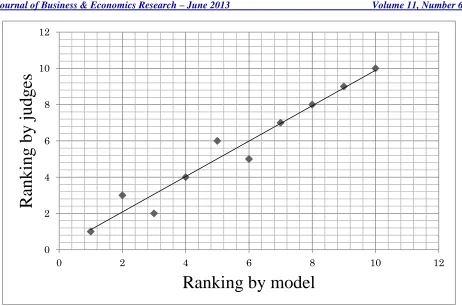
The six judges were then asked to score the barre training movements from the same ten dancers using traditional scoring methods (see Table 6). The totals were used to rank the dancers and the order of the results was compared with that obtained using the model. The rank correlation coefficient was 0.7333, indicating a high degree of consistency with the actual results (see Table 7 and Figure 4).
Table 6: Scoring Result by Traditional Scoring Methods
Dancers Akoh Kan-ichi Kawai Watanabe Kaori Chiho Sum Ranking
#1 65 78 63 73 60 75 414 6
#2 67 77 64 73 63 80 424 3
#3 64 76 64 75 63 75 417 5
#4 65 77 66 78 62 77 425 2
#5 60 70 65 74 59 79 407 7
#6 68 81 67 75 66 84 441 1
#7 66 79 67 76 61 70 419 4
#8 60 70 60 73 60 57 380 10
#9 65 72 58 78 65 62 400 8
#10 60 73 62 75 62 63 395 9
Table 7: The Rank Correlation Coefficient Dancers Score by Model Ranking
by Model
Total Score by Judges
Ranking
by Judges (Difference)^2
#1 65.30 5 414 6 1
#2 67.61 2 424 3 1
#3 65.24 6 417 5 1
#4 67.22 3 425 2 1
#5 62.05 7 407 7 0
#6 70.70 1 441 1 0
#7 66.33 4 419 4 0
#8 55.45 10 380 10 0
#9 61.22 8 400 8 0
#10 58.55 9 395 9 0
Rank correlation
Figure 4: Relation between Ranking by Judges and Ranking by Model
Verification by Interview to Judges
Professional judges were interviewed on the scoring criteria obtained through this model. When the scoring criteria created in this study were suggested, the judges offered positive feedback, such as “taking a scientific approach to scoring could make it more fair”, “I saw that there are some scoring items I’m not taking into consideration”, and “this could help improve competitors’ basic skills”. Another judge remarked that scoring was easier once the scoring criteria had been clarified, indicating that the model meets a need among classical ballet judges.
CONCLUSION
The authors further used data collection, statistical analyses, and a verification/utilization workflow to create a scoring support approach model. Putting this approach model to use allowed the authors to offer scoring criteria for sporting events that may help address the problem of score variation among judges due to ambiguous scoring criteria.
Future studies are needed to build a scoring support approach model that considers artistic scores, a scoring evaluation system for other sporting events, and to further develop and utilize scoring support models.
AUTHOR INFORMATION
Kazuma Yanagisawa is a graduate student of the Graduate School of Science and Engineering at Aoyama Gakuin University, Japan. E-mail: [email protected] (Corresponding author)
Kakuro Amasaka is a Professor in the College of Science and Engineering at Aoyama Gakuin University, Japan. He received his Ph.D. degree in Precision Mechanical and System Engineering, Statistics and Quality Control at
0 2 4 6 8 10 12
0 2 4 6 8 10 12
Ranki
ng
by
judge
s
Hiroshima University in 1997. Since joining Toyota Motor Corporation in 1968, He worked as a quality control consultant for many divisions, and the General Manager of the TQM Promotion Division (1998-2000). His specialty is New JIT, Science TQM, Science SQC, Numerical Simulation (CAE) and Customer Science. Now, He has been serving as the vice chairman of JSPM (2003-2007) and JOMSA (2008-2010), the director of JSQC (2001-2003) and the commissioner of the Deming Prize judging committee (2002-present). Now, he is inaugurated as the chairman of JOMSA (2011-2012). E-mail: [email protected] (Corresponding author)
REFERENCES
1. Amasaka, K. (2002a), New JIT, A New Management Technology Principle at Toyota, International Journal
of Production Economics, Vol.80, pp.135-144.
2. Amasaka, K. (2004), Development of “Science TQM”, A New Principle of Quality Management :
Effectiveness of Strategic Stratified Task Team at Toyota-, International Journal of Production Research,
Vol. 42, No. 17, pp.3691-3706.
3. Amasaka, K. (2005), Constructing a Customer Science Application System “CS-CIANS”: Development of
a global strategic vehicle “Lexus” utilizing New JIT –,WSEAS Transactions on Business and Economics,
Vol.3, No. 2, pp. 135-142.
4. Amasaka, K. (2007), The validity of "TDS-DTM": A strategic methodology of merchandise development
of New JIT - Key to the excellence design “LEXUS”, International Business & Economics Research
Journal, Vol. 6, No. 11, pp. 105-116.
5. Amasaka, K. (2008a), Science TQM, A New Quality Management Principle: The Quality Management
Strategy of Toyota, The Journal of Management and Engineering Integration, Vol. 1, No. 1, pp. 7-22.
6. Amasaka, K. and Nagaya, A. and Shibata, W. (1999), Studies on Design SQC with the application of
Science SQC -Improving of business process method for automotive profile design, Japanese Journal of
Sensory Evaluations, Vol. 3, No. 1, pp. 21-29.
7. Amasaka, K. Customer science: studying customer values, Japan Journal of Behavior Metrics Society,
Vol.32, No.1, pp.196-199.
8. Iino, Y. and Moriya, T. and Takahashi, T. (2011), Motion Analysis of Street Dance Performance and its
Applications for Instructional Coaching, The Institute of Image Information and Television Engineers, Vol.35,
No14, pp. 49-52.
9. Kudo, S. and Komura, T. and Ikeuchi, K. (2010), Modeling Balance Maintenance with Whole-body Motion
Based on Observation of Human Motion, MIRU2005, Vol.2005, pp. IS3-111.
10. Kwon, I. and Nobuta, Y. and Park, N. (2010), Dance Sports in Korea: The Present Condition of Class and
Participation in Korean Universities, Kyushu Kyoritsu University.
11. Ota, H. (2011), History of Dance Culture for Qualification Training by Actual Competition, No Dance, No
life, pp. 20-30.
12. Takebuchi, S. and Amasaka, K. (2012), The Automobile Exterior Color Design Approach Model, Aoyama
Gakuin University. (Unpublished) (in Japanese)
13. Yanagisawa, K. and Sato, D. and Hara, K. (2011), Constructing a Scoring Support Approach Model Using
Motion Capture and Statistics, Aoyama Gakuin University. (Unpublished) (in Japanese)
14. Yazaki, K. and Tanitsu, H. and Hayashi, H. and Amasaka, K. (2012), A Model For Design Auto
Instrumentation To Appeal To Young Male Customers, Journal Of Business Case Studies, Vol.8, No.4,