Local Binary Pattern and Local Linear
Regression for Pose Invariant Face Recognition
Raju Dadasab Patil Shreekumar T
M. Tech Student Associate Professor
Department of Computer Science & Engineering Department of Computer Science & Engineering Mangalore Institute of Engineering & Technology, Badaga
Mijar, Moodbidri, Mangalore
Mangalore Institute of Engineering & Technology, Badaga Mijar, Moodbidri, Mangalore
Karunakara K Professor & Head of Dept.
Department of Information Science & Engineering Sri SidarthaInstitute of Technology, Tumkur
Abstract
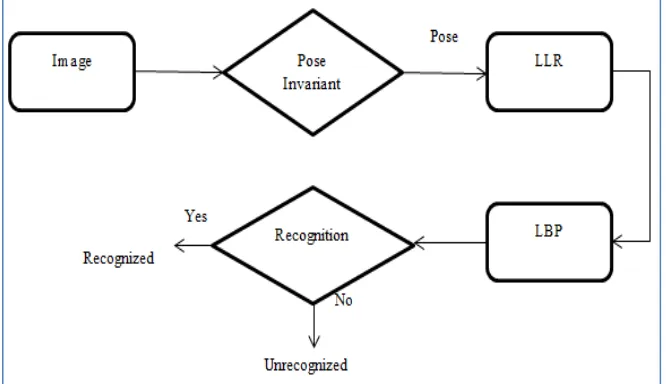
In this paper, we propose a new face recognition method that consists of two parts. One part consists of Local Linear Regression for pose invariant face images. In Recognition part, there are two methods, SIFT (Scale Invariant Feature Transfer) is feature point detection method. Using that feature points recognize and identify the face using Local Binary Pattern (LBP). This is face recognition technique that recognize the face. We also propose an approach using the region of interest (ROI) to remove the useless interest points for saving our computation time and maintaining the recognition rate.
Keywords: Local Linear Regression, Local Binary Pattern, Scale, Invariant Feature Transform
_______________________________________________________________________________________________________
I. INTRODUCTION
Fig. 1: overall working process of face recognition method
II. LOCAL LINEAR REGRESSION
Local Linear Regression (LLR) method which can generate the virtual frontal face from a given non-frontal face image. Locally Linear Regression process uses the current frame and the front surface of each one after the other in a P -frame to be identified. A process for producing LLR Frameless edge. If the illumination source is determined (X, Y, Z), the intensity of each point of the surface. It is independent of viewpoint and it is evaluated as
(1) Where, is a vector that shows each intensity of the surface
Points in scan-line sequence, (x, y, z) is the albedo of the
Specified point and is the angle between the normal n( z,y,x) and the lighting directions s(x, y, z). After that, a 2-D face image I can be obtained from γ. orthogonal linear projection, select a specific angle given visible point.
Apparently, the operator is influenced by both the viewpoint and the 3-D structure of the specific face. Especially, it should be a matrix of dimensionmn, where m and nare the number of pixels in I and number of surface points in
respectively. If theth
j surface point in
is visible from the viewpoint Qand it is anticipated as the ith pixel inI , thenDij 1, otherwiseDij 0.The non-frontal view indexed by and the frontal view indexed by 0 are the two different viewpoints in which we are
interested. The frontal image vector (I0) and the non-frontal image vector (IP) are evaluated as follows,
Predicting I0 fromIP necessitates recovery of
fromIP. But, it is obvious that it is not a well-posed problem and it doesnot have a distinct solution since m is always less thann. The skipped data a blocked version
can be determined as,In eqn. (4), T P PI
D is an mn identity matrix adapted by changing the ith “1” in diagonal with a “0” if the ith surface point is
blocked. Therefore, the only distinction between
and
' is the intensities of the invisible surface points set to “0” for '. Hence, the assessment of
can be computed as follows,From the above analysis, it is obvious that ifA is known virtual frontal face I0 can be easily obtained from a given
non-frontal face imageI. Thus, the problem is converted into a linear mappingA estimation problem. First, each face image of the
specified training set must be partitioned into M blocks (rectangle patches). Same partitioning rules are used for each of the frontal faces.
These patches are either overlapping or adjacent. The non-frontal counterpart of each frontal patch is expected to contain the surface points of the same semantics as that of the frontal patches. As is performed for the training images with poseP , the
given input imageI , of pose is partitioned to obtain
III. LOCAL BINARY PATTERN
Local Binary Pattern was originally designed for texture description. The LBP operator is one of the best performing texture descriptors and it has been widely used in various Applications. Local binary pattern (LBP) is a pixel on the basis of Texture extraction method, which has the highest surface achieved recognition Calculation low interest rates. We propose a new descriptor Combining LBP textures and direction sift information to improve the recognition rate has a limited number of Points of interest. Adding texture information LBP, this can reduce the number sieve described in nature the half. Therefore, we can reduce the computer time maintaining recognition rate. And Effective matching pairs calculate the similarity between the two images. Combine both of these methods can effectively check the various details of the transaction and further reduce the computational cost. We also offer Region Of interest (ROI) method to remove the unnecessary sights of interest, in order to save our time calculation and to keep recognition rate is maintained. The below figure shows that working of LBP method.
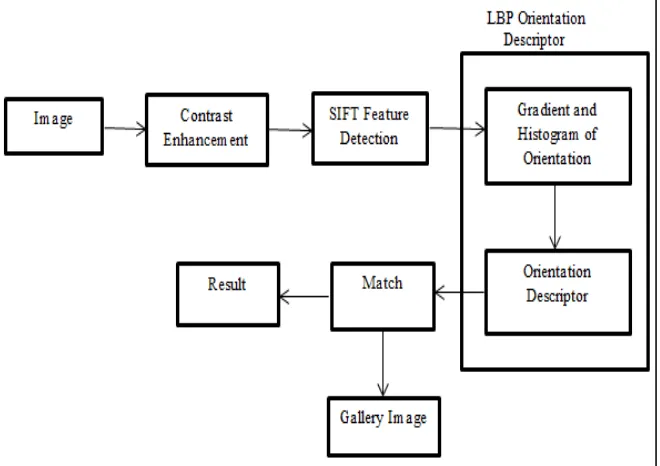
Fig. 2: shows that working of LBP method
Our proposed method is composed of two major parts, the LBP orientation descriptor and the matching method. First, proposed method process the contrast enhancement by histogram equalization on the input image. Then identify the interest points by the SIFT method and defines the information for each interest point by the LBP orientation descriptor. The descriptor is composed of two parts, the histogram of gradient and the LBP orientation. We get magnitude and angle from the gradient and make an 8-bin orientation histogram. Finally, the matching method and matching score is applied to determine the similarity between gallery and probe images.
Scale Invariant Feature Transform:
Scale-invariant feature transform (or SIFT) is an algorithm in computer vision to detect and describe local features in images. SIFT is a description of a method based on the recognition feature points of the alignment pattern. It is a robust under zoom and rotates changes conditions. The changes, but the rising cost of calculating characteristic points.
additional options that agree on associate object and its cause is then subject to additional careful model verification and afterward outliers arc discarded. Finally the probability that a specific set of options indicates the presence of associate object is computed, given the accuracy of fit and range of probable false matches. Object matches that pass all these tests are often identified as correct with high confidence.
LBP Orientation Descriptor
In the wake of getting the perpetual introductions for every interest point utilizing SIFT, we make a descriptor to depict the interest focuses. To start with, the angle extents and introductions of the interest focuses are figured. As opposed to the SIFT utilizing 16*16 pixels to ascertain the introduction histogram, we take more data from 20*20 pixels around the interest focuses. In Fig. 2, one square is made out of 4*4 pixels, and one cell is made of 5*5 pieces. We make an introduction histogram over the 4*4 pixels (one piece). The introduction histogram has 8 canisters covering the 360 degree scopes of introduction. Fig. 2 demonstrates that there are eight canisters for every introduction histogram in a square, with the length of every bolt comparing to the extent of that histogram. We acquire the introduction histogram of the cell. The introduction histogram processed them for eight individual introductions. With respect to every individual introduction in this cell, we utilize a 3*3 squares LBP module to portray them. Customarily, the LBP descriptor is ascertained to create the LBP histogram. To keep away from the LBP histogram error because of little range, we connect the LBP grouping for every individual introduction. There are 8 * 9 = 72 element feature vectors in the descriptor. Algorithm 1 shows that shows that flow of the LBP orientation.
Fig. 3: The orientation histogram diagram. One block is composed of 4*4 pixels; one cell is made of 5*5 blocks.
The mθi,j,cj (X) is the histogram magnitude of the central block in module j with angle θi at the interest point X. The mθi, j,aj,k (X) is the histogram magnitude of the block around the central block at block k of module j with angle θi at the interest point X. The θi is the individual orientation from 0, 45, 90,..., to 360 degree. Fig. 3 shows an example of the LBP orientation descriptor. The red arrow is individual orientation, which is at angle of 45 degree. The red square region is the LBP module, the blue square region is central block at this module. Fig. 4 shows 8 × 9 array of descriptor.
Matching Method:
discard the less discriminative interest points. A point is discriminative if its distance with the target interest point is much less than the others points. Next, we filter other incorrect matching pairs by the coordinate location. If the coordinate distance of a matching point is too far from the target point, it is removed. We obtain the final matching pairs through the above two selection steps. We combine the matching pairs number and the coordinate distances to calculate a score to represent the similarity of two images. The distances of all the final matching pairs are calculated and averaged. To re-duce the error introduced by rotation, we use the median of all final matching pairs distance in the score calculation. It can be expressed as below.
matchnum is the matching pairs number. Our matching algorithm can be expressed as below. The computation cost in the SIFT method increase with the number of feature points. We propose a system to eliminate the useless interest points and reserve the region of interest to reduce the computation time. We observe that most useful interest points are around the eyes and nose regions, especially the interest points on the edges.
IV. CONCLUSION
This paper proposed that invariant pose is normalize using LLR method, and proposing a new descriptor and matching method for improving the SIFT algorithm in face recognition. The new descriptor combining the LBP texture and SIFT orientation information to improve the recognition rate using limited number of interest points. We also propose an approach using the region of interest (ROI) to remove the useless interest points for saving our computation time and maintaining the recognition rate.
REFERENCES
[1] P. N. Belhumeur, J. P. Hespanha, and D. J. Kriegman, “Eigenfaces vs. Fisherfaces: Recognition Using Class Specic Linear Projection, IEEE Trans. Pattern Anal. Mach. Intelligence, vol. 19, no. 7, pp. 711-720, Jul. 1997.
[2] T. Ahonen, A. Hadid and M. Pietik ainen, Face Description with Local Binary Patterns: Application to Face Recognition, IEEE Trans. Pattern Anal. Mach. Intelligence, vol. 28, no. 12, pp. 2037-2041, Dec. 2006.
[3] B. C. Zhang, Y. S. Gao, S. Q. Zhao and J.Z. Liu, Local Derivative Pattern Versus Local Binary Pattern: Face Recognition With High-Order Local Pattern Descriptor, IEEE Transactions on Image Processing, vol. 19, no. 2, pp. 533-544, Feb. 2010.
[5] N. S. Vu, A. Caplier, “Enhanced patterns of oriented edge magnitudes for face recognition and image matching,” IEEE Transactions on Image Processing, vol. 21, no. 3, 1352-1365, March 2012.
[6] D. G. Lowe, “Distinctive image features from scale invariant key points,” Journal of Computer Vision, vol.60, no. 2, pp. 91-110, 2004.
[7] D.G. Lowe, “Object recognition from local scale-invariant features.” In International Conference on Computer Vision, Corfu, Greece, pp. 11501157, 1999. [8] M. Brown, D. G. Lowe, “Invariant features from interest point groups.” In British Machine Vision Conference, Cardiff, Wales, pp. 656665, 2002. [9] Xiujuan Chai, Shiguang Shan, Xilin Chen, Wen Gao, “Local Linear Regression (LLR) for Pose Invariant Face Recognition”, Proceedings of the 7th
International Conference on Automatic Face and Gesture Recognition, 0-7695-2503-2/06, 2006.
[10] Xiujuan Chai, Shiguang Shan, Xilin Chen, “Locally Linear Regression for Pose-Invariant Face Recognition”, IEEE TRANSACTIONS ON IMAGE PROCESSING, VOL. 16, NO. 7, JULY 2007.
[11] Yi-Kang Shen, and Ching-Te Chiu, “Local Binary Pattern Orientation Based Face Recognition”, 978-1-4673-6997-8/15, IEEE, ICASSP 2015.
[12] Shreekumar T, Karunakara K, “Particle Swam Optimization Based Identification of Face Images from Video”, International Journal of Advanced Computational Engineering and Networking, ISSN: 2320-2106, Volume-4, Issue-2, Feb.-2016.
[13] Shreekumar T, Dr. Nagaratna Hegde, “A New Method For Face Recognition From Video Sequence Using DCT and LLR”, Internal journal of System, algorithms & application, Volume 2, Issue ICRAET12, May 2012, ISSN Online: 2277-2677.
[14] Shreekumar T and Nagaratna P. Hegde, “An Approach To Pose And Illumination Invariant Face Recognition In Video”, International Journal of Image Processing and Applications, 2(1), 2011, pp. 93-100.
[15] Mahesh Prasanna K, Nagaratna Hegde, “A Fast Recognition Method for Pose and Illumination Variant Faces on Video Sequences”, IOSR Journal of Computer Engineering (IOSR-JCE) e-ISSN: 2278-0661, p- ISSN: 2278-8727Volume 10, Issue 1 (Mar. - Apr. 2013), PP 08-18 www.iosrjournals.org. [16] Amith G K, Shreekumar T, “A Novel Approach for Blurred and Noisy Face Image Recognition”, International Journal of Science and Research (IJSR)