e-ISSN: 2278-067X, p-ISSN: 2278-800X, www.ijerd.com Volume 7, Issue 3 (May 2013), PP. 71-77
Static and Modal Analysis of Leaf Spring with Eyes Using
FEA Packages
Y.Venu
1, G.Diwakar
2 1PG Student, Department of Mechanical Engineering, PVP Siddhartha Institution of Technology, Kanuru
2
Associate prof, Department of Mechanical Engineering, PVP Siddhartha Institution of Technology, Kanuru, Vijayawada, AP, INDIA
Abstract:- The objective of this present work is to estimate the deflection, stress and mode frequency
induced in the leaf spring of an army jeep. The emphasis in this project is on the application of computer aided analysis using finite element concept.
The component chosen for analysis is a leaf spring which is an automotive component used to absorb vibrations induced during the motion of vehicle. It also acts as a structure to support vertical loading due to the weight of the vehicle and payload. Under operating conditions, the behaviour of the leaf spring complicated due to its clamping effects and interleaf contact, hence its analysis is essential to predict the displacement, mode frequency and stresses.
The leaf spring, which we are analysing, is a custom designed leaf spring with different eyes like viz., Berlin and upturned eyes with different materials at different sections. This spring is intended to bear heavy jerks and vibrations reduced during real operating conditions in military operations.
In analysis part the finite element of leaf spring is modelled using solid tetrahedron10-NODE-187 elements. Appropriate boundary conditions, material properties and loads are applied selected as per intended performance. The resultant deformation, mode frequencies and stresses obtained are analyzed.
I. INTRODUCTION
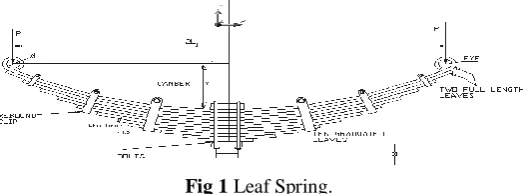
A spring is defined as an elastic body, whose function is to distort when loaded and to recovers its original shape when the load is removed. Semi- elliptic leaf springs are almost universally used for suspension in light and heavy commercial vehicles. For cars also, these are widely used in rear suspension. The spring consists of a number of leaves called blades. The blades are varying in length. The blades are us usually given an initial curvature or cambered so that they will tend to straighten under the load. The leaf spring is based upon the theory of a beam of uniform strength. The lengthiest blade has eyes on its ends. This blade is called main or master leaf, the remaining blades are called graduated leaves. All the blades are bound together by means of steel straps. The spring is mounted on the axle of the vehicle. The entire vehicle rests on the leaf spring. The front end of the spring is connected to the frame with a simple pin joint, while the rear end of the spring is connected with a shackle as show in fig1.1
Fig 1 Leaf Spring.
Shackle is the flexible link which connects between leaf spring rear eye and frame. When the vehicle comes across a projection on the road surface, the wheel moves up, leading to deflection of the spring. This changes the length between the spring eyes. If both the ends are fixed, the spring will not be able to accommodate this change of length. So, to accommodate this change in length shackle is provided as one end, which gives a flexible connection.
also avoids stress concentration, thereby improving the fatigue strength. When the leaf spring deflects, the upper side of each leaf tips slides or rubs against the lower side of the leaf above it. This produces some damping which reduces spring vibrations, but since this available damping may change with time, it is preferred not to avail of the same. Moreover, it produces squeaking sound, Further if moisture is also present, such inter-leaf friction will cause fretting corrosion which decreases the fatigue strength of the spring, and phosphate paint may reduce this problem fairly. Occasionally, thin liners of zinc or any other soft metal are also help to keep the value of the friction coefficient constant. In some springs special inserts are provided at the end of each leaf, excepting however the master leaf. The material for the inserts may be rubber or waxed cloth, or even some soft bearing metal impregnated with oil. This gives efficient spring operation. Sometimes the leaf springs are provided with metallic or fabric covers to exclude dirt. The covers also serve to contain the lubricant used in between the spring leaves. The leaves of the leaf spring require lubricant at periodic intervals. If not, the vehicle is jacked up so that the weight of the axle opens up the leaves. The spring is then cleaned thoroughly and sprayed with graphite penetrating oil. However, it is important to remember that in some vehicles, (e.g. Ambassador) it is specified that the lubricant of spring leaves should not be done. In such cases the instruction must be followed. The lubrication of shackle pins at regular intervals, say 1000km, should also be done with S.A.E 140 oil. However, no lubrication is required when rubber bushes are used, as in case of the Hindustan Ambassador car.
II. MODELLINGOFLEAFSPRING
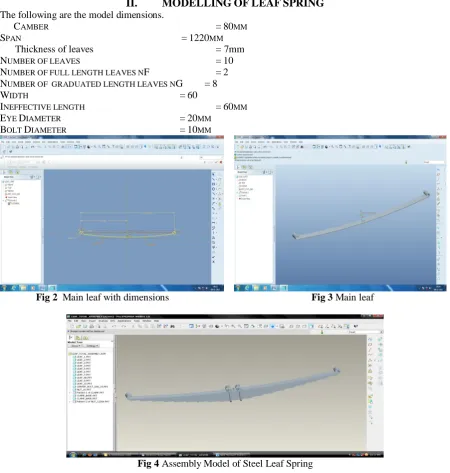
The following are the model dimensions.
CAMBER =80MM
SPAN =1220MM
Thickness of leaves = 7mm
NUMBER OF LEAVES =10
NUMBER OF FULL LENGTH LEAVES NF =2 NUMBER OF GRADUATED LENGTH LEAVES NG =8
WIDTH =60
INEFFECTIVE LENGTH =60MM
EYE DIAMETER =20MM
BOLT DIAMETER =10MM
Fig 2 Main leaf with dimensions Fig 3 Main leaf
III. ANALYSISOFLEAFSPRING
Fig 5 Assembly of leaf spring in Ansys 11 work bench
Fig 6 Model > Mesh > Image
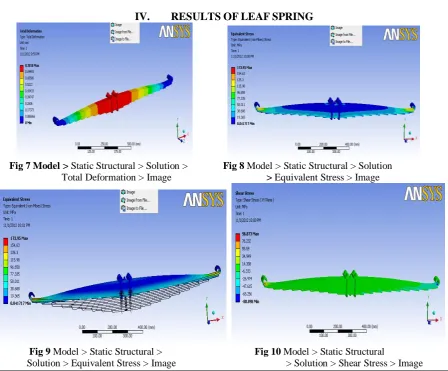
IV. RESULTSOFLEAFSPRING
Fig 7 Model > Static Structural > Solution > Fig 8 Model > Static Structural > Solution
Total Deformation > Image > Equivalent Stress > Image
Fig 9 Model > Static Structural > Fig 10 Model > Static Structural
Fig 11 Structural Steel > Alternating Stress Fig 12 Structural Steel > Strain-Life Parameters
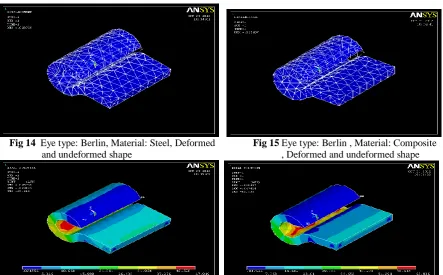
V. BERLINTYPEOFLEAFSPRINGEYESANALYSIS
FIG 13 EYE WITH REAL DIMENSIONS
Fig 14 Eye type: Berlin, Material: Steel, Deformed Fig 15 Eye type: Berlin , Material: Composite
and undeformed shape , Deformed and undeformed shape
Fig 16 Eye type: Berlin, Material: Steel, Stress intensity Fig 17 Eye type: Berlin, Material: Composite,
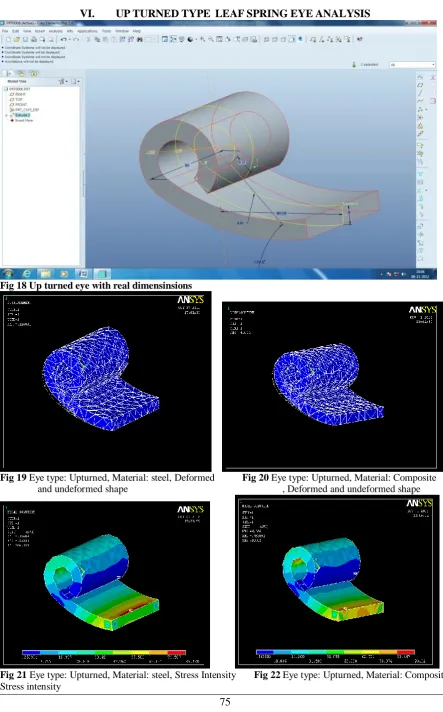
VI. UPTURNEDTYPE LEAFSPRINGEYEANALYSIS
Fig 18 Up turned eye with real dimensinsions
Fig 19 Eye type: Upturned, Material: steel, Deformed Fig 20 Eye type: Upturned, Material: Composite
and undeformed shape , Deformed and undeformed shape
Fig 21 Eye type: Upturned, Material: steel, Stress Intensity Fig 22 Eye type: Upturned, Material: Composite,
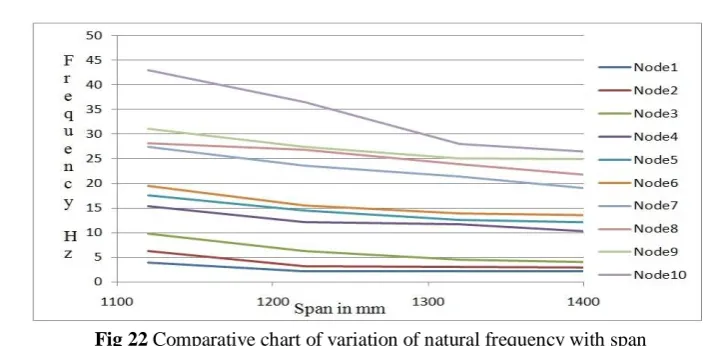
Fig 22 Comparative chart of variation of natural frequency with span
VII. CONCLUSIONSANDFUTURESCOPEOFWORK
The leaf spring has been modeled using solid tetrahedron 10 – node -187 element. By performing dynamic analysis it is concluded that the applied pressure 1.77 M pa is safe for the given specifications and design of the leaf spring.
The results show:
1. The stresses in the eyes of composite leaf spring are much lower than that of the eyes of steel spring. 2. The strength to weight ratio is higher for composite leaf spring eye than conventional steel leaf spring eye with similar design.
The major disadvantages of composite leaf spring are the matrix material has low chipping resistance when it is subjected to poor road environments which may break some fibers in the lower portion of the spring. This may result in a loss of capability to share flexural stiffness. But this depends on the condition of the road. In normal road condition, this type of problem will not be there. Composite leaf springs made of polymer matrix composites have high strength retention on ageing at severe environments.
The steel leaf spring width is kept constant and variation of natural frequency with leaf thickness, span, camber and numbers of leaves are studied. It is observed from the present work that the natural frequency increases with increase of camber and almost constant with number of leaves, but natural frequency decreases with increase of span. The natural frequencies of various parametric combinations are compared with the excitation frequency for different road irregularities. The values of natural frequencies and excitation frequencies are the same for both the springs as the geometric parameters of the spring are almost same except for number of leaves.
This study concludes that it is advisable to operate the vehicle such that its excitation frequency does not match the above determined natural frequencies i.e. the excitation frequency should fall between any two natural frequencies of the leaf spring.
An extended study of this nature by varying the layer configuration higher strengths can be achieved. Replacing the conventional leaf spring by composite leaf spring can be considered from strength, stiffness and vehicle stability point of view in vehicle stability. Instead of mono composite material, multi composite materials with multiple layers can be considered for study. An efficient design and manufacturing process of composite material leaf spring can reduce the cost and weight of the vehicle.
REFERENCES
[1]. Rajendran, I., Vijayarangan, S. “Optimal Design of a Composite Leaf Spring using Genetic
Algorithms” Int. Jr. of Computer and Structures 79 2001: pp. 1121 – 1129.
[2]. Rajendran, I., Vijayarangan, S. “Design and Analysis of a Composite Leaf Spring” Journal of
Institute of Engineers India 82 2002: pp. 180 – 187.
[3]. Daugherty, R. L. “Composite Leaf Springs in Heavy Truck Applications”. K. Kawata, T.Akasaka
(Eds). Composite Materials Proceedings of Japan-US Conference Tokyo,1981: pp. 529 – 538.
[4]. Dharam, C. K. “Composite Materials Design and Processes for Automotive
[5]. Applications”. The ASME Winter Annual Meeting, San Francisco, December 10-15, 1978: pp. 19 – 30.
[6]. Vijayarangan, S., Ganesan, N. “Static Stress Analysis of a Composite Bevel Gear
[7]. using a Three-dimensional Finite Element Method” Computer Structures 51 (6) 1994: pp. 771 – 783.
[8]. Tanabe, K., Seino, T., Kajio, Y. “Characteristics of Carbon/Glass Fiber Reinforced
Plastic Leaf Spring”, SAE 820403 1982: pp. 1628 – 1634.
Spring” Comp. Structure 1998: pp. 279 – 300.
[10]. Jones, R. M. “Mechanics of Composite Materials”. 2e, Mc Graw-Hill Book Company, 1990.
[11]. ANSYS Inc: “ANSYS Users Manual”, Rev. 1995, 5.2-Vol. I – IV, Houston, PA.
[12]. P. Beardmore, “Composite structure for automobiles,” 1986. [13]. R.S. Khurmi, J.K. Kupta. “A text book of Machine Design,” 2000.
[14]. Shiva Shankar, Sambagam Vijayarangan. “Mono Composite Leaf Spring for Light Weight Vehicle – Design,End Joint Analysis and Testing,” Gulur Siddaramanna - 2006