ISSN (e): 2250-3021, ISSN (p): 2278-8719
Vol. 10, Issue 1, January 2020, ||Series -VI|| PP 21-27
Real-Time Life Saving Drones
Anandatirtha J S
Department of Computer Science and Engineering
Sri Venkateswara College of Engineering Sriperumbudur, Kanchipuram, Tamilnadu, India Received 03 January 2020; Accepted 17 January 2020
Abstract
:
This research aims to implement a better solution to the bore-well accidents. The challenges involved in rescue operations are nature of rock, depth and diameter of bore-well, incident site condition and so on. The use of aerial vehicles (unmanned) is ideal for the rescue effort. Using drones the crew can better react and respond to emergencies. Even though they cannot directly rescue or save people, drones are the crucial first step in locating someone and making all the efforts to save them. This drone is supported by Grove oxygen sensor, Motion sensor, Camera, LED lights and Umbrella tool technique. This helps in planning and developing a rescue strategy. The time for the rescue operation is effectively saved.Index Terms: Unmanned Aerial Vehicle, sensors.
I.
INTRODUCTION
Drone innovation and technology have improved immensely. Drones are not just for wars and military purposes but also used in wildlife and atmospheric research. Drones can easily reach places that many humans cannot, and this can be invaluable when timely rescues are critical and can be designed to travel through small spaces. This tremendous development can be used in the field of the rescue operation. It will be one more tool in a crew's arsenal to collect information to better assess dangerous situations and save lives. The drones in rescue operation are efficient, cost-efficient and quicker than any other alternatives. The emergency responders need information and real-time imagery to make a better decision and save time. It can also help keep workers safe, and ultimately speed up efforts in a sector where every second count.
During the day and night, the operational support provided to the rescue team. The drone can provide the crew with a high definition (HD) live- videos and photos that the rescue team can analyse the present situation. Drones with cameras can re-define the way you watch. These feature built-in LEDs for darkness visibility and a versatile outer cage which allows it to rebound off of obstructions. The advantages of using drones in the rescue field are they can be nearer to the scene, can deploy much faster, and manoeuvrable [1].
The need for the drones arises when the victim accidentally falling into Bore-wells, most of them were Uncovered, abandoned and left uncapped. Due to the lack of oxygen and malignant environment took their life off. This requires a large number of human resources and heavy machineries like rig machines, JCB etc..[1], all these challenges can be made easy by introducing drones in this operation field. The recent incident was Tamilnadu’s Sujith Wilson, who was stuck in an 80ft bore well and the combat lasted about 80 hours and results in death.
II.
PROBLEM STATEMENT
Bore-well rescue operation is one of the difficult, complicated and lengthy which requires technology. Due to insufficient technologies, it takes more time to make the necessary decision. The aim is to rescue the victim safely from the rugged surfaces without hurting them. All these will make the chances of victim life being saved.
III.
LITERATURE SURVEY
A bore-well is a narrow shaft bored in the ground either vertically or horizontally. A bore-well may be constructed for many purposes like extraction of water, petroleum. The bore-well ranging from 4.5inches to 12inches.Some of the dug bore-wells are left open. This open pit becomes the death pit for the unaware small aged victim. The NDRF data suggests the deadly combination of uncovered, abandoned bore wells and victim playing around them are the biggest cause of fatal accidents [1]. There are no proper rescuing techniques to save the victim. It also depends on some factors like the type of soil, the diameter of the bore well, standardizing equipments and so on.
3.1 Pipeline Inspections and Borewell Rescue Robot
In 2014, Palwinder Kaur, Ravinder Kaur, Gurpreet Singh has published a paper that describes the rescue operation without human intervention. They proposed their concept to handle bore well rescue operations using robots. The proposed system contains a claw or gripper mechanism to save the victim. The robot can adjust its legs according to pipeline dimensions. The robot supports the switch pad and gear motor. The victim motion is captured using a USB camera and monitored on the PC. So this method is lesser time consumption and risky than the normal operation. [4]
3.2 Bore-Well Rescue Robots
Rajarathnam, Lakshmi Raj Thilak, Rithvik, Vignesh has presented to his knowledge about the technology involved in Bore-well Rescue operation. This proposed model is designed to provide the victim with two levels of safety achieved using robotic holding at the top. The airbag at the bottom ensures that the victim does not slip further deep. This robot helps to monitor the victim behaviour in the bore well using IR Thermographic cameras. The entire robot is lowered using the pulley. It reduces the human resources for the rescue operation. It would make the rescue operation easier [5].
3.3 Robots for Borewell
John Jose Pattery et-al proposed the robot for bore well rescue operations. This system consists of 4 separate mechanism driven by motors. The motor placed at the top turns a gear mechanism which, in turn, pushes 3 blocks arranged at 120 degrees from each other towards the side of the bore well. The 2nd motor placed below the plate turns the bottom shaft by 360 degrees, thereby helping to locate the gap through which the lifting rod passes. This is done with the help of a wireless camera attached to the lifting rod. Once the gap has been located, the 3rd motor adjusts the radial distance of the lifting rod. When the diameter is adjusted, the 4th motor helps the lifting rod to screw its way through the gap towards the bottom of the victim [6].
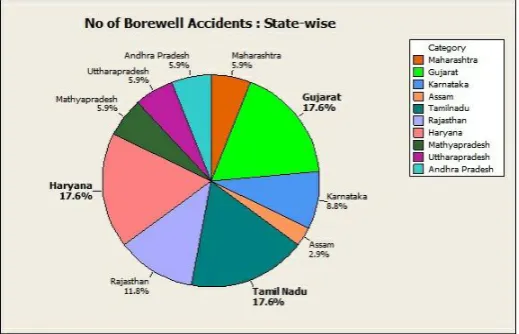
Figure 3.3.1. Number of Borewell accidents state wise
IV.
METHODOLOGY
4.1.The Architecture of Convolution Neural Network
The automatic identification of the rock type will help in determining the rescue technique. So that particular method can be utilised to rescue the victim. Deep learning plays a major role in pattern recognition and machine learning. The convolution Neural Network has been used to improve the accuracy to predict the type of rock in the deep bore-well. Cheng et al. proposed a deep learning model based on CNNs to identify three types of sandstone in image slices with an accuracy of 98.5% [7].
Input: Image dataset R from the camera while moving deep into the deep bore-well Output: Nature of rock
Step 1: Reading the training set R.
Step 2: Apply Conv layer.
A convolution layer extracts the features of the input images by con7volution and outputs the feature maps. It is composed of a series of fixed size filters, known as convolution kernels, which are used to perform convolution operations on image data to produce the feature maps [8]. The number of the parameter in the CONV layer is given below.
((m*n) +1)*k)
Where m is the shape of width, n is the shape of height and k is the number of filters. The 1 represent the bias term for each filter.
Step 3: Apply Rectified Linear Units (ReLU) layers
After each Conv layer, it is necessary to apply the activation function. ReLU is a type of activation function. The purpose of this layer is to introduce non-linearity to a system has been computing linear operations during Conv layers. The ReLU layers work far better without making any significant difference in the accuracy.
f(x) = max(0,x)
Step 4: Apply Max-pooling layer
Max-pooling function gradually reduces the spatial size of the representation to reduce the amount of parameter and computation. Pooling layer operates on each feature map independently.
Step 5: Flattening
Flatten is the function that converts the pooled feature map to a single column that is passed to the fully connected layer.
4.2 Classification of rock types
A Naive Bayes classifier is a probabilistic machine learning model that’s used for classification purpose. The classifier algorithm is based on the Bayes theorem.
Input: Data N obtained from Convolution Neural Network. Output: Type of rock
Step:
● Reading the training dataset N.
● Calculate the grain size, structure and colour between the rocks.
● Calculate the probability of the function using the gauss density equation in each class until the probability of all predictor variables.
● Calculate the likelihood of each class ● Get the greatest likelihood
4.3 Rescue performance
The Real-time Life-saving drone (RLSD) will perform the following step for the rescue operation 1. The RLSD firstly goes down the bore well.
2. The camera mounted on the RLSD gives the insight view of the dimension of the bore well and the position of the target.
V.
CHALLENGES
Challenges are meant to be met and overcome. Just like any form of technology RLSD has Battery performance /life, accuracy in the sensor, cost, types of rock are some of the factors determining the challenges to be looked out.
(1) Battery life
According to the research made by the Impossible Aerospace, most of the battery-powered drones are restricted to a short battery life span due to some factors. Drones ideally work on LiPo (Lithium Polymer) powered batteries. These are much better than the NiCad (Nickel Cadmium) batteries. When we make use of 1.2 kWh of Li-ion cells the drone can be operated up to 2 hours. The drone weight also determines the life of the battery. The great way to extend the flying timings is to decrease the size of the drone. The battery life is inversely proportional to not only determined by the weight of the drone but also the camera recordings.
(2) Improper Mounting of Sensor
Improper installation can also affect sensor accuracy. A sensor must be mounted correctly to operate effectively. An improperly mounted sensor can lead to a shift in the output or sensor failure. The accuracy is how close the average of all measurements to real value. Installation is a critical moment in sensors and it will also rely greatly on sensor accuracy. The sensors must be placed in the right location and at the right angle.
(3) Weight
The weight that a drone can carry is a significant limiting factor. The factors that decide how much weight the drone can carry is based on motor power, the size, number of propellers and weight of the drone. The different types of drones are designed to have specifications and functions can vary greatly from one model to another, which will impact the maximum weight that the drone can lift.
4) Cost
The cost factor is one of the main challenges in determining the performance of the Drone. The major facts such as quality of sensor, motors, type of battery used and camera determine the cost.
VI.
PROPOSED SYSTEM
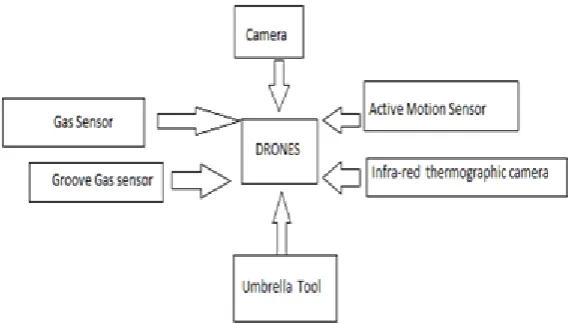
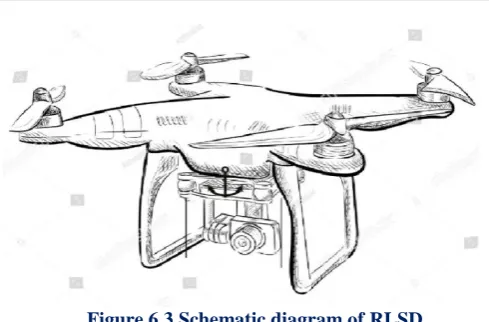
The Drone is an aerial vehicle that is integrated with a few other instruments to make the rescue operation more efficient. The RLSD is a single instrument that is integrated with other components such as Active Motion Detector, Infrared thermographic camera, Microphone, clamps and Grove Gas sensor. This RLSD is interlinked with a technique called Umbrella tool technique which makes the system more efficient and effective.
(a) Active Motion detector
A motion detector (or motion sensor) is an electronic device that is designed to detect and measure movement. The motion sensor can be customized to perform highly specific functions. Active motion sensor transmits radio frequency towards the person/object and analyses received frequency to determine the motion. Such a device is often integrated as a component of a system that automatically performs a task.
In our system, the Active motion sensor is used to monitor the movement behaviour of the victim continuously. Using this drone can alert the rescue team about the movement.
Figure 6.1 Working of Motion Sensor
(b) Infrared thermographic cameras
Incident Radiant Power = (Emitted Radiant Power + Transmitted Radiant Power +
Reflected Radiant Power)
(c) Electret Condenser Microphone:
The microphone is a device that captures audio by converting sound waves into an electrical signal. This signal can be amplified as an analogue signal. The Electret condenser microphones are used because of their high-quality recordings and lavalier use to built-in microphones in small sound recording devices.
In our system, the microphone is used to communicate /make comfort the victim who is being fallen into deep bore-well.
(d) Umbrella tool technique
It is the best technique to rescue the victim from the bore-well. This technique forms a circle-shaped structure below the victim. Using this technique, the victim can be lifted easily using the clamps without any dissenting. The main advantage of the Umbrella tool technique is that the victim cannot move further into bore-well. This operates like a lift. So that victim can be easily rescued.
(e) Gas sensor
The gas sensor is one in which where we have to detect the variation in concentration of toxic gases to avoid any unexpected threats.
In our system, the Gas sensor is used to measure the presence of any toxic gas in the deep bore-well so that immediate action can be taken to rescue the victim.
(f) Grove Gas sensor
Grove-Gas Sensor (O2) is a kind of sensor to test the oxygen concentration in air, which is based on the principle of the electrochemical cell. It's very suitable for detecting oxygen concentration in environment protection. The advantage of Grove Gas sensor is that high precision, high sensitivity, wide linearity range and also extraordinary reliability.
In our system, the Grove-Gas sensor is used to measure the range of oxygen level in bore-well. So that when the oxygen level is not sufficient the oxygen supply can be increased.
(g) Clamps
It is used to hold the victim safely so that the victim cannot move further into bore-well.
Figure 6.3 Schematic diagram of RLSD
VII.
PERFORMANCE
Life of the victim can be saved easier with RLSD because it provides real-time visual information and other necessary amenities to make the complicated process easier and make them efficient. This reduces the anxiety situation. Its main application is to focus on the decision-making process. It reduces time and easy to assemble. It can be operated easily.
VIII.
ADVANTAGES
1. The RLSD provides real-time information to the crew to make a better decision 2. The RLSD can easily fly in, move around and access hard-to-reach zone. 3. High-resolution mapping of the deep inner bore well.
4. Umbrella tool technique will not allow the victim to move further. 5. It requires less human resources.
IX.
FUTURE WORKS
The battery is one most required amenity for flying time as well as it is the limitation. When we use 1.2 kWh the flying time can be extended to 2hrs not more than that. However, this can be improved by using wireless charging technology. The way to create a power-cloud that can be utilized to charge the drone while it’s in flying. Near the accident spot, a ground-based power station is positioned. When turned on this creates the electromagnetic field. The special antenna charges the RLSD wirelessly.
While using Remote controlled RLSD the signal can be interpreted during the deep bore-well rescue. However, this can be solved by using Convolution Neural Networks (CNN) the deep learning algorithm for achieving autonomous navigation [2]. The end-to-end trained deep CNN is used to map input images from the camera to a steering angle and also the Reinforcement Learning (RL) to train a deep neural network on drone obstacle avoidance [3].
The data from the sensors can be uploaded into the cloud. So that the data can be processed and we apply the Convolution Neural Network (CNN) the Deep Learning algorithm to predict the time needed to rescue the victim and techniques that can be sought for the rescue operation.
X.
CONCLUSION
In the last 10 years, the number of bore-well accidents is comparatively high. The RLSD ensures the basic facilities for the victim such as monitoring oxygen level, the existence of any toxic gases and so on. The proposed system is to overcome all difficulties. This design mechanism is made to suit every possible condition to save the innocent victim. This method not only saves time but also rescue the victim safely who struck between rugged rocks.
REFERENCES
[1]. “Standard operation procedure on bore well incidents.”[2]. M. Borski, D. Del Testa, D. Dworakowski, B. Firner, B. Flepp, P. Goyal, L. D. Jackel, M. Monfort, U.
Muller, J. Zhang, et al. End to end learning for self-driving cars. arXiv preprint arXiv:1604.07316, 2016. [3]. Y. Zhu, R. Mottaghi, E. Kolve, J. J. Lim, A. Gupta, L. Fei-Fei, and A. Farhadi. Target-driven visual
[4]. Palwinder Kaur, Ravinder Kaur, Gurpreet Singh,”Pipelines Inspection and Borewell Rescue Robots” IJRET eISSN:2319-1163 | pISSN:2321-7308
[5]. Rajarathnam D.R.P, Lakshmi Raj Thilak R, Rithvik K, Vignesh G, Mohamed Marsook Hameed SH,” Borewell rescue robots”, 2018 IJMRET paper ISSN:2456-5628.
[6]. John Jose pottery “robots for bore well” amal jothi college of engineering vol 10, Jun 2009
[7]. Cheng, G.; Guo, W.; Fan, P. Study on Rock Image Classification Based on Convolution Neural Network. J. Xi’an Shiyou Univ. (Nat. Sci.) 2017, 4, 116–122
[8]. Ferreira, A.; Giraldi, G. Convolutional Neural Network approaches to granite tiles classification. Expert Syst. Appl. 2017, 84, 1–11