S.T.B.S. College of Diploma Engineering, Surat S.T.B.S. College of Diploma Engineering, Surat
C. R. Dobariya G. K. Sabhadiya
Diploma student Diploma student
Department of Mechanical Engineering Department of Mechanical Engineering S.T.B.S. College of Diploma Engineering, Surat S.T.B.S. College of Diploma Engineering, Surat
J. R. Gohil Diploma student
Department of Mechanical Engineering S.T.B.S. College of Diploma Engineering, Surat
Abstract
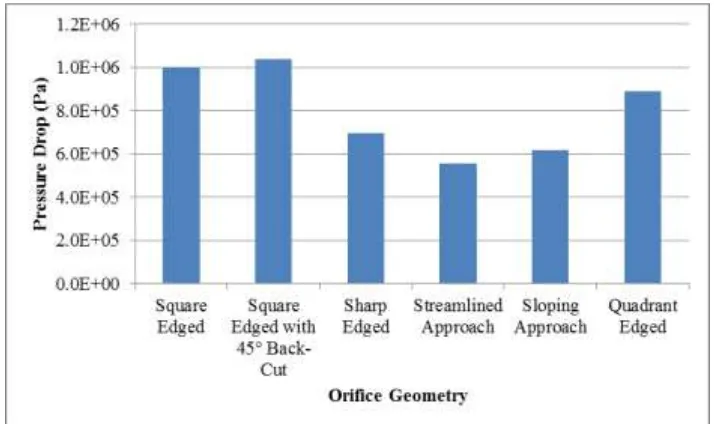
Accurate measurement of fluid flow is an essential task for many industries. If we see today’s scenario, there are number of flow measuring devices available in market. Still orifice meter has broad application areas for flow measurement of fluids like chemical, oil, gas, etc. due to simple construction, low cost and easy operation. In this paper, fluid flow through orifice plate having different geometries was analyzed by using Computational Fluid Dynamics (CFD) technique. Using ANSYS CFX 15.0 software, various geometries of orifice were studied in terms of pressure drop. The simulation results revealed that under the same condition of diameter ratio and thickness, square-edged with 45° back-cut orifice plate has the highest pressure loss and stream line approach orifice plate has minimum pressure loss. This result can be used to select the most suitable geometry of orifice plate in practical applications.
Keywords: CFD, CFX, Geometry, Orifice plate, Pressure drop
________________________________________________________________________________________________________
I. INTRODUCTION
An orifice meter is a well-known flow measurement device. It works on Bernoulli's principle which states that there is a relationship between pressure and velocity of the fluid. With reduction of cross section area of flow passage, pressure difference is created in fluid. By measuring that difference, flow rate of fluid can be calculated. Behind the orifice plate, a significant amount of pressure drop occurs which creates turbulence in pipe or duct and hence the flow recovery gets delayed. It is necessary to recover the flow as fast as possible to lower the energy cost related to pressure drop necessary for flow metering [1]. Aly et al. [2] investigated the pressure drop after fractal shaped orifices and measured the pressure recovery. It was found that the pressure drop across the fractal-shaped orifices is lower than that from regular circular orifices of the same flow areas. The relationship between cross-sectional area of the flow and the orifice hole are extremely complex due to clearances, chamfers, and other factors as a result of machining limitations. So, Wu et al. [3] simulated the fluid flow for different opening shapes of orifice and presented a closed form equation of the flow. Kumar and Bing [4] investigated the effect of different geometrical perforations on the performance of the slotted orifice and simulation results showed that the shape of the perforation has no effect on the differential pressure, but, a marginally better pressure recovery was observed with rectangular perforations having aspect ratio of l/w = 3.0. The effect of holes distribution in an orifice plate on the performance of flow characteristics was studied by Barki et al. [5] using FLUENT software and found that multi holes orifice plate have better flow characteristics compare to single hole orifice plate having same area of exit. Ding and Wang [6] compared three different geometry of orifice plate and showed that for same contraction ratio and thickness, sharp-edged orifice plate has the highest energy dissipation capacity. Besides other parameters, geometry of orifice plate also has significant effects on pressure drop. So it is essential to study geometrical effects of orifice plate on pressure drop. The intention of the present work is to inspect and compare pressure drop in different types of orifice plate.
II. ORIFICE GEOMETRY
Fig. 1: Geometries of Orifice Plates [8]: (a) Square-Edged (b) Square-Edged with 45° Back-cut (c) Sharp-Edged (d) Streamlined-Approach (e) Sloping-Approach (f) Quadrant-Edged
III. CFD METHODOLOGY
In this study, ANSYS CFX 15.0 software is used for analyzing the fluid flow in orifice meter. The flow is assumed to be steady and incompressible as well as it follows Newton’s law of viscosity. Water was used as a working medium.
Flow domain
The Flow domains for various geometry of orifice plate chosen for the analysis are shown in Fig. 2. It consists of a pipe of 28mm diameter in which an orifice plate is fitted at a distance of 300mm from the inlet. The parameters chosen for the analysis are as follows, L = 603.92mm, D = 28mm, d = 14mm, t = 3.92mm.
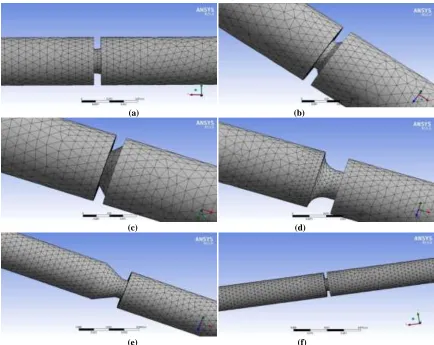
The meshing of the flow domain for various geometries of orifice plate is shown in Fig. 3. Using automatic volume mesh generation tool, these domains were meshed with tetrahedral elements. The total number of elements used were 35470, 35983, 36109, 38121, 35854 and 35285 in square-edged, square-edged with 45° back-cut, sharp-edged, streamlined-approach, sloping-approach and quadrant-edged orifice plate respectively.
(a) (b)
(e) (f)
Fig. 2: 3D model of flow domain: (a) Square-Edged (b) Square-Edged with 45° Back-cut (c) Sharp-Edged (d) Streamlined-Approach (e) Sloping-Approach (f) Quadrant-Edged
(a) (b)
(c) (d)
(e) (f)
Fig. 3: Meshing of flow domain: (a) Square-Edged (b) Square-Edged with 45° Back-cut (c) Sharp-Edged (d) Streamlined-Approach (e) Sloping-Approach (f) Quadrant-Edged
Boundary Conditions
The various boundary conditions specified for the flow domain are as follows: At the inlet of pipe, the constant velocity of 8 m/s was specified.
On the pipe wall as well as orifice surface, “No Slip Wall” boundary condition was used. At the outlet of pipe, the gauge pressure was specified as zero.
Results and Discussion
(a) (b)
(c) (d)
(e) (f)
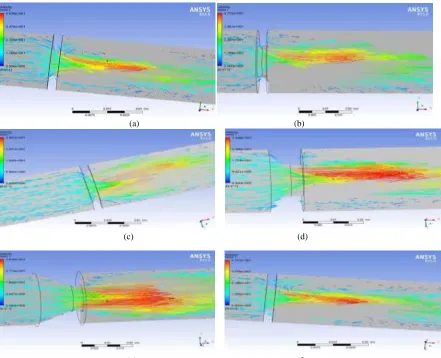
Fig. 4: Velocity vector plot (a) Square-Edged (b) Square-Edged with 45° Back-cut (c) Sharp-Edged (d) Streamlined-Approach (e) Sloping-Approach (f) Quadrant-Edged
(a) (b)
(e) (f)
Fig. 5: Pressure drop graph (a) Square-Edged (b) Square-Edged with 45° Back-cut (c) Sharp-Edged (d) Streamlined-Approach (e) Sloping-Approach (f) Quadrant-Edged
Fig. 6: Comparison of Orifice geometries for pressure drop
IV. CONCLUSION
The effect of orifice plate geometry on pressure drop was investigated by CFD analysis in ANSYS CFX 15.0 software. By keeping same diameter ratio and thickness, six different geometries of orifice plate such as square-edged, square-edged with 45° back-cut, sharp-edged, streamlined-approach, sloping-approach and quadrant-edged were analyzed using water as a working medium. Analysis result showed that minimum pressure loss occurs in streamlined approach orifice and maximum pressure loss occurs in square-edged with 45° back-cut orifice. This work can be used in selection of proper orifice plate geometry for relevant industrial applications.
REFERENCES
[1] N. Franck, S. L. Navin, B. Wernher, N. Andrzej. Experimental Investigation of Flows Generated by Fractal Orifices. 14th European Turbulence Conference, 1–4 September 2013, Lyon, France.
[2] A. A. Aly, A. Chong , F. Nicolleau , S. Beck. (2010) Experimental study of the pressure drop after fractal-shaped orifices in turbulent pipe flows. Experimental Thermal and Fluid Science. 34, pp. 104–111.
[3] D. Wu, R. Burton, G. Schoenau, D. Bitner. (2003). Modelling of Orifice Flow Rate at Very Small Openings. International Journal of Fluid Power. 4(1), pp. 31-39.
[4] P. Kumar, M. W. Bing. (2011). A CFD study of low pressure wet gas metering using slotted orifice meters. Flow Measurement and Instrumentation. 22, pp. 33–42.
[5] M. Barki, T. Ganesha, M. C. Math. (2014). CFD Analysis and Comparison of Fluid Flow Through A Single Hole And Multi Hole Orifice Plate. International Journal of Research in Advent Technology. 2(8), pp. 6-15.
[6] T.Ding, Y. Wang. (2015). Comparison Research on Hydraulic Characteristics of Three Type’s Orifice Plate. The Open Fuels & Energy Science Journal. 8, pp. 43-46.
[7] L. K. Bohra. “Flow and Pressure Drop of Highly Viscous Fluids in Small Aperture Orifices”, MS Thesis,Mechanical Engineering, Georgia Institute of Technology, Atlanta, 2004.
![Fig. 1: Geometries of Orifice Plates [8]: (a) Square-Edged (b) Square-Edged with 45° Back-cut (c) Sharp-Edged (d) Streamlined-Approach (e) Sloping-Approach (f) Quadrant-Edged](https://thumb-us.123doks.com/thumbv2/123dok_us/7824743.1665758/2.612.136.477.52.296/geometries-orifice-plates-streamlined-approach-sloping-approach-quadrant.webp)