Comparative Analysis GA Based Hybrid
Algorithms for Standard Cell Placement in VLSI
Design
Dr. Aaquil Bunglowala Dr. Nidhi Asthana
Associate Dean & Professor Assistant Professor
Department of Electronics and Telecommunication Engineering Department of Engineering Mathematics MPSTME, Shirpur, Maharashtra SAIT, Indore, M.P.
Abstract
Local search algorithm (LSA), genetic algorithm (GA) and Hopfield neural network (HNN) were independently used for solving the standard cell placement (SCP) problem. This paper deals with the concept of hybridization and reports application of hybridizing on GA and HNNA, GA and LSA. In first section we compare the operation of the hybrid of GA and HNNA. In the second section we present a new hybrid of GA and LSA named Memetic Algorithm (MA). In the last section of the paper we compare the results of hybrid system of GA and HNN with MA in respect of wire length and cpu time in association with the standard cell placement problem.
Keywords: Genetic Algorithm, Hopfield Neural Network, Local Search Algorithm, Memetic Algorithm, NP Hard, Standard Cell Problem
________________________________________________________________________________________________________
I. INTRODUCTION
Placement is the most crucial problem during physical design stage. It is accountable for minimizing the area of the chip and interconnection wire-length. Therefore, placement is the key step in minimizing the fabrication cost per chip and optimizing its performance. The standard cell problem is stated as: Given an electrical circuit consisting of fixed rectangular shaped cells and a net-list stating interconnections among terminals on the periphery of the cells and on the periphery of the circuit itself, it is required to construct a layout indicating the position of each cell such that all the nets can be routed and the total area is minimized. The idea for high performance systems is to reduce the delay of the system by decreasing the length of the critical paths [9]. The quality of placement is based on layout area, completion of routing and circuit operations. SCP is computationally NP-hard. These problems cannot be solved in polynomial time.
II. HYBRID TECHNIQUES OF SCP
Hybrid of GA and HNN for SCP
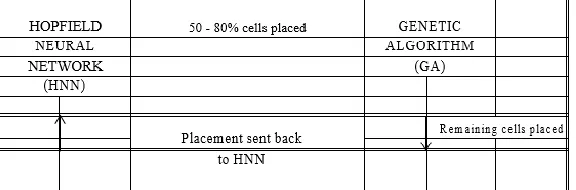
A hybrid system of a HNN and GA is introduced. The performance of the HNN was shown inferior to SA and GA. The computing time taken by the HNN had also been prohibitively high. The reason has been the use of bilinear energy function that minimizes the pair-wise wire-length and not the required total bonding rectangle wire-length. In this paper, we suggest methods to overcome these constraints. Here, we make use of the observation that the HNN takes very long to converge and in that 90% of the time is spent for the placement of about 20% of the last cells, in our strategy to reduce convergence time in hybrid. It is apparent that placement by HNN is almost rigorous. The cells which are once placed are least disturbed while placing the remaining cells. Then why not to run the HNN to place say, 75% of the cells and explore other method to place the remaining cells. This instigates us to propose a method using hybridizing. Thus, we use HNN for the placement of 50% to 80% of the cells. Remaining cells are proposed to be placed by GA. GA is designed to put the unplaced cells at the empty positions on the layout while minimizing the wire length. The placements so obtained are sent back to HNN for validation. The flow of algorithm is expressed in fig. 1
Hybrid of GA and LSA for SCP
For SCP, simple local search techniques are embedded with GA to improve the performance. As Genetic algorithms are not appropriate for fine tuning, we use a local advancement operator into re-compound step of GA. Then GA applies local optimization method on the offspring. In general, GAs are competent of exploring and exploiting promising regions of the search space. They take relatively long time to locate the exact local optimum within the region of convergence. Memetic algorithms (MAs) are extension of GA with the introduction of individual learning as an additional process of local refinement to accelerate local search. Recent studies of MA have demonstrated that they converge to high-quality solutions more efficiently than the conventional counterparts [1,3,7,8,10,11] on many real world applications. Moreover, many dedicated MAs have been evolved to solve domain specific problems more efficiently.MA applies separate local search process to improve the fitness of individuals by hill climbing. To operate exploration, MA collaborate global and local search algorithms by using GA while the local search operations are applied for. A kind of local search algorithm is injecting constructive initial solutions within a population. Moreover, the idea of clustering can be considered another form of repetitive improvement embedded within the MA, used to smooth the landscape. Many of the local search procedures embedded within the MAs are not standard, they intend to perform a shorter truncated local search.
Set population size, generation size Set mutation rate and cross-over rate
Set generation=0
Generate initial population Npop randomly REPEAT
Select individuals for mating Apply cross over
Apply mutation Apply Hill-Climbing to Npop UNTIL (generation≤ generation size
Fig. 2: Generic Memetic Algorithm
III. COMPARISON AND RESULTS
Test results of hybrid of HNN and GA for SCP
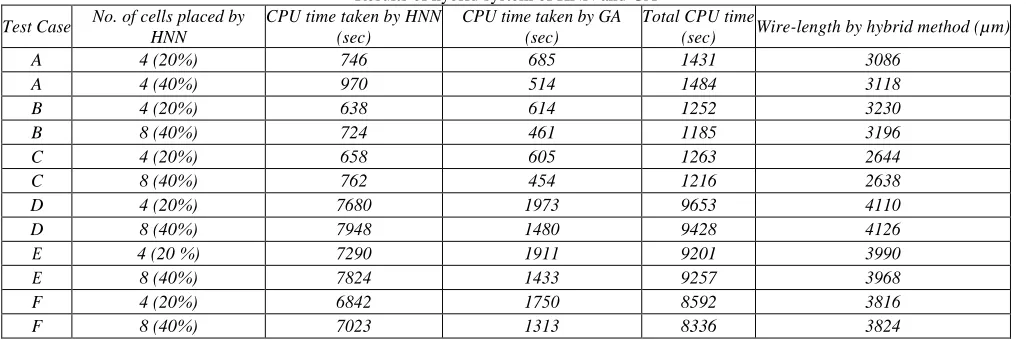
Two placement problems consisting of 20 and 40 cells [test cases A to F] are taken for illustration. In table 1, the results of the six placement problems is solved by hybrid approach treating 20%, 40%, 60% and 80% of cells placed by HNN and remaining by GA. It is observed that:
1) To place 20 cells, the Hybrid system (A, B,C) needs approximately 20-25 minutes. To place 40 cells, the hybrid system takes about two hours (D, E, F), a fivefold improvement.
2) Wire Length: It is within 1% variation in hybrid techniques Table - 1
Results of hybrid system of HNN and GA
Test Case No. of cells placed by HNN
CPU time taken by HNN (sec)
CPU time taken by GA (sec)
Total CPU time
(sec) Wire-length by hybrid method (µm)
A 4 (20%) 746 685 1431 3086
A 4 (40%) 970 514 1484 3118
B 4 (20%) 638 614 1252 3230
B 8 (40%) 724 461 1185 3196
C 4 (20%) 658 605 1263 2644
C 8 (40%) 762 454 1216 2638
D 4 (20%) 7680 1973 9653 4110
D 8 (40%) 7948 1480 9428 4126
E 4 (20 %) 7290 1911 9201 3990
E 8 (40%) 7824 1433 9257 3968
F 4 (20%) 6842 1750 8592 3816
F 8 (40%) 7023 1313 8336 3824
It is apparent that hybrid of HNN and GA offers a significant improvement in the performance of algorithm reducing the CPU time many fold. Note that when compared to average CPU time with pure GA, the time taken by the hybrid increases with the size of problem. So, for placement of more number of cells, this approach is not recommended.
Test results of hybrid of GA and LSA (MA) for SCP
It is observed that application of LSA in generating initial good population and subsequently applying it after GA, It is noteworthy that application of local search before and after GA produces improved results. For smaller test cases it is clear from table 2, we get that before and after GA, application of LSA give better results of wire lengths than that of pure GA and for complex test cases the performance of LSA is comparable to that of pure GA. The results improve with population size. The results presented in the table 2 show that the wire lengths are reduced as much as 12-15% in case of MA-IX.
Table - 2
Results of Memetic Algorithms [wire length in µm]
Test Case Result Quality
Wire length in µm MA
I MA II MA III MA IV MA
V MA VI MA VII MA VIII MA IX
A
Best 3505 3498 3318 3458 3456 2950 3401 3416 3269 Worst 3757 3596 3364 3523 3520 2987 3645 3558 3448 Average 3582 3555 3360 3496 3475 2927 3506 3520 3385
B
Best 2712 2644 2511 2632 2640 2281 2586 2543 2440 Worst 2844 2735 2598 2738 2746 2353 2664 2584 2480 Average 2769 2680 2545 2673 2687 2320 2625 2564 2461
C
Best 2588 2580 2455 2554 2565 2199 2515 2525 2418 Worst 2694 2688 2554 2646 2624 2245 2656 2598 2418 Average 2641 2626 2504 2594 2592 2215 2596 2562 2418
D
Best 3368 3357 3188 3327 3309 2849 3253 3224 3047 Worst 3537 3480 3306 3456 3430 2990 3395 3291 3081 Average 3477 3433 3257 3405 3381 2935 3343 3270 3079
E
Best 2810 2818 2636 2895 2884 2678 2333 2352 2248 Worst 2958 2925 2766 3013 2990 2792 2496 2415 2248 Average 2897 2868 2713 2957 2951 2756 2437 2387 2248
F
Best 2736 2782 2555 2808 2772 2603 2313 2333 2192 Worst 2876 2832 2690 2924 2911 2715 2432 2348 2192 Average 2828 2798 2629 2867 2851 2621 2398 2337 2192
Table 3 indicates that the time taken for the MA for completion is almost 20-30% less than that of GA with population size of 64. On comparing these results with that of GA for population size of 132 MA is almost twice as fast as GA. Also as seen from table 2 the wire lengths in case of MA are better making it a better alternative to GA in all respects.
Table - 3
Results of Memetic Algorithms [CPU time in seconds]
Test Case Result Quality CPU time in seconds
MA I MA II MA III MA IV MA V MA VI MA VII MA VIII MA IX
A
Best 99 111 209 133 182 249 285 313 352
Worst 134 154 215 192 276 257 384 431 365
Average 109 123 212 149 208 254 313 359 360
B
Best 107 122 205 148 208 243 310 353 346
Worst 119 136 210 167 238 249 342 385 353
Average 112 127 207 155 219 246 323 365 350
C
Best 102 115 202 140 196 239 300 340 343
Worst 134 155 208 194 281 244 387 428 350
Average 118 135 205 166 238 242 341 383 345
D
Best 263 288 642 333 436 774 747 885 1085
Worst 272 299 672 345 454 814 786 933 1146
Average 266 292 660 338 443 792 769 907 1118
E
Best 255 278 627 321 418 765 720 864 1067
Worst 291 322 665 378 505 799 828 970 1122
Average 277 305 644 356 471 784 780 926 1092
F
Best 234 254 610 289 370 755 665 815 1050
Worst 250 273 619 315 409 783 706 875 1080
IV. CONCLUSION
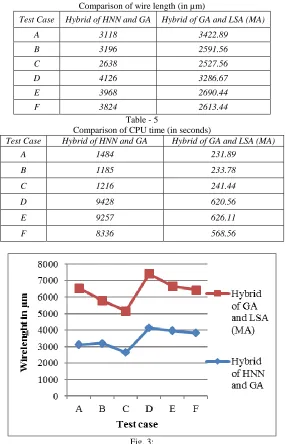
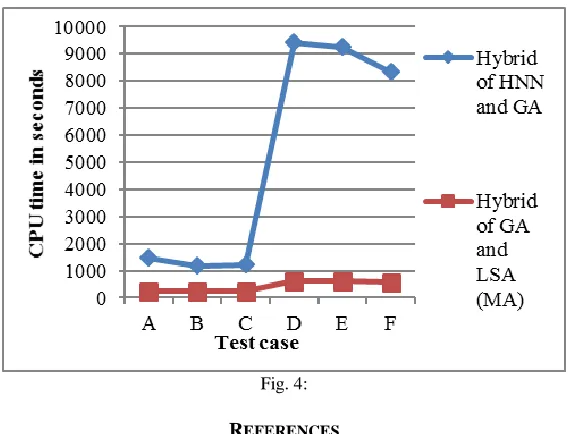
This paper investigated in detail the hybrid systems based on GA, HNN and LSA. MA presents results better than the other hybrid techniques of HNN & GA in specific as shown in table 4 and table 5 (refer fig. 3 and fig. 4), and moreover proves to be even better than any of the iterative, local search or coupled network approach in general. It is true that the parameters set play a major role in defining the performance and results of any hybrid algorithm. Hybrid of HNN and GA has been attempted first and it quite significantly contributed in speeding up the performance of HNN but it is still very slow. The hybrid method employing GA and LSA implemented and tested in this work is MA The performance of MA surprisingly varied with different combinations of the values of mutation and cross-over rates, sometimes giving very poor results and at other occasions give results far better than any previously established technique. The results, with right parameter sets of this algorithm proved to be the best as compared to any stand alone or hybrid technique.
Table - 4
Comparison of wire length (in µm)
Test Case Hybrid of HNN and GA Hybrid of GA and LSA (MA)
A 3118 3422.89
B 3196 2591.56
C 2638 2527.56
D 4126 3286.67
E 3968 2690.44
F 3824 2613.44
Table - 5
Comparison of CPU time (in seconds)
Test Case Hybrid of HNN and GA Hybrid of GA and LSA (MA)
A 1484 231.89
B 1185 233.78
C 1216 241.44
D 9428 620.56
E 9257 626.11
F 8336 568.56
Fig. 4:
REFERENCES
[1] Areibi, S., Bao, X., Grewal, G., Banerji, D., Du, P., “A Comparison of Heuristics for FPGA Placement”, ACTA International Journal of Computers and Applications
[2] A. Torn and A. Zilinskas, “Global Optimization” LNCS vol. 350, New York: Springer-Verlag, 1989.
[3] A. Vicini and D. Quagliarella, “Airfoil and wing design using hybrid optimization strategies” Amer. Inst. Aeronautics Astronautics J., vol. 37, no. 5, pp. 634– 641, 1999.
[4] Bunglowala, A., Singhi, B. M., “Memetic Algorithms as a Solution to combinatorial Optimization Problem”, Proceedings of 2nd PIMR International Conference, 2008.
[5] 111111111111
[6] Bunglowala, A., Singhi, B.M., “Performance Evaluation And Comparison and Improvement of Standard Cell Placement in VLSI Design”, International Conference on Emerging Trends in Engineering and Technology, July 2008
[7] Bunglowala, A., Singhi, B.M., “A Solution to combinatorial Optimization Problem using Memetic Algorithms”, International Journal of Computer System Applications [IJCSA], December 2008.
[8] C. Houck, J. Joines, and M. Kay, “Utilizing lamarckian evolution and the baldwin effect in hybrid genetic algorithms” Meta-Heuristic Research and Application Group, Depart. Ind. Eng., North Carolina State Univ., Raleigh, CA, NCSU-IE Tech. Report 96–01, 1996.
[9] P. Moscato, “On evolution, search, optimization, genetic algorithms and martial arts: Towards memetic algorithms” Caltech Concurrent Computation Program, Publication Report 790, 1989.
[10] Sherwani, N. A.: “Algorithms for VLSI Physical Design Automation” Boston (1993).
[11] Y. S. Ong, P. B. Nair, and A. J. Keane, “Evolutionary optimization of computationally expensive problems via surrogate modeling” Amer. Inst. Astronautics J., vol. 41, no. 4, pp. 687–696, 2003.
![table 2 show that the wire lengths are reduced as much as 12-15% in case of MA-IX. Table - 2 Results of Memetic Algorithms [wire length in µm]](https://thumb-us.123doks.com/thumbv2/123dok_us/7826449.1666115/3.612.106.508.442.719/table-lengths-reduced-table-results-memetic-algorithms-length.webp)