DUELING CANONS
ANITA S.KRISHNAKUMAR†
ABSTRACT
This Article offers the first targeted study of the Supreme Court’s use of canons and other tools of statutory interpretation in a “dueling” manner—that is, in both the majority and dissenting opinions in the same case, to support opposing outcomes. Taking its inspiration from Karl Llewellyn’s celebrated list of canons and countercanons, this Article examines how often and in what ways the members of the Roberts Court counter each other’s references to particular interpretive tools when disagreeing about the proper reading of a statute. Many of the Article’s findings are unexpected and undermine the assumptions made by some of the most prominent theories of statutory interpretation. Most notably, the data reveal that several of textualism’s most-favored interpretive tools are at least as susceptible to dueling use as the purposivist tools that textualists have long denigrated as indeterminate and readily subject to judicial manipulation. For example, the study shows that the Justices dueled extensively over the meaning of statutory text. By contrast, they dueled at far lower rates over legislative history, purpose, and intent. Moreover, the Justices dueled over dictionary references, the whole act rule, and language canons at rates that were virtually identical to the rates at which they dueled over the purposivist-preferred tools. The study also reveals that the canons do not seem capable of constraining the Justices to vote against ideology and that noncanon tools of analysis, including precedent and
practical-consequences-Copyright © 2016 Anita S. Krishnakumar.
based reasoning, lead to higher rates of dueling than do most traditional canons or tools of statutory interpretation. After reporting the data, the Article examines doctrinal patterns in how the Justices duel over individual canons and explores the theoretical implications of the Justices’ dueling canon use.
TABLE OF CONTENTS
Introduction ... 911
I. Background ... 916
A. Llewellyn’s “Thrusts” and “Parries” ... 916
B. Prior Empirical Work ... 918
II. Findings ... 921
A. Methodology ... 921
B. Dueling Statistics ... 927
1. Frequency of Dueling ... 927
2. Statutory Subject Matter ... 938
3. Dueling Canons and Ideology ... 947
III. Doctrinal Findings ... 960
A. Inside Story: Patterns of Dueling Canon Use ... 960
1. Text / Plain Meaning Rule ... 961
2. Whole Act Rule ... 967
3. Statutory Purpose ... 971
4. Practical Consequences ... 975
B. Other Observations ... 977
1. Dictionary Definitions ... 978
2. Legislative History ... 979
IV. Theoretical Implications ... 981
A. Textualism ... 982
B. Purposivism ... 989
C. Pragmatism ... 992
D. Methodological Stare Decisis ... 996
Conclusion ... 999
INTRODUCTION
Judge A is an appellate-court judge tasked with interpreting a criminal sentencing-enhancement statute. She believes that there is a strong argument based on the expressio unius canon1 that the enhancement provision does not apply to the defendant in the case. Judge B, who is sitting on the panel with Judge A, believes that the purpose of the sentencing statute covers conduct like the defendant’s and that the enhancement therefore should apply.
Will Judge B write an opinion that relies on statutory purpose alone, or will he search for an opposing language canon to counter Judge A’s expressio unius argument? Will Judge A’s opinion confine itself to discussing the expressio unius canon, or will it also seek to demonstrate that her interpretation is consistent with the statute’s purpose—perhaps framing that purpose in different terms than Judge B’s opinion? How easy will it be for Judge A and Judge B to find countervailing purpose or language canon arguments, if they seek to counteract each other in this manner?
If we extrapolate from the above hypothetical, two larger questions emerge: To what extent do judges tailor the interpretive tools they discuss in statutory opinions to counter the tools referenced by opposing opinions in those same cases? Or, put somewhat differently, to what extent do various canons or tools of statutory interpretation lend themselves to “dueling” use, such that they can be employed to support competing statutory constructions? These are two important, yet rarely asked, questions in statutory interpretation. Both questions implicate some of the key theoretical debates in the field—such as whether certain interpretive tools constrain judges more than others—and both are deeply tied to underlying views about the proper role of judges.
In 1950, Columbia Law Professor Karl Llewellyn offered a memorable answer to the second question, in what has been called “one of the most celebrated law review articles of all time.”2 The article famously challenged the view that the canons of statutory
1. The expressio unius canon is based on a Latin maxim, “expressio unius est exclusio alterius,” which dictates that the express inclusion of one item implies the exclusion of other items not listed. See, e.g., WILLIAM N. ESKRIDGE, JR., PHILIP FRICKEY & ELIZABETH
GARRETT,CASES AND MATERIALS ON LEGISLATION:STATUTES AND THE CREATION OF
PUBLIC POLICY 852–54 (4th ed. 2007).
construction provide neutral, predictable legal rules that lead courts to one “correct” reading of a statute.3 Its most feted feature is a list of twenty-eight pairs of canons and countercanons, which Llewellyn labeled “thrusts” and “parries.” The article’s demonstration that the canons readily can be used to cancel each other out has been taken to demonstrate the canons’ illegitimacy and has served as a catalyst for discussions about the ability of interpretive tools to constrain judges.4
But to show that the canons (or other tools of construction) are capable of being used by judges in a discretionary, canceling-out manner is not to say that they will be used in such a manner. Theoretical possibility is not the same as actual judicial practice.
This Article takes Llewellyn’s famous juxtaposition of canons and countercanons as its inspiration and examines the extent to which the modern Supreme Court actually duels over the most common statutory interpretation canons and tools in opposing opinions in the same case. That is, the Article identifies the extent to which a majority (or occasionally, concurring) opinion’s reference to a particular canon or tool is countered by a dissenting opinion’s offsetting reference to the same canon or tool, in the same case. Notably, the Article measures a different kind of judicial dueling over interpretive canons and tools than that suggested by Llewellyn’s “thrusts” and “parries”: the Article counts as dueling those instances in which a majority and dissenting opinion in a case invoke the same interpretive tool to reach different readings of the statute. It does not measure instances in which a majority opinion invokes one tool (e.g., purpose) and the dissenting opinion counters by relying on another tool (e.g., text or a language canon). The reasons for this methodological choice are elaborated in Part II.A.
3. Karl N. Llewellyn, Remarks on the Theory of Appellate Decision and the Rules or Canons About How Statutes Are to Be Construed, 3 VAND.L.REV. 395, 401–06 (1950).
4. See, e.g., William N. Eskridge, Jr., Norms, Empiricism, And Canons In Statutory Interpretation, 66 U.CHI.L.REV.671, 679–80 (1999); Daniel A. Farber, The Inevitability of Practical Reason: Statutes, Formalism, and the Rule of Law, 45 VAND.L.REV. 533, 547–48 (1992); John F. Manning, Continuity and Legislative Design, 79 NOTRE DAME L.REV. 1863, 1863–64 (2004); John F. Manning, Legal Realism and the Canons’ Revival, 5 GREEN BAG 2d 283, 283 (2001) (“Llewellyn largely persuaded two generations of academics that the canons of construction were not to be taken seriously.”); Richard A. Posner, Statutory Interpretation—In the Classroom and in the Courtroom, 50 U.CHI.L.REV. 800, 805–14 (1983); David L. Shapiro,
Continuity and Change in Statutory Interpretation, 67 N.Y.U.L.REV. 921, 923 (1992) (noting that the canons have been “interred” by Llewellyn’s essay); Cass R. Sunstein, Interpreting Statutes in the Regulatory State, 103 HARV.L.REV. 405, 452 (1989). But see Geoffrey P. Miller,
Despite the Llewellyn article’s tremendous influence on statutory interpretation scholars, only two empirical studies to date have considered, even in passing, the extent to which majority and dissenting opinions rely on the same interpretive canons to counter each other’s constructions of the same statute.5
One of the studies was limited to employment law and only briefly discussed dueling references to language and substantive canons.6
The other focused exclusively on the Supreme Court’s use of legislative history and paid only passing attention to judicial dueling over this tool.7
No study has examined whether, or to what extent, the Court uses the canons in a dueling manner when construing statutes dealing with subjects other than employment law. And, importantly, no study to date has compared the extent to which the Court uses other traditional statutory interpretation tools such as purpose, dictionaries, the common law, and the like in a dueling fashion, period. This Article offers the first empirical evidence of this kind, going beyond the linguistic and referential canons contained in Llewellyn’s list,8
and also exploring the extent to which majority and dissenting opinions duel over the full array of other statutory interpretation tools.9
Thus far, statutory interpretation theory has operated with a blind spot regarding the extent to which particular interpretive tools and canons are used to support competing statutory constructions in the same case. Scholars and jurists have made assumptions about how manipulable they think certain interpretive tools are, but no one has tested those assumptions systematically or examined how judges use
5. See James J. Brudney & Corey Ditslear, Canons of Construction and the Elusive Quest for Neutral Reasoning, 58 VAND.L.REV.1, 4 (2005) [hereinafter Brudney & Ditslear, Canons of Construction]; David S. Law & David Zaring, Law Versus Ideology: The Supreme Court and the Use of Legislative History, 51 WM.&MARY L.REV. 1653, 1654 (2010). Both of these studies measured judicial dueling by counting instances in which a majority opinion’s reference to a particular interpretive resource (e.g., a language canon or legislative history) was countered by a dissenting opinion’s reference to the same interpretive resource. That is, both of these studies defined “dueling” the same way that this Article does—rather than counting how often the majority opinion in a case invoked one interpretive tool (a “thrust”) while the dissenting opinion countered with a different canon or tool (the “parry”), as suggested by Llewellyn’s famous list.
6. Brudney & Ditslear, Canons of Construction, supra note 5, at 65 tbl.XII, 68 & n.222, 96–102.
7. Law & Zaring, supra note 5, at 1736–38, 1739 tbl.9.
8. See, e.g., Eskridge & Frickey, supra note 2, at 595 & nn.2–3 (characterizing “Thrust But Parry” numbers 2–6, 8–10, and 13–14 as referential canons and numbers 11–12 and 15–28 as linguistic canons).
interpretive tools to counter each other in practice. This Article begins to address that lacuna.
The Article’s findings are surprising, and intriguing, for statutory interpretation theory. Five points stand out: (1) the overall rate of dueling canon or interpretive tool use in the Roberts Court’s first five terms was low—at or below 25.0 percent for most tools;10
(2) the rates of dueling for text/plain meaning and precedent were much higher than for other tools, at 42.7 percent and 63.3 percent, respectively;11 (3) the rate of judicial dueling over most textualist-preferred interpretive tools was roughly the same (about 25.0 percent) as the rate of judicial dueling over purposivist-preferred interpretive tools;12 (4) statutes dealing with certain subject areas—criminal law, environmental law, and antidiscrimination law—showed particularly high rates of dueling;13
and (5) none of the canons or tools seemed capable of constraining the Justices’ tendency to vote consistently with their ideological preferences, at least in divided-vote cases.14
These empirical findings have important implications for some of the key debates in statutory interpretation. They are particularly relevant to theoretical approaches that emphasize predictability or seek to constrain judicial discretion. For example, the findings call into question some of textualism’s (and in particular Justice Scalia’s) claims about the unique manipulability of interpretive tools like purpose, intent, and legislative history as compared to text, language canons, dictionary references, and “other statutes.”15 The findings also cast some doubt on purposivism’s claims that reliance on legislative history, relative to other interpretive resources, helps courts act as faithful agents of the legislature.16
The findings even have implications
10. Seeinfra Table 1; discussion infra Part II.B.1. 11. Id.
12. Id.
13. Seeinfra Table 3a; discussion infra Part II.B.2. Of the eighty-eight cases in the dataset that contained judicial dueling over one or more statutory interpretation-specific tools, 26.1 percent involved a criminal statute, 13.6 percent involved an antidiscrimination statute, and 6.8 percent involved an environmental statute.
14. Seeinfra Part II.B.3; Tables 6a–6g, 8. In the subset of cases decided unanimously, by contrast, some of the interpretive tools consistently correlated with votes against individual Justices’ ideology. See infra notes 127–36; Table 7.
for pragmatism—a theoretical approach that does not claim to promote predictability or constrain judges—because the data confirm that practical consequences play a significant role in the judicial interpretation of statutes, and because they show that judges duel along predictable lines with respect to this interpretive tool. Specifically, the data reveal that most of the Court’s dueling over practical consequences involves one opinion that emphasizes administrability-type practical concerns and an opposing opinion that emphasizes policy-constancy concerns.17
The Article also engages in doctrinal analysis of how precisely majority and dissenting opinions invoke the same interpretive resource to reach different readings of a statute. This analysis reveals some noteworthy patterns in the Court’s dueling over particular canons. For example, in applying the plain meaning rule, the Justices often divide over the prototypical, core meaning versus the legalist meaning of key statutory text.18
Similarly, when dueling over a statute’s purpose, the Justices who favor one reading of the statute sometimes focus on a generalized purpose, while those who favor an opposing reading focus on a narrower, more specific purpose. These patterns provide valuable insights and add texture to our understanding of how the Court applies the tools of statutory construction. The patterns also suggest that it may be possible to eliminate some of the dueling that occurs over certain interpretive tools—through clearer meta-rules about how those tools should be applied.19
17. See infra Part III.A.4. This administrability versus policy-constancy divide is one that I describe in earlier empirical work regarding the Roberts Court. See Anita S. Krishnakumar,
Statutory Interpretation in the Roberts Court’s First Era: An Empirical and Doctrinal Analysis, 62 HASTINGS L.J.221,244–45 (2010). Briefly, administrability concerns focus on an interpretation’s effect on judicial resources, the difficulty of implementing the interpretation, or the clarity and predictability of the rule the interpretation creates. Policy-constancy concerns focus on whether an interpretation ensures consistent application of the statute over time, any arbitrariness created by the interpretation, or the justness of the interpretation.
The Article proceeds in three parts. Part I examines the theoretical and empirical background for this study. Part II reports the study’s findings on the Roberts Court’s dueling use of interpretive canons and other tools from the middle of the 2005 term, when Justice Alito joined the Court, to the end of the Court’s 2010 term. It also provides doctrinal analysis of the Court’s dueling over several individual interpretive tools. Part III explores the theoretical implications of the data and doctrinal observations.
I. BACKGROUND
A. Llewellyn’s “Thrusts” and “Parries”
Ironically, Llewellyn’s “fiendishly deconstructive”20 attack on the canons—the famous list of “Thrust But Parries”—was not the focus of his article. Indeed, Llewellyn included the list only at the end of the article, as an illustrative exercise.21
His focus, instead, was on the broader legal-realist claim that judges do not decide cases based on neutral legal rules, and that neutral legal rules capable of producing a single correct answer do not in fact exist. Llewellyn had made this point earlier in the common-law context, arguing that case law precedents are highly malleable and subject to multiple, conflicting applications.22
His article was designed to show that the same is true in the statutory interpretation context, despite the existence of numerous seemingly definitive “canons of construction.”23
One reason why Llewellyn’s list of “thrusts” and “parries” has endured, and proved so influential among academics, is because the list seems to demonstrate concretely that the canons are easily manipulated and, therefore, incapable of constraining judges. Llewellyn did not actually argue that courts would use his canon– countercanon pairs to reach opposing statutory constructions in the same case, but the strong implication was that judges looking to
suggesting that federal courts might benefit from adopting some form of methodological stare decisis as well).
20. Robert Weisberg, The Calabresian Judicial Artist: Statutes and the New Legal Process, 35 STAN.L.REV. 213, 213 (1983).
21. See Llewellyn, supra note 3, at 401.
counter a statutory reading based on one canon could readily find an opposing canon to support their preferred outcome. Indeed, Llewellyn called it a “foolish pretense” for courts to justify their statutory constructions based on “a set of mutually contradictory . . . rules on How to Construe a Statute.”24
If Llewellyn was correct that judges can readily find countercanons for every canon and that judges use the canons as after-the-fact justifications for their decisions, then we might expect, in practice, to see judicial opinions pitting canon against canon to neutralize the tools that supposedly support an opposing reading—at least in cases where judges disagree about the best reading of the statute. For example, we might expect to see dictionary definitions in a majority opinion countered by opposing dictionary definitions in the dissenting opinion, references to statutory purpose in a majority opinion (e.g., “the Civil Rights Act was enacted in order to remedy the nation’s long history of discrimination against racial minorities”) countered by an opposing statutory purpose in the dissenting opinion (e.g., “the Civil Rights Act’s primary goal was to create a color-blind society”), and a majority opinion’s reliance on the whole act rule met by reliance on a contradictory subset of the whole act rule in the dissenting opinion.25 Although this Article does not measure the Court’s use of Llewellyn’s precise form of canon-for-countercanon pairings, it takes his canons-can-point-in-different-directions heuristic as inspiration for examining how often majority and dissenting opinions in the same case use the same canon to support different statutory constructions.
In a less-celebrated passage of his article, Llewellyn also embraced a purposivist approach to statutory interpretation. He argued that “if a statute is to make sense, it must be read in the light of some assumed purpose.”26 Llewellyn did not claim that judicial reliance on statutory purpose would be more determinate than reliance on the canons, but his simultaneous rejection of the canons and endorsement of statutory purpose raises the comparison. This is particularly so given that the New Textualism popularized by Justice Scalia takes precisely the opposite view—hailing the canons as
24. Id.
25. See id. at 404 (describing “Thrust But Parry” number 17, which says “The same language used repeatedly in the same connection is presumed to bear the same meaning throughout the statute” versus “This presumption will be disregarded where it is necessary to assign different meanings to make the statute consistent”).
neutral rules that enhance predictability, while arguing that statutory purpose is malleable and easily shaped to justify an individual judge’s policy preferences.27
Indeed, both Llewellyn’s list and New Textualism’s claims about the relative merits of different interpretive tools invite empirical analysis of the extent to which statutory purpose—as well as other noncanon tools, like legislative history— are susceptible to Llewellyn’s “thrust and parry” criticism.
Part II of this Article answers these questions with data from the Roberts Court’s first five terms. Before turning to the data, however, the next Section reviews the two empirical studies that have addressed judicial dueling over the canons of construction and legislative history, respectively.
B. Prior Empirical Work
As noted above, only two studies to date have attempted to measure the extent to which judges use the canons of construction against each other to support opposing readings of the same statute in the same case. The first study, conducted by James Brudney and Corey Ditslear, reviewed the Supreme Court’s use of interpretive canons in every workplace-law case decided between 1969 and 2003.28 The study focused on the extent to which the canons of construction operate as neutral legal rules, constraining the Justices’ ability to interpret statutes according to their ideological preferences. Brudney and Ditslear treated “dueling canons” in passing, as a way to test claims that the canons enhance consistency and predictability and perform an important “gap-filling” function.29 They made two findings that seem to support Llewellyn’s skeptical view of the canons: (1) dissenting Justices were significantly more likely to rely on language and substantive canons when language canons were part
27. See, e.g., ANTONIN SCALIA,AMATTER OF INTERPRETATION:FEDERAL COURTS AND THE LAW 25–27 (1997); sources cited infra note 186.
28. See Brudney & Ditslear, Canons of Construction, supra note 5, at 15–69. The Brudney– Ditslear study coded for judicial reliance on two categories of interpretive tools: language canons, which the study defined to include grammar rules, Latin maxims, the whole act rule, and the in pari materia rule, and substantive canons, defined as judicial presumptions based on constitutional and common-law norms about how statutes should be interpreted. Id. at 12–13. 29. See CASS SUNSTEIN, AFTER THE RIGHTS REVOLUTION: RECONCEIVING THE
REGULATORY STATE 147, 151–53 (1990); William N. Eskridge, Jr. & Philip P. Frickey,
of the majority’s reasoning than when they were not; and (2) the canons failed to constrain the Justices’ ideological preferences, as conservative Justices tended to use the canons to reach conservative results, while liberal Justices tended to use the canons to reach liberal outcomes.30
Based on these findings, the authors concluded that, “in divided decisions, the Justices themselves are more prone to view the canons as reasonably amenable to supporting either side.”31
In a subsequent article expanding on their original study, Brudney and Ditslear found some evidence that judicial reliance on legislative history does have a constraining effect on judicial ideology. Specifically, they reported that liberal Justices were more likely to vote in favor of employer interests when they invoked legislative history,32 and that, during the Burger Court, conservative Justices were more likely to vote in favor of worker interests when they relied on legislative history.33 However, Brudney and Ditslear found that after 1986, conservative Justices ruled increasingly in favor of employers (consistent with their ideological preferences), relying on canons and even legislative history to do so.34
Brudney and Ditslear also reported what they called a “Scalia Effect,” finding that liberal Justices opted not to rely on legislative history in a series of proemployer majority opinions that Justice Scalia joined, and that when liberal Justices did rely on legislative history, Justice Scalia was significantly less likely to join their majority opinions, even when he voted for the same result.35
Conversely, the authors found that Justice Scalia’s resistance to legislative history did not extend to majority opinions authored by his conservative colleagues; that is, he was just as likely to join his conservative colleagues’ majority opinions when they relied on legislative history as when they did not.36
These findings are significant, particularly given the large sample size of workplace-law cases examined by Brudney and Ditslear. But the findings also are limited in their generalizability because, as Brudney and Ditslear acknowledged, their study examined cases in
30. Brudney & Ditslear, Canons of Construction, supra note 5, at 57–60. 31. Id. at 98.
32. See James J. Brudney & Corey Ditslear, Liberal Justices’ Reliance on Legislative History: Principle, Strategy, and the Scalia Effect, 29 BERKELEY J.EMP.&LAB.L. 117, 143–44 & tbl.6 (2008) [hereinafter Brudney & Ditslear, Legislative History].
33. Id. at 144 tbl.6.
34. Id. at 142–44; Brudney & Ditslear, Canons of Construction, supra note 5, at 6. 35. Brudney & Ditslear, Legislative History, supra note 32, at 160–69.
only one subject area—workplace law.37
It is thus unclear whether the significant level of dueling that Brudney and Ditslear found over language and substantive canons is representative of how the Justices use the canons in all statutory interpretation cases. Moreover, Brudney and Ditslear, like Llewellyn, focused exclusively on language and substantive canons. But there are many other interpretive tools that courts regularly use to construe statutes—including the plain meaning rule, purpose, legislative history, dictionary definitions, and congressional intent. And there are non-statute-specific tools of legal analysis, such as precedent and practical consequences, which recent empirical work has shown to play a significant role in the judicial interpretation of statutes.38 The Brudney–Ditslear study thus provides an incomplete picture of how the Court duels over statutory interpretation tools other than language and substantive canons, leaving open the questions of how susceptible other tools are to competing inferences and whether such tools provide any constraining effect on judges’ ability to vote according to their ideological preferences.
The second empirical study to date on judicial dueling is David Law and David Zaring’s comprehensive study of the Supreme Court’s use of legislative history.39 Law and Zaring studied every Supreme Court statutory interpretation case decided from 1953 to 2006. Their focus was on identifying legal factors that might influence the Court to rely on legislative history, such as the age or length of a statute.40 Like Brudney and Ditslear, they examined judicial dueling over legislative history only in passing, as a small part of their larger project about legislative history use.41 And, like Brudney and Ditslear, Law and Zaring found that dissenting Justices were significantly more
37. Brudney & Ditslear, Canons of Construction, supra note 5, at 26–27.
38. See Jane S. Schacter, The Confounding Common Law Originalism in Recent Supreme Court Statutory Interpretation: Implications for the Legislative History Debate and Beyond, 51 STAN.L.REV. 1, 5, 12, 18, 21 (1998); Nicholas S. Zeppos, The Use of Authority in Statutory Interpretation: An Empirical Analysis, 70 TEX. L. REV. 1073, 1107–08 (1992); see also
Krishnakumar, supra note 17, at 236–37 & tbl.1 (reporting that practical consequences were the third most frequently cited interpretive resource cited by the Roberts Court during its first three-and-a-half terms, showing up in 51.8 percent of all statutory cases decided during that time period).
39. Law & Zaring, supra note 5.
40. Additional variables for which Law and Zaring coded were the complexity and obscurity of the statute, as well as the number of times the statute was amended. Seeid. at 1689– 98.
likely to cite legislative history when a majority or concurring opinion also cited legislative history than when no other opinion cited this interpretive resource.42
Law and Zaring hypothesized that these data “suggest that Justices are sensitive to the types of arguments made by their colleagues and feel an obligation or desire to respond in kind, especially when they disagree with one another on the merits.”43
Law and Zaring’s findings, like Brudney and Ditslear’s, are important, especially given the depth and breadth of their sample size—all cases before the Court that involved statutes over a fifty-year period. Their study was not limited by subject area, so their findings are less likely to be distorted by partisanship, judicial impressions of congressional expertise, age of a statute, obscurity, or other concerns that might be particular to one area of the law. But Law and Zaring examined judicial dueling over only one interpretive tool—legislative history—shedding no light on competing judicial invocations of the numerous other canons and tools of statutory construction. Thus their study, too, only scratches the surface in exploring how Justices authoring an opinion respond to interpretive canons and tools used by an opposing opinion.
The next Part seeks to provide a more complete picture of the Justices’ dueling over multiple interpretive tools as well as to explore doctrinally how the Justices engage each other’s use of particular interpretive tools.
II. FINDINGS
A. Methodology
The findings and conclusions presented below are based on empirical and doctrinal analysis of all decisions in the Roberts Court’s 2005 (post-January 31, 2006)44
through 2010 terms that confronted a question of statutory interpretation. Every case decided during that period was examined through the Supreme Court’s online database to determine whether it dealt with a statutory issue.45 Any case in which
42. Id.
43. Id.
44. This is the date that Justice Alito joined the Court. Biographies of Current Justices of the Supreme Court, SUPREME COURT OF THE U.S., http://www.supremecourt.gov/about/ biographies.aspx [http://perma.cc/8HLT-QVKN].
the Court’s opinion contained a discussion about statutory meaning was included in the study. Cases interpreting the Federal Rules of Civil Procedure were not included,46
but a handful of constitutional cases in which the Court construed the meaning of a federal statute before deciding the constitutional question were included.47
This selection methodology yielded 255 statutory cases over five-and-a-half terms, with 255 majority or plurality opinions, 103 concurring opinions, 156 dissenting opinions, 12 part-concurring/part-dissenting opinions, and 2 part-majority/part-concurring opinions, for a total of 528 opinions.48 Of these, 115 cases were decided unanimously, and 140 were decided by a divided vote.
In coding and analyzing these cases, my primary goal was to determine the frequency with which the Court referenced a range of interpretive sources when giving meaning to federal statutes. The cases in the study were examined for references to the following interpretive tools: (1) statutory text, including appeals to plain meaning; (2) dictionary definitions; (3) grammar rules; (4) the whole act rule; (5) other federal and state statutes; (6) common-law precedent; (7) substantive canons; (8) Supreme Court precedent; (9) statutory purpose; (10) practical consequences; (11) legislative intent; (12) legislative history; and (13) language canons such as noscitur a sociis and expressio unius.49
These interpretive sources are consistent with those examined in other empirical studies of the Court’s statutory interpretation
back to the 2009 Term, id., but when I began coding cases in 2007, it went back to the 2005 Term.
46. I made this judgment call because the Federal Rules of Civil Procedure (FRCP) are created in a manner that differs significantly from federal statutes—they are drafted by judges rather than Congress and do not require the President’s approval. Accordingly, several of the interpretive tools available when construing statutes either are not available with respect to the FRCP or provide a very different kind of context, from a very different perspective, when used to construe the FRCP—e.g., legislative history, intent, the whole act rule, and other statutes.
47. In such cases, the opinion was coded as unanimous, close margin, or wide margin based on the Justices’ votes regarding the statutory interpretation question only; thus, if the Justices agreed unanimously that the statute should be read to mean X, but then split regarding the constitutional validity of the statute, the opinion was coded as unanimous. See, e.g., Nw. Austin Mun. Util. Dist. No. 1 v. Holder, 557 U.S. 193, 211 (2009).
48. For a list of the cases examined in the study, see infra Appendix.
practices.50
A few differences in definitions used for the different sources were inevitable and will be pointed out where notable. For example, unlike the Brudney and Ditslear study, which grouped together several interpretive tools under the heading “language canons,” I counted separately references to grammar canons, language canons, and the whole act rule.51 However, in order to allow comparison with Brudney and Ditslear’s data, I also created a combined variable that coded for reliance on any one of these interpretive resources (so that if an opinion referenced at least one of these interpretive sources, it was coded as a “yes”). Further, unlike some previous studies,52
I recorded as a reference to “practical consequences” any reliance on the absurdity of a result, the administrative or other burdens caused by an interpretation, the fairness of an interpretation, an interpretation’s coherence or incoherence, the workability of an interpretation for lower courts, or other effects that an interpretation could be expected to produce. I also further disaggregated this interpretive tool, coding for administrability-type practical consequences concerns versus policy-constancy-type practical consequences concerns.53
In recording the Court’s reliance on the above interpretive tools, I counted only references that reflected substantive reliance on the tool in reaching an interpretation. Opinions that mentioned a particular interpretive tool but rejected the tool as unconvincing were
50. See, e.g., Schacter, supra note 38, at 11–12; Zeppos, supra note 38, at 1089; see generally
FRANK B. CROSS, THE THEORY AND PRACTICE OF STATUTORY INTERPRETATION (2009) (surveying the tools of statutory interpretation and presenting empirical findings on the Rehnquist Court's use of interpretive tools).
51. The term “grammar canons” refers to interpretive maxims that are based on basic conventions of grammar and syntax, such as “‘[o]r’ means in the alternative” or “[s]hall’ is mandatory, while ‘may’ is precatory.” See ESKRIDGE ET AL.,supra note 1, at 856–60. The term “language canons” refers to canons that are based on Latin maxims, such as “expressio unius est exclusio alterius” (the inclusion of one item implies the exclusion of others not listed) or “noscitur a sociis” (terms in a statutory list should be interpreted in light of the other items in the list). See id. at 852–54. The whole act rule refers to a series of inferences that courts may draw about the meaning of one section of a statute based on how other sections of the statute are structured; it includes the rule that differences in similar or parallel statutory provisions should be deemed deliberate and intentional (the meaningful variation rule), rules dictating that the title and preamble of a statute are relevant but not dispositive in determining statutory meaning, and the rule that one section of a statute should not be construed in a manner that renders another section superfluous (the rule against superfluity). See id. at 862–65.
52. Seeinfra Part III.A.4.
not counted. Similarly, I did not count instances in which the Court merely acknowledged, but did not accept, a litigant’s argument that a particular canon or tool dictated a particular result.54
Secondary or corroborative references to an interpretive tool were counted. That is, when the Court relied primarily on one interpretive tool but went on to note that x, y, and z tools further supported that interpretation, the references to x, y, and z were coded along with the primarily relied-upon source(s).55
In addition, the vote margin in each case was recorded, and each case and opinion was recorded as unanimous, close margin, or wide margin (cases with six or more Justices in the majority).56
Each Justice’s vote in each case also was recorded, as was the author of each opinion. This methodology comports with my previous empirical study.57
54. An example may help illustrate. In Barber v. Thomas, 560 U.S. 474 (2010), the majority opinion relied on the plain meaning rule, statutory purpose, and practical consequences to conclude that the phrase “term of imprisonment” in a statute allowing good time credit for good behavior by prisoners applies to the time actually served by the prisoner, rather than the time the prisoner was sentenced to serve. Id. at 479–84. In so ruling, the majority rejected a legislative history argument advanced by petitioner, finding that the cited portions of the legislative record did not address the precise interpretive question at issue. See id. at 485. It also rejected rule of lenity and whole act rule arguments relied on by petitioner and the dissent, stating that the rule of lenity was inapplicable because the statute was not ambiguous and that interpreting “term of imprisonment” consistently throughout the statute would contradict the statute’s text (a text-trumps-whole-act-rule argument). Id. at 486–89. The opinion was coded for reliance on text/plain meaning, purpose, and practical consequences, but not legislative history, substantive canons, or the whole act rule.
55. For example, in Schwab v. Reilly, 560 U.S. 770 (2010), the Court held that when a bankruptcy debtor underestimates the value of “property claimed as exempt” on her Schedule C filing, the bankruptcy trustee is entitled to retain in the estate any actual value above that listed, even if he did not initially object to the “property claimed as exempt.” Id. at 774. The majority opinion relied primarily on the “clear” meaning of the Bankruptcy Code’s text, combined with a whole act argument. Id. at 782. The opinion also noted that this interpretation was consistent with the historical treatment of bankruptcy exemptions (common-law precedent), disagreed with the majority’s reading of Supreme Court precedent, and cited other Supreme Court precedent supporting its interpretation. Id. at 786–91. The opinion was coded for references to text/plain meaning, the whole act rule, common law, and Supreme Court precedent.
56. Cases decided by a vote margin of 5–4, 5–3 (with only eight justices participating), 5–2 (with only seven justices participating), and 4–1–4 (by a plurality) were coded as “close margin” cases. If the vote margin was 6–3, either with six justices in the majority or with only five justices in the majority and one concurring and three dissenting, the case was coded as a wide margin case. A quick perusal of the full dataset (not just dueling canon cases) reveals only six cases like this (6–3 with five in the majority plus one concurring).
To measure the Court’s use of interpretive canons and tools in a dueling fashion, I sorted the cases in the dataset by docket number and identified those that showed a majority and dissenting opinion (or a concurring and dissenting opinion) referencing the same canon or tool. For these purposes, I defined “same canon or tool” to mean that both the majority and dissent argued that a specific interpretive resource—purpose, dictionary definition, substantive canon— supported their respective readings of the statute. I did not count as “dueling canon” cases those in which the dissenting opinion mentioned, or even criticized, the majority’s application of a particular canon or tool, unless the dissenting opinion also argued that the interpretive tool supported its reading of the statute.58 I made this methodological choice because in my view, judicial rejections or disagreements over whether an interpretive canon applies in a particular case do not constitute disagreements over the meaning dictated by the canon. Rather, such disagreements show merely that the canon has limitations or exceptions and that the opposing opinion author found the argument from the canon powerful enough to require criticism. Further, while battles over applicability do provide some evidence that a canon does not constrain judges—who retain the discretion to refuse to apply the canon in a particular case—they do not show that the canon itself is malleable or indeterminate. That is, disagreements over applicability do not necessarily reflect an underlying looseness as to what construction the canon, if applicable, directs the Court to adopt or the canon’s ready susceptibility to judicial massaging to support a judge’s chosen construction. Thus, counting such disagreements as instances of “dueling canon” use would be misleading, measuring something other than how often the
58. For example, in Dolan v. United States, 560 U.S. 605 (2010), the Court held that a district court retained the power to order restitution to crime victims—even though the court missed the Mandatory Victims Restitution Act’s 90-day deadline for establishing the amount of the victim’s losses—because the court had made clear, prior to the deadline, that it would order restitution in some amount. Id. at 608. The majority opinion referenced several interpretive tools, including the statute’s purpose of helping victims by imposing restitution on convicts. Id.
Justices used particular interpretive tools to support opposing statutory readings.59
I also did not count as “dueling canon” cases those in which a majority opinion relied on one interpretive canon, such as the whole act rule, while the dissenting opinion relied on another interpretive canon or tool, such as statutory purpose or a dictionary definition.60 On the one hand, a high rate of this kind of interpretive resource dueling would provide some evidence that the interpretive canons and tools do not constrain judges by showing that judges retain significant discretion about which canons to apply, and which ones to privilege when different canons point in different directions. But measuring this type of dueling would not reveal very much about the indeterminacy of individual interpretive tools or show how often the Justices counter each other’s references to specific interpretive resources. Instead, it would demonstrate only, or at least primarily, that there is no settled methodology dictating which interpretive canons and tools judges should use to construe statutes, and no hierarchy indicating the order in which they should prioritize particular tools when different tools point toward different constructions. The whole act rule is not necessarily indeterminate simply because statutory purpose points toward a different interpretation; and the entire practice of consulting canons and tools of statutory construction is not meaningless simply because judges faced with different tools pointing in different directions disagree about which tools to privilege.61 Accordingly, in order to provide a better picture of individual canons’ malleability, this study counted as dueling only those cases in which a majority opinion’s reliance on purpose was countered with a dissenting opinion’s reliance on purpose, or a majority opinion’s reference to a dictionary definition was countered with a dissenting opinion’s reference to a dictionary definition, or a substantive canon reference in a majority opinion was countered with a substantive canon reference in a dissenting opinion, and so on.
59. See SCALIA,supra note 27, at27(arguing that Llewellyn’s “parries” do not contradict the corresponding canon but merely show that it is not absolute).
60. In this sense, my definition of “dueling” interpretive tool use departs from Llewellyn’s, as Llewellyn’s thrusts and parries certainly include opposing pairs of this kind.
B. Dueling Statistics
Before reporting the data, it is important to note some limitations of this study. First, the study covers only five-and-a-half Supreme Court terms and only 255 statutory interpretation cases, decided by some combination of the same eleven Justices. While this dataset is large enough to teach us some things about the Court’s use of canons and interpretive tools in a dueling manner, the data reported may reflect trends specific to the Roberts Court. Second, although the number of cases reviewed is large enough to provide some valuable insights, the focus should be on the patterns that emerge rather than on precise differences in the percentages reported. Third, in noting the canons and other interpretive tools referenced in majority and dissenting opinions, I make no claims to have discovered the Justices’ underlying or “true” motivations for deciding statutory cases; the data do not reveal whether a particular opinion relied on a tool because the opinion’s author was persuaded by that interpretive tool, or merely because the author felt it necessary to counter an opposing opinion’s reliance on that tool. The study’s empirical and doctrinal claims are confined to describing how the Justices publicly justify their statutory constructions, and to theorizing about discernable patterns in the kinds of public justifications the Justices regularly provide.
dueling because statutes often have multiple purposes, again providing the Justices with ample fodder for fashioning an argument that their chosen statutory construction is more consistent with a statute’s purpose than is the opposing opinion’s.
For substantive canons, I expected to find lower, but still meaningful rates of judicial dueling (perhaps in the range of 30 percent to 40 percent). This expectation stemmed from the fact that substantive canons are judicially created policy norms, so they should prove relatively easy for the Justices to craft anew, or to tweak and invoke in order to lend an aura of inevitability and consistency with larger legal norms to their chosen interpretation. I similarly expected to find noteworthy rates of judicial dueling (perhaps in the 30 percent range) over language canons. This expectation was based on the fact that it is often possible to characterize the common denominator connecting statutory terms in different and competing ways, so as to support competing noscitur a sociis or ejusdem generis arguments about what a term in a list means. I also expected the rates of dueling over text/plain meaning to be lower than the rates of dueling over legislative history, purpose, and dictionary definitions. For the other canons and interpretive tools, I did not have specific expectations about how often the Justices would employ them in a dueling manner.
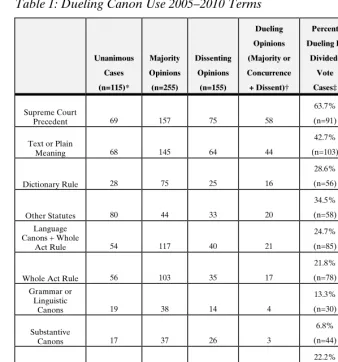
Table 1 lists the frequency with which the Justices on the Roberts Court employed the various canons and tools of statutory construction in a dueling fashion—that is, in both the majority and dissenting opinions in the same case—in the 255 cases decided and the 528 opinions issued from the time Justice Alito joined the Court in 2006 through the end of the Court’s 2010 term.62
For each interpretive tool, the Table first reports the number of unanimous opinions, majority opinions, and dissenting opinions that referenced the tool. It then reports the percentage of cases in which a majority and dissenting opinion in the same case both referenced the interpretive tool. This figure is calculated using as a denominator the total number of divided-vote cases in which the interpretive tool was invoked by at least one opinion (second-to-last-column) and, separately, using as a denominator the number of all cases—including unanimous cases—in which at least one opinion referenced the tool (last column).63
62. See infra Table 1.
Table 1: Dueling Canon Use 2005–2010 Terms Unanimous Cases (n=115)* Majority Opinions (n=255) Dissenting Opinions (n=155) Dueling Opinions (Majority or Concurrence + Dissent)† Percent Dueling In Divided-Vote Cases‡ Percent Dueling In All Cases˚ Supreme Court
Precedent 69 157 75 58
63.7%
(n=91)
32.6%
(n=178)
Text or Plain
Meaning 68 145 64 44
42.7%
(n=103)
25.3%
(n=174)
Dictionary Rule 28 75 25 16
28.6%
(n=56)
18.2%
(n=88)
Other Statutes 80 44 33 20
34.5%
(n=58)
21.1%
(n=95)
Language Canons + Whole
Act Rule 54 117 40 21
24.7%
(n=85)
14.1%
(n=149)
Whole Act Rule 56 103 35 17
21.8% (n=78) 12.7% (n=134) Grammar or Linguistic
Canons 19 38 14 4
13.3%
(n=30)
8.2%
(n=49)
Substantive
Canons 17 37 26 3
6.8%
(n=44)
4.9%
(n=61)
Common Law 25 40 12 6
22.2%
(n=27)
11.5%
(n=52)
Purpose 30 75 47 20
24.7%
(n=77)
19.6%
(n=107)
Unanimous Cases (n=115)* Majority Opinions (n=255) Dissenting Opinions (n=155) Dueling Opinions (Majority or Concurrence + Dissent)† Percent Dueling In Divided-Vote Cases‡ Percent Dueling In All Cases˚ Practical
Consequences 45 93 69 29
30.9%
(n=94)
20.9%
(n=139)
Intent 22 40 39 13
26.5%
(n=49)
18.3%
(n=71)
Legislative
History 32 74 47 19
25.3%
(n=75)
17.6%
(n=108)
* This column reports the number unanimous cases in which the majority opinion invoked an interpretive tool to support its chosen construction.
** This column includes a small number of double-counts for cases in which more than one dissenting opinion referenced the interpretive tool.
† This column counts the number of cases in which both the majority and one or more dissenting opinions relied on the interpretive tool to support its construction and a few cases in which a concurring opinion and at least one dissenting opinion relied on the interpretive tool. As explained in the article’s methodology section, the figures reported in this column do not include cases in which one opinion relied on the interpretive tool and an opposing opinion rejected the tool as inapplicable or criticized the opposing opinion’s reliance on the tool. ‡ Percentages in this column were calculated by dividing the number of cases that dueled over this interpretive tool (reported in previous column) by the number of divided-vote cases in the dataset in which at least one opinion relied on the tool to support its statutory construction (reflected in the figure n=90 for Supreme Court precedent, n=104 for Text/Plain meaning, and so on).
˚ Percentages in this column were calculated by dividing the number of cases that dueled over this interpretive tool (reported in the fourth column) by the total number of cases in the dataset in which at least one opinion relied on the tool to support its statutory construction, including unanimous cases (reflected in the figure n=177 for Supreme Court precedent, n=175 for Text/Plain meaning, and so on).
The data reveal several surprising results. First, prior Supreme Court precedent and text/plain meaning show very high rates of dueling during the Roberts Court’s first five-and-a-half terms—the Justices dueled over the application of Supreme Court precedent in 63.7 percent of the divided-vote cases in which at least one opinion cited precedent, and they dueled over text/plain meaning in 42.7 percent of the divided-vote cases in which at least one opinion found a clear statutory meaning.64
(The percentages are significantly lower when unanimous cases are included in the count, but still higher than for other interpretive resources). Practical consequences and other statutes exhibited the next-highest rates of dueling, generating
competing judicial references in 30.9 percent and 34.5 percent of the divided-vote cases that referenced either resource, respectively. By contrast, the Justices dueled over purpose, legislative history, and intent in roughly 25.0 percent of the cases in which they invoked these tools. The rates for these interpretive tools are almost identical to the rates at which the Justices dueled over textualist-preferred tools, such as dictionary definitions (28.6 percent), the whole act rule (21.8 percent) and the combined grammar/language canons/whole act rule (24.7 percent), and the common law (22.2 percent). Finally, the data revealed that the Justices rarely dueled over substantive canons, at a rate of just 10.4 percent.65
In short, the Court engaged in the highest rates of dueling canon or interpretive tool use when invoking traditional tools of legal analysis—i.e., precedent, text, and to a lesser extent, practical consequences—not when invoking statutory-interpretation-specific tools such as the language or substantive canons, statutory purpose, legislative history, the whole act rule, or dictionary definitions. The only statutory-interpretation-specific tool for which the Justices exhibited rates of dueling comparable to those exhibited for traditional legal tools was other statutes—an interpretive tool which requires traditional legal analysis of prior Supreme Court precedents interpreting analogous statutory provisions, in addition to the statutory-interpretation-specific task of making analogies across statutes.66
The data are intriguing on many levels. First, the relatively low rate of dueling over dictionary definitions is noteworthy and unexpected. Dictionary definitions are bountiful; there are numerous dictionaries in print and each dictionary typically contains several definitions for the same word. Moreover, a recent study of the Supreme Court’s dictionary usage from 1986–2010 found that the Justices’ choices regarding which dictionary to cite to be “largely ad hoc, based on the appeal of particular dictionaries in particular
65. I counted as substantive canon “duels” those cases in which a majority opinion cited one substantive canon (e.g., the rule of lenity) and an opposing opinion cited another substantive canon (e.g., the constitutional avoidance canon). I did not count as “dueling” cases in which a majority opinion invoked the rule of lenity and the dissenting opinion argued that the rule was not applicable. Seesupra Part II.A.
cases.”67
That study also found that in the vast majority of cases, judicial opinions that referenced dictionary definitions used them as “ornament[s]”—meaning that the dictionary played a minimal substantive role in the opinion’s reasoning, but nevertheless was used to “lend[] a patina of objectivity and legitimacy” to the chosen construction.68 Given the abundance of dictionary definitions and empirical evidence indicating that the Justices use them in an ad hoc manner, one would expect that jurists seeking to use this interpretive tool readily could find some definition to support almost any construction of a statute—and that majority and dissenting opinions in the same case frequently would employ competing dictionary definitions, however marginally helpful, to cancel out any aura of objectivity that an opposing opinion might gain from using such definitions.
Thus, the low rate of dueling dictionary use—28.6 percent—is puzzling.69
One explanation could be that the Justices tend to prefer a handful of dictionaries, so that despite the abundance of dictionaries and definitions in publication, competing definitions may not be readily available within their preferred lexical universe.70 But upon closer examination, this explanation seems insufficient for at least two reasons. First, the Court’s opinions in recent cases like Taniguchi v. Kan Pacific Saipan, Ltd.71
demonstrate that despite the Justices’ individual preferences for certain dictionaries, they are perfectly willing to reference other dictionaries (as many as fourteen in Taniguchi!).72 Second, empirical research shows that even those Justices with the most pronounced dictionary preferences deviate from their preferred dictionary in a substantial number of cases.73
67. James J. Brudney & Lawrence Baum, Oasis or Mirage: The Supreme Court’s Thirst for Dictionaries in the Rehnquist and Roberts Eras, 55 WM.&MARY L.REV. 483, 537 (2013). 68. Id. at 548.
69. This finding is consistent with the 28.8 percent rate of dueling dictionary use found in Brudney and Baum’s study of employment law, business and commercial law, and criminal-law cases from 1986 to 2010. See id. at 526.
70. My earlier empirical study of the Roberts Court and Brudney & Baum’s recent study of the Rehnquist and Roberts Courts found that the Justices cited the following five dictionaries most frequently: Webster’s Third New International Dictionary, the Oxford English Dictionary, Webster’s Second New International Dictionary, the American Heritage Dictionary, and Black’s Law Dictionary. See Brudney & Baum, supra note 67, at 529; Krishnakumar, supra note 17, at 240 n.85.
71. Taniguchi v. Kan Pac. Saipan, Ltd., 132 S. Ct. 1997 (2012). 72. See id. at2002–03, 2003 n.2.
Another possible explanation for the relatively low rate of judicial dueling over dictionary references is that, despite the availability of numerous dictionaries, there may have been no competing definition available in the forty cases in the dataset in which majority or dissenting opinions declined to counter an opposing opinion’s dictionary reference(s). In order to test this possibility, I (or a research assistant) examined the briefs in thirty-eight of the forty cases in which a majority or dissenting opinion referenced a dictionary definition, but the opposing opinion(s) did not counter that reference.74 In the vast majority of the cases (67.5 percent), both the petitioner and the respondent (or, in some cases, amici) had provided dictionary definitions supporting their respective statutory constructions. Moreover, in another handful of cases, the party whose interpretation was favored by the opinion that did not invoke a dictionary definition did provide a supporting dictionary definition in its brief.75 Ultimately, in 75.0 percent (thirty out of forty) of the cases in which a majority or dissenting opinion declined to counter a dictionary reference in an opposing opinion, at least one brief supporting the opposing opinion provided a helpful dictionary definition. Thus, the lack of availability of opposing definitions does not seem to explain the low level of dueling—nor does a lack of framing by litigants and attorneys.
A third possibility is that the Justices are motivated to counter an opposing opinion’s dictionary references only, or primarily, in those cases in which the opposing opinion relies significantly on dictionary definitions to reach its statutory construction—and tend to leave unanswered those dictionary references that are used merely as “ornaments.” I explore this possibility further in the doctrinal analysis conducted in Section III.B.76
Second, the Roberts Court’s relatively low rate of dueling over legislative history is quite surprising. The legislative history of most federal statutes is extensive, and debate on the House and Senate floor often produces competing statements about a statute’s
74. Briefs were not available online for the other two cases.
75. See, e.g., Brief for the State of Cal. at 44–46, Burlington N. & Santa Fe Ry. Co. v. United States, 556 U.S. 599 (2009) (Nos. 07-1601 & 07-1607); Brief for the United States as Amicus Curiae Supporting Respondents at 7, 15, Fed. Express Corp. v. Holowecki, 552 U.S. 389 (2008) (No. 06-1322); Brief for the Petitioners at 16–17, Zuni Pub. Sch. Dist. No. 89 v. U.S. Dep’t of Educ., 550 U.S. 81 (2007) (No. 05-1508).
meaning.77
Accordingly, as with dictionary definitions, one would expect there to be “something for everyone” in the legislative history—and for this to translate into frequent dueling over this interpretive resource. Yet the data from this study reveal judicial dueling over legislative history in only 25.3 percent of the divided-vote cases. Part III will explore the theoretical implications of this finding in detail, but for now it bears noting two possible explanations for the data: On the one hand, the conventional wisdom could simply be wrong, and the legislative history of many statutes may not in fact contain support for competing characterizations of the statute’s meaning. Alternatively, the Justices who make legislative history references may not be citing directly on-point “smoking gun” statements, and those authoring opposing opinions accordingly may not consider it crucial to counter such legislative history citations.
Third, the low rate of judicial dueling over substantive canons also is unexpected. Substantive canons are judicially created interpretive presumptions and rules based on background legal norms, policies and conventions.78
They reflect judicially preferred policy positions, expressed as rules of thumb about how to treat statutory text in light of constitutional priorities, common-law practices, or specific statute-based policies. Because substantive canons are policy-based, there often are two or more that point in opposite directions. Indeed, Llewellyn lists in his “thrust” column the substantive canon that “[s]tatutes in derogation of the common law will not be extended by construction” and, as its “parry,” the countercanon that “[s]uch acts will be liberally construed if their nature is remedial.”79 Accordingly, it seems surprising that the members of the Roberts Court dueled over substantive canons at a rate of only 10.9 percent.80
Last, the high rates of judicial dueling over precedent and practical reasoning, as compared to the low rates of dueling over purpose, legislative history, the whole act rule, and the like suggest
77. See, e.g., SCALIA, supra note 27, at 36 (“Legislative history provides, moreover, a uniquely broad playing field. In any major piece of legislation, the legislative history is extensive, and there is something for everybody.”); In re Sinclair, 870 F.2d 1340, 1343 (7th Cir. 1989) (Easterbrook, J.) (“Often there is so much legislative history that a court can manipulate the meaning of a law by choosing which snippets to emphasize . . . .”).
78. See, e.g., WILLIAM N.ESKRIDGE,JR.,DYNAMIC STATUTORY INTERPRETATION 276 (1994); Brudney & Ditslear, Canons of Construction, supra note 5, at 13.
that the canons and tools of statutory construction may not be as readily manipulable as the traditional tools of legal analysis that Llewellyn sought to compare them to in his article. Or, at the least, the Justices on the Roberts Court do not seem as inclined to use the tools of statutory construction to counter each other as they do to use the common-law tools of analysis in a dueling manner.
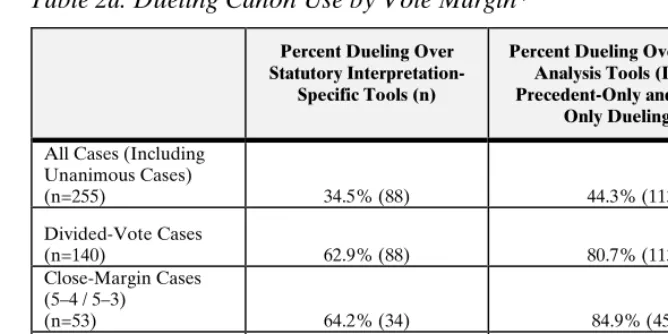
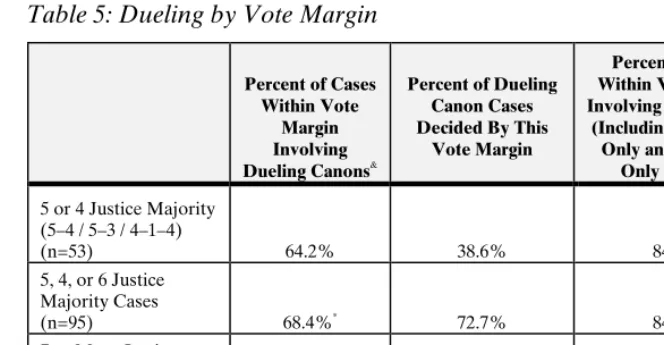
Before we rush to conclude that the Court rarely duels over statutory-interpretation-specific tools, however, it is worth looking at the rate of dueling by case type rather than by individual interpretive tool. As Table 2a shows, only 88 of 255 statutory cases decided during the period studied (34.5 percent) involved competing references to the same interpretive tool in both a majority and a dissenting opinion, excluding cases in which the Justices dueled only over Supreme Court precedent or practical consequences.81
This is not a trivial number, but neither does it constitute a terribly high rate of dueling. If we separate out unanimous cases and focus on the 140 cases in which the Justices divided over a statute’s construction, the rate climbs significantly, indicating that the Roberts Court engaged in dueling canon use in 62.9 percent of such cases. Put differently, a large majority of the cases in which the Justices disagreed over the construction of the statute involved majority–dissent dueling over the same interpretive canon or tool.
Table 2a: Dueling Canon Use by Vote Margin*
Percent Dueling Over Statutory
Interpretation-Specific Tools (n)
Percent Dueling Over All Legal Analysis Tools (Including Precedent-Only and
Practical-Only Dueling) (n)
All Cases (Including Unanimous Cases)
(n=255) 34.5% (88) 44.3% (113)
Divided-Vote Cases
(n=140) 62.9% (88) 80.7% (113)
Close-Margin Cases (5–4 / 5–3)
(n=53) 64.2% (34) 84.9% (45)
Wide-Margin Cases
(n=87) 62.1% (54) 78.2% (68)
*
A chi-squared test revealed no statistical difference between rates of dueling for close-margin versus wide-margin cases.
In addition, when the Justices used the interpretive tools in a dueling fashion, they tended to do so on multiple levels, dueling over numerous resources. Indeed, the members of the Roberts Court dueled over two or more interpretive tools in 83.0 percent of the eighty-eight dueling canon cases. Only fifteen of the eighty-eight dueling canon cases (17.0 percent) involved majority and dissenting opinions that dueled over only one interpretive tool.82
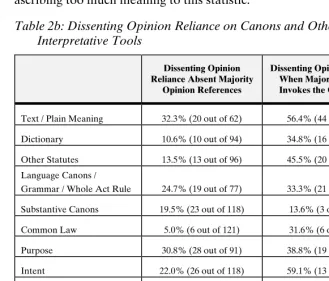
Further, as Table 2b below shows, the data from the Roberts Court’s first five terms are consistent with the Brudney–Ditslear and Law–Zaring findings that dissenting opinions were significantly more likely to invoke a canon or legislative history when the majority opinion relied on that interpretive resource than when the majority opinion did not. On the one hand, this finding could be taken to demonstrate that the Justices are strategic in their interpretive tool use—tailoring their references to counter the specific tools relied on by an opposing opinion rather than referencing only those tools they independently find compelling. This is the conclusion that Brudney–Ditslear and Law–Zaring reached based on similar data.83 On the other hand, the
82. Seeinfra Appendix (listing each “dueling canon” case and all tools over which majority and dissenting opinions dueled by case). If we include cases that involve dueling only over precedent or practical consequences, then thirty-seven of one-hundred and thirteen or 32.7 percent of the dueling cases involved dueling over only one interpretive tool.
83. See Brudney & Ditslear, Canons of Construction, supra note 5, at 96; Law & Zaring,
cases in which a majority opinion references a particular interpretive tool may also be cases in which citation to that tool is more appropriate than in the average case. In many cases, for example, the legislative history may not contain on-point discussion of the relevant statutory issue; in those cases where it does, and the majority references that discussion, a competing comment about the statutory provision may also be available. Thus we should be cautious before ascribing too much meaning to this statistic.84
Table 2b: Dissenting Opinion Reliance on Canons and Other Interpretative Tools
Dissenting Opinion Reliance Absent Majority
Opinion References
Dissenting Opinion Reliance When Majority Opinion Invokes the Canon/Tool
Text / Plain Meaning 32.3% (20 out of 62) 56.4% (44 out of 78)
Dictionary 10.6% (10 out of 94) 34.8% (16 out of 46)
Other Statutes 13.5% (13 out of 96) 45.5% (20 out of 44)
Language Canons /
Grammar / Whole Act Rule 24.7% (19 out of 77) 33.3% (21 out of 63)
Substantive Canons 19.5% (23 out of 118) 13.6% (3 out of 22)
Common Law 5.0% (6 out of 121) 31.6% (6 out of 19)
Purpose 30.8% (28 out of 91) 38.8% (19 out of 49)
Intent 22.0% (26 out of 118) 59.1% (13 out of 22)
Legislative History 28.9% (28 out of 97) 44.2% (19 out of 43)
Practical Consequences 49.4% (40 out of 81) 49.2% (29 out of 59)
Supreme Court Precedent 32.7% (17 out of 52) 65.9% (58 out of 88)
Overall, the data regarding the frequency of dueling canons provide a mixed picture. The rates of judicial dueling for most individual tools of construction are low—certainly lower than I expected to find for legislative history, dictionary references,
language/whole act, and substantive canons. At the same time, a large percentage of the Court’s divided-vote cases involved some level of majority–dissent dueling over the same interpretive tool. Indeed, in 52.1 percent of the cases in which the Justices disagreed (73 of 140), majority and dissenting opinions dueled over multiple canons or tools. Thus, on the one hand, the worst implications of Llewellyn’s “thrusts” and “parries” do not appear to be borne out, in that most individual tools of construction are not being pitted against themselves in the vast majority of cases. On the other hand, however, the tools of statutory construction hardly seem to constrain the Justices or point neatly to one correct interpretation, as nearly two-thirds of the Court’s divided-vote cases (88 of 140) contained competing applications of the same interpretive tool.
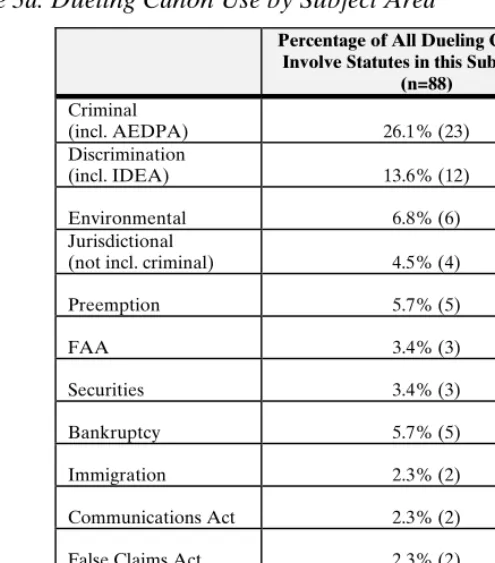
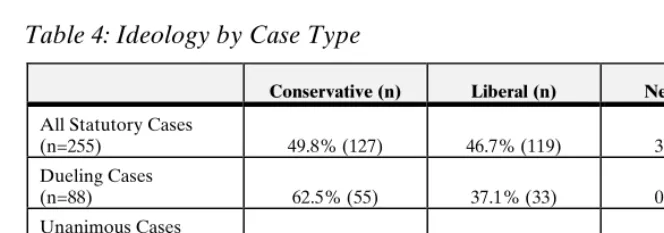
2. Statutory Subject Matter. If we break the cases down by statutory subject matter, the data become still more interesting. As Table 3a illustrates, subject matter seems to have a notable correlation to the rate at which the Roberts Court dueled over one or more interpretive canons when interpreting the statute. Table 3a reports the percentage of all dueling canon cases that involve statutes in a particular subject area.85
Caution should be used in interpreting these figures because once the data are disaggregated by statutory subject matter, the number of case observations dips significantly. Accordingly, this Article focuses on only the most striking data from Table 3a: criminal and antidiscrimination statutes each made up a substantial proportion of the Roberts Court’s dueling canon cases; nearly 40 percent of the cases in which the Court dueled involved a statute that fell within one of these two subject areas.86 If we add in cases construing environmental statutes, nearly half (46.5 percent) of the Court’s dueling canon cases are accounted for.87
85. Seeinfra Table 3a. 86. Seeid.