Research Article
ISSN 0975-248X
Preparation and Evaluation of Cyclodextrin Based Binary Systems for
Taste Masking
S. T. Birhade
*, V. H. Bankar, P. D. Gaikwad, S. P. Pawar
P.S.G.V.P.M’s College of Pharmacy, Shahada, Dist-Nandurbar - 425 409 (M.S.) India
ABSTRACT
The present study was aimed to investigate the potential of cyclodextrin complexation as an approach for taste masking. For this purpose, Rizatriptan benzoate (RZBT) was selected as model drug which is having bitter taste. Taste improvement of drug by β-Cyclodextrin was done by simple complexation approach using physical and kneading mixture methods with various ratios. Taste perception study was carried out in-vitro by spectrophotometrically and in-vivo by gustatory sensation
to evaluate the taste masking ability of binary complexation. The optimized taste masking ratio 1:10 of kneading mixture was selected based on bitterness score and characterized by fourier transform infrared spectroscopy (FTIR), differential scanning calorimetry (DSC) and X-ray diffractometry (XRD) to identify the physicochemical interaction between drug and carrier and its effect on dissolution. In-vitro drug release studies for physical mixture and kneaded system were performed
in pH 1.2 and 6.8 buffers. The FTIR, DSC and XRD studies indicated inclusion complexation in physical mixture and kneaded system. Both the binary systems showed effective taste masking and at the same time showed no limiting effect on the drug release. Whereas in comparison; kneading system showed better results. The results conclusively demonstrated effective taste masking by β-Cyclodextrin in both binary systems, which can be utilized as a novel alternative approach for effective taste masking.
Keywords: Rizatriptan Benzoate, Cyclodextrin, Binary complexation, Taste masking.
INTRODUCTION
The role of technologies related to formulation of effective drug delivery systems with enhanced patient compliance is unique and fascinating. Administration of an oral drug with bitter taste and acceptable level of palatability has always been challenge in developing a formulation for paediatric and geriatric purpose. The bitterness of drug or drug product is minimized or eliminated by various physical, chemical and physiological means such as use of flavours, sweeteners and amino acids and by using various techniques such as lipophilic vehicles, coating, inclusion complexation, ion exchange, effervescent agents, rheological modification, solid dispersion system, group alteration and prodrug approach, freeze drying process, wet spherical agglomeration technique and continuous multipurpose melt technology. [1]
Each technique has its own disadvantages. Addition of sweeteners and flavours is not very successful for extremely bitter drugs. Ion-exchange resins are functional group specific (amino group) and sometimes cause delayed drug release while coating with polymer requires sophisticated
*Corresponding author: Mr. S. T. Birhade,
P.S.G.V.P.M’s College of Pharmacy, Shahada, Dist-Nandurbar - 425 409 (M.S.) India;
E-mail: [email protected]
instruments. Chemical modification may alter the therapeutic activity of drug substance. [2]
The use of Cyclodextrin for taste masking is well reported. However, the application of CDs (especially β-Cyclodextrin) for taste masking is generally restricted to drugs that forms complex with high binding/stability constant because a low stability constant would lead to a rapid release of free drug in the oral cavity, resulting in inefficient taste masking. [3]
Cyclodextrins have the ability to mask the bitterness of numerous drugs, first of such observation was done by in 1953 by Freudenberg et al. in the very first drug/CD patent.
[4] They successfully masked the bad taste of bromoisovaleryl
urea by complexing it with Cyclodextrin. Though CD itself cannot be considered as a tasteless or only slightly sweet substance, although its taste threshold value is lower than that of sucrose (detection, 0.03 and 0.27%; recognition, 0.11 and 0.52%, respectively). A 0.5% CD solution was as sweet as sucrose and a 2.5% solution as sweet as a 1.71% solution of sucrose. [5]
taste buds and give a rapid and complete release at comparatively higher dilutions (i.e. gastric lumen). [6]
The structural feature of Cyclodextrin provides the enough space for different molecules for entrapment in it’s cyclic cavity containing the water molecules (13-14%) in the form of ‘crystal water’ which is bound in adjacent CD molecules comprising about the half of total water content and remaining is in the form of ‘inclusion water’ included into the hydrophobic cavity of CD. Hydrophobic drugs form complex by replacing ‘inclusion water’ while easily migrating (hydrophilic, well soluble) drugs form complex, assuming replacement of ‘crystal water’. [7]
Rizatriptan Benzoate is 5HT 1B/1D agonist thought to
contribute its antimigraine activity, including vasoconstriction of intracranial extra cerebral blood vessels, inhibition of non receptive neurotransmission in trigeminal pain pathways and inhibition of neurogenic dural vasodilatation and plasma protein extravasations. [8] Beside
this, it possesses the problem of bitter taste which has to be masked in order to reduce its bitterness to increase its palatability and also to improve patient compliance. [9]
Thus, the present work was carried out to investigate for the possibility of using ‘Binary Cyclodextrin Complexation’ as an approach for taste masking.
MATERIALS AND METHODS Materials
Rizatriptan Benzoate was kindly gifted by Unimerk Remedies Pvt. Ltd., Ahemadabad, β Cyclodextrin was generously provided by S.A. Pharmachem. Pvt. Ltd, Mumbai, All other chemicals and solvents used were of Pharmaceutical and analytical grade obtained from commercial sources.
Methods
Preparation of Rizatriptan Benzoate-Cyclodextrin Binary System
Binary systems of inclusion complexes were prepared by physical mixture method and by kneading method in the sequential w/w ratios of 1:1, 1:2, 1:4, 1:6, 1:8, 1:10, 1:12, 1:14, 1:16.
Physical Mixture (PM)
The physical mixture of RZBT and β-CD was obtained by mixing individual components geometrically in glass mortar for 45 minutes, Pure RZBT and β CD were previously been sieved through # 44.
Kneading Method (KM)
The physical mixture of RZBT and β CD was triturated in a mortar with a small volume of distilled water. The thick slurry was kneaded until mild dryness (~40 minutes). The dried mass was then pulverized and sieved through # 44.
Characterization of Binary Systems
Fourier Transformed Infra-red Spectroscopy (FTIR)
FTIR transmission spectra were obtained using Thermo Nicolet, Avatar 370a Fourier transform infrared spectrophotometer.
Differential Scanning Calorimetry (DSC)
Differential scanning calorimetry study was performed using Mettler Toledo DSC 822e differential scanning calorimeter all the samples were accurately weighed (3–6 mg), sealed in an aluminum pan and heated at a scanning rate of 10°C min-1.
Nitrogen was used as the purge gas. Aluminium pans and lid were used for all samples. An empty aluminium pan was used as reference.
X-Ray Powder Diffractometry (XRD)
X-Ray powder diffractometry was carried out using Bruker AXS D8 Advance X Ray diffractometer at the incident angle of 2θ to study the powder behaviour of binary systems.
In-vitro Drug Release
In-vitro drug release study of physical mixture and kneaded
system was performed by powder dispersion method at 37±0.5°C, using three station USP XXII apparatus with paddle rotating at 50 rpm. The drug release study was carried out in phosphate buffer pH 6.8 because the pH of the saliva is in the range from 6.3 to 7.2. Further, the drug release study was performed in hydrochloric acid buffer, pH 1.2 to demonstrate the availability of RZBT in gastric pH. Complexes containing equivalent of 10 mg of RZBT were suspended in 900 ml of the buffer solution and 10 ml sample was withdrawn at 1, 5, 10, 15, 30 and 60 min and analyzed using UV spectrophotometer (Systronics UV visible spectrophotometer 2201). Each sample was replaced with fresh buffer solution.
Assessment of the Bitter Taste
Determination of Threshold Bitterness
Binary systems were subjected to sensory evaluation by a panel of six healthy volunteers using time intensity method. Prior informed consent was obtained from all participant volunteers. The bitter taste threshold value of RZBT was determined based on the bitter taste recognized by six volunteers (three females and three males). A series of RZBT aqueous solutions were prepared at different concentrations as standard solutions, i.e. 50, 100, 150, 200, 250, 300, 350µg/ml respectively. 1ml of each standard solution was placed on the center of the tongue, it was retained in the mouth for 15 seconds and then the mouth was thoroughly rinsed with distilled water. The threshold value was correspondingly selected from the different RZBT concentrations as the lowest concentration that had a bitter taste.
Estimation of the Bitter Taste of Binary Systems in-vitro
Binary systems containing about 10 mg RZBT were put into a test tube containing 10 ml distilled water. The mixture was immediately vibrated for 15 seconds and then filtered. The clear solution was analyzed in a spectrophotometer (Systronics UV Visible spectrophotometer 2201) at 225 nm to determine the dissolved drug concentration in water after the appropriate dilutions, which was then compared with the threshold value. The calibration curve between absorbance (A) and concentration (C) was, A = 0.114C- 0.0210 (r2 =
0.999, n = 5) which was used for determination of dissolved concentration.
Estimation of the Bitter Taste of Binary Systems by Gustatory Sensation
RESULTS AND DISCUSSION FTIR Studies
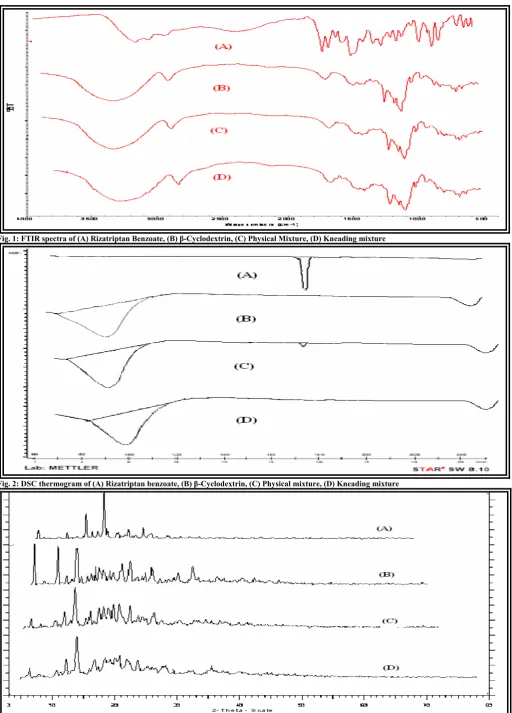
IR spectroscopy was used to characterize complex formation and also to detect the possible molecular interaction between RZBT and β-CD. The FTIR spectrum of RZBT, β CD, physical mixture 1:16 and kneaded system in 1:10 are shown in the Fig. 1. FTIR spectra of the samples illustrated here states that there were no major changes in the FTIR spectra indicating no chemical interaction between the components. Whereas from minor changes in FTIR spectra of kneaded system confirm that there is complete complexation. Peaks at 1057.84, and 1136.50 represents ‘C-N’ stretching in tertiary amines. The characteristic peaks of RZBT at 1282 cm-1, 1379
cm-1 indicates aromatic ‘C–H’ stretching whereas 1379 cm-1,
2909 cm-1, shows the presence of aliphatic stretching of
‘C-H’ bond the peak at 1282 cm−1 was assigned to ‘C–O’
stretching vibration in ‘C–O–H’ the peak at 2297 cm−1 was
assigned to ‘-C=N’ stretching in triazole shifted to higher wave numbers due to negative inductive effect. FTIR spectra of both binary systems physical mixture and kneading mixture correspond to β-CD with no major peaks corresponding to RZBT.
DSC Studies
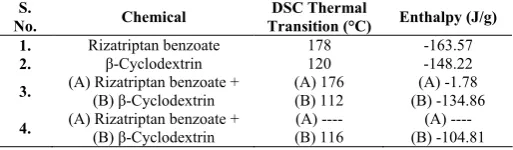
The DSC thermograms of RZBT, β-cyclodextrin, physical mixture and the kneading mixture are illustrated in Fig. 2. The thermogram of β-CD showed a broad peak at 85-100°C, attributed to desolvation of water molecules present in β-CD cavity and that of pure drug showing sharp endothermic peak at 179°C attributing to its melting point. Relatively sharp peak between 290-300°C corresponds to melting point of β-cyclodextrin. Physical mixture system showed the diminished endothermic peak of RZBT at 176°C. In case of kneading system, it was found to be completely diminished indicating the complete complexation of drug with that of β-CD.
XRD Studies
XRD analysis was carried out to confirm formation of a new solid state as shown in Fig. 3, X-Ray diffraction pattern for Rizatriptan benzoate showed number of sharp edged peaks stating the presence of crystalline structure, whereas β-Cyclodextrin showing diffused peaks showing the amorphous integrity. XRD pattern of physical mixture and kneading mixture both showed the peaks of drug and β-Cyclodextrin, stating the no interaction of drug and polymer. On comparing the diffractograms of all the samples, it can be suggested that the formation of binary system resulted in retention of crystalline state of drug.
In–vitro Dissolution Studies
In the present study, in-vitro drug release study was carried
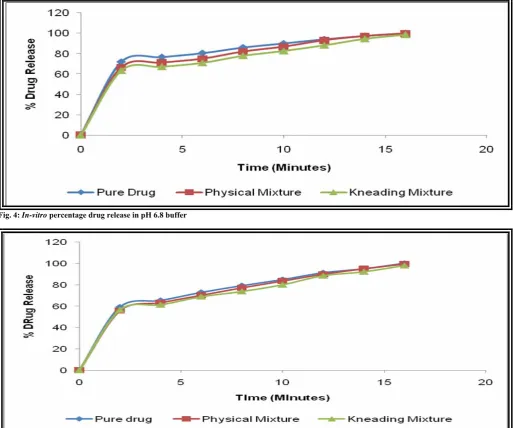
out to evaluate the effect of complexation on dissolution rate of binary system. Physical mixture and kneaded systems were dispersed in a dissolution medium, a very rapid dissolution was observed. Dissolution studies were based on the observation in order to characterize the inclusion complexation between the β-CD and drug. Fig. 4-5 show the dissolution profiles of physical mixture and kneaded system at pH 6.8 buffer and pH 1.2 HCl respectively.
The results of dissolution efficiency and percent of RZBT dissolved at 6 min are reported in Table 3. Dissolution studies showed that the drug release was slightly decreased in kneaded system. It was around 68.95% of drug dissolved in 6 minutes from kneaded system, physical mixtures showed 70.34% and pure RZBT about 73.15 % in pH 1.2 buffer. The
results in pH 6.8 were 71.11 % for kneaded system, 75.06 % for physical mixture and 86.11 % for pure RZBT at the end of 6 minutes.
The significant improvement in dissolution characteristics of the physical mixture was supposed to be due increased particle wettability and reduction of crystallinity of the product. [10- 11] Improved dissolution may be attributed to the
high energetic amorphous state and reduction in crystallinity of the RZBT following complexation in physical mixture and kneaded system, which was verified from XRD and DSC studies.
Taste Perception Studies In-vitro Taste Evaluation
The results of spectrophotometric analysis of binary systems showed drug release of 84.52 ± 1.12 µg/ml for physical mixture and 82.80 ± 0.30 µg/ml for kneading mixture which was very less when compared to threshold bitterness value of 350 µg/ml.
Taste Evaluation by Panel
The efficiency of taste masking was evaluated by six human volunteers. It was observed that there was no bitter taste percepted for both binary systems viz. physical mixture and kneading mixture when compared with the pure drug. The results have been shown in Table 4.
The utilization of cyclodextrin binary systems as an approach for taste masking were studied and conclusively demonstrated the efficient taste masking of bitter drug with complexation evidences of FTIR, DSC and XRD studies. The investigation here confirmed the principle of complexation as
Table 1: Numerical scale representing taste
Rating Taste Inference
0 Tasteless
0.5 Very slightly bitter
1 Slightly bitter
1.5 Slight to moderate bitter
2 Moderately bitter
2.5 Moderate to strong bitter
3 Strongly bitter
3+ Very strongly bitter
Table 2: Thermal transition and enthalpy values of rizatriptan benzoate, β-cyclodextrin and its physical and kneading mixtures
S.
No. Chemical
DSC Thermal
Transition (°C) Enthalpy (J/g)
1. Rizatriptan benzoate 178 -163.57
2. β-Cyclodextrin 120 -148.22
3. (A) Rizatriptan benzoate + (B) β-Cyclodextrin (A) 176 (B) 112 (B) -134.86 (A) -1.78
4. (A) Rizatriptan benzoate + (B) β-Cyclodextrin (B) 116 (A) ---- (B) -104.81 (A) ----
Table 3: Results of dissolution profile and dissolution efficiency of RZBT in binary systems with comparison of pure drug
Dissolution Profile after 6 min. (%)
Dissolution efficiency at 16 min. (%) Formulation
pH 1.2 pH 6.8 pH 1.2 pH 6.8
Pure drug 73.15 86.11 74.97 80.91
Physical Mixture 70.34 75.06 73.21 77.76
Kneading Mixture 68.95 71.11 71.35 74.39
Table 4: Evaluation of bitterness score by panel of volunteers Volunteers rating Formulation
0.5 1 1.5 2 2.5 3 3+
Pure RZBT ---- ---- ---- ---- ---- 5 1
Physical
Mixture 5 1 ---- ---- ---- ---- ----
Kneading
Fig. 1: FTIR spectra of (A) Rizatriptan Benzoate, (B) β-Cyclodextrin, (C) Physical Mixture, (D) Kneading mixture
Fig. 2: DSC thermogram of (A) Rizatriptan benzoate, (B) β-Cyclodextrin, (C) Physical mixture, (D) Kneading mixture
Fig. 4: In-vitro percentage drug release in pH 6.8 buffer
Fig. 5: In-vitro drug release pH 1.2 buffer
an approach for taste masking and can serve as novel approach for taste modifications of Pharmaceuticals.
ACKNOWLEDGEMENT
The authors are thankful to Unimark Remedies Pvt. Ltd., Ahemadabad for providing the drug under study and also to S. A. Pharmachem. Pvt. Ltd., Mumbai for providing the β-Cyclodextrin for present investigation. Special thanks to P.S.G.V.P.M’s College of Pharmacy, Shahada for providing the needful facilities for this study.
REFERENCES
1. Bhise K, Shaikh S, Bora D. Taste Mask, Design and Evaluation of an Oral Formulation using Ion Exchange Resin as Drug Carrier. AAPS PharmSciTech. 2008; 9(2):557-562.
2. Shah PP, Mashru RC. Formulation and Evaluation of Taste Masked Oral Reconstitutable Suspension of Primaquine Phosphate. AAPS PhamSciTech. 2008; 9(3):1025-1030.
3. Rajeshwari RA, Chhalla VJ. Pharmaceutical Applications of Cyclodextrins II: in-vivo Drug Delivery. J Pharm Sci. 1996; 85:1142–1169.
4. Freudenberg K, Cramer F, Plieninger H, Inclusion Compounds of Physiologically Active Organic Compounds. Germen Patent 895769: 1953.
5. Szejtli J, Szente L. Elimination of Bitter, Disgusting Tastes of Drugs and Foods by Cyclodextrins. Eur J Pharm Biopharm. 2005; 61:115–125.
6. Patel AR, Vavia PR. Preparation and Evaluation of Taste Masked Famotidine Formulation Using Drug/β-cyclodextrin/Polymer Ternary Complexation Approach. AAPS PharmSciTech. 2008; 9(2):544-550.
7. Szejtli J, Szente L. Elimination of Bitter, Disgusting Tastes of Drugs and Foods by Cyclodextrins. Eur J Pharm Biopharm. 2005; 61:115–125.
8. Lainez JA. Rizatriptan in the Treatment of Migraine. Neuropsychiatric Disease and Treatment. 2006; 2(3):247–259. 9. Chaudhari PD, Chaudhari SP, Kolhe SR, More DM. Optimizing the
Taste Masking of Rizatriptan Benzoate by using Cation Exchange Resins. The Indian Pharmacist. 2006; 5(49):79-82.
10. Rekharshy MY, Inoue Y. Detection of Paramagnetic pH Dependent Inclusion Complexes. Chem Rev. 1998; 98:1875–1896.