Page 614 www.ijiras.com | Email: [email protected]
A New Method For Communication Efficiency Using
Compression And Data Hiding Based On SMVQ And Image In
Painting
G. Sreenivasulu
B. Srinivasa Rao
Assistant Professors,
Sree Vidyanikethan Engineering College, Tirupati
I. INTRODUCTION
With the rapid development of Internet technology, people can transmit and share digital content with each other conveniently. In order to guarantee communi-cation efficiency and save network bandwidth, compression techniques can be implemented on digital content to reduce redundancy, and the quality of the decompressed versions should also be preserved. Nowadays, most digital content, especially digital images and videos, are converted into the compressed forms for transmission [1]–[4]. Another important issue in an open network environment is how to transmit secret or private data securely. Even though traditional cryptographic
Manuscript received August 22, 2012; revised December 31, 2012 and February 21, 2013; accepted April 15, 2013. Date of publication April 30, 2013; date of current version January 20, 2014. This work was supported by the National Natural Science Foundation of China under Grant 61303203, the Natural Science Foundation of Shanghai, China under
Grant 13ZR1428400, and the Innovation Program of Shanghai Municipal Education Commission under Grant 14YZ087. The associate editor coordinating the review of this manuscript and approving it for publication was Prof. Sanghoon Lee.
C. Qin is with the School of Optical-Electrical and Computer Engineering, University of Shanghai for Science and Technology, Shanghai 200093, China (e-mail: [email protected]).
C.-C. Chang is with the Department of Information Engineering and Computer Science, Feng Chia University, Taichung 40724, Taiwan, with the Department of Computer Science and Information Engineering, Asia University, Taichung 41354, Taiwan, and also with Department of Biomed-ical Imaging and Radiological Science, China Medical University, Taichung 40402, Taiwan (e-mail: [email protected]).
Y.-P. Chiu is with the Department of Computer Science and Informa-tion Engineering, National Chung Cheng University, Chiayi 62102, Taiwan (e-mail:
Abstract: In this paper, we propose a novel joint data-hiding and compression scheme for digital images using side match vector quantization (SMVQ) and image inpainting. The two functions of data hiding and image compression can be integrated into one single module seamlessly. On the sender side, except for the blocks in the leftmost and topmost of the image, each of the other residual blocks in raster-scanning order can be embedded with secret data and compressed simultaneously by SMVQ or image inpainting adaptively according to the current embedding bit. Vector quantization is also utilized for some complex blocks to control the visual distortion and error diffusion caused by the progressive compression. After segmenting the image compressed codes into a series of sections by the indicator bits, the receiver can achieve the extraction of secret bits and image decompression successfully according to the index values in the segmented sections. Experimental results demonstrate the effectiveness of the proposed scheme.
Page 615 www.ijiras.com | Email: [email protected] [email protected]).
Color versions of one or more of the figures in this paper are available online at http://ieeexplore.ieee.org.
Digital Object Identifier 10.1109/TIP.2013.2260760 methods can encrypt the plaintext into the ciphertext [5], [6], the meaningless random data of the ciphertext may also arouse the suspicion from the attacker. To solve this problem, information hiding techniques have been widely developed in both academia and industry, which can embed secret data into the cover data imperceptibly [7], [8]. Due to the prevalence of digital images on the Internet, how to compress images and hide secret data into the compressed images efficiently deserves in-depth study.
Recently, many data-hiding schemes for the compressed codes have been reported, which can be applied to various compression techniques of digital images, such as JPEG [9], [10], JPEG2000 [11], and vector quantization (VQ) [12]–[15]. As one of the most popular lossy data compression algorithms, VQ is widely used for digital image compression due to its simplicity and cost effectiveness in implementation [16], [17]. During the VQ compression process, the Euclidean distance is utilized to evaluate the similarity between each image block and the codewords in the codebook. The index of the codeword with the smallest distance is recorded to represent the block. Thus, an index table consisting of the index values for all the blocks is generated as the VQ com-pression codes. Instead of pixel values, only the index values are stored, therefore, the compression is achieved effectively. The VQ decompression process can be implemented easily and efficiently because only a simple table lookup operation is required for each received index. In this work, we mainly focus on the data embedding in VQ-related image compressed codes.
In 2003, Du and Hsu proposed an adaptive data hiding method for VQ compressed images [18], which can vary the embedding process according to the amount of hidden data. In this method, the VQ codebook was partitioned into two or more subcodebooks, and the best match in one of the sub-codebooks was found to hide secret data. In order to increase the embedding capacity, a VQ-based data-hiding scheme by a codeword clustering technique was proposed in [19]. The secret data were embedded into the VQ index table by codeword-order-cycle permutation. By the cycle technique, more possibilities and flexibility can be offered to improve the performance of this scheme. Inspired by [18], [19], Lin et al. adjusted the pre-determined distance threshold according to the required hiding capacity and arranged a number of similar codewords in one group to embed the secret sub-message [20]. The search-order coding (SOC) algorithm was proposed by Hsieh and Tsai, which can be utilized to further compress the VQ index table and achieve better performance of the bit rate through searching nearby identical image blocks following a spiral path [21]. Some steganographic schemes were also proposed to embed secret data into SOC compressed codes [22]–[24].
Side match vector quantization (SMVQ) was designed as an improved version of VQ [25], in which both the codebook and the subcodebooks are used to generate the index values, excluding the blocks in the leftmost column and the topmost row. Recently, many researchers have studied on embedding
secret message by SMVQ [26]–[31]. In 2010, Chen and Chang proposed an SMVQ-based secret-hiding scheme using adaptive index [27]. The weighted squared Euclidean distance (WSED) was utilized to increase the probability of SMVQ for a high embedding rate. In order to make the secret data imperceptible to the interceptors, Shie and Jiang hided secret data into the SMVQ compressed codes of the image by using a partially sorted codebook [29]. The restoration of the original SMVQ-compressed image can be achieved at the receiver side.
However, in all of the above mentioned schemes, data hiding is always conducted after image compression, which means the image compression process and the data hiding process are two independent modules on the server or sender side. Under this circumstance, the attacker may have the opportunity to intercept the compressed image without the watermark information embedded, and the two independent modules may cause a lower efficiency in applications. Thus, in this work, we not only focus on the high hiding capacity and recovery quality, but also establish a joint data-hiding and compression (JDHC) concept and integrate the data hiding and the image compression into a single module seamlessly, which can avoid the risk of the attack from interceptors and increase the implementation efficiency. The proposed JDHC scheme in this paper is based on SMVQ and image inpainting. On the sender side, except for the blocks in the leftmost and topmost of the image, each of the other residual blocks in raster-scanning order can be embedded with secret data and compressed simul-taneously by SMVQ or image inpainting adaptively according to the current embedding bit. VQ is also utilized for some complex residual blocks to control the visual distortion and error diffusion caused by the progressive compression. After receiving the compressed codes, the receiver can segment the compressed codes into a series of sections by the indicator bits. According to the index values in the segmented sections, the embedded secret bits can be extracted correctly, and the decompression for each block can be achieved successfully.
The rest of the paper is organized as follows. Section II describes the proposed joint data-hiding and compression scheme, including the procedure of image compression and secret data embedding and the procedure of image decom-pression and secret data extraction. Experimental results and analysis are given in Section III, and Section IV concludes the paper.
II. JOINT DATA-HIDING AND COMPRESSION SCHEME
Page 616 www.ijiras.com | Email: [email protected]
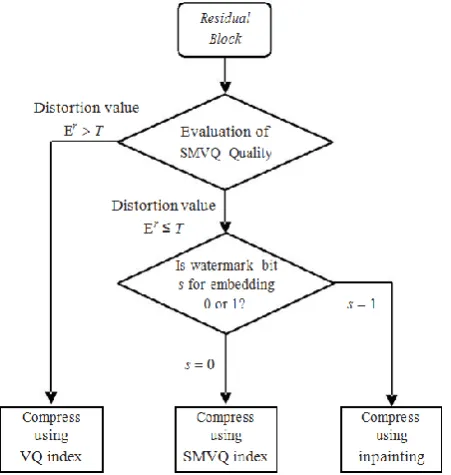
Figure 1: Flowchart of compression and secret data embedding for each residual block
A. IMAGE COMPRESSION AND SECRET DATA EMBEDDING
As an extension of VQ, SMVQ was developed to alleviate the block artifact of the decompressed image and increase the compression ratio, because the correlation of neighboring blocks is considered and the indices of the subcodebooks are stored. In our scheme, the standard algorithm of SMVQ is modified to further achieve better decompression quality and to make it suitable for embedding secret bits. The detailed procedure is described as follows.
In our scheme, the sender and the receiver both have the same codebook with W codewords, and each codeword length is n2. Denote the original uncompressed image sized M × N as I, and it is divided into the non-overlapping n × n blocks. For simplicity, we assume that M and N can be divided by n with no remainder. Denote all k divided blocks in raster-scanning order as Bi,j, where k = M × N / n2, i = 1, 2, . . . ,M/n, and j =
1, 2, . . . , N /n. Before being embedded, the secret bits are scrambled by a secret key to ensure security. The blocks in the leftmost and topmost of the image I, i.e., Bi,1(i = 1, 2, . . . ,
M/n) and B1, j ( j = 2, 3, . . . , N /n), are encoded by VQ
directly and are not used to embed secret bits. The residual blocks are encoded progressively in raster-scanning order, and their encoded methods are related to the secret bits for embedding and the correlation between their neighboring blocks. The flowchart of the processing for each residual block is illustrated in Figure 1.
Denote the current processing block as Bx,y(2 ≤ x ≤ M/n,
2≤ y ≤ N /n), and its left and up blocks areBx,y−1and Bx−1,y,
respectively. As shown in Figure 2, cp,1 (1 ≤ p ≤ n) and c1,q(2
≤ q ≤ n) represent the 2n − 1 pixels in the left and upper borders of Bx,y. The n pixels in the right border of Bx,y−1 and the n pixels in the bottom border of Bx −1,y are denoted as lp,n
(1 ≤ p ≤ n) and un,q (1 ≤ q ≤ n), respectively. Similar with
SMVQ, the 2n − 1 pixels in the left and upper borders of Bx,y
are predicted by the neighboring
CHANG et al.: NOVEL JOINT DATA-HIDING AND COMPRESSION SCHEME
Figure 2: Illustration of the prediction based on left and up neighboring pixels.
pixels in Bx,y−1 and Bx−1,y : c1,1 = (l1,n +un,1)/2,cp,1 = lp,n
(2 ≤ p ≤ n), and c1,q = un,q (2 ≤ q ≤ n). Instead of all n2 pixels in
Bx,y, only these 2n − 1 predicted pixels are used to search the
codebook. After transforming all W codewords in the codebook into the n × n matrices, the mean square error (MSE) Ew is calculated between the 2n − 1 predicted pixels in Bx ,y with the corresponding values of each transformed
codeword Cw sized n × n.
n n
Ew = (c p,1− cwp,1)2+(c1,q− c1w,q )2 , (1)
p=1 q=2
where cwp,q are the elements of each codeword Cw in
code-book. The R codewords with the smallest MSEs, i.e., Ew, are selected to generate one subcodebook x,y for the block Bx,y (R
< W ). Suppose that, among the R codewords in x ,y, the
codeword indexed λ has the smallest MSE, i.e., Er, with all n2
pixels in Bx,y(0 ≤ λ ≤ R − 1). If the value of Er is greater than
a pre-determined threshold T for distortion control, it implies that the current residual block Bx ,y locates in a relatively
complex region and it has lower correlation with its neighboring blocks. Under this circumstance, in order to achieve better decompression quality, the standard, block-independent VQ with codebook is used to compress the block Bx,y, and no secret bits are embedded. Otherwise, if Er ≤ T , it
implies that the current residual block Bx ,y locates in a
relatively smooth region and it has higher correlation with its neighboring blocks. Thus, in this condition, SMVQ or image inpainting is adaptively utilized to compress the block Bx ,y
according to the secret bit s for embedding, which results in the shorter index length and the success of secret data hiding. Note that, if VQ is adopted, an indicator bit, i.e., 0, should be added before the compressed code of the VQ index for Bx,y.
If not, the indicator bit, i.e., 1, is added as the prefix of the compressed code for Bx,y.
As for the block Bx ,y, if its Er is not greater than the
threshold T and the current secret bit s for embedding is 0, SMVQ is utilized to conduct compression, which means that the index value λ occupying log2R bits is used to represent the block Bx ,y in the compressed code. Because the codeword
Page 617 www.ijiras.com | Email: [email protected] number W of the original codebook, the length of the
compressed code for Bx ,y using SMVQ must be shorter than
using VQ. On the other hand, if Er ≤ T and the current secret bit s for embedding is 1, the image inpainting technique is used.
The concept of image inpainting is inherited from the ancient technique of manually repairing valuable artworks in an undetectable manner [34]. Inpainting for digital images has found applications in such areas as repairing of damaged photographs, filling in or removing chosen areas, and wiping off visible watermarks. Image inpainting can generate or create image regions that initially do not exist at all, based on the useful information in the close neighborhood. Currently, there are mainly three classes of the image inpainting methods, i.e., partial differential equation (PDE) based methods [34]–[36], interpolation-based methods [37], and patch-based methods. The PDE-based inpainting methods often propagate the available information of gray values automatically from surrounding areas into region to be inpainted along a specific direction. There are several mathematical physics models that can be used for PDE-based inpainting, such as the fluid dynamics model [34] and the heat transfer model [35]. Different PDE models correspond to the different methods of information propagation. Image inpainting can recover the image structural information effectively when the processed region is not too large. Evidently, if Er ≤ T, it implies that Bx,y locates in a relatively
smooth region. Thus, it is suitable to conduct image inpainting in the compression for Bx,y under this condition.
In our scheme, a PDE-based image inpainting method using the fluid dynamics model is adopted [34]. Denote Bχ as
the region including the current block Bx ,y that needs
compression by inpainting and the available neighboring region of Bx ,y. Let Bχ (ξ , η) be the gray value of Bχ in the
coordinate (ξ , η). The Laplacian Bχ (ξ , η) is used as a
smoothness measure of the region Bχ. By analogizing the
inpainting process as the fluid flowing and imitating the practice of a traditional art professional in the manual retouching, details in the unknown region may be created through propagating the available information in the surrounding areas into the unknown region along isophote directions. The field of isophote is defined as:
(2) Where i and j are unit directional vectors. Clearly, variations in image gray values are minimal along the isophote directions. Having finished the inpainting process, ∇⊥Bχ (ξ , η)
should be normal to the gradient of the smoothness Bχ(ξ , η):
∇ [ Bχ(ξ , η)] · ∇⊥Bχ(ξ , η) = 0 . (3)
The scalar product in the above equation indicates projection of the smoothness change onto the direction of isophote. If we let the projection value be equal to the change of image gray values with respect to time t, the following PDE
can be acquired:
∂ B
(ξ , η)
= ∇[ B
(ξ , η)]·∇
⊥
B
(ξ , η), (ξ , η)
∈ Bxy .
χ χ χ
∂ t ∀ ,
(4)
By using the finite difference method, we can obtain a discretized iteration algorithm to solve the PDE in Eq. (4). Information propagation of this inpainting model finishes until the gray values in Bx ,y reach stable state. Consequently, the
structural and geometric information of the block Bx ,y can be
recovered effectively without serious blurring on edges. Consequently, when s = 1, in order to indicate that block is processed by inpainting and differentiate from the λ produced by SMVQ, the index value R occupying log2(R + 1) bits is used as the compressed code of Bx ,y (R > λ). For
simplicity, we assume that log2(R + 1) is an integer and log2R ≡ log2(R + 1).
After the current block Bx ,y is processed, the following
block in raster-scanning order repeats the above procedure. Note that each processed block should be substituted with its corresponding decompressed result, i.e., VQ codeword, SMVQ codeword, or inpainting result, for the success of progressive mechanism. The used image inpainting technique is described in the next subsection detailedly. The whole procedure of image compression and secret data embedding finishes until all residual blocks are processed. Then, the compressed codes of all image blocks are concatenated and transmitted to the receiver side.
B. IMAGE DECOMPRESSION AND SECRET DATA EXTRACTION
After receiving the compressed codes, the receiver conducts the decompression process to obtain the decoded image that is visually similar to the original uncompressed image, and the embedded secret bits can be extracted either before or during the decompression.
Because the (M + N − n)/n blocks in the leftmost and topmost of the image need to be used in the decompression for other residual blocks, they should be first decompressed by their VQ indices retrieved from the image compressed codes. Each VQ index of these pre-decompressed blocks occupies log2 W bits. Then, the k − (M + N − n)/n residual blocks are processed block by block in raster-scanning order. Figure 3 shows the flowchart of decompression and secret bit extraction for each residual block.
Page 618 www.ijiras.com | Email: [email protected] corresponding to this section was compressed by SMVQ and
that the embedded secret bit is 0.
Figure 3: Flowchart of decompression and secret data extraction for each residual block
If the current segmented section corresponds to an inpaint-ing compressed block Bi np, the available information
of its neighboring decompressed blocks are utilized to conduct recovery by the same inpainting technique used in the com-pression process. If the current segmented section corresponds to an SMVQ compressed block Bs mq, SMVQ index value, i.e.,
λ’, is used to recover this block with the assistance of its left and upper decompressed blocks. Using the same prediction method described in Subsection A, the 2n − 1 pixels in the left and upper borders of Bs mq are estimated by the neighboring
pixels in its left and upper decompressed blocks. Similarly, the MSEs are calculated between these 2n − 1 predicted pixels in Bs mq with the corresponding values of all W codewords in the
codebook. Then, the R codewords in with the smallest MSEs are chosen to generate a subcodebook. Finally, the codeword indexed λ’ in the generated subcodebook is used to recover the block Bs mq.
After all the segmented sections in the compressed codes complete the above described procedure, the embedded secret bits can be extracted correctly, and the decompressed image Id
can be obtained successfully. Due to the decoding of the compressed codes, the decompressed image Id doesn’t contain
the embedded secret bits any longer. Note that the process of secret bit extraction can also be conducted independently, which means that the receiver can obtain all embedded bits by simply segmenting and analyzing the compressed codes without the decoding.
CHANG et al.: NOVEL JOINT DATA-HIDING AND COMPRESSION SCHEME
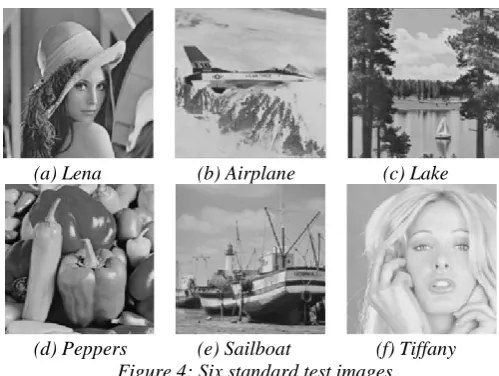
(a) Lena (b) Airplane (c) Lake
(d) Peppers (e) Sailboat (f) Tiffany Figure 4: Six standard test images
Therefore, besides the image compression, the proposed scheme can achieve the function of data hiding that can be used for covert communication of secret data. The sender can transmit the secret data securely through the image compressed codes, and the receiver can extract the hidden secret data effectively from the received compressed codes to complete the process of covert communication. Additionally, because the secret data extraction in our scheme can be conducted independently with the decompression process, the receiver can obtain the secret bits at any time if he or she preserves the compressed codes. The proposed scheme can also be used for the integrity authentication of the images, in which the secret bits for embedding can be regarded as the hash of the image principle contents. The receiver can calculate the hash of the principle contents for the decompressed image, and then compare this calculated hash with the extracted secret bits (embedded hash) to judge the integrity of the received compressed codes and the corresponding decompressed image. If the two hashes are equal, it means the image is authen-ticated. Otherwise, the received compressed codes must be tampered.
Page 619 www.ijiras.com | Email: [email protected]
(a) Lena (b) Airplane (c) Lake
(d) Peppers (e) Sailboat (f) Tiffany Figure 5: Labels of image blocks with different types (T = 16). The black block, gray block, and white block in Figures 5(a)–(f) correspond to the blocks compressed by VQ, SMVQ,
and image inpainting, respectively
Figure 6: Labels of image blocks with different types (T = 28). The black block, gray block, and white block in Figures 6(a)–
(f) correspond to the blocks compressed by VQ, SMVQ, and image inpainting, respectively
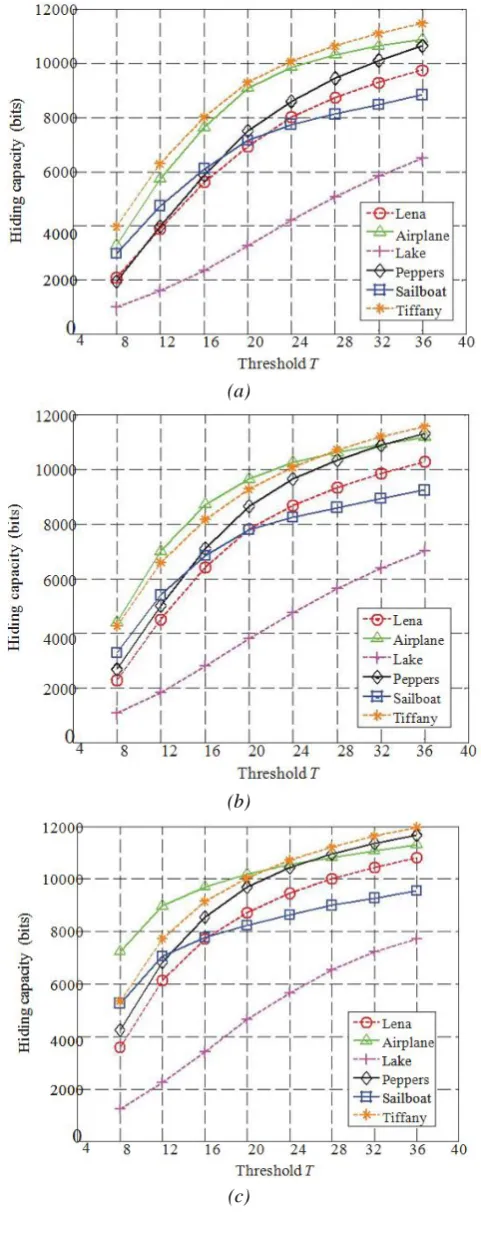
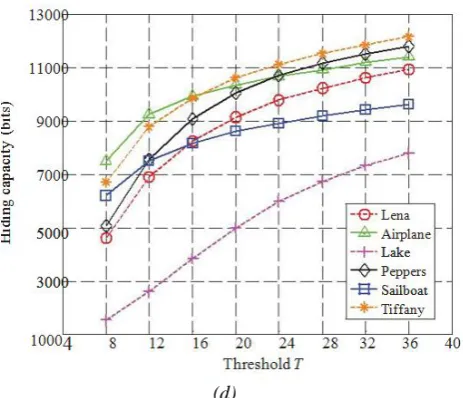
Because the threshold T used in the procedure of image compression and secret data embedding is closely related to the compression method for each residual block and also influences on the performance of the proposed scheme (see Figure 1), the testing for different values of T was first conducted in the compression and secret embedding procedure. Figures 5 and 6 show the labeling results of image blocks with different compression methods, in which the black block, gray block, and white block correspond to the blocks compressed by VQ, SMVQ, and image inpainting, respectively. The VQ codebook size W used in Figures 5 and 6 was 256, and secret bits for embedding were generated by pseudo-random number generator (PRNG). Note that the blocks in the topmost row and the leftmost column must be black, i.e., compressed by VQ. It can be obviously found that the number of SMVQ blocks and inpainting blocks increases with T, while the number of VQ blocks decreases. As described in Section 2, the blocks compressed by VQ are not used for secret bit embedding, and the secret bits are only embedded in the SMVQ and inpainting blocks. Thus, the hiding capacity of the proposed scheme is equal to the sum of the numbers of SMVQ and inpainting blocks. Figures 7(a)–(d) show the relationships between hiding capacity and threshold
for the six test images in Figure 4 with codebook sizes W = 128, 256, 512, and 1024, respectively. We can observe that, with the same codebook, the hiding capacity increases with the threshold T. It can also be seen from Figure 7 that, under the same threshold T, the hiding capacity also increases with the codebook size W.
(a)
(b)
Page 620 www.ijiras.com | Email: [email protected]
(d)
Figure 7: Relationship between hiding capacity and threshold T with different codebook sizes W. (a) W = 128, (b) W = 256,
(c) W = 512, (d) W = 1024.
We compared the hiding capacity of the proposed scheme with three typical schemes [31]–[33]. The schemes in [31], [32] and the proposed scheme all conduct the secret data hiding in the image compressed codes, while the scheme in [33] embedded secret data directly in the uncompressed form of the cover image, and its hiding capacity was based on the pixel number corresponding to the two highest peaks of the image histogram. Similar with our scheme, Tsai et al.’s
scheme [31] was also based on SMVQ, but it isn’t a kind of joint data-hiding and compression scheme, which means it embeds secret bits after compression. Qian et al.’s scheme
[32] utilized the JPEG compressed form of cover image, i.e., Tsai et al.’s Qian et al.’s Ni et al.’s Proposed
Images Scheme Scheme Scheme Scheme
[31] [32] [33]
Lena 5237 248 4604 10292
Airplane 7920 526 15384 11182
Lake 4983 457 7320 7247
Peppers 5332 372 5624 11295
Sailboat 6228 513 10546 9301
Tiffany 7522 625 7692 11566
Min. of 2055 124 2139 2246
UCID
Max. of 7126 609 91178 11832
UCID
Mean of 4852 437 10076 9153
UCID
Table 1: Comparis Ons Of Hiding Capacity Between The Prop Os Ed Scheme And [31]– [33] (UNIT: BITS)
JPEG bitstream, to embed secret bits. In this experiment, the threshold T in the proposed scheme and the JPEG quality factor in [32] were set to 36 and 70, respectively. As we described before, the hiding capacity of the proposed scheme is equal to the number of residual blocks that satisfy the evaluation condition of SMVQ quality, i.e., distortion value
Schemes
W =128 W =256 W =512 W =1024
C
R PSNR SSIM C
R PSNR SSIM C
R PSNR SSIM C
R PSNR SSIM VQ 18.29 29.70 0.8871 16.00 30.40 0.9101 14.22 31.13 0.9287 12.80 31.67 0.9412
SMVQ 20.66 29.70 0.8871 19.80 30.40 0.9100 19.16 31.12 0.9269 18.32 31.64 0.9413 Scheme
in 20.66 28.86 0.8853 19.80 29.75 0.9037 19.16 30.49 0.9254 18.32 30.93 0.9347 [31]
Scheme
in 21.98 26.62 0.8754 20.20 28.11 0.8986 17.73 28.54 0.9038 15.65 28.94 0.9105 [27]
Proposed 20.66 29.85 0.9086 19.80 30.57 0.9353 19.16 31.27 0.9447 18.32 31.78 0.9526 Scheme
Table 2: Comparis Ons Of Comp Res S Ion Perf Ormance With Different Codebook Sizes F Or Lena
Schemes
W =128 W =256 W =512 W =1024
C
R PSNR SSIM C
R PSNR SSIM C
R PSNR SSIM C
R PSNR SSIM VQ 18.29 29.16 0.9188 16.00 29.81 0.9305 14.22 30.62 0.9479 12.80 31.14 0.9570
SMVQ 21.37 29.16 0.9188 20.49 29.81 0.9305 19.61 30.62 0.9481 18.80 31.12 0.9559 Scheme
in 21.37 28.20 0.9001 20.49 28.75 0.9284 19.61 29.97 0.9330 18.80 30.56 0.9416 [31]
Scheme
in 25.51 26.29 0.8914 21.23 27.38 0.8995 17.70 27.90 0.9026 16.42 28.35 0.9157 [27]
Propose
d 21.37 29.31 0.9273 20.49 29.95 0.9367 19.61 30.72 0.9528 18.80 31.24 0.9602 Scheme
Table 3: Comparis Ons Of Comp Res S Ion Perf Ormance With Different Codebook Sizes F Or Airp Lane
Schemes
W =128 W =256 W =512 W =1024
C R PSNR SSIM C R PSNR SSIM C R PSNR SSIM C R PSNR SSIM VQ 18.29 26.63 0.9073 16.00 27.15 0.9189 14.22 27.69 0.9387 12.80 28.11 0.9496
SMVQ 18.83 26.63 0.9073 17.61 27.15 0.9192 16.81 27.69 0.9387 15.75 28.10 0.9513 Scheme
in 18.83 26.04 0.9008 17.61 26.58 0.9124 16.81 27.16 0.9325 15.75 27.76 0.9486 [31]
Scheme
in 20.70 25.23 0.8986 19.72 26.40 0.9042 16.95 26.78 0.9250 15.13 27.24 0.9393 [27]
Proposed 18.83 26.67 0.9164 17.61 27.19 0.9287 16.81 27.74 0.9430 15.75 28.14 0.9524 Scheme
Table 4: Comparis Ons Of Comp Res S Ion Perf Ormance With Different Codebook Sizes F Or Lake
Er ≤ T. Table I gives the comparison results of the hiding capacity for the six standard images in Figure 4 and the 1338 images in UCID database. The last three rows of Table I are the minimums, maximums, and mean values of the hiding capacities for the images in UCID database, respectively. We can find from the results that the proposed scheme has greater hiding capacity than the two schemes in the compressed domain, i.e., Tsai et al.’s scheme [31] and Qian et al.’s scheme
[32], and is comparable to the scheme in [33] that embedded secret information by histogram shifting in the uncompressed domain. The comparison results also demonstrate that the image compressed codes based on SMVQ can be used to carry more secret bits than the JPEG compressed codes.
We also compared the compression ratio and decompression quality of the proposed scheme with some VQ/SMVQ related schemes, i.e., the standard VQ method, SMVQ method, Chen et al.’s scheme [27], and Tsai et al.’s
Page 621 www.ijiras.com | Email: [email protected] the image as Lc. The compression ratio CR can be calculated
according to Eq. (5).
Peak signal-to-noise ratio (PSNR) was utilized to measure the visual quality of the decompressed images Id , see Eq. (6).
C
R =
8 × M × N , (5)
L c
2552 × M × N
PSNR = 10 × log10 MN , (6)
[I(x, y) − Id(x, y)]2
x =1 y=1
Where M and N are the height and the width of the images, respectively; I(x,y) and Id(x , y) are the pixel values
at coordinate (x , y) of the original uncompressed image I and the decompressed image Id , respectively Besides PSNR, the
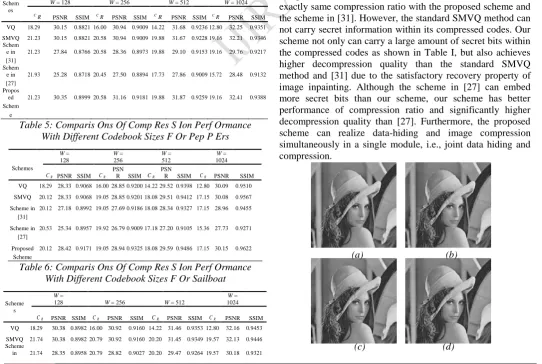
structural similarity (SSIM) was also used to assess the visual quality of the decompressed image. The mea-sure of SSIM was developed based on the characteristics of the human visual system (HVS), which integrated the information of structure, luminance and contrast synthetically for the image quality assessment [40]. Figure 8 shows the decompressed images of Lena by the proposed scheme with different thresholds T, and where the codebook sized 256 was used. Obviously, with the increase of T, more blocks are processed by SMVQ and image inpainting, therefore, the compression ratio C R increases accordingly, and the decom-pression quality also becomes better because image inpainting has superior recovery capability for smooth blocks compared with VQ.
Schem es
W =128 W =256 W =512 W =1024
C
R PSNR SSIM C
R PSNR SSIM C
R PSNR SSIM C
R PSNR SSIM VQ 18.29 30.15 0.8821 16.00 30.94 0.9009 14.22 31.68 0.9236 12.80 32.25 0.9351 SMVQ 21.23 30.15 0.8821 20.58 30.94 0.9009 19.88 31.67 0.9228 19.16 32.21 0.9346 Schem
e in 21.23 27.84 0.8766 20.58 28.36 0.8973 19.88 29.10 0.9153 19.16 29.76 0.9217 [31]
Schem
e in 21.93 25.28 0.8718 20.45 27.50 0.8894 17.73 27.86 0.9009 15.72 28.48 0.9132 [27]
Propos
ed 21.23 30.35 0.8999 20.58 31.16 0.9181 19.88 31.87 0.9259 19.16 32.41 0.9388 Schem
e
Table 5: Comparis Ons Of Comp Res S Ion Perf Ormance With Different Codebook Sizes F Or Pep P Ers
Schemes
W = 128
W = 256
W = 512
W = 1024
C R PSNR SSIM C R
PSN R SSIM C R
PSN
R SSIM C R PSNR SSIM VQ 18.29 28.33 0.9068 16.00 28.85 0.9200 14.22 29.52 0.9398 12.80 30.09 0.9510 SMVQ 20.12 28.33 0.9068 19.05 28.85 0.9201 18.08 29.51 0.9412 17.15 30.08 0.9567 Scheme in 20.12 27.18 0.8992 19.05 27.69 0.9186 18.08 28.34 0.9327 17.15 28.96 0.9455
[31]
Scheme in 20.53 25.34 0.8957 19.92 26.79 0.9009 17.18 27.20 0.9105 15.36 27.73 0.9271 [27]
Proposed 20.12 28.42 0.9171 19.05 28.94 0.9325 18.08 29.59 0.9486 17.15 30.15 0.9622 Scheme
Table 6: Comparis Ons Of Comp Res S Ion Perf Ormance With Different Codebook Sizes F Or Sailboat
Scheme s
W =
128 W =256 W =512
W = 1024
C R PSNR SSIM C R PSNR SSIM C R PSNR SSIM C R PSNR SSIM
VQ 18.29 30.38 0.8982 16.00 30.92 0.9160 14.22 31.46 0.9353 12.80 32.16 0.9453 SMVQ 21.74 30.38 0.8982 20.79 30.92 0.9160 20.20 31.45 0.9349 19.57 32.13 0.9446 Scheme
in 21.74 28.35 0.8958 20.79 28.82 0.9027 20.20 29.47 0.9264 19.57 30.18 0.9321 [31] Scheme
in 26.46 26.14 0.8746 22.68 27.89 0.8989 18.83 28.05 0.9018 17.04 28.30 0.9152 [27]
Propose
d 21.74 30.54 0.8996 20.79 31.09 0.9175 20.20 31.63 0.9348 19.57 32.29 0.9454 Scheme
Table 7: Comparis Ons Of Comp Res S I On Perf Ormance With Different Codebook Sizes F Or Tiffany
Schemes
W = 128
W = 256
W = 512
W = 1024
C R PSNR SSIM C R PSNR SSIM C R PSNR SSIM C R PSNR SSIM
VQ 18.29 29.05 0.9001 16.00 29.69 0.9267 14.22 30.34 0.9423 12.80 30.92 0.9536 SMVQ 20.67 29.04 0.8998 19.74 29.69 0.9273 18.96 30.33 0.9465 18.13 30.90 0.9532 Scheme
in 20.67 27.73 0.8994 19.74 28.34 0.9095 18.96 29.09 0.9228 18.13 29.72 0.9301 [31]
Scheme
in 22.82 25.83 0.8923 20.68 27.36 0.9016 17.68 27.74 0.9102 15.99 28.19 0.9247 [27]
Proposed 20.67 29.19 0.9012 19.74 29.85 0.9294 18.96 30.73 0.9488 18.13 31.69 0.9623 Scheme
Table 8: Comparis Ons Of Comp Res S Ion Perf Ormance With Different Codebook Sizes F Or Ucid
Tables II–VIII show the performance comparisons of the compression ratio and the decompression quality with different codebook sizes, and where T was set to 36. Note that the results of CR, PSNR and SSIM in Table VIII are the mean values for all the images in the UCID database. We can find from Tables II–VIII that, compared with the standard VQ method, the proposed scheme can achieve the comparable visual quality of decompressed images and obtain greater compression ratios. The standard SMVQ method has the exactly same compression ratio with the proposed scheme and the scheme in [31]. However, the standard SMVQ method can not carry secret information within its compressed codes. Our scheme not only can carry a large amount of secret bits within the compressed codes as shown in Table I, but also achieves higher decompression quality than the standard SMVQ method and [31] due to the satisfactory recovery property of image inpainting. Although the scheme in [27] can embed more secret bits than our scheme, our scheme has better performance of compression ratio and significantly higher decompression quality than [27]. Furthermore, the proposed scheme can realize data-hiding and image compression simultaneously in a single module, i.e., joint data hiding and compression.
(a) (b)
Page 622 www.ijiras.com | Email: [email protected] IV. CONCLUSION
In this paper, we proposed a joint data-hiding and compres-sion scheme by using SMVQ and PDE-based image inpaint-ing. The blocks, except for those in the leftmost and topmost of the image, can be embedded with secret data and compressed simultaneously, and the adopted compression method switches between SMVQ and image inpainting adaptively according to the embedding bits. VQ is also utilized for some complex blocks to control the visual distortion and error diffusion. On the receiver side, after segmenting the compressed codes into a series of sections by the indicator bits, the embedded secret bits can be easily extracted according to the index values in the segmented sections, and the decompression for all blocks can also be achieved successfully by VQ, SMVQ, and image inpainting. The experimental results show that our scheme has the satisfactory performances for hiding capacity, compression ratio, and decompression quality. Furthermore, the proposed scheme can integrate the two functions of data hiding and image compression into a single module seamlessly.
REFERENCES
[1] W. B. Pennebaker and J. L. Mitchell, The JPEG Still Image Data Compression Standard. New York, NY, USA: Reinhold, 1993.
[2] D. S. Taubman and M. W. Marcellin, JPEG2000: Image Compression Fundamentals Standards and Practice. Norwell, MA, USA: Kluwer, 2002.
[3] A. Gersho and R. M. Gray, Vector Quantization and Signal Compression. Norwell, MA, USA: Kluwer, 1992. [4] N. M. Nasrabadi and R. King, ―Image coding using vector
quantiza-tion: A review,‖ IEEE Trans. Commun., vol. 36, no. 8, pp. 957–971, Aug. 1988.
[5] Announcing the Advanced Encryption Standard (AES), National Institute of Standards & Technology, Gaithersburg, MD, USA, Nov. 2001.
[6] R. L. Rivest, A. Shamir, and L. Adleman, ―A method for obtaining digital signatures and public-key cryptosystems,‖ Commun. ACM, vol. 21, no. 2, 120–126, 1978.
[7] F. A. P. Petitcolas, R. J. Anderson, and M. G. Kuhn, ―Information hiding-survey,‖ Proc. IEEE, vol. 87, no. 7, pp. 1062–1078, Jul. 1999.
[8] C. D. Vleeschouwer, J. F. Delaigle, and B Macq, ―Invisibility and application functionalities in perceptual watermarking: An overview,‖ Proc. IEEE, vol. 90, no. 1, pp. 64–77, Jan. 2002.
[9] C. C. Chang, T. S. Chen, and L. Z. Chung, ―A steganographic method based upon JPEG and quantization table modification,‖ Inf. Sci., vol. 141, no. 1, pp. 123–138, 2002.
[10] H. W. Tseng and C. C. Chang, ―High capacity data hiding in JPEG-compressed images,‖ Informatica, vol. 15, no. 1, pp. 127–142, 2004.
[11] P. C. Su and C. C. Kuo, ―Steganography in JPEG2000 compressed images,‖ IEEE Trans. Consum. Electron., vol. 49, no. 4, pp. 824–832, Nov. 2003.
[12] W. J. Wang, C. T. Huang, and S. J. Wang, ―VQ applications in steganographic data hiding upon multimedia images,‖ IEEE Syst. J., vol. 5, no. 4, pp. 528– 537, Dec. 2011.
[13] Y. C. Hu, ―High-capacity image hiding scheme based on vector quanti-zation,‖ Pattern Recognit., vol. 39, no. 9, pp. 1715–1724, 2006.
[14] Y. P. Hsieh, C. C. Chang, and L. J. Liu, ―A two-codebook combination and three-phase block matching based image-hiding scheme with high embedding capacity,‖ Pattern Recognit., vol. 41, no. 10, pp. 3104–3113, 2008. [15] C. H. Yang and Y. C. Lin, ―Fractal curves to improve the
reversible data embedding for VQ-indexes based on locally adaptive coding,‖ J. Vis. Commun. Image Represent., vol. 21, no. 4, pp. 334–342, 2010.
[16] Y. Linde, A. Buzo, and R. M. Gray, ―An algorithm for vector quantiza-tion design,‖ IEEE Trans. Commun., vol. 28, no. 1, pp. 84–95, Jan. 1980.
[17] C. C. Chang and W. C. Wu, ―Fast planar-oriented ripple search algorithm for hyperspace VQ codebook,‖ IEEE Trans. Image Process., vol. 16, no. 6, pp. 1538–1547, Jun. 2007.
[18] W. C. Du and W. J. Hsu, ―Adaptive data hiding based on VQ com-pressed images,‖ IEE Proc. Vis., Image Signal Process., vol. 150, no. 4, 233–238, Aug. 2003.
[19] C. C. Chang and W. C. Wu, ―Hiding secret data adaptively in vector quantisation index tables,‖ IEE Proc. Vis., Image Signal Process., vol. 153, no. 5, pp. 589–597, Oct. 2006.
[20] C. C. Lin, S. C. Chen, and N. L. Hsueh, ―Adaptive embedding techniques for VQ-compressed images,‖ Inf. Sci., vol. 179, no. 3, pp. 140–149, 2009.
[21] C. H. Hsieh and J. C. Tsai, ―Lossless compression of VQ index with search-order coding,‖ IEEE Trans. Image Process., vol. 5, no. 11, 1579–1582, Nov. 1996.
[22] C. C. Lee, W. H. Ku, and S. Y. Huang, ―A new steganographic scheme based on vector quantisation and search-order coding,‖ IET Image Process., vol. 3, no. 4, pp. 243–248, 2009.
[23] S. C. Shie and S. D. Lin, ―Data hiding based on compressed VQ indices of images,‖ Comput. Standards Inter., vol. 31, no. 6, pp. 1143–1149, 2009.
[24] C. C. Chang, G. M. Chen, and M. H. Lin, ―Information hiding based on search-order coding for VQ indices,‖ Pattern Recognit. Lett., vol. 25, no. 11, pp. 1253–1261, 2004.
[25] T. Kim, ―Side match and overlap match vector quantizers for images,‖ IEEE Trans. Image Process., vol. 1, no. 2, pp. 170–185, Apr. 1992.
[26] C. C. Chang, W. L. Tai, and C. C. Lin, ―A reversible data hiding scheme based on side match vector quantization,‖ IEEE Trans. Circuits Syst. Video Technol., vol. 16, no. 10, pp. 1301–1308, Oct. 2006.
[27] C. C. Chen and C. C. Chang, ―High capacity SMVQ-based hid-ing scheme using adaptive index,‖ Signal Process., vol. 90, no. 7, 2141–2149, 2010.
Page 623 www.ijiras.com | Email: [email protected] [29] S. C. Shie and J. H. Jiang, ―Reversible and high-payload
image steganographic scheme based on side-match vector quantization,‖ Signal Process., vol. 92, no. 9, pp. 2332– 2338, 2012.
[30] C. F. Lee, H. L. Chen, and S. H. Lai, ―An adaptive data hiding scheme with high embedding capacity and visual image quality based on SMVQ prediction through classification codebooks,‖ Image Vis. Comput., vol. 28, no. 8, pp. 1293–1302, 2010.
[31] P. Tsai, ―Histogram-based reversible data hiding for vector quantisation-compressed images,‖ IET Image Process., vol. 3, no. 2, pp. 100–114, 2009.
[32] Z. X. Qian and X. P. Zhang, ―Lossless data hiding in JPEG bitstream,‖ J. Syst. Softw., vol. 85, no. 2, pp. 309– 313, 2012.
[33] Z. C. Ni, Y. Q. Shi, N. Ansari, and W. Su, ―Reversible data hiding,‖ IEEE Trans. Circuits Syst. Video Technol., vol. 16, no. 3, pp. 354–362, Mar. 2006.
[34] M. Bertalmio, G. Sapiro, V. Caselles, and C. Ballester, ―Image inpaint-ing,‖ in Proc. 27th Int. Conf. Comput. Graph. Interact. Tech., New Orleans, LA, USA, Jul. 2000, pp. 417–424.
[35] C. Qin, S. Wang, and X. Zhang, ―Simultaneous inpainting for image structure and texture using anisotropic heat transfer model,‖ Multimedia Tools Appl., vol. 56, no. 3, pp. 469–483, 2012.
[36] T. F. Chan and J. Shen, ―Nontexture inpainting by curvature-driven diffusions,‖ J. Vis. Commun. Image Represent., vol. 12, no. 4, 436–449, 2001.
[37] C. Qin, F. Cao, and X. Zhang, ―Efficient image inpainting using adaptive edge-preserving propagation,‖ Imag. Sci. J., vol. 59, no. 4, pp. 211–218, 2011.
[38] A. Criminisi, P. Perez, and K. Toyama, ―Region filling and object removal by exemplar-based image inpainting,‖ IEEE Trans. Image Process., vol. 13, no. 9, pp. 1200– 1212, Sep. 2004.
[39] G. Schaefer and M. Stich, ―UCID—An uncompressed color image database,‖ Proc. SPIE, vol. 5307, pp. 472– 480, Jan. 2004.