ISSN: 2278-067X, Volume 2, Issue 1 (July 2012), PP. 14-21
www.ijerd.com
Comparative Study of Different Forms of
Moringa Oleifera
Extracts for Turbidity Removal
Milind R. Gidde
1, Anand R Bhalerao
2, Chetan N.Malusare
3 1,2Professor,Dept. of Civil Engineering, Bharati Vidyapeeth Deemed University College of Engineering, Pune.-411043 3Institute of Environment Education and Research, Bharati Vidyapeeth Deemed University, Pune-411043.
Abstract––
Moringa oleifera (M.O) seeds are used as a primary coagulant in drinking water clarification due to presence of a water–soluble cationic coagulant protein, which is able to reduce the turbidity of treated water. Seeds are powdered and added to the water directly or after preparing crude extract. The seed kernels contain significant quantities of series of low molecular weight and water soluble protein, which carries positive charge to the solution. The protein is considered to act similar to a synthetic and positively charged polymer coagulant. When this protein is added to raw water, it binds with the predominantly negatively charged particulate making the raw water turbid. Under proper agitation these bound particulates then grow in size to form the flocks, which may be left to settle by gravity or removed by sedimentation. The study was carried out to observe the effectiveness of purification M. O. coagulant. The three forms of coagulants were used viz. Shelled blended, Deoiled powder and Protein powder. At optimum dosage, the percentage turbidity removal is found to increase with initial turbidity in case of all three coagulants. Among the three forms, protein powder has more removal efficiency than Deoiled and Shelled blended powder respectively. However, the amount of protein powder required for coagulation is least, followed by Deoiled and Shelled blended coagulants. Economics of all these three coagulants is compared with alum (chemical coagulant).K e y w o rd s ––
M o ri n g a ol e if e r a, c o ag u l a n t, de o il e d , tu r b i d it y
I.
INTRODUCTION
Turbidity removal is one of the important steps in water treatment process and generally is achieved by coagulation – flocculation – sedimentation process. Common coagulants like alum and iron salts have been widely used in conventional water treatment processes. Recent studies have pointed out many serious drawbacks of using these coagulants. Production of large sludge volume, Alzheimer’s disease, reduction in pH and low efficiency of coagulation in low temperature water are some of the problems faced with these coagulants. Also because of high cost and low availability, their use is difficult in many developing countries1. Many researchers have worked on natural coagulants produced and extracted from plants, animals and microorganisms2,3. Moringa oleifera is a tropical multipurpose tree that naturally grows in India, South Africa and South America4. The traditional use of Moringa oleifera seed for domestic household water treatment is limited to rural areas, where surface water is used for drinking purposes. It has been reported that MO has good coagulation1,4 and antimicrobial6,8 properties.
Moringa oleifera seeds are used as a primary coagulant in drinking water clarification and wastewater treatment due to presence of a water- soluble cationic coagulant protein, which is able to reduce turbidity of treated water. Seeds are added to the water straight or after preparing crude extract. Seed contains 43% oil, 41% protein and 9% carbohydrates7. However, the presence of oil and carbohydrates increases the content of organic matter in the treated water. This fact represents a disadvantage for its application at full scale water treatment and highly recommends purification of crude extracts. Extraction of seed oil before crude extract preparation can be a suitable purification option allowing oil recovery for industrial and food procedures and add value to defatted residues8.
The seed kernel contains significant quantities of series of low molecular weight and water soluble proteins, which impart positive charge to solution. The protein is considered to act similar to a synthetic positively charged polymer coagulant. When this protein is added to raw water, it binds with the predominantly negatively charged particulates which make raw water turbid. Under proper agitation, the bound particulates then grow in size to form the floc, which may be left to settle by gravity or may be removed by sedimentation9. MO coagulant protein has been has been identified as low molecular mass peptide10.
In the present study shelled blended, deoiled extracts and purified protein powder of Moringa oleifera were used as coagulant to remove the turbidity. The effects of these different forms of coagulant extracts were studied.
Objective
1: To study the effect of shelled blended M.O. extract for turbidity removal
II.
MATERIALS AND METHODS
Setting
This research was carried out in the laboratories of the Department of Civil Engineering at Bharati Vidyapeeth Deemed University College of Engineering, Pune, India.
Study design
The Moringa seeds were collected and three forms of these seeds were used as coagulant. We analyzed residual turbidity after treatment and the optimum dose was determined for varied turbid water samples of 50 NTU, 150 NTU and 450 NTU turbidity.
Preparation of turbid water samples:-
5 gm of Bentonite clay was mixed to 500 ml distilled water. Mixed clay sample was allowed to soak for 24 hrs. Suspension was then stirred in the rapid stirrer so as to achieve uniform and homogeneous sample. Resulting suspension was found to be colloidal and used as stock solution for preparation of turbid water samples. Everyday stock sample of bentonite clay was diluted by tap water to desired turbidity.
III.
PLANT MATERIAL
Moringa oleifera seeds were collected from surrounding of Pune and Satara districts of Maharashtra. The seeds were analysed to know the presence of carbohydrates, proteins and oil and other elements (Table No.1).
Table No. 1: Results of Seed analysis
Sr. No Sample Name Parameters Results Units Test Methods
1
Moringa oleifera Seeds
Protein 36.90 % AOAC 920.152
2 Fat 37.25 % Ranganna
3 Carbohydrates 16.38 % IS: 1656-1997
4 Crude Fiber 12.85 % SP-18 (P-IX) 1984
5 Moisture 6.41 % Ranganna
6 Ash 3.06 % AOAC 940.26
Pod shells were removed manually and kernel were ground in a domestic blender and sieved through 600µm stainless steel sieve. The three forms of coagulants were prepared in the following manner.
Coagulant 1: Shelled blended extract
Tree dried good quality Moringa Oleifera seeds were selected, shelled and the kernel crushed to fine powder in a blender. Two grams of the powder was added to 100 ml distilled water and blended for 10 minutes at high speed. This volume was made up to 200 ml resulting in the stock solution with an approximate concentration of 10,000 mg/l (1%). Fresh stock solution was prepared every day for each day’s experimental run. All experiments were performed with 1% concentration of coagulant.
C oa g u l a n t 2 : D e oi l e d p ow d e r
To the crushed shelled blended Moringa oleifera powder, ethanol (95%) was added in 1:10 ratio (1gm of seed powder and 10ml ethanol) to form a suspension. Then it was mixed with the help of magnetic stirrer for 10 minutes. The resulting supernatant was separated by centrifugation (300 rpm, 45 min) and the settled material was dried at room temperature for 24 hours.
C oa g u l a n t 3 : P r ot e i n p ow d e r
T o ob t a i n t h e pr ot e i n p ow d e r fol l ow i n g t w o s t e p s w er e p er for me d .
A ) E x t r a ct i o n o f p o lym er
Dried de-oiled Moringa Oleifera powder was used for extraction of polymer. This powder was then added to 3% sodium chloride solution. This suspension was continuously agitated for 12 hours in an orbital shaker. The resulting extract was then filtered through Whatman filter No.44 & brown colored sodium chloride filtrate was collected. Now the filtrate was further heated in such a way that no white precipitation was formed at the bottom of solution.
B ) P u r if i c at i o n o f P o l ym e r
Heated crude protein extract solution was further poured into a dialysis tube (Himedia, Mumbai) and kept for 12 hours in a beaker containing cold water which was kept in an ice bath. During dialysis, salts were removed into the surrounding water solution and white protein remained inside the tube. The protein was removed out from the tube by rinsing with deionised water. This separated protein was homogenized with cold acetone for delipidization in a homogenizer to remove lipids. After delipidization this protein was then dried at room temperature.
C oa g u l a n t a c t i vi t y t es t
Supernatant was collected from each sample and residual turbidities were used as a base for comparing the efficiency of coagulation. Jar tests were performed with synthetic turbid water samples of 50 NTU, 150 NTU and 450 NTU turbidity. In order to ensure the validity of the experiments, all the tests were carefully performed in triplicate and the arithmetic average values were used for further calculation. The average percentage error of the triplicate samples was 1.2%, with a minimum of 0.0%, a maximum of 9.5%, and a standard deviation of 2.1% of the goal turbidities of 50 NTU, 150 NTU and 450 NTU. The actual laboratory initial turbidity values were, on average, within 3.1% of the goal turbidities of 50 NTU, 150 NTU, and 450 NTU. The minimum error from intended initial turbidity was 0.0%, the maximum error was 20.0%, and the standard deviation was 4.2%. Single factor method of Optimization is used for the study. In this method the experimentation is carried out by keeping one parameter varying and other parameters are kept constant.The experiments were performed according to Bureau of Indian Standards IS 3025(PART 50): 2001
IV.
COST ECONOMICS
Each tree can produce approximately 400-1000 pods per year i.e. 15000 to 25000 seeds per year11. The average weight of non shelled seed is 300 mg. The kernel to hull ratio is 75.25%.
To compare the cost of Moringa seeds with that of alum, a case study of one village was studied. For one village with a population of 5000, water requirement is 200,000 lit/day.For daily water treatment, required quantity of Alum and Moringa coagulants and correspondingly plantation to produce required Moringa seeds for three coagulants are given in Table No. 2. The area required for plantation of one M.O. tree is considered to be 9 sq. m.
V.
RESULTS AND DISCUSSION
Jar test experiments with different Moringa oleifera coagulant forms were performed by using three forms of coagulant extracts. These coagulants were prepared by using a standard preparation method as discussed earlier. Initially the optimum dosage was determined. This was the dosage of coagulant corresponding to the lowest residual turbidity.At optimum dosage, the percent turbidity removal rate was found to increase with initial turbidity in case of all three coagulants.
1) Shelled blended Moringa oleifera coagulant was able to achieve 76.45% turbidity removal at an optimum dosage of 70 mg/L for 50 NTU whilst for 150 and 450 NTU turbidity the dosage were 120 mg/L and 240 mg/L respectively and percentage turbidity removal was 92.33% and 97.7% respectively.(Graph-1,2,3)
24
23 21
20
11.8
12.7
0
5
10
15
20
25
30
0
50
100
R
e
s
id
u
a
l
te
rb
id
ity
(NT
U
)
M O Shelled blended Dose (mg/L)
Graph No.1 - Optimum dose for 50
…
70 mg/l Optimum …
30
27
22.1
19
11.2
16
0
5
10
15
20
25
30
35
50
70
90
110
130
150
R
e
s
id
u
a
l
te
rb
id
ity
(N
T
U
)
M O Shelled blended Dose (mg/L)
Graph No.2- Optimum dose for 150
…
2) Deoiled powder of Moringa oleifera was able to achieve 77.8%turbidity removal at an optimum dosage of 50 mg/L for 50 NTU whilst for 150 and 450 NTU turbidity the dosage were 90 mg/L and 210 mg/L respectively and percentage turbidity removal was 95.86% and 98.11% respectively (Graph-4,5,6).
33
30
27
21
12.7
17.1
0
5
10
15
20
25
30
35
150
170
190
210
230
250
270
Res
id
u
a
l
te
rb
id
it
y
(
NT
U)
M O Shelled blended Dose (mg/L)
Graph No.3- Optimum dose for 450 NTU turbidity
240 mg/l Optimum dose
24
20
17
13.1
11
14.5
0
5
10
15
20
25
30
0
20
40
60
80
R
e
s
id
u
a
l
te
rb
id
ity
(N
T
U
)
M O Deoiled powder Dose (mg/L)
Graph No.4 - Optimum dose for 50 NTU
turbidity
50 mg/l Optimum dose
11.4
8.2
6.2
7.4
9.4
9.8
0
2
4
6
8
10
12
50
70
90
110
130
R
e
s
id
u
a
l
te
rb
id
ity
(N
T
U
)
M O Deoiled powder Dose (mg/L)
Graph No.5 - Optimum dose for 150 NTU
turbidity
3) Protein powder extract of Moringa oleifera was able to achieve 84.4% turbidity removal at an optimum dosage of 20 mg/L for 50 NTU whilst for 150 and 450 NTU turbidity the dosage were 40 mg/L and 100 mg/L respectively and percentage turbidity removal was 95.86% and 98.11% respectively.(Graph-7,8,9)
11.4
8.2
6.2
7.4
9.4
9.8
0
2
4
6
8
10
12
50
70
90
110
130
R
e
s
id
u
a
l
te
rb
id
ity
(N
T
U
)
M O Deoiled powder Dose (mg/L)
Graph No.5 - Optimum dose for 150 NTU
turbidity
90 mg/l Optimum dose
9.1
7.8
10.7
12.7
0
2
4
6
8
10
12
14
0
20
40
60
R
e
s
id
u
a
l
te
rb
id
ity
(N
T
U
)
M O Protein powder Dose (mg/L)
Graph No.7- Optimum dose for 50 NTU
turbidity
20 mg/l Optimum dose
12.5
5.5
9.7
10.2
0
2
4
6
8
10
12
14
0
20
40
60
80
R
e
s
id
u
a
l
te
rb
id
ity
(N
T
U
)
M O Protein powder Dose (mg/L)
Graph No.8 - Optimum dose for 150
NTU turbidity
The oil content in the seed forms an emulsion or film coating, which may inhibit the contact with surface of reaction and thus reduce flocculation. This can be a possible explanation for maximum percentage of turbidity reduction when coagulant has no oil content.
Percentage reduction in dose
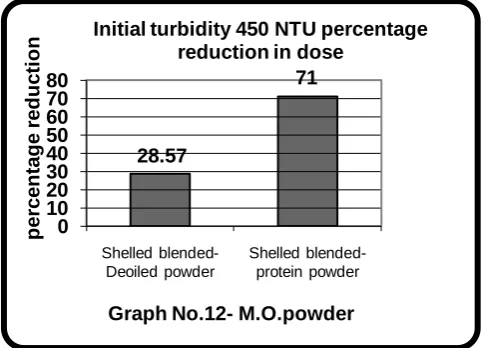
At 50 NTU turbidity, 28.57% dose reduction in de-oiled powder and 71.42% reduction in protein powder were observed whereas for 150 NTU turbidity, the percentage reduction in dose for de-oiled powder was observed to be 25% and for protein powder was 66.66%. Whereas for 450 NTU turbidity, the percentage reduction in dose for de-oiled powder was observed to be 12.5% and for protein powder was 58.38 % (Graph-10, 11, 12).
14.1
6.7
7.7
9.2
0
2
4
6
8
10
12
14
16
50
70
90
110
130
150
R
e
s
id
u
a
l
te
rb
id
ity
(N
T
U
)
M O Protein powder Dose (mg/L)
Graph No. 9- Optimum dose for 450 …
100 mg/l Optimum dose
12.5
58.38
0
10
20
30
40
50
60
70
Shelled blended-Deoiled powder
Shelled blended-protein powder
p
e
rc
e
n
ta
g
e
r
e
d
u
c
ti
o
n
Graph No.10-M.O.powder
Initial turbidity 50 NTU percentage
reduction in dose
25
66.66
0
10
20
30
40
50
60
70
Shelled blended-Deoiled powder
Shelled blended-protein powder
p
e
rc
e
n
ta
g
e
r
e
d
u
c
ti
o
n
Graph No.11- M.O.powder
Shelled blended, de-oiled powder & protein powder, all three are being used as coagulants. Among them, protein powder has more removal efficiency than de-oiled & shelled blended powder respectively, but the amount of protein powder as coagulant requirement is less followed by de-oiled & Shelled blended.
Cost economics
For cost economics studies one village having population 5000 was considered. Water requirement for this village @ 40 lpcd is 2 lakh litres per day. For daily water treatment the amount of coagulant required depends upon the turbidity of water in that area. If a village receives turbid water of 50 NTU, then optimum dose of alum is 30 mg/lit. So the quantity of alum required will be 6 kg per day, which will cost nearly Rs.96 per day at the rate of Rs.16/kg. Whereas in case of different forms of Moringa coagulant - shelled blended, deoiled powder, protein powder - the optimum dose is 70 mg/lit, 50 mg/lit & 30 mg/lit respectively. The total quantity of these coagulants required per day will be 14 kg of shelled blended, 10 kg of deoiled powder & 2.7 kg of protein powder. It will cost around Rs.2800 for shelled blended & Rs.1200 for deoiled powder per day. Then the area required for cultivation of Moringa plantation was determined. Then to obtain required quantity of coagulant (shelled blended, deoiled powder, protein powder), the number of trees is 637, 775 and 342 respectively and the land requirement for cultivation is 1.42 acre, 1.72 acre & 0.76 acre respectively (for 150 NTU and 450 NTU turbidity water, the required coagulant cost and number of trees are given in the Table No.2.
T a b l e N o . 2 : C os t E c on omi c s Form of Coagulant Initial
Turbidity (NTU)
Optimum dose (mg/l)
Seed Quantity (kg/day)
Rate (Rs)
Cost (Rs/day)
No of trees
(182. day)
Area (acre)
Shelled blended 50 70 14 Rs. 200/kg
2800 637 1.42
150 120 24 4800 1092 2.43
450 240 48 9600 2184 4.86
Deoiled powder 50 50 10 Rs. 120/kg.
1200 775 1.72
150 90 18 2160 1368 3.04
450 210 42 5040 3193 7.1
Protein powder 50 20 2.7 Data not available
342 0.76
150 40 5.4 664 1.4
450 100 13.5 1642 3.65
Alum 50 30 6 Rs.
16/kg.
Not required
150 50 10
450 90 18
( S ou r ce s - * R i mp l e a l oe ve r a p r od u ct s , G u j a ra t * R ahe j a ch e mi ca l s , P u n e , * N at i on a l r u r al dr i n ki n g w a t e r pr ogr a m, * J a h n , 1 9 8 8, * P a r a g S a d d gi r, 2 0 0 7 )
VI.
CONCLUSION
Three coagulants shelled blended powder; deoiled powder and protein powder of the Moringa oleifera coagulant were used in the present study. Among them, protein powder has maximum removal efficiency compared to deoiled and shelled blended powder. The Shelled blended powder contains carbohydrates, oil and protein. The protein acts as a coagulant. The oil and carbohydrates present increase the organic matter contained in the treated water. This makes water unsuitable for drinking after storing it for some time. The deoiled powder contains protein and carbohydrates. The removal
28.57
71
0
10
20
30
40
50
60
70
80
Shelled blended-Deoiled powder
Shelled blended-protein powder
p
e
rc
e
n
ta
g
e
r
e
d
u
c
ti
o
n
Graph No.12- M.O.powder
of oil reduces the organic matter content of the water thus making water more suitable for drinking. The purified proteins reduce the organic matter content to the least. The reduction in the optimum dose required for shelled blended powder to deoiled powder to protein powder is because of the removal of oil and the carbohydrates, as only protein acts as a coagulant.
In many villages of India, hundreds of acres of barren land are available. These lands can be utilized for cultivation of Moringa plants. As this plant does not require any specific soil type to grow, it can grow even in semi-arid regions as well. This plantation ultimately reduces the cost of chemical coagulants and also different byproducts of Moringa like leaf powder, Moringa oil and flowers are available. It can be of better economic benefits to locals.
VII.
ACKNOWLEDGEMENT
The authors are grateful to Bharati Vidyapeeth Institute of Environment Education & Research Pune, and B.V.D.U. College of Engineering, Pune and Rajiv Gandhi Institute of I.T. & B.T. Pune.
REFERENCES
[1]. Ndabigengesere Anselme, Narasiah K.S Quality of water treated by coagulation using Moringa Oleifera seeds. Water Res. 32(3), 781-791(1998)
[2]. Kawamura S. Effectiveness of natural polyelectrolytes in water treatment. JAWWA, 83(10), 88-91 (1991)
[3]. Lee S.H., Lee S. O., Jang K.L., Lee T. H.,Microbial flocculant from arcuadendron SP – 49. Biotechnol. Lett. 17(1), 95 – 100
(2001)
[4]. Jahn S.A.A. Using Moringa seeds as coagulants in developing countries. Journal of American Water Works Association, 80:43– 50 (1988).
[5]. Muyibi S.A. and Evison L.M Optimising Physical Parameters affecting Coagulation of Turbid water with Moringa Oleifera seeds. Water Res. 29 (12), 2689-2695 (1995)
[6]. Olsen Annette Low technology water purification by Bentonite clay and Moringa oleifera seed flocculation as performed in Sudanese villages: Effects on Schistosoma mansoni cercariae. Water Res. 21 (5) 517-522(1987)
[7]. Anhwange B.A., Ajibola V.O., Oniye S.J. Chemical studies of the seeds of Moringa oleifera (Lam) and Detarium microcarpum (Guill and Spurr) J. Of Biological Sciences 4(6) 711-715 (2004)
[8]. Ghebremichael K.A, Gunaratna K.R, Henriksson H,Brumer H, Dalhammar G. A. Simple purification and activity assay of the coagulant protein from Moringa oleifera Seed. Water Research 39: 2338-2344 (2005).
[9]. Geoff Folkard, John Sutherland, Rod Shaw .water clarification using Moringa oleifera seed as coagulant. Val-3, (2007)
[10]. Gassenschmidt U, Jany K K, et al. Isolation and characterization of a flocculation protein from MO lam. BBA Biochem Biophys Acta 1243: 477-481 (1995)