IOSR Journal of Engineering (IOSRJEN) www.iosrjen.org
ISSN (e): 2250-3021, ISSN (p): 2278-8719
Vol. 09, Issue 11, November. 2019, Series -III, PP 51-56
Induce the Qualitative Effect of Applied Stresses on the Low
Temperature Sensitization of Type 304 SSS
Kalyani K. Choudhari
1, Prasad P. Mahajan
Lecturer, Dept. of Mechanical Engineering, Govt. Polytechnic, Yavatmal, IndiaCorresponding Author: Kalyani K. Choudhari Received 21 November 2019; Accepted 05 December 2019
Abstract: In most industries Austenitic stainless steel equipments are used for the various purpose. This equipments are fail due to sensitization in long service life of equipments. Sensitization is the corrosion phenomenon which occurs due to formation of chromium carbide along the grain boundary which causes chromium depletion near the grain boundary during welding or any other heat treatment.. Main study of this paper is to analyze the qualitative effect of residual stresses which is formed during welding on the diffusion kinetics of chromium carbide has been studied. This is done by applying external loading condition in simulated environment condition. For sensitization evaluation Oxalic etch test is used. It is found that residual stresses accelerate the diffusion kinetics of chromium carbide.
Keywords: High Temperature Sensitization (HTS), Low Temperature Sensitization (LTS), Residual Stresses, oxalic acid etch test
I.
INTRODUCTION
As Austenitic stainless steel was the major group of stainless steelsused in many industries like chemical, nuclear power industries due to its excellent corrosion resistance. But this material are fail in many areas like furnace tubes in petrochemical industries, impeller blade of centrifugal pump in coke plant etc. is due sensitization effect. Sensitization is the corrosion phenomenon which occur at temperature between 500 ºC to 800 ºC during welding. At such high temperature chromium is unstable and drawn from solid solution.Because of this chromium carbide is formed along the grain boundary causing chromium depletion near the grain boundary called chromium depletion [1, 2]. This sensitization is mainly occur in HAZ (Heat Affected Zone) of welding [3, 4]. This phenomenon is called High temperature sensitization(HTS). When this welded steels equipments are used in industry at temperature below 300 ºC, chromium carbide formed during welding can be grown and causeslarge degree of chromium depletion called Low Temperature Sensitization (LTS). During Low Temperature Sensitization, pre-existing carbide which are already formed during welding are grows but there is no new nuclei of chromium carbide forms [5]. For simulating the environmental condition, Laboratory heat treatment condition was used. This condition was simulated by using the Arrhenius equation which is the relationship between time, temperature and activation energy [6].
Effect of alloying element and cold working on low temperature sensitization had been already investigated [7, 8]. But the very few research are available on the effect of applied stresses on the degree of sensitization. During welding, residual stresses are formed which is due to uneven expansion and contraction. These residual stresses are remain in the material during its service life. But weather this stresses affect the diffusion kinetics of chromium carbide, weather this stresses accelerate or deaccelerate the degree of sensitization. Very limited researches are available on this study. Therefore, the main objective of present study is to determine variation of chromium carbide due to these residual stresses.
II.
EXPERIMENTAL DETAILS
a. Materials
The chemical composition of the solution annealed 304 stainless steels used in this study is given in Table 1.
Table 1: Chemical Composition of the 304 stainless steels
Alloy Elements (wt. %)
Cr Mn Ni C Si S Fe
Type 304 18.39 1.9 8.01 0.046 0.401 0.014 70.1
condition for carbide precipitation (ASTM A262) . For simulating the service life at 300 ºC for 10 and 40 years in laboratory, low temperature sensitization at 500 °C for 24 h (LTS1) and 500 °C for 100 h(LTS2) respectively was used. This is calculated by using Arrhenius equation at the activation energy of 150 kJ/mole which is measured for LTS [8]. For studying the effect of residual stresses, same heat treatment condition was used by applying the tensile load of 1 kg on the both side of specimen.
c. Experimental Setup for the Sensitization Heat Treatment
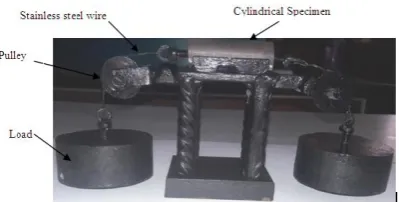
Schematic diagram of the specimen required for sensitization heat treatment without stressed condition and with stressed condition are shown in Fig.1 Experimental setup for the sensitization heat treatment under tensile stress condition is given below in Fig. 2
(a) (b)
Figure 1:Schematic diagram of the specimen for sensitization heat treatment (a) without stressed condition and (b) with stressed condition (All dimensions are in mm)
Figure 2: Experimental set-up for sensitization heat treatment under stressed condition
d. Sensitization Evaluation Method - Oxalic Acid Etch Test (ASTM A262 – Practice - A)
To study the microstructure of a received material and sensitized material ASTM A262, Practice A, Oxalic Acid Etch Test is used. This test is used for the classification of micro structure of austenitic stainless steels. The oxalic acid etch test is a highly rapid method.This method is used for screening the specimens of certain stainless steel grades. After oxalic acid test, the etched surface is examined on optical metallurgical microscope at 250X to 500X. The etch structures are classified into step, dual and ditch structures.
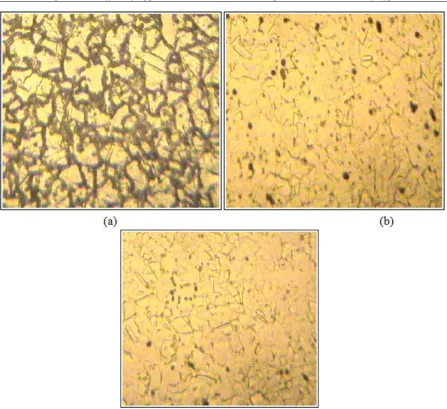
Step structure:Only steps are seen between the grains,no ditches at grain boundaries as shown in fig. 3(a) at 500 X magnification.
Dual Structure:Some ditches are formed at grain boundaries in addition to steps, but no single grain are completely surrounded by ditches as shown in fig .3(b) at 250 X magnification
Ditch Structure: One or more grains boundariesare completely surrounded by heavy ditch attack due to the presence of carbides / chromium depletion regions at grain boundaries as shown in fig. (c) at 500X magnification.
(a) (b) (c)
Figure 3.The etch structures for oxalic acid test (a) Step Structure (500X) (b) Dual Structure (500X) (c) Ditch Structure (500X)
The microstructure of all the stainless steel samples were examined after electrochemical etching in oxalic acid (H2C2O4.2H2O) according to ASTM A262 – Practice – A with the help of optical microscope. ASTM A262, Practice A, Oxalic Acid Etch Test gives the results for the intergranular attack which shows the precipitation of chromium carbides.
Specimen Preparation for Oxalic Acid Each Test
Hack saw machine is used for the cutting the samples of required length. On all types of materials, cross sectional surfaces should be polished for etching and microscopical examination. After cutting the specimen the uneven surface formed because of cutting action is remove by using grinding belt of 80 or 120-grit. Then polish the specimen on successively finer emery papers, No. 400, 600, 800, 1000 and 1200 by using wet polishing technique. After completing the polishing, sample is taken for the Oxalic acid etching test. The solution used for etching is prepared by adding 100 grams of reagent grade oxalic acid crystals (H2C2O4·2H2O) to 900 ml of distilled water and stirring until all crystals are dissolved. The sample is connected in circuit as anode and reference material (cylindrical piece of stainless steel) is connected in circuit as cathode. The polished specimen should be etched at 1 A/cm2 for 1.5 min. The etched surface is examined on a metallurgical microscope at 500X magnification. Apparatus needed to carry out ASTM A262, Practice A, are as follows:
(a) (b)
Figure 4.a) Schematic diagram b) Set-up for the oxalic acid etch test
Figure 5.Photograph of specimen for the Oxalic test
III. RESULTS AND DISCUSSION
a.Microstructural Characterization by Oxalic Acid Etch Test
The microstructures of different heat-treatment of Types 304 stainless steels obtained after the oxalic acid test, according to ASTM A262, Practice A, are shown in Fig.6
(one or more grains are completely surrounded by heavy attack due to the presence of carbides/chromium depletion regions at grain boundaries) as shown in Fig. 6[b].The low-temperature-sensitized alloy 304 (500 °C for 24 h) shows structure with attack observed only on very few grain boundaries as shown in Fig. 6[c].The low-temperature-sensitized alloy 304 (500 °C for 100 h) shows ―dual‖ structure (some ditches are formed at grain boundaries in addition to steps, but no single grain are completely surrounded by ditches) as shown in Fig. 6[d].
Figure 6. Optical micrographs of type 304 stainless steel for (a) Solution annealed condition (b) Sensitization heat treatment at 675 °C for 1 h (c) Low temperature sensitization (500 °C for 24 h) (d) Low
temperature sensitization (500 °C for 100 h).
e.Microstructural Evaluation with Tensile Stressed Condition of 2 kg Load
The microstructures of different heat-treatment of Types 304 stainless steels obtained after the oxalic acid test for tensile stressed condition of 2 kg load are shown in Fig. 3.2.
(c)
Figure 7:Optical micrographs of type 304 stainless steel for (a) Sensitization heat treatment at 675 °C for 1 h (b) Low temperature sensitization (500 °C for 24 h) (c) Low temperature sensitization (500 °C for 100
h) with 2 kg tensile load.
The continuous chromium depleted zone along the grain boundary is due to the diffusion of chromium towards the growing carbides precipitates. (T. M. Devine 1990). As time and temperature increase of heat treatment width of Cr depleted zone are also increases. Diffusition kinematics of carbon is more as compared to chromium, hence the formation of Cr23C6 mainly depend on chromium diffusion (E. L. Hall and C. L. Briant 1984). Povich can performed number of experiment which are below 500 °C which showed that the sensitization phenomenon occurred at temperature which are below the normal temperature range. A necessary requirement for this low temperature sensitization is a heat treatment which are capable of nucleating grain boundaries carbides (M. J. Povich 1978). As the carbon content increases time necessary for the sensitization dec. Addition of nitrogen retards the sensitization and Molybdenum helps to form the passive layer (C. L. Briant et. al 1982, A. J. Sedriks 1986).
International organization of Scientific Research
56 | Page
IV.
CONCLUSIONS
Sensitization behaviour of 304 Stainless Steel for heat treatment 675 °C for 1h, Low temperature sensitization-LTS1 (500 °C for 24 h) and Low temperature sensitization- LTS2 (500 °C for 100 h) for without stressed condition and with stressed condition was studied using the oxalic acid test.
By comparing the micro structure of without stress condition anf by using the stressed condition it was shown that carbide formation during stressed condition condition increases as compared to without stress condition. Hence from this it was prove that if the stresses are remain in material during welding then it increases the carbide formation. But this is only on the basis of qualitative method.
REFERENCES
[1]. Ernest L. Hall and Clyde L. Briant. (1984). Chromium Depletion in the Vicinity of Carbides in Sensitized Austenitic Stainless Steel.International journal of Corrosion Science. 15A 793-811.
[2]. T. M. Devine. (1990).The Mechanism Of Sensitization of Austenitic Stainless Steel. International journal of Corrosion Science.30 135-151.
[3]. M. J. Povich and P. Rao. (1978).Low temperature sensitization of Welded Type 304 Stainless Steel. International journal of Corrosion Science. 34 269-275.
[4]. Schmidt C. G. Caligiuri R. D., Eiselstein L. E., Wing S. S. and Cubicciotti D. (1987)Low temperature sensitization of Type 304 stainless steel pipe on weld heat affected zone. International journal of Corrosion Science.18 1483-1493.
[5]. G. Cragnolino and D. D. Macdonald. (1982). Intergranular Stress Corrosion Cracking of Austenitic Stainless Steel at Temperatures Below 100 C —A Review.International journal of Corrosion Science. 38, 406-427.
[6]. M. J. Povich. (1978). Low temperature sensitization of Type 304 Stainless Steel.International journal of Corrosion Science. 34 60-65.
[7]. A. J. Sedriks. (1986). Effect of alloy composition and microstructure on the passivity of stainless steels.International journal of Corrosion Science. 42 376-389.
[8]. Kain V., Chandra K., Adhe K. N., and De P. K.(2004). Effect of cold work on low-temperature sensitization behavior of austenitic stainless steels.Science direct. 334 115-132.
[9]. ASTM A262-02a. Standard Practices for Detecting Susceptibility to Intergranular Attack in Austenitic Stainless Steels. ASTM International, 2002).
[10]. C. L. Briant, R. A. Mulford, and E. L. Hall. (1982). Sensitization of Austenitic Stainless Steels, I. Controlled Purity Alloys. International journal of Corrosion Science. 38 468-477.

![Fig. 6[d].](https://thumb-us.123doks.com/thumbv2/123dok_us/7798986.1659968/4.595.76.526.157.561/fig-d.webp)