Parameter Auto-tuning Method Based on
Self-learning Algorithm
Chaohua Ao
Dept. of Automation, Chongqing Industry Polytechnic College, Chongqing, China Email: [email protected]
Jianchao Bi
College of Automation, Chongqing University, Chongqing, China Email:[email protected]
Abstract—The central air condition system is a complex
system. Aimed at the puzzle of optimal status adjusting by once setting parameter of fuzzy PID, the paper proposed a sort of parameter auto-tuning method of fuzzy-PID based on self-learning algorithm. It adopted parameter auto-tuning technique to adjust the PID parameters in real time so as to ensure good quality of control system. It combined fuzzy logic control with classical PID control, and then made the fuzzy auto-tuning of PID parameter on line, after that, the parameters of adjusted system were switched to the natural work status. Once the change of system performance occurred, and it went beyond the specified range, then the system would automatically start the parameter tuning process of PID. The engineering practice shows that the retuned parameters could obtain better control effect than before, therefore the system performance is greatly enhanced, and it is higher in control accuracy, better in stability, stronger in robustness.
Index Terms—parameter auto-tuning, fuzzy PID controller,
self-learning algorithm
I. INTRODUCTION
The central air condition system is a complex system with big lag, nonlinearity and big inertia of multi-input and multi-output, and also a huge energy consumption system over 50℅ in the whole building energy consumption. Furthermore, the system is difficult to build the precise math model, so the traditional PID controller used currently is not a better choice, such as poor in control precision, bad in stability and reliability, difficult in satisfying user demand etc. And these shortcomings make an unsatisfying control effect and result in a huge waste in energy consumption. The paper takes an engineering reform of central air condition system for a certain tobacco factory as an example, and discusses the method of related parameter auto-tuning. The system reform adopts parameter auto-tuning technique of fuzzy PID controller. By means of fuzzy auto-tuning online of PID parameter, it can modify the PID parameter in real time, and make system running locate the optimal status all the time. As a result, compared with the convention algorithm it makes not only satisfy the technical
performance index better, but also saves the energy source in great extent outstandingly.
II.CYBERNETICS CHARACTERISTIC OF CONTROLLED
OBJECT AND ITS CCONTROL STRATEGY SELECTION
A. Cybernetics Characteristic
The central air-condition control system mainly is used to control the temperature and humidity in the room of the building, and it is a very complicated system. As a result of building space being a open system, the temperature and humidity located at each coordinate point in the room are different each other, therefore it is a complex control system with input and multi-output, and thereby it has become a hot spot of the control theory and control engineering area. In order to obtain better control effect and control quality, first it has to research on cybernetics characteristic of controlled object so as to seek correct control strategy and algorithm.
Because the control of temperature and humidity in a open space is a very typical complex process, it is hard to describe the control process characteristic by strict mathematics method, such as nonlinear in variable parameter, time varying in system performance, and so on. Also it appears the randomicity, fuzzification and non-stability, up to now, it is still difficult to build the strict mathematics model by uniform mathematics method.
In generally speaking, the process characteristic in cybernetics of controlled object can be reduced as the following.
1) The process parameter is unknown or uncertainly known, and varying with the time, random in regular pattern as well as decentralized in space distribution.
2) The time lag of process is unknown or uncertainly known, and the time lag is always varying.
3) There is a serious nonlinearity in parameter and process with the changing of time and space coordinate position.
5) The disturbance of process environment is unknown or uncertainly known, and the representation form appears multiformity and randomicity.
6) The controlled object is a big inertia system with uncertainty lag.
From the above mentioned, we can known that it is difficult to obtain better control effect for central air-condition process control by means of traditional control strategy (PID) and method of modern control theory. Therefore it is necessary to research farther the control strategy.
B.Control strategy Selection
There are lots of control strategies that can be supplied to select, but there still are lots of puzzle needed to be solved. For example, NN control needs definite experiment samples. Due to the influence of uncertainty, it is hard to obtain the experiment samples from the known experience and forehand experiment. Because of the method limitation, it is also difficult to realize effective control generally. The expert control system is based on the knowledge, and because it is difficult to sample the characteristic information to express the characteristic information and build the maturity repository. Therefore the expert control system is also difficult to realize the control of air-condition process. The hominine control experience can carry through the summarization and description by means of hominine language, it can be depicted to fuzzy linguistic language by means of fuzzy set in fuzzy mathematics, and also it can be realized by the sentence of “IF condition THEN action”. But because the uncertainty factors are too much, the general fuzzy control is unnecessarily a good choice for air-condition process. The basic property of HSIC
(Human Simulated Intelligent Control) is to simulate the control behavior of control expert. Therefore its control algorithm is multi-mode control, and the material method is to execute alternate use among multi-mode control. Such a property makes that a good many contradictions of control quality demand are perfectly harmonized for control system. It is maybe a sort of more wise choice. But as a result of the parameters adjusted being too much, the parameter tuning is very complex, therefore it is not able to be selected. In this paper, we select the parameter auto-tuning method based on self-learning algorithm of fuzzy PID controller. The next we discuss the related problem of parameter selection for PID controller.
III. INFLUENCE OF EACH PID PARAMETER FOR SYSTEM
The following discusses influence of each parameter of PID controller for steady and dynamic performance.
A. Proportional Unit
The function of proportional unit is to reduce the system deviation. If the proportion coefficient KP increases, then the response speed will be quickened, and the system steady error will be reduced, therefore the control precision will be enhanced. But too big KP can result in bigger overshoot and system unstable. If KP takes too small then the overshoot will be reduced, the
system stability margin will be magnified, but the control precision will be reduced, and it will make the transitional process be long [1, 2].
B. Integral Unit
Its action is to eliminate steady error of the system, but it can make the system response speed get slow down, and therefore it makes system overshoot quantity get big, it is possible to result in producing system oscillation. If the integral coefficient KI increases, then it is propitious to reduce the system steady error. But the over strong integral action will make the overshoot quantity intensify, even if it will result in producing oscillation. And if the KI reduces, then it is propitious to make system stable, avoid producing oscillation and reduce system overshoot quantity, but it is not propitious to eliminate steady error of the system [3 ,4, 5].
C. Differential Unit
The differential unit can reflect the change trend of deviation signal. After the deviation signal changes too big, it can introduce an effective signal at early stage, and it is propitious to reduce the overshoot, overcomes the oscillation, makes system quicken approaching stable quickly, enhance response speed of system, and reduces the adjusting time, as a result the dynamic characteristic is improved. The disadvantage is poor in anti-jamming ability, and it is big in influence of response process to the differential coefficient value KD. If KD increases, then it is propitious to quicken system response, makes the system overshoot reduce, increases the system stability. But it can bring with disturbance sensitivity, and weaken anti-jamming ability. If KD is too big, then the response process will be in advance braking, thereby the adjusting time will be delayed. And otherwise, if the KD is too small, then the deceleration of system adjusting process will be delayed, the overshoot will be increased, and it makes the system response speed slow down, therefore the system stability will get bad [6, 7].
IV. PARAMETER TUNING AND ITS PUZZLE
A.Tuning Principle of PID-parameter
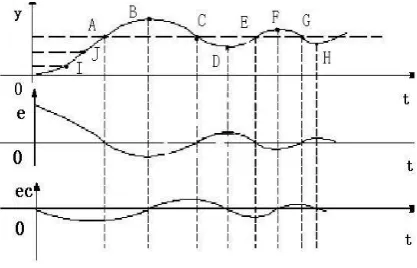
In the control system of PID, the most part of math models can be simplified as a two order system so as to carry through the system analysis. The typical response curve is shown as in Fig.1. In which, system deviation e(t) = r(t)-y(t), system deviation change rate ec(t) = de(t)/dt. Now we can analyze the tuning principle of each subsection for each parameter in the control algorithm of routine PID controller.
proportion control mode is adopted then when the output reaches the steady value it is impossible to hold steady value and certainly it will bring the overshoot because of the system itself inertia. In order to make the system response speed rapidness and not to bring the great overshoot, the subsection OA should be divided as three subsections to carry through analysis, namely that is respectively OI, IJ and JK. In the subsection OI, the deviation value e is larger, it can take larger gain coefficient KP and less gain KD so as to expedite the response speed and prevent instantly biggish value of starting deviation e. In order to prevent integral saturation, the integral action should be canceled (gain KI = 0) or reduce the integral action so as to avoid the system response bringing larger overshoot. In the subsection IJ, the gain coefficients, such as KP , KI and KD, should not be taken too much value to avoid the system producing overshoot. It should take less KI and middle KP as well as KD so as to insure the response speed of the system. And in the subsection JA, it has better development trend to reduce the deviation, we should reduce the KP and enlarge KI to avoid the oscillation around the set value. In order to enhance the anti-jamming performance, generally it is better to take middle size value for KD.
Figure 1. Typical response curve of 2-order system
2) For subsection AB (e < 0, ec < 0), the response output of the system has been beyond the steady value and presents the bad trend towards to get increase of system deviation. Up to point B, the deviation reaches negative maximum, and it should take the measure to reduce the control quantity. In the subsection AB, the control action is to reduce the overshoot, except taking proportion control it should strengthen the integral action so that it can strengthen control action through the deviation integral to make the system output return to the steady value as soon as possible. In order to enhance the anti-jamming performance, it can take the larger value KD. Generally it is better to take middle size value.
3) In the subsection BC (e < 0, ec > 0), the deviation e begins to reduce. Under the condition of control action, the system presents better trend towards to steady variation. Here if we still add integral action then it will certainly make the control execution too strong, and it appears system callback. Therefore the integral action should be reduced or taken out. In order to enhance the anti-jamming performance, the value of differential
coefficient KD can take the larger value, generally it is better to take middle size value.
4) For the subsection CD (e > 0, ec > 0 ), the output response of the system reduces, it has badness trend to have the variation towards to reverse direction, and it will reach the positive maximum value at point D. In this situation, the integral control action should be the main to weaken the influence of badness trend.
5) In the subsection DE (e > 0, ec < 0 ), the system response appears good trend that the system deviation will be gradually reduced. Therefore the control action is not able to be too strong. Otherwise the system overshoot will be appeared again. Obviously the integral action should be reduced. Thereafter the situation of each time section is similar to the above situation. Here it is not any more to repeat.
B. The Puzzle of Parameter Tuning
From the above mentioned, we can see that the control parameter choice is very complex. The main problem is that the once tuned parameter is difficult to insure always locating optimal status of the system by traditional tuning method of PID. Therefore it is necessary to adopt auto-tuning system of the parameter. The method is presented by Astron [8, 9, 10]. With simple speaking, the auto-tuning of parameter is that the controller can tune the parameter value of PID, after the parameter is tuned the system can automatically switched to normal work situation. Once the system performance is changed or goes beyond the anticipated bound, the system can automatically tune to start the parameter tuning process of PID, and retune the parameter of PID to obtain better control effect. There are lots of parameter tuning methods. This paper adopts the parameter auto-tuning method of fuzzy control technique on line based on self-learning system. The most outstanding advantages are that it is better in real time performance, and faster in system response.
V. PARAMETER AUTO-TUNING SYSTEM OF FUZZY PID
BASED ON SELF-LEARNING FUNCTIONS
A.Algorithm Design of Fuzzy PID
Figure 3. Fuzzy adjusting of PID parameter
Figure 2. Fuzzy control system structure based on self learning function
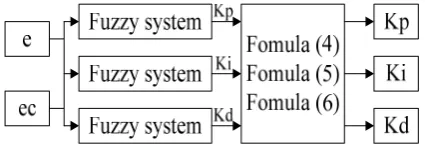
The parameter auto-tuning organization adopts increment adjusting principle. The reasoning method of Mamdani would be adopted by fuzzy inference and defuzzification for control rule.
IF Ei AND ECi THEN
Δ
K
P is Ui ( i=1,2,…49) Its fuzzy implication adopts least value method) ( ) ( ) ( )
( P Ei ECi Ui P
Ui ΔK =
μ
e ∧μ
ec ∧μ
ΔKμ
‘ (1)For fuzzy compound, it adopts maximum value method, and the reasoning principle is
) ( )
( ) ( )
( '
49 '
2 '
1
' P U P U P U P
U ΔK =
μ
ΔK ∨μ
ΔK ∨…∨μ
ΔKμ
(2)At a certain sample moment, ΔKPcan be determined
by barycenter of fuzzy output
U
'.49
49 ( )
( ) pj
j
pj j
Kp Kp
Kp
Kp
μ
μ Δ • Δ Δ =
Δ
∑
∑
(3)In which, μPj(ΔKP)(j=1,2,…49) is the membership
grade of
Δ
K
P. In like manner, it can get ΔKI and ΔKD.The value obtained by fuzzy reasoning and defuzzification multiplies by a proportional factor, and the value of increment adjusting for PID can be obtained. By means of adjusting formula (4), (5) and (6), it can be considered as the control parameter of PID controller. In which, KP0, KI0, KD0 is the initial value of controller parameter, and it can be obtained by conventional method. The adjusting process is shown as in Fig.3.
K
P=
Δ
K
P+
K
p0 (4)
K
I=
Δ
K
I+
K
I0 (5)
K
D=
Δ
K
D+
K
D0 (6)B. The Design of Self-learning Unit
The reference [11] proposed a sort of algorithm of self-learning fuzzy control for multi-input single output system. The Δy shows the output modification quantity of fuzzy controller, and performance function is used to reflect the ideal response characteristic of system. Assume the increment model of controlled object to be
)]
1
(
[
)
(
=
Δ
−
−
Δ
y
k
M
e
uk
τ
(7) In which, Δy(k) is output increment, Δeu(k) iscontrol increment,
τ
is the beat number of pure lag. It can compute the modified quantity ofΔ
e
u(
k
−
τ
−
1
)
of control quantity by increment model. Because all the control quantity and observed number of each step are stored in the storage, therefore eu(k −τ −1) can be
taken out from storage, and the control quantity should be modified as eu(k −τ −1)+Δeu(k −τ −1), then it is
transferred as fuzzy quantity Au
.
And the measured value beforeτ
+
1
step is taken out, and it is transferred as the corresponding fuzzy number A1,A2,L,Ak , andthus the new rule is formed. If it has the rule like the same precondition in the rule base, then it is substituted by new rule. Otherwise the new rule would be written into the rule base. The self-learning process is continuously repeated, and then the control rule is gradually improved and perfected until there is any rule needed to be modified or added. By means of sampling e and ec value of current measurement, the control algorithm can make the performance evaluation for control effect, and it can be carried through modification by action part of control rule in the learning algorithm of rewards and punishment on line before
τ
+1 beat by means of varying domain method. In this way, it can achieve the aim of modifying the control rule base, and improve the big lag characteristic of the system.The dynamic characteristic of the system can be summarized as following [12].
When e(k)· ec(k) < 0 the system has the trend toward to increasing the deviation
In terms of the above characteristic, the evaluation function C(k) can be expressed as in formula (8).
C(k) = e(k) · ec(k) (8) When C(k) > 0 , we carry through the reward for corresponding control rule.
When C(k) < 0 we carry through the punishment for corresponding control rule.
C. Determining the Function of Reward and Punishment
In order to assure learning performance on line, it is introduced to the concept of rewards and punishment function from the angle of system stability. The establishing of reward and punishment function is based on that the deviation obtained on line should be gradually going to zero. The established function of reward and punishment is shown as in formula (9).
1
max max
f(k)=1
( )
k k/(3
)
e k
e
e
− −τST
⎡
⎤
±
⎣
+
+
⎦
•
(9)In which, when C(k) > 0, it takes as f(k) = 1 + [∣e(k)
∣+ ek max + ek
-1-τ
max ]/(3 · ST) . When C(k) < 0 it takes as f(k) = 1 - [∣e(k)∣+ ek
max + ek-1-τmax ]/(3 · ST), in which ek
max , ek
-1-τ
max is respectively the maximum absolute value of deviation on line at the time k and
k-1-τ. The τ is the lag beat of system delay. ST is the maximum of object set value (Assuming as temperature), and usually it sould be a constant value. In this paper, the temperature set range is from 18 to 25±C, The ST is set as equal to 25. The feasibility of reward and punishment function has been approved through system response experiment.
D. The Algorithm Flow for Self-learning
The basic step, which is the algorithm flow of self-learning on line for reward and punishment based on varying-domain, is as the following.
(1) Start-up self-learning system
(2) Read e(k), ec(k) and e(k-1-τ) from database (3) Read the sequence number num(k) and
num(k-1-τ) of control output u(k) (respectively △KP , △KI and
△KD and u(k-1-ττ ) of fuzzy controller according to corresponding rule).
(4) Read reward and punishment factor ω
[num(k-1-τ)] in terms of num (k-1-τ ) from database according to corresponding control rule.
(5) Read ek
max and ek-1-τmax from database (6) If ek
max ≤0.1 then go to (8) else go to (7) (7) Computing c(k)=e(k) ·ec(k) if c(k)=0 then go to (8), if c(k) < 0 then go to (9), if c(k) > 0 then go to (10).
(8) Let f(k) = 1 then go to (11) (9) Let f(k) = 1 - [∣e(k)∣+ ek
max + ek
-1- τ
max ]/(3 · ST) then go to (11)
(10) Let f(k) = 1 + [∣e(k)∣+ ek
max + ek-1- τ max ]/(3·ST) then go to (11)
(11) Take [(former value of ω [num (k-1-τ)] ·f(k)] replacing ω [num(k-1-τ)] then go to (12)
(12) End the process of this time learning.
VI. SYSTEM SIMULATION
For convenience to explain and more intuitivism, the simulation experiment is divided into two parts. First it makes the simulation for control method so as to compare that which control strategy is better. Then based on the optimization of control method, it makes the overall system simulation.
Here it takes following model to make the simulation. W(S) = K e-τs / (Ts + 1)
In which, K is a gain coefficient, T is the time constant of controlled object,
τ
is pure lag time of the system.For convenience, it takes K=1, T=1.2,τ
=2, thenW(S) = e-2s/(1.2S + 1)
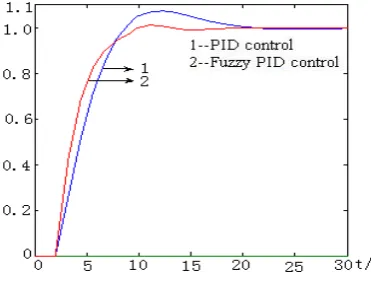
Based on the environment of MATLAB, by means of Simulink to build the system simulation model, under the condition of unit step input, it makes the simulation for the same controlled object respectively by PID and fuzzy PID controller. The response curve of simulation is shown as Fig. 4.
Figure.4. System response curve
Figure.5. Response of system with a pulse disturbance
Fig.6 is the curve comparison of robustness in change of object parameter, in which, it supposes K=1, T=1.2,
τ
=2, and it changes only the open-loop gain K from K = 1 to K = 2, the others are not changed. From Fig.7, it can be seen that after the gain is changed, the overshoot of PID controller is enlarged much more, but it is still kept non-overshoot for fuzzy PID controller.Figure 6. Curve of response after gain K changed
For other parameter change, when T changes from 1.2s to 2s, if the other parameters are not changed, then it is slightly a overshoot for PID controller, but there is hardly any change for fuzzy PID controller in response curve, and it is shown as in Fig.7.
Figure 7. Curve of response after time constant changed
When
τ
is changed from 2s to 4s, if the other parameters are not changed, then the response curve is shown as in Fig.8. It shows that the overshoot is more enlarged for PID controller, but for the curve of fuzzy PID controller, in spite of there is a little change it is still hardly any change, and it is only to postpone 2s in response time. Fig.8 shows the result of simulation.Figure.8. Response with time-lag
τ
changed
Figure 9. Curve of response with 2-order system
Here it is worth to be mentioned that if it follows a inertia unit after controlled object, then the transfer function will be W(S) = K e-τs/(Ts + 1) (2s+1), the result of simulation is shown as in Fig.10. From Fig.9, it can be seen that the overshoot enlarged, but for fuzzy PID controller, there is hardly any changed in system response, and special there is not any overshoot.
The above simulation shows that if the disturbance is appeared then fuzzy PID controller has better anti-interference performance than PID controller. And if the controlled object is changed then the curve of system response is hardly any change, but for PID controller, it is obviously appeared the overshoot, the rising and adjusting time gets slowly, and therefore the fuzzy PID controller has better quality.
output
Δ
Kp
,Δ
K
I,Δ
Kd
. The controlled object and its parameter value are shown as in Tab.1.The ideal output is 23℃, the steady deviation less than 0.5℃, the over-shoot Mp≤ °4 C ,tr ≤150s, the rising
timets ≤400s, Suppose the initial parameter of fuzzy
PID controller isKp0 0.18= , KI0 =0.00158, K d0 =1.
TABLAE I.
PARAMETER VALUE OF SYSTEM SIMULATION
Variable e ec ΔKp ΔKI ΔKd
Linguistic variable E EC ΔKp ΔKI ΔKd
Basic domain [-15,15] [-30,30] [-0.03,0.03] [-610.7,610.7] [-0.102,0.102]
Fuzzy subset NB, NM, NS, ZE, PS, PM, PB
Fuzzy domain [-6,6] [-3,3] [-6,6] [-6,6] [-6,6]
Quantition factor 0.4 0.1 0.005 0.0000001 0.017
Control object ( ) 10 30
(60 1)( 1)
s
e G s
s s
−
⋅ =
+ +
If the routine PID is used then the precision of system can be controlled in the error range of ±0.5 .℃ And if it adopts the fuzzy PID controller then the system response has excellent performance in system overshoot, rising time and adjusting time.
If we change the model parameter, for example, KP changes from 10 to 13, then when the routine PID controller is used the adjusting time (ts = 750s) exceeds the performance index, If the fuzzy PID controller is used then the overshoot of system will be appeared but the most over-shootM p≤ °4 C , it is still within the allowable
range, rising time tr= 84s, adjusting time ts= 172s, the performance index is still satisfied.
If one term of denominator of the transfer function changes from (60s+1) to (50s+1), and the lag time changes from 23 to 26 then it is still able to be stable within 2000s but it seriously exceeds the performance index of engineering demand. Under the same condition, if the fuzzy PID controller is used then the adjusting time will be 202s. All the system overshoot and rising time will satisfy the performance index.
Under the disturbance of unit-step signal, if the routine PID controller is used then it can not be convergent to the set value. Therefore the system performance becomes bad. If the fuzzy PID controller is used then the system will appear certain overshoot, but the overshoot is 1.2, after disturbance about 230s, the system can automatically be convergent to steady value.
VII. REALAZATION OF SYSTEM CONTROL
For convenience, we take the room temperature control of tobacco production workshop as an example to validate the method correctness presented by fuzzy auto-tuning parameter of PID controller. The main environment demand of tobacco production workshop is
that the room can not exceed the ideal temperature (23℃
24℃) and the above, the time of fluctuating amplitude
0.5℃ of ideal temperature (23℃) is not great than 400s to
avoid the product quality descending. In order to obtain optimal environment control effect of temperature and humidity, it adopts the parameter auto-tuning method of fuzzy PID controller based on the self-learning in the central air conditioner system. The control parameters of increment output of PID controller such as △KP, △KI and △KP , through defuzzification and parameter
computing, we can obtain each control parameter of PID controller next time. Finally the control parameter is sent to PID controller to carry through the system adjustment. If the deviation exceeds the allowable error then the self-learning system is started up and carries through the adjustment, such as reward and punishment, and fuzzy rule and so on. Otherwise it does not enter the self-learning system and carries through the parameter auto-tuning on line according to the current fuzzy rule. The fuzzy parameter auto-tuning system of PID extracts the advantages, such as control precision being higher in PID control, and response being faster in fuzzy control, and so on. The practical test and running effect of system show that it is successful in system design.
VIII. CONCLUSIONS
self-learning owns better self-adaptability that has obvious advantage in robustness and steady precision of the system and so on. It is better able to satisfy the work situation of high precision control.
REFERENCE
[1] Cheres, E., Tuch, J., Div. of Planning Dev. & Technol., Israel Electr. Corp. Ltd.: Haifa Man-utility focused tuning algorithm, Electrotechnical Conference. (2002)396-397. [2] Han, Houde, Kan, Ankang; Sha, Lili. Application of fuzzy
control technology on the marine heat exchanger control system. 6th International Symposium on Heating, Ventilating and Air Conditioning, ISHVAC 2009, 2009: 311-317.
[3] Larbes, C., Aït Cheikh, S.M.; Obeidi, T., Zerguerras, A. Genetic algorithms optimized fuzzy logic control for the maximum power point tracking in photovoltaic system. Renewable Energy. 2009:2093-2100.
[4] Chen, Yifei, Wang, Ku; Dai, Wenguang. Natural ventilation control system by fuzzy control technology. ICINIS 2009 – Proceedings of the 2nd International Conference on Intelligent Networks and Intelligent Systems. 2009: 35-38. [5] Tehrani, Fleur T. Automatic control of mechanical
ventilation. Part 2: The existing techniques and future trends.
Journal of Clinical Monitoring and Computing. 2008: 417-424
[6] Avgelis, A. Papadopoulos, A.M. Application of multicriteria analysis in designing HVAC systems. Energy and Buildings. 2009: 774-780.
[7] Wei Zhi-nong, Yu Xiao-yong, Wu Jia-jia, Han Lian-shan, Xie Xiang, Che Dan, Wang Yue: The intelligent control of DFIG-based wind generation. Sustainable Power Generation and Supply. 2009:1-5.
[8] Jian Zhang, Xuhui Wen, Lili Zeng. Research of parameter self-learning fuzzy control strategy in motor control system for electric vehicles. Electrical Machines and Systems, 2009. ICEMS 2009. International Conference on . 2009: 1 - 5 [9] Srivastava, S., Sukumar, V.; Bhasin, P.S.; Arun Kumar, D.
A Laboratory Testbed for Embedded Fuzzy Control Education. IEEE Transactions on Volume: 54, Issue: 1. 2011: 14 – 23.
[10] Shiuh-Jer Huang, Hsin-Wei Shieh. Motion control of a nonlinear pneumatic actuating table by using self-adaptation fuzzy controller. 2009: 1 – 6.
[11] Jianxian Cai, Xiaogang Ruan. Self-organization stochastic fuzzy control based on OCPFA and applied on self-balanced robot. 2010: 4775 – 4780.