RESEARCH ARTICLE
BOTTOM-UP MODULATION WITHIN THE SCOPE OF CONSUMERS´ VISUAL PERCEPTION: THE
EFFECT OF PREVIOUS OCULAR FIXATIONS ON THE PERCEPTION OF BISTABLE LOGOTYPES
1,*
Guillermo Rodríguez and
2Fernando Marroquín-Ciendúa
1
Ph.D. in Psychology, Lecturer Assistant at School of Advertising, Universidad Jorge Tadeo Lozano
2
Ph.D. (C) in Psychology, Lecturer Assistant at School of Advertising, Universidad Jorge Tadeo Lozano
ARTICLE INFO ABSTRACT
Background: Bistable images are visual stimuli that have the particular characteristic of being
interpreted in two different ways. Due to their physical characteristics, these images, while being observed, encourage the observer to make perceptual alternations, in such a way that it is never possible to perceive the two possible percepts simultaneously. The defining lines and contours of a bistable image, along with all its characteristics, can influence its perception, as well as the areas of the image that are observed. Thus, the fixation points that direct attention to specific areas become modulating factors of the bottom-up type. This phenomenon applies to advertising logos of bistable
type. Objective: the study aimed at establishing the influence that a fixation point shown previously
can exert on the perception of two bistable logotypes. Thus, it was wanted to find if there is (or not) a bottom-up modulation effect caused by eye-fixations on a particular area of the images that might be related to one of the possible percepts of the bistable stimuli. Method: Using a fixed 120-Hz eye-tracking device, two bistable logos were observed by thirty-five participants in optimal mental health conditions. A fixation point was manipulated at the beginning of the observation of each logo to contrast the perceptions reported in that condition with the interpretations given when the logos were observed without any fixation point that could modulate the observer´s attention. An intrasubject design was conducted so that the two bistable logotypes used could be observed by all the participants. The presentation of bistable stimulus was counterbalanced so as to control the effect that the order of images could make. Results: The data was not distributed normally. By using a non-parametrical statistical test (U-MannWithney), it was found that the fixation point had a significant effect on the interpretation of the percept associated with the area where such point was placed. There is some evidence that lends support to the fact that the observed areas of a bistable stimulus have an
impact on its interpretation. Conclusions: It is possible to influence the perception of a bistable logo
by means of bottom-up modulators. The brain processes visual sensory information by focusing on specific features of bistable stimuli that can modulate the perception. By drawing the observer´s attention to areas that can influence visual perception, it is possible to direct bistable perception favoring one of the possible percepts to be perceived over the other one.
INTRODUCTION
Bistable perception is a perceptual phenomenon, through which an observer perceives a stimulus in two different ways (Borisyuk, Chik, & Kazanovich, 2009; Clément, & Demel, 2012; van Loon, Knapen, St. John-Saaltink, Donner, & Lamme, 2013; Gori, Giora, & Pedersini, 2008; Grossmann & Dobbins, 2006; Pressnitzer, & Hupé, 2006; Sterzer, & Rees, 2009; Weilnhammer, Ludwig, Sterzer, & Hesselmann, 2014). While the stimulus remains invariable, the observer changes from one interpretation to the other one as the stimulus has two different possibilities to be interpreted (Baker, Karapanagiotidis, Coggan, Wailes-Newson, & Smallwood, 2015; Liu, Tzeng, Hung, Tseng, & Juan, 2012; Schauer, Kanai, & Brascamp, 2016). As regards, the two possible percepts cannot be perceived simultaneously (Rodríguez, & Castillo, 2018).
*Corresponding author: Guillermo Rodríguez ,
Ph.D. in Psychology, Lecturer Assistant at School of Advertising, Universidad Jorge Tadeo Lozano.
Given the fact that bistable visual stimuli allow for two possible percepts, they can also be called ambiguous images (Gijs, & van Ee, 2006; Okazaki, Kaneko, Yumoto, & Arima, 2008). Similarly, the phenomenon of perceptual visual bistability can also be called visual bistability (Intaité, Kovisto, & Castelo-Branco, 2014), whereby the leap from one percept to the other one is known as perceptual reversal (Clément, & Demel, 2012; Sandberg, Barnes, Bahrami, Kanai, Overgaard, & Rees, 2014). Bistable perception implies two internal mental states that are called transition and maintenance (Sen, Daimi, Watanabe, Takahashi, Bhattacharya, & Saha (2019). The transition state lasts a short time whereas maintenance state is comparatively longer and is related to the stabilization of one of the two possible percetps after having experienced the transition (Sen et al., 2019). This transition is the so-called perceptual reversal (Rodríguez, & Castillo, 2018). The study of bistable perception has led to categorizing several types of bistable images (Bialystok, & Shapero, 2005). Long and Toppino (1981) identified three different types of bistable images (see in figure 1): 1.
Article History:
Received 20th may, 2019 Received in revised form 10th June, 2019 Accepted 24th July, 2019 Published online 31st August, 2019
International Journal of Recent Advances in Multidisciplinary Research
Vol. 06, Issue 08, pp.5129-5135, August, 2019
Keywords:
In figure-ground reversals, whereby a possible percept can be recognized in the background while the other is salient relative to the background (as an example, the image The vase-face
illusion); 2. Images In perspective reversal, that allows
observers to perceive changes in both orientation and sense of perspective (e.g. the Necker cube); and, 3. In meaning-content
reversals, bistable images understood as images that alternate
between two percepts at the same level of salience where each of them is different in terms of shape and meaning. My
girlfriend or my mother-in-law by Boring (1930) is an example
of this type of bistable images.
Figure 1. The three types of bistable images. On the left is The
vase-face illusion (in figure-ground reversals). In the center is
being shown the Necker cube (in perspective reversal). On the
right is My girlfriend or my mother-in-law (in meaning-content
reversals). Source: Rodríguez, & Castillo, 2018.
The factors which allow bistable images to have more than one possible interpretation have been widely studied (Rodríguez, & Castillo, 2018). Firstly, it has been stated that the physical features of bistable images generate ambiguity so that the resulting perceptual configuration depends not only on the way in which the stimulus is being observed, but also on the areas of the image upon which the eyes are fixed as well as on the visual path followed by the observer during ocular fixations (Gale & Findlay, 1983; García-Pérez M., 1989a; García-Pérez M., 1992; Hsiao, Chen, Spence, & Yeh, 2012). Providing that the physical characteristics of visual stimulus are able to exert an influence on perception (as shared contours for the two possible interpretations, indefinite planes, contrary and complementary tonalities, etc.), it is inferred that these issues underscore a modulation of visual perception, in this case, implying the bottom-up modulating effect (Hsiao et al., 2012; Meng, & Tong, 2004;).
Secondly, it has been stated that perceptual configuration of a bistable image also depends on isolated information processing of the stimulus’ physical characteristics (Brouwer, & van Ee, 2006). Besides, there is also an influence exerted by concepts and ideas previously recorded in memory which are linked to the perceptual process in such a way that the final percept is built. In terms of basic psychological processes, this is what is called top-down processing (Firestone, & Scholl, 2016), in which the interpretation of a bistable stimulus is established by both previous stored information (or knowledge) that is recorded in memory, and information which can foray suddenly into the human perceptual system so that an interpretative echo emerges as the percept is semantically defined (Pitts, Gavin, & Nerger, 2008). Just as was stated by Intaité et al. (2014), visual perception can easily be understood as a dynamic brain function which is modulated equally by basic sensorial processes (bottom-up) and also by outside references to the distal stimulus, which come into play in its interpretation (top-down processing). In other words, the alternation between one percept and the other is, many times, involuntary (especially when bottom-up modulations are exerting their influence).
However, perceptual reversals are also voluntary, especially when observers can manage attention control so as to direct their perception (Gijs & van Ee, 2006; Intaité, Koivisto, Rukšėnas, & Revonsuo, 2010). It is important to state that
perceptual reversals have the chance of being explained by the
high and low level theoretical model. As found in Sterzer, & Rees (2009), there is a correspondence between high-level theory and low-level theory. As can be seen in figure 2, there are two ways in which a perceptual reversal is able to occur: alternative A, associated with low level theory, which suggests that spontaneous alternation take place in the visual cortex. This alternation is based on the so-called bottom-up process.
The bottom-up theory explains that perceptual bistability is
founded on the fact that a perceptual reversal occurs by means of an adaptation in the sensorial mechanisms so that the activity of a perceptual mechanism sustains a specific perceptual configuration until, as an effect of fatigue, the competing percept emerges, supported by another mechanism (Intaité et al., 2010; Kogo, Hermans, Stuer, van Ee, & Wagemans, 2015).
Regarding alternative B (high level), in order for the perceptual reversals to operate, that is, the occurrence of them, there is a dependence on central processes which may involve the frontal area of the brain among others (Sterzer, Kleinschmidt & Rees, 2009). It is widely known that perceptual reversibility is closely linked to these two types of processes (Long & Toppino, 2004; Yamamoto & Yamamoto, 2006).
Figure 2. Low level (A), and high level (B) processes (adapted from Sterzer, & Rees, 2009)
In addition, it should be considered that various studies reinforce the idea that both top-down processing and bottom-up
Fixation points as bottom-up perceptual modulators for
bistable images and logotypes: Taking into account that eye
movements tracking are substantially important within the understanding of parameters of visual search, researchers in this area, being aware that without an accurate control of variables certain results would be taken as spurious, managed to acquire techniques and paradigms, simplifying visual stimulation to the maximum in comparison with the ecological natural field of everyday life, in such a way that tasks regarding controlled saccades movements are included (Brouwer, Reuderink, Vincent, van Gerven, & van Erp, 2013; Dandekar, Ding, Privitera, Carney, & Klein, 2012), as well as tasks of visual search with artificial stimulation (Kamienkowski, Ison, Quiroga, & Sigman, 2012).With regard to the specific study of the incidence of ocular fixation points in the perceptual configuration of bistable images, there are several studies conducted with eye-tracking techniques such as Gale & Findlay (1983) and Hsiao et al. (2012).
It is noticed from the review of these studies that there are critical areas of ocular fixation that favor a certain perceptual configuration of the ambiguous image of Boring (1930), My
gilrlfriend or my mother-in- law (image in which it is possible
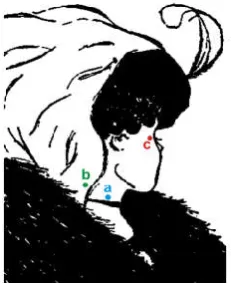
to recognize to both a young woman or an old woman). From the study conducted by Gale & Findlay (1983), it was stated that both certain points and specific areas of eye fixation allowed participants to recognize the percept of a young woman, while for the other possible perceptual configuration other areas of the image were stated so as to favor the old woman percept. Hsiao et al. (2012) took into account these findings and, having identified and manipulated experimentally those points of fixation modulators of perception (see in figure 3), inquired about the effect of semantic congruence, recognizing that it is present in the observation of any bistable image. The chance of bottom-up modulations emerges, owing to the characteristics of the stimulus and/or by the way in which they are captured depending on the position of the receiving organs with respect to the visual stimulus. In that study, the bistable image was exposed using a neutral fixation point (see blue dot on the bistable image shown in figure 3). This fixation point does not favor the perceptual configuration of any of the two possible percepts that the image offers. On the other hand, the point that is green favors the perception of the elderly woman, whereas the red one, located at the top right on the image, helps the young woman to be perceived (see figure number 3).
Figure 3. The bistable image “My girlfriend or my mother-in-low” and three different fixation points: the green one, the point that is
considered to be neutral. The blue one is the point that exerts an influence on the old-woman percept. The young-woman percept can
be modulated by the red point. Source: Hsiao et al. (2012).
In fact, it has ben stated that ocular fixation points necessarily interfere in the way in which a bistable visual stimulus is interpreted (Gale, & Findlay, 1983; Meng, & Tong, 2004), which leads to the conclusion that those who design reversible images with the purpose of transmitting to a target audience two different meanings (from the perceptual configuration of each of the possible admissible perceptions by the bistable figure) will have to recognize, beyond possible semantic modulations that may impact on the perceptual configuration, the influence that can be exerted by bottom-up type modulations, which are based on the ocular fixation points.
Regarding this, graphic designers of this type of images can consider the insertion of fixation points that modulate the interpretation of ambiguous stimuli, for example, in a piece of audiovisual advertising communication. Therefore, it should be estimated that it is strategic to design logos and brand visual identifiers that allow various perceptual configurations in such a way that it is possible to modulate their final perception (and, consequently, the message that is going to be conveyed). This modulation can be mediated by bottom-up modulators as fixation points linked to the determination of critical areas that favor a certain perceptual configuration with its corresponding semantic load.
MATERIALS AND METHODS
Thirty-five healthy volunteers participated in this study (57%=female; 43%= male; age ranging between 18 and 37 years old; mean age= 25.14; SD= 6.43). All of them were naive of the purpose of the experiment, and all were healthy and had normal or corrected-to-normal vision. All participants provided written informed consent. The experiment was conducted in a dimly-lit experimental chamber. Participants had to view the logotype of the brand FedEx. The image of the logotype was in color on a gray background (RGB= [127, 127, 127]). Each participant was able to view the image twice, at a viewing distance of 60 centimeters. The image was presented on an eye-tracker device (120 Hz., Tobbi technology). On the first occasion, when participants viewed the image, there was no fixation point that could exert an influence on the way they were going to start to view the logotype. The second time, they viewed a point of fixation 250 miliseconds (ms.) before the bistable logotype were exposed. Both options (logotype with and without point fixation) were presented randomly, so as to obtain counterbalanced exposure. Participants clicked the mouse buttons, so as to report which percept was being perceived by them during image presentation (each exposure lasted 15 seconds).
Likewise, we sought to make an observation about the total of eye fixations, in order to propose some reflections on the way in which visual identifiers of bistable nature are observed. As mentioned before, the time-prevalence of each percept was taken by considering the time that passed from the report of one percept and the switch to the other one.
Figure 4. Fixation points (see the two letters “x”) that were used to drive the attention as bottom-up modulators. As for the case of the logotype of the brand “La Alquería”, the fixation point was placed in a critical area for the recognition of the "head of cow" percept (consider that the other possible percept of this bistable logo is a milk jet). Regarding the logo of FedEx, the fixation point was placed to favor the perceptual configuration of the arrow that is constructed from the contours of the letters “E” and “x” of the corresponding identifier (it is assumed that the other possible percept for this logo bistable is the word or set of letters, without notice of the recognition of the arrow that is formed between letters E and x).
RESULTS
As can be seen in table 1, the percepts that were modulated by placing a fixation point (in the “Arrow” for the FedEx logotype, in the “cow head” for the “La Alquería” logo) had higher prevalence with respect to the percepts that were reported when the observation was made without using the fixation point. For the FedEx logo, with fixation point there was a statistically significant difference in prevalence between the "arrow" percept and the "word" percept (M.D. = 4.8317, Mdn = 9.727, U = 0.734, p = 0.037).
Without fixing point, the difference was also in favor of the "arrow" percept, but in a lesser proportion and without statistical significance (M.D. = 1.369, Mdn = 6.306, U = 0.727,
p = 0.394). In the case of the "La Alquería" logo, when the fixation point was exposed in the area of the head of the cow, a significant difference was given in favor of the modulated percept, that is, "cow head" (MD = 3.1779 ; Mdn = 9.632, U = 0.184, p = 0.043). On the other hand, without a fixation point, a slight difference was given in favor of the "cow head" percept, but the difference was not significant (M.D. = 0.0828, Mdn = 5.111, U = 2.932, p = 0.85).
Figure 5. Fixations-map that depicts eye-fixations after having exposed a point fixation just in the middle of the arrow
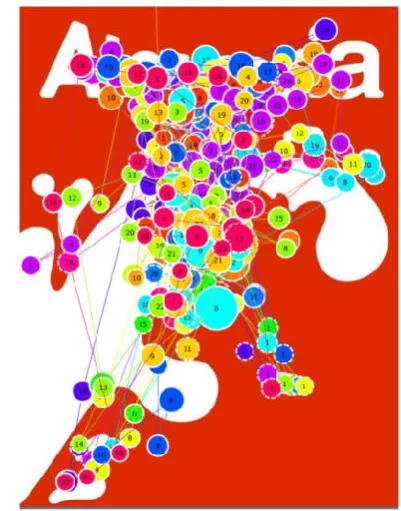
Figure 6. Fixations-map that depicts eye-fixations after having exposed a point fixation in the center of the head of the cow
In figure 5, it is shown the fixations map in which eye-fixations were located after having exposed a point fixation just in the middle of the arrow that is formed between letters “E” and “x”. It can be noticed how the full stop at the end of the logotype drives the attention. On the other hand, figure number 6 shows the map relating to the eye-fixations that occurred after having exposed a fixation point in a central position with respect the head of the cow.
DISCUSSION
The results show a tendency in the sense that the perceived percepts (their prevalence in time) have an association with the location of the fixation point that is placed in an area that can favor such percepts.
Given that constitutive aspects of the visual stimuli such as edges, angles, line thicknesses and textures, contribute to get their final perception (as well as the areas and points of ocular fixation), it must be understood that in the present study the results for each logo can be reviewed independently, thus incorporating the model of a descriptive type of research. The case of the FedEx logo turns out to be very telling in that the placement of the fixation point within the shape of the "arrow" does imply that this percept is mostly interpreted. In figure number 7 it can be seen the whole area of the logotype (cluster 1) covered by the ocular fixations taken altogether
Figure 7. Visualization of the observed zones (all participants who observed the FedEx logo with previous positioning of the fixation point in
the area of the "arrow" configured between the letters "E" and "x").
In this sense, there is a disambiguation of the bistable image, where both attention and fixation within these parts encourage one of the two alternatives of interpretation to be perceived, configuring bottom-up modulation (Kornmeier, & Bach, 2005).
Take into account, in addition, that the modulator factor used involved sensory processing without the provision of exogenous contextual information that could elicit a priming effect (Meng, & Tong, 2004). It must also be considered that one of the difficulties in conducting studies on the relationship that may exist between observed areas and configured percepts is the lack of homogeneity during the process of observing the bistable stimulus (García-Pérez, 1989a).
There are many factors that make a person move their eyes, so that the visual pathways do not necessarily have the same pattern between person and person, beyond the conditions that may exist, derived from the instructions given in function of reporting one percept or the other one. Visual homogeneity is understood by considering that a sustained and focused perception of a given stimulus within the context of the entire visual information flow emerge while viewing. In order to reach homogeneity, it is necessary that the focus area be rather constant during the observation process of an image, which also implies greater permanence of the ocular fixations (García-Pérez, 1989b).
Visual homogeneity is also explained by the relative static quality of the eyes during a sustained fixation at the point of focus within the Panum fusion area, that is, the set of points in the visual space that have their corresponding projected image in points in the two retinas (Lakshminarayanan, Rajaram, & Joseph, 2002). The fact that visual homogeneity is not stable is associated with the binocular disparity produced by the perception of depth (stereoscopy). In addition, visual homogeneity is limited to Panum's fusion area around the horopter.
Figure 8. Visualization of the observed zones (all participants who observed the “La Alquería” logo with previous positioning of the fixation point in the area of the "head of cow").
It should be considered that the length of the vertical line of the visual field (vertical horopter) is usually perceived in a linear dimension (length), different from the horizontal one (horizontal horopter), configuring an apparent asymmetry; likewise, this asymmetric interpretation of the visual field is defined by internal mechanisms of perceptual representation (Lipshits, McIntyre, Zaoui, Gurfinkel, & Berthoz, 2001).
Regardless of the fact that these logos are different considering both their physical characteristics and their disposition within visual space, the phenomenon of bottom-up modulation emerged.
Conclusion
For purposes of conducting research on the relation between fixation areas observed in a bistable image and the configuration of percepts, it is necessary to have control over the recording of oculomotor activity, trying to determine what percept is configured in relation to pre-established areas of analysis of the bistable stimulus. Likewise, the manipulation that is made in relation to directing attention to one or another area of the bistable image exerts an influence on what is perceived by the observer, allowing, furthermore, to infer that the first glance determines the perception of the ambiguous stimulus, if the observed area favors one of the possible percepts of the bistable stimulus. According to the findings reported here, it is possible to influence the perception of a bistable logo by means of bottom-up modulators. This fact must be assumed as important for professionals who are involved in designing this type of images with the aim of conveying different semantic loads by using a single visual stimulus. Further studies will have to carry out so as to continue stating the ways in which fixation points that drive the attention operate in the context of bistable perception.
Funding statement
This study was 100% funded by the University of Bogotá Jorge Tadeo Lozano. The funds used were provided by the Department of Research, Creation and Extension of this university.
REFERENCES
Baker, D. H., Karapanagiotidis, T., Coggan, D. D., Wailes-Newson, K. and Smallwood, J. 2015. Brain networks underlying bistable perception. NeuroImage(119), 229-234. Bialystok, E. and Shapero, D. 2005. Ambiguous benefits: the effect of bilingualism on reversing ambiguous figures.
Developmental Science, 8(6), 595-604.
Biederman, I. and Ju, G. 1988. Surface versus edge-based determinants of visual recognition. Cognitive Psychology, 20, 38-64.
Boring, E. 1930. A new ambiguous figure. American Journal
of Psychology(42), 444-445.
Borisyuk, R., Chik, D. and Kazanovich, Y. 2009. Visual perception of ambiguous figures: synchronization based neural models. Biological Cybernetics(100), 491-504. Brouwer, A., Reuderink, B., Vincent, J., van Gerven, M. and
van Erp, J. 2013. Distinguishing between target and nontarget fixations in a visual search task using fixation-related potentials. Journal of Vision, 13(3), 17.
Brouwer, G. J. and van Ee, R. 2006. Endogenous influences on perceptual bistability depend on exogenous stimulus characteristics. Vision Research(46), 3393-3402.
Chastain, G. and Burnham, C. A. 1975. The first glimpse determines the perception of an ambiguous figure.
Perception & Psychophysics, 17(3), 221-224.
Clément, G. and Demel, M. 2012. Perceptual reversal of bi-stable figures in microgravity and hypergravity during parabolic flight. Neuroscience letters(507), 143-146. Dandekar, S., Ding, J., Privitera, C., Carney, T. and Klein, S.
2012. The fixation and saccade. PLoS One, 7(11), e48761. Firestone, C. and Scholl, B. J. 2016. Cognition does not affect
perception: Evaluating the evidence for “top-down” effects. Behavioral and brain sciences, 39.
Gale, A. and Findlay, J. 1983. Eye-movement patterns in viewing ambiguous figures. In Eye movements and
psychological functions: international views (pp. 145-168).
Hillsdale NJ: LEA.
García-Pérez, M. 1989a. Visual inhomogeneity and eye movements in multistable perception. Perception &
Psychophysics, 46(4), 397-400.
García-Pérez, M. 1989b. Visual inhomogeneity and reference frames. Bullletin of the Psychonomic Society, 27, 21 García-Pérez, M. 1992. Eye movements and perceptual
multistability. In E. Chekaluk, & K. Llewellyn (Eds.), The
role of eye movements in perceptual processes (pp.
73-109). Amsterdam - London - New York - Tokyo: North-Holland.
García-Pérez, M. A. 1992. Eye movements and perceptual multistability. In E. Chekaluk, & K. Llewellyn (Eds.), The
role of eye movements in perceptual processes (pp.
73-109). Amsterdam - London - New York - Tokyo: North-Holland.
Gijs, B. and van Ee, R. 2006. Endogenous influences on perceptual bistability depend on exogenous stimulus characteristics. Visual Research(46), 3393-3402.
Goldman, A. I. 2018. Philosophical applications of cognitive
science. London: Routledge.
Gori, S., Giora, E. and Pedersini, R. 2008. Perceptual multistability in figure-ground segregation using motion stimuli. Acta Psychologica(129), 399-409.
Grossmann, J. K. and Dobbins, A. C. 2006. Competition in bistable vision is attribute-specific. Vision Research(46), 285-292.
Hsiao, J., Chen, Y., Spence, C. and Yeh, S. 2012. Assessing the effects of audiovisual semantic congruency on the perception of a biestable figure. Consciousness and
Cognition(21), 775-787.
Intaité, M., Koivisto, M., Rukšėnas, O. and Revonsuo, A. 2010. Reversal negativity and bistable stimuli: attention, awareness, or something else? Brain and Cognition(74), 24-34.
Intaité, M., Kovisto, M. and Castelo-Branco, M. 2014. Event-related potential responses to perceptual reversals are modulated by working memory load. Neuropsychologia, 56, 428-438.
Intaité, M., Noreika, V., Šoliūnas, A. and Falter, C. M. 2013. Interaction of bottom-up and top-down processes in the perception of ambiguous figures. Vision Research(89), 24-31.
Kamienkowski, J., Ison, M., Quiroga, R. and Sigman, M. 2012. Fixation-related potentials in visual search: a Table 1. Averages of prevalence of time per percept, considering use or absence of fixation point (FP=Fixation point; WP=Without fixation point)
FedEx FP
time mean arrow vs. word
FedEx WP
time mean arrow vs. word
Alquería FP time mean cow head vs. milk
Alquería WP time mean cow head vs. milk
Arrow/head 10.2961 8.6588 9.1148 8.1091
combined EEG and eye tracking study. Journal of Vision, 12(7), 4.
Kogo, N., Hermans, L., Stuer, D., van Ee, R. and Wagemans, J. 2015. Temporal dynamics of different cases of bi-stable figure-ground perception. Vision Research(106), 7-19. Kornmeier, J. and Bach, M. 2005. The Necker cube - an
ambiguous figure disambiguated in early visual processing.
Vision Research(45), 955-960.
Kornmeier, J. and Bach, M. 2006. Bistable perception - along the processing chain from ambiguous visual imput to a stable percept. International Journal of
Psychophysiology(62), 345-349.
Kornmeier, J., Hein, C. M. and Bach, M. 2009. Multistable perception: when bottom-up and top-down coincide. Brain
and Cognition(69), 138-147.
Lakshminarayanan, V., Rajaram, V. and Joseph, S. 2002. Lakshminarayanan, V., Rajaram, V., Joseph, S. and Beatty, J. A. Empirical Longitudinal Horopter With Induced Optical Displacment. Investigative Ophthalmology &
Visual Science, 43(13), 4715-4715.
Liu, C.-H., Tzeng, O., Hung, D., Tseng, P. and Juan, C.-H. 2012. Investigation of bistable perception with the "silhouette spinner": Sit still, spin the dancer with your will. Vision Research(60), 34-39.
Lipshits, M., McIntyre, J., Zaoui, M., Gurfinkel, V. and Berthoz, A. 2001. Does gravity play an essential role in the asymmetrical visual perception of vertical and horizontal line length? Acta Astronautica, 49, 123-130.
Long, G. and Toppino, T. 1981. Multiple representations of the same reversible figure: implications for cognitive decisional interpretations. Perception(10), 231-234. Long, G. and Toppino, T. 2004. Enduring interest in perceptual
ambiguity: alternating views of reversible figures. Psychol.
Bull.(130), 748–768.
Meng, M. and Tong, F. 2004. Can attention selectively bias bistable perception? Differences between binocular rivalry and ambiguous figures. Journal of Vision(4), 539 - 551. Okazaki, M., Kaneko, Y., Yumoto, M. and Arima, K. 2008)
Perceptual change in response to a bistable picture increases neuromagnetic beta-band activities. Neuroscience
Research(61), 319-328.
Pitts, M. A., Gavin, W. J. and Nerger, J. L. 2008. Early top-down influences on bistable perception revealed by
event-related potentials. Brain and cognition, 67(1), 11-24.
Pressnitzer, D. and Hupé, J.-M. 2006. Temporal dynamics of auditory and visual bistability reveal common principles of perceptual organization. Current Biology(16), 1351-1357. Qiu, J., Dongtao, W., Hong, L., Caiyun, Y., Ting, W. and
Quinglin, Z. 2009. The vace-face illusion seen by the brain: An event-related brain potentials study. International
Journal of Psychopshysiology(74), 69-73.
Rock, I., Hall, S. and Davis, J. (1994). Why do ambiguous figures reverse? Acta Psychologica(87), 33-59.
Rodríguez, G. and Castillo, H. 2018. Bistable perception: neural bases and usefulness in psychological research.
International Journal of Psychological Research, 11(2),
63-76.
Sandberg, K., Barnes, G. R., Bahrami, B., Kanai, R., Overgaard, M. and Rees, G. 2014. Distinct MEG correlates of conscious experience, perceptual reversals and stabilization during binocular rivalry. Neuroimage(100), 161-175.
Schauer, G., Kanai, R. and Brascamp, J. W. 2016. Parietal theta busrs TMS: Functional fractionation observed during bistable perception not evident in attention tasks.
Consciousness and Cognition (40), 105-115.
Sen, S., Daimi, S. N., Watanabe, K., Takahashi, K., Bhattacharya, J. and Saha, G. 2019. Switch or stay? Automatic classification of internal mental states in
bistable perception. Cognitive Neurodynamics, 1-19.
Sterzer, P. and Rees, G. 2009. Bistable Perception and Consciousness. Encyclopedia of Consciousness. 93-106. Sterzer, P., Kleinschmidt, A. and Rees, G. (2009). The neural
bases of multistable perception. Trends in Cognitive
Sciences, 13(7), 310-318.
van Loon, A. M., Knapen, T., Scholte, H. S., St. John-Saaltink, E., Donner, T. H. and Lamme, V. A. 2013. GABA Shapes the Dynamics of Bistable Perception. Current Biology(23), 823-827.
Weilnhammer, V., Ludwig, K., Sterzer, P. and Hesselmann, G. 2014. Revisiting the Lissajous figure as a tool to study bistable perception. Vision Research(98), 107-112.
Yamamoto, S. and Yamamoto, M. 2006. Effects of the gravitational vertical on the visual perception of reversible figures. Neuroscience Research(55), 218-221.