Analytical Study on the Behaviour of a
Multi-Storeyed Structure under the Failure of One Pile
Considering Soil Structure Interaction
Swetha Felix Dr. AliceMathai
PG Student Associate Professor
Department of Structural Engineering and Construction
Management Department of Civil Engineering Mar Athanasius College of Engineering, Kothamangalam,
Ernakulam, M.G University, Kerela
Mar Athanasius College of Engineering, Kothamangalam, Ernakulam, M.G University, Kerela
Abstract
Foundation failure - though rare - has occurred in many a construction project. Such a failure is more probable for a pile foundation than any other type of foundation. The study here is an investigation of an anticipated pile failure and the behaviour of the super structure supported on the pile as a soil-structure interaction problem. The study closely follows the post failure pattern of the displacements, forces and moments of the superstructure. The load transfer and redistribution to the adjacent columns and the surrounding soil is also investigated.
Keywords: Finite element analysis, pile foundation, settlement of pile, soil structure interaction
________________________________________________________________________________________________________
I.
INTRODUCTION
Installation of cast –in-situ end bearing piles involves complex procedures with hidden uncertainties which lead to a particular pile failing to achieve the design load capacity in rare occasions. The deficiency in the capacity becomes obvious only during a routine NDT and a subsequent test loading. The deficient pile will undergo excess settlement under the application of load. This study aims at studying the behaviour of the superstructure along with its pile foundation as one unit interacting with the sub soil using a FEM model. ANSYS software has been used to study the behaviour of the model. The displacement values obtained are fed back to a STAAD model to arrive at the design values of forces and moments.
II.
METHODOLOGY
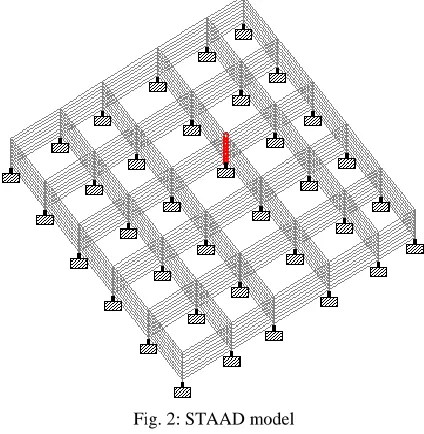
A simple structure with base dimension 20mx19m and eight floors with a total height of 27m height was analysed in STAAD to obtain the support reactions and moments. To study the soil structure interaction, a 3D ANSYS analysis was carried out. Two sets of analysis were conducted ie. for pre-failure and post-failure cases. The results from ANSYS were fed back to STAAD in order to study the structural behaviour.
III.
STRUCTURAL ANALYSIS USING STAAD
Fig. 1: Plan of the building frame (All dimensions in m)
Fig. 2: STAAD model
IV.
FINITE ELEMENT ANALYSIS USING ANSYS 14.5
As in the case of STAAD two sets of analysis were conducted in ANSYS that is for before and after the failure of pile. For the assessing the complete behavior of the structure, proper element selection is very important. Here, pile and raft were modeled as linear isotropic and the properties considered for analysis are Young’s modulus (E), Poisson’s ratio(μ) and density for pile and raft. For pile, raft and soil, SOLID 187 was used as the element type. Contact elements CONTA174 (for soil) and TARGET170 (for pile and raft) at soil-pile and soil-raft interface are considered. SURF 154 was also used to model the complex surface. The material properties used for pile, raft and soil are given in table 1.
Table – 1 Material Properties
Properties Foundation Soil Super structure Concrete (Sandy clay) Concrete E (Pa) 2.5x10¹⁰ 2.5x10⁷ 2.5x10¹⁰
ν 0.15 0.3 0.15
r (Kg/m3) 2500 1900 2500
∅ 35
Ѱ 10.5
Geometry A.
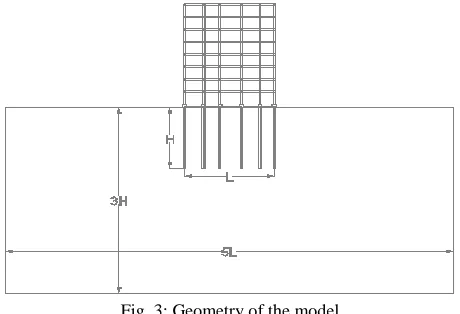
The 3D model contained three parts i.e. the superstructure which is an eight storied concrete building, its foundation and the soil. The soil volume was 100m x 95m x 45m. The soil volume was fixed such that, the depth of soil should be at least three times the pile depth and the horizontal dimension should be at least five times the horizontal dimension of the building [5]as shown in figure 3. The building was founded on concrete piles of 15m depth, one pile below each column. The piles were connected with grade beams at the pile cap level.
Fig. 3: Geometry of the model
Boundary Conditions B.
Regarding boundary conditions, nodes constituting bottom of the soil zone was fixed against both vertical and horizontal directions whereas the zone away from pile raft, i.e., the vertical surface of soil at the boundary was restricted against horizontal movements. The 3D ANSYS model is as shown in figure 4.
Fig. 4: 3D Model in ANSYS
Mesh C.
The regions of greater importance were provided with closer mesh i.e. the structure, foundation and soil which immediately surrounds the piles. As the distance from the pile increased the mesh size also proportionately increased.
V.
RESULTS AND DISCUSSIONS
Case 1- Before Failure A.
All piles were modeled as end bearing by providing fixed supports at bottom end. The vertical deformation at the mid- section is as shown in figure 6.
Fig. 6: Vertical displacement of fixed end piles with grade beam connection at pilecap level
Case 1- After Failure B.
Excessive settlement of one pile is affected here by releasing the fixed end of one of the pile. The excessive settlement of one pile results in the differential settlement of the entire structure. The vertical deformation at the section of failed pile is shown in figure 7.
Fig. 7: Sectional view of vertical displacement on the failure of one pile with grade beam connection at pilecap level
Effect of failure on the Bending Moment of the superstructure C.
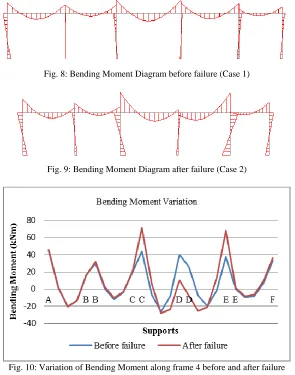
Bending moment of frame 4 (refer figure 1) at the ground floor roof level was studied in which the support D undergoes excessive settlement. Due to the settlement the moment values at D shows a sudden drop which leads to increase of moment at the adjacent supports by about 60% and much lesser values at other supports.
Fig. 8: Bending Moment Diagram before failure (Case 1)
Fig. 9: Bending Moment Diagram after failure (Case 2)
Fig. 10: Variation of Bending Moment along frame 4 before and after failure
Effect of failure on the Axial Loads of the superstructure D.
Axial forces are directly affected by the support displacements. The support which undergoes excessive settlement shows a drastic variation in the axial load. Maximum settlement of the failed pile is 8.52mm including the axial shortening of pile, for which the support column shows a reduction in the axial load by 25%. The variation in axial load at supports along frame 4 is plotted in figure 11.
Fig. 11: Variation of Bending Moment along frame 4 before and after failure
VI.
CONCLUSIONS
Column beam junctions of the structure which are near to the failed pile are strained to a large extend.
The increase in support moments at the adjacent columns of the failed pile can go up to 60%, which of course depends on factors like soil type, stiffness of structural members etc
Due to the excessive settlement of pile, the axial load on the adjacent columns can increase by about 25%
REFERENCES
[1] Joseph E. Bowles,“Foundation Analysis and Design,”4thed. 3, Peoria, Illinois: McGraw-Hill,1988.
[2] Y.M. Desai, T.I. Eldho, A.H. Shah, “Finire Element Method with Applications in Engineering” Pearson, 2011. [3] H.G. Poulos, E.H. Davis. “Pile Foundation Analysis and Design”. [online]. Available: https://drive.google.com
[4] PallaviRavishankar, Dr D Neelima Satyam, “Finite Element Modelling To Study Soil Structure Interaction Of Asymmetrical Tall Building”, Workshop of TC207 during the 18th International Conference on Soil-Mechanics and Geotechnical Engineering, Paris, September 2013.
[5] G Srilakshmi, DarshanMoudgalya N S, “Analysis of Piled Raft Foundation Using Finite Element Method”, IJERST. Vol. 2, No. 3, August 2013
[6] R RChaudhari, K N Kadam. (2013, June). Effect of Piled Raft Design on High-Rise Building Considering Soil Structure Interaction. International Journal of Scientific & Technology Research.[Online].2(6),pp.72–79. Available:http://www.ijstr.org