Exploring Students‟ Image Concepts Of
Mathematical Functions Through Error Analysis
Dominga C. Valtoribio, Melanie G. Gurat, Gerome H. Bautista
Saint Mary‟s University, School of Graduate Studies, Bayombong, Nueva Vizcaya, Philippines
School of Teacher Education and Humanities, Saint Mary‟s University, Bayombong, Nueva Vizcaya, Philippines
[email protected]; [email protected]
Abstract: Students do not necessarily use the definitions presented to them when determining examples or non-examples of given mathematical ideas. Instead, they utilize the concept image they carry with them as a result of experiences with such examples and non-examples. Hence, teachers should try exploring students‟ images of various mathematical concepts in order to improve communication between students and teachers. This suggestion can be addressed through error analysis. This study therefore is a descriptive-qualitative type that looked into the errors committed by senior high school students in dealing with mathematical functions, explored the und erlying reasons for such errors, and provided recommendations on how students could learn to manage their errors and how teachers could realize how to manage students‟ errors. Initial findings showed that the students generally demonstrated mathematical, logical and strategic errors. Mathematical error was generally exhibited in their inability to use properties and operations properly. Logical error was exhibited in their false arguments, rearranging concepts, improper classifications, arguing cyclically, and using equivalent transforms. Strategic error was manifested in their not being able to distinguish patterns, lack of integral concept, and not being able to transform a word problem into symbols. Errors prevailed despite the students‟ positive view and confidence in mathematics not only because of poor image concepts but because of lack of exposure to certain important mathematical tasks. Further investigation on the other sources of these errors is therefore necessary.
Keywords: error management, error pattern, logical error, thinking skills
1.
Introduction
The emerging international trends and the presence of many forms of modern technology have posed complex challenges to the educational system. The Partnership for 21st Century (2007) has crafted the Framework for 21st Century Learning which maps out theskills, knowledge and expertise students should master to succeed in work and life in the 21st century. The skills include various thinking, problem solving and decision making skills, among others, that have to be imbibed by an individual to prepare him or her for increasingly complex life and work environments. Along the prevailing international educational reforms and initiatives, the Philippine government has also embarked into the full implementation of the K to 12 Program for basic education to set reforms that shall address the challenges through Republic Act 10533 also known as Enhanced Basic Education Act of 2013. Section 10 of the Implementing Rules and Regulations (IRR) of the Republic Act provides that the basic education curriculum should be contextualized and global. Contextualized teaching and learning is a process in which students are assumed to learn more effectively when they are taught using real-world context and are engaged in hands-on activities rather than in an abstract manner (Kalchik & Oertle, 2010). This is in consonance with the Framework for Philippine Mathematics Teacher Education which provides that mathematics must be real to students and therefore, mathematics teachers should be mindful of students‟ contexts when teaching mathematics (SEI-DOST & MATHTED, 2011). The same Framework had also echoed the longtime ideas of educational experts that assessment must be an integral part of mathematics instruction. The infusion of the senior high school in the Philippines is now on its second year. Curricular reforms are already in place for basic education. The problem now is
of all the cognitive structure in the individual‟s mind associated with a given concept. Vinner noted that students do not necessarily use the definitions presented to them when determining examples or nonexamples of given mathematical ideas. Instead, they utilize the concept image they carry with them as a result of experiences with such examples and nonexamples. Vinner further indicated that the concept a student carries with him and the mathematical ideas or objects derived by definitions may lead to unexpected results for teachers. Thus, Vinner and Dreyfus (1989) propose that before even entering the classroom, teachers should try exploring students‟ images of various mathematical concepts in order to improve communication between students and teachers. This suggestion therefore can be carried out through error analysis. Cohen and Spenciner (2010) in Pearse and Dunwoody (2013) pointed out that the purposes of error analysis are to 1) identify the patterns of errors or mistakes that students make in their work, 2) determine the reasons why students make the errors, and 3) provide interventions to correct the errors. The teacher therefore in the process has to check the students‟ problems and categorize the errors. One interesting topic in mathematics to reckon in the senior high school is the study of mathematical functions. Mathematical functions deal with relations between and among variables that may represent real-life situations. Doing problems with mathematical functions entails algebraic image concepts. Understanding functions can help students, particularly the senior high school students pursuing the strand Science, Technology, Engineering and Mathematics (STEM) succeed in dealing with more complex studies in calculus and other fields of mathematics and related disciplines. Knowing the sources and patterns of errors of students in these contexts can help mathematics teachers refocus their activities and strategies for better learning and better preparation for college mathematics work, and later on to graduate coursework in mathematics. This study aimed at using error analysis as an assessment tool to enable teachers to better adjust their instructional strategies so as to help students construct clear concept image about mathematical functions. This study operated on the following objectives:
1) Describe the Grade 11 students‟ image concepts manifested in their level of mastery of mathematical functions.
2) Identify and describe the mathematical errors committed by the students in dealing with mathematical functions. 3) Derive qualitatively a pattern of mathematical errors. 4) Provide recommendations on how students could learn
to manage their errors and how teachers could manage the students‟ errors.
2.
Conceptual Framework
This study is anchored on Principle 6 of the Framework for Philippine Mathematics Teacher Education formulated by the Science Education Institute, Department of Science and Technology (SEI-DOST) and the Philippine Council of Mathematics Teacher Education (MATHTED), Inc. in 2011 which states that assessment must be an integral part of mathematics instruction. This implies that a teacher has to be a reflective teacher so that he or she can always determine whether or not a student has learned something from a lesson. Consequently, instruction may be diagnostic in nature so that the teacher can identify at once the students‟ misconceptions and errors committed in the process, and
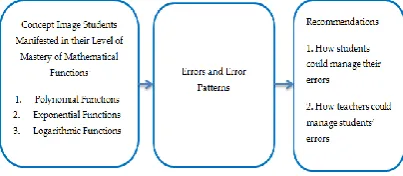
error analysis can address this concern. Pen and Lou (2009) also proposed a framework derived from various researches in which four keys for the nature of mathematical errors for teachers were identified: mathematical, logical, strategic and psychological. According to Pen and Lou, mathematical error is manifested by confusion of concepts and characteristics, negligence of the conditions of formulas and theorems. Logical error is shown in false arguments, rearranging concepts, improper classifications, arguing cyclically, and using equivalent transforms. Strategic error is described as not being able to distinguish patterns, lack of integral concept, not good at reverse thinking, and could not transform the problem. Finally, psychological error is demonstrated by improper mental state. Although Pen and Lou‟s framework are intended for teachers, it is assumed in this study that the students are likely to commit the same errors. Figure 1 shows the specific concepts of this study.
Figure 1: Research Paradigm
3.
Research Methodology
3.1 Research Design
A mixed method type of research was used in the study. Both quantitative and qualitative techniques were utilized. The quantitative technique was used to generate students‟ data on interest in mathematics, exposure to varied types of mathematical tasks, and level of mastery of mathematical functions. On the other hand, the qualitative techniques specifically content analysis and interviews were to identify and describe the mathematical errors and error patterns of the students.
3.2 Respondents and Sampling Technique
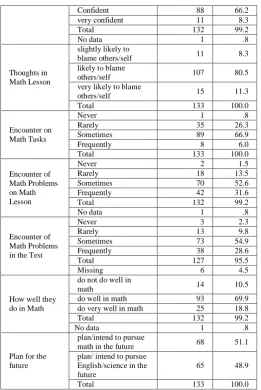
The respondents of the study were the Grade 11 mathematics students enrolled at SMU Science High School during the school year 2017-2018. Two sections shall be randomly chosen from the 13 sections belonging to the STEM strand. To avoid biases, the teachers randomly chose the sections. The three classes under the same teacher that served as the respondents in the study, comprising of 53 (39.8%) male students and 80(60.2%) female students. Table 1 shows the characteristics of the respondents.
Table 1: Profile of the Students
Profile Variables Categories Frequency Percent
View on mathematics
very negative view on
math 1 .8
negative view on
math 16 12.0
positive view on math 81 60.9
very positive view on
math 35 26.3
Total 133 100.0
Confidence in Math
not at all confident 2 1.5
Confident 88 66.2
very confident 11 8.3
Total 132 99.2
No data 1 .8
Thoughts in Math Lesson
slightly likely to
blame others/self 11 8.3
likely to blame
others/self 107 80.5
very likely to blame
others/self 15 11.3
Total 133 100.0
Encounter on Math Tasks
Never 1 .8
Rarely 35 26.3
Sometimes 89 66.9
Frequently 8 6.0
Total 133 100.0
Encounter of Math Problems on Math Lesson
Never 2 1.5
Rarely 18 13.5
Sometimes 70 52.6
Frequently 42 31.6
Total 132 99.2
No data 1 .8
Encounter of Math Problems in the Test
Never 3 2.3
Rarely 13 9.8
Sometimes 73 54.9
Frequently 38 28.6
Total 127 95.5
Missing 6 4.5
How well they do in Math
do not do well in
math 14 10.5
do well in math 93 69.9
do very well in math 25 18.8
Total 132 99.2
No data 1 .8
Plan for the future
plan/intend to pursue
math in the future 68 51.1
plan/ intend to pursue English/science in the future
65 48.9
Total 133 100.0
Majority of the students have positive view on mathematics and confidence in doing mathematical tasks. However, majority tend to blame others or their own selves regarding their performance in mathematics class. Majority also claimed that they only sometimes encounter math tasks and math problems in both lessons and in the test. Majority also perceived that they do well in mathematics and slightly beyond half of the class even plan/ intend to pursue mathematics in the future. Furthermore, Table 2 shows the mean, standard deviations and qualitative descriptions of the students‟ characteristics.
Table 2: Means, standard deviations and qualitative descriptions of students’ characteristics
Mean Std.
Deviation Qualitative Description
View on math 3.05 0.55 Positive view on math
Confidence in math 2.73 0.49 Confident
Thought on math lesson 2.93 0.40 Likely to blame
others/self
How well they do in math 3.00 0.46 Do well in math
Future Plan or Intention 0.52 0.40 Plan /intend to pursue
math in the future How often they encounter
math tasks 2.78 0.52 Sometimes
How often they encounter
math problems in the lesson 3.06 0.60 Sometimes
How often they encounter
math problems in the test 3.06 0.60 Sometimes
3.3 Research Instruments
Two questionnaires were used in the study: First, the Questionnaire that calls for a) some personal information about the student, and b) some insights about the students‟ attitude towards dealing with mathematics. Second, the questionnaire on Exposure to Mathematical Tasks. The items in these questionnaires were adopted from Programme International for Student Assessments (PISA) in Mathematics. The data from this became part of the description of Grade 11 respondents in Chapter III. Another source of data was a researcher-made test on mathematical functions. The test was tried out to pre-service mathematics teachers and selected Grade 11 students who do not belong to the study‟s actual respondents. The reliability coefficient obtained was 0.799, which indicates an acceptable internal consistency of items in the test. The data from the actual test was used to determine the students‟ level of performance, image concepts and types of mathematical errors.
3.4 Data Gathering Procedure and Data Analysis
The questionnaires on exposure to mathematical tasks, attitude towards mathematics and personal data were first administered to the students to establish their profile. The researchers requested the mathematics teachers of the students to administer the test on polynomial, exponential and logarithmic functions. The answer sheets/worksheets were collected from the teacher thereafter. Each score was converted into percent value, after which the average of the scores was computed for each type of functions. The scores were interpreted using the following scale provided in DepEd Order No. 8 s. 2015 also known as Policy Guidelines on Classroom Assessment for the K to 12 Basic Education Program:
Mean Percent Description
96 – 100 Mastered
86 – 95 Closely approaching to mastery
66 -85 Moving towards
mastery
35 – 65 Average mastery
15 – 34 Low mastery
5 – 14 Very low mastery
0 - 4 No mastery
4.
Results and Discussion
4.1 The Grade 11 students’ image concepts manifested in their level of mastery of mathematical functions
Table 3 shows the frequency distribution of the level of mastery of the grade 11 students in mathematical functions.
Table 3: Frequency counts and percents of Grade 11 students’ image concepts manifested in their level of mastery
of mathematical functions
Level of mastery of mathematical functions Polynomial Functions Exponential and Logarithmic Functions Mathematical Functions (TOTAL)
f % f % f %
no mastery 5 3.8 15 11.3 3 2.3
very low
mastery 45
33.
8 13 9.8 16 12.0
low mastery 49 36.
8 78 58.6 94 70.7
average
mastery 27
20.
3 26 19.5 19 14.3
moving towards mastery
5 3.8 1 .8 1 .8
closely approaching to mastery
2 1.5 0 0 0 0
Mastered 0 0 0 0 0 0
Total 13
3 100
.0 133 100.0 133 100.0
Mean (Qualitative Description) SD 26.17 low mastery / poor image concept 17.98 24.09 low mastery/ poor image concept 13.35 24.88 low mastery/ poor image concept 12.56
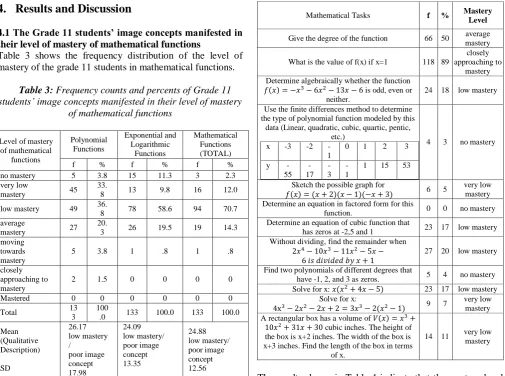
As gleaned in Table 3, many of the students obtained low mastery (36.8%) in the polynomial function with slight difference with those students who belong to very low mastery (33.8%). More than half (58.6%) of the students have low mastery in exponential and logarithmic functions. In general, majority of the students have low mastery in mathematical functions (70.7%). On the average, the results also show that students have low mastery in polynomial functions (26.17%), exponential and logarithmic functions (24.09%). The low mastery of the students along the competencies indicates that the Grade 11 students have generally poor image concepts of polynomial, exponential and logarithmic functions. Moreover, Table 4 and Table 5 display the frequency, percent and mastery level of the students in each of the competencies in the test given to the students.
Table 4: Frequency, Percent and Mastery Level in each Competencies on Polynomial Functions in the Test (N =133)
Mathematical Tasks f % Mastery
Level
Given: ( ) ( )( )
Determine the x intercepts of the function 28 21 low mastery
Give the degree of the function 66 50 average
mastery
What is the value of f(x) if x=1 119 89
closely approaching to
mastery
Given: ( ) ( )( )
Determine the x intercepts of the function 25 19 low mastery
Mathematical Tasks f % Mastery
Level
Give the degree of the function 66 50 mastery average
What is the value of f(x) if x=1 118 89
closely approaching to
mastery Determine algebraically whether the function
( ) is odd, even or neither.
24 18 low mastery
Use the finite differences method to determine the type of polynomial function modeled by this
data (Linear, quadratic, cubic, quartic, pentic, etc.)
x -3 -2
-1
0 1 2 3
y
-55 -17 -3 -1
1 15 53
4 3 no mastery
Sketch the possible graph for
( ) ( )( )( ) 6 5 very low mastery Determine an equation in factored form for this
function. 0 0 no mastery
Determine an equation of cubic function that
has zeros at -2,5 and 1 23 17 low mastery
Without dividing, find the remainder when
27 20 low mastery
Find two polynomials of different degrees that
have -1, 2, and 3 as zeros. 5 4 no mastery
Solve for x: ( ) 23 17 low mastery
Solve for x:
( ) 9 7 very low mastery A rectangular box has a volume of ( )
cubic inches. The height of the box is x+2 inches. The width of the box is x+3 inches. Find the length of the box in terms
of x.
14 11 very low
mastery
The results shown in Table 4 indicate that the mastery level of the students along the competencies needed in polynomial functions ranges from no mastery to closely approaching to mastery. Yet, the students have obtained closely approaching to mastery level in determining the value of the function given the value of x and average mastery in determining the degree of the given functions. Moreover, the students have no mastery in determining the type of polynomial function and sketching the graph given the values of x and y. Also, in determining the equation in factored form, and finding two polynomials of different degrees given the zeroes of the function. The results further indicate that the Grade 11 students have generally poor to very poor image concepts of polynomial functions. The interview conducted with the students surfaced the fact that the topics related to the items where they obtained no mastery were not discussed in their Grade 11 Mathematics classes, neither were they given similar assignments.
Table 5: Frequency, Percent and Mastery Level in each Competency on Exponential and Logarithmic Functions in
the Test
Mathematical tasks f % Mastery Level
Given:
Asymptote 19 14 low mastery
Sample points 18 14 very low mastery
Domain 53 40 average mastery
Range 24 18 low mastery
Graph 3 2 no mastery
Given: ( )
Asymptote 4 3 no mastery
Mathematical tasks f % Mastery Level
Domain 33 25 low mastery
Range 62 47 average mastery
Graph 3 2 no mastery
Find algebraically the inverse of
the function 2 2 no mastery
Write in exponential form
108 81
moving towards mastery
Write in logarithmic form:
97 73
moving towards mastery
Evaluate: 109 82 moving towards
mastery Expand and simplify:
( )(√ ) 34 26 low mastery
( )
14 11 very low mastery
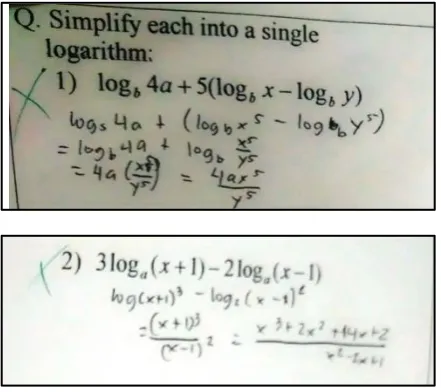
Simplify each into single logarithm
( ) 5 4 no mastery
( ) ( ) 11 8 very low mastery Solve each of the following
equations. Round your answers to two decimal places if necessary.
( ) 46 35 average mastery
34 26 low mastery
43 32 low mastery
Sodium-24 is a radioactive isotope of sodium that is used to
study circulatory dysfunction. Assuming that 4 micrograms of
sodium-24 are injected into a person, the amount A in micrograms remaining in that person after t hours is given by
the equation What amount of sodium-24
remains after 5 hours? 38 29 low mastery
What is the half-life of
sodium-24? 1 1 no mastery
In how many hours will the amount of sodium-24 be equal to
1 microgram?
14 11 very low mastery
According to a software company, the users of its typical tutorial can expect to type ( ) words per minute after t hours of practice with the product, according to the
function
( ) (
How many words per minute can a student expect to type after two
hours of practice?
29 22 low mastery
According to the function N, how many hours, to the nearest hour of practice will be required before a
student can expect to type 60 words per minute?
21 16 low mastery
As shown in Table 5, students‟ mastery level ranges from no mastery to moving towards mastery. However, students have moving towards mastery only in rewriting logarithmic form to exponential form and vice versa. This is because the teachers just finished discussing the topics when they had the test, as revealed by the students during the interview. The students have average mastery in some competencies such as finding the domain and range and solving for x for simple logarithmic equation. But they have low mastery or very low mastery in finding asymptote, range and domain or in finding the value x for more complex equations. They also have very low mastery in providing sample points and solving word problems on mathematical functions. It can be said therefore that the students have relatively poor to very poor concept image of exponential and logarithmic functions. This result
was supported by studies on low performance of the students in mathematics in general. Mundia (2012) and Abdurrahman (2010) revealed that mathematics is considered the most difficult subject for students and this led to poor performance. Usually, previous studies aimed to explore the possible intervening variables that might affect the performance of students in mathematics such as teacher, student, infrastructure, tools, media and environmental factors (Sanjaya, 2010), dominance of conventional learning (Trianto, 2010) or attitudes towards mathematics ((Nicolaidou and Philippou, 2003). In this study, the characteristics of the students were also considered. However, explorations on intervening variables were not done since the selected students were from Science, Technology, Engineering and Mathematics (STEM) strand. Students were expected to like mathematics subject. This assumption was supported by the characteristics of the students revealed in Chapter 3. The results of the study are quite alarming because despite the students„ positive view on math, confidence in math, perception that they do well in mathematics and plan to pursue mathematics in the future, the students did not get a favorable level of mastery. Nonetheless, their characteristics also reveal that they are likely to blame others or their own selves on their performance in mathematics. Their profile also speaks of their exposure in solving mathematics problems and tasks, and the result was unexpected that they only “sometimes” encountered math problems or tasks when in fact they should be always engaged in problem solving tasks as one of the skills needed for 21st century learners. Moreover, based on the K to 12 Curriculum Guide (2013), problem solving and critical thinking skills are the twin goals of mathematics as shown in the conceptual framework of Mathematics Education in the basic education levels. The students‟ profile that shows students‟ limited exposure to certain mathematical tasks might be a possible factor why they have low mastery. This limited exposure may be traced to teacher-factor. Teachers are the ones responsible to engage the students in the problem solving tasks be it in the form of lesson, activities, homework and tests. The teacher as the facilitator of class discussions was supported by Abante (2014) that teaching styles must match with learning styles and that according to Pasion (2010), a teacher is obliged to seek the most suitable learning strategy according to the situation of the class. The attitude of the students was also one of major concerns that can boost the students‟ interest to learn mathematics and that different strategies were explored to change the attitudes of students but it can be either from negative to positive or vice versa (Nicolaidou and Philippou, 2003; Haladyna, Shaughnessy & Shaugnessy , 1983; Olatunde, 2009. However, the result of this study is contrary to the study of Moenikia & Zahed-Babelen (2010) that attitude is one of the predictors of mathematics achievement. Also, the study of Esteves (2013), Mata (2012) and Nicolaidou and Philippou (2003) revealed that in general students with more desirable attitude towards mathematics performed better than those with negative attitude.
4.2 The mathematical errors committed by the students in dealing with mathematical functions
4.2.1Polynomial Functions
Figure 2 shows the solution of a student to a problem on determining the x-intercepts.
Figure 2
The student made a mistake in factoring x2 + 2x. It was factored as (x+2) (x+1) instead of factoring out x only to get x(x+2). This indicates error in factoring and lack of concept on factoring. Similar problems are shown in Figure 3.
Given: ( ) ( )( ) Determine the x intercepts
of the function Give the degree of the
function
What is the value of f(x) if x=1?
Figure 3
The student did not equate each factor to 0 in number (1); instead the student multiplied the factors. The same error was committed in number (2). Instead of factoring the polynomials to derive the x-intercepts, the factors were multiplied. The two solutions indicate that the student does not have a grasp of x-intercept. The student had committed mathematical error because of confusion, and strategic error because of lack of integral concepts on x-intercepts. Interview with the students revealed that their immediate reaction when shown such case is to multiply without further analyzing the directions. This result was supported by Kotsopoulos (2007) that found that secondary students experience many difficulties when factoring. According to him, the difficulties arise due to students being challenged to recall basic multiplication facts. The writing of polynomials as a product of polynomials is the process of factoring in which students need to have both procedural knowledge and a strong conceptual understanding of multiplication of polynomials in order to recall basic multiplication facts effectively. Figure 4 shows a student‟s answer about the degree of the function:
Figure 4
The student looks familiar with what to consider in getting the degree of the function. But the student included the
variable x and failed to report the degree. The degree is supposed to be represented by the highest exponent that appears when the function is not in factored form. The answers should have been 3 and 4, respectively. This is a case of mathematical error; the student appears to have an idea of what a degree is but might have been confused whether or not to include the base. Figure 5 shows that a student had exhibited error in operation. Instead of multiplying 3 and -2, the student added 3 and -2. Consistently, another student also committed the same error in the next item on finding the value of f(x) if x=1 as shown in Figure 6.
Figure 5
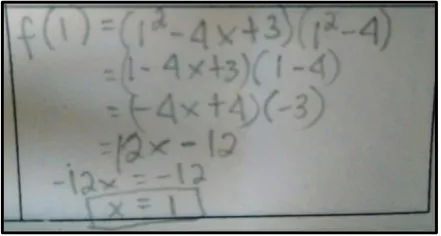
After doing the operations inside the parentheses, the student disregarded the open and close parentheses signs that indicate multiplication operation. Meanwhile in Figure 6, another student did not substitute 1 to all x‟s, ending up computing the value instead.
Figure 6
Figure 7
It appears in Figure 8 that the student had an initial idea of plotting the x-intercepts. The student was successful in finding and plotting the x-intercepts, but other important properties were not considered. This is therefore a case of both mathematical and strategic errors.
Figure 8
In Figure 9, a student had identified correctly two factors but the three others were not identified. It appears that the student does not have a full grasp of the fact that equations may be derived from the values of x-intercepts. This is a case of mathematical and strategic errors.
Figure 9
Figure 10 is a case of mathematical, logical and strategic errors. The student who answered this does not have a good understanding about curve sketching. Instead of following the factored form to take the intercepts, the student multiplied the factors, making the procedure more complicated. There seems to be a confusion on how to use the intercepts, and lack of knowledge on how to proceed.
Figure 10
In Figure 11, a student appears to have some ideas on synthetic division as shown in the arrangement of the coefficients in one line. The second step was already
erroneous. The student did not know anymore how to proceed. This is a clear case of mathematical and strategic errors.
Figure 11
In Figure 12, instead of factoring the other part of the equation, a student multiplied the two factors x and x2 + 4x -5, resulting to a failure to find the correct solution. The student tends to do the operations instead of finding the factors that comprise the equation. This is again a clear case of mathematical and strategic errors.
Figure 12
4.2.2Exponential and Logarithmic Functions
Figure 13 reveals that a student tends to copy the constant number if the asymptote of a function is being sought. This is a very clear case of mathematical error.
Figure 13
Figure 14 demonstrates negligence in the process of multiplication. The procedure could have been correct already but carelessness prevailed in multiplying 32 by 4. The product is supposed to be 128, not 136; a case of a mathematical error.
Figure 14
form. The same error was committed by the student in number 2. It seems consistent that mathematical and strategic errors prevailed.
Figure 15
In Figure 16, a student had a correct answer; however, the solution does not clearly show how it was derived. This is a case of mathematical, logical and strategic errors. It is a case of logical error because the student obtained one correct answer with wrong solution.
Figure 16
Figure 17 shows a student‟s answer that seems not to have understood the instruction. Instead of finding the inverse, the student assigned some values to x and solved for y. Obvious computational mistakes are noted in the values. Moreover, no further answer was given. Meanwhile, Figure 18 and Figure 19 were representations of graphs of the function. The sketches were marked wrong because the students did not place any labels aside from having wrong ordered pairs.
Figure 17
Figure 18: Graph of K drawn by a student
Figure 19: Graph of K drawn by another student
Figure 20
Figure 21 shows that the transformation could have been correct; however, the student was careless to write 343 as 344. This is a case of a mathematical error. The same error was demonstrated in Figure 22 wherein the student seems not to know how to use a fraction as an exponent.
Figure 21
Figure 22
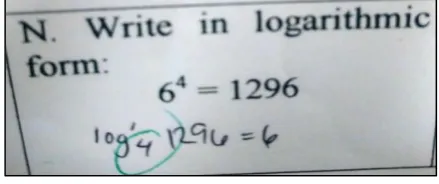
Meanwhile, Figure 23 shows that at a glance, the transformation is correct; however, a closer look of the
answer would tell one that the number 1296 was used as an exponent which is not correct. This is a case of a strategic error.
Figure 23
Figure 24 reveals a mathematical error in that the student did not know the rules to transform the equation into logarithmic form.
Figure 24
All the errors presented in this section are similar to the ones committed by the other students who did not get the correct answers. Interviews with teachers and students were conducted to explore further the reasons behind the prevailing errors.
4.3 Deriving qualitatively a pattern of mathematical errors
Based on the analysis in Section 2, Table 6 shows the summary of the errors committed by the students in solving polynomial functions, exponential and logarithmic functions.
Table 6: Summary of mathematical or strategic errors in polynomial, exponential and logarithmic functions
Topic Mathematical Errors or Strategic Errors
Polynomial Functions
Error in factoring
lack of integral concepts on x-intercepts
lack of concept on factoring
lack integral concepts on doing several operations at a time.
Lack of knowledge how to proceed
No full grasp that equations may be derived from the values of x-intercepts.
Confusion on how to use confusion on how to use the intercepts
Doing the operations instead of finding the values of x by factoring
Exponential and Logarithmic Functions
negligence in the process of multiplication or careless in computing
erroneous application of the properties
Misunderstood the instructions
Incomplete answer by not placing proper labels
No idea of any idea about asymptote, how to
identify points on the curve, and
consequently how to find the domain and the range
The errors committed by students reveal that something went wrong in the teaching-learning process. Vital to understanding better concepts in mathematics is the framework used by the teacher to teach the subject. As mentioned by Posamentier (2006), teaching mathematics is not about providing rules and formulas, definitions and procedures for students to remember, but it is more of involving students as functional participants through active interaction like discussion and cooperation among students. Results of the interview with students further revealed the teacher usually starts the class with a review of the past lesson. Lessons and unfamiliar concepts are generally presented using multimedia, specifically PowerPoint. Solutions to problems are provided with not many details. The students also claimed that they find it hard to comprehend the presentation because of the fast transition. They sometimes are not able to cope because of difficulty in analyzing problems and because of the time pressure given during problem solving tasks. Moreover, when asked if they refer to several sources when working with mathematical tasks, the students said that they simply rely on the prescribed textbook which the teacher usually use in teaching.
4.4 Recommendations on how students could learn to manage their errors and how teachers could manage the students’ errors
1. In addressing errors in exponential and logarithmic functions, a student must review the fundamentals of laws and properties of exponents and logarithms to avoid confusions. This is supported by Marcus (2001) when said that students may fail to understand the meaning of the properties and laws of logarithms without seeing the connections with the law of exponents. He also explained that students only memorize the rules but do not fully understand them. 2. Results of the interview showed that teachers generally
teach the subject and explain examples using Powerpoint. Kenney (2005) suggested that teachers need to find different approaches of doing more than just teach process and properties involved in logarithms and instead make logarithmic expressions objects to which students can relate. Further, Bientenbeck (2011) emphasized that traditional teaching which includes rote memorization of rules, formulas and procedure, and teaching by telling, has a substantial positive effect on student achievement, while the estimated impact of the modern teaching in mathematics is much smaller and statistically insignificant. Thus a balance between traditional and modern strategies of teaching mathematics must be observed. At the students‟ end, they must also be required to memorize rules, formulas and procedure so that they will always have something to retrieve when an occasion requires because technology cannot do it for them.
3. Berezovsky (2004) also suggested that teachers should implement proper techniques in teaching exponential and logarithms so that students can acquire deep understanding of the topic. He also added that teachers need to state clearly terms like exponential expressions, logarithmic expressions and term, exponential function and equations and logarithmic function and equations. Moreover, De Gracia (2014) recommended that teachers have to self-construct problems/items on exponents and
logarithms to help students improve their problem solving skills not only when dealing with exponents and logarithms but with mathematics in general.
4. Teachers need to clearly explain the mathematical tasks such as to convert, find the value of, evaluate, expand, show and the like. This explains the mistakes done by the students of misunderstanding the given tasks and thus leads to error (Berezovsky, 2004).
5.
Conclusion
Based on the findings of this study, the following conclusions are drawn:
1. The Grade 11 students have poor to very poor concept image of polynomial, exponential and logarithmic functions, which are topics necessary to understand advanced topics in mathematics.
2. The Grade 11 students exhibited mathematical, strategic and logical errors in solving problems involving polynomial, exponential and logarithmic functions. 3. The Grade 11 students encountered many errors that
stem from inadequate grasp of operations, rules, formulas and procedures, and limited exposure to significant mathematical tasks.
4. The teachers‟ strategies appeared not be adequate enough to engage STEM students to utilize their maximum potentials in doing mathematical tasks.
6.
Recommendations
Because of the poor to very poor concept image of functions among Grade 11 students, a thorough review of the resource materials being used by the teachers and how they use the materials effectively, have to be looked into. Moreover, the teachers have to find ways on how to manage the students‟ errors in mathematics. For instance, similar problems may be administered to see better the recurrence of the errors. Requiring students to memorize rules, formulas and procedures might help the students cope better in doing more complex tasks in mathematics. The students have to be given more inputs on how to improve their study skills to help them manage their errors, which include reading additional reference materials apart from what the required textbooks. Furthermore, the students who exhibit more types of errors have to be given closer attention by the teachers. Because only qualitative analysis was used in the study, future researchers may consider statistical analysis of the relationship between the students‟ concept image and the profile variables used to describe the students.
References
[1] Abante, M., Almendral, B., Manansala, J., & Mañibo, J. (2014). Learning styles and factors affecting the learning of general engineering students. International Journal of Academic Research in Progressive Education and Development. 3(1), 17-27
[2] Abdullah, A. H., Abidin, N.L.C., and Ali, M. (2015). Analysis of students‟ errors in solving higher order thinking skills (hots) problems for the topic of fraction. Asian Social Science 11(21). July 2016. DOI: 10.5539/ass.v11n21p133
[4] Abedi, J., Courtney, M., Leon, S., Kao, J. and Tarek, A. (2006). English language learners and mathematics achievement: A study of opportunity to learn and language accommodation. National Center for the Study and Evaluation (CSE) Graduate School of Education and Information Studies University of California, Los Angeles.
[5] Aguila, M. G. T. (2015). 21st century skills of Nueva Vizcaya State University Bambang campus,
Philippines. Retrieved from
http://apjeas.apjmr.com/wp- content/uploads/2015/04/APJEAS-2015-2-118-21st-Century-Skills.pdf
[6] Anderson, L. W., Krathwohl, D. R. (2001). A taxonomy for learning, teaching and assessing: A revision of Bloom‟s taxonomy. New York. Longman Publishing. Artz, AF, & Armour-Thomas, E.(1992). Development of a cognitive-metacognitive framework for protocol analysis of mathematical problem solving in small groups. Cognition and Instruction, 9(2),
137-175. Retrieved from
https://nsee.memberclicks.net/assets/docs/Knowledge Center/EnsuringQuality/BooksReports/146.%20a%20t axonomy%20for%20learning.pdf
[7] Arikan, E. S., Ozkan, A., and Ozkan, E. M. An examination in Turkey: Error analysis of Mathematics students on group theory. Academic Journals, Vol. 10 (16), pp.2352-2361, 23 August 2015. DOI: 10.5897/ERR2015.2329
[8] Berezovsky, T. (2004). An inquiry into high school students‟ understanding of logarithms. Canada: Simon Fraser University
[9] Bientenbeck, J. (2011). Teaching practices and student achievement:Evidence from TIMSS.Master Thesis. Centro de Estudios Monetarios y Financieros (CEFMI) No. 1104, Casado del Alisal 5; 28014 Madrid. Retrieved on October 12, 2017 from
http://www.cemfi.es.
[10] Borasi, R. (1987). Exploring mathematics through the analysis of errors. For the Learning of Mathematics. 7(3), 2-8. November 1987. Retrieved from http://www.jstor.org/stable/40247900
[11] Bush, S. B. (2011). Analyzing common algebra-related misconceptions and errors of middle school students. University of Louisville. Retrieved from http://ir.library.louisville.edu/cgi/viewcontent.cgi?artic le=1186&context=etd
[12] Cohen, L. G., & Spenciner, L. J. (2010). Error analysis of mathematics. Pearson/Allyn Bacon/Prentice Hall: Boston, MA.
[13] Cromley, J. G. (2009). Reading achievement and science proficiency: International comparisons from the programme on international student assessment. Reading Psychology, 30(2), 89-118. Retrieved from
http://p16277.typo3server.info/fileadmin/download/pt am/1-2011_20110328/06_Azevedo.pdf
[14] Daymude, L. K. H. (2010). Test error analysis in mathematics education: a mixed methods study. University of Georgia, Athens.
[15] De Gracia, R. S. (2014). Teaching with-error high aptitude mathematically-challenged high school seniors with alternative conceptions on exponents and logarithms. Unpublished thesis. Saint Mary‟s University, Bayombong, Nueva Vizcaya.
[16] Department of Education (2013). Implementing Rules and Regulations of the Enhanced Basic Education
Act of 2013. In
http://www.officialgazette.gov.ph/2013/09/04/irr-
republic-act-no-10533/, June 20, 2017
[17] Department of Education (2016, April 24). DepEd Order No. 8 s. 2015: Policy Guidelines on Classroom Assesment for the K to 12 Basic Education program. In
http://www.deped.gov.ph/sites/default/files/order/2015 /DO_s2015_08.pdf
[18] Department of Education (2016, April 24). DepEd Order No.8 series of 2015-Policy Guidelines on Classroom Assessment for the K to 12 Basic Education Program. Retrieved from http:www.deped.gov.ph/orders/do-8-s-2015 Emmer, E.T.
[19] Devlin, K. (2012). Mathematical thinking. In http://www.mat.ufrgs.br/~portosil/curso-Devlin.pdf. June 20, 2017.
[20] Edwards, M. C., & Briers, G. E. (2000, January). Higher-order thinking versus lower-order thinking skills: Does school-day scheduling pattern influence achievement at different levels of learning?. In Annual Publication of the Southern Agricultural Education Research Conference (p. 15). Retrieved from http://jsaer.org/pdf/vol50Whole.pdf#page=15
[21] Elder, L. (2007). Our concept and definition of critical
thinking. Retrieved from
http://www.criticalthinking.org/pages/defining-critical-thinking/766
[22] Esteves, G. (2013). Problem posing and problem solving skills involving similarity among high school geometry students in relation to some variables. (Unpublished master‟s thesis). Saint Mary‟s University, Bayombong, Nueva Vizcaya
[23] Forehand, M. (2011). Bloom‟s taxonomy: Original
and revised. Retrieved from
http://epltt.coe.uga.edu/cgi-sys/suspendedpage.cgi?title=Bloom%27s_Taxonomy
http://www.sreb.org/programs/hstw/publications/briefs /05V06_research_Brief_high-quality_teaching.pdf
[25] Goldsmith, L.T., Doerr, H.M., and Lewis, C.C. (2014) Mathematics teachers‟ learning: a conceptual framework and synthesis of research. J Math Teacher Educ (2014) 17:5-36 DOI 10.1007/s10857-013-9245-4
[26] Haladyna, T., Shaughnessy, J. and Shaughnessy, M. (1983). A casual analysis of attitude toward mathematics. Journal for Research in Mathematics Education, 1 (14), 19-29
[27] Herholdt, R. and Sapire, I. ( 2014) An error analysis in the early grades mathematics: A learning opportunity. South African J. Child. Educ. 4 42–60.Retrieved from http://www.scielo.org.za/scielo.php?pid=S2223-76822014000100004&script=sci_arttext&tlng=pt
[28] Kandarakis, A. G., & Poulos, M. S. (2008). Teaching implications of information processing theory and evaluation approach of learning strategies using LVQ neural network. Advances in Engineering Education,
5(3), 111-119. Retrieved from
https://www.researchgate.net/publication/241773548_ Teaching_Implications_of_Information_Processing_T heory_and_Evaluation_Approach_of_learning_Strateg ies_using_LVQ_Neural_Network
[29] Ketterlin-Geller, L. R., & Yovanoff, P. (2009). Diagnostic assessments in mathematics to support instructional decision making. Practical Assessment, Research & Evaluation, 14(16), 1-11. In Herholdt, R., & Sapire, I. (2014). An error analysis in the early grades mathematics-A learning opportunity?. South African Journal of Childhood Education, 4(1), 43-60.
Retrieved from
http://www.scielo.org.za/scielo.php?pid=S2223-76822014000100004&script=sci_arttext&tlng=pt
[30] Ibe, M. D.. (2003). High school students‟
understanding of English mathematics phrases, clauses, and sentences. LEAPS: Miriam College Faculty Research Journal, 22(1). Retrieved from
http://ejournals.ph/form/cite.php?id=3333
[31] Iseni, A.( 2011). Assessment, testing and correcting students' errors and mistakes. Language Testing in Asia.1(3), 60-90. November 2011. Retrieved from https://link.springer.com/article/10.1186/2229-0443-1-3-60
[32] Jayadoky, G. Interplay between concept image and concept definition: definition of continuity. Retrieved from
http://pzacad.pitzer.edu/~dbachman/RUME_XVI_Lin
ked_Schedule/rume16_submission_27.pdf, July 6,
2017.
[33] Kadir M., & Masi, L. (2014). Mathematical creative thinking skills of students junior high school in Kendari City. In International Seminar on Innovation in Mathematics and Mathematics Education.
Departement of Mathematics Education Faculty of Mathematics and Natural Science Yogyakarta State
University. Retrieved from
http://eprints.uny.ac.id/24314/1/E-35.pdf
[34] Kalchik, S. Oertle, K. M. (2010). the theory and application of contextualized teaching and learning in relation to programs of study and career pathways.
Transition Highlights. Issue 2. In
https://eric.ed.gov/?id=ED513404, June 19, 2017.
[35] Kandarakis, A. G., & Poulos, M. S. (2008). Teaching implications of information processing theory and evaluation approach of learning strategies using LVQ neural network. Advances in Engineering Education,
5(3), 111-119. Retrieved from
https://www.researchgate.net/publication/241773548_ Teaching_Implications_of_Information_Processing_T heory_and_Evaluation_Approach_of_learning_Strateg ies_using_LVQ_Neural_Network
[36] Kenney, R. (2005). Students‟ understanding of logarithmic functions notation. Proceedings of the 27th annual conference of the north and American chapter of the international group for psychology of mathematics education. 24, 275-280.
[37] Kotsopoulos, D. (2007). Unraveling student challenges with quadratics: A cognitive approach. Australian Mathematics Teacher 63(2)
[38] Lai, E. R. (2011). Critical thinking: A literature review. Pearson's Research Reports, 6, 40-41.
Retrieved from
http://images.pearsonassessments.com/images/tmrs/Cr iticalThinkingReviewFINAL.pdf
[39] Lutz, S., & Huitt, W. (2003). Information processing and memory: Theory and applications. Educational Psychology Interactive, 1-17. Retrieved from http://edpsycinteractive.org/brilstar/chapters/infoproc. doc
[40] Moenikia, M. & Zahed-Babelan. (2010). A study of simple and multiple relations between mathematics attitude, academic motivation and intelligence quotient with mathematics achievement. Procedia-Social and Behavioral Sciences, 2, 1537-1542.
[41] Mundia, L. (2012). The assessment of math learning difficulties in a primary Grade-4 Child with high support needs: Mixed Methods and Approached, Journal of Education vol 4(2): 347-366
[42] Marcus, N. (2001). A review of logarithms. Retrieved from http://www.sosmath.com/algenra/logs/log1.html
Retrieved from
http://www.ccsenet.org/journal/index.php/ass/article/v iew/47330
[44] Nicolaidou, M. & Philippou, G. (2003). Attitudes towards mathematics, self-efficacy and achievement in problem solving”, in European Research in Mathematics Education, M. A. Mariotti, Ed., pp.1-11, University of Pisa, Pisa, Italy
[45] Olatunde, Y. (2009). Mathematics anxiety and academic achievement in some selected senior secondary schools in Southwestern Nigeria. Pakistan Journal of Social Sciences, 3(6), 133-137
[46] Pasion, J. (2010). Models of high school students‟ year level mathematics performance as influenced by their supportive learning environment. Unpublished Thesis, Saint Mary‟s University, Bayombong, Nueva Vizcaya
[47] Paola, D. (1998). „Mathematical discussion in classroom about students‟ concepts images‟. In P. Abrantes, J. Porfirio, M. Baía (editors), Proceedings of CIEAEM 49 (Setubal, Portogallo), 132-139. Retrieved from
http://www.matematica.it/paola/CIEAEM%20Abrante
s.pdf, July 6, 2017.
[48] Partnership for 21st Century Learning (2007). Framework for 21st century learning. In
http://www.p21.org/our-work/p21-framework
[49] Pearse, M. and Dunwoody, M. (2013). Learning that
never ends: Qualities of a lifelong learner. R & L Education, USA.
[50] Peng, A., & Luo, Z. (2009). A Framework for examining mathematics teacher
[51] knowledge as used in error analysis. For the Learning of Mathematics, 29(3), 22-25. Retrieved from http://www.jstor.org/stable/25594562
[52] Posamentier, A.S., B.S. Smith and J. Stepelman, 2006. Teaching Secondary Mathematics: Techniques and Enrichment Units. 7th Edn., Pearson Education, New Jersey, ISBN: 0-13-118520-9, pp: 6.
[53] Republic Act 10533 (Enhanced Basic Education Act of 2013).
[54] Säljö, R. (1979). Learning about learning. Higher education, 8(4), 443-451. In Van Rossum, E. J., & Hamer, R. N. (2010). The meaning of learning and knowing. Sense publishers. Retrieved from https://dspace.library.uu.nl/handle/1874/43866
[55] Sanders, S. (2016). Critical and creative thinkers in mathematics classrooms. Journal of Student Engagement: Education Matters, 6(1), 19-27. Retrieved from http://ro.uow.edu.au/jseem/vol6/iss1/4/
[56] Sanjaya, W. (2010). Learning strategies: Standard process oriented education, Jakarta, Kencama Pub.
[57] SEI-DOST & MATHTED, (2011). Framework for Philippine mathematics teacher education. Manila: SEI-DOST & MATHTED.
[58] Shorser, L. (1999). Bloom‟s Taxonomy interpreted for
mathematics. Retrieved from
https://pdfs.semanticscholar.org/3b9b/215f1b0713d44 504d7b7898ec19069768c07.pdf
[59] Siswono, T. Y. E. (2010). Leveling students‟ creative thinking in solving and posing mathematical problem. Journal on Mathematics Education, 1(1), 17-40.
Retrieved from
https://ejournal.unsri.ac.id/index.php/jme/article/view/ 794
[60] Sulaiman, T., Muniyan, V., Madhvan, D., Hasan, R., Syrene, S., & Rahim, A. (2017). Implementation of higher order thinking skills in teaching of Science: A Case Study in Malaysia. International Research Journal of Education and Sciences (IRJES), 1. Retrieved from http://www.masree.info/wp- content/uploads/2017/02/20170226-IRJES-VOL-1-ISSUE-1-FULL-2017.pdf#page=7
[61] Swartz, R., & McGuinness, C. (2014). Developing and assessing thinking skills. Find Report of Thinking Skills Project. Boston and Northern Ireland: The International Baccalaureate Organization. Retrieved from http://www.ibo.org/globalassets/publications/ib- research/continuum/student-thinking-skills-report-part-2.pdf
[62] Tall, D. (1988). Concept image and concept definition. Senior Secondary Mathematics Education, (ed. Jan de Lange, Michiel, Doorman), (1988), OW & OC Utrecht, 37- 41.
[63] Tall, D., & Vinner, S. (1981). Concept image and concept definition in mathematics with particular reference to limits and continuity. Educational Studies in Mathematics, 12(2), 151-169. Retrieved from
http://www.jstor.org/stable/3482362
[64] Teaching as Leadership (2009). Retrieved from https://www.oecd.org/berlin/43541674.pdf
[65] Trianto, E. (2010). Designing innovative learning model-progressive: The concept, foundation, and its implementation in the educational unit level curriculum. Jakarta, Kencana Publication
[66] University of Rhode Island (2017). Bloom‟s
Taxonomy (2017). Retrieved from
https://web.uri.edu/teach/higher-lower-thinking-skills/
[67] Van Rossum, E. J., & Hamer, R. N. (2010). The meaning of learning and knowing. Sense publishers.
Retrieved from
[68] Vinner, S. (1983). Concept definition, concept image and the notion of function. International Journal of Mathematical Education in Science and Technology, 14, 293-305.
[69] Vinner, S., & Dreyfus, T. (1989). Images and definitions for the concept of function. Journal for Research in Mathematics Education, 20(4), 356-366.
[70] Vinner S. & Hershkowitz, R. (1980) “Concept images and some common cognitive paths in the development of some simple geometric concepts”, Proceedings of the Fourth International Conference of P.M.E., Berkeley, 177-184.
[71] Visande, J. C. (2014). Developing critical thinking skills among education students through formative education. Retrieved from http://infonomics- society.org/wp-content/uploads/ijcdse/published- papers/volume-5-2014/Developing-Critical-Thinking-Skills-among-Education-Students-.pdf