Available online on 15.9.2018 at http://ujpr.org
Universal Journal of Pharmaceutical Research
An International Peer Reviewed JournalOpen access to Pharmaceutical research
This is an open access article distributed under the terms of the Creative Commons Attribution-Non Commercial Share Alike 4.0 License which permits unrestricted non
commercial use, provided the original work is properly cited Volume 3, Issue 4, 2018
RESEARCH ARTICLE
FORMULATION AND EVALUATION OF IBUPROFEN GASTRO-RETENTIVE
FLOATING TABLETS
Saddam C Shaikh*, Dnyaneshwar Sanap , Dipak V Bhusari, Shirish Jain, Pooja P Kochar, Vikram N Sanchati
Rajarshi Shahu College of Pharmacy, Buldana, Maharashtra, India
ABSTRACT
Objective: The objective of the present study was to formulate the gastro-retentive floating tablets containing Ibuprofen, which would remain in stomach and/or upper part of GIT for prolonged period of time. Floating systems have low bulk density so that they can float on the gastric juice in the stomach. Ibuprofen is an anti inflammatory drug.
Methods: On trial and error basis formulation design was done. Four different batches of floating tablets of Ibuprofen were prepared using HPMC, Xanthan gum, and gas generating agent sodium bicarbonate and citric acid. The tablets were characterized for the pre and post compression parameters such as friability, hardness, thickness, drug content, weight variation, in-vitro buoyancy studies and 13 hrs in-vitro drug release studies and the results were within the limits.
Results: There was no interaction found in between drug and other ingredients. Maximum release was shown by formulation of batch F4 (47.38%), and minimum by the formulations of batch F2 (34.46%) in the duration of 13 hrs.
Conclusion: From the results obtained, it was concluded that the optimized formulation F4 desired drug release properties and floating behavior.
Keywords: Citric acid, gastro-retentive floating tablets, HPMC K4M, Ibuprofen, sodium bicarbonate, xanthan gum.
Article Info: Received 13 June 2018; Revised 26 August; Accepted 3 September, Available online 15 September 2018 Cite this article-
Shaikh SC, Sanap D, Bhusari DV, Jain S, Kochar PP, Sanchati VN. Formulation and evaluation of Ibuprofen gastro-retentive floating tablets. Universal Journal of Pharmaceutical Research. 2018; 3(4): 19-23.
DOI: https://doi.org/10.22270/ujpr.v3i4.178
Address for Correspondence:
Saddam C Shaikh, Rajarshi Shahu College of Pharmacy, Buldana, Maharashtra, India. E-mail: [email protected]
INTRODUCTION
Administration of drugs by oral route offers ease administration and gastrointestinal physiology offers more flexibility in dosage form design than other routes1. Drugs that are easily absorbed from gastrointestinal tract (GIT) and have short half lives are eliminated quickly from the systemic circulation. So, there is need of frequent dosing of these drugs is required to achieve desired therapeutic activity. To avoid this, the development of oral sustained/controlled release formulations is an attempt to release the drug slowly into the GIT and maintain an effective drug concentration in the systemic circulation for a long time. Floating drug delivery systems (FDDS) were first described by Davis in 19682. Floating systems or Hydro-dynamically controlled systems are low-density systems that have sufficient buoyancy to float over the gastric contents and remain buoyant in the stomach without affecting the gastric emptying rate for a prolonged period of time while the system is floating on the gastric content; the drug is released slowly at the desired rate from the floating system. After release of drug, the residual system is emptied from the stomach3.
drug release due to its rapid hydration, good compression and gelling characteristics along with its ease of use, availability, and very low toxicity. It regulates the release of drug by controlling the swelling and cross-linking10,11.
The main intention of this work was to formulate a single unit floating tablets of ibuprofen with use of HPMC for the release of the drug after a definite lag time and provides required concentration of drug at regular intervals of time which results reduction in frequency of dose of administration and will improve patient compliance12.
MATERIALS AND METHODS
Ibuprofen was obtained as a gift sample from Leben Parma, Akola, Maharashtra, India. HPMC K4M, Xanthan gum, Citric acid, lactose and Sodium bicarbonate, Talc and MCC were obtained from Research Lab, Akola, Maharashtra, India. All the chemicals and reagents required for the present experimental work are of analytical grade.
Standard Calibration Curve
10 mg of Ibuprofen was weighed and dissolved in 10 ml of phosphate buffer 6.8, to give a solution of 1000 μg/ml concentration. From this solution 1 ml was taken and diluted to 10ml using Phosphate buffer 6.8 to produce a stock solution of 100μg/ml. From this stock solution different concentrations were prepared. The absorbance of these solutions was measured at 221 nm by UV spectrophotometer (Jasco V530 plus)13.
Figure 1: Standard calibration curve of Ibuprofen
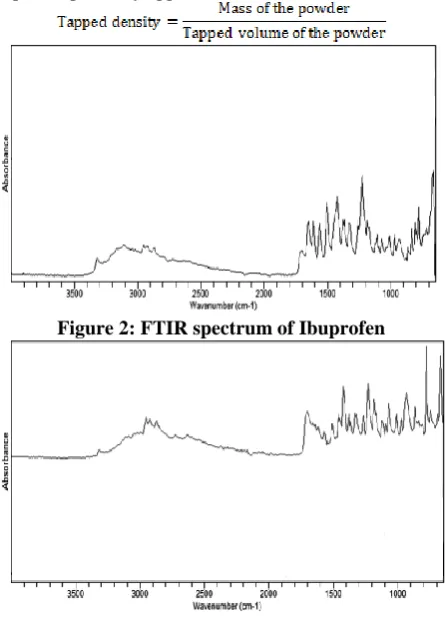
Fourier Transform Infra-Red (FTIR) Spectroscopy Interaction of drug with excipients was confirmed by carrying out IR interactions studies. Drug and excipients used in study were placed in air tight screw cap amber colored vials, then vials were kept at room temperature as well as in hot air oven at 400C for one week to get them moisture free and FT-IR analysis was carried out with saturated potassium bromide using pellet making method. Standard and KBr were taken in the ratio of 1:300 to make a solid disc or pellet with the help of Hydraulic Pellet Machine14, 15.
Powder characterization
1. Bulk Density: It refers to packing of particles. The bulk density of the formulated granules was evaluated using a bulk density apparatus16. It is expressed in gm/ml and is given by below equation-
2. Tapped density
Weighed quantity of tablet blend was into a graduated cylinder. Volume occupied by the drug was noted
down. Then cylinder was subjected to 100, 200 and300 taps in tap density apparatus17.
Figure 2: FTIR spectrum of Ibuprofen
Figure 3: FTIR spectrum of mixture of Ibuprofen, HPMC K4M
3. Carr’s Index (Compressibility)
The compressibility index and Hausner ratio was measures the property of powder to be compressed. The packing ability of tablet blend was evaluated from change in volume, which is due to rearrangement of packing occurring during tapping18.
It was indicated as Carr’s compressibility index was calculated by following formula-
4. Hausner Ratio
It is measurement of frictional resistance of tablet blend19. The ideal range should be 1.2-1.5. It was determined by the ratio of tapped density and bulk density
5. Angle of Repose
It is defined as the maximum angle that can be obtained between the free standing of powder heap and horizontal plane20. It was determined by the following equation:
Where, θ = Angle of repose, h = of powder heap. r = Radius of the powder cone.
polymer were blended and geometrically in a mortar and pestle for 15 minutes then magnesium stearate, sodium bicarbonate, talc, lactose and magnesium stearate were mixed one by one. After thoroughly mixing the ingredients, the powder was blend was passed through 44# sieve and compressed on rotary tablet punching machine21,22.
Post compression parameters of Ibuprofen floating tablets
1. Weight uniformity test
Twenty Ibuprofen tablets were weighed individually, average weight was calculated and individual tablet weights were compared to the, average weight. The tablets met the USP test if no more than 2 tablets are outside the percentage limit and if no tablet differs by more than two times the percentage limit23.
2. Hardness test
The hardness of the tablets was determined using Monsanto Hardness tester. It is expressed in kg/cm2. Six tablets were randomly picked from each formulation and the mean and standard deviation values were calculated24.
3. Friability
A friability test was conducted on Ibuprofen floating tablets using a Roche friabilator. Twenty tablets were selected from each batch and any loose dust was removed with the help of a soft brush. The tablets were initially weighed and transferred into friabilator. The drum was rotated at 25 rpm for 4 minutes after which the tablets were removed. Any loose dust was removed from the tablets as before and the tablets were weighed again25,26. The percentage friability was then calculated by,
4. Lag Time
The In-vitro buoyancy was determined by the lag time. The Ibuprofen tablets were placed in a 100 ml beaker containing 0.1 N HCl. The time required for a tablet to rise to the surface for floating was determined as the lag time27.
5. Floating Time
The Ibuprofen tablets were placed in a 100 ml glass beaker containing 0.1 N HCl. The time for which the tablet remained floating on the surface of medium was determined as floating time28.
6. Drug Content
Ten Ibuprofen tablets were weighed and average weight was calculated. All the 10 tablets were crushed in a mortar. The powder equivalent to 10 mg was accurately weighed, dissolved in 5 ml of Methanol and made up to 100 ml of 0.1 N HCl. The volumetric flask was then shaken for approximately 20 minutes. The solution was filtered and 1 ml of filtrate was diluted to 10 ml using 0.1 N HCl. Absorbance was measured at 221 nm using 0.1 N HCl as a blank. The amount of drug present in one tablet was calculated29.
7. In vitro release studies
In vitro drug release study for the prepared Ibuprofen floating tablets were conducted for period of 13 hours using a six station USP XXVI type II (paddle) apparatus at 37±0.50C and 50 rpm speed. The dissolution studies were carried out in triplicate for 10
hours in phosphate buffer of pH 6.8 under sink condition. At first half an hour and then every 1 hour interval samples of 5ml were withdrawn from dissolution medium and replaced with fresh medium to maintain the volume constant. After filtration and appropriate dilution, the sample solution was analyzed at 221 nm for Ibuprofen by a UV- spectrophotometer29.
RESULTS AND DISCUSSION
Floating tablets of Ibuprofen were developed in order increase the gastric residence time of drug, so that they can be retained in stomach for longer time to reduce the frequency of administration. Four different batches of tablets were made using HPMC K4M, along with effervescing agent sodium bicarbonate and citric acid to optimize the drug content, in-vitro buoyancy and in-vitro drug dissolution studies.
Table 1: Results of physical evaluation of pre-compression blend
Batch code
Angle of repose
(θ)
Bulk Density
Tapped Density
Carr’s Index
Hausner’s ratio
F1 21 0.224 0.264 15.15 1.17 F2 22 0.222 0.260 14.61 1.17 F3 26 0.251 0.289 13.14 1.15 F4 25 0.229 0.260 11.92 1.13
The selection of viscosity grade of a polymer is an important consideration in the formulation of tablet. All the formulations were prepared by direct compression method.Preformulation is the first step in development of new formulation. Characteristic absorption bands in FTIR spectrum of the drug sample showed and proved identity of drug. There was no interaction found in between drug and other ingredients.Absorption maxima of the Ibuprofen were determined by UV spectrophotometric method using UV/Visible spectrophotometer. The λmax of Ibuprofen
breakage, under conditions of storage, transportation and handling before usage depends on its hardness22. Friability is the measure of tablet strength. The friability was measured by Roche friabilator and was found 0.2 to 0.7 %, and this parameter given the
satisfactory mechanical resistance of the tablet. In the present study the percentage friability for all the formulations was below 1% indicating that the friability is within the prescribed limits26.
Table 2: Composition of different Ibuprofen floating tablets
Batch code
Ibuprofen (mg)
HPMC K4M
(mg)
Xanthan gum (mg)
NaHCo3
(mg)
M.C.C (mg)
Citric acid (mg)
Lactose (mg)
Mg stearate
(mg)
Talc (mg)
F1 100 25 12 20 38 15 13 5 5
F2 100 12 25 18 38 12 11 5 5
F3 100 37 37 25 38 18 18 5 5
F4 100 50 50 30 38 25 20 5 5
Table 3: Evaluation parameters of Ibuprofen floating tablets Batch
code
Average weight (gm.), n=20
Hardness (kg/cm3), n=6
Friability (%), n=20
Buoyancy lag time (sec)
Total floatation time (hrs)
% Drug Content, n=10 F1 0.485±0.03 3.7 ±0.93 0.7 120±1.01 >10 98.86±0.15 F2 0.492±0.14 6.3 ±0.98 0.3 100±1.78 >8 98.32±0.09 F3 0.500±0.25 4.2 ±1.26 0.5 200±1.46 >10 97.58±0.47 F4 0.468±0.09 5.9 ±1.35 0.2 240±1.59 >11 99.57±0.63
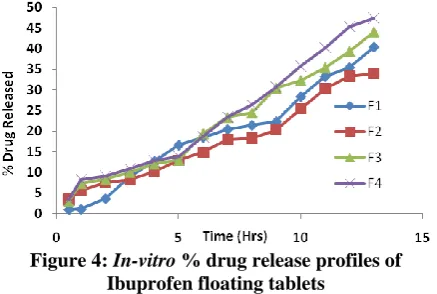
The drug content estimations showed values in the range of 97.58±0.47 to 99.57±0.06 %. These results showed the good drug content uniformity of the tablet. The release profiles of formulations F1, F2, F3 and F4, are shown in Figure 4. The release of drug mainly depends upon the polymer concentration. Maximum release was shown by formulation of batch F4 (47.38%), and minimum by the formulations of batch F2 (34.46%) in the duration of 13 hrs. The release profiles showed tri-phasic with initial burst effect (less than 30 min) followed by a polymer-controlled slower release in the second phase.
Figure 4: In-vitro % drug release profiles of Ibuprofen floating tablets
The difference in burst effect was the result of difference in the viscosity of the polymers. It is reported that citric acid level greatly influenced the drug release, irrespective of hydroxypropyl methyl cellulose grade. Lactose was used as diluents as well as channeling agent in the floating delivery of the drug.
In vitro release profile showed that on increasing the concentration of lactose release rate increased. Floating lag time for formulations of batches was found to in the range of 100±1.78 to 240±1.59 sec. The concentration of gas generating agent affected the floating lag time, as the amount of gas-generating agent was increased, the floating lag time decreased. The incorporation of gas generating agent exhibited reduction in the floating lag time. After the analysis of the above formulation
and optimization study we can conclude that optimized formulation of batch F4 is the best and promising formulation for the delivery of the Ibuprofen in order to provide the controlled release and increased gastro retentive drug delivery system to reduce frequency of its administration.
CONCULSION
The ultimate aim of the present study was to prepare gastroretentive floating tablet of Ibuprofen using polymers like HPMC K4M by direct compression method. FTIR study concludes no drug polymer interaction. Different pre compression properties like Carr’s Index, Hausner’s ratio indicate good flow properties of powder. The formulations were evaluated for various parameters like hardness, friability, weight variation, floating lag time, floating time, in-vitro drug release etc. Based on different evaluation parameters formulation of batch F4 was concluded as an optimum formulation. The present research work was successful in improving the efficacy of Ibuprofen oral therapy as the drug release was extended reducing dosing frequency thereby improving patient compliance.
AUTHOR’S CONTRIBUTION
The manuscript was carried out, written, and approved in collaboration with all authors.
CONFLICT OF INTEREST
No conflict of interest was associated with this work.
REFERENCES
1. Sonar GS, Jain DK. Prepatation and in vitro Evaluation of
bilayer and floating – bioadhesive tablet of Rosiglitazone
Maleate.Asian J Pharm Sci 2004; 1(4) ,161-169.
https://doi.org/10.1016/j.ijpharm.2014.09.056
2. Igwe J. Chibueze, Emenike IV, Oduola AR. Formulation and
evaluation of Finasteride sustained-release matrix tablets using different rate controlling polymers. Universal J Pharm
Res 2016; 1(2): 25-31.
3. Arora S, Ali J, Ahuja A, Khar RK, Baboota S. Floating drug delivery systems: a review. AAPS Pharmsci Tech 2005; 6 (3)
Article 475. https://doi.org/10.1208/pt060347
4. Vendruscolo CW, Andreazza IF, Ganter JL, Ferrero C,
Bresolin TM. “Xanthan and galactomann matrix tablets based for oral controlled delivery of theophylline. Int J Pharm 2005; 296: 1-11.
https://doi.org/10.1016/j.ijpharm.2005.02.007
5. Chandran S, Laila FA. Design and evaluation of Ethyl
Cellulose Based Matrix Tablets of Ibuprofen with pH Modulated Release Kinetics. Indian J Pharm Sci 2008; 3(4):
418-423. https://doi.org/10.4103/0250-474X.45397
6. Seifert, SA; Bronstein, AC; McGuire, T. Massive ibuprofen
ingestion with survival. J Toxicol Clin Toxicol 2000; 38 (1):
55–7. https://doi.org/10.1081/CLT-100100917
7. Davanzo R, Bua J, Paloni G, Facchina G. Breast feeding and
migraine drugs. Europ J Clin Pharmacol 2014; 70 (11):
1313–24. https://doi.org/10.1007/s00228-014-1748-0
8. Rainsford KD. Discovery, mechanisms of action and safety
of ibuprofen. Int J Clin Prac 2003; 135: 3–8.
9. Ziyaur R, Mushir A and Khar RK. Design and Evaluation of
bilayer floating tablets of captopril. Acta Pharmaceutica 2006; 56: 49-57.
10. Paert Zhang J, Massart MH. Feasibility study of the use of near Infrared spectroscopy in the quantitative analysis of green tea, camellia sinesis. Analytica Chimica Acta 2003; 478(2):303-312.
https://doi.org/10.1016/S0003-2670(02)01509-X
11. Varshosaz J, Tavakoli N. Formulation and evaluation of sustained release matrix tablet of asprin. AAPS Pharm Sci Tech 2006; 7(1): 13-18.
12. Chandran S, Laila FA. Design and evaluation of Ethyl Cellulose Based Matrix Tablets of Ibuprofen with pH Modulated Release Kinetics. Indian J Pharm Sci 2008; 3(4):
418-423. https://doi.org/10.4103/0250-474X.45397
13. Ikechukwu UR, John Francis DE, Ambi AA. Development and evaluation of Ritonavir hollow microballoons for floating drug delivery. Univ J Pharm Res. 2017; 2(2): 30-34.
https://doi.org/10.22270/ujpr.v2i2.R3
14. Fukuda M, Peppas NA, Mc Ginity JW. A floating hot-melt extruded tablets for gastroretentive controlled drug release system. J Cont Rel 2006; 115:121-129.
https://doi.org/10.1016/j.jconrel.2006.07.018
15. Kristl J, Baumgartner S, Vodopivec P, Zorko B. Optimisation of floating matrix tablets and evaluation of their gastric residence time. Int J Pharm 2000; 195:125-135.
https://doi.org/10.1016/S0378-5173(99)00378-6
16. Tadros MI. Controlled-release effervescent floating matrix tablets of ciprofloxacin hydrochloride: Development,
optimization and in vitro–in vivo evaluation in healthy
human volunteers. Europ J Pharm Biopharm 2010;
74:332-339. https://doi.org/10.1016/j.ejpb.2009.11.010
17. Elmowafy EM, Awad GAS, Mansour S, El Shammy.
Release Mechanisms Behind Polysaccharides-Based
Famotidine Controlled Release Matrix Tablets. AAPS. Pharm Sci Tech 2008; 9(4):1230-1239.
https://doi.org/10.1208/s12249-008-9155-4
18. Felix Sunday Yusuf. Formulation and in-vitro evaluation of floating microballoons of stavudine. Universal J Pharm Res
2016; 1(1): 13-19. https://doi.org/10.3797/scipharm.1501-07
19. Timmermans J, Moes A J: Factors controlling and gastric retention capabilities of floating matrix capsules: New data for reconsidering the controversy. J Pharm Sci 1994; 83 (1):
18-24. https://doi.org/10.1002/jps.2600830106
20. Dave BS, Amin AF, Patel MM. Gastro retentive drug delivery system of ranitidine hydrochloride: formulation and in-vitro evaluation. AAPS Pharm Sci Tech 2004; 5: E34.
https://doi.org/10.1016/j.ajps.2016.04.007
21. Jimenez M, Quirino-barreela IJ. Sustained delivery of floating matrix labeled. Ind J Pharm 2008; 362:37-4B.
https://doi.org/10.1208/pt060347
22. Kendre PN, Lateef SN, Godge RK, Chaudhari PD, Fernandes SL, Vibhute SK. Oral sustained delivery of theophylline
floating matrix tablets- formulation and in-vitro evaluation.
Int J Pharm Tech Res 2010; 2(1), 130–139.
23. Yonezava Y, Ishida S, Sunanda S. Release from or through a wax matrix system: I, basic release properties of the wax matrix system. Chem Pharm Bull 2001; 49:1448e51. 24. Klausner EA, Lavy E, Barta M, Cserepes E, Friedman M,
Hoffman A. Novel gastroretentive dosage forms: Evaluation of gastroretentivity and its effect on levodopa absorption in humans. Pharm Res 2003; 20:1466-73.
https://doi.org/10.1023/a:1025770530084
25. Anyanwu NCJ, Adogo LY, Ajide B. Development and evaluation of in situ gelling gastroretentive formulations of Meloxicam. Universal J Pharm Res 2017; 2(3): 11-14.
https://doi.org/10.22270/ujpr.v2i3.R3
26. Wu W, Zhou Q, Zhang HB, Ma GD, Fu CD. Studies on nimodipine sustained release tablet capable of floating on gastric fluid with prolonged gastric resident time. Yao Xue Xue Bao 1997; 32:786-90.
27. Li S, Lin S, Daggy BP, Mirchandani HL, Chein YW. Effect of HPMC and carbopol on the release and the floating properties of gastric floating drug delivery system using factorial design. Int J Pharm 2003; 253:13-22.
https://doi.org/10.1016/S0378-5173(02)00642-7
28. Verma BK, Pandey S, Arya P. Tablet granulation: current scenario and recent advances. Universal J Pharm Res 2017;