22
ASSURING EDUCATIONAL CONTINUITY
ON MACRO SYSTEM LEVEL
Dina Bethere, Anita Lidaka
Liepaja University, Latvia E-mail: [email protected] , [email protected]
Abstract
This publicationwilladdress a problem topical for international educational system: assuuring educational continuity in segmented educational system. Functioning of mutualy united educational stages is a signifi cant factor for implementing the aims of lifelong education. Educational transition period is consequential for segmented educational system and leaves sustainable infl uence on educational process of the child. This phase is a particular challenge for children with special needs, and it is not possible to overcome transition without external help. One of the most important aspects of educational transition is preparing children and fostering their adaptation for learning in primary school. According to ecosystemic approach, this development depends from interaction of children’s parents and microsystems of preschool and primary school. In Latvian educa-tional macrosystem there are no approaches elaborated that would assure interaction possibilities of above mentioned microsystems. There are no traditions of cooperation also on macrosystemic level. To overcome these problems and to implement transition periods qualitatively, schools need to increase their capacity. Key words: continuity of value system and learning process, ecosystemicmodel of education system, educa-tional policy, interaction of educaeduca-tional system componentes, life long education, normative base of educaeduca-tional system, transition.
Introduction
Nowadays the intensive development of social and economic life infl uences everybody’s life and subject people to signifi cant reforms. Complicate tasks require higher level of concentration, development of logical and analytical thinking, problem solving skills, ability to orientate in complex correlations, ability to cooperate and communicate. Due to the infl uence of people’s life-context re-forms, the social demand for person’s initiative, readiness to take responsibility, to learn and develop creativity is increasing. Human skills, knowledge and ability to involve, initiate and take personal responsibility in the processes of change are of great importance in this complex of cognitive and social competences.
23 Volume 12, 2009 educational continuity is a topical demand, that is, supplementing and improving one’s knowledge
during the whole life, emphasizing the competences of learning and overcoming the changes. The lifelong education model, which in European society is defi ned as a priority, meets these conditions. The structure of this model provides integration of continuative processes of formal and informal education. The implementation of lifelong education in each of EU countries depends on formal and structural principles of national educational system. Nevertheless, in most European countries including Latvia, educational system is segmented. Therefore, the formal education in educational establishments is divided in several stages: preschool education, primary school education and its segments, secondary school or professional education, etc. There are transition phases between these segments, and they can be considered as consequential components of the process of lifelong education.
In European countries the research and practical activities in the sphere of educational transition were initiated in the VIIth conference in Munich (1997) organized by Childhood Education Research Association. According to H. Welzer, in scientifi c research and educational praxis transition peri-ods are called as particular „life stages” (Griebel, Nisel, 2004: 35), and they are characterized by complex processes of change that infl uence a person’s interaction and communication with social environment. In these life stages there is a demand for personal identity and environmental context changes. These processes are characterized by extra physical and psychological pressures as transi-tion period requires more intense personal development and more concentrated formal and informal learning process (ibid.). Each transition phase can become either an exciting adventure or a critical, mentally and physically traumatizing experience in the life of an individual. Therefore, theses phases can be considered as socially and culturally constructed challenges for the development of children. These phases are especially complicated for children with special needs because of their diffi culties to adapt in society and unknown environment and also because of specifi cs of formal and informal learning process, etc.
In Latvian educational system children and their families are confronted with transition phases already in the early stage. In the research described in this publication the transition phase pre-school - primary pre-school is considered. The importance of this transition stage in context of lifelong education determines the fact that successful overcoming of transition creates a signifi cant base for further formal learning and for the ability to overcome changes in educational career and also future life (Griebel, Niesel, 2004, 84, Denner, Schumacher, 2004, 13). International educational practice research proves that nowadays during this transition phase children and their families need external support (Fthenekis, 2004, 11). According to this requirement, educational policy of each country should provide the support for successful overcoming of transition stage. In this publication the formal conditions of preschool-primary school transition period are analyzed and assessed, as well as practical relevance in the context of lifelong learning policy.
Theoretical Concept of Transition
Researching transition periods and implementing practical activities as a scientifi c base the Ecosystemic theory of U. Bronfenbrenner is applied. U. Bronfenbrenner has elaborated a unifi ed and differentiated theoretical model that provides the possibility to characterize systematically and analyze human life’s social context structure and interaction in unity with advanced processes of person’s development (Bronfenbrenner, 1981, 37). In ecosystemic model there are several systems functioning in mutual interaction: microsystem, mezzosystem, exsosystem, macrosystem, and hro-nosystem or ecological transfer (ibid.). According to the aims of this publication and in the context of transition concept, the infl uence of micro, mezzo and macro environment on the processes of change will be analyzed.
24 These spheres are interconnected. Microsystems create mezosystem, which includes interactions between life spheres in which a self-developing personality actively participates (Bronfenbrenner, 1981, 41), for example, relationship between parents’ house, school, group of friends, etc. In the period when a child prepares for schooling or starts the educational process in primary school, he/she gets involved in transition process activities. This phase is called ecological transition. In this phase change is considered as normative critical life situation that integrates within itself the results of prior development and impulses for further process of psychosocial growth (Bronfenbrenner, 1981, 262). Educational establishment of the child parallel to family microsystem, becomes a secondary context for development, in other words – microsystem. As the result, the child’s personality and his/her development is infl uenced by demands of two micro systems (Tippelt, 2004, 10), which serve as a challenge for further development in a wider social context, that is, adjustment of a person and the environment (Bronfenbrenner, 1981:43). Educational transition phase socially requires changing the social roles and activities in order to implement interpersonal relationships (Bronfenbrenner, 1981, 265). When entering school microsystem, children start learning social role of a pupil, which is particular socially required model of behavior. Differently from family and preschool institution, the learning process in the school microsystem becomes more formal. This requires higher level of motivation and independence as it was, for example, in preschool microsystem. Positive experience while overcoming transition stage strengthen child’s self-esteem and psychical resilience in relation towards further transition periods (Carle, 2004, 46). It also fosters development of skills necessary for overcoming the change that is important for the further educational career of the child (Denner, Schumacher, 2004, 13).
Consequently, this process of intense interaction of a person and environment cumulates not only results of positive development, but also factors of workload and stress (Däschler-Seiler, 2004, 22). Signifi cant is risk that a person entering a new microenvironment can reject the new type of social relationship, if the person is not motivated or has too superfi cial or formal percepts about the new environment (Bronfenbrenner, 1981, 265). The negative effects of transition periods can
fi nd expressions such as class-doubling, change of type of educational institution, leaving of school (Denner, Schumacher, 2004, 55), as need for a repetition service because of bad marks (Rudolph, 2004, 186), and even as health disorders. Therefore, for the continuity of person’s development in educational transition stage the assurance of positive changes is necessary as the quality of this stage leaves long-term infl uence on the person’s life.
Successful overcoming of transition period depends from various factors: individual resources and institutional conditions. The following subjective child’s resources are important:
health condition; •
individual motivation to engage in processes of change; •
positive and negative experience in previous transition period (Bronfenbrenner, 1981, •
265);
previously developed cognitive and social competences, that is, obtaining practical knowl-•
edge and skills and their further development (Bronfenbrenner, Morris, 2000, 39). It is important to admit that for children with special educational needs the assurance of above mentioned somatic, psychic and social resources can be limited.
The factors of institutional provision for a transition phase are the following:
On Microsystem level (preschool and primary school) it is necessary to foster child’s 1.
basal competences, such as learning, social and reorganizational competences. This can assure child’s activity in overcoming social challenges (Fölling-Alberts, 2004, 7). On Mezosystem level, while preparing for a particular transition phase, a child has to get 2.
acquainted with the primary school institution, because if the child lacks this experience, he/she will not be able to implement his/her potential of development (Bronfenbrenner, Morris, 2000, 33).
On Micro and mezzo system level
25 Volume 12, 2009 both for fostering potential of mezosystemic development and provision of emotional
well-being of a person (Bronfenbrenner, 1981, 202).
On Mezosystem level the important factor for assuring the quality of transition period is 4.
creation of social network between persons from all mutually interacting microsystems, that is, between pedagogues, children and their parents. Organizing and implementing this cooperation fosters mutual trust, positive orientation and agreement about common goals for activities. The effectiveness of these processes depends from regularity of common activities and dynamics of complexity (Bronfenbrenner, Morris, 2000, 33).
Besides the direct links, communication between Microsystems is also important, that 5.
is, conscious exchange of information in personal conversations on different spheres of life, written conversations, advise, exchange of opinions using the social network. This way one microsystem gathers information about another microsystem (Bronfenbrenner, 1981, 200).
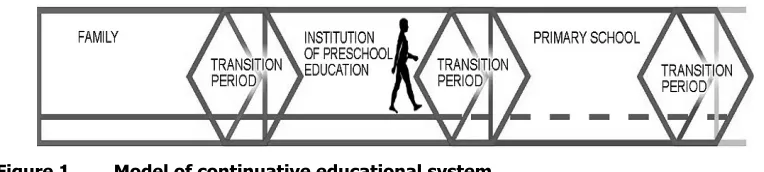
Assurance of above mentioned factors fosters continuity of educational process and creates the desirable model for transition period (see Figure 1).
Figure 1. Model of continuative educational system.
The development of educational system’s model described in Figure 1 is directly infl uenced by macrosystem. This structure includes ideological, economical, cultural, technological, juridical and political conditions of the society (Bronfenbrenner, 1981, 242). The conditions of interaction and functioning of microsystems of educational institutions are formulated by macrosystem. The political views determine the content of educational programs and defi ne the learning criteria in educational establishments. The responsibility of parents to participate in educational process of children is regulated on macrosystem level. This structure infl uences also the formation of coop-eration traditions between educational institutions and family microenvironment. This publication has emphasis on provision of macrosistemic conditions and resources for assuring the qualitative transition period in the context of lifelong education.
Methodology of Research
The educational system has its own national specifi cs characteristic each country. In the research described in this publication two aspects are emphasized: analysis of formal conditions in normative documents of educational system on providing transition and research of educational praxis in the context of providing educational continuity in transition phase preschool – primary school.
To explore formal conditions of this transition phase the normative and strategic development documents of Latvian educational system, such as Law of Education, preschool educational pro-grams, Standards of primary school learning subjects, guidelines of educational development, etc. are analyzed.
26 • 20 schools are located in the cities with several preschool educational establishments, 2 – in country regions with one preschool institution in each.
in 5 schools, besides the basic educational program, there is an educational program •
implemented for 5-6 year old children to prepare them for learning in school; 2 from institutions are associated to a preschool institution and a primary school; •
in 6 schools, besides the basic educational program, there are licensed special education •
programs for children with mental development disorders and learning diffi culties The questionnaire was structured in several thematic groups:
teacher education and understanding of transition phase; •
adaptation activities for children who are preparing to start education at school; •
cooperation of preschool and primary school educational institutions before the transi-•
tion stage;
cooperation of primary school and parents before the transition stage; •
provision with needed resources for successful implementation of the transition proc-•
ess.
Results of Research
The analysis of normative and strategic development base of Latvian educational system proves that the lifelong education principles are formulated in the document “Strategic Guidelines of the Development of Education for Years 2007 – 2013” (2006), which includes developmental goals of educational system for the next fi ve years and directions for their implementation, and also criteria for activities, policies and achieving the goals. According to these guidelines, the life long educa-tion is „educational process during the human life span, which is motivated by changing needs of society and need for adults to obtain the knowledge, skills and competences, experience, to raise
or change their qualifi cation. It includes formal, informal education, as well as everyday learning”
(Izglītības attīstības pamatnostādnes, 10). The life long education policy is characterized as „
juridi-cal, organizational and fi nancial support of the state for education of each inhabitant, which fosters
motivation, employment and adaptation abilities, active citizenship and social inclusion, personal
self-fulfi llment in every stage and every sphere of human life” (ibid.). In Latvian Law of General
Education (1999) the lifelong education is not defi ned, but its goals include the demand to provide uninterrupted continuity of education (Vispārējās izglītības likums, v.2, 19).
One of the basic elements of educational system is the educational program, which defi nes the segments of the system. They are preschool education, primary school education, basic educa-tion and special educaeduca-tion as a special type of general educaeduca-tion (ibid., v.3). According to the Law of Education and particular educational program, in preschool children are prepared for acquiring the basic education (ibid., v.20, 1§). Respectively, preparation of 5-6 year old children for basic education is mandatory (ibid, v. 21, 1§). Preschool educational programs are intended for children until age of 7. This educational process can be extended or shortened for one year depending from the health conditions and psychological preparedness of a child, taking into account the parents’ wishes and a doctor’s statement (ibid, v.20). Starting general education, the basic required skills are formulated in particular educational program, as well as stated in Directions issued by Ministry of Science and Education (1998). They include different aspects, for example, social skills, ability to orientate in surrounding environment, language development, reading skills and basic mathemati-cal skills, learning of different productive activities, etc. (Pamatprasmes pirmsskolēnam, uzsākot pamatizglītības apguvi, 16). However, this system does not include the learning competence and value system. According to normative documents, basic education is mandatory (Vispārējās izglītības likums, v.32, 19), and basic educational establishments cannot organize entering examinations for the students (ibid, v.31, 1§).
27 Volume 12, 2009 of special and comprehensive education (ibib, vs. 51, 53). One of results for preschool educational
program for children with special needs is “psychological readiness for school” (Speciālās pirmsskolas izglītības programmas paraugs, 16). The explanation of this category cannot be found in the norma-tive documents of educational system. Also, the normanorma-tive documents do not include basic principles for transition periods. The Standard of Basic Education, which serves as the basis for a respective educational program, does not require reciprocity of basic school and preschool. Therefore, it can be concluded that Latvian educational system does not provide the link and interaction between the segments of educational systems (see Figure 2).
Figure 2. Transfer model in the system of education.
In comparison with transition concept (see Fig.1), the processes that take place at the end of preschool education period and beginning of basic school are considered as a transfer, that is, an automatic transfer of learning experience into particular situation of learning and activity (Keck, Sandfuchs, 1994, 335). The manifestation of this problem is also stated in the developmental strategy of educational system, emphasizing insuffi cient cooperation between various institutions and lack of understanding from the side of society about the solving of educational issues (Izglītības attīstības pamatnostādnes, 10).
The research of educational praxis in the sphere of transition certifi es that 80% from respon-dents consider their education about transition as suffi cient, but 9% - would like to supplement their knowledge. Evaluating importance of transition period, 85% of respondents agree with the statement that during this phase children have to overcome signifi cant stress, but 88% - believe that success-ful overcoming of this stage is a warrantee for a successsuccess-ful further educational career of the child. 2 % of respondents organize special adaptation events for preschoolers entering the basic school, mostly in the form of excursions, but 10% consider open-door days for children and their parents as suffi cient activity for adaptation. Considering the mutual conformity of preschool and basic school programs, 57% of respondents emphasize the priority of child’s academic abilities. 54% of respon-dents participate in preschool informative events such as parent meetings at the end of school year, but 28% - in discussions about child’s development together with preschool teacher and parents. 31% of respondents observe the children and their activities in preschool. Discussions with parents are considered as priority by 100% of respondents, but their effectiveness is never evaluated at schools, 66% ensure written information about items needed for the learning process in the form of school informative booklets, but 37% involve parents of children into implementation of school projects. The following resources are stated as important to improve the transition period: well-timed signing for learning at basic school at the end of fi rst semester (65%), functioning of preschool and basic school in the joint building (43%), extra time resources for purposeful consultations (20%), cooperation of leadership of school and preschool institutions (60%), and provision of assistance in the basic school (40%).
Discussion and Conclusions
The analysis of research data certifi es several reciprocal problem aspects in connection with assuring continuity of educational process in transition periods: insuffi ciencies of normative regula-tions, traditionally unchanging hierarchy of educational system elements, defi cit of teacher motivation and real possibilities.
28 lifelong education is devoted to this particular aspect. However, preschool and basic school education is the beginning stage of person’s formal education. The transfer between these educational phases is politically regulated, but the responsibility about the quality of this process is not delegated to any of these institutions. Analysis of normative documents proves that the transition phase preschool-primary school marks a special position between individual and preschool educational institution, but there is an absolute lack of defi nition of school functions. Consequently, also the principles connected with preschool and primary school interaction are missing in this stage. However, analyzing construction of child’s readiness for school from ecosystemic perspective, it is important to state that the complex result is created by transactional relationship of three systems - preschool, basic school and a pupil who is starting the schooling. Particularly problematic is provision of transition for children with special needs if their educational career is connected with inclusion in comprehensive school. As special education programs are implemented only in special preschool institutions, the children with special needs cannot get early experience of inclusion.
The analysis of the documents allows concluding that the normative documents are based on construction of traditional educational system that is formed in a long period of time. Analysis of political documents allows concluding that the normative base has a construction of educational system formed in a long period of time. It has strong hierarchical positions of preschool and basic school. Preschool institutions have to prepare children for school according to this position, but its educational aims are connected with preparation of children for the next educational stage. As the result, a linear system model is created, which does not provide place for mezosystemic coopera-tion between different educacoopera-tional microsystems, also lacks the respect for needs and abilities of becoming student. Therefore, in the basic school greater attention is put on academic achievements of child, and factors such as child’s emotional maturity, his/her wellbeing and motivation to learn are considered as less important.
In the context of previously characterized traditional approach the teachers’ level of understand-ing and knowledge about the essence and importance of transition can be considered as suffi cient. Still, the analysis of research data shows that the provision of adaptation activities in the basic school is a great defi cit. Also the choice of cooperation forms between microsystems of child’s family and preschool are quite limited. It is important to admit that fragmentary cooperation of microystems is also the result of functional traditions of Latvian education system, because ecosystemic model requires provision of long-term and regular interaction between the elements of the structure. Cre-ating this type of mutual relationships between microsystems requires accordant provision of time and resources of teaching staff. In Latvia, the earliest basic educationa stage lasts 4 years. Therefore, strategically planning qualitative start of basic education, the elaboration and implementation of transition activities is the task of forth grade teachers. It is important that becoming students would be signed for schooling at the fi rst semester of the current year. The effective use of time resources depends from possibilities to include transition activities in the work load of teachers. Signifi cant factor for providing interaction of microsystems is the cooperation of preschool and basic school leadership teams.
The research analysis certify that salvation of previously discussed micro and mezzo systemic problems depends from two aspects: introducing the qualitative changes in educational state policy and normative documents, and perfecting teachers’ professional education in the sphere of transition. On the political level it is necessary to increase the capacity of the basic school in order to foster interaction between microsystems of preschool and school. Teacher training programs and further education programs should offer topics on transition problematic. This way it would be possible to develop strategic understanding of teachers and their methodical competence in the sphere of transi-tion. Especially topical is perfection of professional competences in the sphere of consulting.
References
Bronfenbrenner, U. (1981). Die Ökologie der Mneschlichen Entwicklung. Stuttgart
29 Volume 12, 2009
Ǜberlegungen. In: Denner, L., Schumacher, E. (Hrsg.). Übergänge im Elementar- und Primarbereich
reflek-tieren und gestalten. Bad Halbrunn. S. 30-51.
Denner, L., Schumacher, E. (2004). Einführung: Ǜbergängeim Elementar- und Primarbereich- Relevanzen,
Chancen und Risiken. In: Denner, L., Schumacher, E. (Hrsg.). Übergänge im Elementar- und Primarbereich
reflektieren und gestalten. Bad Halbrunn. S. 11-14.
Denner, L., Schumacher, E. (2004). Übergänge zwischen Bildungsinstitutionen- bildungspolitische,
pädago-gische, didaktische und curriculare Überlängungen. In: Denner, L., Schumacher, E. (Hrsg.). Übergänge im
Elementar- und Primarbereich reflektieren und gestalten. Bad Halbrunn. S. 52-71.
Däschler – Seiler, S. (2004). Übergänge: zur Kontinuität und Diskontinuität im Erziehungsprozess unter
antropologischen Gesichtspunkten. In: Denner, L., Schumacher, E. (Hrsg.). Übergänge im Elementar- und
Primarbereich reflektieren und gestalten. Bad Halbrunn. S. 15-29.
Fölling-Alberts, M. (2004). Geleitwort. In: Denner, L., Schumacher, E. (Hrsg.). Übergänge im Elementar- und
Primarbereich reflektieren und gestalten. Bad Halbrunn. S. 7-10.
Fthenakis, W. E. (2004). Vorwort. In: Griebel, W. , Niesel, R. Transitionen. Fähhigkeit von Kinder in Tages-einrichtungen fördern, Veränderungen erfolgreich zu bewältigen. Weinheim: Beltz Verlag. S. 9-13. Griebel, W., Niesel, R. (2004). Transituonen: Fähigkeit von kindern in Tageseinrichtungen fördrn, Veränderun-gen erfolgreich zu bewältiVeränderun-gen. Weincheim: Beltz Verlag.
Izglītības attīstības pamatnostādnes 2007.–2013.gadam. (2006). See 2008.20.09.: http://izm.izm.gov.lv/up-load_file/Normativie_akti/izm_260906_izgl_att_pamatnost_2007-2013.doc
Keck, R. W., Sandfuchs U. (Hrsg.). (1994). Wörterbuch Schulpädagogik. Bad Heilbrunn: Verlag Julius
Klinkhard.
Mūžizglītības memorands.(2000). See 2009.10.01.: http://www.tip.edu.lv/faili/Muzizglitibas_memorands.
doc
Noteikumi par valsts standartu pamatizglītībā un pamatizglītības mācību priekšmetu standartiem. (2008). See 2009. 10. 01.: http://www.isec.gov.lv/normdok/mk061027.htm
Rudolph, M. (2004). Nachhilfe als Indikator für Übergangsprobleme bei Schülern, Eltern und Schule. In:
Denner, L., Schumacher, E. (Hrsg.). Übergänge im Elementar- und Primarbereich reflektieren und gestalten.
Bad Halbrunn. S. 185-198.
Tippelt, R. (2004). Geleitwort. In: Schumacher, E. (Hrsg.). Übergänge in Bildung und Ausbildung. Bad
Heil-brunn: Verlag Klinkhard, S. 7-14.
Pamatprasmes pirmsskolēnam, uzsākot pamatizglītības apguvi. (2005). ISEC aktuālā informācija. See 2008.03.12.: http://www.izm.izm.gov.lv/upload_file/Izglitiba
Pirmsskolas izglītības programmas paraugs. (1998). See 2008. 20.09.: http://izm.izm.gov.lv/upload_file/
Izglitiba/Vispareja_izglitiba/Pirmsskola/Pirmsk-%20izgl_Programma.doc
Speciālās pirmsskolas izglītības programmas paraugs. (2008). See 2008.20.09.: http://izm.izm.gov.lv/up-load_file/Izglitiba/Vispareja_izglitiba/Pirmsskola/Paraugi/Pirmssk_spec_08.doc
Vispārējās izglītības likums. (1999). Sk. 2008.20.09.: http://www.isec.gov.lv/normdok/vizglik.htm
Adviced by Ilze Miķelsone,
Liepaja University, Latvia
Dina Bethere M. A., lecturer of Department of Pedagogy, Liepaja University, Liela Street 14, Liepaja, Latvia.
E-mail: [email protected]
Website: http://www.liepu.lv/index.php?lang=en
Anita Līdaka Dr. paed., Assoc. Professor, Head of Institute of Educational Science, Liepaja University, Liela Street 14, Liepaja, Latvia.
E-mail: [email protected]