Practical Anonymous Access Control Protocols
for Ubiquitous Computing
Kilho Shin and Hiroshi Yasuda
Research Center for Advanced Science and Technology, The University of Tokyo Email:{kshin, yasuda}@mpeg.rcast.u-tokyo.ac.jp
Abstract— Privacy has been a central concern of ubiquitous (pervasive) computing. The boundary between private and public moves dynamically depending on the context in which the issue is considered. As for access control for ubiquitous computing, the concept of consensual disclosure is an answer to the question of where the boundary should be drawn — Unless a user gives their explicit consent to opening the identity, perfect privacy, that is, anonymity and unlinkability are supported. This paper presents concrete protocols for anonymous and unlinkable access control that are appropriate for ubiquitous computing partly in the sense that they support consensual disclosure. The protocols presented in this paper are practical because they are efficient and based on a model that represents the real world. In particular, they support a characteristic of the key transfer: a service appliance acquires keys to decrypt contents of services, if, and only if, it accepts proof of access rights as presented by a user, and can prove that it is trusted by the service provider. Moreover, the protocols are provably secure. This study has been sponsored by the Ministry of Economy, Trade and Industry, Japan (METI) under contract, New-generation Information Security R&D Program.
I. INTRODUCTION
In a ubiquitous (pervasive) computing environment, users can enjoy access to various kinds of services and resources without restrictions on time and location. From the viewpoint of protecting services and resources, this also implies that the security functionalities of trust management, authentication and access control are the mandatory building blocks for ubiquitous computing.
However, naive implementation of these security func-tionalities can certainly invoke an invasion of privacy. Since networked sensors for ubiquitous computing easily collect information about users’ personal identities and access histories, a malicious entity, which could be an organization, a system administrator or an application manufacturer, may possibly use the collected information in ways such that the users would never permit. It has been reported that this problem of privacy has been of central concern to people [1], [2].
It is also widely accepted that ubiquitous computing requires security measures that are more flexible than those for accessing the Internet. In terms of privacy, Palen and Dourich give the following description [3].
Privacy management is not about setting rules and enforcing them; rather, it is the contin-ual management of boundaries between differ-ent spheres of action and degrees of disclosure
within those spheres. Boundaries move dynami-cally as the context changes. ... The significance of information technology in this view lies in its ability to disrupt or destabilize the regulation of boundaries.
Certainly, the boundary between private and public is dynamic, since we “disclose or publicize information about ourselves, our opinions and our activities, as means of declaring allegiance or even of differentiating ourselves from others” [3]. Thus, perfect privacy is far from ideal. Where should the boundary between private and public for ubiquitous computing be drawn? Our answer to this problem is the concept of consensual disclosure — if, and only if, users give their explicit consent, their identity is revealed only during the relevant access event. In addition, their identity remains anonymous for any other access events, whether they have already happened in the past or will happen in the future.
In one aspect, this paper aims to present a set of practical access control protocols that support anonymity and unlinkability based on consensual disclosure.
On the other hand, trust management is not an issue no less important than privacy in ubiquitous computing.
Blaze et al. [4], [5] advocate a distributed trust man-agement model, which presents a methodology to express and handle the varying trust structures of ubiquitous computing, and in particular, to allow users to arbitrarily migrate from one domain to another where different trust policies control access to services and resources. This model is also important because it is a natural extension of the trust management models widely accepted for the access to the Internet (e.g. X.509, SPKI).
One of the central concepts of the distributed trust man-agement model is known as authorization. Here, the term “authorization” is used to represent the binding of entity authentication and access control into a unified process. For example, a basic SPKI certificate associates a public key pair with not only the identity of its subject but also the roles, qualifications, privileges and other attributes assigned to the subject. Hence, verifying that an entity possesses the private key of the key pair indicates that the relevant entity is the one identified by the certificate, and also assigns to the entity the roles, qualifications or privileges specified in the certificate.
represents roles, qualifications or privileges assigned to the entity. This feature contributes to realizing anonymous access control and also to making our access control scheme conform to the distributed trust model at a more flexible level.
Thirdly, ubiquitous computing is becoming more ap-plicable in the real world fueled by the recent develop-ment of infrastructures, such as the Internet, short-range wireless communication (e.g. Bluetooth, IEEE 802.11) and cellular phones. This also implies that technologies for ubiquitous computing take the complexity and the heterogeneity of the real world into consideration.
In this paper, we describe a trust model that represents the heterogeneous trust structures of the real world. The access control protocols in this paper are based on this trust model.
II. RELATEDWORK
A. Distributed Trust Management
The term of distributed trust management was first introduced by Blaze et al. [4], [5]. Distributed trust management must meet the following two requirements:
• combining entity authentication and access control into a unified process (authorization);
• incorporating local policies and delegation of access rights into the existing trust management methodol-ogy based on PKI.
By introducing an authorization certificate, Simple Public Key Infrastructure (SPKI, [6]) partially supports the above requirements and can be regarded as the first step towards distributed trust management. A basic SPKI certificate defines the binding between authorization and a public key pair. Therefore, verifying possession of the private key of the key pair immediately indicates that the certificate’s subject has access rights to certain services or resources as specified in the certificate.
Moreover, the certificate’s subject can issue a new certificate meaning that the authorization of the original certificate is to be delegated to the subject of the new certificate (whether or not the delegation itself is permitted may be specified in the original certificate).
The methodology of the authorization certificate for SPKI can take the place of the existing approach of centralized and nested ACLs (Access Control Lists), and enable a distributed management of authorization.
However, to make trust management flexible to such a level so that it can be applicable to ubiquitous computing, supporting authorization and delegation is yet insufficient. In fact, there exist a number of administrative entities in a distributed system of ubiquitous computing and each of these entities may have different trust policies. In other words, proofs of trust (e.g. a chain of authorization and delegation certificates for SPKI) may be understood differently, depending on the administrative entity.
Blaze et al. [4], [5] present an elaborate and formal scheme to incorporate local policies into the existing trust management and to fill the gap between differing
understanding. Some systems [7], [8] are known to be designed based on this scheme, in which a service agent, who receives a request for access to the services or re-sources for which it is responsible, submits a query to the PolicyMaker system. On receipt of the query, PolicyMaker returns proof, if present, that determines whether the requested action can be permitted to the requesting user. Queries to PolicyMaker take the following form:
key1,key2, . . . ,keyn REQUESTS ActionString
The keys are the public keys of which the requesting user claims to possess the private counterparts, and Ac-tionString indicates the action requested by the user. PolicyMaker makes up the answer to the query of one or more assertions, each of which is of the following form:
Source ASSERTS AuthorityStruct WHERE Filter
• Source indicates the relevant local policy if the asser-tion is a policy asserasser-tion, and specifies a public key if the assertion is a signed assertion. A policy assertion is axiomatic, and hence, is unconditionally evaluated as being valid. In contrast, a signed assertion is accepted, if, and only if, the public key specified as the Source is trusted and the associated signature is successfully verified using the public key. • AuthorityStruct specifies the structure of one or more
public keys. It may specify a single public key, a set of public keys or a more complicated structured list of public keys (e.g. anyk instances of then public keys in the list).
• Filter specifies a predicate that returns either true or false upon an input of the ActionString.
If a signed assertion includes a single public key as AuthorityStruct and the valid predicate, which returns the value true irrespective of input, as Filter, the assertion is semantically identical to an ordinary X.509 certificate.
Upon receipt of a query, PolicyMaker generates and returns the smallest acyclic directed graph that satisfies the following: each vertex of the graph is labeled by a single assertion; any starting vertex of the graph, which is not the target vertex of any arc, is a policy assertion; for each arc, the assertion of its source vertex asserts Source of the assertion of its target vertex; and the assertions corresponding to the terminal vertices, any of which is not the source vertex of any arc, collectively assert the public keys specified in the query. The key holder of the query is recognized as being qualified for the action requested in the query, if, and only if, the signatures of all the signed assertions appearing in the graph are successfully verified and ActionString satisfies all Filters specified in the assertions.
However, for ubiquitous computing, it is crucial that users agree on a method to verify their access rights with service agents from any location. Of course, the ideal way to support this requirement is to standardize a unique method. In the worst case, a negotiation mechanism may be required through which a device worn by a user and a service agent can agree on such a method from several candidates.
The importance of this requirement is made clear, by considering the following scenario.
Alice always wears a smart badge that con-tains her private keys. One day, she visited a building where her friend Bob works. As soon as she entered the building, she was faced with problems: she could not access the directory service, she was not allowed to get off the elevator at the floor where Bob’s office was located, and she could not call Bob using an internal phone. Since she knew that Bob had delegated the authorization necessary for Alice prior to her visit, she could not understand why there were such problems. The delegation was performed by a standardized means of dele-gation credentials. Afterward, she realized the cause behind the problems — her smart badge was not compatible with the service agents in Bob’s building.
One of the focuses of this paper is, based on Blaze’s distributed trust management scheme, to propose a con-crete protocol by which a service agent communicates with users’ devices to verify their access rights. For this purpose, the requirements that such protocols should support, particularly in a ubiquitous computing scenario, are clarified. For example, anonymity and unlinkability are two of the recognized requirements.
B. Group signatures
The following features characterize group signatures. 1) A group signature is a digital signature that a
member of a group produces on behalf of the group. 2) Although whoever has an access to a predetermined group verification (public) key can verify the group signature, the identity of the individual who gener-ated the group signature is never revealed.
3) Only a trusted group authority (TGA) has an ability to identify the individual member who generated the group signature. The TGA may perform this function when there are disputes, etc.
Chaum and Heijst [9] first introduced the concept of group signatures, and since then, various technical proposals to realize group signatures have been made [9]– [12].
As an application of group signatures, Chen [11] pro-posed a secure electronic auction system that excludes malicious participants from participating while protecting the privacy of honest participants through using a bid document, which is signed by a bidder and is always
anonymously verifiable. If a dispute arises, the auction organizer works as the TGA, and reveals the identities of malicious bidders, based on the signatures that they have produced.
Commonly, a group signature scheme consists of the SETUP, JOIN, SIGN, VERIFY and OPEN operations.
• SETUP: The TGA generates a group public key pair. The TGA publicizes the public component of the pair for verification of group signatures, and withholds the private component.
• JOIN: In cooperation with the TGA, a member of the group generates a group signing key for themselves.
• SIGN: A member of the group signs an arbitrary message using the group public key and their own group signing key.
• VERIFY: A verifier uses only the group public key to verify signatures that members of the group generate.
• OPEN: If a dispute arises, the TGA identifies the individual who signed a particular message. For this purpose, the TGA uses the group public key pair. A group signature scheme is required to support the following requirements.
• Correctness: A signature generated by a group member is accepted.
• Unforgeability: A signature generated by anyone other than a member of the group is denied. • Anonymity: In verifying the signature, only the
TGA is able to identify the originator of a signature in verifying the signature.
• Unlinkability: Anyone other than the TGA is not able to correctly answer the question of whether two independent signatures were produced by the same member.
• Exculpability: The TGA and/or any group mem-bers who conspire with one another is/are not able to forge the signatures of any other group member. • Traceability: The TGA is able to identify the
orig-inator of any given signature.
It is also desirable that a group signature scheme supports the requirement that the addition or withdrawal of members or a change in the group signing key of a member does not necessitate changing the group public key. A group signature scheme that supports this addi-tional requirement is considered dynamic.
Camenisch and Stadler presented the first dynamic group signature scheme [10]. Their scheme has the ad-vantage that the sizes of a group public key and generated signatures are independent of the size of a group.
The scheme that Ateniese, Camenisch, Joye and Tsudik present [13] has practical efficiency, in addition to all of the features stated above.
The following outlines the scheme by Ateniese et al [13].
2p0 + 1 and q = 2q0 + 1 hold for some primes p0, q0. Further, the TGA selects a, d, g, g
1∈R QRn
and x ∈R Z∗p0q0, and calculates y = gxmodn.
The tuple(n, a, d, g, g1, y)is publicized as a group public key, while the tuple(p, q, x)is preserved by the TGA as a group secret key.
2) A userU takes the following procedures to join the group.
a) U and the TGA cooperate with each other to select xu so that U and the TGA are
respec-tively confident that xU distributes uniformly
in its domain. xu is a secret ofU and yu =
axu modnis kept by the TGA.
b) The TGA randomly selects a prime eU and
calculatescu as shown below:
cu= (yud) 1
eu modn
The strong RSA hypothesis guarantees that only the TGA, who knows p and q, can calculate (cu, eu).
c) The TGA issues (cu, eu) to U. Eventually,
(xu, cu, eu) becomes a group signing key of
U.
3) A group signature to a messagemis non-interactive proof of the knowledge of(cu, eu, xu)satisfying
ceu
u =daxu modn.
According to the Fiat-Shamir heuristic, the chal-lenge is dependent onm.
In addition, U encrypts cu with the key y, and
issues the encryptedcu with non-interactive proof,
showing that the encryption is in the correct form. 4) For OPEN, the TGA decrypts cu to reveal the
identity ofU.
More group signature schemes [14]–[16] have been presented after [13]. However, if we measure efficiency of verification by the number of times of executing scalar multiplication over an elliptic curve and modular exponentiation over a large composite or prime number, none of them is more efficient than the scheme by [13].
C. Anonymous credentials
Camenisch et al [17] present a highly sophisticated algorithmic scheme for anonymous credentials. More specifically, the scheme supports the following features.
• An authority can issue non-transferable credentials under the pseudonym of a user.
• A verifier can verify the fact that a user retains a credential issued by a certain authority without knowing his/her pseudonym or the credential. • An authority can verify that a user, who is known
to the authority by a certain pseudonym, retains a credential issued by a different authority.
The technical principles of the scheme are as follows. 1) QRn is the group of quadratic residues modulo an RSA compositen. The compositenis public infor-mation, while the prime factors ofn are withheld
by an authority. In addition, a, b andd are public elements of QRn.
2) A pseudonym p of a user is an element of QRn such that
p≡aαbβmodn,
whereαandβ are withheld by the user.
3) A credential that the authority generates is its dig-ital signature to the pseudonym p. Precisely, the credential is a pair (c, γ)such thatc∈QRn and
cγ≡pd≡aαbβdmodn
Consequently,γis data such that only the authority can generate, whileαandβ are user secrets. 4) The user presents zero-knowledge proof of the
fact that they know α, β and γ satisfying cγ ≡ aαbβdmodn. The proof does not reveal anything
buta, b, c, d andn.
Idemix [18] is implementation of this scheme. The problem of this scheme is the overhead of perform-ing time-consumperform-ing zero-knowledge proof procedures. In particular, certain services require continual verification of credentials and the overhead of verification would harm the quality of the services. For example, a rendering service using video signals may be required to render contents only while the authorized persons are in front of the screen. To support this requirement, the service must continually verify the credentials of people in front of the screen and the resulting overhead would reduce the CPU capability that the service can allocate to decoding video signals.
In fact, sacrificing security, [19] presents a simple technique that does not involve cryptography to avoid such overhead.
Thus, another focus of this paper is to realize anony-mous access control that requires only small amount of calculation to verify access rights.
In particular, when continual verification is required, the burden of executing the subsequent verification should be much lighter than that of executing the initial one. An example of a technique to support this requirement is to use the common key cryptography for the subsequent verification based on keys exchanged during the initial verification. Hence, the access control protocol presented in this paper is, in one aspect, a key exchange protocol.
D. Problems
Both group signatures and anonymous credentials seem to be applicable to the anonymous access control required for ubiquitous computing. However, they, in fact, involve some deficiencies to be used for this purpose.
note that the role of the TGA is played by a service provider or a resource manager, who determines whether access rights are to be granted to users. Since the service provider and the resource manager are potential enemies to users, against whom users want to protect their privacy the most, this setting contradicts one of the fundamental requirements for anonymous access control.
On the other hand, it is also a fact that access to certain services and resources requires having users to reveal their identities. For example, entering a critical area, manipulating an important machine or browsing con-fidential information may require recording the identities of accessed users.
An answer to this problem may be the concept of consensual disclosure, which represents that, if, and only if, a user gives their explicit consent, their identity is revealed during verification of their access rights. In addition, any other anonymous access events performed by this user remain anonymous and unlinkable.
Secondly, the schemes known to be the most efficient for group signatures and anonymous credentials may not be efficient enough to be applied to access control for ubiquitous computing. For example, both the group sig-nature scheme by Ateniese et al. [13] and the anonymous credential scheme by Camenisch et al. [17] requires 22-time execution of the modular exponentiation for the single occurrence of simple verification of a signature or possession of a credential. In ubiquitous computing, it is naturally presumed that access control events occur much more frequently, and therefore the requirement for efficiency in ubiquitous computing must be stricter. Thus, while the efficiency of the schemes presented in [13]– [16] and [17] may be sufficient for group signatures and credentials, they may not be applicable to access control for ubiquitous computing.
In particular, when a service is continuously provided during a certain period of time, the efficiency of continual authentication of access rights is important. In the previ-ous scenario of a rendering service using video signals, it is desirable that continual and subsequent authentication be executed more efficiently than the initial authentication of access rights.
III. UNDERLYING MODEL
A. Players
The design for the access control protocol presented in this paper is based on a model that represents the real world. The model defines four players: User Agent (UA), Service Provider (SP) Service Provider Agent (SP-A), and Service Appliance (SA).
1) SP-A: In ubiquitous computing, it is unrealistic to assume that users’ accesses are controlled in a centralized manner (e.g. by means of an ACL (Access Control List) in a centralized server), since access may occur in an off-line environment. Moreover, since a user migrates from one domain to another at will, a user naturally carries their access rights (e.g. credentials) with them. In this setting, unauthorized transfer of access rights by malicious users
are certainly a serious threat to the security of services and resources.
We present two basic measures to counter the threat: prevention and after-the-fact detection. In the real world, prevention is more desirable than after-the-fact detection, since even a single occurrence of unauthorized access to critical resources may be fatal.
Two approaches exist for prevention: one approach assumes safe (tamper-resistant) hardware at the user’s point, while the other does not. Camenisch et al. [17] propose a strong measure for the latter, namely all-or-nothing non-transferability, where a user transfer of a single instance of credentials results in a transfer of all the credentials that the user retains. However, the proposed scheme for all-or-nothing non-transferability [17] is not efficient enough in practice. Moreover, it is not certain that the measure is effective in the real world.
Thus, this paper assumes the existence of a safe hard-ware module in the computer that a user carries with them. However, this setting may pose the threat of a big brother; from the user’s view, the hardware, a black box, may leak private information. To avoid this threat, we deploy the idea of the wallet-with-observer model [20]: a black box hardware module (an observer) supervises the user’s behaviors, while communication between the observer and the outside is under full control of the user. Precisely, the SP-A play the role of an observer.
From a practical point of view, the tamper-resistance characteristic of the SP-A is the key to maintaining secu-rity in the scheme, and in particular, to preventing unau-thorized transfer of access rights (e.g. credentials). Recent applications like UIM (User Identification Module) for cellular phones and digital cash schemes that deploy smart card technology have proven that this tamper-resistance technology is effective.
Thus, the SP-A has the following properties:
• The SP-A works on behalf of SP. In other words, SP-A prevents abuse of access rights including unau-thorized transfer of access rights.
• The SP-A always works as a “slave”: it is basically inactive. It wakes up when an outside program ac-cesses it through the equipped interfaces and remains awake until the access ceases.
• The SP-A is tamper-resistant. The programs and data that exist within the SP-A are protected from any sort of access from the outside.
2) UA: The UA is a module that exists in the computer that a user carries with them, and is controlled by the user. The UA plays the role of supervising the SP-A on behalf of the user so that Token will not leak any data that possibly infringe on anonymity or unlinkability.
The following is an example of the implementation of UA and SP-A. The SP-A is a smart chip embedded in a cellular phone, and the UA is the device driver program installed in the same cellular phone that interfaces the SP-A with the OS of the cellular phone.
In granting access rights, the SP communicates with the SP-A via the UA.
4) SA: The SA is a software program, device, or apparatus that renders services on behalf of the SP. The SA communicates with the SP-A via the UA to verify access rights granted to the user carrying the SP-A.
B. Trust between players
To represent the real world faithfully, it is extremely im-portant that the four players are defined to be completely independent of each other. In other words, any two of them independently determine whether to trust each other based solely on mutual agreement.
For example, assume that the SP is a record label (e.g. Sony BMG Music Enterprise), and provides digital contents of music to portable music players (e.g. iPod), which play the role of the SA. In this setting, the man-ufacturers of portable music players (e.g. Apple Corp.) are companies independent of the SP. This indicates that the SP cannot control the SA in any sense. As another example, when the SP-A is incorporated into a cellular phone, it is likely that the SP-A is manufactured by the same manufacturer as the cellular phone (e.g. Motorola), which is different from the SP or the manufacturers of the SA. Thus, to represent the real world, the four players are assumed to be independent of each other.
In addition, it is necessary to understand that trust between the players is arbitrary and heterogeneous. A record label may provide its contents only to portable players manufactured by major manufacturers (e.g. Ap-ple Corp, Panasonic), and may reject small third party ventures for security reasons. Conversely, it is natural that a single music player may play back music provided by different SP’s (e.g. Sony BMG Music Entertainment, Toshiba EMI), and refuse pirated contents.
To support the complexity and heterogeneity of trust between the players, the following is defined by the model.
• The SP permits the SA’s to render its services, if, and only if, it trusts them and they are authenticated at the point of access events. We call this feature verifier authentication
• Reversely, the SA renders services of those the SP’s that it trusts.
• The SP grants access rights to its services to only the users who carry the trusted SP-A.
• In contrast, the SP-A does not have any preference for particular SP’s. It is the user that draws a line between the trusted and non-trusted SP’s.
• The SA by itself does not have any preference for a particular SP-A, either. It renders services, if, and only if, the following conditions are satisfied: the SP-A can present a valid proof of possession of access rights, and the SP-A authenticates the SA on behalf of the SP for the relevant services.
• The SP-A by itself does not have any preference for a particular SA, either. The SP-A only inspects whether
the SA that it is communicating with is trusted by the SP.
IV. REQUIREMENTS
Based on the discussion in the previous sections, the access control scheme presented in the subsequent sec-tions is designed to support the following requirements.
• Anonymity and unlinkability.
• Compliance to the distributed trust management model presented by Blaze et al. [4], [5].
• Verifier authentication. • Efficiency.
• Provable security.
The following is a small, detailed illustration on “anonymity and unlinkability”.
To protect services from unauthorized access, the SP-A is required to play the following roles on behalf of the SP:
• The SP-A prevents users from unauthorized transfer of granted access rights;
• The SP-A cooperates with the SA to prevent users without valid access rights from accessing services. • The SP-A prevents unauthorized SA from rendering
proprietary services of the SPs.
Thus, the SP-A which remains in a user’s computer, is regarded as an agent for the SP. This implies that the SP-A may work against the user, and, in particular, may leak the identity of the user to the SP and the SA.
The role of the UA is to prevent the SP-A from infringing on the user’s privacy by interfacing the SP-A with the SP and the SA. Therefore, two interfaces exist: one between the UA and the SP/SA, another between the UA and the SP-A.
Thus, the requirement for anonymity and unlinkability is refined as follows.
a) Interface between the UA and the SP/SA: The UA randomizes (anonymize) the messages that are to be issued to the SP or the SA.
b) Interface between the UA and the SP-A: There are no means to prevent the SP-A from submitting ar-bitrary messages. Therefore, if the SP-A colludes with an adversary who can observe communication through this interface, the adversary may acquire information, thus invading the user’s privacy. The best possible measure to this invasion is the assurance that, if the SP-A deviates from the specification of the protocol, the UA will detect it.
V. BASIC PROTOCOLS
In this section, the basic protocols for granting and verifying access rights are presented.
For the key transfer protocol, refer to Section VI.
A. Outline of protocols
rights is carried out using the assigned public key instead of a user’s certificate, in principle, the SA does not use information that may reveal users’ identities.
Our access control scheme is comprised of the follow-ing three phases.
1) Identifying services: The SP generates a public key pair and assigns it to a service that it intends to provide to users. The public key of the pair (service public key) is publicized as a public identifier of the service, while the SP withholds the private key (service private key).
2) Granting access rights: By request from a user, the SP mathematically transforms the requested service private key and issues the transformed data, or Access ID, to the requesting user. This is a one-way transformation with a trap door; it is impossible to reveal the service private key from the Access ID without the key that the SP and the user’s SP-A exchanged prior to the transformation. 3) Verifying access rights: The SA verifies that the anonymized Access ID presented by a user was properly generated from the private key of the requested service. Since the verification of the anonymized Access ID is performed using only the public key of the service, and the UA randomizes the messages that the SP-A generates, the communication does not reveal any information indi-cating the user’s identity or linking the current access to any past or future accesses by the same user.
B. Notation
From here, this paper employs the following notation.
• GT and GS are both additive groups. GT (GS) is
associated with the the SP-A (Service, resp.) and is used for granting (verifying, resp.) access rights. • The notationxGT= y (xGS= y) indicates thatxandy
are identical to each other in GT (GS, resp.).
• GT (GS) satisfies the property that solving the
equa-tion A GT= xB (A GS= xB, resp.) in x is intractable for randomly selectedAandB fromGT (GS, resp.).
• GT (GS) is a base element in GT (GS, resp.) with
orders nT (nS, resp.).
• T GT= τ GT is a public key of the SP-A, while τ
is its private counterpart, which is securely confined within the SP-A. An SP-A group shares the same (T, τ).
• S GS= σGS is a public key of the service, while σ
is its private counterpart, which is securely confined within the SP.
• A GS= αGS is a public key of the SA, while α is
its private counterpart, which is securely confined within the SA.
• π(x) is a one-to-one mapping that transforms an element xof GT or GS into a bit string of a fixed
length.
• ω(x) is a pseudo random function, which takes a variably long bit string as an input and outputs a bit string of a fixed length. Since ω(x) is a pseudo random function, it is also one-way and collision-free.
• µ(key, x)is a secure MAC generation (verification) function.
C. Access ID
The Access ID is data that the SP issues to a user as a representation of the access rights granted to the user. The Access ID, denoted by aid, is generated through cooperation between the SP and the SP-A. In fact, aid is the service private key σ of the relevant service masked with a random secret k shared between the SP and the SP-A.
aid=σ−kmodnS.
The UA may anonymize the Access ID when requested to present it to the SA. The anonymized form of the Access ID, denoted by anm, is the Access ID aid masked with a random secret ρ∈[0, nS)generated by the UA.
anm=aid−ρmodnS
D. Anonymous rights granting protocol
To generate and issue an Access ID, the SP has to share a random secret kwith the SP-A. The following are the requirements that the protocols used for sharing k must support.
• The SP authenticates an SP-A group without know-ing the individual SP-A that initiated the communi-cation for sharingk.
• The SP does not share k with anyone but the initiating SP-A. In particular, any other SP-A, even if it belongs to the same group, does not knowk. • The UA randomizes the messages that the SP-A
submits to the SP to prevent the user’s identity from leaking from the SP-A.
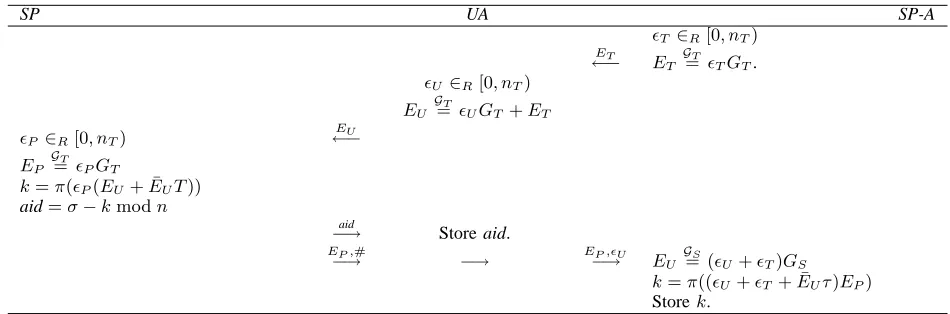
Figure 1 depicts the protocol for granting rights, which is based on the unilateral version of the MQV (Menezes-Qu-Vanstone) protocol for exchanging keys [22].
The public key T represents an SP-A group instead of an individual instance. In other words, all of the SP-As belonging to the same group share the same private key τ. An SP-A group may consist of products that are accredited by an authority or manufactured by a trusted manufacturer. Because of these settings for T, the SP cannot distinguish between instances of the SP-A.
On the other hand, only the instance of the SP-A that knows²T and²U can actually calculatek. Therefore, an
attack, such as those in which malicious SP-As generate common ²T to share k is not effective, since the UA
prevents ²U from leaking. Moreover, the UA randomizes
ET by using a random ²U, and therefore the SP cannot
obtain any information about a user’s identity even if the SP and SP-A collude with each other.
Authentication of the SP is assumed to be carried out in an out-of-band manner. A technical reason for this is because it is not desirable to assume that the SP always has its public key inGT. Moreover, from a practical point
SP UA SP-A
²T ∈R[0, nT) ET
←− ET
GT
= ²TGT. ²U∈R[0, nT)
EU
GT
= ²UGT+ET
²P ∈R[0, nT)
EU ←−
EP
GT
=²PGT
k=π(²P(EU+ ¯EUT))
aid=σ−kmodn
aid
−→ Store aid.
E−→P,# −→ E−→P,²U E U
G= (S ²
U+²T)GS k=π((²U+²T+ ¯EUτ)EP)
Storek.
Figure 1. Rights granting protocol
(e.g. SSL), whose deployment may be required by outside applications.
Anonymity of the rights granting protocol is apparent, since what SP gains through the communication is only EU, which uniformly distributes over GT due to ²U ∈R
[0, nT).
E. Anonymous rights verifying protocol
The SA communicates with the SP-A through the UA to verify the access rights of the user carrying the SP-A. In the same communication, the SP-A examines, on behalf of SP, whether the relevant SA is one of the SAs trusted by the SP.
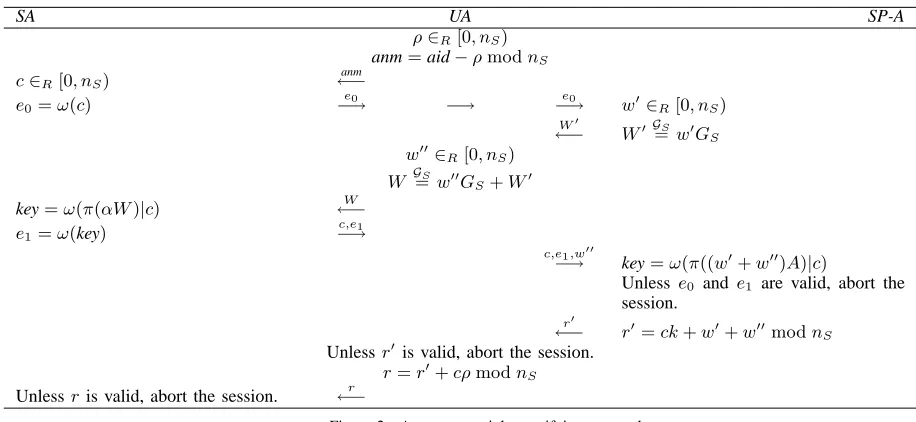
Figure 2 depicts the anonymous version of the rights verifying protocol, which supports the following require-ments.
• The SA examines an anonymized Access ID to verify whether the SP-A retains the secret k.
• The UA randomizes all of the messages that the SP-A submits to the SSP-A in order to hide the identity of the user.
• The UA can detect if the SP-A deviates from the specification of the protocol.
The protocol is designed based on the Schnorr identi-fication algorithm [23], which fulfills the condition for perfect ZKIP (Zero-Knowledge Interactive Proof). The difference between our scheme from the original Schnorr scheme is that the SP selects c from a much wider interval[0, nS). This modification reduces the probability
of a dishonest UA cheating the SA so that it is almost nonexistent, even if the SA and the UA exchange the triplet (W, c, r)of a witness, challenge and response only once. In exchange, this modification harms the simulatability of the scheme in that the simulator may not stop in polynomial time. To fix this deficiency, our scheme makes the SP submit the cryptographic secure one-way hash ω(c)of the challengecprior to receiving the witnessW. By this, our scheme becomes a statistical ZKIP.
The following are to be noted regarding the anonymous rights verifying protocol.
• The SA verifiesrreceived from the UA by:
(r+c·anm)GS GS=cS+W (1)
• The UA verifiesr0 received from the SP-A by:
(r0+c·aid)G
S GS= cS+W0 (2)
• By verifying Eq. (2), the UA can investigate whether the SP-A deviated from the specification of the protocol.
• If the UA successfully verifies Eq. (2), an attacker who can observe the communication between the UA and the SP-A can only perform the guess-and-verify attack, where the attacker has a list of one or more guesses of aid’s and tests whether each guess makes Eq. (2) hold.
• The SP-A verifies that Service Appliance is trusted by the SP (verifier authentication). For this purpose, the SA and the SP-A first exchange a secret using the Diffie-Hellman key exchange algorithm and then respectively derive a MAC key (i.e. key) from the exchanged secret. The SP-A authenticates the SAby verifying the MAC generated by the SA using the key,
F. Proof of anonymity and unlinkability for V-E
The following discussion asserts the anonymity and unlinkability of the communication between the SA and the UA.
We consider the following two cases.
If the UA successfully verifies Eq. (2), then the commu-nication between the UA and the SA is a statistical ZKIP. Therefore, what the SA learns from the communication is only anm, but as anm uniformly distributes over [0, nS),
this implies that the SA learns nothing after all.
If UA fails to verify Eq. (2), what SA gains through the communication are only anm and W. Since the two independent random numbers ρ and w00 uniformly dis-tribute over [0, nS), anm andW are also independent of
SA UA SP-A
ρ∈R[0, nS)
anm=aid−ρmodnS
c∈R[0, nS) ←−anm
e0=ω(c)
e0
−→ −→ e0
−→ w0∈
R[0, nS) W0
←− W0 GS
= w0G
S w00∈
R[0, nS) W GS
=w00G
S+W0
key=ω(π(αW)|c) ←−W
e1=ω(key) −→c,e1
c,e−→1,w00
key=ω(π((w0+w00)A)|c)
Unlesse0 and e1 are valid, abort the session.
r0
←− r0=ck+w0+w00modn
S
Unlessr0 is valid, abort the session.
r=r0+cρmodn
S
Unlessris valid, abort the session. ←−r
Figure 2. Anonymous rights verifying protocol
G. Non-anonymous rights verifying protocol
Figure 3 depicts the non-anonymous protocol for veri-fying rights. The important differences between this non-anonymous version and the non-anonymous version are as follows.
• The UA presents aid instead of anm to the SA. • The SP-A signs r0.
H. Proof of non-anonymity and unlinkability for V-G
In terms of non-anonymity and unlinkability, the fol-lowing are the requirements that the non-anonymous protocol for verifying rights must support.
• The SA can detect if the UA presented anm instead of aid.
• What SA learns from the communication is aid and (U, s).
The following discussion asserts that the protocol given by Figure 3 supports the above requirements.
The UA can modify the signature s so that it can be verified using anm instead of aid. The modification is performed only by adding ω(π(U) | r0)ρ to s, where ρ ≡ aid−anmmodnS. In fact, the following equality
holds.
(s+ω(π(U)|r0)ρ+ω(π(U)|r0)anm)G
S
GS
=ω(π(U)|r0)S+U
However, the UA cannot modifyr0 in the same way as it can dos, sincer0 is signed by SP-A. Hence, the UA can cheat the SA if, and only if, it has obtained a signature to r0 +cρ by the SP-A in the precedent conversations with SP-A, since the Schnorr signature scheme is non-malleable. However, this is unlikely to happen, since the UA has to present anm prior to receiving r0. At the moment that UA presents anm, the probability that the UA receives c and r0 such that a signature to r0 +cρ exists in the list of the received signatures is vanishingly
small. This immediately asserts that the non-anonymity of our protocol.
Supporting of the second requirement of unlinkability is due to the fact that the protocol is a statistical ZKIP, if we neglect(U, s)sent in the last message to the UA.
VI. KEY TRANSFER
A. Protocol specification
The key transfer is the feature that the SA receives a secret key that the SP has generated, if, and only if, the SA succeeds in the rights verifying protocol. That is, the SA verifies the possession ofkby the A, and the SP-A authenticates the SSP-A based on the SSP-A’s public key A. Apparently, this feature augments the support for verifier authentication.
Let K denote the key that the SP intends to transfer to the SA. K satisfies K GS= κS, where κ∈R [0, nS) is
a random number that the SP generates. For the transfer, the SP issuesLGS= κGS to the SA, and the SA recaptures
K through the protocol.
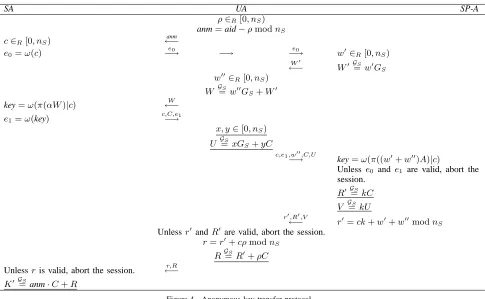
The key transfer protocol consists of an anonymous version and a non-anonymous version, as is the same for the rights verifying protocol. Figure 4 depicts the anonymous version.
In performing the protocol, the SA does not send raw L, since any observer of the communication including UA could also revealK, otherwise.
1) The SA selects a random λ ∈ [0, nS), and then
calculatesCGS= λL.
2) The SA sends C instead of L to the SP-A via the UA.
3) On receipt ofR from the UA, the SA calculates the following.
K0 GS= anm·C+R GS
= (σ−k−ρ)C+ (k+ρ)C GS
SA UA SP-A
aid
←−
c∈R[0, nS)
e0=ω(c) −→e0 −→ −→e0 w0, u0∈R[0, nS)
W0,U0
←− W0 GS
=w0G
S U0 G=u
0
GS w00, u00∈
R[0, nS) W G=Sw00G
S+W0
key=ω(π(αW)|c) ←−W
e1=ω(key)
c,e1
−→
c,e1−→,w00,u00
key=ω(π((w0+w00)A)|c)
Unlesse0 and e1 are valid, abort the session.
r0=ck+w0+w00modn
S U GS
= U0+u00G
SmodnS r0,s
←− s=ω(π(U)|r0)·k+u0+u00modn
S UGS
=u00G
S+U0
Unlessr0, U, s
are valid, abort the session.
r=r0 Unlessr, U, sare valid, abort the
ses-sion.
r,U,s ←−
Figure 3. Non-nonymous rights verifying protocol
SA UA SP-A
ρ∈R[0, nS)
anm=aid−ρmodnS
c∈R[0, nS) ←−anm
e0=ω(c)
e0
−→ −→ −→e0 w0∈
R[0, nS) W0
←− W0 G=Sw0G
S w00∈
R[0, nS) W GS
=w00G
S+W0
key=ω(π(αW)|c) ←−W
e1=ω(key)
c,C,e1
−→
x, y∈[0, nS) U G=SxG
S+yC
c,e1,w00,C,U
−→ key=ω(π((w0+w00)A)|c)
Unless e0 and e1 are valid, abort the session.
R0 G=S kC V G=SkU r0,R0,V
←− r0=ck+w0+w00modn
S
Unlessr0 and R0
are valid, abort the session.
r=r0+cρmodn
S RGS
=R0+ρC
Unlessris valid, abort the session. ←−r,R
K0 GS
=anm·C+R
Figure 4. Anonymous key transfer protocol
4) Finally, the SA recaptures KGS= (λ−1modn
S)K0.
A typical example of the usage ofKis to use it as keys that encrypt contents of the relevant service. For example, let SA be a music player that provides users with a service of playing back music. From the viewpoint of the SP (e.g.a record label), the clear (decrypted) music data shall be processed only by the trusted music players, which are only those music players (i.e. the SA) that the SP-A authenticates on behalf of the SP. This requirement is
supported using the key transfer feature, since only the trusted SA is capable of recapturingK.
B. Proof of anonymity and unlinkability
Diffie-Hellman tuple — a method that determines whether z ≡ xymodn for a given quadruple (G, xG, yG, zG), whereG is an arbitrary point on an elliptic curve andn is the order ofG.
In fact, on receipt ofR0 from the SP-A, the UA inves-tigates whether (GS, S−aid·GS, C, R0)is a decisional
Diffie-Hellman quadruple, or in other words, whetherR0 is identical to kC without knowing k. For this purpose, the UA performs the following.
1) The UA selects a pair of mutually independent random numbersx, y∈[0, nS).
2) The UA calculatesU GS=xGS+yC and submitsU
to the SP-A.
3) On receipt of R0 and V from the SP-A, the UA verifies Eq. (3).
V GS=x(S−aid·GS) +yR0 (3)
If the SP-A calculatesR0 andV correctly byR0 G=S kC andV GS=kU, it is apparent that the UA has successfully verified Eq. (3).
Conversely, if Eq. (3) holds, R0 G=S kC holds except for an almost nonexistent, small probability. This fact is proven as follows. For a fixedU, there existnS pairs of
(x, y)satisfying U GS=xGS+yC, since
logGSU =x+λκymodnS. (4)
On the other hand, Eq. (3) implies that
logGSV ≡xk+ylogGSR0modn
S. (5)
Therefore, unlesslogGSR0≡λκkmodnS, only a single
(x, y)satisfies Eq. (5) out of thenScandidates that satisfy
Eq. (4). Since all what the SP-A can know about (x, y) is that it satisfies Eq. (4), the probability that the UA succeeds in verifying Eq. (3) with an incorrectR0 is only
1
nS, which is vanishingly small.
The deployment of this method allows the key transfer protocol to support anonymity and unlinkability.
If the UA successfully verifies Eq. (3), the SA gains no new knowledge from the communication except for the value of σC. In other words, since generating R is simulatable with the knowledge of anm andσC(i.e.σL), the protocol remains a statistical ZKIP. This means that the communication is anonymous and unlinkable.
What should be noted here is that Ldoes not contain any information indicating the identity of the user. For example, consider the scenario where L is contained in the header of encrypted data of a music file. If a user downloads the music file from the same site where they purchased aid, the site (i.e. the SP) has the opportunity to generate L so that it indicates the identity of the user. Thus, to protect his/her own privacy, the user should acquire music file data through procedures completely separate from the procedures used for purchasing aid.
VII. SUPPORTING OF THE REQUIREMENTS
The previous sections have already showed that out of the requirements presented in Section IV, our access
control scheme supports “anonymity and unlinkability”, “verifier authentication”, and “provable security”.
A. Efficiency
First, readers should note the following.
• The efficiency of the protocol is impacted the most by the calculation performed by the SP-A, since the computing power of the SP-A is usually restricted. • Scalar multiplication over an elliptic curve and
equivalently modular exponentiation are much heav-ier than any other calculation including addition over an elliptic curve, a hash function, MAC generation and verification, and modular addition and multipli-cation.
In this regard, our rights verifying protocol based on the Schnorr zero-knowledge identification algorithm [23] is efficient, since the SP-A has to execute scalar multipli-cation over GS only 2 times for the witnessW and the
shared secret key. In addition, the calculation of witnesses can be done prior to execution of the protocol, if the SP-A has enough room in its memory to store pre-calculated witnesses.
As for the total number of times of executing scalar multiplication and the modular exponentiation, our scheme requires 6, while the schemes by Ateniese et al. [13] and Camenisch et al. [17] require 22.
In the situation where continual verification between the SA and the SP-A is required, verification is performed very efficiently using the shared secret key.
B. Compliance to the distributed trust management model
It is easy to extend the protocol so that verification by SA is based on multiple service public keys and multiple aid. This extension is necessary to fully conform to the Blaze’s distributed trust management model [4], [5].
Let (Si, σi)be the public key of the i-th service (i=
1, . . . , k). Then, the i-th anonymized Access-ID anmi is
defined by
anmi=σi−ki−ρimodnS.
For the challengec, SP-Acalculates the responser by
r=
k
X
i=1
ω(c|i)(ki+ρi) +wmodGS.
Therefore, the SA verifies rby à k
X
i=1
ω(c|i)anmi+r
! GS GS=
k
X
i=1
ω(c|i)Si+W.
Hiroshi Yasuda received the B.E., M.E. and Dr.E. from the University of Tokyo, Japan in 1967, 1969, and 1972 respectively. Then, he had joined the Electrical Communication Laboratories of NTT in 1972. After served twenty-five years (1972-1997), with the last position of Vice President, Director of NTT Information and Communication Systems Laboratories at Yokosuka, he left NTT and has joined The University of Tokyo. He acted Director of The Center for Collaborative Research (CCR) for 2 years(2003-2005), and he is now a professor in CCR and Research Center for Advanced Science & Technology(RCAST). His study area is applied information technology. He has been involved in works on Video Coding, Image Processing, Tele-presence, B-ISDN Net-work and Services, Internet and Computer Communication Applications. Now he has started researches on DRM (Digital Rights Management), Network Security and ”Kansei” (more human) communication. He is now advocating collaboration between Industries and Academia. In International Standardizing Area, he had served as the Chairman of ISO/IEC JTC1/SC29 (JPEG/MPEG Standardization) from 1991 to 1999. He had also served as the President of DAVIC (Digital Audio Video Council) from September 1996 to September 1998. He received 1987 Takayanagi Award, 1995 the Achievement Award of EICEJ, 1995-1996 The EMMY from The National Academy of Television Arts and Science , 2000 Charles Proteus Steinmetz Award from IEEE , 2005 Takayanagi Award and also Ericsson Telecommunication Award 2006. He is Fellow of IEEE, EICEJ, and IPSJ, a member of Television Institute. He wrote ”International Standardization of Multimedia Coding” in 1991, ”MPEG/International Standardization of Multimedia Coding” in 1994, ”The Base for the Digital Image Coding” in 1995, ”The Text for Internet” in 1996, ”The Text for MPEG” in 2002 and ”The Text for Content Distribution” in 2003.
REFERENCES
[1] L. Barkhuus and A. Dey, “Location-based services for mobile telephony: a study of users’ privacy concerns,” in INTERACT 2003, 9th IFIP TC13 International Conference on Human-Computer Interface, 2003.
[2] E. Kaasinen, “User needs for location-aware mobile ser-vices,” Personal Ubiquitous Comput., vol. 7, no. 1, pp. 70–79, 2003.
[3] L. Palen and P. Dourish, “Unpacking ”privacy” for a networked world,” in CHI2003, 2003.
[4] B. Blaze, J. Feigenbaum, and J. Lacy, “Decentralized trust management,” IEEE Proceedings of the 17th Symposium, 1996.
[5] B. Blaze, J. Feigenbaum, J. Ioannidis, and A. Keromytis, “The role of trust management ini distributed sistems,” Secure Internet Programming, LNCS, vol. 1603, pp. 185– 210, 1999.
[6] C. Ellison, B. Frantz, B. Lampson, R. Rivest, B. Thomas, and T. Ylonen, “SPKI certificate theory,” IETF, RFC 2693, September 1999.
[7] L. Kagal, V. Korolev, S. Avancha, A. Joshi, T. Finin, and Y. Yesha, “Centaurus: an infrastructure for service manage-ment in ubiquitous computing environmanage-ments,” Wirel. Netw., vol. 8, no. 6, pp. 619–635, 2002.
[8] L. Kagal, S. Cost, T. Finin, and Y. Peng, “A framework for distributed trust management,” in IJCAI-01 Workshop on Autonomy, Delegation and Control, 2001.
[9] D.Chaum and E. van Heist, “Group signatures,” in In Advances in Cryptology — EUROCRYPT ’91, LNCS 547, 1991, pp. 257–265.
[10] J. L. Camenisch and M. A. Stadler, “Efficient group signa-ture schemes for large groups,” Lecsigna-ture Notes in Computer Science, vol. 1294, pp. 410+, 1997. [Online]. Available: citeseer.ist.psu.edu/article/camenisch97efficient.html [11] L. Chen and T. P. Pedersen, “New group signature
schemes,” in In Advances in Cryptology — EUROCRYPT ’94, LNCS 550, 1995, pp. 171–181.
[12] D. X. Song, “Practical forward secure group signature schemes,” in ACM Conference on Computer and Communications Security, 2001, pp. 225–234. [Online]. Available: citeseer.ist.psu.edu/457688.html
[13] G. Ateniese, J. Camenisch, M. Joye, and G. Tsudik, “A practical and provably secure coalition-resistant group signature scheme,” Lecture Notes in Computer Science, vol. 1880, pp. 255–??, 2000. [Online]. Available: citeseer.ist.psu.edu/ateniese00practical.html
[14] J. Camenisch and A. Lysyanskaya, “Dynamic accumulators and application to efficient revocation of anonymous credentials,” 2002. [Online]. Available: citeseer.ist.psu.edu/article/camenisch02dynamic.html [15] J. Camenisch and J. Groth, “Group signatures: better
effi-ciency and new theoretical aspects,” 2004. [Online]. Avail-able: citeseer.ist.psu.edu/article/camenisch05group.html [16] J. Furukawa and H. Imai, “An efficient group signature
scheme from bilinear maps,” in ACISP 2005, 2005, pp. 455–467.
[17] J. Camenisch and A. Lysyanskaya, “Efficient non-transferable anonymous multi-show credential system with optional anonymity revocation,” in EUROCRYPTO 2001, LNCS 2045. Springer-Verleg, 2001, pp. 93–118. [18] J. Camenisch and E. V. Herreweghen, “Design and
imple-mentation of the idemix anonymous credential system,” in CCS ’02: Proceedings of the 9th ACM conference on Computer and communications security. New York, NY, USA: ACM Press, 2002, pp. 21–30.
[19] G. Iachello and G. Abowd, “A token-based access control mechanism for automated capture and access systems in ubiquitous computing,” Georgia Institute of Technology, GVU Center, GIT Technical Report GIT-GVU-05-06, June 2005.
[20] D.Chaum and T.Pedersen, “Wallet databases with ob-servers,” vol. 740, pp. 89–105, 1993.
[21] K. Shin, “Digital Qualification: An approach to infrastruc-tures of access control for internet commerce,” in SSGRR 2001, 2001.
[22] M. Menezes, M. Qu, and S. Vanstone, “Some new key agreement protocols providing implicit authentication,” in 2nd Workshop on Selected Areas in Cryptography (SAC ’95, 1995.