Volume-7 Issue-1
International Journal of Intellectual Advancements
and Research in Engineering Computations
Food computer using big data analysis
Asif Ahamed P T
1, Karthi T
2, Thamilarasi C
3PG Student,
23Assistant Professors, Department of ECE,
Shree Venkateshwara Hi-Tech Engineering College, Gobi, Tamilnadu, India
ABSTRACT
In this propelled universe of fluctuating atmosphere and temperamental atmosphe re conditions, the outside cultivation part is confronting colossal issues. Requires more substance generation to meet the necessities of the expanding total populace. Likewise, the dry seasons, starling climate, surges and air contamination which all together remain against the nourishment creation. The time has come to consider present day methods for cultivation. This project food computer is a computer-controlled environment for horticulture. Hydroponic innovation is used to grow plants in this controlled domain. The atmosphere to grow the plants is controlled and monitored by Raspberry pi. All the environment parameters are sensed by various sensors which is controlled by Arduino. Raspberry talks with the Arduino and collects data and compare with pred efined settings called climate recipe and gives the command to Arduino to actuate or de -actuate the devices.
Keywords:
Raspberry pi, Arduino mega, Python, Bigdata, sensorsINTRODUCTION
The Open Agriculture Initiative coined the term "Food Computer" to describe their main product. riginally developed under the MIT CityFARM project, the Food Computer is controlled-environmentgriculture platform that utilizes soillessagriculture technologies ncluding Hydroponic and Aeroponic systems to grow crops doors. The Food Computer also utilizes an array of sensors that monitor the internal climate within apecializedrowing chamber and adjust it accordingly so that the environmental conditions remain consistent and optimum. This project food computer is a computer-controlled environment for horticulture.The Food Computer is a table top-sized, computer-controlled platform which control and screen atmosphere, vitality, and plant
development within a specific developing chamber. Atmosphere factors, for example, carbon dioxide, air temperature, humidity, oxygen, hydrogen, electrical conductivity, light intensity and temperature are among the numerous conditions that can be controlled and observed inside the developing chamber to yield different phenotypic articulations in the plants. Plants are observed by controlled based algorithms which has risen as of late in the exactness and computerized agricultural fields. Personal Food Computer allows its user to create, store, and share the data generated during the growth cycle. This controlled small-scale nursery model could control the environment around the plants.
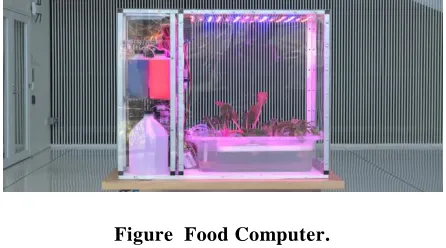
Figure Food Computer. [Adapted from MIT media lab
https://www.media.mit.edu/projects/personal-food-computer/overview/]
Figure shows food computer model. The OpenAg Brain - The cerebrum of the Food Computer which is a product introduced in Raspberry Pi OS. All nature detecting components are controlled and checked by Arduino. Arduino is speaking with raspberry pi and updates the readings constantly. Raspberry Pi is associated with Ethernet arrange. The information sharing by the raspberry pi can be observed and controlled by means of a User Interface called OpenAg farmware. [1-2]
TYPES OF ROBOT FOR PERSONAL
FARMING
Farmbot
The Farmbot is an open-source Computer Numeric Control (CNC) machine that allows the user to plant small herbs and vegetables in an outdoor 2D grid layout (4.5 m2 or 14.7 ft2). Optimized for backyard usage, the Farmbot can perform operations such as watering, spraying, and seed spacing with a single end effector due to its exchangeable head tool. Even though it incorporates data acquisition and analysis tools, the Farmbot cannot control the environment since it is designed for outdoor use. On the other hand, the Farmbot is open source, fully documented and customizable. [2-6]
Aero-Garden
The Aero-Garden platform is a consumer kit for growing herbs, small flowers, and plants. Aero-Garden devices provide enhanced capabilities such as WiFi connectivity to smartphones or 45 Watts
of LED lighting. However, Aero-Garden is a closed platform while other model cannot control the environment. In addition, the environment is uncontrolled and affected by the surrounding climate. Finally, the customizability of the system is low and its inputs are proprietary.
Leaf
The Leaf platform is a medium-size (600 _ 600 _ 1520mm or 24 _ 24 _ 60 inches) indoor farming solution specially designed to grow cannabis and other medicinal plants. Leaf is more expensive than the Aero-Garden platform. However, while other devices provide enhanced capabilities such as WiFi connectivity to smartphones Leaf provides the possibility to control and adapt the environment around the plants. On the other hand, it is still a closed platform (both hardware and software) and its customizability is low. [7, 8]
Grove
Conviron A1000
Personal Computer provides the possibility of creating “climate recipes” and allowing other suitable devices to recreate the same environmental conditions, improving the reproducibility of the experiments. So the development of PFC will be a revolution in the farming technology of world.
LITERATURE REVIEW
In 2015 the MIT Open Agriculture Initiative (OpenAg) was developed by Caleb Harper as an initiative of the MIT Media Lab at the Massachusetts Institute of Technology. This aims to develop controlled environment agriculture platforms called "Food Computers" that operate on a variety of scales, and which can be used for experimental, educational, or personal use. All of the hardware, software, and data will be open source, with the intention of creating a standardized open platform for agricultural research and experimentation.
OpenAg advocates pursue transparency in the agricultural industry, and promote sustainable, local growing practices. Much of their focus is on enhancing urban agriculture and improving access to fresh, healthy foods. The MVP PFC (Minimal Viable Product) is a minimalist Personal Food Computer developed by OpenAg Community members on the OpenAg Forum, in response to a call placed by MIT Open Agriculture Initiative's Director Caleb Harper to build the “first truly community derived device” for OpenAg.
MVP PFC 1.0 (2015)
Personal Food Computer 1.0 (2016)
Personal Food Computer 2.0 (2017)
Personal Food Computer 2.1 (2018)
Personal Food Computer 3.0 (latest in October 2018
Another study by Joaquín Gutiérrez in 2014 developed a sytem that aims at optimizing water use for agricultural crops. An algorithm was developed with threshold values of temperature and soil moisture that was programmed into a microcontroller-based gateway to control water quantity. The system was powered by photovoltaic panels and had a duplex communication link based
on a cellular-Internet interface that allowed for data inspection and irrigation scheduling to be programmed through a web page. The issue is that the investment in electric power supply would be expensive.
Study on the Construction of Smart Agricultural Demonstration Park by Yichuan Zhang, Kai Zhou and Xinzheng Li School of Horticulture and Landscape Architecture, Henan Institute of Science and Technology, Xinxiang 453003, China, 2014 Proposes the implementation of the land circulation system has brought new opportunities for China's agricultural development, and building the agricultural demonstration park is an important measure to promote the efficient development of modern agriculture. Integrating the concept of smart into the construction of agricultural demonstration park can promote the sustainable development of the park.
Another study reviews the state of art wireless sensor technology in agriculture. Based on the value of soil moisture sensor the water sprinkler works during the period of water scarcity. Once the field is sprinkled with adequate water, the water sprinkler is switched off. Hereby water can be conserved. Also the value of soil pH sensor is sent to the farmer via SMS using GSM modem. The issue is that it provides only precision values that is not accurate and is not cost efficient.
PROPOSED METHOD
The PFC is an open-source open-hardware platform; its design prioritizes the criteria mentioned above: desktop size, low-cost, customizability, user friendliness, and open information. These five constraints imply the following actions: First, to reduce the size of a system with a large number of components. Second, to reduce the price of the device using cheap “off the-shelf” components and mass production manufacturing techniques. Third, to obtain a user-friendly device by providing an intuitive and interactive user interface as well as a modular hardware system to add or remove sensing, actuation, or computing devices. Food Computer is controlled-environment agriculture platform that utilizes soilless
including Hydroponic and Aeroponic systems to grow crops indoors.
BLOCK DIAGRAM
In this design process, a central aspect is the choice of the PFC capabilities. This particular choice is one of the innovations of the PFC design. The sensors, actuators, and interfaces of the PFC represent a wide range of devices one can find in
several engineering sub-domains. Figure 3.1 explains the block diagram of food computer. Food Computer is controlled-environment agriculture platform that utilizes soilless agriculture technologies The atmosphere to grow the plants is controlled and monitored by Raspberry pi. All the environment parameters are sensed by various sensors which is controlled by Arduino.
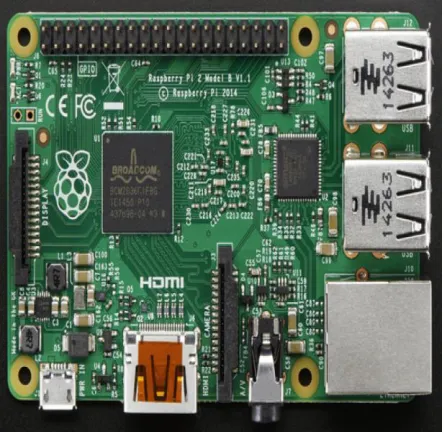
MOTHER-BOARD Raspberry pi 2
Raspberry Pi is the ace mind of the Food computer. OpenAg cerebrum is the product exceptionally created for Food Computer which is introduced in Raspberry Pi operating System. Raspberry Pi speaks with the all the detecting components and actuators by means of Arduino. It
Specifications
Chip- Broadcom BCM2836 soc
Core Architecture- Quadcore ARM Cortex-A7
CPU-900 MHz
Memory-1GB LPDDR2
Power -Micro USB socket5V,2A
GPIO Pins can be designed to be input/output:
Reading from different ecological sensors.
Writing output to dc engines, LEDs for status Arduino Mega 2560
Figure Arduino Mega 2560
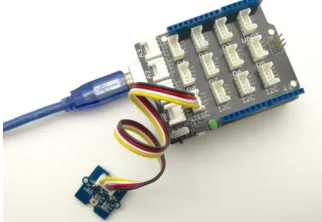
Arduino mega 2560 go about as a terminal for all the environment detecting segments and driver for the AC switching and DCswitching circuits. Arduino screens every one of the parameters by means of sensors and converses with Raspberry Pi. The Grove base shield is mounted on the Arduino to which the vast majority of the sensors are
Figure Air temperature and Humidity sensor
The grove Temperature and Humidity sensor shown in figure 3.8 monitors the Air temperature and Humidity of the Food computer camper. The detection range of air temperature is -40 degree Celsius to 80 degree Celsius. For humidity the detection range 5% RH to 99% RH. This sensor is connected to A0 and A1 pins of the Arduino analog section.
Light Intensity and PAR Sensor
The light intensity and PAR sensor in figure 3.9 module is based on the I2C light to digital converter [TSL2561], which converts light intensity to digital signal. The PAR (Photosynthetic Active Radiation) Sensor detects Photosynthetic Photon Flux Density.
Figure Light Intensity and PAR sensor
Carbon Dioxide Sensor
The CozIR Ambient Air 2,000 ppm CO2 sensor is intended to screen carbon dioxide levels inside. It is perfect for observing CO2 in structures, workplaces or anyplace indoor air quality is vital for the individual solace of the tenants. A carbon dioxide sensor or CO2 sensor is an instrument for the measurement of carbon dioxide gas. The most
Figure Co2 Sensor
Electrical Conductivity Sensor and
Temperature Probe
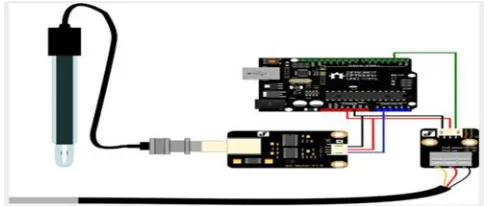
EC (Electrical Conductivity) sensor measure the saltiness of the dirt, water system water
frameworks or manure arrangements is a vital parameter influencing the root zone condition of plants. Any of these variables can significantly affect plant development and quality.
PH Sensor
pH remains for power of hydrogen, which is an estimation of the hydrogen particle concentration in the body. The aggregate pH scale ranges from 1
RESULTS AND DISCUSSION
Performance evaluation
The grove Temperature (Air Temperature sensor) and Humidity sensor monitors the Air temperature and Humidity of the Food computer camper. The detection range of air temperature is -40 degree Celsius to 80 degree Celsius. For humidity the detection range 5% RH to 99% RH. I
connected this sensor to A0 of the Arduino analog section.
SIMULATION
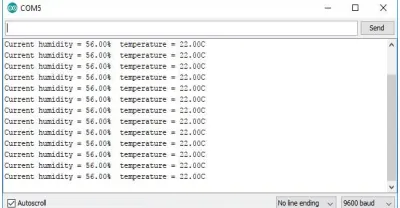
Figure 4.1 shows the simulation of different sensors feedback. Humidity sensor and temperature sensor outputs are simulated in the serial monitor of Arduino. Can monitor sensor readings, edit and change recipe settings
Simulation of sensor output
CONCLUSION
Nowadays major challenge in farming is unpredicted nature of climate. PFC is a system that can control the climate. So in this project, the humidity, temperature, intensity etc inside the structure that developed can be measured using corresponding sensors. So using the concepts of big data analysis, data's are analyzed to maintain required climate inside the structure of developed
REFERENCES
[1]. Du et al L, “Estimation of rice leaf nitrogen contents based on hyper spectral LIDAR,”Int.J.Appl.Earth Observ.Geo information, 44, 2016, 136–143.
[2]. Duemilanove A, & Blue P.S,"Version NEW, Mega D, Mega A, Mega T.A, Mega T, Mega 2560 V3.0 (Arduino Mega 2560 R3 Compatible)", 2016, 0,0-2.
[3]. Enazi S. A, Abdullah A, and Damaj I., March “Agrisys: A smart and ubiquitous controlled-environment agriculture system,” 2016, 1–6.
[4]. Ferrer E.C, Rye J, Brander G, Savas T, Chambers D, England H, & Harper C. Personal Food Computer. A new device for controlled-environment agriculture. Retrieved from http://arxiv.org/abs/1706.05104. 2017
[5]. Lee k “Turning plants into drug factories,” Scientific American,.Mellis D. Arduino Mega 2011, 2560. Retrieved 2560. https://doi.org/10.107/CB09781107415324.004. 2016.
[6]. Next E. Hardware setup for Arduino Mega 2560 Pin Mapping for Arduino Mega 2560 Arduino Altair Pin Direction Arduino Altair Pin. 2015.
[7]. Raspberry pi Foundation. Introducing the Raspberry pi 2 - Model B, 2015, 1-23. Retrieved from https://cdn-learn.adafruit.com/.