Knowledge, Attitude and Practice Regarding
Pharmacovigilance and Consumer Pharmacovigilance
among Consumers at Lalitpur District, Nepal
Nisha Jha,1 Devendra Singh Rathore,2 Pathiyil Ravi Shankar,3 Shital Bhandary,4 Mohammed Alshakka,5 Sudesh Gyawali6
1Department of Clinical Pharmacology, KIST Medical College, Lalitpur, Nepal, 2Department of Pharmacy, NIMS University, Rajasthan, India,3Department of Pharmacology, American International Medical University, St. Lucia, caribbean, 4Department of Community Medicine, Patan Academy of Health Sciences, Lalitpur, Nepal,5 Department of Pharmaceutics and Clinical Pharmacy, Aden University, Yemen,6 Department of Clinical Pharmacology, Manipal College of Medical Sciences, Kaski, Nepal
Correspondence: Dr. Nisha Jha, Department of Clinical Pharmacology and
Therapeutics, KIST Medical College, Lalitpur, Nepal. Email: nishajha32@gmail.
com, Phone: 9841602808.
ABSTRACT
INTRODUCTION
Adverse drug reactions (ADRs) can be a threat to the health of people in Nepal. There is no mandate to report ADRs by any regulatory authorities in Nepal.1 Voluntary reporting of ADRs is limited to the healthcare professionals (HCPs) in Nepal.2 There is no system developed for involving consumers in the system of ADR reporting.3 The doctor patient ratio in Nepal is not satisfactory.4 Underreporting remains a big problem worldwide among HCPs, including community pharmacists (CPs).5-7 The number of retail pharmacies is much greater than the number of health centres.8 These factors support and encourage self-medication increasing the incidence of ADRs.9,10 Use of medicines by consumers can be influenced by various factors.11 Medicine use problems are also evident in
Nepal.12 Consumer reporting of ADRs is already active in developed countries.13 Netherlands and Denmark opened their respective national spontaneous reporting systems to the general public in 2003, followed by the United kingdom (UK) in 2005 and Sweden in 2008.14-23 Few studies have been done in this area.24 The main purpose of the study was to evaluate knowledge, attitude and practices of the consumers visiting the out-patient department of KIST Medical College and Teaching Hospital regarding pharmacovigilance.
METHODS
This cross-sectional study was carried out from May 2015 to September 2015 at KIST Medical College Teaching Hospital, Imadol Village Development Committee (VDC),
Background:
Adverse drug reactions (ADRs) can be a big threat to the health of people in Nepal as a variety of
medicines are consumed in the country. Involving consumers in pharmacovigilance can strengthen ADR reporting. The
study aims to find out knowledge, attitude and practice regarding pharmacovigilance and consumer pharmacovigilance
among consumers at Lalitpur district, Nepal
Methods:
It was carried out in outpatients visiting in KIST Medical College and Teaching Hospital, Lalitpur, Nepal.
Participant’s knowledge, attitude and practice were measured by noting their agreement with a set of 21 statements
along with multiple choice and open ended questions.
Results:
A total of 157 outpatients were surveyed. The knowledge scores for males (12) was better compared to the
females (11), but the scores for attitude and practice were same for both groups. The maximum score for knowledge
was 29, attitude was 6 and practice was 10. The overall KAP scores was 45. The total scores for knowledge, attitude and
practice for males (24) were better compared to female (22) respondents. Seventy-one patients (68%) who participated
in this study favoured establishing a consumer centre for obtaining information about ADRs.
Conclusions:
Knowledge scores among consumers regarding pharmacovigilance is low and require advocacy and
improvement.
Keywords:
Adverse drug reaction; consumers; reporting systems.
J Nepal Health Res Counc 2017 Jan - Apr;15(35): 31-7
Original
Lalitpur district, Nepal. This study was done among in‐ dividuals visiting various out-patient departments of the institution. Patients visiting the outpatient pharmacy of KIST Medical College Teaching Hospital to purchase medicines after attending the outpatient department of the hospital were selected for this study. A systematic random sampling method was used. Every fifth patient visiting the outpatient pharmacy was interviewed using the questionnaire.
For sample size calculation, we assumed that the knowl‐ edge should be about 40% in our population of respon‐ dents. This was obtained from the results of the pilot test and also from the literature review.25 Total sample size needed with provision for drop outs from the study was 157 respondents. Information like gender, age, pro‐ fession, ethnicity, educational qualifications, and place of residence were noted. Respondents’ KAP were mea‐ sured by using a set of 21 statements using questions with 12 multiple choice questions and nine open ended questions. Respondents were explained about the multi option system while answering the questions. The scores for knowledge items were given 1 for each possible op‐ tion. Since the questions were with multi option answer, the score for each question depended on the number of options available. Similarly, for attitude questions, posi‐ tive attitude was scored as one and the negative attitude as 0. Similarly, for practice, the score was calculated by giving one for each possible options from the mul‐ tiple choice questions. There were eleven statements for assessing knowledge with a maximum possible score of 29 and six statements for attitude with a maximum possible score of six. Similarly, there were four state‐ ments for practice and the maximum possible score for practice was 10. The total scores was obtained by add‐ ing the ‘Knowledge’, ‘Attitude’ and ‘Practice’ scores. The maximum total score was 45. The median and in‐ terquartile range was calculated for total ‘Knowledge’, and ‘Attitude’ and ‘overall’ scores. The questionnaire addressed different aspects of pharmacovigilance and consumer pharmacovigilance. The topics to be included in the questionnaire were developed on the basis of a thorough review of literature and the authors’ experi‐ ence of important issues related to pharmacovigilance in Nepal.11,23,26
The questionnaire included questions based on knowl‐ edge attitude and practice studies about pharmaco‐ vigilance and consumer pharmacovigilance conducted in Malaysia.11 Manuscripts and published papers describing similar research and methodological issues were also studied.11,23 After finalizing the statements, these were further discussed with other faculty members of the pharmacology department of KIST Medical College for
their valuable inputs. Inputs were also obtained from other researchers in the field. The questionnaire was pilot tested among ten consumers with regard to read‐ ability and their understanding of the content matter. The questionnaire was developed in English, and then translated into Nepali for better understanding of the respondents. The questionnaire was administered to the patients visiting the out-patient department by the re‐ searcher. The collected data were analyzed using SPSS version 19.0 for Windows. The knowledge, attitude and total scores were tested for normality of distribution us‐ ing one sample Kolmogorov-Smirnov test. The samples were noted not to follow a normal distribution and me‐ dian was calculated as a measure of central tendency, interquartile range as a measure of variance and non-parametric tests were used for comparison between dif‐ ferent subgroups of respondents.
This study was approved by the Institutional Research Committee of KIST Medical College. All participants were informed about the aims and objectives of the study and invited to participate. Written informed consent was ob‐ tained from all interested participants.
RESULTS
Among the 157 respondents surveyed, maximum were females 90 (57.3%) and only 67 (42.7%) were males. Forty-six (73%) respondents were below 20 years of age, and 57 (36.4%) were from the 21-30 years age group. Sixty-nine (44%) respondents were self-employed/ business and 64 (40%) were from the Newar ethnic group. With regard to the educational level, 74 (45.8%) respondents had completed bachelor level followed by 56 respondents who had completed intermediate level of education. Table 1 shows the demographics of the respondents who participated in the study.
Table 1. Demographic characteristics of respondents.
Characteristic Number (percentage)
Gender Male Female
67 (42.7) 90 (57.3) Age
< 20 21-30 31-40 41-50 51-60
Profession Service Business Housewives Students Others 39 (24.8) 69 (44) 18 (11.5) 20 (12.7) 11 (7) Ethnicity Brahmin Chetri Newars Janajatis 37 (23.6) 38 (24.2) 64 (40.8) 18 (11.5) Qualifications
Below class 10 Intermediate Bachelor Masters 13 (8.3) 56 (35.7) 75 (47.8) 13 (8.3)
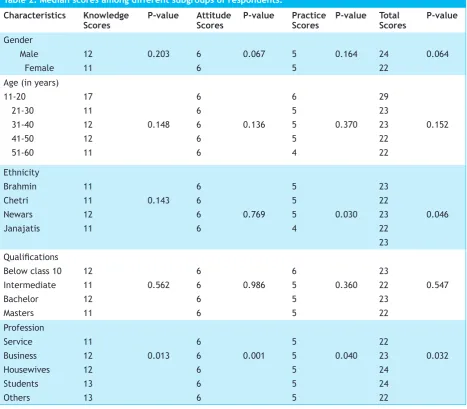
Table 2 shows the knowledge, attitude and practice scores among different subgroups of respondents. The knowledge scores for males was higher compared to females, but the scores for attitude and practice were the same for both genders. The total KAP scores for males were found to better compared to females. These differences were however, not statistically significant. Similarly, the knowledge scores for respondents of age group below 20 years was higher compared to other age groups. Again, none of these scores were found to significantly different statistically. Overall scores were similar for respondents belonging to different ethnic groups. The knowledge score for respondents having diploma level of education was greater compared to respondents having higher educational levels. Respondents having educational level below class ten and bachelor level were having maximum scores for knowledge and total scores for KAP.
Table 2. Median scores among different subgroups of respondents.
Characteristics Knowledge
Scores P-value AttitudeScores P-value PracticeScores P-value TotalScores P-value
Gender Male Female 12 11 0.203 6 6 0.067 5 5 0.164 24 22 0.064
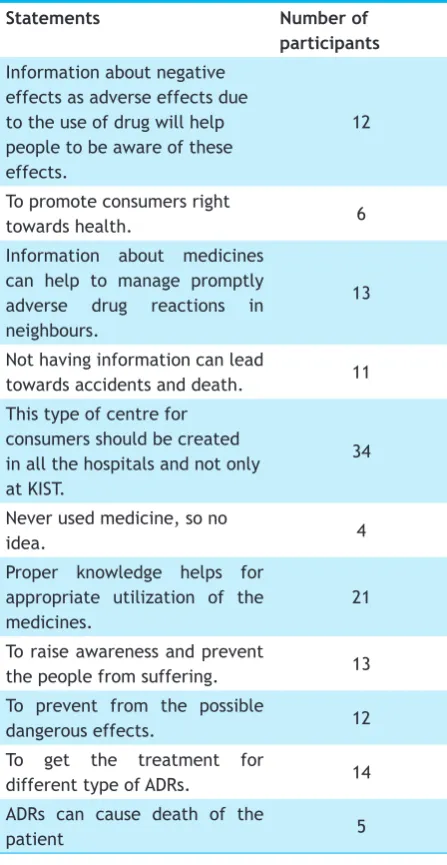
Maximum number of patients who participated in this study were in favour of establishing a consumer centre for providing information on adverse drug reactions. They were also of the opinion that proper and adequate knowledge regarding medicines will help prevent possible ADRs and reduce suffering. Thirty four(22%) consumers opined that there is need for the establishment of consumer pharmacovigilance centre at all the hospitals including KIST Medical College. They also mentioned that establishment of such centers would be more helpful for obtaining information about the adverse effects caused due to medicines.
Table 3. Common statements by the participants for open ended questions.
Statements Number of
participants Information about negative
effects as adverse effects due to the use of drug will help people to be aware of these effects.
12
To promote consumers right
towards health. 6
Information about medicines can help to manage promptly adverse drug reactions in neighbours.
13
Not having information can lead
towards accidents and death. 11 This type of centre for
consumers should be created in all the hospitals and not only at KIST.
34
Never used medicine, so no
idea. 4
Proper knowledge helps for appropriate utilization of the medicines.
21
To raise awareness and prevent
the people from suffering. 13 To prevent from the possible
dangerous effects. 12
To get the treatment for
different type of ADRs. 14
ADRs can cause death of the
patient 5
DISCUSSION
Consumers should be involved in ADR reporting and
pharmacovigilance as they are important stakeholders in the medicine use process.27 Encouraging consumer reporting is a vital step which can further strengthen the pharmacovigilance system. Studies have shown the beneficial effects of involving consumers in the ADR reporting process.26,28 In a developing country like Nepal, ADR reporting by consumers may be important in improving reporting rates and strengthening the pharmacovigilance system.
Many people who consume medicines do not have a proper understanding of ADRs as shown by studies reported in the literature.26, 28 Only 53.5% of patients had a proper understanding about what is meant by an ADR according to research done in a hospital in Ireland, where only 30% of patients on warfarin identified the risk of bleeding as one of the important ADRs.29 This low level of awareness can be improved by measures like conducting an awareness program and medicine use campaigns as suggested by a research conducted about the ADRs of statins at Beaumont hospital in Ireland.28 Many consumers agreed that the purpose of ADR reporting was to use drugs more safely.27 This reflected that people were having a better understanding about ADRs and hence a better cognition about drug safety. A research done in Dublin showed that the patients were mostly unaware of and inaccurate about the risks associated with their medicines.27 Very few respondents in the present study (2.54%) knew that the department of drug administration (DDA) is the national pharmacovigilance centre in Nepal. The reason for this low awareness about the national pharmacovigilance centre may be less publicity and awareness programs about pharmacovigilance for the general public. There are only eight regional pharmacovigilance centres in Nepal, among which, many are situated in the capital city Kathmandu. Many laypersons were not aware about the existence of the pharmacovigilance program. One of the reasons may be that no legal document or any act related to drugs contained the term ‘pharmacovigilance’ earlier, but now, a revised and a new edition of the national health policy contains some terms and operational definitions of ADRs.30 Till date there is no involvement of consumers in the ADR reporting process in Nepal and it has been solely dependent on reporting by the healthcare professionals.12
the healthcare professionals. The results of the Chinese study showed that respondents with a higher level of education were having a greater level of knowledge and awareness about ADRs.31 A study done in Sri Lanka regarding the general people’s awareness about the mass treatment regimen for filariasis revealed that there was no significant association between the area of residence of the participants and their likelihood to report any experience of ADRs.32
About 91.8% of consumers agreed that a consumer ADR reporting system should be beneficial for consumers. Reports from the literature have demonstrated that involving consumers will bring many advantages and benefits to the existing pharmacovigilance systems. Participation of consumers in ADR reporting systems may also address the problem of underreporting of ADRs by healthcare professionals.33,34 Lay persons have few problems with regards to the understanding of the types of ADRs.35 In the present study, respondents with bachelor level of education had better scores for knowledge and total KAP scores. This result confirms that bachelor level of education have better awareness and perceptions towards ADR reporting. The consumers having diploma (two years of education after ten years of schooling) level of education were also showing higher scores.
Thirteen consumers (8.3%) emphasized that “Information about medicines can help to manage promptly adverse drug reactions in neighbours”. This response from consumers is also in accordance with a study done by researchers in 2009 which focused on educating consumers for reporting ADRs and about the process for reporting ADRs.35 Consumers have a right to obtain proper information about their medicines.11 These efforts may reduce the suffering due to ADRs.35 Nearly 14% of consumers in our study stated that “proper knowledge helps in appropriate utilization of medicines.”
There were no significant difference in the response to questions and statements among respondents according to gender, age and education. Almost sixty percent of patients stated that they were not being informed about any ADRs which might occur after taking medicines and also many of them opined that they would prefer visiting a doctor for reporting any ADR verbally. These methods will increase the awareness of the possible risks for getting any ADRs and thus the morbidity and mortality rates due to ADRs would be reduced.29 Thirty four percent of respondents stated that centres should be established for consumers to obtain authentic information regarding ADRs along with the management. Many respondents agreed that there should be an establishment of a
centre to benefit consumers, not only at the study site, i.e., KIST Medical College, but also at each and every hospital in the country for providing them information about medicines. Currently, there are eight regional pharmacovigilance centre in Nepal and most of them are located in Kathmandu. They can also forward the ADR reports from consumers legally to the national pharmacovigilance centre at DDA. This can go along with a better dissemination of this new system development to strengthen the existing system of pharmacovigilance.
CONCLUSIONS
Knowledge scores among consumers regarding pharmacovigilance is low and require advocacy and improvement. Consumers can be an important pillar in the existing pharmacovigilance system of Nepal. The awareness about the pharmacovigilance and ADR reporting systems for consumers through establishment of consumer pharmacovigilance centre at the hospitals could be an important action.
ACKNOWLEDGEMENTS
The authors take this opportunity to thank all the participants of the study. They also acknowledge the faculty members of the department of pharmacology at KIST Medical College and the management of the college for allowing us to conduct the study in the college area. We also thank to Mr. Padam Kanta Dahal, Demonstrator at Department of Community Medicine, KIST Medical College for his help in manuscript formatting.