Identify and submit the tile restoration plan for
Sheikh Safiuddin Tomb Collection
Homan bakhshaee
*Master of Science in Restoration of Works of Art University of Tehran, Iran Corresponding Author email: [email protected]
Abstract :The monastery of Sheikh Safi al-Din is one of the great and most luxurious Safavid collections that have been the guardians of the ancestors, sultans and princes of the Safavid. In addition, its unique mansions are unique, its ornaments are of special significance to the most beautiful Islamic historical works of Iran. Therefore, the main purpose of this research is to identify and present a tile restoration plan for Sheikh Safiuddin's tomb collection. Which has been carried out in three stages: library, laboratory and field. The results of the research show that the analysis showed that the type of glaze and body of tiles used in Sheikh Safiuddin Ardebili's Tomb in terms of materials and tiles The existing one is almost identical with the tiles of its period. And no big difference was seen. The common tile of Sheikh Safi tiles is technically high in silica compounds in their bodies. The tiles are not of an integrated structure and the glazing structure has cracks. The results of the qualitative analysis of mosaic tiles in Sheikh Safi monument set by electronic microscopy system show the presence of lead in samples. According to this identification, it is deduced that the glazes of these tiles are of lead lead type. In the end, a proposal has been made for the construction of the building of Sheikh Safiuddin
Keywords: Tomb of Sheikh Safiuddin Ardebili, tiling, technology, pathology, restoration plan
INTRODUCTION
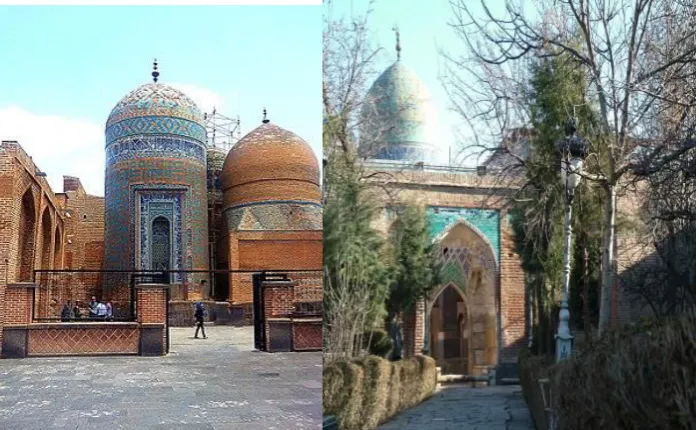
16 Figure 1 & 2 - Sheikh Safiuddin Ardebili's Tomb Building (Writer)
Research Methodology
So far, there has not been a comprehensive study on the pathology of tile tiles, and in some cases reports and references have been made in some books and articles. Mostly, the introduction of buildings has been described in terms of history, printing of maps and a number of photographs, and less analysis has been done. And the research method in this research is library, archive of cultural heritage of Ardabil province, laboratory studies, field studies, tools Collecting sampling data and conducting experiments on the introduction and rehabilitation of these tiles, as well as the classification of tile species, cooking techniques and refinishing operations, and can be proposed in a comprehensive review and provide all technical and expert aspects for Access to a complete conclusion about the future restoration of the building.
background research
The shrine of Sheikh Safi al-Din Ardebili is one of the historical and ancient sites of the city of Ardebil in the northwestern part of Iran. It is one of the registered works of Iran in the UNESCO World Heritage List. In addition to the shrine of Sheikh Safi al-Din Ardebili, the tombs of Shah Isma'il I (the first king of Safavid) Ishmael (mother of Shah Tahmasb), as well as some elders and rulers of the Safavid era, as well as Iranian martyrs of Chaldoran War. The other parts of this collection are Chinese mosque, Janet Sara, Khaneghah, Chaleh house, Shahidgah and Zarghaghala. This cylindrical building after the death of Sheikh Safi-edin in 735 was ordered by his successor and his son, Sheikh Sadr al-Din Musa, during the ten years Has been. In the eyes of the 11th century AH people, the tomb of Ardabil was a place of miracles, as described by Ole Arius, "Sheikh Safiuddin built the building after the death of his father by the architecture brought with him from Medina to Ardabil. According to the political statement The map of the tomb is from Sheikh Sadr al-Din himself; he ordered the architect to close his eyes and then described the building and envisioned his vision for him and the architect began to describe the building. Sheikh Jenid later built a lot of courtyards and built it around. "
17 masterpieces of Iranian art in the eighth century AH. The marble of glazed bricks in this In order to inscribe and cover. But the most remarkable cultural and artistic work of the tomb, the crocheting basket, the carving and the artwork of Sheikh Safi al-Din is. "Under the dome of the tomb, the tomb was located on the shrine of Sheikh Safi al-Din, previously wearing a red golden hood that was found by the professors of the fan and in the form of a very interesting from Harir, but since the year 1314, when the historical coveralls in Tehran It was not transferred to another fund. " The box, which is inside a glass compartment, is placed on a white marble tombstone. The upper four sides of the grave box were previously covered with golden sheets and were scratched with jewelry such as ruby and emerald and turquoise. History: European scholars such as the German Army and the English Weaver in the Sheikh Safi Mausoleum are almost identical in history. In the analysis of the history of the monument, Weaver appears to be influenced by Zarah's view. "This scholar considers the date of construction of the tomb of Sheikh Safi al-Din in 749 by Sadr al-Din Musa, the son of Sheikh Safi-edin." Walter Hinets, German emphasizing on the construction of the tomb by Sadr al-Din, "determines the history of the building of the Sheikh Safi's tomb in the years 776 - 802, because it seems that Sadr al-Din brought the masters and industrialists from Medina, and the Sheikh pilgrimage in the late-life of practical life It's been effortless. "
Types of tiles in the tomb of Sheikh Safi al-Din Ardebili Mosaic tile
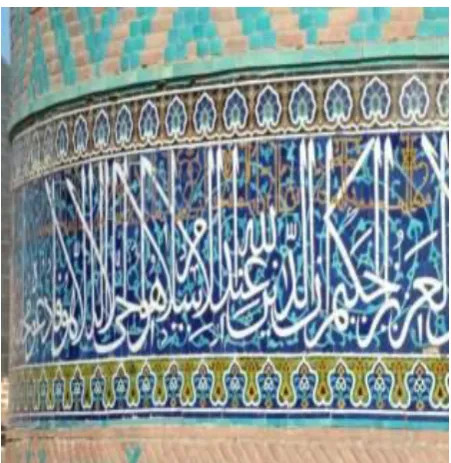
At the end of the Ilkhani era and the beginning of the Timurid era, the tile art with a history of about three centuries appeared to be the most beautiful form of the tile of "Mareq". The art of tiling mosaic or tile flower and bush, which is more famous for mosaics with Europeans, has gradually become an adornment of Iranian architecture, especially religious buildings, since the seventh century AH. The importance of mosaic tile to other types of beautiful tile is its degree of strength. To make a mosaic tile, first tile is cut into small pieces or large pieces, and according to the previously prepared map, they fill the pile and then fill with gypsum droplets and joints, so that all of it becomes integrated into a tile piece and when Which is tight, installs it on the building. Various colors were applied in the mosaic tile, in which white, dark blue, turquoise, green, orange were more visible. The tiles used in Sheikh Safi-al-Din Ardebili's Tomb are more than tile mosaic, including inscriptions, mud-plant designs, header lattices, etc., for example, in the southern side of the dome of Allah, Sample There are various works of tile mosaic such as geometric designs, slabs, mogharnas, pencils of the inscription with the third line and koufi jokes, etc. Another design is visible in their bit and it is a combination of tile with bricks that tile mosaic With elegance, the more complete it comes with the brickwork of beautiful geometric designs.
Figure 3.Sheikh Safi al-Din Ardebili's Mosaic Tile (Writer)
Screw tiles
18
Figure 4. Sheikh Safi's Tombstone Tile (Writer)
Pure tile
The family is a mosaic tile. But the mosaic tile is easier and more affordable. The tile used is the same 15x15-tile tiles used in mosaic tiles that are cut to the desired size. (Of course, these slices should be true) Slim and thin designs are not applicable. And only geometric shapes are applicable to it. Of course, the building lines are also written. If bricks are used, glazed bricks or tiles are used and this is done at the right angle. In the name of Maqali is famous and it can be said that "some graffiti of materials such as brick and tile (separated and dashed) are made. Its application is in Sheikh Safiuddin Ardebili's Tombstone Collection, which is the stem of Shah Ismael's Gonbad, which you can see in the picture below.
Figure 5. Gonbad Shah Ismail's Tile (Writer)
4-Chinese knot tile
In the category of mosaic tile is a combination of tiles and bricks. And they create different Indian forms. Both prominently and equally applicable. In Chinese knot, designs such as Slimy, Khatami, etc., which are widely used in mosaic tiles, are not possible. The Chinese knot is used in the tombstone in the stem of the dome, which is shown in the picture below.
19
Tile seven colors
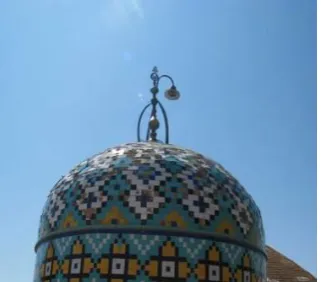
From the end of the Timurid period and the beginning of the Safavid period, the use of another type of tile known as "Adhesive" or "Seven Colors" was used to decorate various buildings. The application of the "seven colors" tile, which has been used since the end of the Timurid period in different buildings, continued until the Qajar period. The seven-tone tile, which has a lot of reputation, is from the four-tier clay tile, measuring 15x15x5 inches. They paint the desired role on it and heat it to the slave furnace to cook the glaze. Then the furnace is installed and mounted on the wall. Seven colors are commonly used: black, white, azure, turquoise, red, yellow and banana, which are used in historical buildings and places of this type of tile. Used in a tile of seven colors in the tomb of Sheikh Safiuddin Ardebili are the lower parts of the Chinese house. (Among the tiles of the seven colors used in the tombstone, even 20 x 20 dimensions can be seen.)
Figure 7 and 8 - The seven-color tile of Shah Ismael dome (Writer)
Investigation of damage to tiles of Sheikh Safi Ardebili
Naturally, the damage to the tile can be attributed to three factors, which can be divided into the following diagram.
Damage to the tile
Otherwise injuries to the tiles of the Mogharnas of the external view of the house will be broken down into injuries and injuries by categorizing the injuries and mentioning the reasons for them in the six separate sections, along with the color images. Of course, it should be noted that parts of the injuries and the causes of injuries are common. However, each of these injuries has been tried individually to discuss and discuss:
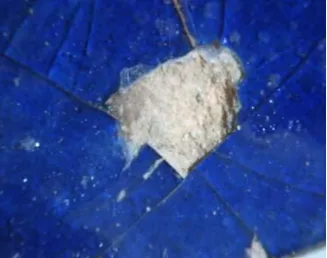
Some of the used tiles have lost their glaze over time and have left their glazes inadequately, due to the poor quality of the tiles, the influence of moisture on the underlying layers, and the lack of proper selection of tiles and glazes. .. have been . Of course, the difference in night-time temperature in the area should not be ignored. It should be noted that most of these damage are seen in green and azure tiles.
Internal factors
Weakness while building
the body
Weakness during glazing
Soluble salts
(crystallization of salts)
Damage caused by the
baking stage
External factors
Freeze
Moisture
Temperature
the light
Atmospheric pollution
Biological agents
Wind, earthquake, storm
20
Figure 9 & 10 - Glazing (Writer)
In many cases, in addition to the glaze, the tiled part of the flower was lost. As for A, the main cause of this lesion is the selection of raw materials, as well as the atmospheric and geographical conditions of the site.
Figure 11 & 12 - Tile Blossom (Writer)
The tiles of some levels of Mogharnas are completely gone. One of the reasons for this is the lack of proper connection between the tile and the mortar, as well as the influence of moisture on the tile's back layers, and the inappropriate percentage of the mortar composition, as well as the removal of the retaining metal sheet and the further pressure on the Mogharnas and ... cited.
Figure 13 & 14 - The destruction of the Mogharnas Tile (Writer)
21
Figures 15 and 16 - Laying Metal Plates (Writer)
Another case of damage to the tile set used in Mogharnas is the seamless integration of tiles and, consequently, the separation of the tile layer from the gypsum bed, thus providing a suitable ground for penetrating rain and moisture to the layer. Underneath the tile and reduce the life of the tiles and the loss of gypsum mortar and .... The lesion is caused by different influences such as the pressure of the various layers, the loss of the metal (laminate) and the slackness of the primitive mortar, as well as the penetration of moisture from the back wall and possibly the movement and movement of the wall, and in the event of incorrect and cross-sectional repairs. Is.
Figure 17 & 18 - Tile layer separation from gypsum bed (Writer)
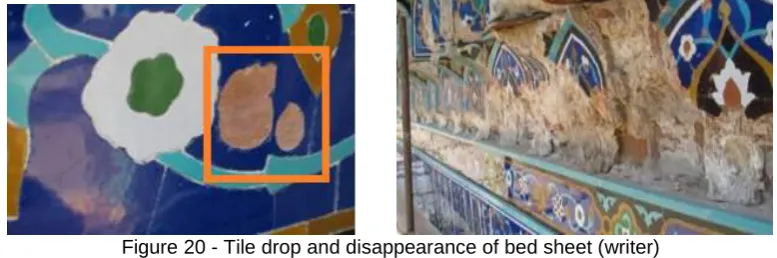
One of the important factors in the elimination of tiles and their instability is the lack of precision in the selection of improper mortar so that the selected mortar does not have sufficient stability and resistance to maintain tiles. The main reason for this can be attributed to the incorrect mixing of the mortar with excessive moisture penetration from the wall. Hence, in most parts of the tiles, there is a loss of tiles, as well as the loss of bedding.
Figure 19 - Inappropriate Mortar (Writer)
22
Figure 20 - Tile drop and disappearance of bed sheet (writer)
The effects of environmental and human factors on tiled decoration of Sheikh Safi monument Freeze
The phenomenon of freezing occurs mostly on fronts where rain has had direct and long-lasting contact with the tile. According to the statistics presented in a balanced way in the past years - a cold day and a show of frost, on such days humidity has been able to put significant damage to the tiles.
Dissolution
Humidity from rain can solve soluble parts of building materials and eliminate them from their structure. Although the process of this low solubility is related to the early years of the installation or use of building materials, it can not be ignored as a deterioration factor in moisture. Other factors have a more destructive effect on the subject, which can be interpreted in part by interpretation.
Dandruff
The moisture content of soluble salts increases after it reaches the surface of the porous material. Due to the level of evaporation, the concentration increases in near-surface layers and, as a result, provides a crystallization phenomenon. This phenomenon causes pressure on the surface layers and disrupts the structure of the surface of porous building materials and materials, which can be seen in the image, glaze or surface layers. This phenomenon can also be seen in areas where moisture has penetrated the tiles behind and has been able to dissolve the tile bonding mortar to the body.
Mortar washed
Many tiles, especially in positions near the gutters where moisture is most stored, is tiled from the body. In other positions that are most noticeable, wherever the water outlet systems of the floor of the moonlight have encountered a problem and the water has accumulated, the mortar behind the tiles has been affected.
Acid rain
One of the most important causes of damage to building materials, and in particular monuments, is the phenomenon of acid rain that is the product of industrialization of the world and the expansion of the use of fossil fuels in industrial city centers. Contaminants from incomplete combustion of fossil fuels appear in cars and industrial plants in the form of gas, chemical particles and smoke in the midst of densely populated cities. The destructive effects of the presence of acidic rains on the decoration of the Sheikh Safi tile set, especially the decorative gypsum and gypsum tiles, are very revealing.
The destructive effects of light and heat generated by it
In the city of Ardabil, the maximum angle of radiation in the beam is 75 degrees 2 minutes. At this time, the sun sets at 7 and 18 minutes in the southeast of Tolo, at 16 and 42 minutes in the southwest. Continuous oscillations in the tiles with fluctuations due to the temperature drop in the cold seasons, which sometimes reduce the surface temperature of the tiles to several degrees below zero, has led to a loosening and disconnect between the tile's glazing body. . This damage is more pronounced especially in areas where glazing is more vulnerable. The damage in the positions on the green glazed tiles is low in glaze thickness, leaving a lot of damage. The ultraviolet light of the sun does not leave any noticeable impact on its tile and glaze, but the change in the color of the glaze in the black enamel areas is influenced by this part of the light.
Damage effects caused by non-standard repairs
23 traditional materials of the building is one of these problems. In some areas, the exterior exterior tiles of the house have lost their connection to the body.
Laboratory studies of the body of tiles of Sheikh Safi-edin monument
These experiments were carried out with two physical examination methods by optic microscopy (optical) as well as an electron microscope scanning system. In the first step, a sampling of Sheikh Safi tile body was performed. The sample was cut in a section of a cutting and mantle, then prepared and polished for microscopic study.
Sample blue tile
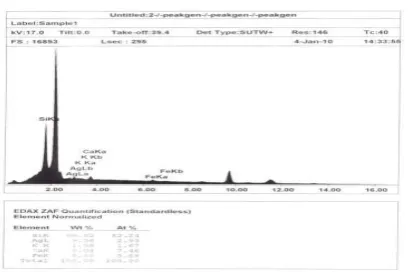
Tile structure: Determination of the percentage of elements in Sheikh Safi tombstone tile body composition by SEM analysis system. The results of the peak obtained from this system show that the tile biscuit elements have the highest percentage of their presence, including, silicon oxide 79.17 percent had the highest amount, silver oxide with 6.87 percent, calcium oxide with 5.39 percent, iron oxide with 7.38 percent, and potassium oxide with 1.19 percent lowest.
Analysis of glaze by SEM method: silicon oxide 69.82, silver oxide 9.56, potassium oxide 1.98, calcium oxide 9.04, iron oxide 9.60%. Identification of the composition and formation of porosity in the sample was one of the other materials of the study, which was carried out using the SAM system. This system identifies porosity dimensions from other experiments, such as volumetric measurements. The results of this study are shown in microscopic images taken from the sample with different magnifications. According to these studies, the size of the pores and pores in the sample was measured in several sections and with different dimensions, which on average indicates diameter: 7.83 /62.5 / 2.15 and 4.66 Micro-mm.
Figure 21 - Tile Body Building Compounds by SEM Analysis System
Figure 22- Smoothing percentage analysis (SEM)
Sample green tile
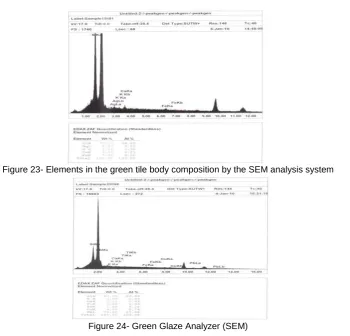
Tile structure: Identify the percentage of elements in the Sheikh Safi tombstone tile body composition by the SEM analysis system: The results of the peak obtained from this system indicate that the tile biscuit elements have the highest percentage of their presence, including silicon oxide With 57.61% the highest amount, calcium oxide with 4.05%, iron oxide with 6.63%, silver oxide with 3.50%, lead oxide with 25.18% titanium oxide with 2.43%, and potassium oxide with the lowest content of 0.59%.
24
Figure 23- Elements in the green tile body composition by the SEM analysis system
Figure 24- Green Glaze Analyzer (SEM)
Based on the obtained images, it was found that the blue sample is of a single fabric texture, without cracks or fine cracks, which suggests the strength and good structure of the tiles of the Sheikh Safi monument tile. Green tile specimens do not have an integrated structure and glaze structure is cracked.
Structural and laboratory studies of glaze tiles
Laboratory studies on the glazed tiles of Sheikh Safi-edin monastery complex were carried out in two ways: - Visual observations by Optical microscopy
Elemental analysis and structural analysis of glaze by electron microscope system
In the specimen, the surface of the sample was examined using stereomicroscope. In this study, the surface porosity of the sample was observed and recorded in air bubbles, gliding, and imperfections.
The microscope system made it possible to sample the sample in terms of drawbacks such as bubbles, their size, color variations in glazes, especially in green and blue glazes, and the quantitative changes of the elements and glaze ingredients. The results of measuring the waterproofing of the glaze by the device showed that the average thickness of the glaze layer in tile tiles is 350 μm and the thickness of the green layer is 262 μm.
The results of the qualitative analysis of mosaic tiles in Sheikh Safi monument set by electronic microscopy system show the presence of lead in samples. Due to this identification, it is concluded that the glazes of these tiles are lead-based glazes. Lead glues are obtained at low to moderate temperatures (1095 to 1190 degrees). The advantages of easy-to-follow lead glazings are easy to control, high-quality color and high quality. The lead glaze is soft, but adds silica and other oxides to beautiful enamels.
25
Figure 25- Silica dispersion in the water tile body
Figure 26- The presence of the crystalline structure of salts under the glaze
Figure 27- Glazing under the influence of dandruff
Figure 28- Silica dispersion in the body
26 the contract, a large part of the existing tiles was rebuilt, which was the result of the disagreement with the Technical Office of the Cultural Heritage Institute on the location of the studied tiles, but this part remained intact and almost It can be claimed that this section is the only surviving sample And reconstitution of the 20s. (It should be noted that during the same years, based on the complete repositioning method and the overall reconstruction of the surfaces where parts of its tiles were destroyed, the very large surfaces of the tiles that were necessary and easy to repair were eliminated, resulting in New layers have been replaced by them, but there are errors in some of the designs, especially in the inscriptions.) In recent years, unlike years and decades ago, much of the effort was on conservation and restoration rather than reconstruction. So, in the last few years, it's just. Only tiles have been restored.
What the organization policy is about decorative tile works, especially architectural decoration, has been the advancement of a protective system and, as far as possible, avoiding the rebuilding of the century's recommendation. Therefore, considering all the cases regarding the tile works of Sheikh Safi's tomb collection, including the place in question, it is strongly recommended to continue the process of reflection. With the study, at least 55-60% of existing tiles can be used and the remaining parts are filled in with new tiles or gijks, and finally, by creating a pattern on them and using the color of watercolor, and In the end, in order to avoid moisture penetration, a critical factor in the tiling freezing process is to be coated with hydrophobic resins.
Another point to be made about the above location is the attention to the used mortar behind the work. Considering the physical conditions of the site and considering the high probability of moisture penetration from the back of the work, during the permanent inspection of the insulator behind the work and ensuring its strength (in 2004, the insulation was completed, but it is necessary every six months The location is accurate and should be rectified as soon as possible in case of any damage). It is necessary to review the used mortar. In this regard, we propose:
Using traditional gypsum mortar, add as much as 7 to 5% volumetric gypsum to the composition, white cured whitened to achieve a relatively stable and stable mix mortar which, while being insulated against moisture penetration In the case of moisture absorption, there is no evidence of an increase in volumes that are usually present in gypsum mortar in such cases, which will cause the tiles to be tiled and get out of the surface.
In the case of metal sheet metal, to prevent the possibility of rusting metal (metal), resulting in increased volume and slippage at the tile surfaces, also due to the necessity of using the board and the lack of suitable replacement for it. Before installing the work piece (metal) in the areas used, it should be done to insulate them. For this purpose, it is recommended that the sheets be treated with a fine, accurate, accurate, and so on, and then their surface is removed from any additions. Finally, they should be added to the surface with the precision of all stainless steel. After drying and ensuring their insulation, install them in the desired area.
In the case of tiled tiles, it is sometimes seen that parts of the tiles, especially the edges of them, have been lost. If the new tile is not possible, these tiles, if left intact, will be a good place to penetrate the moisture to the back. Therefore, it is suggested in the first step that the use of such tiles can be avoided as much as possible, but if necessary, re-use these tiles should be done at the end of the work, in comparison with the insulation of the edges. For this, the use of para-white B72 or similar polymer compounds is recommended.
CONCLUSION
27 type of glazing and body of tiles used in Sheikh Safiuddin Ardebili's Tomb is almost identical with the tiles of its period in terms of materials and tiles. And no big difference was seen. The common theme of Sheikh Safi's tombstones is technically high in silica compounds in their bodies. The tiles are not of an integrated structure and the glazing structure has cracks. The results of the qualitative analysis of mosaic tiles in Sheikh Safi monument set by electronic microscopy system show the presence of lead in samples. According to this identification, it is deduced that the glazes of these tiles are lead enamels. The presence of the silver element in the glaze: probably this test error is due to the error of the SEM device of the Tarbiat Modarres University. Hence, further testing is needed to reject or prove this.
REFERENCES
Abdolhossein, Spanta, Tile in Past and Present, Vahid Monthly, No. 2. Dibaj, Ismail, Guide to the Historical Works of Ardabil, Tabriz, Baki, 1343.
Gholamreza Yazdani, Study on the mural painting of the tomb of Sheikh Safiuddin Ardebili, Thesis of Azad University of Tehran Central Branch, 2003.
Golmaghanizadeh Eslami, Queen and Yousefi Hassan, 2005, Archeology and History of the Art of the Martyrdom of Sheikh Safiuddin Ardebili, Nicamac Publishing - Ardebil.
Hadayn Dehkordi, Manijeh 1392, Uses for laboratory research in the conservation and restoration of monuments (materials and materials), publications and publications of Tehran University.
Harold.J. Plenerillite VIA Werner, 1389, Preservation and Maintenance of Art and Historic Works, Treatment, Restoration, Art University Press, translation of Rasoul Vatan Doust.
Ibn Bazaz Ardebili, Safavah al-Safa, Correction of Gholamreza Tabatabai Majd, Tabriz, edited by editors, 1994. Jandamir, Ghiyath al-Din bin Hammuddin al-Hussein The history of Shah Isma'il and Shah Tahmasb Safavi:
Under the History of Habib al-Sair, Correction and Extermination, Mohammad Ali Jarrahi, Tehran, Nasr Gostareh, First Printing, 1370.
Kiani, Mohammad Yousef, 1362, Introduction to the Iranian Tile Art, Reza Abbasi Museum Publications.
M Oh you . Weaver, Preliminary Study on Protective Issues of Five Historical Buildings of Iran, translation of Karmatallah Afsar.
Pope, Arthur, Iranian Architecture, 2009, Translating Gholam Hossein Sadri Afshar, Third Edition, Tehran, Samira Publishing
Porter, Venitia, - Islamic Tiles, 2010, Translation by Mahnaz Shayestefar, Second Edition, Tehran, Islamic Studies Studies Institute
Proceedings of the First Conference on the Protection and Restoration of Historical and Cultural Works, Fourth to Eighth March, 1996, Publisher: Art University and Research Institute for the Protection and Restoration of Takihi Books, First Edition.
Rezaei, Laboratory of SEM, Teacher Training.
Two letters of specialty, restoration of cultural objects and monuments, first year, number two, spring and summer 2011.