http://www.ijcmph.com pISSN 2394-6032 | eISSN 2394-6040
Original Research Article
Assessment of gadgets addiction and its impact on health
among undergraduates
Aravind K. Kumar, Mayur S. Sherkhane*
INTRODUCTION
Society has always been worrying about the term „Drug Addiction‟ of our youth but „Gadget Addiction‟ is a more critical area of concern in the present era and can be observed in today‟s scenario where the young generation‟s inclination towards the latest gadgets such as Smart Phones, Tablets, Laptops and other electronic gadgets is posing a threat to the social infrastructure in the future.1
Addiction is characterized by inability to consistently abstain, impairment in behavioral control, craving,
diminished recognition of significant problems with one‟s behaviours and interpersonal relationships, and a dysfunctional emotional response.2 Addiction refers to irrepressible urge which is often accompanied by loss of control. Research on impact of Internet addiction on young adults is in an early stage of development.3
The term “gadget” refers to the portable electronic devices. Gadget usage has both pros and cons. Continuous use of gadget leads to many reported health problems like eye straining, finger pain, backache, neck pain and sleep disturbances. Depending on the amount of time spent on gadget (duration and frequency), there are
ABSTRACT
Background: Technology has made our youth the most vulnerable group among today‟s population, because of their accessibility and addiction to newer gadgets, which are cheap and easily available. Society has always been worrying about the term „Drug Addiction‟ of our youth but „Gadget Addiction‟ is a more critical area of concern in the present era and is a threat to the social infrastructure in the future. Addiction is an irrepressible urge which is accompanied by loss of control leading to lower emotional intelligence indirectly deteriorating the academic and professional performance as well as hampering their family life leading to life threatening problems in future.
Methods: Cross sectional study was done among 200 undergraduates using predesigned and pretested questionnaire. Gadget dependency was analysed using 5-point Likert-scale. Descriptive statistics and chi-square test was used for analysing the data collected.
Results: 71% belonged to 21-24 years age group. 73.5% were males and 43.5% belonged to class I socio-economic status and 70% had normal BMI. 72.5% of subjects had first gadget at 16-20 years and 90.5% were using smart-phones as a common gadget, of them, 50.2% were using for more than 7 hours a day. 61% had difficulty in day to day work performance. Females were more prone compared to males (p=0.008).
Conclusions: High level of dependency was present with gadget addiction. Health action to be taken in form of counselling about the pros and cons in the early phase can prevent future complications.
Keywords: Dependency, Gadget, Smart-phones, Undergraduates
Department ofCommunity Medicine, SDM College of Medical Sciences and Hospital, Dharwad, Karnataka, India
Received: 04 June 2018
Revised: 09 July 2018
Accepted: 10 July 2018
*Correspondence:
Dr. Mayur S. Sherkhane, E-mail: [email protected]
Copyright: © the author(s), publisher and licensee Medip Academy. This is an open-access article distributed under the terms of the Creative Commons Attribution Non-Commercial License, which permits unrestricted non-commercial use, distribution, and reproduction in any medium, provided the original work is properly cited.
adverse effects like physiological, psychological, social and emotional.4
There is relationship between excessive internet use and loneliness, antisocial values and lower emotional intelligence and depression.5 Social network sites, online games, video-sharing sites and gadgets, such as iPods and smart-phone phones are now fixtures of youth culture
(UNICEF, 2011).6
The dependency of people on these technological gadgets and services provided by these has reached at such a level that, without these, they are unable to think a step forward in the direction of their growth. The degree of dependency is leading to addiction of the tech-devices and services. Youth (15-24 years) is the most vulnerable group among the population to be addicted to technology.7 India‟s youth population is 231 million and so provides a large market for gadget companies.8
The main concerns are about emissions of radio frequency (RF) radiation from smart-phone phones and base stations that receive and transmit signals. There are two direct ways by which health could be affected as a result of exposure to RF radiation: thermal (heating) effects caused mainly by holding smart-phone phones close to the body, and possibly non-thermal.9 Extensive usage of gadgets especially smart-phones has an effect on
human‟s upper extremities, back and neck.10
Studies in this area show a significant association between the total times spent using smart-phone device each day and relative health problems. Using internet through gadget has always been favourably regarded as informative, convenient, resourceful and capable of producing economical as well as social benefits. However, criticisms encircling its negative effects are rapidly arising. Evidences from studies conducted revealed that excessive and unmanageable use of the Internet is associated with social, psychological and
occupational impairment.11 The present study was done to
assess gadget addiction among the undergraduates and its impact on their health.
METHODS
A cross sectional study was conducted among individuals who had passed 12th standard in the age group of 18-28 years and presently pursuing graduation and residing in urban area of Dharwad city, which is the field practice area of department of community medicine, attached to a tertiary care hospital.
Individuals more than 18 years and less than 28 years and exposed or using any one type of gadget. Individuals residing in the study area for more than one year and willing to participate on voluntary basis after giving a written informed consent will be included in the study. Individuals who don‟t compile with the inclusion criteria will be excluded.
The study was conducted from June 2017 to August 2017 for a period of three months. Prior to data collection the purpose of the study was explained and written consent was taken from all the study participants on voluntary basis. Predesigned and pretested questionnaire was used to collect socio-demographic profile, BMI and data regarding gadget usage.
To analyze gadget dependency 5-point Likert-scale was used, where 5 refer to strongly agree and 1 refers to strongly disagree. The score in this 5-points scale varied from 10 to 50. The score between 34-50 is regarded as high dependency, 17-33 moderate and 10-16 low dependency.
Data collected was entered in Microsoft excel software and analyzed using SPSS v22. Descriptive statistics like frequencies, percentages, mean and standard deviation were calculated. Chi square test was applied. P value less than 0.05 was considered statistically significant.
RESULTS
A total of 200 study participants were interviewed and data was collected. The study population comprised 147 (73.5%) males and 53 (26.5%) females, their age ranged from 18-28 years (mean 21.44±2.02 years).
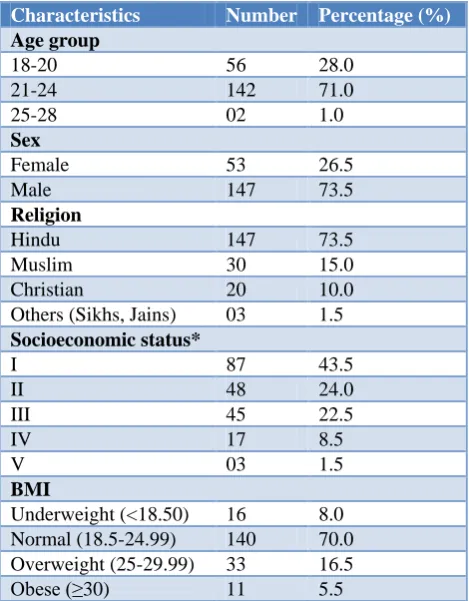
Table 1: Socio-demographic characteristics of the study participants (n=200).
Characteristics Number Percentage (%)
Age group
18-20 56 28.0
21-24 142 71.0
25-28 02 1.0
Sex
Female 53 26.5
Male 147 73.5
Religion
Hindu 147 73.5
Muslim 30 15.0
Christian 20 10.0
Others (Sikhs, Jains) 03 1.5
Socioeconomic status*
I 87 43.5
II 48 24.0
III 45 22.5
IV 17 8.5
V 03 1.5
BMI
Underweight (<18.50) 16 8.0
Normal (18.5-24.99) 140 70.0
Overweight (25-29.99) 33 16.5
Obese (≥30) 11 5.5
Table 1 shows the socio-demographic characteristics of the study participants. The mean age was 21.44±2.02 years. Out of 200 study participants, majority 73.5% were males, 43.5% belonged to class I socioeconomic status. Majority 70% of study participants had normal BMI, followed by 16.5% overweight and 5.5% obese.
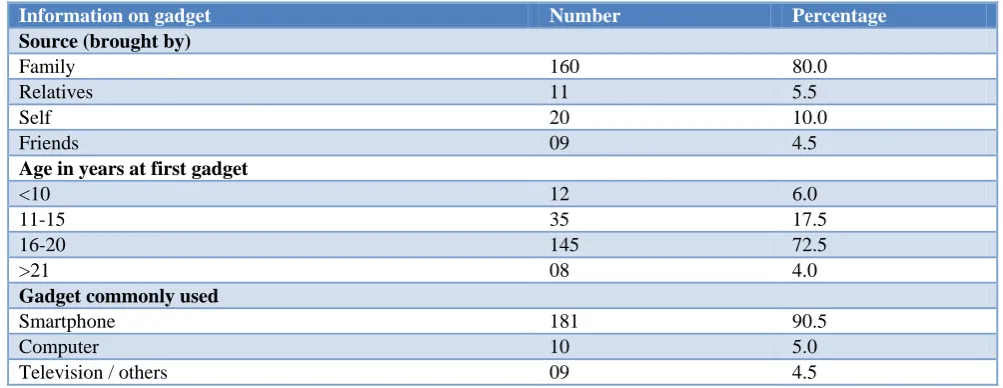
Table 2 shows information of gadget used by study participants. Majority 80% had received their first gadget as a gift from family members, 72.5% got their first gadget at age 16-20 years. Most commonly used gadget was found to be smart phones, with 90.5% of study participants using it.
Table 3 describes the purpose of using each gadget against duration. Use of gadgets for more than 7 hours
was regarded as addictive use in the present study. Out of 90.5% study subjects it was found that majority 50.2% were using smart-phones for more than 7 hours a day. It was also found that majority 42.5% of study participants used gadgets for social networking, 14% for work and 13.5% for entertainment for more than 7 hours a day.
Table 4 shows the dependency ratio categorized into low, moderate and high. Majority 55% were moderately dependent and 45% were high dependent on gadgets. The table also depicts the factors affecting dependency ratio in which gender was found to be significantly associated with gadget dependency (χ2=6.889, df=1, p=0.008). Factors like age, SES and BMI were not found to be significantly associated with gadget dependency.
Table 2: Information of gadget used by study participants (n=200).
Information on gadget Number Percentage
Source (brought by)
Family 160 80.0
Relatives 11 5.5
Self 20 10.0
Friends 09 4.5
Age in years at first gadget
<10 12 6.0
11-15 35 17.5
16-20 145 72.5
>21 08 4.0
Gadget commonly used
Smartphone 181 90.5
Computer 10 5.0
Television / others 09 4.5
Table 3: Number of hours spent and purpose of individual gadgets.* Gadgets (n=200)
Time (hours) Smartphone Computer Television/others No. (n=181) % No. (n=10) % No. (n=9) %
1-2 25 13.8 0 0 1 11.1
3-4 21 11.7 2 20.0 4 44.4
5-6 44 24.3 5 50.0 1 11.1
>7 91 50.2 3 30.0 3 33.4
Purpose and duration *
Time (hours) Social network Work Entertainment
No. % No. % No. %
1-2 45 22.5 78 39.0 87 43.5
3-4 33 16.5 30 15.0 46 23.0
5-6 37 18.5 25 12.5 40 20.0
>7 85 42.5 28 14.0 27 13.5
* multiple responses.
Majority 61% of study participants had difficulty in day to day work performance, 57.5% vision, 43% breathing,
Table 4: Comparison of demographic characteristics in relation to dependency ratio (n=200). Dependency ratio (5-Point likert-scale)
Dependency status Score Number Percentage (%)
Low 10-16 00 0.0
Moderate 17-33 110 55.0
High 34-50 90 45.0
Variables Moderate High Total χ2 df P
No. % No. % No. % Age
18-20 36 64.3 20 35.7 56 28.0
4.873 2 0.087
21-24 74 52.1 68 47.9 142 71.0
25-28 00 0.0 02 1.0 02 1.0
Sex
Female 21 39.7 32 60.3 53 26.5
6.889 1 0.008
Male 89 60.5 58 39.5 147 73.5
SES
I 48 55.2 39 44.8 87 43.5
2.915 3 0.404
II 24 50.0 24 50.0 48 24.5
III 29 64.5 16 35.5 45 22.5
IV+V 09 53.0 11 48.0 20 10.0
BMI
Underweight 07 44.0 9 56.0 16 8.0
4.176 3 0.243
Normal 77 55.0 63 45.0 140 70.0
Overweight 22 67.0 11 33.0 33 16.5
Obese 04 36.0 07 64.0 11 5.5
DISCUSSION
The present study was aimed to find out the magnitude of gadget dependency among the undergraduate students.
In our study prevalence of high dependency was found to be 45%, which was more when compared to a study done in Delhi12 where the prevalence was 22% and a study done in Changsha, China13 the prevalence was found to be 21.3%. The difference in findings could be because of conduct of latter studies among the undergraduates of different disciplines of different universities and the former urban based study was conducted at a community level, where the real picture of gadget addiction has been retrieved.
In our study majority 90.5% of the study participants were found to be using smart-phones, among them 57.5% had problems related to vision, 39% hearing problems and 20% had reduced physical activity. This was similar to a study done in Karachi, where 88.5% owned smart-phones, among whom 71% reported problems with concentration on day to day activities, 36.5% hearing problems and 7% had problems related to vision.14 This shows that usage of gadgets have common effects over the health.
Our study also found that majority 61% had difficulty in day to day work performance, 12% disturbed sleep and 10.5% concentrating or thinking problems. It was in
consistence with a study done in Sweden, where frequent smart-phone phone use was associated with sleep disturbances and symptoms of depression were experienced by both men and women.15 This shows that lack of rest to the body leads to exhaustion and directly decreases the quality of performing activities.
CONCLUSION
Dependency with gadgets was high, which was at 45% among study subjects and majority were in age group of 21-24 years and most of them belonged to class I socioeconomic status. Preventive measures are needed to be streamlined to tackle the growing issue of gadget addiction. To reduce this problem of future, health education sessions should be implemented and given to all school going children and adolescents regarding pros and cons of gadget usage and its health effects. This may be imparted in form of lectures, health talks and if required counseling sessions at an individual level. Implementing preventive interventions at early age of life not only reduces the problems but also will increase the awareness about usage of gadgets in a better educational and purposeful way.
ACKNOWLEDGEMENTS
Funding: No funding sources Conflict of interest: None declared Ethical approval: Not required
REFERENCES
1. Singh T, Kumar A, Liu Y, Theog JNV. Personal
Electronic Gadgets: A Comprehensive Study on their Addiction and Sustainable Usage. Int J Electronics Communication Tech. 2015;6(1):14.
2. Definition of addiction. Available at:
https://www.asam.org/resources/definition-of-addiction. Accessed on 5 October 2016.
3. Alam SS, Hashim NM, Ahmad M, Wel CNC, Nor
SM, Omar NA. Negative and positive impact of internet addiction on young adults: Empericial study in Malaysia. Intangible Capital. 2016;10(3):619-38.
4. Lee D. FCJ-03 Women‟s creation of camera phone
culture. The Fibre culture J. 2005.
5. Esen BK, Gündogdu M. The Relationship between
Internet Addiction, peer pressure and perceived social support among adolescents. Int J Educational Res. 2010;2(1):29-36.
6. Simuforosa M. The impact of modern technology on
the educational attainment of adolescents. Int J Edu Res. 2013;1(9):1-8.
7. Mamatha SL, Hanakeri PA, Aminabhavi VA.
Impact of gadgets on emotional maturity, reasoning ability of college students. Int J Applied Res. 2016;2(3):749-55.
8. Census of India: Population Enumeration Data
(Final Population). Censusindia.gov.in. 2018.
Available at: http://censusindia.gov.in/2011census/ population_enumeration.aspx/. Accessed 9 July 2018.
9. Meo SA, Al-Drees AM. Smart-phone phone
related-hazards and subjective hearing and vision symptoms in the Saudi population. Int J Occup Med Environ Health. 2005;18(1):53-7.
10. Miakotko L. The impact of smartphones and
smart-phone devices on human health and life. Available
at: http://www.nyu.edu/classes/keefer/waoe/
miakotkol.pdf .Accessed on 9 July 2018.
11. Yeap J, Ramayah T, Kurnia S, Halim HA, Ahmad
NH. The assessment of Internet addiction among university students: some findings from a focus group. Tehnicki vjesnik - Technical Gazette. 2015;22(1):105-11.
12. Gupta N, Krishnamurthy V, Majhi J, Gupta S.
Gadget Dependency among Medical College Students in Delhi. Indian J Comm Health. 2013;25(4):362-6.
13. Long J, Liu T-Q., Liao Y-H., Qi C, He H-Y, Chen S-B, et al. Prevalence and correlates of problematic smartphone use in a large random sample of
Chinese undergraduates. BMC Psychiatry.
2016:16:408.
14. Sarfaraz S, Bano T, Fatima W, Ramzan S, Sabir A,
Irfan S. Smart-Phone Phones: A Threat To Health Of Young Generation? EJPMR. 2015;2(7):17-22.
15. Thomée S, Härenstam A, Hagberg M. Mobile phone
use and stress, sleep disturbances, and symptoms of depression among young adults--a prospective cohort study. BMC Public Health. 2011;11:66.