Volume: 01, Issue: 06, Pages:347-352 (2010)
Robust Image Transmission over Noisy Channel
Using Independent Component Analysis
Deepak. N. A
Department of Computer Science, Ghousia College of Engineering, Ramanagaram-571511 Email: [email protected]
Rajesh Shukla
Vice Principal, Corporate Institute of Technology, Bhopal Email: [email protected]
Puttegowda. D
Department of Computer Science, Ghousia College of Engineering, Ramanagaram-571511 Email: [email protected]
---ABSTRACT---
Independent Component Analysis (ICA) is the decomposition technique of a random vector of data into linear components which are “independent as possible.” Involves finding a suitable representation of multivariate data for computational and conceptual simplicity, the representation is often sought as a linear transformation of the original data. The linear transformation methods include Principal Component Analysis (PCA), Factor Analysis, and Projection Pursuit. Here attempt to transmit similar dimension multiple images as a single linear transformed image using Independent Component Analysis (ICA), Gaussian noise is added into linearly transformed image. We try to retrieve the original images one by one from noisy transformed image. The analysis is made by varying noise variance against peak signal to noise ratio (PSNR) with the original image. Our demonstrated work is highly useful in reducing bandwidth over the channel.
Keywords: Gaussian Noise, Independent Component Analysis (ICA), Principal Component Analysis (PCA), Peak Signal to Noise Ration (PSNR), Random Vector.
--- Date of Submission: 31, March 2010 Date of Acceptance: 14, May 2010
---1. INTRODUCTION
T
he independent component analysis (ICA) model is a generative model which means that it describes how the observed data are generated by a process of mixing the components. The independent components are latent variables meaning that they cannot be directly observed. Also the mixing matrix is assumed to be unknown. All we observe is the random vector [X], and we must estimate both [A] and [S] using it. The components [si] of the sourceshould be statisticallyindependent and must have Non-Gaussian distributions. The mixing matrix is square then after estimating the matrix [A] we can compute its inverse [W].
X = As (1)
Source Signal Observed Mixtures Estimation of (S) A W
Mixing Process Separating Process
Fig1: Blind Source Separation Models
Independent Component Analysis is the de-composition of a random vector in linear components which are “as independent as possible.”[1] This emerging technique
appears as a powerful generic tool for data analysis and the processing of multi-sensor data recordings. In ICA, “independence” should be understood in its strong statistical sense it is not reduced to de-correlation because for the purpose of ICA [2], second order statistics fail to capture important features of a data set as shown by the fact that there are infinitely many linear transforms which de-correlate the entries of a random vector. In ICA, the measure of choice for statistical independence is the “mutual information,” Its use as an objective function for ICA and this choice is strongly supported by the fact that it corresponds to the likelihood criterion when a model of independent components is optimized with respect to all its parameters the linear transform of interest and the distributions of the underlying components.
2. Motivation
Assume two people are speaking simultaneously in two different microphones, which you hold in different locations. The microphones give you two recorded time signals which we could denote by x1(t) and x2(t), with [x1] and [x2] the
amplitudes, and [t] the time index. Each of these recorded signals is a weighted sum of the speech signals emitted by the two speakers which we denote by s1 (t) and s2 (t).
X1(t) = a11s1 + a12s2 (2)
X2(t) = a21s1 + a22s2 (3)
Volume: 01, Issue: 06, Pages:347-352 (2010)
Where [a11, a12, a21, and a22] are parameters that depend on
the distances of the microphones from the speakers. It would be very useful if you could now estimate the two original speech signals s1 (t) and s2 (t) using only the recorded signals x1 (t) and x2 (t) [2]. This is called the cocktail-party problem.
Actually, if we knew the parameters (aij) we could solve the
above linear equation by classical methods. The point is however that if you don't know the (aij) the problem is
considerably more difficult. One approach to solving this problem would be to use some information on the statistical properties of the signals si(t) to estimate the [aii] Actually,
and perhaps surprisingly it turns out that it is enough to assume that s1 (t) and s2 (t) at each time instant t, are
statistically independent [3]. This is not an unrealistic
assumption in many cases and it need not be exactly true in practice. The recently developed technique of Independent Component Analysis, or ICA, can be used to estimate the [ai.j] based on the information of their independence which
allows us to separate the two original source signals s1(t) and s2(t) from their mixtures x1(t) and x2(t).
3. Definitions of linear Independent Component Analysis The problem of independent components analysis, or ICA considered here is the linear case .Though non-linear forms of ICA also exist. In the literature, at least three different basic definitions for linear ICA can be found though the differences between the definitions are usually not emphasized. This is probably due to the fact that ICA is such a new research topic most research has concentrated on the simplest one of these definitions. In the definitions, the observed m-dimensional random vector is denoted by x = (x1,……, xm).
4. Scope
The scope of the work involves understanding of .BMP or .JPEG files and header formats and implementing the concept of linearly transformed image (single image from the set of images) and calculating Mean square error, Peak signal to noise Ratio and Transmission protocols, PCA & ICA this also specifies how to retrieving the source (original) images from an linearly transformed image. This requires good programming skills in MATLAB including importing and exporting of data from MATLAB to database.
5. Definitions of ICA
5.1. General Definition of ICA
ICA of the random vector (x) consists of finding a linear transform S = Wx so that the components [Si] are as
independent as possible in the sense of maximizing some function F(s1,….., sm) that measures independence[2,6,7].
5.2. Noisy ICA model
ICA of a random vector [x] consists of estimating the following generative model for the data
X = As + N (4)
Where the latent variables (components) [Si] in the vector
s = (s1,….,sn) are assumed independent. The matrix A is a
constant MXN 'mixing' matrix, and [n] is an m-dimensional random noise vector.
5.3. Noise-Free ICA model
ICA of a random vector (x) consists of estimating the following generative model for the data
X = As (5)
Where the latent variables (components) [Si] in the vector s
= (s1,….,sn) are assumed independent. The matrix A is a
constant MXN ‘mixing’ matrix, Here the noise vector has been omitted.
6. Application of ICA
6.1 Blind Source Separation
Recently, blind source separation by Independent Component Analysis (ICA) [11] has received attention because of its potential applications in signal processing such as in speech recognition systems, telecommunications and medical signal processing. The goal of ICA is to recover independent sources given only sensor observations that are unknown linear mixtures of the unobserved independent source signals. In contrast to correlation-based transformations such as Principal Component Analysis (PCA), ICA not only de-correlates the signals (2nd-order statistics) but also reduces higher-order statistical dependencies attempting to make the signals as independent as possible. Many algorithms have been proposed from different approaches The Maximum Likelihood Estimation Negentropy Maximization Approach & Nonlinear PCA Algorithm [8, 11].
Fig 2: An illustration of blind source separation. Four source signals are Independent components.
Volume: 01, Issue: 06, Pages:347-352 (2010)
Fig 4: shows the estimates of the source signals.
6.2 ICA for Text Mining
Independent component analysis (ICA) was originally developed for signal processing applications. Recently it has been found out that ICA is a powerful tool for analyzing text document data as well, if the text documents are presented in a suitable numerical form. This opens up new possibilities for automatic analysis of large textual data bases finding the topics of documents and grouping them accordingly. First approaches of using ICA in the context of text data considered the data static. The dynamical text stream can be seen as a time series, and methods of time series processing may be used to extract the underlying characteristics of the data. As a preprocessing step the text stream is split into short windows, and from each window a T-dimensional vector is formed where T is the size of the vocabulary; T is typically several thousands of terms. The ith element of the
vector indicates the frequency of the ith vocabulary term
in the window. The high dimensionality of the data is reduced by singular value decomposition as is often done before applying ICA-type algorithms on the data.
7. Objectives
7.1 Contrast Functions for ICA
The estimation of the data model of independent component analysis is usually performed by formulating an objective function and then minimizing or maximizing it. Often such a function is called a contrast function also the terms loss function or cost function are used. We shall here use the term contrast function rather loosely meaning any function whose optimization enables the estimation of the independent components.
ICA method = Objective function + Optimization algorithm.
In the case of explicitly formulated objective functions one can use any of the classical methods of optimization for optimizing the objective function like (stochastic) gradient methods Newton-like methods, etc. In some cases however the algorithm and the estimation principle may be difficult to separate. The properties of the ICA method depend on both of the elements on the right-hand side of the above equation.
The Statistical properties (e.g., consistency, asymptotic variance, robustness) of the ICA method depend on the choice of the objective function.
The Algorithmic properties (e.g., convergence speed, memory requirements, and numerical stability) depend on the optimization algorithm.
8. Steps Involved in ICA
8.1 Preprocessing for ICA
Preprocessing steps of independent component analysis mainly involves
1. Centering 2. Whitening
8.1.1 Centering
The most basic and necessary preprocessing is to center [x] i.e. subtract its mean vector M = E{X} so as to make [x] a zero-mean variable. This preprocessing is made solely to simplify the ICA algorithms it does not mean that the mean could not be estimated. After estimating the mixing matrix [A] with centered data we can complete the estimation by adding the mean vector of [S] back to the centered estimates of [S].
8.1.2 Whitening
Another useful preprocessing strategy in ICA is to first whiten the observed variables. This means that before the application of the ICA algorithm (and after centering), we transform the observed vector linearly so that we obtain a
new vector which is white, i.e. its components are uncorrelated and their variances equal unity. The covariance matrix of equals the identity matrix. Some ICA algorithms require a preliminary sphering or whitening of the data , and even those algorithms that do not necessarily need sphering, often converge better with sphered data. Sphering means that the observed variable is linearly transformed to a variable [v].
V=Qx (6)
such that the covariance matrix of equals unity {VVT
} = I In addition to sphering, PCA may allow us to determine the number of independent components (if m>n) if noise level is
low, the energy of is essentially concentrated on the subspace spanned by the (n)first principal components.
9. Analyzing ICA Components by Injecting Noise In order to apply unsupervised learning algorithms to real world problems it is of fundamental importance to determine how trustworthy their results are. Boot strap re-sampling method that estimates the reliability and grouping of independent components found by algorithms for independent component However, it is not straightforward for all existing ICA algorithms how to define a re-sampling strategy that preserves the statistical structure relevant to the considered ICA algorithm.
Volume: 01, Issue: 06, Pages:347-352 (2010)
X(t) = [ X1(t),….,Xn(t)]
T
(7)
As a linear combination
X (t) = As (t) (8)
Of statistically independent source signals S (t) = [S1 (t),……….,Sn(t)] T (9)
An algorithm for ICA estimates a mixing matrix [A] only from the observed signal x (t). Therefore, the true sources or equivalently the columns of the mixing matrix [A] can be estimated at best up to permutation and scaling. Real-world signals are usually given as a multivariate time series x (t) comprising of N components each of length T, which we represent as an N X T matrix.
X = [X (1),……,X(t)] (10)
We assume that all signals have mean zero. The ICA algorithm tries to estimate from this matrix [X] the mixing matrix [A] and therewith the de-mixing matrix W = A-1 such
that the de-mixed signals, i.e. the rows of the matrix
Y=WX (11)
10. Noise Generator
This generates noise with the given mean & variance. The mean & variance values can be either scalar or vector when the variance is vector its length must be same as the vector in this case the co-variance matrix whose diagonal elements come from the variance vector.
J = imnoise (I, type) adds noise of type to the intensity image [I]. Type is a string that can have one of these values.
11. Peak Signal-to-Noise Ratio
11.1 Description of PSNR
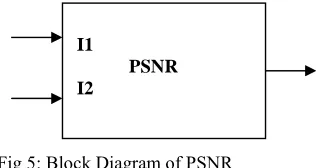
The PSNR block computes the peak signal-to-noise ratio in decibels between two images. This ratio is often used as a quality measurement between the original and a compressed image. The higher the PSNR the better the quality of the compressed image.
Fig 5: Block Diagram of PSNR
To compute the PSNR the block first calculates the mean-squared error using the following equation
(12)
In the above equation, M and N are the number of rows and columns in the input images respectively. Then the block computes the PSNR using the following equation.
(13)
In the above equation, R is the maximum fluctuation in the input image data type. For example, if the input image has a double-precision floating-point data type, then R is 1. If it has an 8-bit unsigned integer data type R is 255.
12. Testing & Results
Original Image Original Image
Original Image Original Image
Original Image
Fig 6: Original Images
Linearly Transformed Image 0.01 Gaussian Noise
Fig 7: Linearly Transformed Image & Noise Added Linearly Transformed Image
1
R
e
tr
ie
v
e
d
Im
a
g
e
2
R
e
tr
ie
v
e
d
Im
a
g
e
I1
Volume: 01, Issue: 06, Pages:347-352 (2010) 3 R e tr ie v e d Im a g e 4 R e tr ie ve d Im a g e 5 R e tr ie v e d Im a g e
Fig 8: Retrieved Images form Noise added linearly transformed Image
Peak Signal to Noise Ratio
000.0050.01 0.0150.020.0250.03 0.0350.040.0450.05 5 10 15 20 25
200.0050.010.0150.020.0250.030.0350. 040.0450.05 4 6 8 10 12 14 16 18
400.0050.010.0150.020.0250.030.0350.040.0450.05 6 8 10 12 14 16 18
Noise ⌐2 Noise ⌐2
0 0.0050.010.0150.020.0250.030.0350.040.0450.05 0 5 10 15 20 25
Noise ⌐2
13. CONCLUSION
The independent component analysis or ICA model is a generative model which means that it describes how the observed data are generated by a process of mixing the components. The independent components are latent variables, meaning that they cannot be directly observed. Also the mixing matrix is assumed to be unknown. All we observe is the random vector [X], and we must estimate both [A] and [S] using it. The starting point for ICA is the very simple assumption that the components [si] are statistically
independent and must also assume that the independent component must have non-Gaussian distributions. However,
in the basic model we do not assume these distributions known for simplicity, we are also assuming that the unknown mixing matrix is square then after estimating the matrix [A], we can compute its inverse [W]. ICA is a very general-purpose statistical technique in which observed random data are linearly transformed into components that are maximally independent from each other and simultaneously have ``interesting'' distributions ICA can be formulated as the estimation of a latent variable model.
The PSNR block computes the peak signal-to-noise ratio, in decibels between two images this ratio is often used as a quantity measurement between the original image and the compressed image. The higher the PSNR the better the quality of the compressed image. Hence we can observe that increase in the noise will reduce the peak signal to noise ratio (PSNR).
ACKNOWLEDGEMENT
I would like to thank Professor V K Ananthashayana HOD Department of Computer Science MSRIT, Bangalore, for the initial project proposal and accepting to supervise my project. He helped in a broad range of issues from giving me direction, helping to find solutions to problems, outlining requirements and always having the time to help me.
REFERENCES
[1] Dr. V.K Ananthashayana, “ Face Detection using Independent Component Analysis with DCT faces “ Department of Computer Science and Engineering MSRIT, Bangalore -54, International conference on IT, Nepal -2003.
[2] Aapo Hyvarinen “Survey of Independent Component Analysis “Helsinki University of Technology, Finland. [3] Patrik O. Hoyer , Aapo Hyvärinen “Independent Component Analysis Applied to Feature Extraction from Colour and Stereo Images “University of Helsinki.
[4] S. Amari, A. Cichocki, and H.H. Yang. “A new learning algorithm for blind source separation“In Advances
in Neural Information Processing 8, pages 757-763. MIT
Press, Cambridge, MA, 1996.
[5] A.J. Bell and T.J. Sejnowski. “An information-maximization approach to blind separation and blind de-convolution “ Neural Computation, 7:1129-1159, 1995.
[6] Aapo Hyvärinen and Erkki Oja “Independent Component Analysis: Algorithms and Applications” Neural Networks Research Centre Helsinki University of Technology, Finland
[7] A.J. Bell and T.J. Sejnowski. “The 'independent components' of natural scenes are edge filters.” Vision
Research, 37:3327-3338, 1997.
[8] J.-F Cardoso. “Infomax and maximum likelihood for source separation” IEEE Letters on Signal Processing,
4:112-114, 1997. 00.0050.01 0.0150.020.0250.030.0350.040.0450.05
2 4 6 8 10 12 14 16 18 20 P S N R P S N R P S N R P S N R P S N R
Volume: 01, Issue: 06, Pages:347-352 (2010)
[9] J.-F Cardoso. “Blind signal separation: statistical principles.” Proceedings of the IEEE, 9(10):2009-2025,
1998.
[10] J.-F. Cardoso and P. Comon. “Independent component analysis, a survey of some algebraic methods” in Proc.
ISCAS'96, volume 2, pages 93-96, 1996.
[11] A. Hyvärinen. “Independent component analysis in the presence of Gaussian noise by maximizing joint likelihood“
Neuro-computing, 22:49-67, 1998
[12] C. Jutten and J. Herault. “Blind separation of sources, part I: An adaptive algorithm based on neuromimetic architecture.” Signal Processing, 24:1-10, 1991
[13] T.-W. Lee, M. Girolami, and T. J. Sejnowski. “Independent component analysis using an extended infomax algorithm for mixed sub-Gaussian and super-Gaussian sources“ Neural Computation, pages 609-633,
1998.
[14] E. Moulines, J.-F. Cardoso, and E. Gassiat. “Maximum likelihood for blind separation and deconvolution of noisy signals using mixture models“ in Proc. IEEE Int. Conf. on
Acoustics, Speech and Signal Processing (ICASSP'97),
pages 3617-3620, Munich, Germany, 1997.
[15] D.-T. Pham, P. Garrat, and C. Jutten. “Separation of a mixture of independent sources through a maximum likelihood approach“ In Proc. EUSIPCO, pages 771-774,
1992.
Authors Biography
Deepak N. A, working as Assistant Professor in the department of computer science, Ghousia College of Engineering Karnataka, currently pursuing research work in Mysore University, and has nine years of teaching experience in the field of computer networks, operating systems, database management systems and image processing, and has published two national papers and one international paper in the field of image processing.
Rajesh K Shukla, working as a Vice Principal and Head of Department of Computer Science and Engg, Corporate Institute of Science and Technology, Bhopal MP, currently pursuing research work in Rajiv Gandhi Technological University, Bhopal and has thirteen years of teaching experience. He has authored three books for engineering students of CSE & IT and MCA. Apart from several papers in International and National Conferences he has also published eleven papers in International Journals. He has been awarded as “Outstanding academic achievement award 2009” by SERC.
Puttegowda D, M.Tech (CSE) working as Senior Lecturer in the Department of computer science, Ghousia College of Engineering, Ramanagarm, Karnataka, currently pursuing research work on Video Mining in NAL