Implementation of Mobility and QoS Aware
Energy Efficient Anycast Routing in MANET
Ms. Komal Badhe
Department of Computer Engineering, MIT Academy Of Engineering, Alandi (D), 412105 Email: [email protected]
Dr. Shitalkumar Jain
Department of Computer Engineering, MIT Academy Of Engineering, Alandi (D), 412105 Email: [email protected]
---ABSTRACT--- Mobile ad hoc network (MANET) is a self-configuring network. It is wireless as well as infrastructure-less networks. It requires limited energy and resources. In MANET, data travel through the host. Each mediator host acts as a router. Therefore, It is difficult to guess the future location or network topology of the host. Anycast routing is nothing but one to one of many associations. In anycast routing, multiple destinations share the same IP address. From multiple destinations, packet routed to the nearest destination. Anycast is the simplest way of communication. It has minimum communication overhead because packet forwarded to the nearest destination. Therefore, it saves power, network bandwidth and message collision during message transmission. Due to host movement and dynamic changes in network topology stability and QoS of nodes is an important issue in MANET. These issues are addressed by Mobility and QoS aware energy efficient routing protocol. Proposed protocol has three major models: (1) Consistency model to identify stable nodes in network, (2) Traffic model to take QoS into consideration by checking traffic in network and (3) Energy model to make sure the link duration is within an acceptable range. Therefore, high data delivery can be achieved and nodes energy will be taken into the consideration and reduce the link failure due to energy loss. PDR of EMQAR protocol is higher than existing MQAR protocol by 9%. Energy cosumption of EMQAR protocol is less than MQAR protocol by 2%. Dealy of EMQAR protocol is reduced by 1% than MQAR protocol. Control overhead of EMQAR protocol is 10% lesser than MQAR protocol.
Keywords –Anycast Routing, DSR, MANET, Mobility, QoS
--- --- Date of Submission: July 13, 2017 Date of Acceptance: July 24, 2017 --- ---
1.
INTRODUCTION
I
n recent years, there is a prominent increase in wireless services. The wireless network includes different categories of ad hoc networks i.e wireless ad hoc network, mobile ad hoc network, vehicular ad hoc network. Due to internet smartphones, laptops, palmtops these wireless devices become common. Ad hoc network creates networks which include only wireless devices. Mobile ad hoc network is one of the fast emerging network. As wireless technology in MANET, there is an absence of base structure. It requires limited energy as well as resources. It does not depend on any centralized control or third party. Devices in MANET performs the role of the end user as well as infrastructure. Each node in MANET is free to move independently in the network. It can leave or join network topology anytime. So MANET has dynamic behaviour. Nodes in MANET dynamically change their topology. Due to mobility devices may not able to receive a packet from other devices. Chances of path failure and path breakage are higher in MANET. But due to the wireless mobility of devices is higher which affects QoS of the network. QoS of the network is nothing but delay, jitter, bandwidth, buffer space. Therefore maintaining stability and QoS in MANET is a difficult task. There are different routing protocols in MANET. These protocols focus on this QoS and mobility related aspects. The maingoal of routing protocol is to increase throughput, energy efficiency, route life time and reduced delay. (D. Helen and D. Arivazhagan, 2014) These routing protocols are classified into two types:
Proactive Routing
Reactive Routing (Anupam B. and Sanjeev G., 2013)
Proactive Routing- It is a table driven routing protocol. If any changes in network topology then each node give intimation to all nodes in the network. Updation regarding changed topology is done in routing table periodically. Link state routing protocol, optimized link state routing protocol are examples of proactive routing protocol.
Reactive Routing- In reactive routing route establish is on demand. Therefore there is a lower overhead of table maintenance. It saves the cost of routing table maintenance. Dynamic source routing, on-demand distance vector routing are the examples
of reactive routing.
1.1 Characteristics of MANET
-Absence of infrastructure- In MANET there is absence of infrastructure.
-Independent terminal- Each node in MANET is independent.
-Lightweight nodes- Due to absence if infrastructure terminals in MANET are lightweight.
Advantages of MANET
-Absence of router- In MANET due to wireless nature there are the absence of any wireless router. Therefore it is cost effective.
-Fault avoidance- There any many routing protocols available in routing which avoid fault.
Costing- Lack of infrastructure which will be affected on the cost of the network. Therefore it is cost effective. Disadvantages of MANET
-Energy limitation- Due to the absence of infrastructure power of batteries are limited.
-Route Failure- Due to dynamic behaviour, chances of route
failure is higher.
-Bandwidth limitations- Bandwidth of MANET components is always lesser than wired components.
1.2 Anycast Routing
There are different types of routing i.e. anycast, multicast, broadcast, unicast. (Shivraj K. et al., 2016). Anycast routing is nothing but source select single destination node from the group of destination nodes. The single anycast address is given to a group of destination. From that group, destination will choose the only nearest destination. It is one individual to one individual of many associations. In proposed system, we used anycast routing approach because anycast chooses the nearest destination. Therefore it reduced network bandwidth, time requires to reaching the destination. Anycast routing therefore slightly increase network performance. Section 2 present review of literature, Section 3 present system overview. Rest of the paper presents mathematical and simulation process.
2.
REVIEW OF LITERATURE
Mobility and QoS aware anycast routing protocol (P.I. Basarkod and S.S. Manvi ., 2015) have been proposed for finding routing which is stable, non-congested. The author focuses on the QoS of a network. The main goal of proposed protocol is to improve QoS of the network. MQAR has three models for calculating the stability of node, to minimize congestion in a network and to improve QoS of the network. These models namely as stability model, congestion model, link expiration model. The author used anycast routing. Anycast routing saves network bandwidth and time. These models are based on anycast routing. MQAR is reactive protocol. Its performance is better in high mobility and dynamic environment. MQAR protocol selects the stable, non-congested route which has a higher link expiration time. MQAR has certain disadvantages. MQAR protocol is not suitable for high throughput situation. e.g. in multimedia applications by using negotiation parameters in request packets for finding nearest server using non-congested path. This protocol is quite complex due to this additional cost required to handle connection state. Energy consumption is higher due to models.
Multiconstrained and multipath QoS aware routing (Mamatha B. et al., 2014) protocol is reactive multipath routing protocol. It focus on three QoS parameter: delay, route lifetime, energy. It used to calculate multiple paths. The path which satisfies these three parameters is selected as a routing path and stored in the routing table. MMQARP has two packets used for communication purpose i.e. MMRREQ, MRREP packets. All request packet has timestamp related with it. The average timestamp value is calculated and stored in the routing table. Routing table stored total timestamp along with each node. It avoids unnecessary loss of packets. MMQARP has certain limitations. Overhead of maintaining the routing table. Overhead of handle packets.
Mobility and load-aware routing (Yaser K. et al.,2011) is reactive routing protocol. The main goal of MLR is to find the more stable path and balancing the load of various routes in high mobility environment. The author used speed and traffic load of the relay node to detect the best route. It increases network lifetime. Each relay node takes the decision of forwarding packet based on load and speed. These decisions are taken by using MDP tool i.e. Markovian decision process tool. MLR solves broadcast storm problem. MLR has some limitations. Link quality, density, remaining power parameters not take into consideration by MDP tool while taking routing decisions. QoS related multicast routing protocol by using reliable node selection approach (Ajaykumar Y. et al., 2016) used less mobile nodes to find multiple paths in the network. The selected path should be reliable. Only the relaible nodes are selected for routing. It is multipath routing protocol. At the time of routing, the source sends data to multiple receivers by using a multicast route to the destination is created. The multicast route has all reliable relay nodes. Reliable nodes are found using reliability pair factor. Reliability pair factor is calculated and compared with threshold reliability pair factor. The nodes which have less reliability is dropped from a route. Route request(RQ) and Route reply(RP)packet used to find multicast routes. While choosing multicast route higher reliability value taken into consideration. QMRPRNS maintain tables i.e. multicast route information table and neighbouring information table which consist of the path from source to destinations choosing a route from source to multiple destinations. Limitations of these protocols are: Overhead of table maintenance. Tables have to update periodically.
Moralism (Gurav S. et al., 2014) is a multicast routing protocol. Node’s movement of nodes is predicted by using node’s mobility. The stable link is searched by using its link expiration time. Signal fluctuations are used to determine node’s direction. This approach does not consider nodes exact position. Moralism has Overhead of connection handling is higher.
along with two previous coordinates and their timestamp value and its own timestamp value is given to NN algorithm. GPR calculate the value and if this value is outside transmission range then the neighbour is not the next hop. Limitations of this protocol are GPR is less efficient in predicting change in mobility. Possibility of node failure. Chances irrelevant table entry.
On demand source routing with reduced packets protocol(DS2R2P) (Mawloud O. et al.,2015) It has two phases: route discovery and data packet routing. DS2R2P has a cache which store routing path. It has an index and sub-route field. At the time of transmission source first, check the cache to search
for a route. It routes not present then node pass route request message to gather other existing path. The nodes which receive request message is attached their own address to request packet and relay back to the sender. This cycle continues till node reaches its destination. DS2R2P has an overhead of maintaining packets. Update in packet header is necessary.
Link state QoS routing approach(Ali M. et al.,2013) related to link stability of MANET. Mobility factor of nodes is calculated using stability function. It is an extension of optimized link state routing protocol. It selects stable and multipoint relay nodes. It also provide QoS i.e. packet loss, response time. The author used two approaches: Stability of node and fidelity of node (SND and FND). Stability of nodes state stability of MPR nodes. This approach tried to minimize certain limitations of OLSR protocol.SND and FND are used in OLSR to find optimize route. Use of MPR to minimize computation of control messages. The author proposed new protocol i.e STOLSR(standard OLSR) elect MPR nodes to acquire the degree of reachability. It reduces flooding in the network. Limitations are performance degrades if path overload occurs. Fails to calculate remaining energy in the network. As an energy consumption is high.
ANFIS and agent-based bandwidth and delay aware anycast routing approach (Budyal et al., 2013) have adaptive neuro fuzzy interference system (ANFIS) based on QoS parameters. It is anycast routing protocol. The author used three agents to achieve QoS. These are Static anycast manager agent(AMA), static optimization agent(OA) and mobile anycast route creation agent(ARCA).These agents calculate multiple routes from source to destination. The mobility of the node is used to calculate QoS factor. Limitations are Consider less QoS constraints. This affects QoS of the overall approach. Performance degrades time of multiple requests for different QoS requirements.
Early congestion detection and adaptive routing approach (Senthil K. et al., 2011) for improving QoS of the network. It maintains non-congested node list and searches path to destinations through non-congested nodes. It reduces network congestion. It is unicast routing protocol. In EDAPR, the non-congested neighbour list is maintained at the time of data transmission. This set is used by the source node to find the non-congested path to the destination. It reduces the packet flooding problem.
Limitations are: This protocol is not suitable in higher packet loss situation. Packet delivery ratio is less.
Location prediction based routing (LPBR) protocol (Natarajan M. et al., 2011) with multipath and multicast routing. This approach collects all information related to the mobility and location of hosts in the network and store all collected information at the final destination. This collected information is used to predict global topology. This protocol lowers the flooding based route. The author used two protocols:1. NRMLPBR (non-receiver-aware multicast extensions of LPBR) 2. R-MLPBR (receiver-aware multicast extension of LPBR). NR-MLPBR not aware of the receiver from multicast combination it guesses the minimum hop path to the source. It used Dijkstra’s minimum hop path algorithm for global topology prediction. R-MLPBR is aware of the receiver from the multicast combination. It guesses the path to the source which has minimum non-receiver nodes. It has an overhead of the control messages. Unnecessary consumption of energy at node i.e. energy consumption for message transmission, energy consumption for receiving message and energy consumption at idle state.
3.
PROPOSED SYSTEM ARCHITECTURE
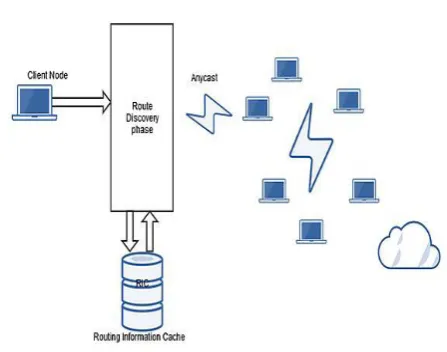
Architectural design gives the overall view of system components and there interface with each other as shown in Fig. 1.
Fig. 1: System Architecture 3.1 Path Creation
In MQEAR path creation is done using path request (PR), Path reply (PP) packets. Path error (PERR) packet is used to inform error or failure information.
3.1.1 Path search
Path search has following phases: 1) Path Request (PR)
by using ID. Perform these steps until reach to the destination. Following fig. 2 shows iterator value database.
Fig. 2: Iterator Value Database
2) Path Reply (PP)
1) Server chooses the path which has higher RET. 2) It creates PP packet and simultaneously it update iterator database.
3) PP packet sends to the client.
4) The data transmission is done using selected path. 3) Path maintenance
Path maintenance is required when path failure or node failure occurs. It is used for recovery purpose. Three cases occur at the time of recovery purpose.
a) If path failure occurs between two relay nodes then nodes used PR and PP packets to find the alternate path. Then send PERR message to the client.
b) If path failure occurs between the source and intermediate nodes. Then by using PR and PP packet they find the alternate path and inform client by using PERR message.
c) If path failure occurs between the destination and intermediate node then by using destination PP and PR packet, an alternate path is selected and information about new path given to the client.
3.2 Path Cache
It includes latest used paths. To avoid route discovery path cache is maintain in MQEAR. It saves network time and energy. It has following fields:
Anycast address- Address of anycast group server.
Path data- It include complete path which will be used for routing.
Timestamp- It include updation time of PC.
Following Fig. 3 shows path cache database and Fig. 4 shows path request packet.
Fig. 3: Path Cache
Fig. 4: Path Request Packet
3.2.1 Consistency model- It is used for calculating host stability. Host stability is nothing but the stability of host from the previous location to current location. Suppose node move from position (anode - atr) to (bnode - btr)
with transmission range of “tr” then stability of nodes is calculated by following eq. 1
𝑑𝑖 𝑖𝑡= √ − 𝑡𝑟 2+ − 𝑡𝑟 2 (1) 3.2.2 Traffic Model- It is used for calculating traffic in the
network. Congestion in the network is predicted using RTS and CTS messages.
1) Client send RTS (Request to send) message to next hop by using iterator database.
2) Nodes which are idle send CTS(Clear to Send) message to client.
3) From the response of RTS and CTS message, traffic factor value of the iterator database is modify.
4) Check node availability. If node is idle TF=0 If node is busy TF=1
3.2.3 Energy Model- In this model transmission energy of each node is calculated by using eq. 2
𝑇𝑥 = 𝑘𝑑𝑖 𝛼 (2)
Where,
“k” is the proportionality constant, “dist” is the distance between the two neighbouring nodes, “𝛼” is a parameter that
depends on the physical environment (generally between 2 and 4). Txnode is a transmission energy of node which
measured in joules per meter.
Then at the time of packet transmission residual energy of node is calculated by using eq. 3
RESenergy = INITenergy – Txnode (3) Where,
RESenergy is residual battery energy. INITenergy is initial battery energy.
Database in MQEAR consist of iterator value database, routing cache
-Iterator Value Database- It consist of destination, next node, distance, node stability, traffic factor, Energy factor. 1) Destination- It includes destination server.
2) Next node- It include next node of current node. 3) Distance- It is nothing but the distance to server from current node.
4) Node stability- It is stability value of node. 5) Traffic factor- It include flag value which indicate weather the congestion available in network.
6) Energy Factor- It shows remaining energy of node. -Path cache- It includes address of anycast, path data, timestamp.
2) Path Data- It include complete path data. 3) Timestamp- It include updation time of PC.
4.
ROUTE DISCOVERY PROCESS
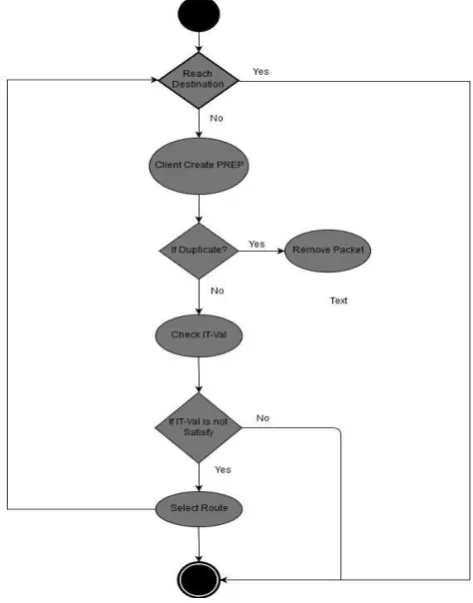
4.1 Path Selection Phase
1. Client Send PREQ
2. Node check iterator value from iterator database. 3. Node shares the RTS Message by using node
information available in iterator database. 4. Idle channel send CTS message.
5. Select next node for data transmission. 6. Schedule Channel according to the request. 7. Calculate residual energy.
8. Each node updates their iterator value database. 9. Select high iterator value nodes.
10. Update status information of intermediate nodes. 11. Priority based delivery pb - > cbr split into the
slot.
12. Analyze the queuing level of sequence no and update into the time stamp and if node reaches limited threshold send PERR message to client
Fig. 5: Flow of Client Request 4.2 Data Delivery Phase
1. Get the Src_id and Dst_id. 2. Check TTL - > time to live.
3. Choose the neighbors from the updated routing table.
Nid - > rtable
4. Send PREP packet to client
5. Assigns the transmission and frequently it checks the neighbour table and update the iterator value database
6. If PERR occur then Send PERR message to client
4.3 METHODOLOGY USED
Step 1: Calculate host stability value, traffic value, energy consumption value.
Step 2: Send PREQ.
Step 3: Compare calculated value of each node. Step 4: Choose efficient route which has higher RET. Step 5: Send PREP to the client.
Step 6: Used selected route for further data transmission. .
Fig 6: Flow of Server Response 5.
PERFORMANCE METRICS
The implementation of “Mobility and QoS-aware energy efficient anycast routing in MANET” is done using C++ language in NS3. Simulation includes different parameters, conditions for performance analysis. The performance analysis is done by using number of nodes, simulation time, number of packets
5.1 Results
Results analysis is done in terms of packet delivery ratio, energy consumption, control overhead, and delay by considering different no of nodes, packet size, simulation time. Simulation scenario In MQEAR performance is analyzed by using following metrics:
5.1.1 Performance Analysis with Packet Delivery Ratio-
checked with different simulation time. Fig. 7 shows performance analysis of MQAR with PDR.
Fig. 7: Performance analysis with PDR
5.1.2 Performance Analysis with Control Overhead-
Performance analysis of control overhead is done by using 30 nodes with different simulation time.
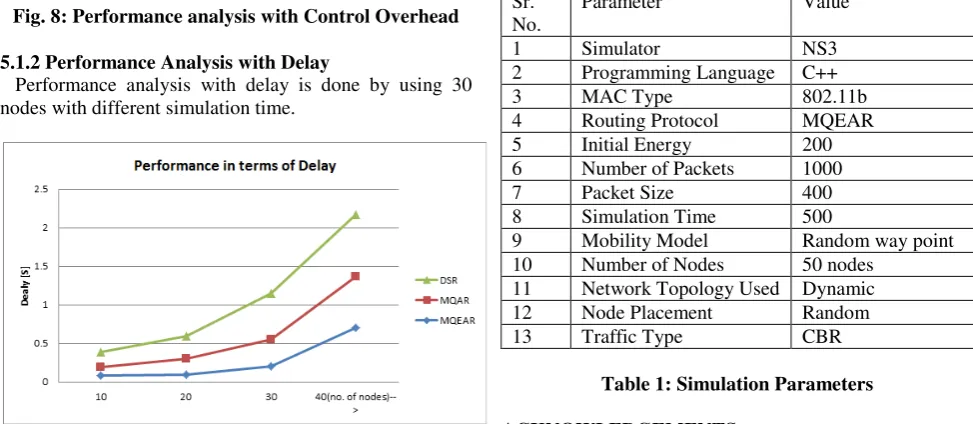
Fig. 8: Performance analysis with Control Overhead 5.1.2 Performance Analysis with Delay
Performance analysis with delay is done by using 30 nodes with different simulation time.
Fig. 9. Performance analysis with delay
5.1.3 Performance Analysis with Energy Consumption-
Performance analysis of energy consumption is done by using 30 nodes with different simulation time.
Fig. 10. Performance analysis with Energy
6. CONCLUSION
Stability of nodes, congestion of nodes, channel load is important QoS parameter. Different routing protocols perform poor in terms of QoS support for anycast routing in MANETs. The proposed mobility and QoS-aware anycast routing protocol which performs better in terms of this QoS parameter and also provides better throughput and packet delivery ratio, energy efficient paths. MQEAR increases network lifetime, reduce delay, reduce energy consumption and find a non-congested path.
Sr. No.
Parameter Value
1 Simulator NS3
2 Programming Language C++
3 MAC Type 802.11b
4 Routing Protocol MQEAR
5 Initial Energy 200
6 Number of Packets 1000
7 Packet Size 400
8 Simulation Time 500
9 Mobility Model Random way point
10 Number of Nodes 50 nodes 11 Network Topology Used Dynamic
12 Node Placement Random
13 Traffic Type CBR
Table 1: Simulation Parameters ACKNOWLEDGEMENTS
department for his exemplary guidance, valuable feedback and constant encouragement. His valuable suggestions were of immense help throughout my paper work. Working under him was an extremely knowledgeable experience for me.
REFERENCES
[1] AjayKumaryadav,SachinTripathi,QMRPRNS:De sign of QoS multicast routing protocol using relaible node selection scheme for MANETs,Springer 2016 Peer-to-peer network application.
[2] Ali Moussaoui, Fouzi Semchedine, Abdallah Boukerram, A link-state QoS routing protocol based on link stability for mobile ad hoc networks, Elsevier journal of network and computer applications 39(2014) 117-125.
[3] Anjum Asma, Energy Efficient Routing Algorithm for Maximizing Network Lifetime of MANETs, International Journal of Innovative Research in Computer and Communication Engineering Vol. 1, Issue 8, October 2013. [4] Anupam Baliyan,Sanjeev Gupta,A Comparative
Survey of QoS Aware Routing in Mobile Ad Hoc Network
[5] Basarkod P. I.,Manvi, Mobility and QoS aware anycast routing in Mobile ad hoc networks, Elsevier journal of Computers and Electrical Engineering 48(2015)86-99.
[6] D. Helen and D. Arivazhagan, Applications Advantages and Challenges of Ad Hoc Networks, Journal of Academia and Industrial Research(JAIR)Volume 2, Issue 8 January 2014. [7] Fraser Cadger, Kevin Curran, Jose Santos, Sandra
Moffett, Towards a location and mobility aware routing protocol for improving multimedia streaming performance, Peer-to-Peer Network application (2015)8:543-554.
[8] Gurav Singal, Vijay Laxmi, M. S. Gaur, Vijay Rao, Moralism:mobility prediction with link stability based multicast routing protocol in MANETs, Springer 2016 Wireless network. [9] Kemal Akkaya, Mohamed Younis, Energy and
QoS Aware Routing in Wireless Sensor Networks, Springer Cluster Computing 8, 179-188, 2005
[10]Mawloud Omar, Sabrine Hedjaz, Souhila Rebouh, katiaAouchar, Bournane Abbache, Abdelkamel Tari, on-demand source routing with reduced packets protocol in mobile ad-hoc networks, Elsevier international journal of electronics and communications 69(2015)1429-1436.
[11]Mamatha Balachandra, K. V. Prema, Krishnamoorthy Makkithaya, Multiconstrained and multipath QoS aware routing protocol for MANETs wireless (2014) 20:2395-2408.
[12]Natarajan Meghanathan, A location prediction based routing protocol and its extensions for
multipath routing in mobile ad hoc networks,Elsevier adhoc networks 9(2011)1104-1126.
[13]R.Vadivel, V. Murali Bhaskaran, Energy Efficient With Secured Reliable Routing Protocol(EESRRP) For Mobile Ad-Hoc Networks, Elsevier, Procedia Technology 4 ( 2012 ) 703 707.
[14]Reza Azizi, Performance Study and simulation of an anycast protocol for wireless mobile ad networks,International journal of wireless and mobile networks vol.5,No. 3,June 2013.
[15]Shivraj Kaur, Kulwinder Singh, Yadvinder Singh, A Comparative Analysis of Unicast, Multicast, Broadcast and Anycast Addressing Schemes Routing in MANETs,International Journal of Computer Applications (0975 8887)Volume 133 No.9, January 2016.
[16]T.Senthil Kumaran, V. Sankaranarayanan, Early congestion detection and adaptive routing in MANET, Elsevier Egyptian informatics journal(2011)12, 165-175.
[17]Tin-Yu Wu , Ching-Yang Huang, Han-Chieh Chao, A survey of Mobile IP in cellular and Mobile Ad-Hoc Network environments,Elsevier Ad Hoc Networks 3 (2005) 351370.
[18]V.R. Budyal, S.S. Manvi, Anfis and agent based bandwidth and delay aware anycast routing in mobile ad hoc networks, Elsevier journal of network and computer applications 39(2014) 140-151.
[19]Vincent D.Park, Joseph P. Macker, Anycast routing for mobile networking
[20]Yaser Khamayseh, Ghadeer Obiedat, Munner Bani Yassin, Mobility and load aware routing protocol for ad hoc networks, Journal of king saud university computer and information sciences(2011) 23, 105-113
Author Biography
Ms. Komal Badhe is pursuing M.E. in Computer Engineering at MIT Academy of Engineering. She Has completed her engineering from Savitribai Phule Pune University. Her research interest include ad hoc network.