Signal Groups of Compatible Graph in
Traffic Control Problems
Arun Kumar Baruah
Department of Mathematics, Dibrugarh University, Dibrugarh : 786004, Assam, India E-mail : [email protected]
Niky Baruah
Department of Mathematics, Dibrugarh University, Dibrugarh : 786004, Assam, India E-mail : [email protected]
--- ABSTRACT--- Signal Groups of a compatibility graph is used to solve conflict between the traffic streams and hence can be used as a solution for traffic control problem at an intersection. In this paper we have considered cliques of the compatible graph as signal groups and the set of signal groups which can simultaneously move at an intersection is taken in a phase. Phasing of traffic lights is done by splitting the cycle time among these phases so that each set of signal group is allowed to move once in the cycle.
Keywords : Compatibility Graph, Conflicting Streams, Phasing and Sequencing, Signal Group, Traffic Control.
Date of Submission : January 05, 2012 Date of Acceptance : June 08, 2012
--- 1. Introduction
T
raffic Theory is a physical phenomenon that aims at understanding and improving automobile traffic, and the problem associated with it such as traffic congestion [1].The traffic control problem is to minimize the waiting time of the public transportation while maintaining the individual traffic flow optimally [2]. A significant development of traffic control systems using traffic lights has been achieved since the first traffic controller was installed in London in 1868. The first green wave was realised in Salt Lake City (U.K.) in 1918, and the first area traffic controller was introduced in Toronto in 1960. At the beginning, electromechanical devices were used to perform traffic control. Then semi conductor-based controllers known as sensors were placed in different places to collect traffic information are used in traffic control system [3], [4]. Nowadays, microprocessor based controller are used in Traffic Control Systems. In 1960’s a method of combinatorial optimisation approach of Branch and Bound type [5] was used for solving optimal traffic control problems [6]. The combinatorial approach to the optimal traffic control problem was founded by Stoffers [7] in 1968 by introducing the Compatibility graph of traffic streams. The most common means of traffic control in modern cities is traffic control by traffic signals. Traffic signals made it possible to solve conflicts between traffic flows at intersections [8]. This goal however can be achieved in different ways and applications of particular methods have different consequences regarding the intersection capacity, delay, or environmental pollution. Traffic signals are introduced at an intersection to solve conflict between traffic streams in traffic control problems. For solving the control problem it is necessary to know
relations between traffic streams at an intersection. By traffic streams we mean the following :
Traffic streams on an intersection are elements of the set of traffic stream, i.e
= { . . . , , . . . , }
where i and is the set of traffic
stream indices :
Since the main objective of traffic control by traffic lights is to give the right-of-way to some of traffic streams, and to stop others, it is necessary to find, in the set of traffic streams of an intersection, the traffic streams that can simultaneously get the right-of-way. Therefore, a traffic stream compatibility relation is introduced, defined by a set of traffic stream pairs, such that elements of the pair can simultaneously get the right-of-way [8].
The traffic streams compatibility relation plays an important role in solving traffic control problems related to :
- Deciding whether traffic control by traffic lights should be introduced at an intersection. - Assigning control variables to traffic
streams or to subsets of traffic streams.
- The intersection geometry
- Factors related to traffic process safety, for which expert estimations of traffic engineers are needed.
The analysis of intersection geometry considers mutual relations of traffic streams. When trajectories of two traffic streams do not cross, these streams can simultaneously get the right-of-way i.e. they are compatible. On the other hand, when trajectories of two traffic streams do cross, the streams are in a conflict, and their simultaneous movement through the intersection cannot be permitted. If volumes are not high, a “filtering” of one stream through another can be permitted in some cases. However, when determining the compatibility relation, some special requirements should be taken into account, e.g., some streams are required to pass through the intersection without any disturbance, although filtering could be permitted if only their volumes were considered. These requirements are usually achieved by directional signals.
2. Conflicting Relation of Traffic Streams
Some pair of traffic streams use, along a part of their trajectories, the same space on the intersection i.e. the conflict area. These are the streams whose trajectories cross or merge. A conflict exists between such streams. The set of all pairs of traffic streams that creates a conflict between elements of the pairs represents the conflictness relation. Thus the conflictness relation can be defined as
i.e. = {( | the trajectories of
cross or merge, }
The graph of conflictness, , is defined by
set and the relation :
, )
3. Compatibility Relation of Traffic
Streams
In determining the compatibility relation of traffic streams, it is necessary to consider the following factors:
- The pairs of conflicting traffic streams that can simultaneously get the right-of-way. - The traffic streams required to pass through the
intersection without any disturbance (the
streams to which the right of way is given by directional signals)
Some pairs of conflicting traffic streams can at the same time are pairs of compatible streams, although the
streams are conflicting. Therefore, it is necessary to divide the conflicts into allowed or forbidden. Forbidden conflicts can be regulated only by traffic lights, while allowed conflicts are solved by traffic participants themselves, respecting priority rules prescribed by traffic regulations. Without traffic lights, conflicts are solved by “filtering” one stream through another. The possibility of filtering depends on vehicle spacing interval, which depends on volume of traffic streams. The volumes changes during the day. There are intervals with very high volume like morning peak, afternoon peak, and intervals with significantly lower volume like off-peak and night periods. Hence, situations may arise that two conflicting traffic streams may simultaneously have the right-of-way in one period and not in another. Thus, it might be necessary to change the compatibility relation during a day.
The compatibility relation is defined as
= ( )
and the graph of the compatibility, , is defined by the set and the relation as
= (
4. Traffic Signals
The use of traffic signals for control of conflicting streams of vehicular and pedestrian traffic is extensive in most of the urban areas. As mentioned earlier the first traffic signal is reported to have been used in London in 1868. The traffic signs and signals occupy a significant place in traffic control problem at an intersection [9]. Traffic signals perform a number of functions :
• They can provide for an orderly movement
of traffic.
• When proper geometric layouts and control
measures are employed, they can increase the traffic – handling capacity of the intersection. • They can reduce the frequency of number of
accidents.
• Under favourable conditions, they can be co-ordinated to provide for continuous or nearly continuous movement of traffic at a definite speed along a given route.
• If properly designed and set, they can assign
right-of-way impartially to traffic, unlike annual controls which can stop and interrupt
traffic streams at personal whim of the
traffic controller. 5. Signal Group
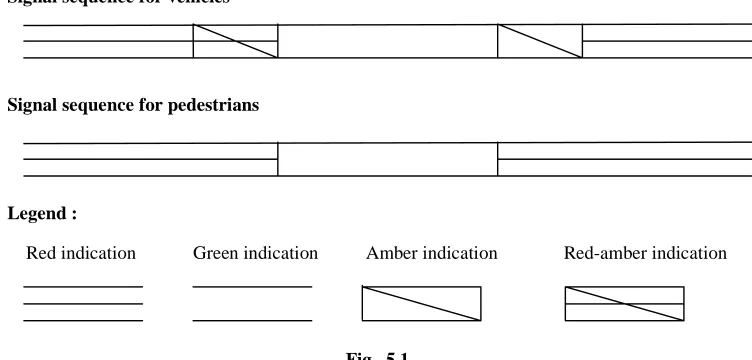
movement of incompatible traffic streams. Traffic control at an intersection consists of giving and canceling the right-of-way to particular traffic streams. Giving and cancelling the right-of-way is performed by different signal indications. Meaning of indications is assigned by a convention. A green indication for vehicles means allowed passage, while red means forbidden passage. An amber indication, appearing after a green indication, as well as a red-amber after a red indication, informs the driver that the right-of-way will be changed. The duration of amber and red-amber
intervals in some countries is determined by traffic regulations, and it is most frequently specified as 3 s for amber and 2 s for red-amber indication.
Signals that control pedestrian streams usually have only two indications : red (“stop”) and green (“walk”).
The most frequently used sequence of signal indications for vehicles and for pedestrians is as shown in the Fig. 5.1 below :
Signal sequence for vehicles
Signal sequence for pedestrians
Legend :
Red indication Green indication Amber indication Red-amber indication
Fig. 5.1
The control of traffic lights, i.e. forming and implementing specified signal sequences, is performed by an electronic device called a traffic controller. A controlled changes signal indications using sequence of pulses. Changes of signal indications are described by a mathematical variable called a control variable. Control variables can be assigned to every traffic streams. However, the fact that compatible traffic streams can simultaneously gain or loss the right-of-way makes it possible that a subset of traffic streams, comprising several compatible streams can be controlled by a signal control variable. Therefore, it is necessary to establish the correspondence between traffic streams and traffic signals sequences i.e. the control variables that control these traffic streams while introducing traffic lights control at an intersection, The simplest assignment of control variables to traffic streams is to assign one control variable to each traffic stream which is generally not applicable.
Various intersection performance indices depend on the choice of traffic control systems for an intersection. Among these performance indices are : total delay or total number of vehicle stops in a defined interval, total flow through the intersection (for saturated intersections). Values of these performance indices also depend on the assignment of control
variables to the traffic streams. The best results are, obviously obtained if each traffic stream is controlled by one control variable. When the number of control variables is less than the number of streams, certain constrains have to be introduced that will express the requirement that several traffic streams simultaneously get or loss the right-of-way. The reduction in the number of control variables results in simplification of traffic control problems and also the possibility to use cheaper and simpler traffic controllers.
Determination of the set of control variables, is in fact, is the problem of partitioning the set of traffic streams, , in subsets of traffic streams, such that a single control variable can be used to control a subset.
Definition 5.1 A subset of traffic streams that simultaneously gains or losses the right-of-way i.e. that is controlled by a single controlled variable is called a signal group.
Alternatively, a signal group is defined as the set of traffic streams that are controlled by identical traffic signal indications. For traffic equipment manufacturers, a signal group is a controller module, which always produces one sequence of traffic signal indications
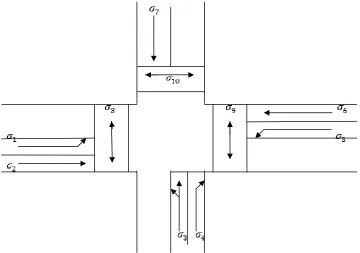
6. An Example
Fig. 6.1 : An intersection with ten traffic streams
The above traffic intersection can be represented as a compatibility graph as shown in Fig. 6. 2. The graph of this intersection is the compatibility graph
where the nodes represent the traffic streams and if two streams are compatible then it is joined by an edge.
Fig. 6.2 Compatibility Graph of the intersection ( Fig. 6.1 )
The cliques of a compatible graph are the maximum complete subgraphs of the compatible graph.
{ ,
{
}, {
},
{
}, {
}, {
},
{
}, {
}, {
},
{
}, {
}, {
},
{
},
{ }, { },{ }, { }, { }
The cliques can be divided into four signal groups and as
{ , , ,
{
},
{ }This selection of set of signal groups may vary according to the choice of signal groups allowing more number of traffic streams together in their right-of-way. The cliques in the set can be controlled by a single signal indication i.e. the signal group will be controlled by one traffic light or by identical signal
indications. Similarly, the signal group and
can be controlled by identical signal indications.
The cliques in the set can simultaneously move in the intersection at a time. As the number of streams is more compared to the number of traffic lights certain constrains have to be introduced that will express the requirement that several traffic streams simultaneously get the right-of-way. Although some of streams may conflict while passing through the intersection, however it may be allowed by filtering of traffic streams or by the traffic participants themselves by respecting the priority rules. Similarly
the cliques of the signal groups and can
simultaneously get the right-of-way in the intersection. To phase the traffic streams in this intersection,
each of the signal group and can be
allowed to move once in the cycle. As the traffic stream conflict with most of the traffic streams, it has be allowed to move alone in the intersection i.e. all other streams will be stationary when the traffic stream
moves.
As the basic intention of traffic signals at an intersection is to prevent the simultaneous movement of conflicting streams, the vehicle traffic streams will be controlled by four signal indications i.e. red, green, amber and red-amber. The signal groups
and can also be controlled by using these signal indications.
Again, if the left turn of the traffic stream is allowed as conditional compatibility considering the traffic streams which conflict with the traffic stream
exactly once, then it becomes compatible with
most of the traffic streams etc.
The seven additional cliques formed thus increases the number of cliques of the compatibility graph. The
additional cliques are
{ { },
Fig. 6. 3 : Compatibility Graph of the intersection (Fig. 6.1) when left turn of traffic stream is allowed
The set of cliques can be divided into the signal groups
and as:
{ , , ,
{
},
{ }Each of these signal groups can be allowed to move once in the cycle. This division of signal group is a
better solution as compared to the earlier one as most of the traffic streams are allowed to move at a time i.e. the traffic stream which was conflicting with almost all other streams, now becomes compatible as a result those conflicting traffic streams are not stationary. In the earlier case when moves, all other traffic streams are not allowed to move through the intersection, which results in delay; increasing number of vehicles stop; total waiting time etc, this is because the stream is in conflict with almost all other traffic streams and cannot be allowed to move simultaneously through the intersection.
Again the division of cycle time of the signal groups will be the same as the earlier case i.e. they can be allowed to move once in the cycle and can be controlled by the same signal indications red, green, amber, red-amber.
those cliques which are complete subgraph of the compatibility graph. In graph theory clique in an undirected graph is a subgraph of its vertices such that every two vertices in the subset is connected by an edge. Here in our problem we shall not consider the cliques which are of one vertex or two vertices as it has no contribution towards any practical solution in a traffic control problem.
The combinatorial approach to the optimal traffic control problem on isolated intersection was founded by Stoffers K. by introducing compatibility graph of the traffic streams. Stoffers also noted that the traffic stream sets with maximum number of non conflicting traffic streams, which can simultaneously get the right-of-way can be determined by extracting cliques of the compatibility graph.
The traffic control on a signalized intersection is performed by means of traffic lights of different colours (green, amber, red and red-amber) that are repeating periodically [10]. Conflicts between traffic participants are prevented by dividing the cycle time in intervals allocated to traffic flows so that the conflicting flows do not get the right-of-way in the same interval. The control in one interval is defined by one control vector called phase whose components are control variables that control traffic by means of traffic lights. A traffic control problem not only includes the problem of
splitting the cycle time into particular phases but also the composition and sequences of the phases.
In case of filtering i.e. when filtering is permitted, there exists an interval when two conflicting and compatible vehicle traffic stream get the right-of-way.
7. Phasing and Sequencing of traffic lights at an intersection
The cycle time or cycle length is the time required for one complete sequence of signal indications. Phase is defined as the sequence of conditions applied to one or more streams of traffic which during the cycle receive simultaneous identical signal indication.
To phase traffic light at an intersection of a traffic control problem is to split the cycle time in equal intervals such that every signal group get the right-of-way or allowed to move once in the cycle i.e. all the signal groups can be allowed to move through the intersection most of the time. Here in the problem, in both the cases there are four signal group. If we consider the cycle time to be 60 seconds, each of the
signal groups and can be allowed to
move for 15 seconds in the cycle as shown in Fig. 7.1. 0
c 0 – 15 seconds moves
45 15 15 – 30 seconds moves
30 – 45 seconds moves
45 – 60 seconds moves
30
Fig. 7.1 : Cycle time of the Signal Groups
In the first case, when the signal groups move most of the traffic streams get the right-of-way but when the signal group moves, all the traffic streams are stationary except as the signal group conflict with almost all the traffic streams. In the second case, this constrain is overcome as the left turn of the traffic stream is allowed and hence it become compatible with most of the traffic streams and
as a result, these traffic streams is allowed to move when is allowed. This solution of the division of cycle time is a better one as most of the traffic streams are allowed to move through the intersection at a time i.e. in an interval. This is because the numbers of traffic streams are more compared to the number of traffic lights that control them.
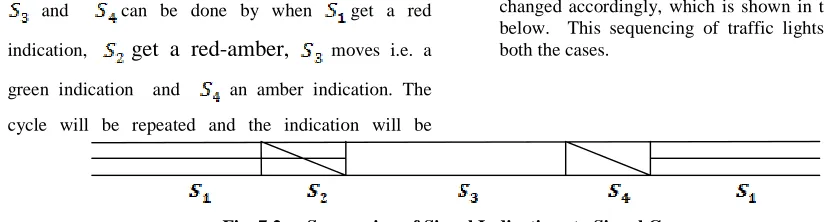
and can be done by when get a red
indication,
get a red-amber,
moves i.e. agreen indication and an amber indication. The
cycle will be repeated and the indication will be
changed accordingly, which is shown in the Fig. 7. 2
below. This sequencing of traffic lights is same for both the cases.
Fig. 7.2 : Sequencing of Signal Indications to Signal Groups
8. Conclusion
Here we have used compatibility graph as a graph theoretic tool to study traffic control problem at an intersection. Traffic signals are used to solve conflict between traffic streams at an intersection and signal groups are used to control traffic streams by different light indications which provides an optimal solution to the control problem. Here we have considered an example of a traffic control problem with two different solutions. In the first case the conflicting streams are not allowed to move simultaneously while in the second case left turn of the conflicting traffic streams are allowed. In terms of accomodating more number of traffic streams in the signal groups, it is found that the solution of the second case is a better one compared to the first case. Finally, it is to be noted that different
choice of signal groups e.g. and of
the example will give different solutions of the problem.
Acknowledgements
This Research is funded by grants from the UGC, New Delhi, India as a Major Research Project awarded to Arun Kumar Baruah. Niky Baruah is associated with the project as a Project Fellow.
References
[1]. D. C. Gazis, Traffic Science ( John Wiley & Sons, New York, 1970).
[2]. D. C. Gazis, Traffic Theory (Kluwer Academic
Publishers, London, 2002).
[3]. W. Gu, X. Jia, On a Traffic Control Problem, 8th International Symposium on Parallel Architectures, Algorithms and Networks (ISPAN’ 05), 2005.
[4]. W. Gu, X. Jia, On a Traffic Sensing Problem,
Preprint, Texas State University, 2006.
[5].L. G. Mitten, Branch and Bound Methods : General Formulation and Properties, Opns. Res., 18, 1970, 24-34.
[6].A. Locatelli, Optimal Control – An Introduction ( Birkhauser Verlag, 2000).
[7]. E. K. Stoffers, Scheduling of Traffic Lights – A New Approach, Transportation Research, 2, 1968, 199.
[8].S. Guberinic, G. Senborn, B. Lazic, Optimal Traffic Control Urban Intersection (CRC Press, 2008). [9].L. R. Kadiyali, Traffic Engineering and Transport
Planning ( Khanna Publisher, 2011).
[10]. F. S. Roberts, Graph Theory and its
Application to the Problems of Society ( SIAM Publications, Philadelphia, 1978).
Authors Biography
Dr. Arun Kumar Baruah M. Sc., Ph. D. Experience 20 years teaching and research experience in Mathematics in Dibrugarh University, Assam . Research Interest : Graph Theory and Combinatorics, Numerical Analysis and Differential Equations.
Ms. Niky Baruah, M. Sc., M. Phil. Experience : 1 year teaching experience in DHSK