http://www.ijcmph.com pISSN 2394-6032 | eISSN 2394-6040
Original Research Article
Awareness of patients towards eye diseases in middle aged
population in rural Odisha
Bhumika Rath
1, Mahesh Rath
2*, P. C. Mahapatra
1, Lisa Sarangi
2,
Z. U. Khan
1, Priyatama Singh
2INTRODUCTION
A person’s perception of life is greatly influenced by what he sees and helps a great deal in achieving a good quality of life. It helps in shaping a person’s life by helping him integrate into the society and also has a
pivotal impact on his education and employment.1-3
Throughout the life course, vision affects child cognitive development, mental health, professional and personal
trajectories and functional capacity in older people.4–8
One of the most important public health issue for developing nations in the world with special reference to
India is preventive blindness.5 The World Health
Organization (WHO) data on prevalence of blindness and vision impairment is based on two papers published by the vision loss expert group published in the The Lancet
Global Health in 2015.9,10 According to it, 36 million
people are blind and 217 million people are with
ABSTRACT
Background: One of the most important public health issue for developing nations in the world with special reference to India is preventive blindness. In the world, 36 million people are blind and 217 million people are with moderate or severe distance vision impairment. The aim and objectives of the study were a qualitative survey to get an initial picture of rural residents knowledge of the prevalent eye disease; serve as an initial assessment of patient’s baseline knowledge of eye conditions and possible treatment methods to aid in the future development of educational outreach initiatives and studies.
Methods: A cross sectional study was carried out in the rural areas of Jajpur, Nayagarh, Puri and Cuttack district of
Odisha during preventive eye screening camps. The study was carried over 6 months from Jan to July 2018. The
sample size was calculated to be 914 and the study subjects were all aged 40 years and above comprising of 64.7% male and 35.3% female.
Results: In this study we found out that 60.18% reported previous eye doctor visits, 24.08% reported using eye drops prescribed by a non-doctor, while 60.18% of the non-doctor visitors reported not knowing that a doctor should prescribe eye drops. While 76.69% had little or no awareness regarding glaucoma, 51.87% had a fair idea regarding cataract surgery.
Conclusions: The increase in patient awareness of prevalent eye diseases and treatments could lead to an increase in patient acceptance regarding the importance of routine eye examinations for proper identification and treatment of various eye conditions.
Keywords: Eye diseases, Cataract, Glaucoma, Odisha 1
Department of Ophthalmology, 2Department of Community Medicine, Hitech Medical College and Hospital,
Bhubaneswar, Odisha, India
Received: 10 January 2019
Revised: 23 January 2019
Accepted: 28 January 2019
*Correspondence:
Dr. Mahesh Rath,
E-mail: [email protected]
Copyright: © the author(s), publisher and licensee Medip Academy. This is an open-access article distributed under the terms of the Creative Commons Attribution Non-Commercial License, which permits unrestricted non-commercial use, distribution, and reproduction in any medium, provided the original work is properly cited.
moderate or severe distance vision impairment. Of those with blindness and MSVI, 124 million people have uncorrected refractive errors and 65 million have cataract and more than 75% of all blindness and MSVI is avoidable. According to studies, approximately 1 billion people over 35 years are currently affected by near vision impairment primarily due to uncorrected presbyopia and
about 668 millions of them are over 50 years.9 The
prevalence of blindness and vision impairment
combined has dropped from 4.58% in 1990 to 3.37% in 2015. Eighty Nine percent of vision impaired people live in low and middle-income countries and of the moderate or severely vision impaired people 55% are women. The top causes of visual impairment: uncorrected refractive errors, cataracts and age-related macular degeneration (AMD) while the top causes of blindness are Cataract (62.6%), refractive error (19.70%), corneal blindness (0.90%), glaucoma (5.80%). In the last 20 years, the number of people visually impaired from infectious diseases has greatly reduced. The National Programme for Control of Blindness (NPCB) was launched forty-one years ago with the goal to reduce the prevalence of blindness from 1.4% to 0.3%. Under NPCB, various activities/initiatives undertaken during the five year plans are targeted towards achieving the goal of reducing the prevalence of blindness to 0.3% by the year 2020.
Aim and objectives
A qualitative survey to get an initial picture of rural
residents knowledge of the prevalent eye disease.
Serve as an initial assessment of patient’s baseline
knowledge of eye conditions and possible treatment methods to aid in the future development of educational outreach initiatives and studies.
METHODS
A cross sectional study was carried out in the rural areas of Jajpur, Nayagarh, Puri and Cuttack District of Odisha during preventive eye screening camps organized by Department of Ophthalmology and Department of Community Medicine of Hi-Tech Medical College and Hospital, Bhubaneswar, Odisha. The study was carried
over 6 months from 1st Jan 2018 to 1st July 2018.
Inclusion criteria
All patients reporting to the eye check up camps aged 40 years or older and those who gave consent to be a part of the study.
Exclusion criteria
Those patients aged less than 40 years and those who didnot consent to be a part of the study.
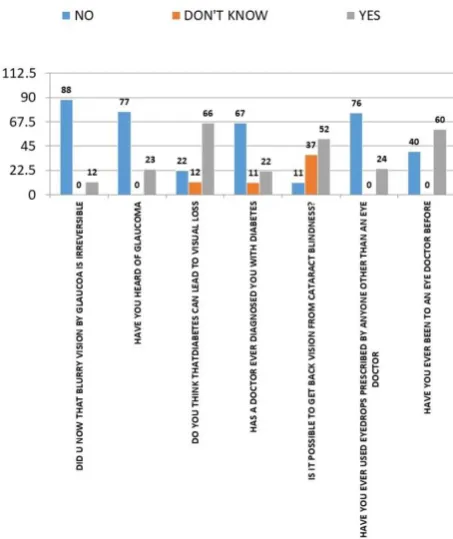
The participants were explained verbally about the study in their local language and made to fill out a pre tested pre-approved schedule (Annexure 1) (Figure 1). Multiple
choice survey questions were based on prior research, including the focus areas in India’s VISION 2020 initiatives. Verbal responses from participants were recorded by hand. These data were entered into IBM SPSS statistics 24.0 of SPSS South Asia Pvt Ltd. Permission from the Institutional Ethics Committee at Hitech Medical College and Hospital, Bhubaneswar was taken for the study.
Figure 1: Distribution of results of the schedule (%).
RESULTS
In this study, all the patients who presented to the camps and consented to be a part were included and the final sample size calculated by convenient sampling came out to be 914. The mean age of the participants was 54.89 (±10.851) years. The study subjects were all aged 40 years and above comprising of 64.7% male and 35.3%
female. In our study, around sixty-four percent of
participants were living on 100 rupees or less per day (Figure 2).
While 60.18% reported previous eye doctor visits, 24.08% reported using eye drops prescribed by a non-doctor (Figure 3).
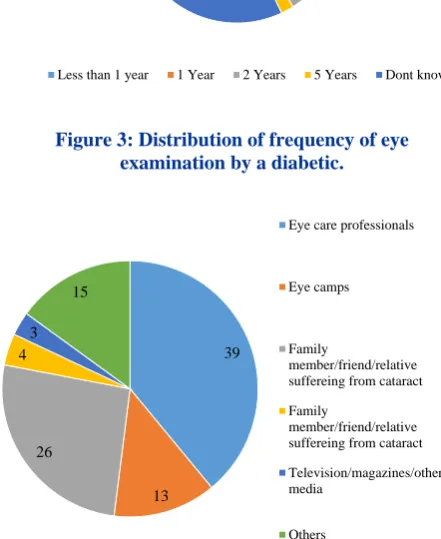
from an eye care professional, 26% got to know of it from a cataract patient.
Figure 2: Distribution of daily income of the study subjects (%).
Figure 3: Distribution of frequency of eye examination by a diabetic.
Figure 4: Distribution of awareness regarding cataract surgery.
DISCUSSION
Prescription eye drop usage
Limited research has been done regarding the usage of eye drop in India as in rural areas most of them preferred to use an eye drop prescribed by village practitioners or shopkeepers. While 60.18% reported previous eye doctor visits, 24.08% reported using eye drops prescribed by a non-doctor. This data gave us an insight that thought educational outreach programs we can benefit both the rural population as well as the rural practitioners equally
regarding correct diagnosis and corresponding
prescription eye drop treatment.
Diabetes
Diabetic retinopathy has been one of the most dreaded and irreversible complication in diabetes patients. In this study, the diagnosis of diabetes was done by a doctor in 22.03% and from among them 66.1% had faint idea regarding visual loss in diabetics. In a study by Rani et al conducted in Tamil Nadu (South India) regarding awareness about diabetic retinopathy it was found that one third of the participants with a confirmed diagnoses of diabetes had the impression that adequate glycemic control was sufficient enough to avoid consultations by
an ophthalmologist.11 A positive correlation between
education, socio-economic status and awareness
regarding vision impairment due to diabetes was also found in the said study. According to the 2012 estimates by Reserve Bank of India Odisha has 33% of its population living below the poverty line, while the
national average was 21.92%.12 Due to the positive
correlation between poverty, education, and awareness, with the increasing incidence of diabetes, Odisha is at a heightened risk of developing secondary complications of diabetes
Glaucoma
In our study, it was quite disheartening to know that 76.69% had little or no awareness while maximum patients (88.07%) had no idea that blurry vision caused by glaucoma is irreversible. In India, it is seen that blindness caused by glaucoma continues to be a growing trend despite advanced surgical techniques that aim at
controlling IOP.13 As the symptoms of glaucoma do not
present till the later stages of the disease, its management has been a major challenge. Due to limited access to routine eye exams in the developing country, people are at high risk of developing late stage symptoms and subsequent irreversible blindness. Various studies have shown an association between a lack of awareness of glaucoma and late clinical presentation of the disease. The Barbados eye study (BES) found that of participants with primary open angle glaucoma, 51% were unaware of
the term or nature of the disease.14 The Andhra Pradesh
eye disease study (APEDS) showed that awareness of glaucoma was very limited in rural populations in
7 9
10
8 9
10 23.07
8.03
6.01
3.28 4.01
1.27 0 7.5 15 22.5 30 N o i n co m e 1 0 -5 0 IN R 5 1 -1 0 0 IN R 1 0 1 -1 0 5 IN R 1 5 1 -2 0 0 IN R 2 0 0 + IN R Male Female 11% 21% 9% 2% 57%
Less than 1 year 1 Year 2 Years 5 Years Dont know
39 13 26 4 3 15
Eye care professionals
Eye camps
Family
member/friend/relative suffereing from cataract
Family
member/friend/relative suffereing from cataract
Television/magazines/other media
Southern India.15 Our research suggests that educational outreach regarding glaucoma would benefit the communities of rural Odisha.
Cataract
It was quite encouraging to know that most of the people were aware regarding cataracts and its treatment methods. Regarding cataract surgery, 51.87% had a fair idea while 36.76% did not have any idea. While 39% learned about treatment from an eye care professional, 26% got to know of it from a cataract patient (Figure 4). These results reflect positively on existing efforts to increase cataract awareness in Odisha. Efforts should be made to relay information regarding cataract effectively from doctor to patient, and patient to family and friends. Because of high participant awareness of cataracts and treatment, future educational outreaches should be focused on different areas of ocular health, such as diabetes-related vision
problems and glaucoma.16
CONCLUSION
Our data suggests that residents in the study area could benefit from educational outreach programs specifically addressing prescription eye drop usage and ocular health complications specific to diabetes and glaucoma. We feel that the increase in patient awareness of prevalent eye diseases and treatments could lead to an increase in patient acceptance regarding the importance of routine eye examinations for proper identification and treatment of various eye conditions. We hope that through our study we could be of help to eye care professionals and health educators for target specific educational initiatives.
Funding: No funding sources Conflict of interest: None declared
Ethical approval: The study was approved by the Institutional Ethics Committee
REFERENCES
1. Nazroo J, Zimdars A. Social inclusion, social
circumstances and the quality of life of visually
impaired older people. London: Thomas
Pocklington Trust; 2010.
2. Harrabi H, Aubin MJ, Zunzunegui MV, Haddad S,
Freeman EE. Visual difficulty and employment status in the world. PLoS One. 2014;27:9(2).
3. Ma X, Zhou Z, Yi H, Pang X, Shi Y, Chen Q, et al.
Effect of providing free glasses on children’s educational outcomes in China: cluster randomized controlled trial. BMJ. 2014;23;349.
4. Cavézian C, Vilayphonh M, Vasseur V, Caputo G,
Laloum L, Chokron S. Ophthalmic disorder may affect visuo-attentional performance in childhood. Child Neuropsychol. 2013;19(3):292-312.
5. Harris J, Lord C. Mental health of children with
vision impairment at 11 years of age. Dev Med Child Neurol. 2016;58(7):774–9.
6. Shaw A, Gold D, Wolffe K. Employment-related
experiences of youths who are visually impaired: how are these youths faring? J Vis Impair Blind. 2007;101(1):7.
7. Christ SL, Zheng DD, Swenor BK, Lam BL, West
SK, Tannenbaum SL, et al. Longitudinal
relationships among visual acuity, daily functional status, and mortality: the Salisbury eye evaluation study. JAMA Ophthalmol. 2014;132(12):1400–6.
8. Murthy GV, Gupta SK, Bachani D, Jose R, John N.
Current estimates of blindness in India. Br J Ophthalmol. 2005;89:257-60.
9. Bourne RRA, Flaxman SR, Braithwaite T, Cicinelli
MV, Das A, Jonas JB, et al. Vision Loss Expert Group. Magnitude, temporal trends, and projections of the global prevalence of blindness and distance and near vision impairment: a systematic review and meta-analysis. Lancet Glob Health. 2017;5(9):e888– 97.
10. Fricke, TR, Tahhan N, Resnikoff S, Papas E,
Burnett A, Suit MH, et al. Global Prevalence of
Presbyopia and Vision Impairment from
Uncorrected Presbyopia: Systematic Review,
Meta-analysis and Modelling. Ophthalmology.
2018;125(10):1492-9.
11. Rani PK, Raman R, Subramani S, Perumal G,
Kumaramanickavel G, Sharma T. Knowledge of diabetes and diabetic retinopathy among rural populations in India and the influence of knowledge of diabetic retinopathy on attitude and practice. Rural Remote Health. 2008;8(3):838.
12. Table 162, Number and Percentage of Population
Below Poverty Line. Reserve Bank of India, Government of India. 2013.
13. Hennis A, Wu SY, Nemesure B, Honkanen R,
Leske MC. Barbados Eye Studies Group,
Awareness of incident open-angle glaucoma in a population study: The Barbados Eye Studies. Ophthalmology 2007;114:1816-21.
14. Quigley HA, Broman AT. The number of people
with glaucoma worldwide in 2010 and 2020. Br J Ophthalmol. 2006;90:262-7.
15. Krishnaiah S, Kovai V, Srinivas M, Shamanna BR,
Rao GN, Thomas R. Awareness of Glaucoma in the rural population of Southern India. Indian J Ophthalmol. 2005;53:205-8.
16. Brilliant GE, Lepkowski JM, Zurita B, Thulasiraj
RD. Social determinants of cataract surgery utilization in south India. The Operations Research Group. Arch Ophthalmol. 1991;109:584–9.
Cite this article as: Rath B, Rath M, Mahapatra PC,
Sarangi L, Khan ZU, Singh P.Awareness of patients
ANNEXURE 1
Study schedule
Name: Place:
Age/Sex: Date:
1. Have you ever been to an eye doctor before?
a. YES
b. NO
2. Have you ever used eye drops prescribed by anyone other than an eye specialist?
a. YES
b. NO
3. Is it possible to get vision back from cataract illness?
a. YES
b. NO
4. Has a doctor ever diagnosed you with diabetes?
a. YES
b. NO
5. Do you think diabetes can lead to vision loss?
a. YES
b. NO
6. Have you heard of glaucoma?
a. YES
b. NO
7. Did you know that blurry vision caused by glaucoma is irreversible?
a. YES
b. NO
8. How did you come to know about the treatment for cataract?
________________________________________________
9. How often a person with diabetes should receive an eye check up?