Original Research Article
A comparative study on vaccination default rates among children
aged 9-24 months attending a static immunization clinic in urban
and rural area of Bangalore
Jayanthi Srikanth, Pankaj Kumar*, Kavya G. Upadhya, Pushpa Rajanna
INTRODUCTION
Immunization is one of the most important public health intervention to reduce disease burden in young children. Immunization currently averts an estimated 2 to 3 million deaths every year. An estimated 19.5 million infants worldwide are still missing out on basic vaccines. Global vaccination coverage has stalled at 86%, with no significant changes during the past year.1
In country like India with world’s largest birth cohort comprising 26 million new-borns, Immunization becomes a key preventive strategy and a cost effective public health intervention to ensure decrease in childhood morbidity and mortality, often cited as the biggest public health achievement of 20th century.
WHO estimates that more than 22 million infants worldwide had not received 3rd dose of DPT vaccine in 2012. The challenge to meet appropriate and full ABSTRACT
Background: Immunization contributes significantly to the achievement of millennium development goal number 4
and is one of the eight elements of primary health care. Effective utilization of immunization services is associated with reduced infections in young children with immature immune system and improved child health outcome. The objectives of the study were to compare the default rates for vaccine doses in immunization schedule; to study the factors responsible for default; to describe the socio-demographic profile of study subjects.
Methods: An observational study was conducted in the urban and rural Primary health centre on immunization days
for 3 months. The study subjects were children aged (9-24) months attending immunization clinics. Their care givers were interviewed regarding socio-demographic profile and causes for default. Sample size calculated was 184 (92) each from urban and rural clinic).
Results: Among 184 care givers interviewed, mean age of study subjects was 14.9±4.6 months in urban & 14.6±4.9
months in rural clinic. Default rates for vaccination were 5.4% (birth dose), 7.6% (6th wk.) both in urban & rural clinic. However, for further doses i.e., 10th week, 14th week, 9 months and 18 months the default rates were slightly higher in rural compared to urban clinic. Commonest reason for default was mother not aware that child had missed dose (urban 52.2% and rural 42.3%) followed by child being sick (urban 26.6% and rural 30.4%).
Conclusions: The overall default rate was found to be very high which is a serious concern and need to be addressed
in order to prevent eventual dropouts.
Keywords: Immunization, Default, Static immunization clinic
Department ofCommunity Medicine, Kempegowda Institute of Medical Sciences, Bangalore, Karnataka, India
Received: 29 September 2018
Accepted: 03 November 2018
*Correspondence: Dr. Pankaj Kumar,
E-mail: [email protected]
Copyright: © the author(s), publisher and licensee Medip Academy. This is an open-access article distributed under
the terms of the Creative Commons Attribution Non-Commercial License, which permits unrestricted non-commercial use, distribution, and reproduction in any medium, provided the original work is properly cited.
daunting as our country adds a pool of around 12.5 million partially immunized children each year.2
Despite immunization service being provided free of cost at all government health centres and through outreach sessions, still only 62% of children aged between 12-23 months are fully immunized in India, while for Karnataka it is 62.6% as per NFHS 4 data. In year 2014 about 20.6 million infants did not receive Measles vaccine through routine immunization and 18.7 million did not complete 3 doses of DPT vaccine. Children are considered fully immunized if they have received one dose of BCG, 3 doses of DPT and Polio vaccine each and one dose of measles vaccine.3
In December 2014 Government of India launched the Mission Indradhanush to ensure all children under 2 years and pregnant women are fully immunized with available vaccines. It has contributed significantly in improving the annual increase in Immunization coverage by 1%.4 Another initiative by Government of India (GOI) was launching of MR-Campaign (Measles-Rubella campaign) in February 2017 with a goal to eliminate measles and control to address problem of Congenital Rubella Syndrome (CRS) which causes birth defects like irreversible deafness and blindness in around 40 thousand children per year globally.5
The term “defaulter” refers to individuals who miss scheduled vaccinations for any reason, including health facility problems, such as cancelled sessions or vaccine stock outs. Defaulters need to be followed up and mobilized to attend the earliest available session, since the goal is to complete any missed vaccinations.6
There is increased risk of outbreak of vaccine preventable diseases in developing country like India due to various factors like urbanization, migration, increased slums, high density of population and poor immunization coverage. Despite increased accessibility to health care services in both urban and rural India utilization rates for these services remain quite low, hence the various predictive factors causing underutilization and increased default rates in immunization need to be addressed.
Objectives
The defaults in immunization need to be addressed on an urgent basis to prevent their eventual dropout from vaccination schedule, hence in this context, the current study was undertaken to:
Compare the default rates for individual vaccines in immunization clinics of urban and rural Bangalore.
To study the factors responsible for defaulting.
To describe the socio-demographic profile of study subjects.
METHODS
Study settings
An observational study was conducted in urban family welfare centre (UFWC) Banashankari and Primary health centre (PHC) Kengeri Bangalore on every Thursdays in immunization clinics for 3 months from July to September 10th 2017.
Study subjects
Study subjects were children aged 9-24 months attending immunization clinic with care giver willing to participate in the study.
Study design
This was a descriptive observational study conducted for a period of 3 months from June to July 2017
Sample size
Considering percentage of children aged 12-23 months fully immunized as 61% from NFHS 4 data (2015-16)7. Sample size was calculated to be (184), 92 each from UFWC- Urban and PHC-Rural taking 10% precision and using formula 4pq/d2.
p=0.61, q=0.39, d=allowable error, should be within 10 per cent of true value =0.1, α=0.1.
n=1.96x 1.96 × 0.61× 0.39/0.01= 91.35 = 92
Data collection procedure
A pilot study was carried out in Yarab Nagar- Urban Primary health centre (UPHC) to pre-test the questionnaire. This allowed us to fine tune the research tools as per requirement, following which the study was started in both urban and rural immunization clinic.
Statistical methods
Data obtained were analysed statistically using MS-Excel 2016. 2 sample T-test was also used. Data were presented as tables, bar diagram and pie charts.
Ethical consideration
Ethical clearance was obtained from Institutional ethics committee of KIMS Bangalore.
RESULTS
A total of 184 care givers were interviewed 92 each in urban and rural immunization clinic. Among the 92 care givers in urban 70 were mothers, 21 were fathers and 1 was grandmother. While in rural 76 were mothers and 16 were fathers as care givers. Mean age of the eligible care givers interviewed were 28±5 years in in both urban and rural area. Mean age of the study subjects was found to be 14.9±4.6 and 14.6±4.9 months in urban and rural immunization clinic.
Socio-demographic profile of caregivers
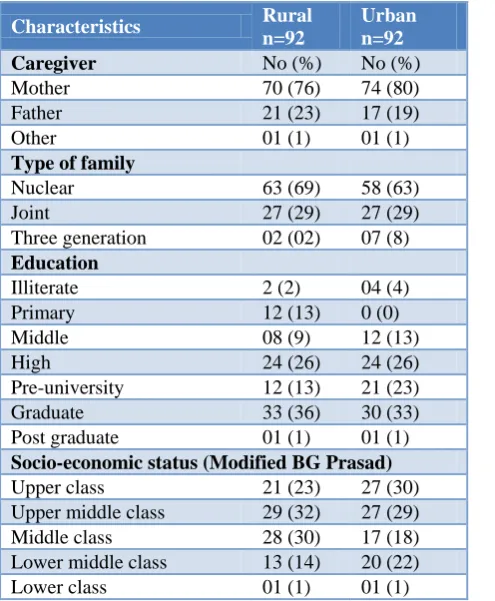
The table below shows that most of the caregivers were mothers belonging to nuclear family and were graduates. In urban area majority of them belonged to upper middle class while in rural area they belonged to upper class as per Modified BG Prasad classification.
Table 1:Socio-demographic characteristics of caregivers (respondents)
Characteristics Rural n=92
Urban n=92
Caregiver No (%) No (%)
Mother 70 (76) 74 (80)
Father 21 (23) 17 (19)
Other 01 (1) 01 (1)
Type of family
Nuclear 63 (69) 58 (63)
Joint 27 (29) 27 (29)
Three generation 02 (02) 07 (8) Education
Illiterate 2 (2) 04 (4)
Primary 12 (13) 0 (0)
Middle 08 (9) 12 (13)
High 24 (26) 24 (26)
Pre-university 12 (13) 21 (23)
Graduate 33 (36) 30 (33)
Post graduate 01 (1) 01 (1) Socio-economic status (Modified BG Prasad) Upper class 21 (23) 27 (30) Upper middle class 29 (32) 27 (29) Middle class 28 (30) 17 (18) Lower middle class 13 (14) 20 (22)
Socio-demographic profile of study subjects
The table below shows that majority of them were male children aged more than one year in both urban and rural area. Most deliveries were conducted in government institutions in rural, while in urban it was almost equal in both government and private hospitals.
Table 2: Socio-demographic characteristics of study subjects (children 9-24 months).
Characteristics Urban n=92
Rural n=92
Age in months N (%) N (%)
9-12 40 (43.4) 43 (46.7)
13-24 52 (56.6) 49 (53.3)
Gender
Male 52 (56.6) 58 (63)
Female 40 (43.4) 34 (37)
Place of delivery
Government institution 48 (52.1) 54 (58.6) Private institution 43 (46.7) 37 (40.2)
Home 01 (1.2) 01 (1.2)
Default rates for vaccines
In the table below default rates were highest for 6th,10th and 14th week in urban, while in rural it was for 10th and 14th week.
Table 3:Default rates for individual vaccines.
Time of immunization Default rates
Urban Rural
Birth 5.4 5.4
6 weeks 7.6 7.6
10 weeks 21.7 26
14 weeks 51 52.1
9 months 34.7 41.3
18 months 25 26
Multiple response for each time of immunization.
Figure 1: Comparison of immunization default rates
0 10 20 30 40 50 60
BIRTH DOSE 6TH WEEK 10TH WEEK 14TH WEEK 9 MONTHS 1.5 YEARS
Comparison of immunization defaults
Default rates were similar for birth and 6th week dose however for further doses it was found to be more in rural area compared to urban. When Unpaired T-test was applied between default rates of urban and rural, it revealed no statistical significant difference between them with t-value of -0.21173 and p value of 0.418287.
Factors causing defaults
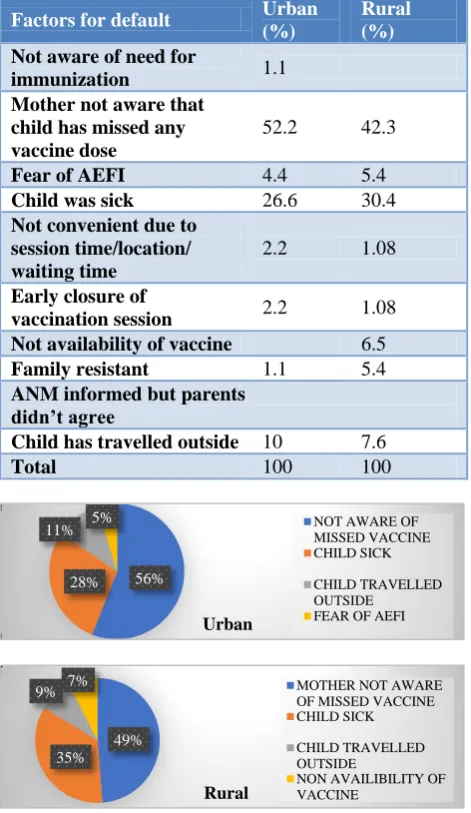
The table below shows that commonest cause of default was mother not being aware of missed dose followed by child being sick, both in urban and rural.
Table 4: The common factors responsible for defaulting include.
Factors for default Urban (%)
Rural (%)
Not aware of need for
immunization 1.1
Mother not aware that child has missed any vaccine dose
52.2 42.3
Fear of AEFI 4.4 5.4
Child was sick 26.6 30.4
Not convenient due to session time/location/ waiting time
2.2 1.08
Early closure of
vaccination session 2.2 1.08
Not availability of vaccine 6.5
Family resistant 1.1 5.4
ANM informed but parents didn’t agree
Child has travelled outside 10 7.6
Total 100 100
Figure 2: Common reasons for default in vaccination of an urban and rural immunization clinic.
The pie chart above shows the distribution of important factors responsible for default among caregivers of urban and rural clinics.
DISCUSSION
The present study was conducted among child aged 9-24 months and their caregivers attending immunization clinic in rural and urban Bangalore city. Default rates in urban and rural immunization clinics and the factors responsible for these defaults were analysed.
The outcome of the study provided insight into the high default rates in immunization at both urban and rural clinic. These defaults would eventually lead to dropout if the trend is not checked urgently. In contrast to various studies showing urban-rural and gender differences as major predictors of delays in immunization this was not reflected in the current study.8,9
In the current study, the commonest reason cited by caregiver for defaulting was unawareness about missed dose of vaccine, unlike the study done at Goa on vaccination delays among under five it was unawareness which was responsible for 5% of defaults. The factors that were significantly associated with delays in vaccination in that study were age of care giver, working status and socioeconomic status.10 In most cases the health worker had told the caregiver about the date for next visit for immunization. However, the same was not documented on the immunization card leading to forgetfulness among caregivers and eventual delays.
In a study by Onyiriuka in Nigeria concluded that the commonest cause for defaults was sick child followed by care giver travelling outstation.11
In the current study default rate was seen maximum for the 9th month dose similar to the study done in Goa and Nigeria.10-11
Although the study showed good literacy rate among the caregivers of children in both urban and rural area it did not reflect on their health seeking behaviour accounting for high default rates in immunization.
Potential limitations of study: Few limitations that need to be acknowledged.
In absence of any standard guideline regarding the duration of delay accounting to default, a grace period of 20 days is given for each vaccination dose from the scheduled date. A delay beyond this period of 20 days was considered as default.
Other potential factors influencing utilization of immunization services like birth spacing and parity of the mother was not undertaken
56% 28%
11% 5%
Urban
NOT AWARE OF MISSED VACCINE CHILD SICK
CHILD TRAVELLED OUTSIDE
FEAR OF AEFI
49% 35% 9% 7%
Rural
MOTHER NOT AWARE OF MISSED VACCINE CHILD SICK
CHILD TRAVELLED OUTSIDE
CONCLUSION
The overall default rate was found to be quite high in the study however it was highest for the 9th month dose. This is a serious concern and need to be addressed in order to prevent the eventual dropouts.
Recommendations
Immunization sessions should be accompanied by health education and promotion campaigns to motivate people and make them realize the importance of timely vaccination for a better health of their child.
Outreach immunization sessions should be conducted periodically to ensure coverage of occasional dropouts.
ACKNOWLEDGEMENTS
I am thankful to caregivers of the study subjects and all the health staff at UFWC Banashankari and PHC Kengeri for their cooperation.
Funding: No funding sources Conflict of interest: None declared
Ethical approval: The study was approved by the Institutional Ethics Committee
REFERENCES
1. Available at: http://www.who.int/news-room/fact-sheets/detail/immunization-coverage. Accessed on 10th September 2017.
2. Shrivastwa N, Gillespie BW, Kolenic GE, Lepkowski JM, Boulton ML. Predictors of Vaccination in India for Children Aged 12–36 Months. Am J Prev Med. 2015;49(6):1–10.
3. Shrestha S, Shrestha M, Wagle RR, Bhandari G. Predictors of incompletion of immunization among children residing in the slums of Kathmandu valley,
Nepal: a case-control study. BMC Public Health. 2016;16:970.
4. Available at: http://www.missionindradhanush.in/ about.html. Accessed on 10 January 2018.
5. National Operational Guidelines 2017- Measles Rubella Vaccine; Available at http://www.searo. who.int/india/topics/measles/measles_rubella_vacci ne_guidelines.pdf?ua=1. Accessed on 13 September 2017.
6. WHO Module 6 of Immunization in practice. Available at: http://www.who.int/immunization/ documents/IIP2014Mod6_19may.pdf. Accessed on 13th September 2017.
7. Ministry of Health and Family Welfare India Fact Sheet. Available at: http://rchiips.org/NFHS/pdf/ NFHS4/India.pdf. Accessed on 13 September 2017. 8. Singh PK, Shengelia B, Gupta N, Moussavi S,
Tandon A. Trends in Child Immunization across Geographical Regions in India: Focus on Urban-Rural and Gender Differentials. Bhutta ZA, editor. PLoS One. 2013;8(9):e73102.
9. Okolo S, Adeleke O, Chukwu G, Egbuaba N, Hassan A, Onwuanaku C. Immunization and Nutritional Status Survey of Children in selected Rural Communities of Sokoto State. Niger J Paediatr. 2005;30(4):123–7.
10. Noronha E, Shah HK. A study of vaccination delay among under-five attendees at an immunisation clinic in a rural area of Goa. Int J Community Med Public Health. 2018;5:1628-33.
11. Onyiriuka AN. Vaccination default rates among children attending a static immunization clinic in Benin City, Nigeria. JMBR. 2005;4(1):71-7.
Cite this article as: Srikanth J, Kumar P, Upadhya