www.esf.org
RESEARCH NETWORKING PROGRAMME
REGENERATIVE MEDICINE
(REMEDIC)
Standing Committee for the Medical Sciences (European Medical Research Councils, EMRC)
The European Science Foundation (ESF) is an inde-pendent, non-governmental organisation of national research organisations.
Our strength lies in the membership and in our ability to bring together the different domains of European science in order to meet the scientifi c challenges of the future. ESF’s membership currently includes 77 infl uential national funding agencies, research-per-forming agencies and academies from 30 nations as its contributing members.
Since its establishment in 1974, ESF, which has its headquarters in Strasbourg with offi ces in Brus-sels and Ostend, has assembled a host of research organisations that span all disciplines of science in Europe, to create a common platform for cross-bor-der cooperation.
We are dedicated to supporting our members in promoting science, scientifi c research and science policy across Europe. Through its activities and instruments ESF has made major contributions to science in a global context. The ESF covers the fol-lowing scientifi c domains:
• Humanities
• Life, Earth and Environmental Sciences • Medical Sciences
• Physical and Engineering Sciences • Social Sciences
• Marine Sciences • Nuclear Physics • Polar Sciences
• Radio Astronomy Frequencies • Space Sciences
The European Medical Research Councils (EMRC) is the membership organisation for all the medical research councils in Europe under the ESF. Its mission is to promote innovative medical research and its clinical application towards improved human health. EMRC offers authoritative strategic advice for policy making, research management, ethics and better health services.
Introduction
Cover pictures:
Mesenchymal stem (stromal) cells differentiating to cartilage (left column) and to cardiomyocyte-like cells (right column). Chondrocyte marker in A is aggrecan (red) and cardiomyocyte marker in D is Nkx2.5 (green). Chondrocyte nuclei in B were counterstained with 4,6-diamidino-2-phenylindole (blue) and the cardiocyte nuclei in E were counterstained with propidium iodide (red). The last images, C and F, represent an overlay of respectively, A&B and D&E. Li W. et al.: Bcl-2 engineered MSCs inhibited apoptosis and improved heart function. Stem Cells 25:2118-27, 2007. AlphaMed Press.
Regenerative medicine, a rapidly evolving and exciting fi eld, can be defi ned as the process of creating living, functional tissues to repair or replace tissue or organ function lost due to age, disease, damage, or con-genital defects. This can be done through a variety of approaches including the replacement of tissue function with sy nthetic constructs (artifi cial organs) and using cellular therapies such as stem cells or genetically mod-ifi ed cells to generate new tissues and organs. Today, there is an enormous need for regenerative medicine therapies as is evident, to take only one example, of the high number of heart transplantations, 75,000 of which are undertaken worldwide each year 1. Their number is
limited by the lack of appropriate donors and due to the heavy regime, such treatment is not easy to administer to the elderly people who most urgently need it. Less invasive treatment to enable heart regeneration with stem cells would be welcome.
Recent advances in stem cell technologies, includ-ing for example the ability to induce human pluripotent stem (iPS) cells, mark a new era for regenerative medi-cine2. Stem cells have an almost unlimited proliferation
potential accompanied by an ability to differentiate. Thus, hematopoietic stem cells (HSCs – that give rise to the various blood cell ty pes, including neutrophils and erythrocytes) and mesenchymal stem (or stromal) cells (MSCs – that give rise to many cell types, including adipocytes and chondrocytes) form an essential ele-ment in regenerative (or reparative) medicine, including guided regeneration.
This fi eld has the potential to allow either the self-repair of damaged tissues and organs or generation of new tissues and organs to be used in transplantations.
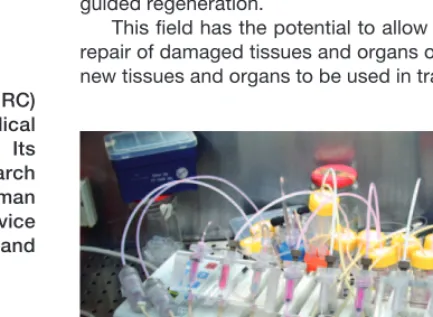
Figure 1. A bioreactor in which naïve or modifi ed stem cells are allowed under controlled circumstances to differentiate and produce extracellular matrix (or resorb or otherwise modify their scaffold) before implantation to the recipient.
Courtesy of Prometheus (Skeletal Tissue Engineering Division) – Katholieke Universiteit Leuven (K.U.Leuven), Belgium.
A D
B E
REMEDIC | 3 Using the versatile genetic information stored within
the cell nuclei, from where it is transcribed (copied) and then translated into proteins, is an intelligent way to regulate the repair of cells, tissues and organs. Impor-tantly, regenerative medicine also has the potential to solve the problem of the shortage of organs available for donation compared to the number of patients that require life-saving organ transplantation.
When multipotent stem cells such as HSCs and MSCs are harvested from autologous sources (i.e. using the patient’s own cells), immunological rejec-tion and the burden of the use of immunosuppressive (cytotoxic) drugs are avoided. Endogenous stem cells can be activated with proper growth and differentiation stimuli to maintain or augment bodily functions. For example, subcutaneous fat tissue forms an autologous MSC source, which can be simply collected using a needle for fat aspiration. Cells isolated are allowed to expand and then driven to differentiate as such, in tissue engineering devices or bioreactors (Figure 1) before application back to body as cells, tissues or organs, either locally by surgical procedure (Figure 2) or systemically by injection. They help the target site(s) to regenerate so that structure and function are not replaced, but restored.
Another possible application is in wound repair, a complex biological process that occurs during most of our lives. Often, in adults, the wound repair process leads to a once functional tissue becoming a non-func-tioning mass of fi brotic tissue, more commonly known as a scar. In contrast, injuries that occur during pre-natal development are completely healed, an ability that is lost during adulthood. One approach would be to insert adult stem cells from the patient into a biometric matrix
Figure 2. Surgical implantation of a regenerative medicine device is done under aseptic conditions. Courtesy of Prometheus (Skeletal Tissue Engineering Division) – Katholieke Universiteit Leuven (K.U.Leuven), Belgium.
within the wound, recreating the prenatal environment and thus stimulating tissue regeneration3. Although,
the development of this form of treatment may seem distant, the individual elements of this approach have been demonstrated in vitro and in vivo.
Furthermore, using HSCs and MSCs raises less ethical concerns than the use of embryonic stem cells for the moment. Autologous stem cells have a known source of origin and as such cannot transmit any new infections or prions to the recipient. Such cells can be used at once or stored in biobanks for eventual future use. The versatility of cell-based therapies can be enhanced by genetic manipulation of the cells in the laboratory, like for example, coding of a missing pro-tein such as a hormone or enzy me which would last for the lifetime of the recipient 4. For experimental work,
markers useful in tracing of the transferred cells can be added to study their long term fate (Figure 5).
As our knowledge advances, the frontiers of regen-erative medicine are rapidly expanding. Regenregen-erative medicine provides new insights in areas including cellular proliferation, effects of humoral and matrix sig-nalling on cells, angiogenesis, tissue remodelling, naïve and adaptive immunity and other basic processes in cell biology. Still, regenerative medicine is in its infancy and to advance progress in this important fi eld, national funding agencies from 13 European countries have joined forces to launch a cross-disciplinary Research Networking Programme, REMEDIC, to identify where the frontiers and future needs are in this complex multidisciplinary high-technology fi eld, by networking researchers and clinicians across Europe.
The running period of the ESF REMEDIC Research Net-working Programme is for fi ve years from May 2008 to May 2013 (07-RNP-128).
References
1. Chien K. R. Regenerative medicine and models of human disease, Nature453, 302-305 (2008). 2. Yu J., et al. Induced pluripotent stem cell lines derived
from human somatic cells, Science, 318, 1917-1920 (2007).
3. Gurtner G. C., et al. Wound repair and regeneration,
Nature453, 314-321 (2007).
Scope and Aims
Bringing regenerative medicine from bench to bedside
is a complex process covering basic, patient-oriented and public health research with regulatory and ethical considerations, and involving various actors including pharmaceutical and biotechnology companies and competent regulatory authorities. REMEDIC aims to put in place a network to facilitate the transfer of knowledge among basic researchers, clinicians and industrial partners, gather information on the current regulations, standards and patents in regenerative medicine and map the current technical research and development resources (see Box 1 on page 5 for a summary of the aims). REMEDIC is led by a Steering Committee com-posed of a Chair, Vice-Chair and 11 other members representing the national organisations that support the programme and these members, all of whom are researchers in the fi eld of regenerative medicine, have the primary objective of ensuring that the high-level sci-entifi c objectives outlined below are achieved. They are also responsible for the management of the programme activities and the promotion of these activities as widely as possible within the larger community of regenerative medicine and within their own country, ensuring that their communities benefi t from REMEDIC.
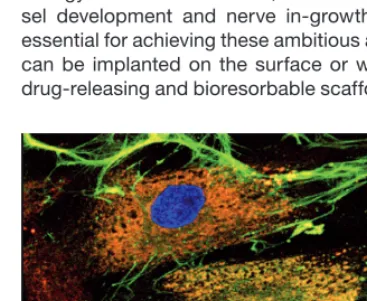
With regard to the research objectives, there will be a particular focus on mesenchymal (stromal) stem cells (Figure 3) and their differentiated derivatives. These cells, endogenously recruited, freshly isolated or expanded in vitro, should be able to replace, restore, repair or regenerate tissues. Understanding the basic biology of cell differentiation, blood and lymphatic ves-sel development and nerve in-growth (Figure 4) are essential for achieving these ambitious aims. Such cells can be implanted on the surface or within intelligent, drug-releasing and bioresorbable scaffolds, which melt
away and are in toto replaced by regenerated tissue1.
Biomaterial-guided tissue regeneration and nano sur-face technologies can be used to regulate matrix-cell interaction. Currently, hot topics in the fi eld are cartilage repair and bone biology – with applications for diseases such as arthritis and osteoporosis and various ty pes of bone and joint trauma, like for example hip fractures and knee injuries. There are many other applications that range from neurological, ophthalmological and otorhinolaryngological to gastroenterological and car-diological applications. Cell therapy, and if appropriate, in combination with existing (minimally invasive) surgical procedures, forms an important research objective.
As the regenerative medicine fi eld has developed and expanded so rapidly, the view of the fi eld is some-what hazy, so clarifi cation of the unmet needs of society, academia and companies (pharma and biotech), is nec-essary to focus interest and funding towards the most important and achievable goals.
Furthermore, as gene, cell therapies and hy brid products have been introduced in a rapid succession, there is need to collect and analyse the rules and stand-ards, which regulate the development, application and marketing of regenerative medicine.
Collection of information on the available equipment and methods used in regenerative medicine has not yet been performed. Due to its inter-disciplinary nature and relevance in many fi elds of medicine, the need for clean room space and excellent clinical research centres is very high. For the latter, the European Clinical Research Infrastructures Network (ECRIN), will serve as a useful resource centre 2. Some of the technologies and
pro-cedures are so specialised that individual groups and centres cannot maintain them all. REMEDIC will gather information on these current technical R&D resources for the research community.
Figure 3. Stromal cells and their differentiated derivatives: Mesenchymal (stromal) stem cells (blue nuclei) containing heat shock protein (granular orange cytoplasm) editing collagen produced to the extracellular matrix (green fi bres). Courtesy of Professor Yrjö T. Konttinen.
Figure 4. Basic biology of nerve in-growth: Cortical neurons in fl uorescence microscopy after staining with anti-Tau antibodies (green) and DAPI (blue nuclei). Tau is a neuronal microtubule associated protein found predominantly in nerve fi bres and DAPI is a fl uorescent stain that binds strongly to DNA.
REMEDIC | 5 Another key aim is to network institutions,
labo-ratories and companies across Europe to generate collaborations to defi ne and develop research projects at the frontiers of this fi eld and potentially implement them through joint grant applications either during the course of REMEDIC or shortly afterwards. Building such consortia takes time and the activities of the programme should ensure that partners with the relevant experience and technological expertise are linked together.
Figure 5. The violet cells are rat mesenchymal stromal cells, which are transgenic for the human placental alkaline phosphatase, in the knee joint of a bone marrow-transplanted, marker tolerant rat knee. Odörfer K. I. et al. Marker tolerant, immunocompetent animals as a new tool for regenerative medicine and long-term cell tracking, BMC Biotechnol. 7:30 (2007).
REMEDIC Aims
1. To facilitate the exchange of ideas and know-how across disciplines in the area of mesenchymal (stromal) and other stem cells; 2. To review the regulatory laws, rules and
standards governing the use of regenerative medicine;
3. To map the unmet population, academia and company needs in regenerative medicine and the current R&D resources (e.g. instruments, analysis techniques);
4. To assist researchers in the fi eld of regenerative medicine in preparing cross-disciplinary coordinated research projects.
Activities
In order to achieve the aims outlined above, the follow-ing activities will be undertaken durfollow-ing the duration of the programme:
• Workshops – it is envisaged that there will be a
work-shop each year of the programme, either stand alone or as part of a larger conference for added synergy, focusing on key aspects of mesenchy mal stem cells, their differentiated derivatives and potential clinical applications. The fi rst workshop on Heart Regeneration took place on 15-17 August 2008 in Helsinki, Finland.
• Short-term (up to 15 days) and exchange (from 15
days up to 6 months) visits – a particular emphasis
will be placed on these visits, to allow researchers to share expertise and techniques in this multi-discipli-nary fi eld. Applications will be open to the community of researchers in the fi eld, as long as the proposed research is relevant to the aims of REMEDIC.
• Reviews – state-of-the-art reviews based on analysis
of literature and patent databases will be prepared for peer-reviewed journals.
• Rules and Standards – a review of the regulatory
laws, rules and standards governing the use of regen-erative medicine will be prepared and made available on the dedicated website.
• Mapping of needs and available resources – this
will be undertaken within the fi rst two y ears of the programme and made available for the regenerative medicine community.
• Internet platform – there will be a dedicated
inter-net platform to act as the main tool for distribution of information on REMEDIC, its advancement and results. It will also serve as a resource to the entire commu-nity, including for example a register of future project partners for joint proposal applications. Dissemination of information is aimed not only at the research com-munity but also at the public, authorities and other key stakeholders.
Box 1:
References
1. ESF-EMRC Scientifi c Forward Look on Nanomedicine, Chapters 2.1.3 & 4.2.1 (2005). www.esf.org
Funding
Steering Committee
ESF Research Networking Programmes are principally funded by the Foundation’s Member Organisations on an à la carte basis. Regenerative Medicine “REMEDIC” is supported by:
• Fonds zur Förderung der wissenschaftlichen Forschung in Österreich (FWF)
Austrian Science Fund, Austria
• Fonds voor Wetenschappelijk Onderzoek – Vlaanderen (FWO)
Research Foundation – Flanders, Belgium
• Forsknings- og Innovationsstyrelsen (FIST) – Forskningsrådet for Sundhet og Sygdom (FSS) Danish Agency for Science, Technology and Innovation – Medical Science Research Council,
Denmark
• Suomen Akatemia/Finlands Akademi Academy of Finland, Finland
• Deutsche Forschungsgemeinschaft (DFG) German Research Foundation, Germany
• Nederlandse Organisatie voor Wetenschappelijk Onderzoek (NWO) – Nederlandse Organisatie voor Gezondheidsonderzoek en Zorginnovatie (ZonMw)
Netherlands Organisation for Scientifi c Research – Netherlands Organisation for Health Research and Development, The Netherlands
• Norges Forskningsråd
Research Council of Norway, Norway
• Fundação para a Ciência e a Tecnologia (FCT) Foundation for Science and Technology, Portugal
• Consiliul National al Cercetarii Stiintifi ce din Invatamantul Superior (CNCSIS)
National University Research Council, Romania
• Slovenská Akadémia Vied (SAV) Slovak Academy of Sciences, Slovakia
• Consejo Superior de Investigaciones Científi cas (CSIC)
Spanish National Research Council, Spain
• Comisión Interministerial de Ciencia y Tecnología (CICYT)
Interministerial Committee on Science and Technology, Spain
• Vetenskapsrådet (VR)
Swedish Research Council, Sweden
• Schweizerischer Nationalfonds (SNF) Swiss National Science Foundation, Switzerland
Professor Yrjö T. Konttinen (Chair)
Department of Medicine Institute of Clinical Medicine Biomedicum Helsinki
PO Box 700 (Haartmaninkatu 8) 00029 HUS • Finland
Tel: +358 9 191 25210 Fax: +358 9 191 25218
Email: [email protected]
Associate Professor Gerjo JVM van Osch (Vice-Chair)
Departments of Orthopaedics & Otorhinolaryngology Erasmus MC, University Medical Center Rotterdam Dr Molewaterplein 50
Offi ce EE16-55 PO Box 2040
3000 CA Rotterdam • The Netherlands Tel: +31 10 7043661
Fax: +31 10 7044690
Email: [email protected]
Professor Kristina Arvidson
Center for Clinical Dental Research Faculty of Medicine and Dentistry
University of Bergen Årstadvn. 17
5009 Bergen • Norway Tel: +47 55 58 66 41 Fax: +47 55 58 64 87
Email: [email protected]
Professor Reinhold G. Erben
Institute of Pathophysiology Veterinärplatz 1
1210 Vienna • Austria Tel: +43 1 250 77 4550 Fax: +43 1 250 77 4599
Email: [email protected]
Professor Enrique Gomez-Barrena
Department of Orthopaedic Surgery Hospital Fundación “Jimenez Díaz” Avda. Reyes Católicos 2
Madrid 28040 • Spain Tel: +34 91 5504826 Fax: +34 91 5431071
Email: [email protected], [email protected]
Professor Moustapha Kassem
Department of Endocrinology University Hospital of Odense 5000 Odense C • Denmark Tel: +45 6541 1606 Fax: +45 6591 9653
REMEDIC | 7
Professor Katarina Le Blanc
Hematology Centre
Division of Clinical Immunology
Karolinska University Hospital Huddige F79 141 86 Stockholm • Sweden
Tel: +46 8 585 813 61 Fax: +36 8 746 66 99
Email: [email protected]
Professor Frank Luyten
Department of Musculoskeletal Sciences University of Leuven (K.U. Leuven) Herestraat 49
3000 Leuven • Belgium Tel: +32 16 34 25 41 Fax: +32 16 34 25 43
Email: [email protected]
Dr. Ana Paula Pêgo
INEB – Institute of Biomedical Engineering Laboratory of Biomaterials
University of Porto
Rua do Campo Alegre, 823 4150-180 Porto • Portugal Tel: +351 22 607 4988 Fax: +351 22 609 4567 Email: [email protected]
Professor Dominique Pioletti
Institute of Bioengineering Laboratory of Biomechanical Orthopedics
École Polytechnique Fédérale de Lausanne (EPFL) 1015 Lausanne • Switzerland
Tel: +41 21 693 83 41 Fax: +41 21 693 86 60
Email: dominique.pioletti@epfl .ch
Professor Laurentiu Popescu
“Victor Babes” National Institute of Pathology & Department of Cellular and Molecular Medicine, “Carol Davila” University of Medicine and Pharmacy Bucharest • Romania
Tel: +40 21 319 4530 Fax: +40 21 312 4885
Email: [email protected], [email protected]
Professor Gustav Steinhoff
Institute for Regenerative Medicine and Stem Cell Therapy (IRMED)
Biomedical Research Centre Rostock (BMFZ) Schillingallee 68
18057 Rostock • Germany Tel: +49 381 203 57880 Fax: +49 381 494 6102 Email: [email protected]
Dr. Ivo Vanicky
Institute of Neurobiology Slovak Academy of Sciences Soltésovej 4
040 01 Kosice • Slovakia Tel: +421 55 678 5069 Fax: +421 55 678 5074 Email: [email protected]
External Coordinator
Eija Kaila B.Sc.
Institute of Clinical Medicine Biomedicum Helsinki
PO Box 700 (Haartmaninkatu 8) 00029 HUS • Finland
Tel: +358 9 191 25237 Fax: +358 9 191 25218 Email: [email protected]
EMRC Standing Committee Representative
Professor Isabel Varela-Nieto
Spanish National Research Council (CSIC)
Institute of Biomedical Investigations “Alberto Sols” C/Arturo Duperier 4
28029 Madrid • Spain Tel: +34 91 585 4422 Fax: +34 91 585 4401 Email: [email protected]
ESF Liaison
Dr. Fiona Kernan Science
Ms. Blanche Facchini-Schaller Administration
European Medical Research Councils (EMRC) European Science Foundation
1 quai Lezay-Marnésia BP 90015
67080 Strasbourg cedex • France Tel: +33 (0)3 88 76 71 18
Fax: +33 (0)3 88 37 05 32 Email: [email protected]
For the latest information on this Research Networking Programme consult the REMEDIC website:
5
0
0 – S
e
p
te
m
b
e
r 2
0
0
8